Three Farriers Failed His Hunter—Until the Duke’s Quiet Bride Turned the Hoof and Found Truths
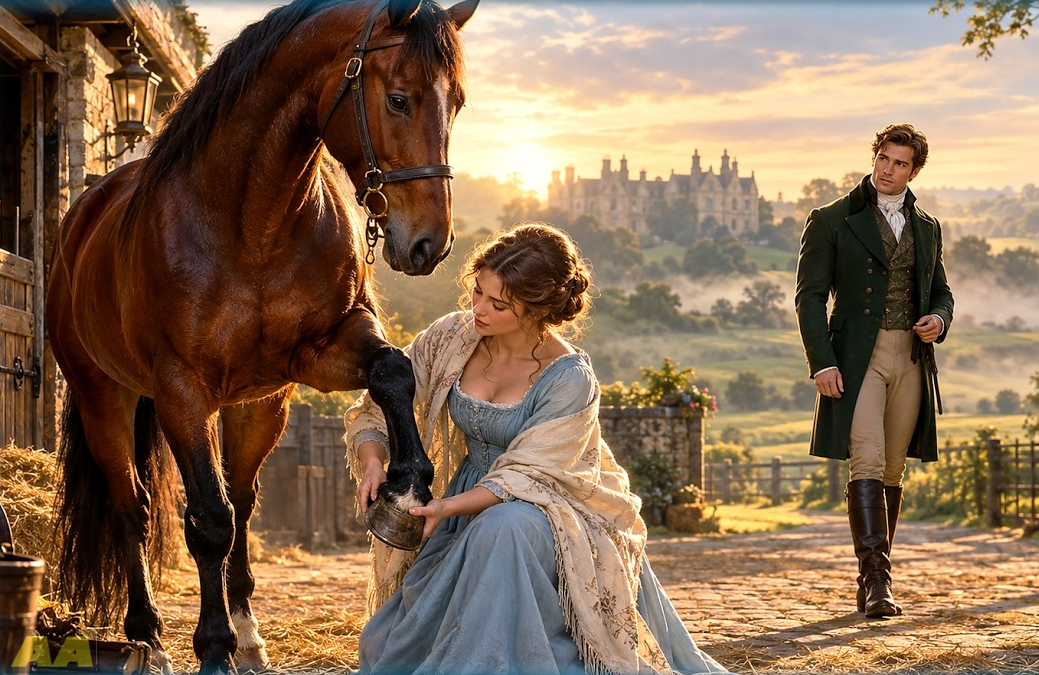
The rain had fallen without mercy for three days, turning the Ashenmore estate into a world of black mud, dripping branches, and silver sheets of water that blurred the distant hills.
On the fourth morning, before the household had finished dressing, a stable boy came running across the courtyard with panic written plainly across his face.
He nearly slipped on the wet stones before catching himself against the stable door. The Duke of Ashenmore was already awake.
He had spent most of the night listening to rain strike the windows and thinking about the hunting season that was quickly approaching.
Corvane, the finest horse in his stables, was meant to carry him during the autumn chase.
The bay had a powerful chest, a proud neck, and a stride that had made lesser horses seem ordinary.
He had won the autumn chase two years running, clearing hedges that other horses would not even approach.
Now the stable boy could barely find his words. “Your Grace, Corvane cannot stand properly.”
The Duke felt an unpleasant chill despite the warmth of the house. “What happened?” “He was fine last night.
This morning he will not put weight on his foreleg.” The Duke did not wait for a coat or boots.
He crossed the courtyard in his dressing gown and entered the stable, where he found his prized horse standing with his head lowered and one leg held carefully above the straw.
There was no wound. No swelling. No obvious explanation. And as the Duke placed his hand against the horse’s leg, he realized that whatever was wrong with Corvane was hidden somewhere no one had yet thought to look.
How could three experienced friers fail to find what was already there? By that afternoon, the first frier had arrived.
He was a broad shouldered man with forty years of experience behind him and a reputation that reached across three shires.
He had treated valuable hunters, carriage horses, farm horses, and racehorses, and the Duke trusted that reputation enough to let him examine Corvane without interference.
For nearly an hour, the frier worked in the stable yard. He tapped the hoof.
He pressed along the leg. He watched Corvane walk. He lifted the injured foot and studied it beneath the gray afternoon sky.
At last he straightened and rubbed his chin. “A strained tendon, Your Grace. Most likely brought on by hard ground during a recent ride.”
The Duke accepted the diagnosis. The frier wrapped the leg, ordered complete rest, and instructed the stable hands to keep Corvane in his stall.
The Duke paid him generously. Then he waited. Seven days passed. Corvane did not improve.
If anything, he seemed worse. In the mornings, he refused to place weight on the leg at all.
Yet by afternoon, the horse sometimes walked almost normally, enough to give everyone hope. Then the following morning the same trouble returned.
The Duke became increasingly impatient. A second frier was summoned. This man was younger and known for his careful methods.
He examined not only Corvane but everything around him. He inspected the stall, the bedding, the feed, the shoes, and the ground in the paddock.
He asked questions about the horse’s exercise, his sleeping habits, and his recent meals. After two full days at Ashenmore, he offered his conclusion.
“There is inflammation somewhere deeper in the joint. I believe the cause may be dietary.”
The Duke stared at him. “Dietary?” “An imbalance, perhaps. Remove the oats. Give him boiled barley and herbs.
We shall see whether the condition settles.” The Duke followed every instruction. Ten more days passed.
Corvane remained lame. The Duke stopped speaking about the hunting season. He stopped asking the stable hands for reports.
Instead, he walked through the estate with a permanent crease between his eyebrows, as though the horse’s suffering were a personal insult.
Then he summoned a third frier. This one came from the neighboring county and was an elderly man whose reputation rested less upon formal learning than upon an uncanny ability to understand animals.
People said he could look at a horse for five minutes and know where the trouble lay.
The old frier did not touch Corvane at firSt. He simply watched. For a long time, he stood in the stable doorway while the horse shifted his weight from one leg to the other.
Eventually, he stepped forward. He lifted the hoof. He turned it gently. He examined the sole in the fading light.
“Deep bruising,” he murmured. “Perhaps a stone struck him weeks ago.” He packed the hoof and instructed the Duke to wait another fortnight.
The Duke did exactly that. At the end of those two weeks, his patience had disappeared completely.
Three friers. Three different explanations. Three failed remedies. And the finest horse in Ashenmore was still lame.
That evening, the Duke sat in his study surrounded by papers he had not read.
The rain had finally weakened, leaving only occasional drops against the tall windows. A fire burned in the grate, but the warmth did nothing to improve his mood.
He was already considering writing to a frier in London. The man was reputed to be exceptional.
He was also expensive, and he would need several days merely to travel to Ashenmore.
At supper, Lady Elizabeth noticed her husband’s silence. She had been married to the Duke for just over two months.
Their marriage had been arranged by their families, a practical union between neighboring estates. Neither had expected romance from the arrangement, and neither had been given much opportunity to know the other before the wedding.
Elizabeth had therefore made herself small within the great house. She spoke when spoken to.
She listened more than she talked. She attended dinners, received visitors, walked through the gardens, and learned the routines of Ashenmore without asking too many questions.
Yet there was one part of the estate where she had begun to feel completely comfortable.
The stables. She often visited in the early morning, before the household servants were fully awake.
She liked the quiet sounds there, the rustle of straw, the gentle stamping of hooves, the smell of leather and hay.
Corvane had become particularly fond of her. Whenever she approached his stall, he would stretch his long neck toward her, expecting the apple slices she carried in her pocket.
Elizabeth had continued visiting him after his trouble began. She had watched his condition deteriorate.
She had noticed the way he placed his weight. She had seen the slight change in his posture each morning.
But she had said nothing. Until that evening. “You are troubled,” she said quietly. The Duke looked up.
It was the first time since their wedding that she had offered an observation about his mood without being asked.
“It is nothing you need concern yourself with, my dear. It is merely a matter concerning one of the horses.”
“Corvane.” The Duke studied her. “You have noticed?” “I have noticed for some time.” He leaned back in his chair.
Perhaps because he was tired, or perhaps because he had exhausted every other option, he told her everything.
He described the first frier. Then the second. Then the third. He explained the remedies and the continued lameness.
Elizabeth listened without interruption. When he finished, she folded her hands together. “Might I see him tomorrow morning?”
The Duke almost smiled. “You wish to examine him?” “I would like to look at him.”
There was something in her voice that made him pause. “All right.” Elizabeth lowered her eyes.
“Thank you.” The Duke thought no more of it. He did not know that his wife possessed a skill she had kept hidden since arriving at Ashenmore.
He did not know that long before she had become a duchess, Elizabeth had spent her childhood in a modest estate where money was scarce and practical knowledge was valuable.
Her father had owned horses but could not afford to summon a professional frier for every problem.
The family had employed an old groom named Thomas. Thomas was not interested in whether Elizabeth was a young lady.
He cared whether she was willing to learn. When she was twelve, he began teaching her how to clean a hoof.
Then he taught her how to inspect the sole. He showed her how to recognize heat, tenderness, bruising, cracks, stones, and signs of poor shoeing.
He taught her how to hold a horse’s leg without frightening the animal. Most importantly, he taught her to look carefully before deciding what she was looking at.
Elizabeth had spent years beside Thomas. She had cleaned hooves in winter. She had helped with horses after long rides.
She had watched him remove damaged shoes and correct careless work. It had never occurred to her that any of those lessons would matter after her marriage.
A duchess was expected to know music, etiquette, correspondence, household management, and the proper behavior at formal dinners.
No one expected her to understand a horse’s hoof. So Elizabeth had simply kept the knowledge to herself.
The following morning, she rose before dawn. She dressed in her plainest gown and wrapped a shawl around her shoulders.
The rain had stopped, but the estate remained wet and cold. She walked toward the stables.
Higgins, the Ashenmore stable master, was already there. He had served the family for thirty years and had developed the quiet, practical manner of a man who trusted experience more than conversation.
He greeted Elizabeth respectfully. “Good morning, Your Grace.” “Good morning, Higgins.” She looked toward Corvane’s stall.
“How is he?” “Much the same.” Elizabeth nodded. “May I have a hoof pick and a short lead rope?”
Higgins blinked. “Your Grace?” “A hoof pick and a lead rope.” He hesitated. “The Duke will be here shortly.”
“I know.” “It may be better to wait for him.” “I only wish to look at the horse.”
Higgins studied her face. For the first time since she had arrived at Ashenmore, he saw something in Elizabeth that had been hidden beneath her quiet manners.
Certainty. He handed her the tools. Elizabeth entered Corvane’s stall. The bay turned his head toward her.
She smiled. “Good morning, Corvane.” The horse gave a quiet breath and nudged her shoulder.
Elizabeth led him into the yard. She did not hurry. She spoke softly while running her hand down his foreleg.
She felt for heat. She watched his reaction. She studied the way he placed the foot.
Then she lifted it. Her movement was smooth and confident. Higgins watched with increasing surprise.
Elizabeth balanced the heavy hoof against her knee exactly as Thomas had taught her years earlier.
She began cleaning it. Dirt came away firSt. Then old packing material. Then more dirt.
Elizabeth continued patiently. She did not accept the first thing she saw. She searched beneath it.
A few minutes later, the Duke entered the stable yard. He had slept poorly and had come to look at Corvane before breakfaSt.
He stopped when he saw his wife. Elizabeth was kneeling beside the horse. The hoof rested against her knee.
A hoof pick was in her hand. She was working with the calm confidence of someone who had performed the same task countless times.
“Elizabeth.” She looked up. The Duke immediately stepped toward her. “You should not be doing that yourself.
Let Higgins handle it.” “Please give me a moment.” The Duke stopped. Her tone was gentle, but firm.
It was unlike anything he had heard from her before. Instead of arguing, he watched.
Elizabeth returned her attention to Corvane. She cleaned around the frog of the hoof, the soft triangular structure at its center.
Corvane shifted. Elizabeth paused. She touched the area again. The horse flinched. “There.” She leaned closer.
The morning light had strengthened. She turned the hoof slightly. Something caught her eye. At first it looked like nothing more than a thin dark line.
Elizabeth wiped the area. Then she saw it. A hairline crack. It was so fine that anyone unfamiliar with the hoof might have overlooked it completely.
Elizabeth studied it in silence. The Duke stepped closer. “What is it?” “I believe this is the problem.”
She traced the line carefully. The crack extended upward from beneath the frog into deeper structures.
Something else was trapped inside it. Small fragments. Old metal. Nail fragments from careless shoeing.
Elizabeth looked at Higgins. “When was Corvane last reshod before he came to Ashenmore?” Higgins frowned.
“I would have to check the stable records.” “Please do.” The Duke crouched beside her.
“Can you be certain?” “I can be certain that this is not new.” She looked at the crack again.
“The fragments have been here a long while. They have been pressed deeper each time he walked.”
The Duke finally understood. The first frier had examined the leg. The second had examined the horse’s diet.
The third had searched for a stone or fresh bruise. But the problem was older than any of those examinations.
It was hidden inside the hoof. Every step had placed pressure on the damaged area.
That explained the changing pain. That explained why Corvane could sometimes walk better in the afternoon.
It explained why rest seemed to help temporarily and why the problem returned each morning.
The Duke looked at Elizabeth. “Can it be fixed?” “Yes.” Her answer came without hesitation.
“But it will require patience.” “What do you need?” “Warm water. A clean cloth. A small knife.
And Higgins will need to change the dressing every day.” The Duke turned toward the stable master.
“Higgins?” “Yes, Your Grace.” “Bring everything she requests.” Within minutes, the supplies had been gathered.
Elizabeth worked carefully. She removed the old material. She freed the tiny pieces of metal one at a time.
She cleaned the crack. She inspected the surrounding tissue. She never rushed. Corvane occasionally shifted his weight, but Elizabeth kept speaking to him until he settled again.
When the hoof was clean, she packed the damaged area with a simple mixture Higgins already kept for treating hoof problems.
She explained exactly how it should be changed. She showed Higgins what healthy healing should look like.
She told him which signs would require another professional examination. The Duke listened to every word.
By the time Elizabeth finished, the sun had risen fully. The household was beginning to stir.
Elizabeth stood and brushed dirt from her skirt. Only then did she seem to realize what she had done.
She looked down at her hands. There was mud beneath her fingernails. Her gown was marked with straw.
A loose strand of hair had escaped near her cheek. She expected embarrassment. Instead, the Duke was looking at her with something entirely different.
IntereSt. Not the polite interest of a husband fulfilling his duty. Real curiosity. “Where did you learn all this?”
Elizabeth hesitated. Then she told him. She spoke about her father’s estate. She spoke about Thomas.
She described the years she had spent learning how to care for horses. She explained that Thomas had never treated her like a fragile young lady when they were working in the stables.
“He taught me because he needed another pair of hands,” she said. The Duke smiled slightly.
“And you were willing to learn?” “I was fascinated by it.” “I would never have guessed.”
“I did not think it was something a duchess should speak about.” The Duke stopped walking.
Elizabeth stopped beside him. “Why not?” She looked at him. “I thought it might seem improper.”
He shook his head. “It seems useful.” Elizabeth smiled faintly. “It was useful this morning.”
“Yes.” For a moment neither spoke. Then the Duke asked another question about Thomas. Elizabeth answered.
He asked about her father. She told him about the small estate. He asked what other things she had learned.
She began with horses. Then gardening. Then the keeping of household accounts. Then the small repairs she had once helped Thomas perform around the stable.
By the time they reached the breakfast room, they had spoken more than they had during all the previous weeks of their marriage combined.
Corvane’s recovery was slow. Elizabeth insisted upon it. She would not allow the Duke to rush the horse merely because he was eager to see him return to the paddock.
For several days, Corvane remained in his stall. The dressing was changed carefully. The hoof was inspected each morning.
Higgins followed Elizabeth’s instructions precisely. The Duke began visiting the stable more often. At first he claimed he was checking the horse.
Soon, however, he found himself staying longer. Sometimes Elizabeth was there. Sometimes she was not.
When she was there, they spoke. The Duke discovered that his wife had a dry sense of humor that rarely appeared in company.
He learned that she disliked overly sweet tea. He discovered that she had once ridden bareback through an orchard at thirteen and had fallen into a hedge.
Elizabeth discovered that her husband had an embarrassing habit of reading the same page several times whenever he was distracted.
Their marriage had begun with ceremony. It began to develop through ordinary conversation. After another week, Corvane placed his hoof more confidently.
A few days later, he walked around the yard. Elizabeth watched closely. The Duke stood beside her.
“He is improving,” he said. “He is.” “Can he hunt again?” Elizabeth gave him a sideways look.
“Eventually.” “How eventually?” “When his hoof is ready.” The Duke laughed. It was the first time Elizabeth had heard him laugh freely.
She smiled. By the time the first frost arrived, Corvane was walking soundly. Soon he was trotting.
Then cantering in the paddock. The horse who had once stood with his head lowered now moved with his old confidence.
The Duke was delighted. But something else had changed as well. The story of Elizabeth’s discovery traveled through the household.
Higgins mentioned it to the stable hands. The stable hands mentioned it to servants. Visitors heard the tale.
Before long, people throughout the county were saying that the Duchess of Ashenmore had found the hidden source of Corvane’s trouble after three professional friers had failed.
The Duke never corrected them. Neither did Elizabeth. She simply returned to the stables each morning.
But the greatest change happened inside the house. The Duke began asking for Elizabeth at supper.
He sought her company after dinner. He asked what she thought about improvements to the estate.
He asked her opinion when a horse became unwell. He asked about her childhood. He asked what she would like to do with the gardens in spring.
Elizabeth gradually stopped waiting to be spoken to. She began offering her thoughts without hesitation.
When the Duke mentioned a new stable design, she suggested changes. When he discussed a purchase of horses, she asked to inspect them.
When he considered hiring another stable hand, she pointed out that Higgins needed help with the younger horses rather than another man assigned to the hunters.
The Duke listened. Sometimes he disagreed. Sometimes she disagreed with him. Neither found that frightening.
One evening, months after Corvane had recovered, the Duke and Elizabeth stood together near the paddock.
The horse moved across the frosted grass with the effortless stride that had first made him famous.
Elizabeth watched him. “He looks happy,” she said. “He does.” The Duke looked at his wife.
“You know, I nearly sent for that man from London.” Elizabeth smiled. “You probably still should, if you ever need his particular skills.”
“I suppose so.” They watched Corvane turn and run toward the far fence. The Duke placed his hands behind his back.
“I used to think I knew everything important about this estate.” Elizabeth looked at him.
“And now?” “Now I suspect there are several things I have never bothered to notice.”
She smiled. “That may be true.” He glanced at her. “I am glad you spoke at supper that night.”
Elizabeth looked toward the paddock again. “So am I.” Their marriage had begun because two families believed the union would be useful.
It had begun with agreements, property, expectations, and polite distance. No grand declaration had changed it.
No dramatic gesture had transformed them overnight. Instead, it had changed in a stable yard on a cold morning.
It had changed when Elizabeth knelt beside an injured horse and trusted knowledge she had been taught as a child.
It had changed when the Duke stopped seeing her merely as the quiet young woman who had entered his household two months earlier and began seeing the person who had been there all along.
Corvane’s hoof healed completely. The crack disappeared beneath new growth. The horse returned to regular exercise.
When the next hunting season came, the Duke rode him again. But he never forgot the lesson.
Neither did Elizabeth. She continued visiting the stables before breakfaSt. Higgins began consulting her whenever one of the horses behaved strangely.
The Duke no longer considered such advice unusual. In fact, when Elizabeth once suggested changing the arrangement of the stable stalls, he approved the alteration before asking anyone else.
Years later, the people of the estate would remember the story differently. Some would say the Duchess had possessed a remarkable gift.
Others would say she had simply been fortunate enough to notice what everyone else had overlooked.
Higgins always gave the same answer. “She knew where to look.” That was all. There had been no mystery in Elizabeth’s knowledge.
Only years of patient learning. Only careful hands. Only the willingness to examine something ordinary until the hidden truth became visible.
And perhaps that was why the discovery had changed more than Corvane’s future. It had taught the Duke to look again.
Not only at horses. Not only at the estate. But at the quiet woman who had entered his life believing that the best parts of herself needed to remain hidden.
He had mistaken her silence for emptiness. He had mistaken her reserve for weakness. He had never imagined that beneath the calm manners of the Duchess of Ashenmore was a woman who could lift a horse’s hoof, recognize an injury invisible to the eye, and solve in an hour what experienced men had failed to understand for weeks.
Elizabeth, meanwhile, had believed that marriage required her to leave certain parts of herself behind.
Ashenmore taught her otherwise. The estate became her home. The stables became a place where her old knowledge could live again.
And her husband, slowly and unexpectedly, became someone whose company she wanted rather than merely accepted.
Their affection did not arrive like thunder. It came quietly. It came through conversations beside the fire.
Through shared walks after rain. Through mornings in the stable yard. Through the Duke asking her opinion and actually waiting for the answer.
Through Elizabeth learning that she did not need to make herself smaller to belong in a great house.
And through Corvane, the proud bay horse whose hidden injury had forced them both to look more carefully at what stood before them.
One evening, as the last light faded over Ashenmore, Elizabeth stood at the paddock fence while Corvane grazed peacefully nearby.
The Duke joined her. For a while, neither spoke. Then he offered his arm. Elizabeth looked at it.
She smiled and took it. Together they walked back toward the house. Behind them, Corvane lifted his head and watched them disappear through the stable gates.
The horse had recovered. The Duke had learned something he had never expected to learn.
And Elizabeth had discovered that the quietest person in the room might sometimes be carrying the very knowledge everyone else needs.
Disclaimer: This content may be created by Al for entertainment purposes. Any resemblance to real persons, events, or places is coincidental.








