“Three Against One, Ma’am,” the Gunman Grinned… She Answered, “Three Men, Three Bullets.”
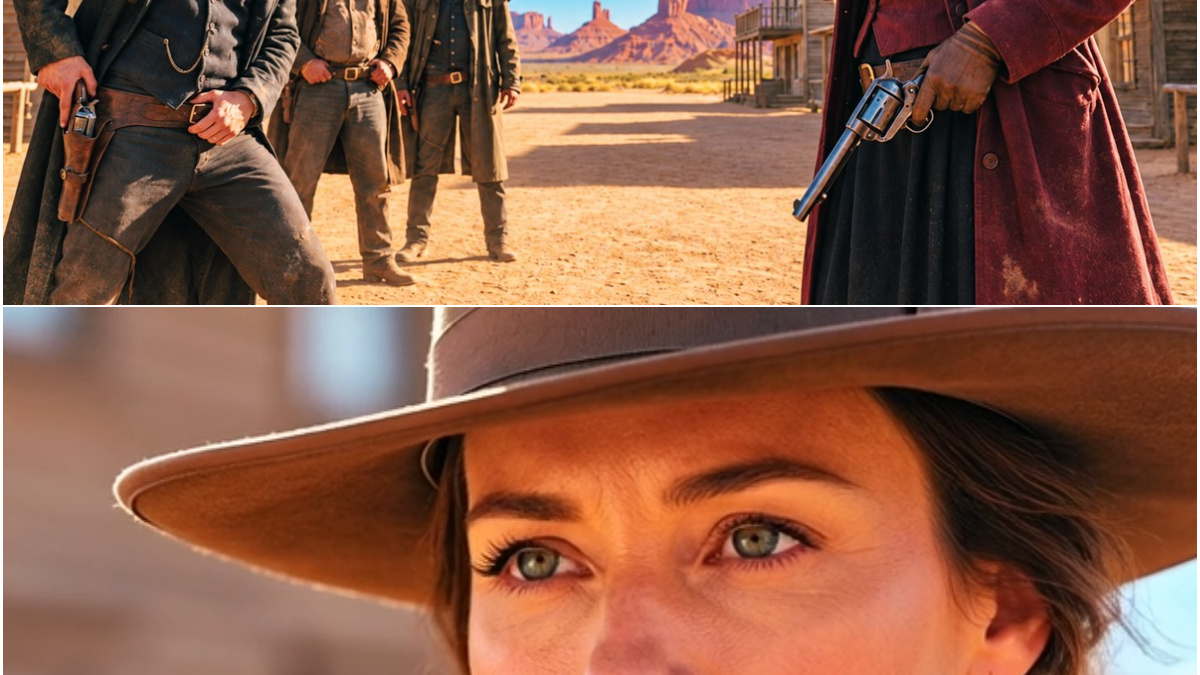
For four days, three riders had followed Josie Rener across the Arizona Territory without once trying to catch her.
That was what frightened her. A man who wanted to take a prisoner would close the distance.
A man who wanted to steal a horse would ride hard. But men who remained exactly one hour behind were doing something else.
They were waiting. From the wagon bed behind her, Harland Boyce lifted his hat from his face and stared at the country slipping paSt. His wrists were secured beneath him by an iron ring, and his eyes had been watching the same distant horizon for most of the morning.
“They have been back there since the tanks,” he said. “You still think this is about me getting away?”
Josie kept her eyes on the road. Whitlo was two hours ahead, a handful of buildings gathered around a spring, a territorial land office, a bank, a livery, three saloons, and a squat adobe jail.
There would be water there. There would be a marshal. There would be witnesses. It should have looked like safety.
Instead, Josie felt the opposite. Her canteen had been empty since midnight. The heat had dried her mouth until speaking hurt.
She had counted the cartridges in both revolvers at sunrise and counted them again now.
Three remained. Three riders were behind her. And somewhere ahead, a federal deputy marshal was supposed to arrive at sundown.
If Josie reached Whitlo with Boyce alive, she could finally hand him over. But if the three riders had followed her for four days only to reach Whitlo, what exactly were they waiting for?
The road into Whitlo was almost white beneath the late June sun. Arizona Territory in the last week of June 1881 offered little mercy to anyone crossing it on horseback or behind a wagon.
The land seemed determined to strip away every unnecessary thing. Water became precious. Shade became a luxury.
Even conversation became something to be measured. Josie Rener had been doing this work for six years.
She knew how to read a trail by the shape of a hoofprint. She knew how to judge whether a rider ahead had stopped because of trouble or because he wanted someone behind him to stop too.
She knew when a horse was exhausted and when a rider was pretending his horse was fine.
Most importantly, she knew how to bring people in alive. That was the one rule she had never broken.
She did not decide along the trail who deserved to arrive. She did not punish people for what they had done.
She did not become judge and jailer simply because she carried two revolvers and knew how to use them.
Years earlier, a marshal had once asked her why she had spent nine days keeping a prisoner safe after learning exactly what the man had done.
Josie had given him a simple answer. “The day I start choosing who deserves to arrive is the day I become no different from the people I bring in.”
She had remembered those words every morning for six years. Harland Boyce was the hardest test that rule had ever faced.
Boyce had been wanted after the April incident involving Anel Su and Marta Su near the Mscow.
The dispute had centered around eight hundred acres and a spring. Josie had found him after following two separate trails across country where every rider seemed to know his name but nobody wanted to say where he had gone.
The reward was two hundred and fifty dollars. It had been posted by the Mscow Valley Cattle Association.
The amount was enough to keep a determined rider moving for weeks. Josie had found Boyce alone.
He had not surrendered easily. But by the time she had him chained inside the wagon, she had already decided one thing.
He would reach Whitlo. He would stand before the law. Whatever happened afterward would belong to the territory.
Not to her. Now the wagon rolled toward town. Boyce lifted his head. “There they are.”
Josie did not look back. “I know.” “You have known all morning.” “I have known for four days.”
Boyce gave a dry laugh. “You really think three men are following you because they want me alive?”
“No.” “Then why keep going?” “Because Whitlo is two hours ahead.” “And if they are waiting there?”
Josie tightened her grip on the reins. “Then I will deal with them there.” Boyce studied her from the wagon bed.
“You could let me out.” “No.” “You could leave me beside the road.” “No.” “You could ride away.”
Josie finally glanced back. “And let you walk into the desert?” Boyce said nothing. Josie turned forward again.
“No.” By four in the afternoon, Whitlo appeared through the heat. It was not much of a town.
One main street ran between rough buildings. There was a bank, two stores, a livery, three saloons standing in a row, and a territorial land office that looked too grand for a settlement of that size.
At the far end stood the adobe jail. One barred window faced the street. A line of cottonwoods marked the spring that had made Whitlo possible.
The thermometer outside the land office read one hundred and six degrees. People came out to watch Josie enter.
They always did. A woman bringing in a prisoner attracted attention. A woman bringing in Harland Boyce attracted more.
Josie was thirty one years old. Her clothes were covered in duSt. Her face was darkened by four days of sun.
Her eyes were red from lack of sleep. But her posture remained straight. The three riders stayed behind.
One hour. Exactly one hour. Josie pulled the wagon toward the jail. Deputy Cobb came outside.
He was nineteen. Sweating. Nervous. He had the uncomfortable expression of a young man who had been given authority before he had learned what to do with it.
Josie climbed down. “Harland Boyce.” Cobb looked at the prisoner. “Yes, ma’am.” “He is wanted on the Su case.”
Cobb reached for the papers. He barely glanced at them. Then he opened the cell.
Boyce entered. Cobb locked the door. Josie watched the key turn. Only then did she breathe properly.
“Where is Marshall Puit?” “Association office.” “When will he return?” “Directly.” Josie looked at him.
“Next district court session?” “Perhaps October.” “That far?” Cobb shrugged. “Territory moves slowly.” Josie looked toward the road.
“How about federal transport?” Cobb brightened slightly. “A deputy United States marshal is riding up from Benson.”
“When?” “Sundown.” Josie calculated. Two hours. Less, perhaps. She looked at Boyce through the bars.
Then she looked toward the ridge. The three riders had finally entered the edge of town.
They were still an hour behind. But now they had a destination. Josie walked across the street.
The Tmaine was the middle saloon. It was dark inside compared with the street, and after four days of dry country, the shade alone felt like medicine.
She stepped through the door. Ellis, the bartender, filled a glass. Josie drank it standing.
Then another. She ordered a beer. It arrived cold. She took a slow drink. There were perhaps ten men inside.
A card game occupied one corner. A drummer sat near the wall with a sample case beside him.
Two Mscow Valley Association hands stood at the far end of the bar. They stopped talking when Josie entered.
Then they started again in lower voices. Ellis was polite. He did not stare. That was something Josie noticed.
She had spent six years watching people watch her. Ellis did not. She drank half the beer.
Then Marshall Puit entered. He was a heavy man of about fifty, wearing a good hat and a coat that looked expensive for Whitlo.
He stopped when he saw her. “Josie Rener.” “Marshall.” “I heard you were in town.”
“I delivered Boyce.” “Good.” Puit smiled. “I will want to see the paperwork.” “Of course.”
“There is no hurry.” Josie studied him. Puit walked past the card players. Past the drummer.
Past the two association hands. Then he went through the back door. Not the front.
The back. Josie lowered her beer. She had learned long ago that rooms told the truth through what disappeared.
The card game had stopped. The drummer stared at his hands. Ellis had moved toward the far end of the bar and was wiping an already clean surface.
Nobody spoke. Josie understood. Puit had not entered to see her. He had entered to confirm that Boyce was inside the jail.
Then he had gone outside to tell somebody. Josie set the beer down. The sound of horses came from the street.
Three of them. Walking. Not rushing. The rhythm was slow and deliberate. Josie moved toward the front door.
Ellis spoke quietly. “There is another door in the alley.” “I know.” “You should use it.”
Josie looked at him. “Why?” Ellis did not answer. She understood that too. She stepped outside.
The three riders had stopped about sixty feet away. They were spread across the road.
The man in the center was Marcus Deal. Josie knew his face from a circular she had carried in her saddlebag for two years.
She had never acted on it. There was a difference between knowing a man was wanted and having a reason to pursue him.
Marcus Deal was about forty. His face was sunburned. His expression was pleasant. That was what made him dangerous.
On his right sat Cphus Book. Older. Thin. Both hands loose near the saddle. His eyes moved constantly.
Roofline. Alley. Land office. Jail. Street. He was studying the town. On Deal’s left sat Hendrickk Wall.
Josie did not know his name yet. He was thin and gray. He sat perfectly still on a very good horse.
He did not look at Josie. He looked toward the jail. Deal smiled. “Three against one, ma’am.”
Josie stood in the doorway. Her hands remained at her sides. “Three men.” Deal smiled wider.
“Three men.” “Three bullets.” The smile disappeared. Nobody laughed. Cphus Book turned his head. Hendrickk Wall finally looked at her.
Josie had counted the ammunition that morning. Two revolvers. Six chambers each. Only three cartridges remained.
The first chamber of each cylinder held a live round. She had loaded them herself.
She knew exactly what she had. And now she had told the three men. Deal slowly removed his hands from the saddle horn.
“You have the wrong idea about us.” Josie waited. “We are not here about you.”
“You followed me four days.” “That is true.” “You stayed exactly one hour behind.” “That is also true.”
“You could have caught me.” Deal nodded. “We could have.” “Then why did you not?”
He smiled again. “Because one of us might have paid for it.” Josie said nothing.
Deal looked toward the jail. “You did a piece of work.” “I did my job.”
“You brought Boyce in alive.” “That was the assignment.” “Your part is finished.” Josie watched him.
“What happens now?” “You get your horse.” He pointed toward the livery. “You ride out.”
“And Boyce?” Deal shrugged. “You already know what happens to him.” Josie’s expression did not change.
“You are here to take him from the jail.” “No.” Deal looked almost amused. “We are here to make sure he does not reach the federal marshal.”
There it was. The truth. Josie had suspected it. Now she knew. She glanced toward the adobe building.
The barred window looked small in the afternoon light. Cobb was nineteen. Puit had gone through the back door.
A federal deputy marshal was expected at sundown. Two hours remained. Deal leaned forward. “Walk away, Josie.”
“Who is paying you?” His smile vanished. “That is not a question a person asks if she plans to leave.”
Josie studied him. “You have been following me because Boyce is worth more to somebody than two hundred and fifty dollars.”
Deal did not answer. She continued. “He knows a name.” No response. “A man with money wants that name to stay inside a cell.”
Deal’s eyes narrowed. Josie understood. The reward had been posted two days after Anel Su and Marta Su were buried.
It had looked like a wealthy association trying to bring a wanted man before the law.
But the timing was wrong. The reward had also created a second advantage. It put every armed rider in the territory on Boyce’s trail.
If Boyce reached court, he could speak. If he disappeared before then, the person who posted the reward could claim that the law had simply failed.
Deal looked at her. “You are clever.” “I am tired.” “That makes you dangerous.” “No.”
Josie looked toward the jail. “The rule makes me dangerous.” Deal frowned. “What rule?” “I deliver who I take.”
Deal shook his head. “You cannot protect everybody.” “I do not.” “You know what Boyce did.”
“Yes.” “And you still intend to hand him over.” “Yes.” “He has no right to your loyalty.”
Josie looked directly at him. “It is not loyalty.” Deal waited. “It is my job.”
The street had become silent. People watched from doorways. Men stood beneath awnings. Nobody moved.
Deal’s right hand dropped from the saddle horn. Book shifted at the same instant. Wall did not move.
Josie drew both revolvers. Two shots cracked through Whitlo. Deal fell from his horse. Book’s shoulder snapped backward as the second shot struck him.
His revolver dropped into the duSt. Wall remained mounted. His hands were still visible. Josie held both guns on him.
The street filled with smoke. A horse broke loose and ran down the road dragging an empty saddle.
Book groaned. Two men from the Tmaine carried him toward the doctor. The whole exchange had lasted seconds.
Josie looked at Wall. “You had time.” Wall nodded. “I had time.” It was the first thing he had said.
His voice carried a faint European accent. “You were paid for Boyce.” “Yes.” “You were not paid for me.”
“No.” Josie kept both revolvers raised. Wall looked toward Deal. “He always talked.” Josie waited.
“He believed every problem could be talked away.” “What is your name?” Wall looked at her.
“Hendrickk Wall.” “Who hired you?” Wall was silent. Josie took one step forward. “You know how many cartridges I have.”
“Yes.” “You counted when I told Deal.” “Yes.” “If you reach for that gun, one of us leaves this street.”
Wall studied her. Then he looked toward the jail. “August Teal.” Josie lowered one revolver slightly.
“Say it again.” “August Teal.” “Why?” Wall’s expression barely changed. “Because he owns more of this valley than most people realize.”
Josie looked toward the northern end of Whitlo. A large house stood there. A porch faced the street.
August Teal stood on it. He had been watching. He was about sixty. He had arrived in the territory before the war.
He owned the bank building. He controlled the water rights around the spring. He held mortgages.
Promissory notes. Cattle contracts. Small ranchers owed him money. Landowners needed him. Merchants depended on him.
The Mscow Valley Cattle Association carried his influence. Josie looked back at Wall. “You can go.”
He nodded. “Why?” “Because you gave me a name.” “You could arrest me.” “I could.”
“You are not going to.” “No.” Wall turned his horse. He walked south through Whitlo.
Nobody stopped him. Nobody called after him. Josie watched until he disappeared beyond the cottonwoods.
Then she turned toward August Teal. He was already walking down from the porch. Marshall Puit appeared behind the land office.
He carried a shotgun. Four association hands followed him. Josie saw them. She saw Teal.
She saw the jail. She saw Cobb standing near the corner. Then she understood the whole shape of the trap.
Puit had not been afraid of Marcus Deal. He had been waiting for Teal. Teal stopped fifteen feet away.
“You have caused a great deal of trouble.” Josie lowered one revolver. She kept the other ready.
“You posted the reward.” Teal smiled. “I posted a reward for Harland Boyce.” “You sent three men after him.”
“I did no such thing.” “Marcus Deal said otherwise.” “Marcus Deal is not here to speak.”
“He spoke before he was taken away.” Teal glanced toward the doctor. Cphus Book was still alive.
That mattered. Teal looked toward the jail. “You have delivered a dangerous prisoner.” “He is entitled to his hearing.”
“He is entitled to nothing.” Josie looked at Puit. The marshal kept the shotgun raised.
“You want me inside that jail too.” Puit said nothing. Teal nodded toward her revolvers.
“Take them.” Josie did not move. “Put her in the cell,” Teal said. Puit stepped closer.
The association hands moved with him. Then Cobb came out. The nineteen year old deputy walked into the street.
He carried the jail’s spare shotgun. His hands shook. But he kept walking. “Deputy,” Puit said.
Cobb stopped. “Sir.” “Take her weapons.” Cobb looked at Josie. Then at Puit. Then at Teal.
He swallowed. “No.” The word was quiet. Puit stared at him. “What?” Cobb raised his voice.
“No.” Teal’s expression hardened. Cobb stepped forward. “Cphus Book is alive.” Nobody moved. “He has been talking.”
Teal’s eyes shifted. Cobb continued. “He gave the same name.” Puit looked toward him. “What name?”
Cobb looked directly at Teal. “August Teal.” Silence spread through Whitlo. The association hands looked at one another.
One stepped backward. Then another. Puit lowered his shotgun. Teal stared at Cobb. “You are nineteen.”
“Yes, sir.” “You do not understand what you are saying.” Cobb’s voice shook. “I understand that Book gave the same name Wall gave.”
That ended it. Puit lowered the shotgun completely. The association hands stopped moving. Josie lowered both revolvers.
Teal stood alone. The town had heard. That was what mattered. He could deny one witness.
He could dismiss one hired gun. He could call Josie an outlaw. But two men who had not spoken to each other had given the same name.
And dozens of people had heard Cobb repeat it. Teal turned. Nobody followed him. He walked back toward his house.
The door closed. Cobb looked at Josie. “I am sorry.” “For what?” “I should have read the papers.”
Josie shook her head. “You read the important part.” Cobb looked toward the jail. “Boyce?”
“He stays there.” Cobb nodded. The federal deputy marshal arrived at sundown. Boyce was transferred into federal custody.
Josie signed the receipt. Then she walked away. She did not collect her reward. Not that night.
Not the next day. Not the next week. She wrote twice to the Mscow Valley Cattle Association.
The second letter came back unopened. The association was already beginning to fall apart. The bank moved away from Teal’s building.
Several members withdrew. Small ranchers began speaking openly. August Teal was indicted. The case went to court.
Boyce was brought to Tucson. He testified about the arrangement. He did not testify because he had suddenly become an honorable man.
He testified because Teal had tried to silence him before he could speak. The territory heard the story.
The evidence included Book’s statement. Wall’s name. The reward notice. The timing. The connection to the association.
Teal had four lawyers. The jury included men who owed him money. The verdict came quickly.
Not guilty. Josie sat in the courtroom and listened. She did not react. Boyce faced his own judgment separately.
He was convicted for what had happened to Anel Su and Marta Su. His sentence was carried out the following month.
Josie never visited him again. She had completed her part. That was all. August Teal lost influence despite the verdict.
Association members abandoned him. The bank moved. The water agreements changed hands. By 1885, Teal had left the valley.
He eventually settled in San Diego. Whitlo changed. Marshall Puit left within a year. Nobody trusted him again.
Cobb remained. He held the office for the next eleven years. He became known for one thing.
He read every paper. He asked every question. And he never again assumed that a prisoner was safe simply because a key had turned inside a lock.
As for Josie Rener, she continued riding. She worked the same way. Six years became seven.
Then eight. She continued delivering prisoners alive. She never decided which ones deserved the protection of the law.
She never pretended every prisoner was innocent. She simply refused to become another person who decided that rules mattered only when convenient.
Years later, she still carried the receipt Cobb had given her in Whitlo. It was not the two hundred and fifty dollars she had expected.
It was only proof that she had delivered Harland Boyce. That paper had almost no value.
But she kept it. Because it reminded her what the job had coSt. Four days in the desert.
An empty canteen. Three bullets. Two armed men in the street. One name traded for one man’s freedom.
And a prisoner who reached the federal marshal because Josie refused to let somebody else’s money decide when her job ended.
People later told the story differently. Some said Josie had defeated three men alone. Some said Hendrickk Wall had been too frightened to challenge her.
Some said Marcus Deal had never been much of a gunman. Some said Teal had been unlucky.
Josie never corrected them. The truth was simpler. She had three bullets. They had three men.
She had a rule. They had an arrangement. And when the moment came, the difference was not speed.
It was that Josie knew exactly what she was willing to protect. She was not protecting Harland Boyce because she admired him.
She was not protecting him because she believed he had done nothing wrong. She was protecting the process that allowed the truth to reach a courtroom.
That distinction stayed with her. Years later, when another young deputy asked why she had refused to walk away from Whitlo, Josie gave him the same answer she had given the marshal six years earlier.
“The day I start choosing who deserves to arrive is the day I become no different from the people I bring in.”
The deputy thought about it. Then he asked whether that meant every prisoner deserved protection.
Josie shook her head. “No.” She looked toward the road. “It means every prisoner gets the chance to reach the place where their actions can be judged by someone other than me.”
That was the closest she ever came to explaining herself. She never collected the two hundred and fifty dollars.
The reward notice eventually disappeared. The Mscow Valley Cattle Association closed its Whitlo office. The men who had signed the notice scattered.
Nobody sent Josie another payment. But she kept riding. There was another detail about that afternoon that stayed with her longer than the money.
Hendrickk Wall had been a dangerous man. She knew it. He had followed her for four days.
He had entered Whitlo prepared to remove Harland Boyce before the federal marshal arrived. She had every reason to take him in.
Instead, she gave him a name and allowed him to ride south. Some people would call that a mistake.
Others would call it mercy. Josie never called it either. She simply remembered the moment Wall had looked at her ammunition and understood that neither of them had much room left for mistakes.
She remembered that he could have drawn. He did not. She remembered that he could have lied.
He gave her August Teal. And she had made a choice. Not about who deserved freedom.
Not about who deserved punishment. Only about what information the territory needed next. That was why she let him go.
The decision still troubled her. Not because she believed Wall was harmless. He was not.
But because rules become difficult when reality refuses to fit inside them. Her rule had always been simple.
Deliver who you take. Whitlo taught her that the rule could also mean something else.
Sometimes delivering one person meant protecting them from people who wanted them silenced. Sometimes protecting the prisoner meant facing the people who paid for the reward.
Sometimes the person who needed to reach the courthouse was the least deserving person in the entire story.
And sometimes the only way to expose the person behind the arrangement was to keep the witness alive long enough to speak.
Josie never became sentimental about it. She did not believe the frontier rewarded good intentions.
It did not. She simply believed that if she accepted a job, she would finish it according to the same rule whether the prisoner was respectable or hated.
That was what separated her from the men who followed her. They were paid to make decisions.
She was paid to refuse that privilege. By the end of June 1881, Whitlo had learned her name.
Not because she had won a gunfight. Not because she had faced three riders. Not because she had stood in front of August Teal’s house with one live cartridge remaining.
They remembered her because she walked into a town where money controlled almost everything and refused to let it control the one thing she had promised to do.
Harland Boyce reached Tucson. Cphus Book survived long enough to testify. Hendrickk Wall disappeared into the territory.
Marcus Deal never returned to Whitlo. August Teal lost the valley even though the first jury cleared him.
Marshall Puit lost his office. Deputy Cobb learned what his position actually required. And Josie Rener rode back into the desert.
The road was hot. The sky was enormous. Her canteen was full this time. Her revolvers were loaded.
Her horse knew the way. Behind her, Whitlo became smaller until it disappeared into the heat.
She did not look back. There was no reason to. She had done what she came to do.
She had brought the prisoner in. She had refused the money’s hidden purpose. And she had left one name behind that the territory could no longer ignore.
August Teal. That name had started as a whisper from a man who had chosen not to draw.
Then it became a statement from an injured witness. Then it became something a nineteen year old deputy repeated in the middle of the street.
After that, it belonged to everyone. Josie never knew whether Hendrickk Wall remembered the bargain the way she did.
She never saw him again. Maybe he rode north. Maybe south. Maybe he left the territory.
She did not search for him. Her work was never about settling every unfinished account.
It was about delivering the person in front of her. That was enough. And when the sun went down behind the Arizona hills that evening, Josie Rener kept riding with the same two revolvers at her hips and the same rule she had carried for six years.
The rule was still simple. Take them in. Bring them through. Let the law decide.
Everything else belonged to someone else.
Disclaimer: This content may be created by Al for entertainment purposes. Any resemblance to real persons, events, or places is coincidental.








