This NEW Bigfoot Footage SO CLEAR You’ll Question Everything!
Beyond New Orleans, where music spills into the streets and the smell of Creole cooking drifts through the air, there is a place where the atmosphere changes completely.
An hour from the celebrations and crowded restaurants, the landscape opens into a vast wilderness of dark water, tangled trees, and narrow channels that seem to disappear beneath curtains of hanging moss.
This is Honey Island Swamp, a sprawling stretch of Louisiana wetlands where the ordinary rules of the outside world feel strangely distant.
Hunters, fishermen, and people who have spent their lives navigating its waterways know that the swamp has its own rhythms, its own dangers, and its own mysteries.
Yet for generations, some have insisted that something unusual shares this wilderness with the alligators, birds, and other creatures that inhabit it.
They describe a figure that walks on two legs, moves with astonishing speed, and watches from the shadows before vanishing into the vegetation.
Some say it resembles a man covered in long, dirty hair. Others describe a face that looks almost human, set above a powerful animal-like body.
The stories are unsettling, but the people telling them often speak with the certainty of those who believe they have seen something they cannot explain.
The legend has a name, and its origins reach back to 1963. But what really moves through the flooded forests of Honey Island Swamp, and why have so many people continued searching for it?
Honey Island Swamp covers approximately 250 square miles in southeastern Louisiana. It is a landscape shaped by water, mud, thick vegetation, and the changing conditions of the surrounding wetlands.
From a distance, its forests can look peaceful, with tall trees rising above still channels and sunlight filtering through layers of leaves.
But anyone traveling through the swamp quickly learns that appearances can be misleading. The water can conceal fallen branches, the ground can become difficult to cross, and the dense vegetation can make it almost impossible to see very far in any direction.
For people who hunt and fish in the area, the swamp is more than a wilderness.
It is familiar territory, a place where knowledge is built over years of watching the weather, reading the water, and recognizing the movements of wildlife.
Yet even experienced visitors sometimes describe moments when the familiar landscape seems to change. A noise comes from somewhere beyond the trees.
Something moves along a distant bank. A shape appears between the trunks and disappears before anyone can get a clear look.
Among the stories associated with these encounters is the account of a creature known as the Honey Island Swamp Monster.
Witnesses describe it as a large, upright figure with long arms, a broad upper body, and hair covering much of its frame.
Some say its shoulders are squared across its back, giving it a different shape from the rounded outline of a bear.
Others remember a face with exposed skin around the cheeks, forehead, nose, and chin. One description focuses on its eyes, which are said to have a striking amber color.
Another emphasizes its unusual movement. According to those who claim to have encountered it, the creature can move quickly through difficult terrain and disappear into the swamp before a person has time to understand what they are seeing.
The accounts do not all agree. Some witnesses describe grayish hair that looks dirty or muddy.
Others remember a reddish tint. A few compare its appearance to a person wearing a heavy coat, while others insist that its body looked unmistakably animal-like.
These differences have become part of the legend, leaving investigators with a collection of descriptions that are similar in some ways but difficult to reconcile in others.
The story is generally traced to 1963, when two wild game hunters reportedly encountered a large and unusual creature in the woods.
Their experience became one of the earliest accounts associated with the Honey Island Swamp Monster.
At the time, there was no established body of evidence that could identify the animal or explain what the hunters believed they had seen.
The story circulated, however, and the possibility of an unknown creature living in the wetlands began to attract attention.
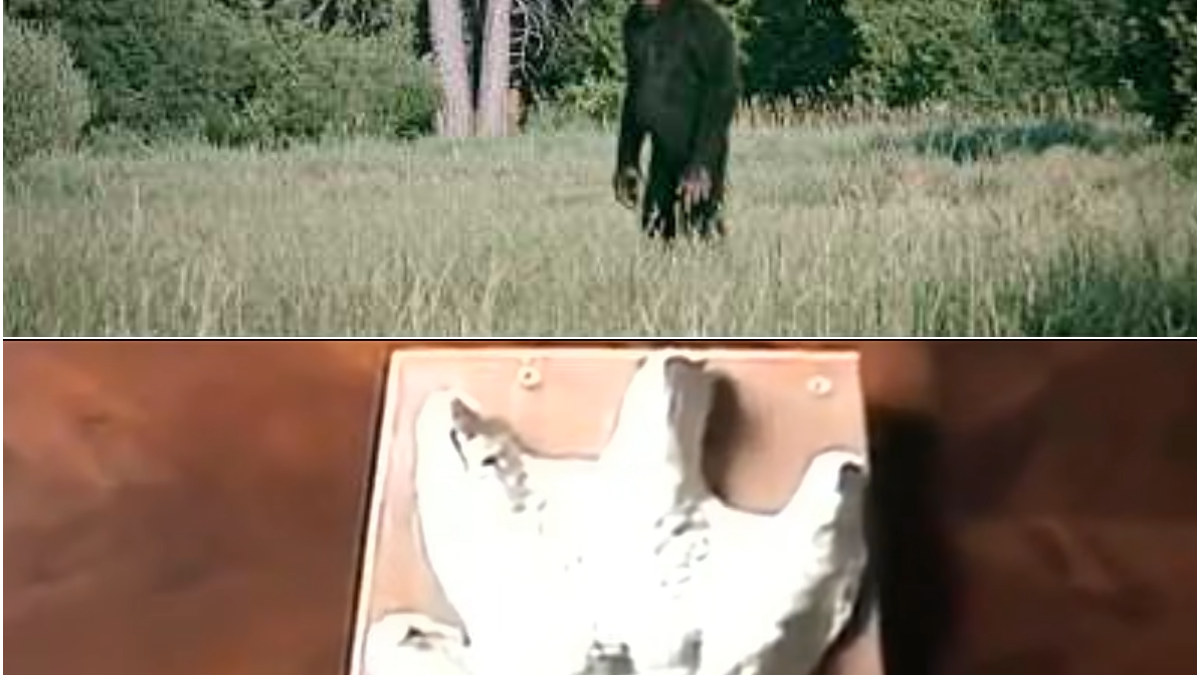
A decade later, one of the original hunters, Harlon Ford, reportedly found enormous footprints in the mud.
The tracks appeared unusual enough to convince him that they might belong to the creature described in the earlier encounter.
Ford made plaster casts of the impressions, preserving their shapes as physical evidence. The casts became an important part of the story because they offered something more tangible than a spoken account.
A witness could describe a strange figure, but a plaster impression could be examined, measured, photographed, and compared with the tracks of known animals.
For people interested in the mystery, the footprints seemed to bring the creature a little closer to the world of observable evidence.
Yet a footprint alone could not establish what had made it. Without a clear record of the creature itself, the casts could not settle the question of whether the tracks belonged to an unknown animal, a familiar species leaving unusual impressions, or something deliberately made to resemble an unusual footprint.
The casts strengthened the legend for believers, while leaving skeptics with unanswered questions. Harlon Ford’s family continued to preserve the story.
His granddaughter, Dana Holyfield, grew up with accounts of the creature and the evidence associated with her grandfather.
She remembered hearing about the enormous tracks and the unusual appearance described by witnesses. In particular, the reports of amber-colored eyes, long arms, and dirty gray hair became central to the family version of the legend.
Dana and her husband, Terrell Evans, live near the swamp. Their proximity to the wetlands has placed them in a position to hear stories from people who say they have experienced something unusual in the area.
Over time, they have received accounts from hunters, fishermen, and other visitors who describe strange figures, unexplained movements, or footprints they believe could be connected to the monster.
The reports are often personal and detailed. Some people remember the moment they first noticed something watching them.
Others describe seeing a shape move through the trees or cross a canal. Many explain that their first impression was of an ordinary animal, but that something about its outline or behavior made them reconsider.
One witness described the feeling of being observed while standing in the woods. The sensation was strong enough to make the person pay closer attention to the surrounding trees.
When a figure became visible, its back appeared unusually flat across the shoulders. The witness compared the shape with that of a bear, but believed the outline was different enough to rule out that explanation.
The encounter changed the person’s plans. Instead of continuing as intended, the witness decided it was time to leave the area.
The description was not simply of a large animal passing through the woods. It was of something that seemed to stand in a way the witness associated with a human figure, while possessing a body that did not look entirely human.
Another account began with a different assumption. A person noticed something moving near a canal and initially considered the possibility that it was a deer.
But the figure did not look right. As it crossed the waterway, the witness felt that it seemed to walk along the bottom rather than swim in the way an ordinary animal might be expected to.
When the figure reached the opposite bank, it reportedly stood and shook its hair. The witness described an appearance that was partly human and partly animal, before the creature continued across the landscape and disappeared.
The moment was brief, but it remained memorable because the movement seemed so unusual. Such accounts are difficult to assess from descriptions alone.
A person observing something in dim light, through vegetation, or from a moving boat may have only a few seconds to interpret what is happening.
Distance can distort proportions, and unfamiliar movement can make an ordinary animal seem extraordinary. At the same time, people who spend years in the same wilderness often develop strong expectations about what they are likely to encounter.
For Dana, the number of stories and the persistence of the reports made the subject worth examining more closely.
She decided to create a documentary called The Legend of the Honey Island Swamp Monster.
The film would explore the history of the creature, the eyewitness accounts, and the evidence that had been associated with the legend over the years.
The project also gave Dana an opportunity to investigate an unusual piece of family material.
While working on the documentary, she discovered footage filmed by her grandfather on Super 8 movie film.
Her grandmother believed the recording had been made in the late 1970s. The footage showed a wooded area of the swamp, where a large, dark figure appeared to move between the trees.
The image was grainy and the details were difficult to distinguish. But to those familiar with the legend, the shape looked remarkably similar to the descriptions given by witnesses.
It appeared to be covered in hair and moved upright through the vegetation. Dana’s family believed the recording showed something that was not an ordinary person walking through the woods.
The footage became one of the most intriguing parts of the documentary. Unlike a verbal description, a film recording offers viewers the chance to study the same visual material and form their own impressions.
Yet old footage also comes with limitations. The image quality, camera angle, distance, lighting, and movement all influence what can be seen.
Without a clear view of the subject or reliable details about the recording conditions, the film cannot independently identify the figure.
Dana’s grandmother’s recollection placed the footage in the late 1970s, but the circumstances surrounding the recording remained important to understanding it.
The person behind the camera was reportedly in a tree blind when something crossed through the swamp on foot.
The family description emphasized that the figure was hairy and did not appear to be human.
The recording’s significance depended partly on whether its shape and movement could be distinguished from a person, a known animal, or an object appearing unusual because of the film’s limitations.
For believers, the footage was a rare glimpse of the creature. For skeptics, it was an intriguing but inconclusive image.
The documentary also brought Dana and Terrell into contact with reports of more recent tracks.
One account concerned impressions discovered in the Peach Lake area. A hunter or fisherman reportedly contacted Terrell after finding tracks in the woods.
The impressions were described as having three prominent toes, along with a smaller fourth feature on the side.
The shape attracted attention because it seemed different from the footprints people expected to find in the swamp.
The impressions were also described as somewhat webbed, suggesting to some observers that they might have belonged to a creature adapted to moving through water.
Their unusual appearance led to further discussion about how the creature might travel through its environment.
A cryptozoologist who examined the tracks, Lloyd Pye, reportedly considered the shape and suggested that it might be consistent with an animal capable of climbing.
The possibility raised additional questions about the creature’s movement and habitat. If the tracks belonged to an unknown animal, its ability to navigate both water and trees might help explain why it was so difficult to observe.
But the tracks could not establish those abilities on their own. An impression can be altered by mud, water, and the pressure of the foot that made it.
The shape of a track may also be affected by the angle at which it was recorded or by the condition of the ground.
Without a verified source, even unusual impressions can be difficult to interpret. Still, the discoveries contributed to the sense that the swamp contained a mystery worth investigating.
The accounts were not limited to Dana’s grandfather or to a single generation of hunters.
People continued to describe experiences that they believed were connected to the same creature, and some claimed to have found tracks resembling those associated with the original story.
Dana’s father, Dan Holyfield, also had his own account. He said that he encountered the Honey Island Swamp Monster in the late 1980s, after returning from a turkey hunting trip.
The experience began while he was traveling by boat through the dark waterways. At first, Dan believed that he had struck a log.
In a swamp filled with floating debris and submerged obstacles, that would have been an ordinary possibility.
But the object behaved in a way that made him uncertain. He turned his attention toward the water and used a light to see what was there.
What he saw confused him. The shape seemed to be standing in the water, and when it rose, it looked like a human being.
Dan remembered an appearance similar to someone wearing a heavy overcoat or some kind of thick garment.
The figure’s outline was difficult to understand, especially in the darkness and under the limited light.
For a moment, he struggled to decide what he was looking at. The creature appeared human in its upright posture, but something about its size and appearance seemed unfamiliar.
The encounter was brief, and the conditions made it difficult to examine the figure closely.
Yet Dan remembered the experience as one of the most unusual moments of his time in the swamp.
His account became another piece of the family history. Harlon Ford had described a creature and preserved unusual tracks.
Dana had collected reports from people who claimed to have seen it. Dan said he had encountered something that seemed to match the descriptions.
Together, these accounts formed a story that extended across decades. Other people also spoke about hearing or seeing evidence of the creature.
One man said that he believed it existed, though he emphasized how elusive it was.
Over the course of his life, he estimated that he had heard reports perhaps half a dozen times and had seen similar tracks around two dozen times.
He described the tracks as believable and difficult to fake, although the impressions alone could not prove that an unknown creature had made them.
His confidence came from the repeated nature of the reports and the fact that some of the evidence appeared to him to be consistent with the legend.
Another person offered a different interpretation of the creature’s possible nature. Rather than thinking of it simply as a monster, the witness suggested that it might be more human than people assumed.
The comment reflected one of the central difficulties in the accounts: the creature was described as having a human-like face and an upright posture, yet also possessing a body covered in hair and moving through the wilderness like an animal.
The distinction mattered because it influenced how people imagined the creature’s behavior. If it were an ordinary animal, investigators might expect its movements, feeding habits, and tracks to resemble those of known wildlife.
If it were something closer to a human figure, its behavior might be harder to predict, and its ability to avoid people might be part of the explanation for the limited evidence.
The swamp itself offered plenty of reasons why an animal could remain difficult to observe.
Thick vegetation creates narrow windows of visibility. Waterways twist through the trees, and a person traveling by boat may have only a brief view of the banks.
Muddy ground can preserve impressions temporarily, but rain, changing water levels, and passing animals can quickly alter them.
Sound can also travel unpredictably through wetlands. A noise that seems close may come from farther away, while the movement of water and vegetation can make it difficult to determine the direction of a sound.
In such an environment, an unfamiliar call or sudden movement can leave a strong impression without providing enough information for identification.
The people who tell stories about the Honey Island Swamp Monster often emphasize that it is faSt. They say it can move out of sight before anyone has time to focus on it.
That speed, combined with the terrain, may help explain why witnesses frequently describe only a partial view.
Some remember the shoulders and back. Others recall the face or the eyes. Few claim to have observed every detail clearly.
The differences between accounts have not prevented the legend from continuing. Instead, they have allowed people to discuss the creature from several angles.
Some concentrate on its size and shape. Others focus on the tracks, the film footage, or the possibility that it is adapted to both water and land.
The family history has given the story a sense of continuity, while newer reports keep it connected to the present.
For Dana and Terrell, gathering these accounts meant listening to people who were willing to describe experiences that others might dismiss.
Some witnesses spoke with confidence, while others appeared uncertain about what they had seen. Their documentary presented these accounts as part of the larger mystery, allowing viewers to consider the reports alongside the historical material and physical evidence.
The film’s central question was not simply whether people believed in the creature. It was whether the stories, tracks, and footage could be brought together into a convincing explanation.
The answer remained elusive. Each piece of evidence offered something to examine, but none provided an indisputable identification.
The old Super 8 recording was especially important because it appeared to show a figure moving through the trees.
But its age and limited clarity made interpretation difficult. A shape that looks like a hairy, upright animal to one viewer might look like a person, a shadow, or a different object to another.
The footage could be studied repeatedly, yet its unclear details left room for disagreement. The plaster casts made by Harlon Ford presented a similar problem.
They preserved the shape of unusual impressions, but the person examining them would still need to establish what had made the tracks.
Without a verified specimen or a clear observation linking the creature to the footprints, the casts remained suggestive rather than conclusive.
The more recent Peach Lake tracks raised further questions about how the creature might move through the wetlands.
Their reported toe arrangement and web-like appearance led to speculation about swimming and climbing. But a possible interpretation is not the same as a demonstrated ability.
To establish what the tracks represented, investigators would need reliable documentation of the impressions and a way to compare them with known animals and other possible sources.
For skeptics, the lack of a captured creature or independently verified evidence was the central issue.
The stories might be sincere, but sincerity alone cannot identify an animal. A witness can be certain about an experience while remaining mistaken about the source of what they observed.
The unusual conditions of the swamp make that possibility especially relevant. The skeptical position does not require assuming that every witness is inventing a story.
It can simply recognize that people interpret unfamiliar events through the knowledge and expectations they already possess.
A shadow in the trees may appear larger than it is. A familiar animal seen from an unusual angle may seem to have unfamiliar proportions.
A brief glimpse in low light may leave a person with a vivid but incomplete memory.
Believers, however, often point to the persistence of the accounts. The legend did not depend on one individual or one isolated report.
It included the 1963 encounter, Harlon Ford’s later discovery of footprints, the memories preserved by his family, Dan Holyfield’s account from the late 1980s, and the reports gathered by Dana and Terrell.
To them, the number and variety of stories suggest that something unusual may be occurring in the swamp.
The two positions continue to meet at the same unanswered question. If the creature exists, what is it?
Is it an unknown animal that has managed to remain hidden in a vast and difficult landscape?
Is it a known species repeatedly misidentified under unusual conditions? Or has the legend grown through years of storytelling, with each new account influenced by the descriptions that came before it?
The people who believe in the monster often describe the swamp as a place where a person can feel watched.
That sensation appears repeatedly in the stories, sometimes before a witness reports seeing anything at all.
It is a feeling that can be difficult to separate from the natural atmosphere of a wilderness where visibility is limited and the sounds of wildlife are constant.
For someone standing alone among the trees, the swamp can seem to close in from every direction.
The water reflects fragments of light, the vegetation blocks the view, and the narrow paths make it difficult to know what lies beyond the next bend.
Even familiar surroundings can feel unfamiliar when darkness begins to settle. The monster legend draws much of its power from this setting.
It is not a story about a creature appearing in an open field where its size and shape could be observed easily.
It is a story about something moving through a landscape that seems designed to conceal it.
Every account is filtered through the conditions of the swamp, and every search begins with the knowledge that the terrain can make even ordinary wildlife difficult to follow.
One witness offered a practical challenge to anyone who remained skeptical. The suggestion was to travel deep into the swamp, roughly a mile and a half from the familiar surroundings, and spend the night there.
The person making the offer joked about leaving a visitor with some Vienna sausage and Snickers bars before returning the following morning.
The remark was humorous, but it also expressed a serious point about the difference between discussing the swamp and experiencing it.
From a comfortable distance, the mystery can seem easy to dismiss. In the middle of the wetlands, surrounded by darkness, mud, and unfamiliar sounds, a person may become more aware of how little they can see or control.
That does not prove the existence of the creature. An uncomfortable night in the swamp would not turn an uncertain account into scientific evidence.
But the challenge captures something important about why the legend has remained compelling. The environment is real, the isolation is real, and the possibility of encountering unfamiliar wildlife is part of the experience of being there.
Honey Island Swamp remains a place where nature can be difficult to interpret. Its wildlife is varied, its waterways are complicated, and its vegetation can conceal movement almost completely.
People who know the area understand that a person cannot always see what is nearby, even when standing only a short distance from it.
The legend of the Honey Island Swamp Monster adds another layer to that uncertainty. It has been carried through family stories, preserved in plaster casts, explored in documentary footage, and repeated by witnesses who say they have seen something they cannot explain.
Its details vary, but the recurring image is of a large, hairy figure walking upright through the trees, with a human-like face and a body that belongs to no familiar description.
Whether that figure represents an unknown animal, a misidentified creature, or a legend shaped by decades of retelling remains unresolved.
The accounts have not produced the kind of evidence that would settle the question for everyone.
Yet the stories continue to draw attention because they connect a mysterious possibility with a real and expansive wilderness.
For Dana Holyfield and Terrell Evans, the search has involved more than following a rumor.
It has meant preserving the memories of people who believe they encountered the creature and examining the objects and recordings associated with the story.
Their work has helped keep the legend alive while giving viewers a chance to consider the evidence for themselves.
For skeptics, the next step remains straightforward: clearer documentation, verifiable tracks, or direct evidence that can be examined independently.
For believers, the absence of such evidence may reflect the creature’s ability to remain hidden in a landscape that offers countless places to disappear.
And for those who live near the swamp, the mystery remains part of the area’s identity.
The wetlands are not simply a backdrop for a strange story. They are a living environment, shaped by water and wildlife, where every journey can reveal something unexpected.
A sound from the trees, a ripple across a canal, or a set of unfamiliar impressions in the mud can become the beginning of another account.
Perhaps the most enduring feature of the Honey Island Swamp Monster legend is that it refuses to end with a single explanation.
The 1963 encounter began a story that continued when Harlon Ford found the footprints ten years later.
The family preserved the descriptions and casts, and later generations added their own accounts. The Super 8 footage brought a visual mystery into the discussion, while the Peach Lake tracks and Dan Holyfield’s experience gave the documentary further material to examine.
Each new report returns the story to the same landscape, where the water can hide what moves beneath it and the trees can conceal what passes between them.
The swamp remains large enough that a person can travel through it without seeing everything that lives there.
That simple fact leaves room for curiosity, but it also makes careful investigation essential. Until stronger evidence emerges, the Honey Island Swamp Monster remains a legend supported by eyewitness accounts and disputed physical material.
Its existence has not been established, and the available descriptions do not provide a reliable identification.
Still, the people who tell these stories continue to insist that they saw something unusual, something that did not fit their expectations of the wildlife around them.
When evening settles over Honey Island Swamp, the waterways darken and the trees become silhouettes against the fading sky.
The sounds of the wetlands continue, even as visibility disappears. Somewhere beyond the reach of a flashlight, something may move through the undergrowth, leaving only a sound, a fleeting shape, or an impression in the mud.
For one person, it might be an ordinary animal moving through its habitat. For another, it might be the beginning of an encounter they will remember for the rest of their life.
And for anyone who has heard the stories of the Honey Island Swamp Monster, the question remains waiting in the darkness: if something really is walking through those trees, what will it take for the world to finally see it clearly?
Disclaimer: This content may be created by Al for entertainment purposes. Any resemblance to real persons, events, or places is coincidental.








