This Is Why FLORIDA ALLIGATORS KEEP DISAPPEARING – What Was Discovered Terrified Scientists
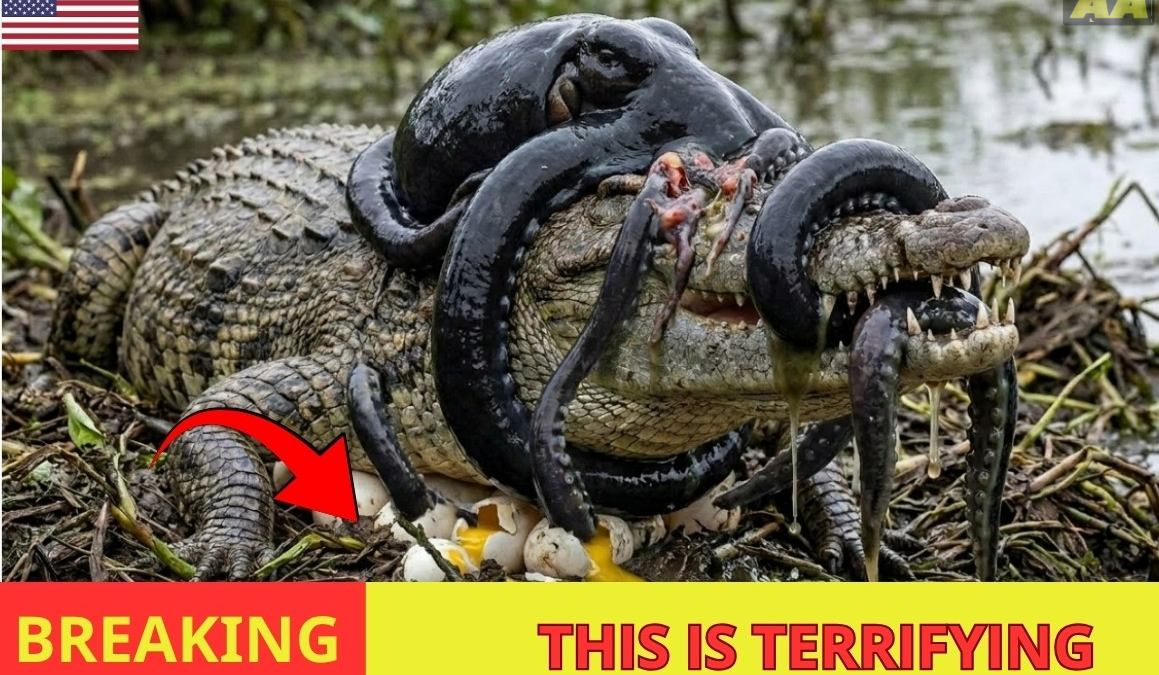
Every April, the wetlands of South Florida seem to wake beneath a veil of heat and pale morning light.
The mangroves stand motionless around shallow channels, birds call from somewhere beyond the reeds, and beneath layers of leaves and damp soil, American crocodile nests wait quietly for the season to reveal what has happened inside them.
For 35 years, dr. Frank Mazzotti and his colleagues have returned to these same wetlands, marking nests, recording locations, counting hatchlings, and following the slow recovery of one of Florida’s rarest reptiles.
They know where the females reSt. They know when the nesting season begins. They know how carefully a mother guards the ground she has chosen.
Yet on one April morning, everything they thought they understood about those nests suddenly became uncertain.
Frank Mazzotti knelt beside a nest he had already marked and pushed his hands through the layer of decaying leaves.
Beneath it was damp soil, and beneath that should have been dozens of eggs. Instead, there was an empty space.
There were no shattered shells scattered across the ground. No obvious disturbance. No clue that could immediately explain what had happened.
How could an entire nest disappear while the mother crocodile remained nearby, and what kind of visitor could walk into one of the most dangerous places in the wetland without appearing to understand the danger at all?
For Frank Mazzotti, the mystery was especially unsettling because he had spent decades learning the habits of American crocodiles.
He knew their nesting grounds and their seasonal movements. He knew how females selected places where vegetation and soil offered protection.
He knew that a nest could contain dozens of potential young and that losing one nest could matter enormously when a species reproduces slowly.
So when the researchers discovered that the eggs were missing, they did not immediately blame the first predator that came to mind.
They began with cameras. Small motion activated cameras were placed around the remaining nests, positioned carefully enough to capture movement without disturbing the animals.
The researchers knew that the wetlands were filled with creatures that could take advantage of an unguarded neSt. Raccoons moved through the vegetation at night.
Other mammals searched through the soil. Birds and reptiles could investigate exposed eggs. Even animals that rarely seemed connected to crocodiles could become part of the story whenever a nest was left unattended.
But the researchers were looking for something more specific. They wanted to know what was happening after dark.
One week later, a motion sensor activated. The camera began recording. A small shadow emerged from the mangroves and moved toward the neSt.
It was a raccoon. The animal stopped near the soil and began investigating the ground.
Somewhere nearby, the mother crocodile remained hidden among the vegetation. The raccoon appeared to know that she was there, yet it continued forward.
Then the water behind the animal shifted. The mother crocodile emerged. The raccoon turned. But it did not immediately disappear.
That detail made the researchers stop and look again. A raccoon weighing roughly 11 pounds was standing near a predator many times larger.
Under ordinary circumstances, the safest response would have been to create as much distance as possible.
Yet the animal waited before finally moving away. The footage raised an even stranger possibility.
Perhaps the raccoon was behaving differently around crocodiles than it normally would. That question became more important when the researchers reviewed other recordings.
In three separate encounters, raccoons had backed away approximately 8 seconds, 6 seconds, and 4 seconds before the crocodile entered the camera frame.
The pattern suggested that the animals were not simply wandering blindly into danger. They were approaching nests, detecting the presence of the crocodile, and remaining close enough to continue testing the situation.
Then one of those unusually bold raccoons succeeded. It reached the neSt. The soil was disturbed.
The eggs disappeared. The camera had captured the behavior that the researchers had been trying to understand, but it had also opened a much larger question.
Why were these raccoons willing to take such extraordinary risks? The answer led the researchers away from the crocodile nest itself and toward something much smaller.
Something that could move through an animal without being visible from the outside. Toxoplasma gondii is a parasite with a complicated life cycle involving several hosts before eventually returning to members of the cat family.
Scientists have studied it for years because of its possible connection with changes in animal behavior.
The idea is surprisingly simple. A parasite cannot reproduce everywhere. It needs the right hoSt.
Toxoplasma gondii eventually completes its reproductive cycle in cats. When an infected intermediate host is consumed by a cat, the parasite reaches the environment where its life cycle can continue.
That means any change that makes an intermediate host more likely to encounter a cat could potentially benefit the parasite.
Researchers have therefore examined whether infection can influence how certain animals respond to danger. Rodents have been among the most studied examples.
Some infected individuals have shown altered reactions to certain smells associated with predators. Instead of moving away immediately, they may become less responsive to a danger cue that would normally trigger avoidance.
The idea has also been examined in larger animals. In a field study in Africa, hyena cubs carrying Toxoplasma gondii were observed approaching lions more closely than uninfected cubs.
In Yellowstone, wolves that tested positive for the parasite were associated with increased participation in risky behaviors, including leaving their pack and reaching positions of leadership.
None of these observations means that every infected animal suddenly becomes fearless. Nature is rarely that simple.
But the possibility that a parasite can influence behavior becomes particularly interesting when the host already possesses a naturally curious personality.
And raccoons certainly fit that description. They are adaptable, intelligent, opportunistic animals that investigate new surroundings and make use of an enormous variety of food sources.
A raccoon does not need to be unusually reckless to approach a crocodile neSt. It only needs to be curious enough to test the boundary between opportunity and danger.
If infection changes that boundary even slightly, the consequences could become important. The raccoon may still recognize the crocodile.
It may still understand that the crocodile is dangerous. But perhaps the urge to investigate the nest becomes stronger.
Perhaps the animal waits a few seconds longer. Perhaps it returns more often. And when enough nests exist across the same wetland, those small differences in behavior could begin to matter.
This is why the discovery was so important. It was not simply a story about raccoons eating crocodile eggs.
Raccoons have always been capable of raiding nests. It was a story about the possibility that a microscopic organism could influence the behavior of an animal that was already one of the crocodile’s most persistent nest visitors.
Every raccoon examined in the study was found to carry the parasite. Scientists suggested that the unusually bold behavior could be associated with toxoplasmosis.
But association is not the same thing as proof. The study, published in March 2025, is recent, and there are still many unanswered questions.
Researchers do not yet have a complete quantitative surveillance system showing exactly how toxoplasmosis varies across every region of the United States.
Florida is among the states where the condition is reported relatively often, along with Texas, California, and New York.
That leaves researchers facing a difficult problem. If infection changes the behavior of some raccoons, how much could that matter for crocodile recovery?
A single raccoon cannot determine the future of an entire species. But crocodile reproduction is slow.
A female crocodile generally produces one nest each year. A young crocodile may require approximately 8 to 10 years before becoming mature enough to reproduce.
That means the future of the population depends on many years of survival between the moment an egg is laid and the moment that young animal can contribute to the next generation.
A nest may contain anywhere from 30 to 70 eggs. If a raccoon reaches that nest and removes the entire clutch, decades of conservation effort can lose an important opportunity in a single night.
The contrast becomes clearer when crocodiles are compared with feral pigs. Feral pigs can reproduce throughout the year, and females can become capable of giving birth at around 6 months of age.
Crocodiles follow a completely different rhythm. Their lives move slowly. Their population recovery moves slowly.
And their losses can therefore have consequences that take years to reveal themselves. But raccoons are not the only animals watching crocodile nests.
Across Florida, nests exist inside an enormous network of ecological relationships. Coatis search through vegetation.
Foxes investigate hidden food. Skunks move through the same wetlands. Black bears in South Florida have also been known to raid nests.
Crabs and large predatory ants can reach eggs that seem protected by soil. Vultures can take advantage of exposed opportunities.
Young crocodiles face an even longer list of potential predators once they leave the neSt.
The crocodile may appear almost invulnerable when viewed from the perspective of an ordinary observer.
A large adult can move through the water with extraordinary power. Its jaws are among the strongest tools in the wetland.
Yet the crocodile’s greatest strength does not protect an egg beneath the soil. It does not protect a nest when the mother leaves.
And it does not protect a hatchling that is still learning how to navigate the channels and vegetation.
That difference between the adult animal and the vulnerable early stages is one of the most important parts of the entire story.
It also appears in another surprising relationship. The green iguana. In places where iguanas and American crocodiles share nesting areas, the relationship between them can change depending on where the two animals meet.
Near the water, a crocodile may wait for an iguana to approach too closely. On land, however, an iguana can become a nest raider.
The same crocodile that represents a serious threat to an adult iguana can leave its nest for a period of time, giving the iguana an opportunity to dig.
With powerful claws, the iguana can work through soil and vegetation until it reaches the eggs below.
It does not need to challenge the crocodile directly. It only needs the crocodile to be somewhere else.
Over three breeding seasons at one monitored site, researchers recorded 12 crocodile attacks on iguanas, with five resulting in the iguana being consumed.
The relationship therefore works in both directions. One species can target the adult. The other can target the next generation.
Florida’s invasive green iguanas have spread rapidly from populations that became established around Miami-Dade, adding another layer to an already complicated ecosystem.
And then there is the Florida panther. The Florida panther seems almost impossible to place in the same story.
Yet these large cats move through landscapes where crocodilians also live, and they are capable of hunting animals that appear extremely difficult to challenge.
In 2008, one documented case involved a male Florida panther and an alligator measuring approximately 106 inches.
The image forces us to reconsider a simple assumption. Size does not automatically decide every encounter.
A predator that understands how to approach at the right moment can sometimes overcome an animal whose physical strength appears overwhelming.
The same pattern becomes even more dramatic farther south. In South America, jaguars are known for hunting caimans.
A jaguar may approach a caiman near the water, close the distance rapidly, and use an extremely powerful bite directed toward the head or back of the skull.
Caimans can grow several feet long. Yet in some wetlands, they form part of the jaguar’s regular food supply.
The jaguar does not need to overpower the caiman through a prolonged struggle. It needs the right position.
The right timing. The right opportunity. That is the larger pattern running through the entire crocodile story.
Predators do not need to defeat the strongest animal in the ecosystem under every circumstance.
They only need to find the moment when that animal is vulnerable. But this does not mean that Florida needs larger predators to manage crocodiles.
There is no evidence that jaguars are being introduced into Florida for that purpose, and introducing a large predator into an ecosystem would create entirely different ecological problems.
The lesson is much simpler. Every species has moments of vulnerability. Even one that appears to dominate its environment.
For the American crocodile, those moments do not happen only at nests. They also happen when environmental conditions change.
South Florida is a landscape of water, salt, mangroves, canals, roads, houses, marinas, and developed shorelines.
When sea levels rise or salinity changes, suitable habitat can shift. A crocodile cannot simply remain in one location and wait for the landscape to return to an earlier condition.
It moves. And movement can bring the animal into places where humans live. That creates another paradox in the recovery of the species.
Florida spent decades working to restore American crocodiles to the landscape. Now those crocodiles are appearing in areas close enough to people that encounters become unavoidable.
A 10 foot crocodile beneath a dock can be impressive to witness, but not every person wants such a large reptile near a home or marina.
As a result, some crocodiles are captured and relocated. The problem is that crocodiles do not understand human boundaries.
A road may separate one wetland from another. A fence may tell people where one protected area ends.
A canal may connect two completely different neighborhoods. To a crocodile, these are simply parts of the landscape.
One famous example involved a crocodile researchers called Yellow Number One. The animal was tagged as a juvenile in Homestead in 1999.
Over roughly the next 14 years, Yellow Number One repeatedly appeared in different locations. At one point, the crocodile was more than 388 km from its original recorded location.
It was captured. It was relocated. Then it appeared somewhere else. Eventually, it returned to the same canal system where it had first been documented as a young animal.
The journey demonstrated something that is easy for people to forget. Wild animals do not necessarily accept the boundaries we create for them.
If a crocodile has learned that a particular canal provides food, shelter, or access to breeding habitat, relocating it does not necessarily erase that knowledge.
The animal may simply begin moving again. That movement can create another hazard. Roads. Crocodiles sometimes cross roads while moving between wetlands, and vehicles create an entirely different kind of obstacle.
In parts of South Florida, wildlife underpasses and guide fencing have therefore been used to help crocodiles move beneath highways rather than across them.
These structures may look like ordinary pieces of infrastructure to a person driving paSt. For a crocodile, they can become the difference between reaching another wetland safely and encountering a completely unfamiliar danger.
And yet, despite all of these pressures, the larger story is not one of collapse.
It is a story of recovery complicated by success. The American crocodile population in Florida is now estimated at around 1,500 to 2,000 individuals, not including hatchlings, with more than 100 nests recorded each year.
Decades ago, the population had fallen to fewer than 300 individuals. Conservation programs changed that trajectory.
For approximately 35 years, researchers such as dr. Frank Mazzotti and his colleagues have returned to the wetlands, measuring nests and tracking the animals through changing conditions.
The work is patient. There are no instant solutions. A nest marked in April may represent a future animal that will not reproduce for another 8 to 10 years.
A crocodile relocated from one canal may return years later. A raccoon approaching a nest may look insignificant until researchers realize that it has visited repeatedly.
A change in salinity may seem minor until an entire wetland becomes less suitable. This is why the decline detected in surveys in 2009 was so concerning.
After decades of progress, the population had begun moving in the wrong direction again. Researchers already knew about habitat changes, human development, roads, nest predators, and environmental pressures.
But the discovery involving raccoons suggested that even the smallest organisms might belong in the investigation.
That is what makes ecosystems so difficult to predict. The crocodile nest is not simply a neSt.
It is a meeting point. A place where crocodiles, raccoons, iguanas, insects, birds, plants, parasites, water, soil, and human development all overlap.
Change one part, and another part may respond. A parasite may influence a mammal. That mammal may alter how often it visits a neSt.
The loss of a nest may reduce the number of young crocodiles entering the wetland.
Fewer young crocodiles may affect the future structure of the population years later. Meanwhile, rising salinity can change habitat.
Roads can alter movement. Development can reduce available space. Relocation can send animals into unfamiliar territory.
None of these pressures needs to act alone. That may be the most important lesson from Frank Mazzotti’s investigation.
There is no single villain hiding in the mangroves. The Burmese python was considered as one possible explanation when crocodile numbers began to decline.
Florida is filled with invasive species capable of changing ecosystems, and Burmese pythons have demonstrated extraordinary abilities to consume large prey.
The famous 2005 photograph of a Burmese python attempting to swallow an American alligator measuring about 6 ft long made it easy to imagine that a python might explain unusual crocodile encounters.
But the evidence did not fit. Biologists examining injured crocodiles found patterns that did not match the expected effects of constriction.
The cameras eventually pointed somewhere else. Toward the raccoon. Then toward the parasite. And suddenly the story became much more complicated.
The discovery did not mean that Toxoplasma gondii had single handedly caused a decline in the American crocodile population.
The evidence does not support such a simple conclusion. Instead, it revealed another possible interaction that scientists now have to consider.
That distinction matters. Wildlife conservation is rarely about finding one creature responsible for everything. It is about identifying the many pressures acting at the same time and understanding which ones matter moSt.
For the American crocodile, researchers are still watching. They are counting nests. They are tracking adults.
They are monitoring habitat. They are studying predators. They are examining environmental changes. They are using cameras to see what happens when people are not present.
And sometimes, those cameras reveal a story no one expected. A raccoon waits near a neSt.
The mother crocodile moves. The raccoon stays. A few seconds pass. Then the animal approaches.
The camera records everything. That tiny sequence of behavior may seem insignificant compared with the enormous forces shaping South Florida.
But conservation often depends on noticing precisely those small details. The American crocodile has already demonstrated that recovery is possible.
The population that once numbered fewer than 300 individuals has become a population of roughly 1,500 to 2,000 adults and subadults, with more than 100 nests appearing each year.
That is an extraordinary transformation. But recovery is not the same as security. The crocodile still needs suitable wetlands.
It still needs nesting areas. It still needs enough young animals to survive into adulthood.
It still has to navigate roads and canals. It still has to share its habitat with raccoons, iguanas, foxes, skunks, coatis, bears, ants, crabs, birds, and countless smaller organisms.
And it still has to adapt to a Florida that is changing around it. So the next time Frank Mazzotti kneels beside a crocodile nest in April, the question may not simply be whether the eggs are still there.
It may be what happened during the hours when no one was watching. Was a raccoon nearby?
Did another predator investigate the soil? Did the mother remain close enough to discourage an intruder?
Did environmental conditions change the nest? Did a microscopic parasite influence the behavior of an animal passing through the mangroves?
Or was the answer something researchers have not even considered yet? That is what keeps the story open.
The American crocodile is still here. The wetlands are still changing. The nests are still being marked.
And somewhere beneath a layer of leaves and damp soil, another generation is waiting for its turn to enter the water.
The future of the species may depend not on one dramatic confrontation, but on thousands of quiet moments like these, moments that happen after sunset, behind mangrove roots, beside canals, beneath roads, and just beyond the reach of human eyes.
Perhaps that is the real lesson hidden inside the missing eggs. In nature, the largest story can begin with the smallest clue.
Disclaimer: This content may be created by Al for entertainment purposes. Any resemblance to real persons, events, or places is coincidental.








