This Is Why Florida Alligators Are LOSING THEIR LEGS EN MASSE
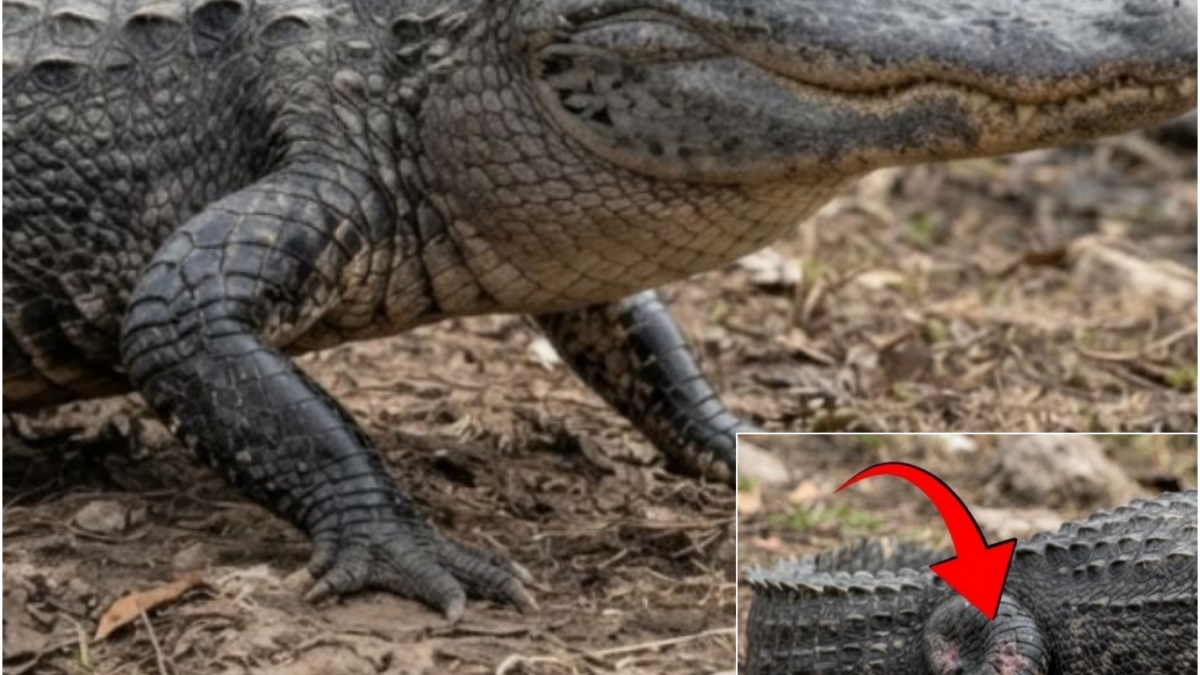
In 2022, deep in the marshes surrounding Lake Okachchobee, a hidden camera recorded something that looked ordinary for only a few seconds.
A mother alligator emerged from the vegetation with a small baby gently held between her jaws.
She was moving toward the water, carrying her young the way an alligator mother sometimes does, but then something went wrong.
Her massive body dropped into the mud. She struggled upright and continued forward, only to collapse again.
She repeated the same exhausting movement until she finally came close enough to the camera for the truth to become visible.
She was missing both legs on one side of her body. What happened to her was only the beginning.
Across Florida, wildlife cameras were recording alligators with missing tails, damaged pelvises, broken teeth, and severe injuries that should have made survival almost impossible.
At first, there seemed to be several obvious suspects. Boats, cars, invasive Burmese pythons, and even people could potentially explain some of the injuries.
But the more scientists looked, the stranger the pattern became. These animals were not simply disappearing.
They were surviving, healing, growing larger, and returning to the water. Somewhere in Florida, a predator was attacking one of the most powerful reptiles in North America.
But what happens when the predator everyone suspects is not actually responsible, and the real answer is hiding in the alligators themselves?
The first clue was the mother near Lake Okachchobee. The hidden camera had captured around 10 minutes of her journey through the marsh.
At first, anyone watching the footage might have assumed they were witnessing a completely ordinary moment.
A mother was carrying her baby toward the water. The young alligator was held carefully between her jaws, protected as she moved through the vegetation.
Then the mother collapsed. Her body sank into the mud. For a moment, she appeared unable to move.
Then she pushed herself upward and continued. A few steps later, she fell again. When she finally came close enough to the camera, the reason became clear.
Both of her legs were gone. That discovery led experts to examine other alligators across Florida, and what they found was difficult to ignore.
Some were missing parts of their tails. Others had badly damaged pelvises. Some of the largest animals had surprisingly few teeth remaining.
These were not small predators struggling to survive their first year. They were enormous American alligators.
Animals that can dominate the shallow waters of Florida were somehow carrying injuries that looked as though they had been produced by something almost as powerful as themselves.
The obvious question was what could do this. Florida has no shortage of things capable of injuring a large reptile.
Speeding boats can strike animals near the surface. Cars can collide with alligators crossing roads.
And then there were Burmese pythons, an invasive species that had already transformed parts of the Everglades.
At first, the python seemed like the perfect suspect. Burmese pythons are not venomous, but they are powerful constrictors.
Once they seize prey, they wrap their bodies around it and tighten their grip. The pressure can become overwhelming for the animal caught inside the coils.
An alligator may have thick skin and powerful muscles, but that does not mean every part of its body is equally protected.
Its legs can be vulnerable. Its tail can be vulnerable. And if a large snake managed to wrap itself around one of those areas, the resulting force could cause severe damage.
There was even an extraordinary case from 2005 that demonstrated just how far the relationship between the two species could go.
A Burmese python roughly 13 ft long was found dead with its belly split open.
Inside was a roughly 6 ft American alligator that the python had apparently attempted to swallow.
The encounter showed that a Burmese python was capable of treating an alligator as prey.
But something about the injured alligators did not fit. A python attacks because it needs food.
It does not normally bite an alligator’s legs, tail, or other vulnerable areas simply to injure the animal before abandoning it.
The strange pattern suggested that something else was happening. Then attention shifted to another possible predator.
The river otter. At first, the idea seemed almost absurd. River otters are small compared with adult alligators.
They have rounded faces and often appear almost playful as they move around lakes and rivers.
But appearances can be misleading. An otter is a genuine predator. It is fast, strong, and equipped with extremely sharp teeth.
There are documented cases of otters attacking animals much larger than themselves. At Lake Woodruff National Wildlife Refuge, Jeff Walsh captured footage of a river otter charging a young alligator, biting it behind the head, wrestling it underwater, and dragging it toward shore.
So an otter could certainly cause trouble for a young alligator. But the injured animals being found across Florida were not all juveniles.
Some were enormous adults. Against a fully grown American alligator, an otter simply did not possess the size and strength necessary to explain the pattern.
The list of suspects was becoming shorter. Then came another possibility. Humans. Boats could explain certain injuries.
Cars could explain others. People could potentially cause harm in many different ways. But alligators are protected by strict regulations, making deliberate human attacks an incomplete explanation for the widespread pattern.
There had to be another answer. Scientists returned to the evidence left behind by the injuries.
They examined bite marks. They compared damaged limbs. They studied wounds and the locations where encounters had taken place.
And eventually, an uncomfortable possibility became increasingly difficult to ignore. The predator might be another alligator.
American alligators can be cannibalistic. Larger individuals may hunt smaller alligators and consume them. James Nifong, an expert with the US Army Engineer Research and Development Center, has explained that adult alligators eat younger alligators more frequently than many other large reptiles.
To a large adult, a young alligator can simply be another source of food. That changes the entire story.
The injuries were not necessarily evidence of some mysterious creature attacking Florida’s apex predator. They could be evidence of alligators fighting each other.
And these fights can become extremely violent. Alligators may attack their own kind while competing for territory, during breeding season, or when one animal refuses to leave an area controlled by another.
Even sleeping does not necessarily make an alligator completely vulnerable. A 2021 study from Australia’s La Trobe University, published in the Journal of Experimental Biology, found evidence that crocodilians can rest with one half of the brain while the other remains alert.
That means an alligator can appear to be resting while remaining capable of responding rapidly to movement nearby.
Another animal brushing against its tail could be enough to trigger a reaction. The resting animal can open its eyes and strike almost instantly.
That makes an alligator’s territory a dangerous place for another alligator. But there is something important about the animal’s bite that many people misunderstand.
An American alligator has an extraordinarily powerful bite, roughly three times stronger than that of a lion according to the source material.
Its jaws are among the most powerful in the animal kingdom. But the teeth are not designed like knives.
They are mostly cone shaped and designed to grip, hold, and lock onto prey. An alligator can also replace thousands of teeth throughout its lifetime, with estimates reaching around 3,000 teeth over the course of its life.
So a broken tooth is not necessarily a permanent problem. But if an alligator bites another alligator’s leg, what actually causes such severe injuries?
The answer is the death roll. When one alligator clamps onto another animal, the victim may instinctively pull backward.
The attacker does not release its grip. Instead, the jaws act almost like a locking mechanism.
The alligator then twists its entire body. Its tail swings. Its body rotates. The animal being held is pulled in one direction while the attacking alligator rotates in another.
In experiments with juvenile alligators, that rotation has been measured at roughly 1.6 revolutions per second.
At that speed, the jaws do not need to slice through anything. They simply have to hold on.
The twisting force does the reSt. Skin can withstand an enormous amount of pressure, but joints, ligaments, and soft tissue are not designed to tolerate the entire body of another large animal twisting against them.
If the bite lands on a leg, the base of the tail, or another vulnerable area, a few seconds of struggling can create an injury that permanently changes the animal’s life.
And the death roll is not used only when an alligator is feeding. Crocodilians also use the movement during fights with members of their own species.
That is where territorial disputes become especially dangerous. Imagine a large male alligator controlling a stretch of water.
The area contains enough fish. There is a sunny shoreline where the animal can bask.
The water is deep enough to provide protection. And during breeding season, females pass through the area.
The territory is valuable. Then another male appears. At first, neither animal needs to attack.
They can raise their heads above the water. They can bellow. They can move closer.
They can measure each other. For an alligator, size matters enormously. A smaller animal has every reason to turn away.
If it does not, the encounter can change in seconds. During breeding season, males move around more and become more territorial.
An animal that might otherwise avoid confrontation may suddenly defend a stretch of water. The first bite may be intended only as a warning.
But if it lands on a leg and the larger animal begins to twist, the smaller alligator can quickly become unable to fight.
At that point, the situation changes again. The animal that was once an intruder can become prey.
An alligator does not need to hate another alligator to eat it. It simply needs an opportunity.
Florida provides plenty of food. Fish are abundant. Turtles, birds, snakes, and small mammals move through the wetlands.
Invasive species have also created new sources of food. But an injured alligator lying helplessly in front of a larger one represents an easy opportunity.
Data from Orange Lake suggests that this behavior is not rare enough to dismiss. Researchers examined 267 stomachs from large alligators and found tags from juveniles in roughly 12 percent of the samples.
Modeling suggested that cannibalism could remove around 6 to 7 percent of juveniles each year in that population.
Smaller alligators may remain vulnerable to larger members of their own species until they reach around 6 to 8 years old.
So the marsh is not simply a place where alligators hunt fish. It is also a place where young alligators must avoid older ones.
But that still leaves the strangest part of the story. If these animals are constantly fighting one another, why do so many injured survivors continue to grow?
Why does the three legged alligator near Lake Okachchobee look as though it is struggling on land while still managing to survive?
The answer becomes obvious once the animal reaches water. On land, the injured alligator looks vulnerable.
Its body drops toward the ground with each step. It braces itself on the remaining legs.
It drags its body forward. Then it stops. Watching that movement gives the impression that the animal cannot possibly survive for long.
But the moment it enters the water, the story changes. The heavy body becomes almost weightless.
The animal begins to glide. Its tail moves from side to side. The water supports its body.
The tail provides the main force driving it forward. In an alligator, the tail can account for nearly 28 percent of total body mass.
The four legs help with movement and steering, but the tail is the main engine for swimming.
That means losing a leg does not necessarily prevent an alligator from hunting. It can still move through the water.
It can still wait beneath the surface. It can still launch toward prey. It can still feed.
It can still survive. The missing leg changes how the animal moves across land, but it does not remove every tool the animal needs.
Then there is another remarkable part of crocodilian survival. Healing. A missing leg is permanent.
An alligator cannot simply grow a new adult leg. But its body is remarkably capable of recovering from serious injuries.
Researchers have repeatedly encountered crocodilians that lost parts of their limbs long ago and survived with healed injuries.
Young animals have even shown the ability to regenerate sections of their tails. The regenerated portion does not look exactly like the original.
But in specimens that have been examined, regenerated sections can equal roughly 6 to 18 percent of the animal’s total body length.
The teeth are even easier to replace. An alligator can lose one and eventually replace it.
Over a lifetime, it may cycle through around 3,000 teeth. That creates an unusual survival system.
A broken tooth can be replaced. A damaged tail can partially regenerate while the animal is young.
A missing leg cannot return, but the animal can adapt to life without it. That ability to adapt may explain why the marshes contain animals that look heavily scarred while still appearing large and healthy.
But the alligator’s relationship with the rest of the ecosystem is even more complicated. One scene seems almost impossible at firSt.
A capybara approaches the edge of a body of water. Only a few feet away, several caimans lie completely still.
The capybara does not appear frightened. In some cases, capybaras have even been observed sitting directly on crocodilians without an attack taking place.
The capybara is the largest rodent in the world. A fully grown adult can weigh between 130 and 150 lb.
It has no special weapon designed to fight crocodilians. It has no powerful claws capable of matching a large predator.
Yet capybaras can live alongside caimans and black caimans. That does not mean crocodilians never eat them.
When the opportunity is right and food is needed, a crocodilian can prey on a capybara.
But an attack requires an opportunity. The predator must approach. It must chase or ambush the animal.
It may need to struggle with it in the water. Capybaras usually remain in groups and often stay near the shoreline.
If a crocodilian is not hungry or has no reason to attack, there may be no benefit in starting a confrontation.
The animals can simply share the same water. One proposed explanation has involved the capybara’s unusual diet and behavior.
Capybaras consume large quantities of vegetation and practice coprophagy, meaning they reingest some of their own feces to absorb additional nutrients.
Their droppings contain organic material that other organisms can use. However, the idea that crocodilians regularly wait for capybara droppings as an alternative food source should be treated cautiously.
There is not strong evidence establishing that this is a widespread feeding mechanism among crocodiles or caimans.
The more important lesson is simpler. Not every crocodilian sitting beside another species is preparing to attack.
Sometimes animals share the same water because neither has a reason to fight. The same principle applies to members of their own species, although the consequences can be very different when territory or food is involved.
And this behavior is not limited to Florida. Across the world, crocodilians have been documented consuming members of their own kind.
In northern Australia, giant saltwater crocodiles eat fish, birds, and mammals, but the Australian Museum also confirms that they eat smaller crocodiles.
Even freshwater crocodiles have displayed similar behavior, with larger individuals sometimes consuming hatchlings. For a young crocodile in Australia, an adult of its own species can therefore represent another threat in an already dangerous environment.
One particularly clear example occurred on the 7th of March, 2023, on India’s Gerwa River.
An adult mugger crocodile noticed a subadult crocodile basking on a log near the riverbank.
The larger crocodile approached. It ambushed the smaller animal and dragged it into the river.
Then it began rotating its body. The death roll. The same movement used by crocodilians when breaking prey into manageable pieces.
Afterward, the larger crocodile dragged the smaller animal toward shallow water and swallowed it head firSt.
The encounter demonstrated the entire process that Florida researchers often see only through the aftermath.
A missing limb. A damaged tail. An injured animal somehow continuing to swim. In Guyana, the evidence is even more striking.
Researchers examined the stomach contents of 36 adult black caimans. Among the largest animals, reptiles accounted for roughly 24.6 percent of dietary importance.
The reptiles were not an unrelated species. They were other black caimans. Five males in the sample showed evidence of cannibalism.
That means the idea of one crocodilian consuming another is not some isolated curiosity. It appears in multiple species and multiple regions.
Back in Florida, territorial disputes can also force an alligator to move. Imagine being a smaller animal pushed out of a familiar stretch of water by a larger male.
Remaining could mean another confrontation. Leaving becomes the safer option. The alligator swims through a canal.
It climbs onto land. It searches for another body of water. But modern Florida is no longer one uninterrupted wetland.
The animal might encounter a road. A neighborhood. A golf course. A drainage canal. Or a retention pond behind someone’s home.
That is where the ancient behavior of an alligator meets the modern landscape of Florida.
Breeding season can increase movement. Changing water levels can also force animals to search for new habitat.
Not every nuisance alligator has been pushed out by another male, but territorial pressure is one factor that can contribute to movement.
Eventually, some animals end up too close to people. Florida removes around 8,000 nuisance alligators each year.
The Florida Fish and Wildlife Conservation Commission operates a dedicated hotline and a network of trappers to respond to animals that move too close to homes, pets, people, or property.
That creates another difficult question. Why not simply capture the alligator and release it somewhere deep in the Everglades?
The answer is that an apparently empty wetland may already be occupied. Resident alligators have territories.
They have feeding areas. They have established social hierarchies. A newcomer does not know the landscape.
It may be pushed away from feeding areas. It may wander into another territory. It may immediately encounter another aggressive alligator.
The Florida Fish and Wildlife Conservation Commission warns that relocation can create stress, produce conflicts with resident wildlife, or cause an animal to leave the release location and continue wandering.
So the problem becomes more complicated than simply moving an animal from one place to another.
Florida also maintains a regulated alligator harveSt. Since 1988, the state has operated a management program involving individual units and carefully calculated quotas.
The goal is to regulate removal without causing long term damage to the population. And that brings the story back to where it began.
Because Florida’s relationship with alligators was once very different. There was a time when the species needed protection because its numbers had fallen dangerously low.
Today, around 1.3 million alligators live across the state. People now see them in lakes, canals, retention ponds, and waterways surprisingly close to their homes.
The success of the species creates a new problem. How does a state protect an animal that has recovered while also protecting people who increasingly live beside it?
The answer becomes even more complicated when you look at the Everglades. Imagine the end of the dry season.
Water retreats from enormous areas of marsh. Fish become concentrated in shrinking pools. Turtles and other aquatic animals search for whatever water remains.
The landscape appears to be drying out. But in the middle of that changing environment are deeper pockets of water.
Alligators create them. Using their feet, snouts, and the weight of their bodies, they clear mud and vegetation and maintain deeper areas around themselves.
These places become alligator ponds. As the surrounding marsh dries, fish become concentrated inside them.
A data set covering 1997 to 2022 found that fish catch per unit of sampling effort in alligator ponds increased by as much as 12 times as the surrounding marsh dried.
The predator creates a place where prey can gather. The prey gathers because water remains.
The alligator then uses that same water as a hunting ground. It is a strange ecological relationship.
The animal waiting for its next meal is also helping maintain one of the places where other animals can survive the dry season.
And the effects extend beyond fish. In 2023, researchers surveyed 10 alligator ponds in Shark River Slough and Taylor Slough.
They found that alligator activity created three distinct habitat types. There was the surrounding marsh.
There was a dense ring of vegetation around the pond. And there was the deeper water in the center.
These areas differed in phosphorus levels, algae, plant life, and aquatic animal communities. The alligators were not simply living in the landscape.
They were modifying it. Another study examined 48 alligator holes in Water Conservation Area Three.
Researchers divided them into shrub holes, marsh holes, and cattail holes. With the exception of cattail holes, these sites showed greater vascular plant richness than the surrounding marsh.
Shrub holes showed the highest diversity. The animal that people often view only as a dangerous predator was also functioning as an ecosystem engineer.
That does not make an alligator harmless. It does not mean people should approach one.
It does not erase the very real risks associated with living near a large predator.
But it changes the story. The three legged alligator near Lake Okachchobee was not simply a damaged animal struggling through the mud.
It was part of a much larger system. Its missing leg could have been connected to territorial fighting.
That fighting could have been connected to breeding season. The injuries could reflect cannibalism. Its survival could be explained by the importance of its tail and its ability to function effectively in water.
Its healing could reflect the remarkable biology of crocodilians. And its existence in Florida could also be connected to a much larger ecological recovery.
The same species that people once feared losing is now numerous enough to create conflicts with roads, neighborhoods, pets, and backyards.
That is the strange paradox of the American alligator. Florida once had to protect it because there were too few.
Now Florida has to manage it because there are so many. And the answer is not as simple as removing every animal that comes close to people.
The Everglades depends on the ecological role alligators play. Their ponds provide refuge during dry periods.
Their activity changes vegetation patterns. Their presence influences other animals. Their feeding behavior affects populations throughout the wetlands.
Even their conflicts with one another are part of the natural system. The scarred animals seen in the marsh are therefore more than survivors of violent encounters.
They are evidence of a species adapting to its environment in ways that can be difficult for humans to understand.
A missing leg does not necessarily mean the end of an alligator’s life. A broken tooth does not necessarily prevent it from eating.
A damaged tail does not necessarily prevent it from swimming. And a confrontation with another alligator does not always end with one animal disappearing from the ecosystem.
Sometimes the smaller animal survives. Sometimes it leaves. Sometimes it finds another pond. Sometimes it carries the injury for the rest of its life.
And sometimes, like the mother captured by the hidden camera in 2022, it keeps moving through the mud because something else matters more.
Her baby was in her jaws. The water was ahead. She fell. She pushed herself back up.
She fell again. Then she kept going. From the camera’s perspective, it looked like a story about an animal that had lost too much and somehow continued anyway.
But when scientists looked deeper, the missing limbs became part of a much larger story about Florida itself.
A story about predators. A story about territory. A story about survival. A story about an ecosystem that can be both brutal and remarkably resilient.
And perhaps most importantly, a story about coexistence. Florida does not have to choose between people and alligators as though only one can exiSt.
The challenge is finding ways for people to keep a safe distance from an animal that belongs in the wetlands, while protecting the wetlands that depend on that animal.
Because the three legged alligator in the mud is not an exception to the natural world.
It is a reminder of how powerful adaptation can be. The animal struggled across land.
Then it entered the water. The struggle changed. The tail began moving. The body began gliding.
The marsh opened around it. And somewhere beneath the surface, the same animal that looked vulnerable on land was once again a predator capable of continuing its place in one of the most complicated ecosystems in North America.
That is what makes the story of Florida’s alligators so difficult to reduce to a simple battle between predator and prey.
The alligator is the predator. The alligator is sometimes the prey. The alligator can be an ecosystem engineer.
The alligator can be a nuisance. The alligator can be a survivor. And the alligator can be its own greatest threat.
The missing legs, broken teeth, damaged tails, and scarred bodies are not signs that the species has somehow become weak.
They are evidence that the struggle never really stops. The marsh changes. Water levels rise and fall.
Males compete. Young animals grow. Predators move. People build closer to wetlands. And through all of it, the alligator continues doing what it has done for millions of years.
It adapts. It waits. It moves through the water. And when the dry season comes, it creates a pond where there might otherwise be nothing but mud.
That may be the most surprising discovery of all. The animal that looks like a threat from the surface can also be part of what keeps the ecosystem alive beneath it.
And the next time someone sees a scarred alligator moving slowly through a Florida marsh, there may be far more behind that injury than meets the eye.
Disclaimer: This content may be created by Al for entertainment purposes. Any resemblance to real persons, events, or places is coincidental.








