They Went Camping in an Empty Cabin, What Happened That Night Was Terrifying
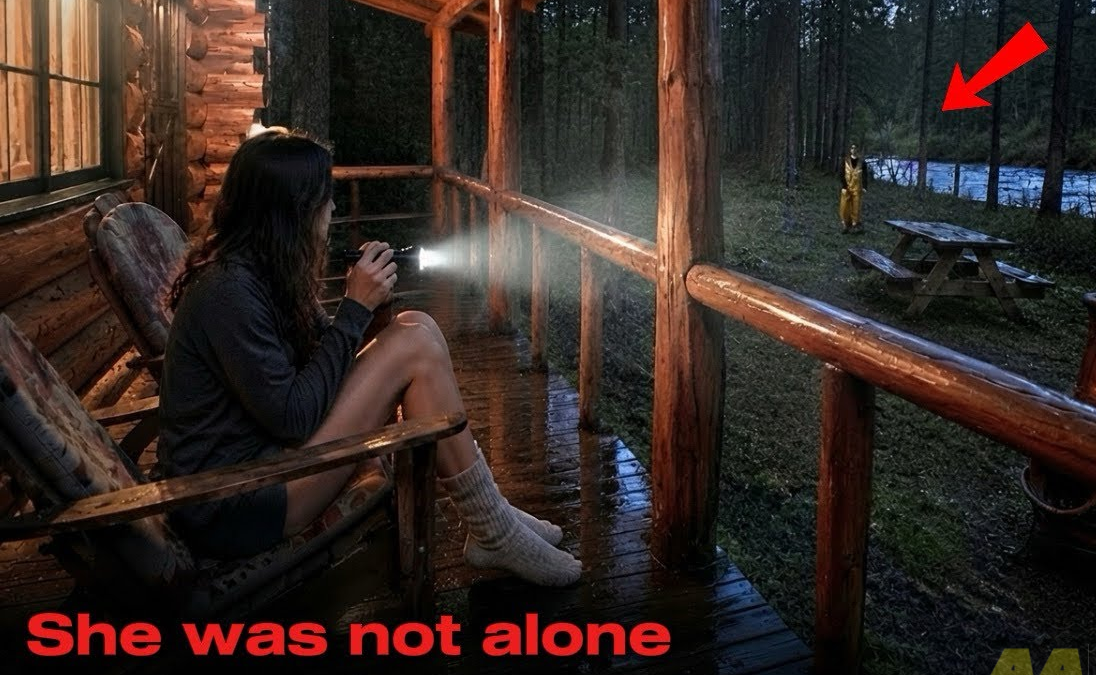
I was thirty miles into a solo backpacking trip when the storm finally came for me.
For two hours, I had watched the sky change over the mountains of West Virginia, telling myself I still had time.
The clouds had been gathering beyond the ridgeline, darkening by degrees, but mountain weather has a way of making distance meaningless.
One minute the horizon can look harmless, and the next, rain is falling so hard that the trail seems to disappear beneath your boots.
By mid afternoon, I was soaked through. The temperature had dropped faster than I expected, and every step made the problem more obvious.
I needed shelter, and I needed it soon. That was when I saw the cabin.
It stood about thirty meters beyond the trail, hidden among the trees. It was small, dark timber beneath a metal roof, with a covered porch and a single step.
It looked old enough that the forest seemed to have grown around it rather than beside it.
I told myself I would only check the door. It was unlocked. Inside was one room, a wooden bunk, a small table, and a rusted stove.
Nothing seemed unusual until I turned toward the door and noticed the latch. It was on the outside.
There was no handle on the inside, no interior latch, and no way to secure the door from where I stood.
Then I noticed the scratches low on the wall beside me. I stood there listening to rain hammer the metal roof, looking at those marks and wondering why anyone would build a cabin where the person inside could not control the door, and what exactly had once been kept behind it?
I put my jacket back on and stepped outside. The storm followed me through the trees.
I had been walking since early morning, and by the time the rain became heavy, I was already thirty miles into the trip.
My original plan had been simple. Keep moving until I reached the next suitable place to camp, find a reasonably dry patch of ground, set up my shelter, make something warm, and wait for the weather to pass.
That plan had depended on the weather behaving approximately the way the forecast had suggested.
It did not. The mountains had been changing the weather around me all afternoon. Clouds gathered in valleys and disappeared over ridges.
Wind moved through the trees in waves. Rain would begin for several minutes, weaken, and then return harder than before.
I had been watching the sky for almost two hours. At first, I thought I had plenty of time.
Then the temperature dropped. That was what changed my thinking. Rain by itself was manageable.
I had rain gear, and I knew how to hike through wet conditions. But being wet while the temperature continued falling was different.
I began thinking about shelter in a more urgent way. Not the comfortable kind of shelter you imagine when you have an entire afternoon to choose a campsite.
The other kind. The kind where you start looking at every structure, every dense cluster of trees, and every patch of ground with the same question in your mind.
Can I stay here until this passes? That was when the cabin appeared. It was only about thirty meters from the trail, but it had been hidden well enough that I had not noticed it earlier.
The trees opened slightly, and there it was. Small. Dark. Old. The metal roof reflected almost no light beneath the clouds.
I walked toward it. The porch was covered, which immediately made the structure seem more inviting.
The door looked intact. There were no obvious signs of damage. Nothing about the outside suggested that entering would be a bad idea.
I reached for the door. It opened. Of course it opened. That thought came back to me later because there was something strangely ordinary about the moment.
An unlocked door in an old cabin seemed like a good thing when you were standing in the rain.
I stepped inside. The room contained exactly what I expected. A wooden bunk stood against the far wall.
A small table sat nearby. There was a rusted stove in one corner. The air smelled old and closed in, the way structures smell when they have been sealed away from fresh air for a long time.
Nothing alarming. Nothing unusual. I pulled off my wet jacket. Then I looked back at the door.
I had pushed it open without thinking about how it worked. Now that I was standing inside, I examined it more carefully.
The latch was on the exterior. It was a simple drop latch. It could be operated from outside, but not from inside.
There was no handle on the interior side. No way to lock the door from where I stood.
No way to secure it. I stared at it. The storm continued pounding the metal roof.
Then I noticed something else. Low on the wall beside the door were scratches. They were irregular marks, not words and not patterns.
They looked like the sort of marks that might be made by fingers or nails repeatedly dragging across the same surface.
They were low enough that they immediately seemed strange. I walked closer. There were more than I had first noticed.
Some were faint. Some were deeper. None formed anything I could understand. I stood there for a long time.
The rain outside was heavy enough that leaving meant getting soaked again. Staying meant remaining inside a cabin where the only way to secure the door was from the outside.
I put my jacket back on. Then I stepped outside. I walked another thirty meters into the forest and found a dense stand of spruce trees.
They did not provide perfect shelter, but they blocked some of the wind and gave me enough protection to wait.
I spent the next four hours there. I was cold. I was wet. I was uncomfortable.
But I was not afraid. There is a difference between being uncomfortable and believing something is wrong.
That cabin had given me a feeling I could not explain, but I did not need to explain it to make a decision.
The exterior latch was enough. The scratches were enough. The fact that I could not control the door from inside was enough.
So I waited beneath the spruce trees until the storm passed. I continued my trip afterward.
But I kept thinking about that cabin. Years later, I still think about it. The question is not whether the cabin was dangerous.
I have no proof that it was. The question is why someone had built a door that could only be secured from outside.
Was it meant to keep something inside? Or was it meant to keep someone outside?
I was not the only person to find a cabin that seemed to have a story of its own.
My friend Youssef and I found ours on the second day of a four day trip.
We had not planned to look for a cabin. We had actually come off the marked trail because we wanted to find a better campsite for the night.
The afternoon light was fading through the trees when we noticed something metallic ahead. At first, we thought it might be a roof.
Then we saw the structure. It was about fifty meters away, partially hidden by trees.
Youssef immediately wanted to investigate. I was less enthusiastic. But when you hike with someone long enough, you learn that curiosity is contagious.
I followed him. The cabin was small and old. The door was unlocked. Inside was a single room with a bunk, a table, and a small stove.
Nothing looked unusual. Youssef walked toward the stove. Then he stopped. He looked at me.
“The stove is warm.” I thought he was mistaken. I crossed the room and held my hand near it.
He was right. It was not hot. It had not been recently lit. But it was warm in the unmistakable way of something that had held heat for several hours.
Someone had used that stove that morning or early that afternoon. We looked around. There was no backpack.
No jacket. No food. No sleeping bag. No equipment. No personal belongings. Nothing. The cabin was empty.
But the stove was warm. I began looking more carefully. That was when I noticed the table.
There was a thin layer of dust across its surface, except for one spot. A circular ring had been left in the duSt.
It was perfectly clear. It looked like someone had placed a cup or mug there and left it long enough to disturb the duSt.
Someone had been sitting at that table. Someone had been drinking something. Someone had used the stove.
And then that person had left. We had not passed anyone on the trail. We had not heard anyone moving nearby.
There was no sign of where they had gone. Nothing dramatic happened. That is what I remember most clearly.
There was no sudden noise. No mysterious figure appeared in the doorway. Nothing moved. Youssef and I simply looked at each other across the room.
The warm stove sat between us. The circular mark remained in the duSt. We both understood the same thing at the same time.
Someone had been here recently. And we did not know where they had gone. Without saying anything, we picked up our packs.
We walked outside. Then we kept walking. We eventually camped two miles farther than we had originally planned.
Only after we were settled did Youssef mention the cabin again. He looked across the campsite and said, “Whoever was in there did not want to be seen.”
I remember the exact way he said it. Not dramatically. Not as a joke. Just quietly.
I asked what made him think that. He did not answer. Maybe the person had heard us coming.
Maybe they had simply left before we arrived. Maybe the warm stove had a completely ordinary explanation.
Maybe someone had been nearby and had no reason to announce themselves. But there was another possibility that stayed with me.
What if whoever had been there had seen us first? Two years later, I still think about that afternoon.
Not because I believe the cabin contained anything extraordinary. I do not know what was there.
I only know what we found. A warm stove. A ring in the duSt. An empty room.
And the unmistakable feeling that someone had been there shortly before us. The third account came from someone who approached the entire situation from a completely different perspective.
She was a science teacher. She had spent twenty years teaching teenagers to think critically, question assumptions, and demand evidence before accepting an explanation.
She did not believe in anything supernatural. She said that herself before describing what happened to her.
October 2023. A solo trip in the Nantahala. Three nights. She had completed the section before and knew the area well.
On the second evening, the temperature dropped faster than she expected. She realized she was underdressed for the night ahead.
Her sleeping gear was rated for warmer temperatures. She was not facing an immediate emergency, but she was uncomfortable enough to begin looking for somewhere better protected from the cold.
That was when she saw the cabin. It was not locked. It did not look threatening from outside.
She opened the door. The interior was familiar. One room. A bunk. A table. A cold stove.
Then she noticed something in the far corner. It was covered by a canvas tarp.
The tarp was old green canvas, similar to the material found on military surplus equipment.
Whatever it covered was not enormous. The shape appeared to be about the size of a person sitting cross legged on the floor.
She stood in the doorway looking at it. She could have walked over. She could have pulled the tarp away.
She could have found out what was underneath. She did not. She later admitted that she had asked herself many times why she had not lifted it.
Her answer never changed. Something inside her simply did not want to know badly enough to find out.
Instead, she set up her sleeping bag on the bunk. She cooked food on her own camp stove.
She did not use the cabin stove. She read by headlamp. Eventually, she turned the light off.
The cabin became dark. The tarp remained in the corner. At some point during the night, she woke up.
The first thing she did was look toward the corner. The tarp had not moved.
It was exactly where she remembered it. But the shape underneath was different. She was certain of it.
She knew what the object had looked like when she went to sleep. Now it had a different configuration.
She remained on the bunk until first light. She did not investigate. She did not touch the tarp.
She waited. When morning came, she packed her bag, gathered her gear, and walked out.
She never lifted the tarp. She later told her husband and two close friends what had happened.
Every one of them asked the same question. Why did you not look underneath? Her answer was always the same.
“Because whatever was under it already knew I was there.” That sentence stayed with her.
She did not know what the object was. She did not know whether the shape had actually changed.
She did not know whether there was an ordinary explanation. She only knew what she remembered seeing.
A canvas tarp. A shape beneath it. One configuration before sleep. Another configuration after waking.
And a decision not to investigate. Three cabins. Three encounters. Three people who entered structures in the wilderness because they seemed useful, ordinary, or simply worth checking.
The first found a door that could only be controlled from outside. The second found evidence that someone had recently been inside.
The third found a covered shape she chose not to investigate. None of those details automatically means something unusual was happening.
Old cabins can have strange construction. People can leave without being noticed. Dust can preserve the shape of a cup.
Objects beneath tarps can look different depending on shadows and perspective. There are ordinary explanations for many things encountered in remote places.
But there is one lesson that connects all three experiences. Pay attention before you step inside.
The first thing to inspect is the door. Look at the latch. Look at which side it is mounted on.
Look for an interior handle. Check whether the door can actually be controlled from inside.
A door that can only be secured from outside tells you something about the structure.
It does not necessarily tell you why it was built that way. It does not prove what the cabin was used for.
But it is information. And information matters when you are alone in the backcountry. The next thing to notice is the ground around the entrance.
Look for disturbances. Look for drag marks. Look at the leaves, soil, and debris near the threshold.
A structure that has not been visited for a long time may have a layer of undisturbed debris around its entrance.
A structure that has been used recently may show something different. Again, none of this automatically means anything unusual.
It simply tells you whether the building has been recently disturbed. Then there is the third detail.
If something is covered, leave it covered. You do not know why it was covered.
You do not know who placed the covering there. You do not know whether what is underneath is useful, harmless, broken, personal, or simply something somebody wanted protected from the weather.
There is rarely a good reason for a stranger in the wilderness to start uncovering objects that do not belong to them.
The three people in these stories made different choices. The solo hiker walked back into the rain.
He spent four hours beneath spruce trees rather than staying inside a cabin with an exterior only latch.
Youssef and his hiking partner left an empty cabin with a warm stove and camped two miles farther away.
The science teacher stayed through the night with the tarp untouched, then packed her belongings and left at first light.
None of them discovered what they had imagined they might discover. None of them found an explanation.
They simply recognized that they had reached a point where curiosity was no longer worth the uncertainty.
That may be the most important lesson from all three accounts. When you are deep in the wilderness, you do not need to understand everything you encounter.
Sometimes you only need to notice enough to make a sensible choice. The mountains can hide structures for decades.
Weather can change faster than expected. A trail can lead somewhere you did not plan to go.
An old cabin can look abandoned while still carrying evidence of recent use. A stove can remain warm after its user has disappeared into the trees.
A cup can leave a ring in duSt. A tarp can cover something you do not recognize.
A door can have its only latch on the wrong side. None of those details tells the whole story.
But together, they can make you stop. And sometimes stopping is the smartest thing you can do.
The first hiker never found out why the scratches were there. Youssef never learned who had used the stove.
The science teacher never discovered what was beneath the tarp. Maybe there were simple answers waiting inside each cabin.
Maybe someone could have explained every detail. Maybe the cabins were nothing more than old structures with ordinary histories.
But there is another part of wilderness travel that experienced hikers understand. You do not always get answers.
Sometimes you get a choice. You can open the door. You can step inside. You can investigate.
Or you can look at the latch, look at the room, listen to the rain, and decide that you have already learned enough.
That is what happened to all three. They saw something that made them pause. They considered it.
Then they walked away. And perhaps the strangest thing about these stories is not what might have been inside those cabins.
It is how little anyone needed to know before deciding to leave.
Disclaimer: This content may be created by Al for entertainment purposes. Any resemblance to real persons, events, or places is coincidental.








