They Took Every Egg From the Chained Dragon — She Secretly Gave One Back
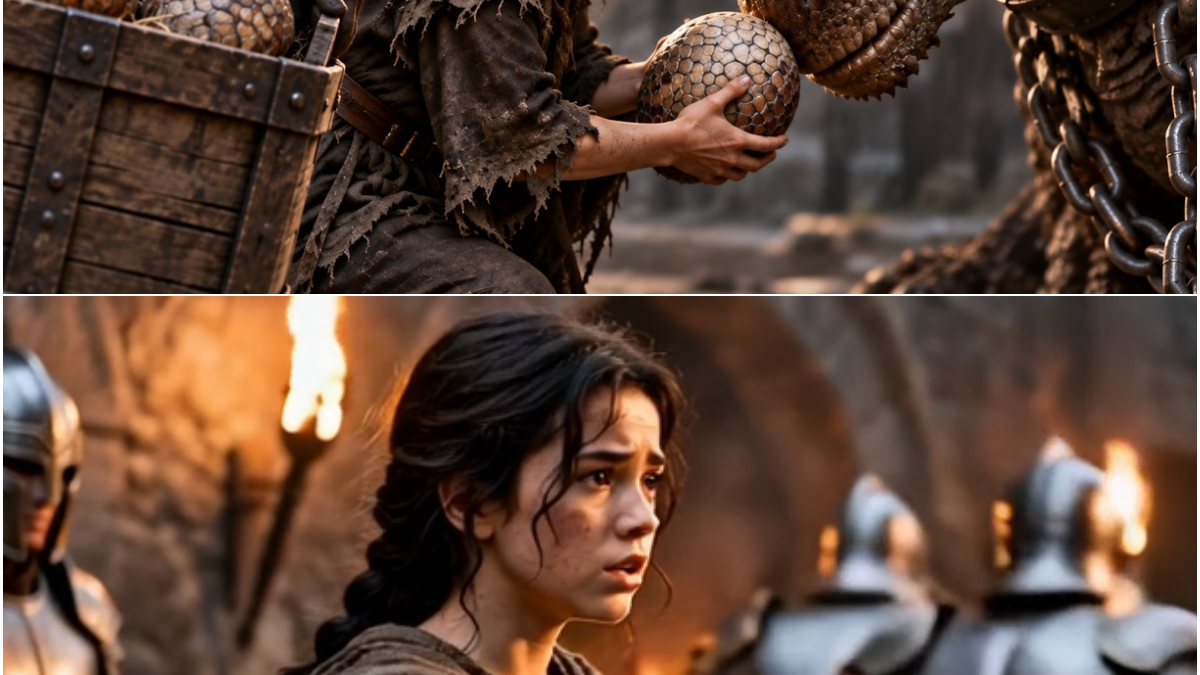
The first thing Kora learned about the dragon was that it could hear a lie through stone.
The second was that the men who owned the island had spent twenty years teaching themselves to lie louder.
At 2 in the morning, while the rest of the barracks breathed beneath rough wool blankets, Kora crossed the black sand with an egg tucked beneath her coat.
It was nearly as large as a sack of rye and warm enough to burn through the cloth.
Behind her, the chained mother watched from the hollow she had worn into the volcanic ground over twenty years.
Eight empty places marked where the other eggs had gone. Kora had stolen the ninth.
Not for herself. She had carried it twelve paces to the ash bin, buried it beneath cold clinker, worked eleven hours beside the vats, then waited until the bell before digging it out again.
Now she stood at the edge of the vent field, where the earth breathed heat through cracks in the basalt.
The dragon lifted her head. Pale amber eyes found Kora in the darkness. Kora expected rage.
Instead, the creature simply watched. There was something worse about that silence. It felt like judgment without anger, as though the enormous animal already knew why Kora had come and was waiting to see whether the human would understand what mattered.
Kora lowered the egg into the warm sand. “There,” she whispered. “That belongs to you?”
The dragon breathed across the field, and the sand shifted around Kora’s boots. Then the creature looked away.
Why would a chained dragon accept help from the very person who had helped the men take her eggs?
Kora would spend the next year finding out. Kelvin was an island made almost entirely of black stone, cold water, and heat that came from beneath the ground.
The Crown Works had been built there because nowhere else in the northern territories possessed such a deep vent field.
Even in winter, the sand above those vents stayed warm enough to preserve the dragon eggs.
The island’s value came from those eggs. The eggs became oil. The oil became medicine.
And the medicine was shipped to Averess, where physicians used it to treat a terrible winter lung sickness that had resisted every ordinary remedy for generations.
That was the reason written in official records. The reason spoken by wardens was simpler.
The eggs were worth a fortune. Kora had been on Kelvin four months when she first understood the difference.
Her sentence was twelve years, assigned at Aess after she had broken a sealed granary and moved eleven sacks of seed rye into nineteen village homes during a long froSt.
She had not stolen silver. She had not taken jewelry. She had taken grain that belonged to a lord because children in the village had nothing left to eat.
The magistrate had called it theft. Kora had called it arithmetic. The law had won.
So she arrived on Kelvin with a number written beside her name and spent every day making more numbers.
Eight eggs came into the rendering shed. Eight were cracked. Eight produced oil. Yet the Crown ledger always recorded seven.
At first Kora thought it was an error. Then she realized errors did not repeat for eleven seasons.
The first night she carried the ninth egg back to the dragon, she understood something else.
The dragon remembered. Not merely the taking. Everything. The chained creature had watched men enter her nesting hollow for twenty years.
She had watched wool lined creels carried away. She had watched eggs disappear. She had watched guards approach with hooks and smoke.
And still she had not forgotten that she was a mother. Kora had seen the dragon’s eye open when she entered the vent field.
She had expected teeth. She had found indifference. That indifference stayed with her for three nights.
On the fourth afternoon, she saw the egg again. It was sitting twenty feet above the tide line on a flat sheet of basalt.
The dragon had moved it. Kora knew because the ground around the nest was undisturbed.
She waited until the evening bell, then went down alone. The egg was cold. Frost had begun forming in the shallow grooves of its leathery shell.
Kora lifted it. “Why would you put it here?” The dragon watched from her hollow.
Kora carried the egg back toward the vents. She did not return it to the neSt.
Instead, she found a place where the ground was almost too hot to touch, dug two feet into the warm sand, placed the egg inside, covered it, and marked the place with three stones.
Then she sat there until the stars came out. The dragon watched the whole thing.
By morning, Kora’s hands were blistered. That was how she met Hesk. The physic hut smelled of vinegar, old tallow, and boiled herbs.
Hesk had been on Kelvin twenty one years. He was forty seven, narrow faced, gray at the temples, and always appeared to be listening to something no one else could hear.
He examined Kora’s hands. “Hot sand,” he said. “Vat splash.” “This isn’t a vat splash.”
Kora looked at him. Hesk continued wrapping her palms. “You will notice I haven’t asked what you were doing.”
“And you’ve noticed I haven’t answered.” For the first time, something almost resembling amusement touched his face.
“How long have you been here?” Kora asked. “Twenty one years this winter.” “I was told your contract was two.”
“It was.” “What kept you?” Hesk tied the linen. “At first, the work.” “And after that?”
He looked toward the small window. “After that, it became difficult to explain why I had stayed.”
Kora understood that answer. There were many kinds of cages. Some had bars. Some had paperwork.
Some were built from the things people convinced themselves they could not change. Hesk told her about the dragon’s collar later.
It was made from an ancient bronze alloy called Fentmark. Eighty feet of bronze chain ran from the collar to a ringbolt driven into the rock.
The dragon could reach the water, the vents, and her nest, but not the boatshed, the barracks, or the main yard.
The collar had another property. It could open only when the correct voice spoke the correct phrase.
Warden Soul had been given that authority decades earlier. Kora watched the process during the autumn maintenance.
Three braziers were placed forty paces upwind. The smoke was supposed to make the dragon sleep.
The creature recognized the smoke immediately. She rose. Dragged the chain. Lowered herself onto the sand.
Then became still. Soul approached with his brass rod. He struck the collar twice. “Ninth of the fell,” he said.
“Bronze hears you. Give.” The impossible happened. The bronze seam opened. Hesk moved quickly beneath it.
Kora saw the skin underneath. The collar had rubbed the dragon’s neck raw for years.
There was scar tissue, swelling, and an old straight edged mark beneath the bronze. “What is that?”
Kora asked. Hesk did not look up. “Someone tried to cut the collar eleven years ago.”
“Did it work?” “No.” “What happened?” Hesk packed the wound. “He learned not to try again.”
Kora looked at Soul. The warden stood with his brass rod beside the dragon. “Can anyone else open it?”
She asked. Hesk’s hands paused. “The phrase is not enough.” “What is?” “The voice.” Kora looked toward Soul.
Hesk nodded. “Fentmark work reads the throat. Not the tongue.” That information settled into Kora’s mind.
She kept it there. She had spent her life counting things. Grain. Sacks. Names. Promises.
Errors. Now she counted possibilities. The dragon tested her for nine weeks. The first test was a fish.
Kora traded two days of bread for it and carried it down to the vent field.
The dragon approached. Placed one claw on the fish. Pressed. Then turned away. Kora understood.
The next evening she went empty handed. She sat forty feet away. The dragon watched her.
Nothing happened. The next night Kora sat thirty feet away. Still nothing happened. Eventually she began talking.
She talked about the village. She talked about the mill. She talked about the old wheel that ran too fast in spring and too slowly in summer.
She talked about the grain sacks and the sound they made when they landed on the boards.
She talked about the courtroom in Aess. She talked about the twenty two names on the paper that had helped condemn her.
Most of all, she talked about the things she had never managed to say when anyone was listening.
The dragon never answered. But she listened. Then one night, Kora’s path was blocked by the dragon’s tail.
She stopped. “May I pass?” The tail moved three feet. Kora stared. Then walked through.
The third test came in the ninth week. The dragon dug beneath the three stones.
She uncovered the egg. Then carried it to Kora. She placed it in front of her.
Kora stared at it. It was warm. It was valuable. It was everything the Crown Works wanted.
The dragon stepped away. For a moment, Kora almost reached for it. Then she understood.
The creature was not offering the egg. She was asking what Kora would do with it.
Kora placed both hands on her knees. “No,” she said. The dragon watched. “I don’t want it.”
The great head lowered. “I never wanted the egg.” The dragon picked it up and carried it back to the warm ground.
Then she lay across the place where she had buried it. Kora remained seated until dawn.
From that morning onward, the dragon allowed her closer. Not close enough to touch. Close enough to belong.
That was when Ren noticed. Renfettle was nineteen, red haired, restless, and incapable of keeping anything to himself.
He caught Kora near the water butt. “You go out there every night.” “I sleep badly.”
“You don’t sleep at all.” Kora said nothing. “They give remission for information.” “Then tell them.”
He looked frightened by his own words. “I am only saying what Soul said.” Kora removed her boots.
She handed them to him. “They’ll fit you.” He stared at them. “They are yours.”
“I know.” “Why give them to me?” “Because your feet are bleeding through your clogs.”
He looked down. Kora walked away barefoot. Ren never reported her. Not then. The winter came.
The vats continued. The dragon’s eggs became oil. The Crown Works recorded seven. Kora recorded eight.
Hesk recorded nine whenever there was a reason to believe nine had existed. Nobody spoke openly.
Everyone knew something was wrong. Then Kora found the real numbers. It happened in the physic hut.
She was reconciling the vat book against the shed count. Eight eggs. Seven declared. One pint of oil from each.
Seven pints declared. Kora checked the stoneware jars. Eight had been filled. Then she checked the outgoing crates.
The missing oil had been leaving under Soul’s private mark. It had been happening for eleven seasons.
Kora calculated the amount. She calculated the value. Then she calculated what would happen if the physician’s hall at Aess discovered it.
Soul had not been protecting the Crown Works. He had been protecting himself. Kora sat with the book open on her knees.
Hesk watched her. “You found it,” he said. “Yes.” “I knew.” Kora looked up. “You knew?”
“I suspected.” “Why didn’t you tell anyone?” Hesk’s answer came quietly. “Because knowing is easier than acting.”
Kora closed the book. “You have been here twenty one years.” “Yes.” “You could have said something.”
“I could have.” “And you didn’t.” “No.” The silence between them lasted a long time.
Then Hesk said, “I am sorry.” Kora looked down at the book. She had heard apologies before.
Most were worth very little. This one sounded different. Not because it was grand. Because Hesk seemed to understand exactly how little it could repair.
The next spring brought two things. A letter from Aess. And trouble with the dragon.
The letter said a factor would arrive with the spring ship. His name was Omory Pel.
He would inspect the Crown ledger, the shed count, the vat book, and the stock.
Soul read the letter twice. Then he began rebuilding everything. The racks were repaired. The sheds were cleaned.
The physic hut was whitewashed. The private crates disappeared into the boatshed. Hesk spent more time at the dragon’s collar.
Kora saw the problem immediately. The dragon had stopped entering the water. She held her head at an angle.
Her breathing had changed. There was a catch in it. The collar wound had worsened.
Hesk examined it. “She needs the collar removed,” he said. “Can it be?” “You know the answer.”
Kora looked toward the vent field. “How long?” “Six months if the wound holds.” “And if it doesn’t?”
Hesk did not answer. Kora looked at the dragon. Then she counted. The egg had been buried for more than one hundred days.
“How long until it hatches?” Hesk looked at her. “About one hundred ten days.” Kora stared toward the neSt.
“And after?” “Nine days.” “Nine days for what?” “For the hatchling to become impossible to hide.”
Hesk lowered his voice. “It will cry. Loud enough for everyone on the island to hear.”
Kora looked back at the dragon. “Then I won’t hide it.” Hesk closed his eyes.
“What are you thinking?” “I am thinking about the collar.” He opened his eyes. “You want Soul to open it.”
“I want Pel to see it open.” Hesk understood. His hands began to tremble. “Kora.”
“The hatchling is the one thing Soul cannot pretend is another number.” The hatchling came on the sixth day.
Kora was repairing shingles on the shed roof when she heard the sound. A thin double note.
Up and down. Not a gull. Not a bird. Not anything she had ever heard before.
She climbed down. Ren was carrying a load of boards. He heard it too. He looked toward the vent field.
Then at Kora. She ran. The hatchling stood beside the warm sand. It was the size of a large hound, with a long neck, soft slate gray hide, folded wings, and feet far too large for its body.
It fell. Got up. Fell again. Then turned toward Kora. It walked directly to her.
Kora froze. The hatchling pushed its wet head against her shin. The dragon watched. Kora swallowed.
“What the shell hears,” she whispered. The mother lowered her head. Kora placed one hand against the hatchling’s neck.
“I have been talking too much.” The dragon’s breath moved through the grass. The hatchling made its double note.
Kora smiled. For the first time in years, she smiled without checking whether anyone was watching.
The spring ship arrived six days later. Factor Omory Pel came ashore with a clerk, a folding desk, and several books.
He was about fifty, small and dry faced, with a coat that had become worn at the cuffs.
Before removing his gloves, he asked for the Crown ledger. Then the shed count. Then the vat book.
Soul tried to redirect him. “You will want to see the stock firSt.” Pel looked at him.
“I have twelve stations to inspect. The stock will remain where it is.” Soul said nothing.
Pel opened the ledger. Kora watched from the racks. He was exactly the kind of man she needed.
Not kind. Not cruel. Interested in numbers. Interested in what was actually there. That evening Hesk brought Kora his private book.
Twenty one years of notes. Every treatment. Every collar examination. Every egg count. Every discrepancy he had been too afraid to report.
“I am giving this to Pel tomorrow,” he said. “You should.” “If I do, Soul is finished.”
“Yes.” “The station may close.” “Yes.” “And the oil will stop.” Kora looked at him.
“That is the part that frightens you.” “It should.” “It does not excuse the reSt.”
“No.” He placed his hand beside hers. “I know.” Neither moved. At first light, Kora carried the hatchling into the yard.
Ren saw her. “Kora?” She kept walking. The cook dropped a pan. Bosque came out of the guard house.
Pel stepped from the tally shed. The hatchling lifted its head. It made the double note.
Everyone stopped. Pel stared. “What is that?” “A hatchling,” Kora said. “There has not been one at this station.”
“I know.” Pel walked closer. “How long?” “Six days.” “Where is the mother?” Kora turned.
A low rolling sound came from the vent field. The hatchling twisted. Kora lowered it to the cinder.
It immediately began walking toward the sound. Pel raised his hand when Bosque moved to stop it.
“Let it go.” The hatchling crossed the black sand. It disappeared beneath the mother’s lower jaw.
Pel reached the rail. Then he saw the dragon’s neck. The dark wound beneath the bronze.
“What is wrong with her?” Hesk answered. “Rot beneath the collar.” “Can you treat it?”
“Not properly.” “What would you need?” “The collar opened.” Soul stepped forward. Pel looked at him.
Soul looked at the dragon. He had already understood. The hatchling was worth more alive than every egg he had taken.
The station had changed in an instant. “Brazers,” Soul said. Hesk looked at Kora. Kora looked back.
The plan had begun. The braziers were lit. The smoke drifted low across the sand.
The dragon rose. She dragged the chain. She stood. Then she lowered herself. Hesk approached with his tray.
Soul walked behind him. Kora remained near the rail. The warden lifted the brass rod.
He struck the bronze twice. “Ninth of the fell. Bronze hears you. Give.” The collar opened.
Hesk moved toward the wound. Soul turned toward the hatchling. “Take it.” The creature was beneath its mother’s jaw.
A boat hook reached in. The hatchling cried. The dragon moved. Soul shouted. The hatchling was pulled clear.
One of its wings caught on the hook. The thin membrane tore. The sound that came from the young creature was sharp enough to stop every person on the beach.
The mother rose. The smoke did nothing. Her eyes opened. Her chain rattled. Soul lifted the brass rod.
“Hold.” But the voice did not come. Kora shouted. “Here.” The hatchling turned. “Come here.”
It began moving toward her. Soul tried again. “Hold.” His voice broke. The dragon came forward.
The loose chain swept across the black sand. Soul stumbled. Kora ran toward the hatchling.
The dragon reached them firSt. She stopped. The great head lowered. Kora wrapped both arms around the hatchling.
The mother stood over them. Pel watched from the rail. Then he spoke. “Remove the collar.”
No one moved. Pel repeated himself. “Remove it.” Hesk stepped forward. Soul looked at him.
“You cannot.” Pel turned. “Why not?” Soul raised the brass rod. “Because I have the authority.”
Pel looked at the open bronze. Then at the wounded dragon. Then at the hatchling.
Then at Hesk. “Do you?” Hesk answered. “No.” Soul’s face changed. Pel nodded toward the collar.
“Take it off.” It took four people and nearly an hour. The bronze was heavy.
The wound beneath it was worse than anyone had understood. But the dragon remained still.
She seemed to know. When the collar finally came free, Hesk pressed both hands against the wound.
The dragon stood. She looked at Kora. Then at the hatchling. Then toward the sea.
She carried the young one down the beach. The water reached her feet. Then her knees.
Then her cheSt. The crooked wing opened. It worked. Not perfectly. But enough. She moved into the water.
Kora watched until the gray shape disappeared beyond the anchored ship. Nobody spoke. Pel returned to the tally shed.
He worked for two days. He compared the Crown ledger. The vat book. The shed count.
Hesk’s medical notes. The private crates. The numbers matched in exactly one direction. Soul had been taking the missing oil for eleven seasons.
Pel sealed the crates. He placed Soul under guard. Then he found Kora sitting on the shedstep.
“The station is closing,” he said. Kora looked at the empty vent field. “What happens to the sentence?”
Pel sat beside her. “It remains.” Kora nodded. “I thought it would.” “But I have authority to settle the remaining term here.”
She looked at him. “What does that mean?” “You remain on Kelvin for eleven years and three months.
You are free to move around the island. You may fish. You may build. You may take care of the place if you wish.”
“And after eleven years?” “We will see.” Kora looked at the sea. “Will the Crown come back?”
Pel considered the question. “I don’t think so.” “You sound uncertain.” “I am a man who deals in records.
Certainty is expensive.” Kora almost smiled. “What about Hesk?” Pel stood. “I have already asked him whether he intends to stay.”
“And?” “He has not answered.” Hesk stayed. So did Kora. So did Ren for another season.
Dun stayed. Eleven people remained on Kelvin. The Crown Works became something else. The vats stopped.
The racks were taken down. The boatshed became a storehouse. The old tally shed became a meeting room.
Hesk continued treating people. Kora kept records. Ren left on the summer ship and wrote back once from the mainland.
The dragon did not return. For a long time, Kora expected that to be the end.
Two years passed. Hesk became less afraid of speaking. Kora became less afraid of listening.
They built a second room beside the physic hut. They shared meals. They argued over numbers.
They repaired nets. They learned what freedom felt like when nobody had explained how to use it.
One evening, Hesk placed his hand against the back of Kora’s neck. She covered it with hers.
Neither said anything. Three years after the Crown Works closed, Kora went down to the vent field at first light.
She carried a bucket of rock cod. The sand had been disturbed. She stopped. There was a wide shallow trail leading from the water toward the warm ground.
Kora followed it. Then she found the hollows. One. Two. Three. She counted slowly. Four.
Five. Six. Seven. Eight. Nine. Ten. Eleven. Eleven round hollows beneath the hot sand. She crouched beside them.
The ground was warm. Very warm. She placed her palm against it. Nothing moved. She looked toward the sea.
Far beyond the tide line, something large disturbed the water. Then it disappeared. Kora remained there for a long time.
She had spent most of her life counting what had been taken. Sacks. Eggs. Years.
Names. Now she counted something different. Possibilities. She placed the bucket beside the warm sand.
Then she stood. “Hesk will want to know.” She started walking back. After ten steps, she stopped.
Looked over her shoulder. The sea was empty. The eleven hollows remained. Kora smiled. She did not mark them in the ledger.
She did not tell the others. She carried the fish home and said nothing. That evening, Hesk found her sitting outside the physic hut.
“You look pleased with yourself,” he said. “I found something.” “What?” Kora looked toward the dark line of the sea.
“Nothing certain.” Hesk sat beside her. “That’s a dangerous answer from you.” “I know.” He waited.
Kora leaned against his shoulder. “Maybe tomorrow.” “Maybe.” “And if it isn’t?” “Then we still have today.”
Kora looked at him. “That is almost wisdom.” “Don’t tell anyone.” She laughed. The sound traveled down toward the black sand.
Far beyond the shore, beneath the rising moon, the water moved once more. And somewhere beyond the reach of the old chain, something answered with a quiet double note.
Disclaimer: This content may be created by Al for entertainment purposes. Any resemblance to real persons, events, or places is coincidental.








