They Told Me To Choose A Partner, So I Chose The Fiercest Alien Woman
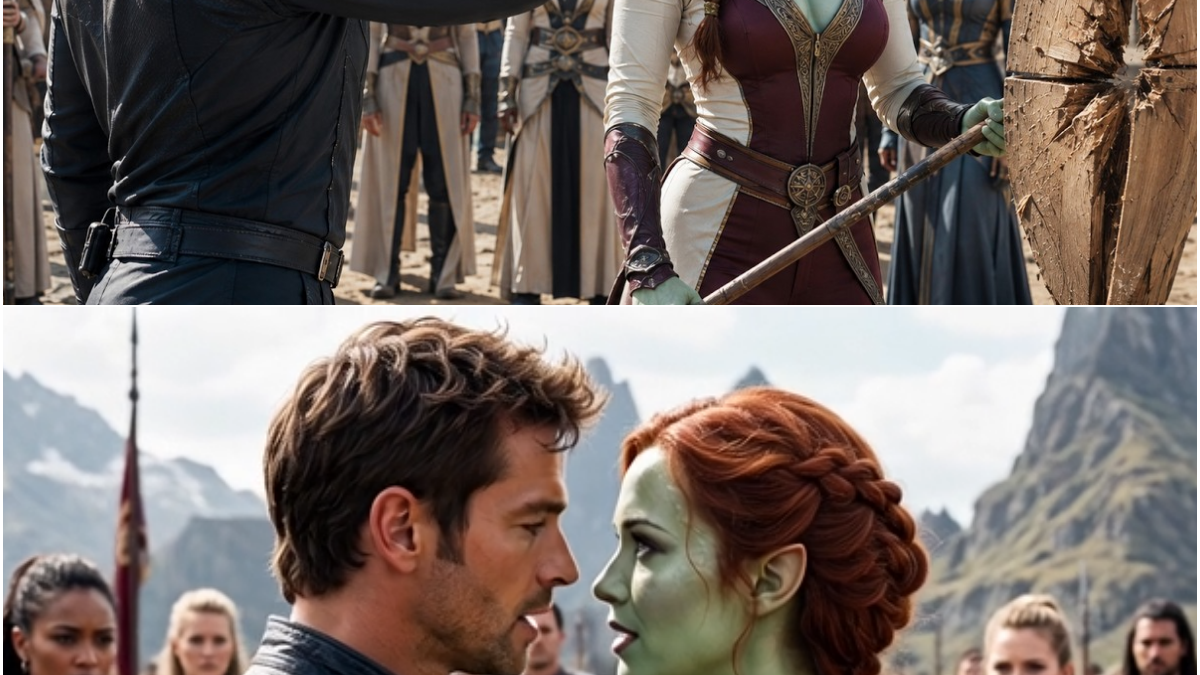
The room had gone so quiet that I could hear the faint hum of the lights above us.
Three alien women stood across from me beneath the pale silver glow, each of them different, each carrying herself with a dignity that made the situation feel stranger by the second.
I had been brought there and told that I was expected to choose one of them.
Choose a bride. Choose a wife. Choose one woman from among the three as though I were standing before a collection of objects in a market, deciding which one suited me beSt. I looked at the women, then at the officials who waited for my answer, and something inside me hardened.
I did not know these women. They did not know me. Yet everyone in the room seemed prepared to speak as though the decision belonged entirely to me.
Then I noticed her. Kessa stood slightly apart from the others, her shoulders rigid, her expression sharp enough to silence anyone who came too close.
She was clearly the fiercest of the three. She was also the only one who looked as though she wanted no part of the arrangement.
Her eyes moved from the officials to me with unmistakable irritation, and for the first time that day, I felt that someone in the room understood exactly what was wrong.
They expected me to choose the woman who seemed most suitable. Instead, I chose the woman who most resented being chosen.
And when Kessa looked directly into my eyes, waiting to discover what kind of man had just selected her, I had to decide what I would say to her?
I had spent years among people who believed tradition was enough to justify almost anything.
If something had been done for generations, they considered questioning it disrespectful. If an arrangement had a familiar name, they assumed everyone involved must understand and accept it.
I had never been good at thinking that way. I had always believed that a tradition could be familiar and still be wrong.
That was why the moment they told me to pick a bride, I felt uneasy.
The people around me called the arrangement customary. They explained that human visitors were sometimes invited to form family bonds with members of their society.
They explained that the women presented to me had been selected because they were considered suitable.
They explained their family histories, their skills, their education, their temperaments, and the qualities that made each one desirable.
The more they explained, the worse the whole thing sounded. The women were not being introduced as people I might come to know.
They were being presented as candidates. There was a difference. A person could not be reduced to a list of qualities.
A future partner could not be selected in the same manner one selected a tool, a residence, or a piece of equipment.
A genuine relationship required two people to decide that they wanted to share their lives.
Yet everyone seemed to believe that because I was the human visitor, I should make the final choice.
I looked at the first woman. She appeared calm, perhaps resigned to the situation. I looked at the second.
She watched me carefully, but her expression revealed little. Then I looked at Kessa. She stared back without lowering her eyes.
There was no practiced smile on her face. No attempt to appear charming. No effort to impress me.
Instead, there was a quiet fury in her expression. At first, I thought she simply disliked me.
Then I realized she did not seem to dislike me at all. She disliked the situation.
That mattered. I understood the feeling because I shared it. I stepped forward. “Kessa,” I said.
The room became even quieter. One of the officials looked surprised. “You have made your selection?”
“Yes,” I said. Kessa’s expression changed slightly. I turned toward her. “I chose you because you are the one person here who looks as uncomfortable with this arrangement as I am.”
Her eyes narrowed. “That is not what people usually say when they choose me.” “I imagine not.”
“And why would you choose someone who clearly does not want to be chosen?” “Because I do not want to possess you.”
The words seemed to catch her completely off guard. I continued before anyone else could interrupt.
“I was told to pick a bride, but I do not believe a wife should be picked like an object.
You are a person. You should have a choice. If you do not want this, you can refuse me.”
Kessa studied my face for a long moment. “And if I refuse?” “Then I will help you leave this arrangement.”
That was the first moment her expression changed. Not softened. Not yet. But the anger became uncertainty.
The officials objected immediately. They reminded me that the selection had already been arranged. They explained the expectations surrounding the ceremony and the importance of fulfilling the agreement.
I listened. Then I looked back at Kessa. “I will not force you,” I said.
She remained silent. Finally, she asked, “What exactly are you offering?” “An alliance.” Her brow lifted.
“An alliance?” “Yes. If you want it, we can make this arrangement work on our terms.
We can stand beside each other rather than one standing above the other. We can make our own decisions.
We can remain free people. We can become partners if we both choose it.” Kessa looked at me as though I had spoken a language she had never heard before.
Then she said, “You are a strange human.” “I have been told that before.” For the first time, the corner of her mouth moved.
It was not quite a smile. But it was close. Kessa agreed to the arrangement.
Not because she had been selected. Because she had been given the right to refuse.
That distinction became the foundation of everything that followed. In the beginning, she did not trust me.
I understood why. Words were easy. Promises were easy. A person could say anything when they wanted someone to believe them.
The real test came later, when there was nothing to gain by keeping the promise.
So I did not ask Kessa to trust me. I simply behaved as though her freedom mattered.
When decisions needed to be made, I asked her opinion. When plans changed, I told her.
When she wanted time alone, I gave it to her. When she disagreed with me, I listened.
Sometimes we argued. Kessa was not the kind of person who quietly accepted an idea merely because someone else had spoken firSt. She questioned almost everything.
She challenged my plans. She pointed out weaknesses in my reasoning. She told me when she thought I was being foolish.
I found that I liked it. One evening, after we had spent several hours repairing a damaged navigation system, she looked at me and said, “You are not very good at being in charge.”
I laughed. “I am beginning to suspect that you are not very good at being agreeable.”
“I never claimed to be.” “That may be your greatest virtue.” She stared at me.
Then she laughed. It was the first time I heard her laugh freely. After that, something began to change.
Not quickly. Nothing between us happened quickly. Our partnership grew through ordinary moments. We repaired equipment together.
We traveled together. We learned each other’s habits. I learned that Kessa became restless whenever she was forced to sit still for too long.
She learned that I became quiet when I was worried. She liked to work with her hands.
I liked to think through problems aloud. She preferred direct answers. I often needed time to reach one.
She was fierce. I was stubborn. Neither of us was particularly good at admitting when the other had been right.
That last quality caused more arguments than anything else. But there was something valuable in those disagreements.
Neither of us was trying to win ownership of the other. We were trying to understand each other.
That difference slowly changed the way Kessa looked at me. At first, she watched me because she expected me to fail.
Then she watched because she was curious. Eventually, she stopped watching for signs that I would betray my promise.
She simply watched because she wanted to know what I was thinking. That was when I realized she trusted me.
I never asked her when the change happened. Trust should not be demanded like a scheduled appointment.
It should be allowed to grow. One evening, we sat together near a wide observation window while the stars moved slowly beyond the glass.
Kessa was quiet. “What are you thinking about?” I asked. She looked toward the stars.
“The first day.” “What about it?” “I thought you were trying to trick me.” I smiled.
“I suspected you did.” “I thought your talk about freedom was simply another way to make yourself appear different.”
“Why did you change your mind?” She looked at me. “You kept doing what you said you would do.”
“That is a surprisingly simple answer.” “It is not simple.” She turned back toward the window.
“People often say things they do not mean. They say they respect freedom, but only until freedom becomes inconvenient.
They say they want equality, but only until the other person disagrees. They say they want partnership, but what they really want is obedience.”
I remained silent. Kessa continued. “You were different.” “I did not do anything extraordinary.” “You did something extraordinary to me.”
“What?” “You let me remain myself.” I looked at her. She gave a small shrug.
“That should not be extraordinary.” “No,” I said. “It should not.” After that night, our relationship became easier.
There was no longer the constant uncertainty that had surrounded us in the beginning. We had become partners in the truest sense.
Neither of us belonged to the other. We belonged beside each other. Kessa’s fierceness changed as well.
At first, much of it had been defensive. She had spent so long resisting the idea that someone else could define her life that resistance had become part of her identity.
Once she knew she did not have to fight me for her freedom, that fierceness became something else.
It became confidence. It became courage. It became humor. It became passion. It became the force that pushed us both to attempt things neither of us would have tried alone.
She became the person who would walk into a difficult situation and say, “We can solve this.”
Even when neither of us had any idea how. I began to understand why I had noticed her firSt.
It was not because she was the fiercest woman in the room. It was because her fierceness revealed something about her.
She could not easily be shaped into whatever someone else wanted her to be. That quality was exactly what I wanted in a partner.
I did not want someone who agreed with me simply because disagreement was uncomfortable. I wanted someone who would tell me when I was wrong.
Kessa did that often. Sometimes enthusiastically. One afternoon, I made a decision without consulting her.
It was a small decision, but she was furious. “You promised we would decide together.”
“I thought this one was obvious.” “That is not the point.” “I was trying to save us time.”
“You were trying to decide for both of us.” I stopped. She was right. “You are right.”
She folded her arms. “I know.” I laughed. She tried not to smile. “You are enjoying this.”
“A little.” “That is irritating.” “I know.” She finally laughed. Those moments mattered more than grand declarations.
Our partnership was built in the ordinary places. In arguments. In apologies. In shared meals.
In long journeys. In quiet evenings. In the simple habit of asking, “What do you think?”
That question became one of the most important phrases between us. Because it meant that neither of us was invisible.
Neither of us was secondary. Neither of us was an object being carried along by someone else’s decision.
We were two people choosing the same direction. Over time, our arrangement began to attract attention.
People noticed that Kessa was different around me. They noticed that I treated her differently from the way their customs expected.
They noticed that she spoke openly in my presence. They noticed that I listened. Some were confused.
Some disapproved. Others became curious. Kessa noticed the attention too. One day she said, “They are watching us.”
“Let them watch.” “They are trying to understand why this works.” “Do you know why?”
She looked at me. “Because you are too stubborn to control me.” “And because you are too stubborn to let me control you.”
She smiled. “That is also true.” Our relationship became an example without either of us planning it.
People began asking questions. Could a partnership work without one person holding authority over the other?
Could two people remain independent while sharing their lives? Could commitment exist without possession? Kessa began speaking publicly about these ideas.
She was better at it than I was. She had experienced the old expectations firsthand, and she knew exactly what it felt like to be treated as though her future belonged to someone else’s decision.
She did not tell people what they had to believe. She simply described what had happened to her.
She described the day she had been presented as a bride. She described the human who had selected her.
Then she explained that the first thing he had offered her was not control. It was a choice.
That story traveled farther than either of us expected. Other women began questioning old expectations.
Some families changed how they introduced potential partners. Instead of presenting a list of candidates, they began encouraging people to meet naturally, speak privately, and make decisions together.
The change did not happen overnight. Kessa understood that. “You cannot rebuild a culture in a week,” she told me.
“What can you do in a week?” “Plant an idea.” “And then?” “Give it time.”
She was right. The idea spread slowly. But it spread. Our own relationship also continued to change.
There was a point when I realized that I no longer thought of Kessa merely as my partner in an arrangement.
She was simply Kessa. The person I wanted to tell things to. The person whose opinion mattered to me.
The person whose laughter could change my entire day. The person whose absence made a room feel strangely empty.
I did not know exactly when affection had become love. Perhaps there was no single moment.
Perhaps it happened in hundreds of small moments. The first time she reached for my hand without thinking.
The first time she fell asleep beside me without any trace of tension. The first time she looked at me after something went wrong and said, “We will figure it out.”
The first time I realized that I was no longer simply grateful for our partnership.
I was grateful that she was in my life. One evening, much later, Kessa and I were sitting together after a difficult journey.
The lights were low. The stars were bright beyond the window. She was unusually quiet.
“What is it?” I asked. She looked at me. “I love you.” I said nothing for several seconds.
Not because I was surprised that she loved me. Because hearing her say it made the entire journey suddenly feel real.
“You do?” She gave me a look. “Do not make me repeat myself.” I smiled.
“I love you too.” Her expression softened. “I never expected that.” “Neither did I.” “I thought I would spend my life resisting you.”
“I thought you might.” “I was prepared to make it very difficult.” “You succeeded.” She laughed.
Then she grew quiet again. “I promised myself that I would never give that part of myself to someone who treated me like something they had chosen.”
I reached for her hand. She held it. “But you did not treat me that way,” she continued.
“No.” “You gave me a choice.” “Yes.” “And somehow, that made me want to choose you.”
I squeezed her hand. “That was all I ever wanted.” She looked at me for a long moment.
“Do you know what the strangest part is?” “What?” “I think I began choosing you long before I realized it.”
I smiled. “Perhaps I did too.” There was something beautiful about the irony of it.
The people who had brought us together had expected a selection. They had expected a decision made quickly.
They had expected a bride to be chosen and a role to be accepted. Instead, they had accidentally created the circumstances in which two people discovered that choosing could happen again and again.
Every day. Every conversation. Every disagreement. Every morning. Every difficult decision. Love did not begin when I selected Kessa.
Love began much later, when we had learned enough about each other to choose each other freely.
That distinction mattered to both of us. Kessa never wanted to be remembered as the woman I picked.
She wanted to be remembered as the woman who chose me too. I agreed. Years passed.
Our partnership became stronger. Kessa continued helping other women question customs that treated relationships as arrangements made for them rather than decisions made with them.
I supported her work. Sometimes I traveled with her. Sometimes she traveled without me. That was another important part of our relationship.
Love did not require constant closeness. Trust allowed distance. She had her own interests. I had mine.
We had friends we did not share. Places we enjoyed separately. Ideas on which we disagreed.
Yet none of those differences weakened what we had built. They strengthened it. Because neither of us had disappeared inside the relationship.
We remained ourselves. And that meant that every time we came back together, we were choosing each other again.
One evening, years after the day we first met, Kessa and I returned to the same hall where we had been introduced.
The room looked smaller than I remembered. The officials who had once expected me to make a simple selection were older now.
Some remembered us. Some had followed the changes our partnership had helped inspire. A new group of young people stood in the room.
They were there for a ceremony. But this time, there was no line of women waiting to be selected.
Two people stood together. They faced each other. They spoke for themselves. They chose each other.
Kessa watched quietly. I looked at her. “What do you think?” She smiled. “I think we caused trouble.”
“Good trouble?” She considered the question. “Useful trouble.” I laughed. The ceremony ended. The young couple walked away together.
Kessa remained beside me. “I remember the first day,” she said. “So do I.” “You chose me.”
“I did.” “And I hated it.” “I know.” She looked at me. “But then you gave me the choice to leave.”
“Yes.” “And I stayed.” “You did.” She smiled. “I think that was the moment that mattered.”
“Which moment?” “The moment when I realized that staying was finally my decision.” I looked at her and understood.
That had always been the heart of our story. Not the ceremony. Not the customs.
Not the expectations. Choice. The first time I saw Kessa, she was the woman who most clearly resented being selected.
That was why I noticed her. But I did not fall in love with her because she resisted.
I fell in love with her because once she was free to choose, she chose to stand beside me.
Her fierceness had first drawn my attention because it revealed a spirit that would not easily surrender itself.
Over the years, I came to treasure that spirit. Not because it belonged to me.
Because it never did. Kessa was herself. That was the person I loved. And she loved me as myself.
That was the gift we gave each other. Freedom was never the opposite of love.
It was the place where our love could exiSt. If I had treated Kessa as something I had selected and claimed, perhaps we would have remained together in name while becoming strangers in every way that mattered.
Instead, I had chosen the fiercest woman in the room because she most clearly rejected the idea of being chosen.
And she had eventually chosen me because I had been willing to let her walk away.
That was the strange beginning of our story. A selection became an introduction. An introduction became an alliance.
The alliance became friendship. Friendship became truSt. Trust became love. And love remained strong because neither of us had ever needed to own the other.
Years later, people still asked Kessa about the day I chose her. She always corrected them.
“He did not choose me,” she would say. “They told him to choose.” “And what did you do?”
“I gave him a choice too.” “What choice?” “To treat me as a person.” “And what happened?”
Kessa would smile. “We chose each other.” That was the answer I would have given too.
Because when I think back to that first room, I no longer remember the officials or the ceremony or the pressure surrounding the decision.
I remember Kessa. I remember the way she stood apart from the others. I remember the fire in her eyes.
I remember realizing that her anger was not something I wanted to defeat. It was something I wanted to understand.
And I remember the decision I made. I would not take her freedom in exchange for a relationship.
I would offer her freedom and see whether she wanted to walk beside me. She did.
And because she could have walked away, her choice to stay meant everything. That was how the fiercest woman in the room became the greatest love of my life.
Not because I had picked her. Because after the picking was finished, after the expectations had fallen away, after every obligation had been stripped from the decision, Kessa and I looked at one another as two free people.
And we chose each other.
Disclaimer: This content may be created by Al for entertainment purposes. Any resemblance to real persons, events, or places is coincidental.








