They Sent the Rancher a Worthless Bride to Ruin His Ranch She Built Wyoming’s Greatest Cattle Ranch
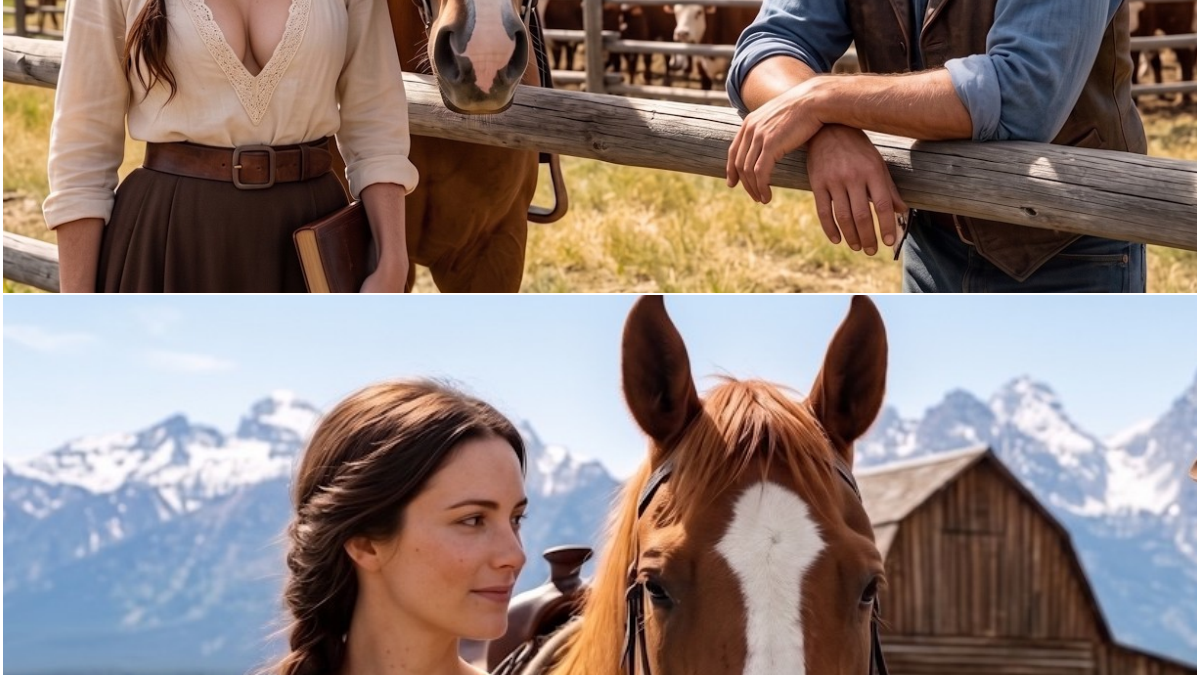
The freight wagon arrived at Thorn Ranch before noon, carrying a woman who had traveled a long distance to marry a man she had never met.
Silas Thorne was busy keeping six restless steers from breaking through the south corral when the driver stopped beside the water pump and announced that his responsibility ended there.
The woman climbed down without asking for assistance. She had one brown suitcase, a plain traveling dress, and boots covered in the red dust of the basin road.
She looked nothing like the kind of bride Silas had imagined when he answered the marriage bureau’s advertisement.
But it was not her appearance that made him uneasy. It was what she told him before the wagon had even disappeared.
Wesley Pike, the man who controlled much of the ranch’s winter feed, had paid the bureau to send her.
He wanted Silas distracted, financially weakened, and desperate enough to sell his land before winter.
Yet Ada Mercer had come anyway, carrying a warning instead of a promise. She had no intention of becoming Pike’s instrument, and she had no interest in pretending that a marriage could be built on a lie.
She asked for thirty days, a room of her own, and the chance to prove whether they could work together.
Silas had spent fourteen years believing he understood every useful inch of his ranch. But when Ada looked toward a forgotten spring beneath the sandstone ridge, she saw something he had overlooked.
Could a woman sent to undermine his future become the person who helped him protect it?
The freight wagon rattled into the Thorn Ranch yard beneath a pale Wyoming sky. Its wheels bumped over the uneven ground, scattering dust around the water pump and the small collection of tools Silas Thorne had left beside the barn.
Silas was in the south corral, trying to keep six restless steers from pushing through a section of fencing that had begun to bow.
He had one hand wrapped around the top rail when he heard the wagon stop.
The driver leaned down from his seat. “This is as far as I was paid to take her.”
Silas looked toward him, then at the woman climbing down from the wagon. She did not wait for the driver to offer a hand.
She lowered herself carefully, straightened her traveling dress, and reached for a brown suitcase that had been placed beside the wheel.
She wore a plain wheat-colored dress, sturdy boots, and a determined expression that did not quite conceal her exhaustion.
“mr. Thorne?” She asked. “That’s me.” “My name is Ada Mercer.” Silas glanced at the wagon.
“You’re early, so I was told.” The driver had already gathered his reins. Within moments, he was turning the wagon toward the road, apparently eager to leave the ranch behind.
Ada watched him go until the dust began to settle. Then she faced Silas again.
“There’s something you should hear before I carry that case into your house.” Silas released the corral rail.
“What is it?” “The marriage bureau that matched us took money from Wesley Pike.” His expression changed.
Pike owned a large cattle operation across the distant ridge and controlled a feed association that supplied several ranches in the basin.
For years, Silas had bought hay and other winter necessities through Pike’s suppliers. Their business relationship had become increasingly expensive, but it had also become difficult to avoid.
Silas looked toward the ridge. “What does Pike have to do with you?” “I heard two men in the Omaha office discussing it.
Pike wanted a woman who would cost you money, distract you from the ranch, and make you easier to buy out before winter.”
Behind Silas, one of the steers struck the corral boards hard enough to make the rails shudder.
“You knew that and still came?” “Yes.” “Why?” Ada’s expression remained steady. “Because Pike deciding I’m worthless doesn’t make it so.”
Silas studied her suitcase. “What do you expect me to do?” “Whatever you think is right.
I can pay my fare back eaSt.” “You came through his arrangement.” “I came through mine,” she replied.
“I answered your letter because it said you wanted a wife who could work beside you and speak plainly.
If that letter was true, give me thirty days.” “Thirty days for what?” “To see whether either of us still wants this marriage.”
She rested one hand on the suitcase handle. “I want a room of my own.
Meals, no promises, and no ceremony. At the end of thirty days, either of us can say no.”
Silas had expected a stranger who would need help adjusting to the ranch. He had not expected someone who seemed prepared to negotiate the terms of her own arrival before stepping through his front door.
“And what do you do for thirty days?” He asked. “What work?” Ada looked beyond the house toward the sandstone bench on the northern slope.
“That depends on whether the spring up there belongs to your land.” Silas turned to look.
A dark line of brush marked the spring’s location before disappearing into pale gravel. He had known about it for years.
Water emerged beneath the sandstone, but it ran into the ground before reaching anything useful.
“It does,” he said. “How much water does it carry?” “Not enough to matter.” “How do you know?”
“I’ve lived here fourteen years.” Ada picked up her suitcase. “That isn’t a measurement.” One of the ranch hands nearby coughed to hide a laugh.
Silas glanced at him, then back at Ada. She did not appear to have noticed the amusement.
He took her suitcase and carried it toward the house. “Thirty days,” he said. By late afternoon, Ada had changed into an older work dress and tied her sleeves above her elbows.
Silas found her halfway up the North Slope, carrying twine, a hammer, and several short cedar stakes cut from scraps in the barn.
She was standing beside an old fence post, studying the ground. “What are you doing?”
“Finding the fall.” “The what?” “The difference in height between the spring and that lower meadow.”
Silas looked downhill. The meadow was mostly brown grass and rabbit brush. It had never produced enough hay to justify the labor of cutting it, and the cattle usually crossed it without stopping.
“You plan on watering all that with a trickle?” “I plan on finding out what the trickle can do before I call it useless.”
She drove a stake into the ground and tied a length of twine between it and another stake farther downhill.
Silas watched her adjust the line. “You know cattle?” “Not enough to tell you how to run them.”
The answer surprised him. “Then what do you know?” Ada crouched and rubbed a little soil between her fingers.
“I know ground. I worked irrigated acres in Nebraska for twelve years.” Silas looked back toward the spring.
A narrow ribbon of clear water slipped from beneath the sandstone. It traveled a short distance before disappearing into gravel.
“Even if you can hold it, I can’t spare men.” “I didn’t ask for men.”
“You’ll need them.” “Then I’ll ask when I can prove why.” She gathered three more stakes and continued downhill.
Silas watched her stop, measure, adjust the twine, and move again. Her line curved gently across the slope, following the land rather than cutting directly toward the meadow.
A few minutes later, she ran out of stakes. Silas looked toward the scrap pile below the barn.
Then he went down, gathered the remaining cedar pieces, and carried them back to her without saying anything.
Ada accepted them. “Thank you.” “That doesn’t mean I believe this will work.” “I know.”
By supper, twenty cedar stakes crossed the brown ground above the meadow. Ada washed her hands at the kitchen pump and joined Silas at the table.
He served beef, beans, and biscuits. She ate quietly, but her attention remained fixed on the practical details of the ranch.
“How much hay do you buy in a normal winter?” She asked. “Too much.” “How much comes through Pike’s suppliers?”
“Most of it.” Ada nodded. “That’s what I thought.” Silas put down his fork. “You’ve been here six hours, and Pike has already told me where your weak point is.”
“He paid to send me here because he thinks I’ll make it worse.” “And you intend to prove him wrong?”
“I intend to find out what can be done.” Silas gave her the numbers. The price of hay had risen twice in three years.
Pike’s association also controlled the nearest dependable downstream watering point outside Silas’s property. Each season, the Thorn Ranch paid more for things it could not easily replace.
Ada listened without interrupting. “Winter comes early sometimes,” she said. “It does.” “How long before you start feeding hard?”
“About eleven weeks.” She looked toward the dark window. “Then we don’t have thirty days to waste.”
At dawn, Ada was already at the spring. Silas climbed the North Slope expecting to find damp soil and little else.
Instead, cold water had crept along the shallow trench she had dug the evening before.
It passed three cedar stakes and collected in a small hollow. Ada knelt beside it, pressing two fingers into the mud.
Then she looked toward the dry meadow below. Silas followed her gaze. For years, he had considered that ground little more than a crossing between the ranch and the northern fence.
Now a thin line of water pointed toward it. The question was no longer whether the spring existed.
It was whether they could make enough water stay. By the third morning, Silas had stopped calling it Ada’s experiment.
He still would not call it a plan, but he sent two ranch hands with a wagon to gather flat stone from the dry wash east of the property.
Ada marked the first basin where the slope leveled beneath the sandstone bench. Silas stood beside the outline with his hat pushed back.
“That hole looks too big.” “It needs enough surface area to slow the water.” “And enough labor to bury half my crew.”
“You gave me two men.” “I’m already regretting it.” Ada handed him a shovel. “Then regret it while digging.”
He looked at the shovel, then at her. She almost smiled. The basin took four days to complete.
They dug it shallow rather than deep, shaped the sides by hand, and carried stone from the wash until the wagon springs groaned beneath the weight.
Silas kept the rest of the ranch moving around them. At sunrise, he inspected fences.
By midmorning, he hauled stone. Before supper, he checked the herd and made sure the cattle had enough water.
Ada learned his routine without needing to be told. When he disappeared toward the south pasture, she did not follow.
When he returned, she usually had another section marked or a new measurement ready. Neither asked the other for permission every time something changed.
They began to work as though they were sharing responsibility, even though neither had said so aloud.
On the fifth afternoon, they opened the small diversion trench. Water slipped from the spring, entered the channel, and began filling the basin.
Ada stood ankle-deep in mud, watching the level rise against a stone marker. Silas leaned on his shovel.
“Well?” “Wait.” “For what?” “To see whether I’m right.” The water continued climbing. By sunset, the basin held a broad sheet of clear water reflecting the red sandstone wall above it.
One of the ranch hands whistled in surprise. Silas said nothing. That evening, he took the winter feed agreement from a drawer and placed it beside his plate.
Ada looked at the folded paper. “What’s that?” “The winter contract.” “When is it due?”
“Tomorrow.” She stopped cutting her beef. “You’re not thinking of refusing it because of one afternoon of water.”
Silas looked at her. “You think I should sign?” “I think one full basin is not the same as winter hay.”
“That sounds cautious.” “It is.” He turned the agreement over. “If this works, I’ll pay Pike for feed I may not need.
If it fails, I’ll pay somebody else more.” He tapped the paper once. “That’s the choice.”
Ada folded her hands in her lap. “What do you want from me?” “Your judgment.”
She looked toward the dark window, beyond which the spring lay beneath the sandstone. “Wait three days before you sign anything.”
Silas nodded. He did. The next morning, the basin was nearly empty. Ada reached it firSt. Silas found her standing at the edge, her boots sunk in damp earth.
Only a shallow pool remained near the western side. The rest had vanished. There was no broken bank, no washed-out ditch, and no obvious leak.
The water had simply seeped through the basin floor. Silas walked around the edge once.
Ada did not explain. Finally, he stopped beside her. “How much did we lose?” “Most of it.”
“How much labor?” “Four days.” Silas stared at the dark, wet ground. Ada pulled one cedar stake from the basin edge, then another.
“What are you doing?” “Clearing it.” “For what?” “So your men can go back to work.”
“They already went back.” She paused. “This was my design.” “Yes.” “It failed.” “Yes.” Ada pulled another stake.
“I told you I understood this ground.” “You understood some of it.” “That isn’t good enough.”
Silas crossed the basin and crouched near the western edge. He touched the soil. It was still wet, darker and heavier than the pale gravel beneath most of the basin.
He dug his fingers into the ground and lifted a clump. “Look at this.” Ada knelt beside him.
She rubbed the soil between her fingers. It flattened instead of crumbling. “Clay,” she said.
Silas watched her expression change. “What?” “I made it too deep.” “That sounds backwards.” “I made one big place for the water to escape.”
She stood and studied the damp patches across the basin floor. “The clay runs through here in narrow bands.
There isn’t enough of it to hold one large pond.” Silas followed her gaze. “But three shallow ones?”
Ada pointed downhill. “Small basin here. Another lower down. One more near the meadow. Stone on the sides and packed clay beneath each one.
If the first loses water, the next can catch what moves through.” “You know that will work?”
“No.” The answer came quickly. Silas looked at her. Ada met his eyes. “I think it will work.
That isn’t the same thing.” For several seconds, the only sound was the spring running into the failed basin.
Ada reached for another stake. Silas put his hand over it. “Leave them.” She looked at his hand.
“Why?” “Because you just learned something.” “At our expense.” “At our expense,” he agreed. The words settled between them.
Silas removed his hand and stood. “Show me where the second basin goes.” They spent the afternoon walking the slope.
Ada marked each clay band, and Silas measured the distance to the meadow. By sunset, they had a new line of stakes, shorter sections, and three places where the water might be persuaded to stay.
That evening, Silas rode to the association office near Redbute. Wesley Pike sat behind a wide desk, his sleeves clean despite the heat.
The office was furnished with polished wood and a large map showing the ranches and watering routes across the basin.
Silas placed the unsigned winter contract in front of him. “I’m not renewing today.” Pike looked at the paper.
“You always renew before AuguSt.” “Not this year.” Pike leaned back. “The bride giving financial advice already?”
Silas did not answer. “I’ll buy what I need when I know what I need.”
“Prices won’t wait for you.” “Then they won’t.” Pike studied him for a moment. “You’re making a mistake.”
“Maybe.” Silas took the contract and left. He returned after dark. Ada was still outside, placing stones beside the first new basin.
Silas tied his horse near the barn. “You refused it for now,” she said. “Yes.”
“That makes the next part matter.” “I know.” At first light, a ranch hand rode in from the southern boundary carrying a length of chain across his saddle horn.
“They changed the lower gate.” Silas went still. “What gate?” “The association watering cut. Pike’s men put a new chain on it sometime last night.”
Silas rode down himself, with Ada following at a distance. For years, Thorn cattle had been allowed through that opening during the driest weeks.
The arrangement had never been written into a formal agreement, but it had become a habit shared by the neighboring ranches.
Now an iron lock hung from the gate. Silas touched it once. Then he looked north toward the sandstone bench, where three unfinished basins waited above the brown meadow.
No one had threatened him directly. Pike did not need to. Silas had challenged the arrangement that kept his ranch dependent, and Pike had removed one of the few alternatives available to him.
Ada stood beside her horse. “He knows we’re trying to change things.” “Yes.” “Then the second plan has to work.”
“It does.” She looked at him. “Do you believe that?” Silas glanced at the locked gate.
“I believe we have to make it work.” The new basins took shape faster than the first one.
Not because the work was easier, but because nobody needed convincing anymore. Silas gave Ada two hands in the morning and one wagon in the afternoon.
The rest of the crew stayed with the cattle. The arrangement was tight, but it worked.
Ada marked the clay bands. Silas hauled stone. The men learned to recognize the difference between the pale gravel that swallowed water and the darker soil that could hold it.
By the end of the week, the upper basin was lined and packed. They opened the spring channel just before sunset.
Water entered slowly. Ada stood beside the edge with her arms folded. Silas waited beside her, watching the marker stone.
They stayed until darkness made it difficult to see. At dawn, the water level had dropped less than an inch.
Silas crouched beside the marker. Ada rubbed the damp soil between her fingers. “Good,” she said.
“Good enough?” “Good enough to keep going.” Silas looked downhill. “Then we keep going.” The second basin took six days.
The third took five. Each sat lower than the one above it, linked by a narrow ditch and simple wooden gates they built themselves.
The first time water passed from the upper basin into the second, Silas followed it on foot.
The stream moved quietly between the stones, narrow but steady. Ada walked beside him, watching the channel.
“You still think it’s too little?” She asked. “I think winter is bigger than this.”
“That isn’t what I asked.” Silas looked at the water. “No.” Ada nodded once. That was enough.
They began turning the lower meadow in strips rather than trying to work the entire field at once.
Ada wanted the water to move slowly and soak the ground evenly. Silas wanted the cattle kept away from the new growth.
They argued over fencing for most of one afternoon. Silas wanted a temporary line close to the ditch.
Ada insisted it would leave too little room for the grass to establish itself. Eventually, he moved the line twenty yards farther south.
Ada said nothing about winning. That made him trust the decision more. By the third week of August, green began appearing where the ditch crossed the meadow.
At first, it was only a thin strip. Then another appeared beside it. The change was uneven, and there was nothing dramatic about it, but it was real.
Silas stood at the edge of the field one evening and watched the breeze move through grass that had not been there a month earlier.
Ada came down carrying a wooden ruler. “You’re measuring grass now?” “I’m measuring whether we can cut it.”
“And?” “Not yet.” Silas looked toward the ranchyard. “We’re running out of summer.” “I know.”
She did not sound defensive. She knew the season was short, and she had no intention of pretending the new meadow could solve every problem.
The days shortened, and the work became more careful. Ada checked the water levels before breakfaSt. Silas adjusted the cattle rotation so the lower meadow remained untouched.
When one section began drying too quickly, they changed the flow instead of forcing the original plan.
Nobody called the first design a failure anymore. It had become the reason the second one worked.
Late in August, Silas found Ada standing outside the house with a folded calendar page.
“What’s that?” “My thirty days.” He looked at the date. He had forgotten. Ada had not.
“You can still leave,” he said. “I know.” “And you can stay.” She looked toward the meadow.
“As what?” Silas paused. The wrong answer would have been easy. He could have told her that he needed her, that the ranch needed her, or that he could not manage the new irrigation system without her.
But he knew those answers would not be enough. “As yourself,” he said. “If you decide against the marriage, you still have a place here until you decide what comes next.”
She studied his face. “You mean that?” “Yes.” “And the water system?” “It’s yours to finish if you want to finish it.”
Ada folded the calendar page and placed it in her pocket. “Then I’m staying.” Silas nodded.
She watched him for a long moment. “For now,” she added, “let’s say I’m staying.”
The first hay cutting began in early September. The grass was shorter than Silas wanted, but the meadow had produced enough to cut, and that mattered.
They worked from morning until the light began thinning across the basin. Fresh hay lay in rows across the lower ground.
Its smell changed the whole ranch, bringing a clean green scent into the yard and the barns.
Silas stopped beside one stack at sunset and pressed his hand into it. “Not enough for the whole winter,” he said.
Ada stood beside him. “No.” “You knew I’d say that.” “Yes.” “How far short?” “If we waste nothing, less than before.”
“That sounds like a careful answer.” “It is.” Silas looked toward the remaining uncut grass.
Ada pointed toward the upper end of the meadow. “That section has another week in it, if the frost waits.”
“If the frost waits.” They began another set of stacks three days later. The ranch hands had stopped treating the meadow as Ada’s project.
They called it the North Hay ground. Silas noticed the name before she did. One afternoon, Ada found him repairing a gate near the corral.
“We need to decide where the next cutting goes.” Silas set down his hammer. “What do you think we should do?”
She paused. He had asked for her opinion many times, but this felt different. He was not asking her to defend a plan she had made alone.
He was asking what they should do together. “Cut the west strip first,” she said.
“It dries faster.” Silas nodded. “Then that’s what we do.” The next morning, Wesley Pike rode into the yard.
He stayed mounted, looking across the ranch with the calm expression of a man who believed he could still control the conversation.
Silas walked out to meet him. Ada remained near the pump. Pike glanced toward the green meadow.
“So the bride found herself a garden.” Silas did not react. “What do you want?”
“That feed shipment you expected next month won’t be available.” Silas’s expression remained unchanged. “You confirmed that load in June, before I declined our agreement.”
“You declined exclusivity, not the shipment.” “Conditions changed?” Pike gave him a small smile. “Conditions change.”
Ada stepped closer. Pike looked at her. “mrs. Mercer.” “Miss Mercer,” she replied. His mouth tightened.
Silas folded his arms. “How much are you offering?” “For the ranch?” “You didn’t ride out here to discuss feed?”
Pike’s smile disappeared. He gave Silas a number. It was lower than his previous offer.
Silas looked toward the meadow, then back at him. “No.” Pike settled deeper into his saddle.
“You think that strip of hay changes your winter?” “I think my answer hasn’t changed.”
Pike turned his horse. “You’ll know by November.” He rode away without another word. Ada watched him disappear beyond the south road.
“The final shipment is gone,” Silas said. “I heard.” “We still have grass standing.” “Yes.”
“And maybe ten days before the nights get hard.” Ada looked toward the upper basin.
“Then we use the ten days.” They did not get ten. Four mornings later, Ada climbed to the top basin before sunrise.
A thin skin of ice covered the still water along its edge. She broke it with one finger.
Silas arrived behind her and looked down at the meadow. The last section of hay stood pale beneath the first froSt.
“Two days,” he said. Ada did not argue. “Two workable days.” They had no expected feed shipment, no access to the old watering point, and no room left for another failed plan.
By sunset on the second day, winter would begin making decisions for them. Before sunrise, Silas had every available hand in the north meadow.
The first frost still silvered the grass as the work began. Ada stayed near the lower ditch, clearing water from a section that needed to dry before cutting.
The ranch hands moved through the field without wasting words. Two days had already become less than that.
By noon, clouds were building over the western ridge. The wind changed with them, bringing colder air across the basin.
Silas stopped beside Ada as she checked the last uncut strip. “How much?” “If we finish this and keep waste low, enough to make winter possible.”
“Possible?” “I won’t promise more.” He studied her face. “That’s why I believe you.” They worked until darkness made the blades unsafe.
The final wagon reached the hayyard under lantern light. Silas climbed onto the stack and spread the last forkful himself.
When he came down, Ada was waiting with a small scrap of paper in one hand.
“Counted twice,” she said. Silas wiped hay dust from his sleeves. “And with what you stored before I came?”
“We can carry the herd if winter stays ordinary. If it doesn’t, we reduce loss everywhere else.”
Silas looked toward the cattle. Selling part of the herd now would protect the reSt. It would also mean surrendering ground he had spent the summer trying to hold.
Ada understood what he was considering. “I’m not asking you to gamble the ranch.” “I know.”
“Then don’t make the decision because of me.” Silas looked at the hay stacks. “I’m making it because of what we built.”
The next morning, he sent no rider looking for replacement feed. He bought nothing from Pike.
Instead, they changed the feeding routine. Hay was weighed before it went out. Loose feed was gathered rather than trampled into mud.
The cattle were rotated through sheltered ground to reduce how much energy they burned standing in the wind.
Ada never tried to tell Silas how to manage cattle. Silas never again treated the water system as something separate from the ranch.
Three days later, Wesley Pike returned. He rode alone and stayed mounted, as he always did.
Silas came from the barn. Ada stepped out of the hayyard, brushing chaff from her sleeves.
Pike looked at the stacks. “You cut it all.” “Most of it,” Silas replied. “It won’t be enough.”
“Maybe.” Pike studied him. “I can still make this easy.” He reached inside his coat and removed a folded offer.
Silas did not take it. “What’s the number?” Pike told him. It was lower again.
Ada said nothing. Silas looked toward the North Hay ground. “Come with me.” Pike frowned.
“Where?” “To see what you came to buy.” Silas started walking. Ada followed. After a moment, Pike dismounted and came after them.
They climbed toward the sandstone bench. The first basin lay cold and clear beneath the rock.
Below it, the second held water close to the stone marker. The third fed the narrow ditch leading toward the meadow.
Pike stopped. His eyes moved from one basin to the next. “You think three ponds make you independent?”
“No,” Silas said. “The work does.” Ada stepped toward the upper headgate. Its wooden handle had become smooth where their hands had used it throughout the summer.
Silas looked at Pike. “You controlled the feed because I depended on you for too much of it.”
“You still need feed some years,” Pike replied. “And that water isn’t yours alone to control.”
Silas glanced down toward the meadow. “You were right about one thing.” Pike waited. “My ranch was weak.”
Ada looked at him. Silas rested one hand on the headgate. “But not because she came here.”
For the first time, Pike looked directly at Ada without amusement. Silas continued. “It was weak because too much of it depended on men who wanted it to stay weak.”
Ada lifted the gate. Water slipped forward. Not dramatically, not in a flood, but as a steady, clear stream finding the channel they had built for it.
Pike watched it travel downhill. Silas did not raise his voice. “The ranch isn’t for sale.”
Pike folded the offer and put it back inside his coat. “Winter hasn’t happened yet.”
“No,” Silas said. “It hasn’t.” Pike walked back toward his horse. No threat followed him.
He had used the leverage he possessed, and it had failed to produce the answer he wanted.
Winter arrived hard in November. For twelve days, the wind pushed across Redbute Basin without giving the ranch much reSt. The hay disappeared faster than Ada liked, and Silas watched the cattle more closely than ever.
They adjusted. They wasted less. When one feeding ground turned to mud, Silas shifted the herd.
When ice formed across the lower basin, Ada kept the connecting flow open enough to prevent the entire channel from freezing solid.
Nothing about the season was easy. But the ranch did not break. By February, Silas stopped counting the remaining hay every evening.
By March, the cattle were nosing through exposed grass on the south slopes. The stacks had lasted.
So had the herd. One morning, Ada found Silas repairing the same corral gate he had been leaning against the day she arrived.
Snowmelt dripped from the barn roof, and the air smelled of damp earth. “My thirty days are over,” she said.
Silas looked up. “By several months.” “You never asked again.” “I said either of us could say no.”
Ada stepped closer. “And if I say yes?” Silas set down the hammer. “I don’t want you marrying me because this ranch needs you.”
She waited. “It doesn’t need saving now,” he continued. “So if I ask, I’m asking because I want you here when there’s nothing left to rescue.”
Ada looked toward the North Hay ground, where the first signs of spring were beginning to show.
Then she looked back at him. “Ask.” Silas stood. “Ada Mercer, will you marry me?”
“Yes.” They married in Redbute the following week, with two ranch hands as witnesses. There was no elaborate ceremony and no grand celebration.
By afternoon, they were home, and the work waiting for them had already begun. Spring came slowly.
The lower meadow turned green firSt. Then the grass spread along the ditch, following the route Ada had marked with cedar stakes the previous summer.
One morning, Silas and Ada walked to the last headgate. The stakes from her first survey still stood along the channel, weathered gray now and softened by the changing seasons.
Silas placed one hand on the wooden handle. Ada placed hers beside it. Together, they lifted.
Clear water moved past the old stakes and spread into the new grass. Beyond the meadow, cattle drifted across the open ground beneath the Wyoming morning.
Silas watched the water travel through the channel. He thought about the woman who had arrived with one suitcase, a warning, and a request for thirty days.
He remembered how she had challenged his certainty, questioned the ground he thought he knew, and refused to let another man decide what she was worth.
He had believed the ranch needed someone who could help him protect it. What he had learned was that the best kind of partnership was not built on one person rescuing another.
It was built on two people willing to look honestly at what was broken, learn from what failed, and work together without taking away each other’s choices.
Ada leaned against his shoulder. The water continued downhill, carrying the promise of another season.
And this time, neither of them had to wonder whether they belonged there.
Disclaimer: This content may be created by Al for entertainment purposes. Any resemblance to real persons, events, or places is coincidental.








