They Sent the Giant Woman to a Lonely Mountain Man—He Saw What Everyone Else Had Missed
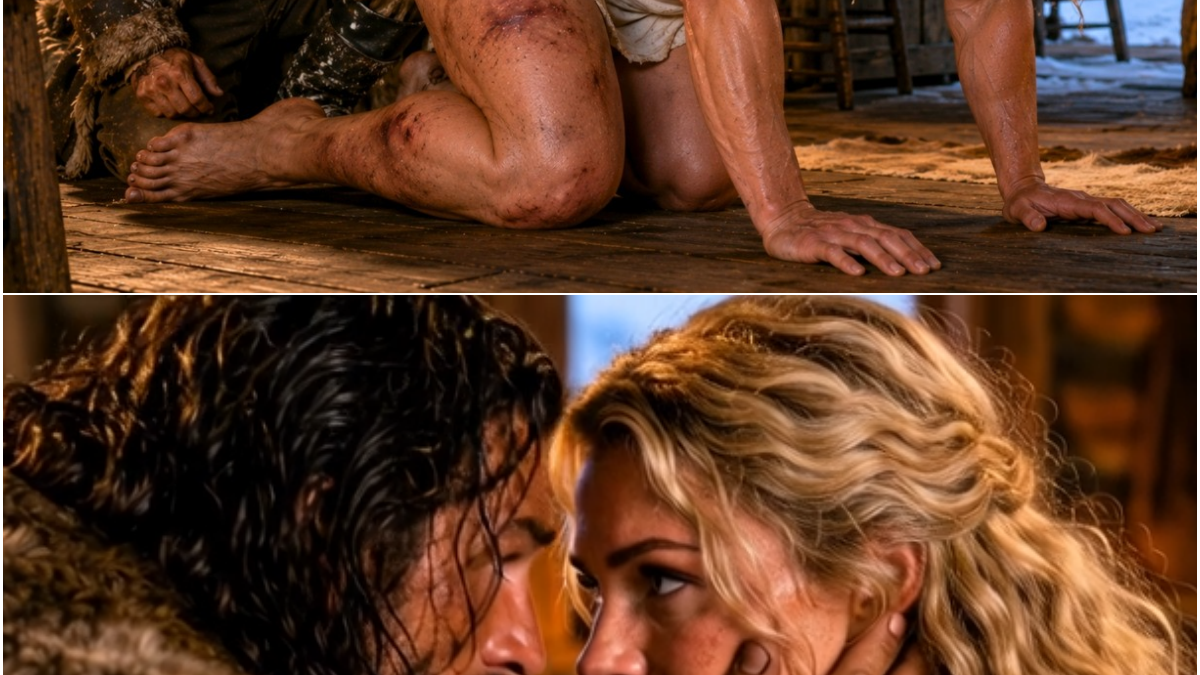
The snow had swallowed the Greywall Mountains, covering the forests, the narrow roads, and the scattered cabins beneath a silence so complete that even the wind seemed reluctant to disturb it.
Somewhere beyond the ridge, two riders were making their way through the storm, carrying papers that could change everything for a woman who had spent years believing she had no right to choose her own future.
Inside a wooden cabin, Rowena Price stood beside the table, her hands resting on a collection of documents she had hidden for months.
Across the room, Amos Decker watched the fire, his expression as steady as the mountains outside.
He was a man who understood hard winters, difficult work, and the comfort of silence.
He understood very little about the woman who had arrived at his door, except that she was stronger than most people realized and had learned to conceal that strength for reasons he was only beginning to understand.
She had come to his mountain seeking somewhere she could finally breathe without permission. He had offered her a room, a warm meal, and a place beside his fire, never expecting that their quiet arrangement would become something neither of them had imagined.
Now, with an unfamiliar rider approaching and the past threatening to reach across hundreds of miles, they would have to discover whether trust could survive the return of everything Rowena had tried to leave behind.
What would happen when the man who had spent years controlling her finally encountered someone who refused to let her stand alone?
Amos Decker had been waiting outside the Greywall Crossing trading post for an hour and forty minutes.
He knew the time because he had checked the sun twice, not because he was impatient.
He was simply a man who preferred knowing where things stood. At forty-five, he had broad shoulders, weathered hands, and the quiet confidence of someone who had spent eleven years learning every trail, stream, and dangerous turn in the mountains.
Waiting for a woman he had never met was something entirely different. Her name was Rowena Price.
She was thirty-four, a widow from the territories east of the Fallow River. Amos had studied her photograph for three months, noticing that it had been taken from farther away than most agency portraits.
He had wondered about that detail but had eventually dismissed it. He would soon discover that the distance in the photograph had not been accidental.
The stagecoach finally appeared around the bend, its horses struggling against the frozen road. The driver climbed down, followed by a merchant who immediately began complaining about his luggage.
An elderly traveling preacher stepped out next, buttoned his coat, and disappeared into the trading post without looking at anyone.
Then Rowena emerged. She descended carefully, one foot at a time, ducking beneath the coach doorway before straightening on the frozen ground.
Amos was five feet ten inches tall. Rowena stood four inches taller, but her height was not what held his attention for long.
It was the way she carried herself. She was broad shouldered and solidly built, with the kind of strength that came from years of physical work.
Her wool coat had been altered at the sleeves, and her carpetbag looked unusually small in her capable hands.
Dark hair framed a sharp, thoughtful face. Her eyes moved across the yard, measuring the buildings, the road, and the people before settling on Amos.
She examined him with an expression that was neither friendly nor hostile. It was the expression of someone who wanted to understand exactly what kind of person stood in front of her.
mrs. Price, he said. Yes. Amos Decker. She nodded. Long journey, he observed. It was fine.
Cold out here. Yes. There’s a meal inside. Hot coffee, too. We’ve got a two hour drive to the cabin, and the last stretch is rough.
She agreed without asking another question. Inside the trading post, the warmth of pine smoke and simmering stew filled the room.
Amos ordered two bowls and two coffees, then chose a table near the fire. Rowena removed her gloves, folded them neatly, and waited until he began eating before touching her own spoon.
He noticed. He also noticed that she watched his movements without appearing to do so.
The cabin has two rooms, he explained. The main room has the stove and workspace.
There’s a separate sleeping room in the back. I put up a proper wall last spring.
You’ll have that room. I’ll sleep on the cot until we’re settled. That’s decent of you, she replied.
It’s practical. We’re strangers. No point pretending otherwise. Something about her posture changed. It was a small adjustment, almost impossible to notice, but Amos had spent enough years observing weather and animals to recognize the smallest changes in things.
He wondered how long she had been expecting something different. After the meal, he reached for her carpetbag.
Rowena reacted immediately. Her grip tightened, her shoulders pulled inward, and she stepped backward before catching herself.
Sorry, she whispered. Amos simply took the bag when she released it, loaded it into the wagon, and checked the canvas cover without asking why she had reacted that way.
The road climbed into the Greywall range, winding between towering pines and frozen slopes. Rowena sat beside him with her hands folded in her lap, her eyes fixed on the road.
For nearly forty minutes, neither spoke. Then an enormous branch broke beneath the weight of its ice.
The crack echoed through the forest like a sudden explosion. Rowena recoiled, raising an arm over her head in a movement so practiced that Amos immediately understood it was not ordinary surprise.
Ice on the branches, he said calmly. Gets heavy this time of year. Sometimes they let go all at once.
I know, she answered. He did not question her. He kept his attention on the horses and allowed the silence to return.
By the time they reached the cabin, the daylight was fading. Amos settled the horses in the lean-to, checked their feed, and carried the remaining supplies inside.
Rowena had already found the lanterns and lit two of them. She stood beside the stove, studying the firebox.
It’s running low, she said. I’ll take care of it. I can. He looked at her for a moment, then stepped aside.
She gathered kindling, arranged the smaller pieces, adjusted the damper, and built a steady fire in less than eight minutes.
Her movements were confident and precise. When she finished, she wiped her hands and turned toward him.
What needs doing before sleep? Nothing tonight. You’ve been traveling since before daylight. Rest is what needs doing.
She seemed uncertain about the instruction, as though resting without first completing a task was an unfamiliar privilege.
Your room is through that door, Amos continued. There are two quilts in the blanket cheSt. The window latches work from the inside.
Thank you. She picked up her carpetbag. Amos, he said when she addressed him as mr. Decker.
She hesitated. If you’re willing. She considered the name before trying it. Amos. The word sounded careful, but he did not ask her to repeat it.
She entered the sleeping room and closed the door. A moment later, he heard the latch fall into place.
For a long time, Amos sat beside the stove, listening to the mountain settle into the cold.
During the next several days, he began to understand the unusual habits of the woman sharing his cabin.
Rowena rose hours before him. When he came out of his cot, the stove was already burning and the coffee was prepared.
She sat at the table with both hands around her cup, looking through the window as though her thoughts had traveled somewhere beyond the mountains.
She never slept late. She never asked what time it was. She never seemed comfortable doing nothing.
When Amos did not assign her a task, she found one herself. On the third day, she reorganized his supply shelves.
She moved tins, jars, tools, and wrapped provisions into an arrangement that made considerably more sense than his previous system.
Amos examined her work, recognized the improvement, and said nothing. He suspected that praising her too quickly might make her feel obliged to apologize for changing his cabin.
Instead, he simply learned where everything had been moved. She worked quietly, mended clothing, cleaned the kitchen, and kept the stove supplied.
She never sang or hummed. Her words were carefully measured, as though every sentence required consideration before it could be released.
Amos also noticed how she moved around him. She preferred keeping a clear path to the door.
She avoided allowing him to stand directly behind her. When he crossed the room, she seemed to register his movements even when she was concentrating on something else.
She also tried to make herself smaller. Her shoulders angled forward. Her head remained lowered whenever she worked at the table.
She occupied as little space as her powerful frame would allow. On the fourth day, Amos accidentally dropped a tin pan from a shelf.
The crash filled the cabin. Rowena immediately pressed herself against the far wall, raising both arms in front of her face.
Her entire body seemed to brace for something that never came. Amos stood still. I dropped it, he said.
That’s my fault. She lowered her arms slowly. I’m sorry. You don’t have anything to apologize for.
She looked toward the pan on the floor. I’ll get back to the bread. Rowena, he called gently.
She stopped. You don’t have to explain anything to me. Not now, and not ever if you don’t want to.
I want you to know that. She remained facing away from him for a long moment before returning to her work.
That evening, she did not mention the incident again, and neither did he. On the sixth day, she asked permission to walk the property line.
Amos explained where the red markers stood and warned her about an unreliable stretch of ice near the eastern creek.
She took his walking stick and disappeared into the trees. She returned two hours later with pine sap on her coat and color in her cheeks.
There’s a fence post leaning on the southern side, she reported. It’ll pull the wire when the ground thaws.
I’ve been meaning to fix it. I can straighten it if you have a post pounder.
Amos studied her. You know how to set fence posts? I know how to do most things, she replied.
I had to. He fetched the tool and followed her outside. Rowena tested the post, packed the ground, and worked with the calm efficiency of someone who had done the same job many times.
She checked the wire tension twice and made certain the post stood straight before declaring the task complete.
Where did you learn that? Harlland’s place. When the hired men weren’t available. It was the first time she had mentioned anything about her former life.
Amos did not ask for more. Instead, he told her the work was good. That evening, after supper, Rowena spoke from across the room.
I came out here because there was nowhere else to go. Amos set down his map.
I want you to know I’m not trying to deceive you about what I am or what I can offer.
What are you? Tired, she answered. Probably more trouble than you paid for. I paid a fee to an agency.
I didn’t pay for a person. She looked at him. That’s a fine distinction. It’s the only one that matters.
You’re not property, Rowena. If this arrangement doesn’t suit you, tell me. We can work out something else.
You’re not trapped here. For a long moment, she studied his face. You don’t know me.
That’s true. You might feel differently once you do. Might. She looked down at her hands.
Why wouldn’t you? Amos considered the question. Because I’ve watched you build fires, straighten fence posts, organize my supplies, and take care of the horses.
You’ve done more useful work in a few days than most people would do in a month.
But none of that is the reason you deserve to be treated properly. She remained quiet.
You’re capable, he continued. You’ve been carrying responsibility for a long time. That doesn’t make you difficult.
She did not answer, but that night she stayed in the main room longer than usual, reading one of the books from his small shelf.
On the ninth day, Amos noticed a bruise on her forearm. It was partly faded, but its shape was unmistakable.
Several older marks had healed beneath it. Rowena heard him stop moving. She glanced over her shoulder, noticed where he was looking, and immediately pulled down her sleeve.
Supper will be ready in an hour, she said. Amos put away his coat, walked to the wood bin, and began filling it.
After a while, he asked quietly, Rowena, who did that to you? She did not answer.
He waited. Finally, she said, Supper will burn if I don’t watch it. All right, he replied.
He sat at the table and left the subject alone. That evening, he washed the dishes without asking her to help.
She watched him from the center of the room. You don’t have to do that, she said.
I know. She went to her room and closed the door. The next morning, she was awake as usual, but something about her expression had changed.
She looked as though she had spent the entire night considering a difficult decision. When you wrote to the agency, she asked, what did you say you were looking for?
A partner. Someone willing to share the work and the winters. Someone I could be honest with.
Anything else? I said I wasn’t a man of many words, but I was steady and would treat whoever came right.
She considered that answer carefully. Then she returned to her coffee. Two evenings later, she began telling him about her former life.
Her first husband had been Harlon Price, a respected member of his church and a man who served on its council.
The congregation regarded him as a leader whose judgment carried considerable authority. They believed a woman of Rowena’s size and strength presented a special spiritual test for a husband.
Her physical presence, according to their teaching, required firm guidance. They called her a demonstration of Harlon’s authority.
Not a wife, Rowena explained. A demonstration. Amos listened without interrupting. The first time Harlon tried to control her through force, she had pushed him away.
She was larger and stronger than he was, and he had fallen. The following morning, several council members arrived and told her that she had endangered her husband’s standing.
They warned her that her strength was a responsibility she must never use against him.
She was twenty-six years old. She had little money, few connections, and nowhere to turn.
The men around her had spent years repeating their beliefs, and she had not yet found another way to understand her circumstances.
She had accepted their explanation because it was the only one she had been given.
Amos’s expression grew still. That’s not faith, he said quietly. That’s a room full of men who needed you to believe them.
Rowena looked at him. That’s not God, he continued. That’s a man using God so nobody looks at his hands.
The words seemed to settle somewhere inside her. She explained that Harlon had been careful about what others could see.
He rarely allowed visible marks to appear where people might notice them. The family physician, Doctor Elton Marsh, had treated her repeatedly throughout the marriage.
Eventually, Marsh began asking whether the explanations she gave him were accurate. She had been too frightened to answer honestly.
But shortly before leaving, she had received something important from him. He had kept private notes describing her injuries, her visits, and the differences between her explanations and his medical observations.
She had hidden copies inside the lining of her carpetbag. Amos stared at her. You came here with evidence.
Several documents, she replied. For the first time, he saw a trace of the woman who might have existed before years of carefully controlled behavior had changed her habits.
She explained that Harlon had spent the final year of their marriage becoming increasingly frustrated with her lack of response.
She had gradually stopped reacting to his attempts to frighten her. She had not planned it.
She had simply become exhausted by the constant demands placed upon her. Harlon interpreted her silence as defiance and insisted that she owed him a response.
Three months later, a difficult incident at the barn changed everything. The congregation gathered afterward, offering the customary words and expecting her to behave according to their understanding of a grieving wife.
Rowena remembered feeling an enormous sense of relief at finally having freedom from the life she had endured.
Then came months of guilt because she could not produce the emotions everyone expected. The council repeatedly reminded her that her feelings were evidence of her character.
Amos listened until she finished. You’re not a monster, he said. You’re a woman who survived a situation you never should have been put in.
She looked at him for a long time. Good, she whispered. It was not a complete answer to everything she had endured, but it was the first time she had heard someone describe her without treating her strength as a problem.
In the following days, she began to occupy the cabin more naturally. She continued rising early and walking the property line, but now she explained why she did it.
She needed to know where the land ended, what lay beyond the trees, and how far she could travel before reaching a boundary.
She needed to understand the space around her before she could feel settled within it.
Amos understood. He had spent eleven years mapping the mountain because knowing the land made him feel at home.
Rowena was doing something similar for a different reason. She also marked hazards along the creek.
She tied red wool from her mending basket to branches near a weak patch of ice and made certain the warning could be seen from both directions.
When Amos discovered what she had done, he thanked her. She seemed surprised by the simple acknowledgment.
The fourteenth night brought a powerful winter storm. The temperature fell rapidly, and the wind struck the cabin walls with enough force to shake the window frames.
Amos was tending the stove when Rowena emerged from her room, already dressed and alert.
How long? She asked. Two days, maybe three. What needs doing? They worked together outside, banking snow against the northern wall to protect the cabin from the wind.
Rowena moved through the work with extraordinary efficiency, using her strength without hesitation or apology.
Amos watched her briefly as she lifted heavy loads and packed them firmly against the wall.
For the first time, she seemed entirely comfortable with the body she inhabited. The storm lasted two and a half days.
They divided their responsibilities without needing to discuss every detail. Amos checked the horses and maintained the outer supplies.
Rowena kept the stove burning and prepared their meals. They took turns checking the oldest sections of the cabin and making certain the wind had not opened any gaps.
On the second afternoon, Amos spread his maps across the table. Rowena studied the markings.
Do you love it? She asked. The mountain? She nodded. Yes, he said. Not the easy kind of love.
The kind that costs you something, and you understand exactly what it costs, but you still wouldn’t leave.
She looked down at the map. I’ve never loved a place. What did you love?
She hesitated. Quiet mornings before everyone else woke up. Reading when I was allowed books.
The smell of bread just before it finishes baking. Those aren’t small things, Amos said.
Harlon thought they were. Harlon was wrong about most things. She looked at him, then returned to the map.
Yes, she said. That evening, she told him about the final months of her marriage and the council’s decision to place her under supervision if she failed to demonstrate renewed obedience.
That meeting had convinced her to prepare her departure. She had begun collecting documents, planning routes, and arranging the things she would need to leave safely.
The physician’s notes became the most important part of her preparations. Amos understood why she had been so careful about the carpetbag and why she had reacted so sharply when he first tried to carry it.
The documents were not simply papers. They represented the first decisions she had made for herself in years.
Three days after the storm, the sun returned. Rowena stood in the doorway, looking across the snow covered slopes.
The south fence needs checking, she said. Probably. I’ll take the post pounder. I’ll come with you.
You don’t have to. I know. They repaired two damaged posts and corrected a section of wire that had pulled loose during the storm.
They worked side by side, passing tools without needing to ask and moving around each other without hesitation.
On the walk back, Rowena caught her foot beneath a hidden root and stumbled. Amos reached out automatically, catching her elbow.
For one brief moment, she went rigid. Then she steadied herself. Sorry, he said, immediately releasing her.
No. I lost my footing. Thank you. They continued walking. That afternoon, she asked him why he had written to the agency in the first place.
Amos explained that the previous winter had been particularly difficult. During one stretch of three weeks, he had spoken to no one.
At first, he had considered the silence ordinary. Then he began wondering whether he had become so accustomed to living alone that he had forgotten how to share his life with another person.
That frightened him. Rowena understood the distinction. There was a difference between being comfortable with silence and no longer believing anyone needed to hear your voice.
That night, Amos told her about his son, Thomas. Thomas had been eight years old when a winter illness struck twelve years earlier.
The road was closed, and the physician could not reach their home for four days.
Amos had done everything he could, but the family had been unable to get the help they needed in time.
His wife, June, had struggled to remain in the house afterward. Every room reminded her of their son, and she eventually left in the spring.
Amos had not blamed her. He had simply come to the mountains because he no longer knew how to live as the man he had been before.
Rowena listened carefully. Did you figure out who you were? She asked. I figured out who I was on the mountain.
I’m not sure that’s the same thing. You’re still Thomas’s father, she said. That didn’t change.
Amos looked at her. You just got used to carrying it alone, she continued. You started thinking that carrying it alone meant you had lost it.
He sat quietly for a long time. Then he nodded. Yes. That’s right. For the first time, he understood that Rowena’s ability to see his sorrow was connected to the years she had spent trying to understand her own circumstances.
They had different histories, but both knew what it meant to carry something important without anyone beside them.
On the twenty-eighth day, Rowena returned from her morning walk earlier than usual. There is a rider on the south road, she said.
Amos stopped working on the harness. Moving slowly? Yes. He seems to be taking his time.
Do you know him? No. But I know who sent him. She explained that Harlon’s younger brother, Birch Price, had been sending letters for months.
The first had expressed concern. The second had become more specific. The third had outlined what Birch believed Rowena should do next.
Harlon had arranged an agreement with the church council during the third year of his marriage.
It involved their jointly owned land and attempted to transfer stewardship to the council if he were no longer able to manage it, provided Rowena remained within the community.
She had never agreed to the arrangement. Her signature was required for any legitimate transfer of the property, but Harlon had apparently believed he could persuade or pressure her into accepting the council’s authority when the time came.
Birch now chaired the land committee. He had spent months preparing a formal petition and gathering church records that he believed would support his position.
Rowena described him as very different from Harlon. Harlon had been quick to anger. Birch was patient, calculating, and careful about the language he used.
He rarely made a move until he believed the outcome had already been decided. Amos went to the window.
The rider remained near the edge of the trees, watching the cabin. Tell me everything you know about him, Amos said.
It’s my problem. You’re in my house. Whatever comes at you comes at me. She looked at him.
He recognized the hesitation in her expression. She had spent years learning not to depend on anyone, and trusting another person now required a kind of courage that had little to do with physical strength.
Finally, she agreed. She went to her room and returned with the carpetbag and a small knife.
Sitting at the table, she carefully opened the lining and removed the documents. There was their marriage certificate, the joint property deed, the council agreement, Birch’s letters, and Doctor Marsh’s notebook.
Amos examined everything. The deed showed that Rowena had equal standing in the property. The council agreement lacked her signature and had not been witnessed outside the church.
The notebook contained eight years of medical observations. Doctor Marsh had recorded the dates of her visits, the injuries he had observed, the explanations she had given, and his professional concerns about whether those explanations matched what he saw.
It was not an official medical file, but it provided a detailed account that Rowena could explain publicly.
Amos read Birch’s final letter twice. He cannot transfer what isn’t his to transfer, he said.
He knows that. Then he’ll come with something else. Rowena nodded. That’s what I’m expecting.
They sat together for hours, discussing the documents and considering what Birch might attempt. They did not pretend to know the outcome.
Instead, they focused on what they could establish, what evidence they possessed, and what questions still needed answers.
When the rider finally turned away from the property boundary, Rowena remained seated at the table.
He was counting, she said. What? Windows, entry points, the horses in the lean-to. Whether I looked like someone who had chosen to be here.
Amos watched the rider disappear down the road. Then we have to make certain he understands that you did choose to be here.
Rowena looked at the documents. Yes, she replied. We do. Four days later, Amos announced that he needed to travel to the North Timber.
He had been watching the deer trails since October, and the opportunity would not remain open much longer.
He expected to be away for a day and a half, perhaps two if the weather changed.
Rowena looked at him over her coffee. Go. He hesitated. You’ll manage? She gave him a steady look.
Go, Amos. He packed his supplies, checked the woodpile, and showed her how to use the cabin rifle.
She asked one question, understood the answer, and watched him demonstrate the procedure again. Before leaving, he made certain the horses had enough feed and the stove was ready.
Rowena stood in the doorway as he rode away. When the sound of his horse faded into the trees, she closed the door.
But she did not latch it. She noticed the missing sound immediately. For years, the click of a locked door had meant safety to her.
Now she was standing in a cabin where she felt secure enough to leave the door unlatched.
The silence did not feel empty. It simply meant Amos was away and would return.
She turned toward the kitchen and began her work. During the first day, she checked the horses, maintained the stove, and discovered that the roan mare was favoring her left foreleg.
She examined the animal carefully, found swelling around the fetlock, and treated it with cold snow wrapped in cloth.
The mare gradually relaxed beneath her hands. Rowena spoke softly as she worked, encouraging the animal to remain calm.
By afternoon, the swelling had begun to ease. The next day, she calculated the remaining firewood and decided the supply was insufficient for the coming week.
She took the splitting axe outside and worked for two hours in the cold. Her shoulders ached, and her fingers grew numb, but she kept a steady rhythm until the pile was large enough to carry them through the next stretch of winter.
She stacked the wood along the northern wall and returned to the cabin. As she warmed her hands beside the stove, she realized something unexpected.
She was not afraid. She was alone on a mountain, waiting for a man whose intentions she did not fully understand, while an uncertain visitor had already begun examining her circumstances.
Yet she felt capable of handling the day. She had treated the horse, prepared the cabin, split the wood, and made certain she had what she needed.
The change was not a sudden transformation. It was a gradual rearrangement of habits, a slow recognition that she could make decisions without constantly expecting someone to punish her for them.
That evening, she read one of Amos’s books about the Western Territories. She left her bedroom door open when she went to sleep.
For the first time in years, she did not feel the need to secure herself behind a locked door before resting.
Amos returned late on the second afternoon. Rowena heard the horse first, then the movement of something heavy through the trees.
She opened the door and saw him emerging from the forest with a mule deer across his shoulders.
He was exhausted, his beard stiff with frost, and his movements had become slow and deliberate.
Set it down, she said. I’m all right. I know. Set it down firSt. He lowered the animal into the snow.
Come inside. The deer needs processing. I’ll do the deer. You come inside firSt. Amos looked at her.
She had already made up her mind. He followed her into the cabin, where she sat him at the table and brought him fresh coffee.
His hands were stiff from the cold. She removed his gloves, examined his fingers, and prepared a basin of cool water.
She placed his hands in it without asking. The roan mare’s leg is improving, she reported.
I treated it yesterday. The woodpile will last through the week, and the deer needs to be processed before dark.
Amos looked at her. You’re giving me orders. Observations, she replied. You’re a reasonable man.
You’ll reach the same conclusions. He almost smiled. Then he asked how she had managed while he was away.
She told him about the horse, the wood, and the book she had read. Then she mentioned something else.
I left the bedroom door open last night. Amos became very still. I noticed it this morning, she continued.
I thought you should know. That’s good, Rowena. Yes. It is. She released his hands, stood, and reached for her coat.
Are you warm enough to come outside? Give me five minutes. Take ten, she said.
The deer isn’t going anywhere. She went outside and examined the animal while he recovered.
When Amos joined her, they began processing the deer together. Rowena knew the work from her years at Harlland’s property.
An older hired hand named Cutter had taught her, and she had developed a natural understanding of the task.
They divided the work without difficulty. At one point, she struggled with a stubborn section of hide and muttered a sharp word beneath her breath.
Amos glanced at her. Don’t, she warned. I didn’t say anything. You were about to.
I was going to say your technique is better than mine. She looked at him.
He appeared entirely serious. Cutter taught me, she said. He told me I had good instincts.
He was right. She returned to her work, but the corner of her mouth lifted slightly.
Then she made another requeSt. I want to learn to shoot. Amos looked at her properly.
Accurate and reliable, she clarified. Not just handling the rifle. All right, he said. There was no hesitation and no attempt to persuade her that she did not need the skill.
They finished their work as daylight faded and stored the meat for the coming weeks.
Over the following days, Amos began teaching her how to handle the rifle safely and how to understand the landscape before taking a shot.
Rowena listened carefully, asked direct questions, and practiced until the movements became familiar. She did not want the weapon because she wished to intimidate anyone.
She wanted to know that she could protect herself and make decisions about her own safety.
Amos respected that. As the winter deepened, their daily life became a partnership in the most practical sense.
They repaired fences, tended the animals, maintained the cabin, and prepared for Birch’s expected visit.
Their conversations grew longer. Sometimes Rowena spoke about the books she had enjoyed before her marriage.
Sometimes Amos told stories about his early years on the mountain, the first winter he had spent alone, and the mistakes he had made learning to manage the property.
They disagreed occasionally. Rowena was willing to challenge his assumptions, especially when she believed his approach was inefficient.
Amos learned that she was not simply capable of following instructions. She was capable of developing better ones.
He began asking her opinion before making decisions about the property. She began offering it without waiting to be asked.
The change was especially clear one morning when Amos found her standing at the table with his maps spread across the surface.
She had added several notes concerning the eastern creek and the southern boundary. He examined them.
You have a better record of the hazards than I do. You know the land better than I do, she answered.
I know the land I’ve spent eleven years looking at. You’ve noticed things I stopped seeing.
She considered that. Then she handed him the map. They continued preparing for Birch. Rowena studied his letters, identifying the language he used whenever he wanted to make an uncertain claim sound established.
Amos helped her organize the evidence and prepare a clear account of the events surrounding her departure.
They also made arrangements to travel to the nearest county office if necessary. The cabin was no longer merely a place where Rowena could hide from her former life.
It had become the place where she could decide what to do about it. One evening, while they sat beside the stove, she asked Amos whether he regretted inviting her into his home.
He looked up from his map. No. Even with everything I’ve brought with me? Especially because you brought the truth with you.
She studied him. I haven’t told you everything. You don’t have to tell me everything at once.
What if there’s more than you expect? Then we’ll deal with whatever there is when we know what it is.
She lowered her eyes to the book in her lap. Amos returned to his map.
After a while, she moved her chair a little closer to the stove, no longer choosing the farthest corner of the room.
Neither mentioned the change. By the time Birch Price finally appeared on the south road, the cabin had become a place where two people understood one another without needing to explain every movement.
Rowena saw the rider from the window. Amos was outside checking the fence. She opened the door and called his name.
He came inside, brushed the snow from his coat, and joined her at the table.
The documents were already arranged. The physician’s notebook lay beside the joint deed. Birch’s letters were stacked in chronological order, and Rowena’s own written account rested on top.
Amos looked at her. Ready? She took a breath. Ready. The rider approached the cabin and dismounted.
He was a well dressed man, careful in his movements, with a polished manner that suggested he had spent years practicing how to appear reasonable.
He introduced himself as Birch Price. Rowena greeted him without stepping aside. Birch glanced at Amos, then at the documents on the table.
He began with a courteous explanation of his visit, describing the council’s concerns and the difficulties surrounding the property agreement.
He spoke about family obligations, community expectations, and the importance of resolving disagreements privately. Rowena listened without interrupting.
When he finished, she asked him to identify the legal authority under which he believed he could demand her return.
Birch’s expression changed only slightly. He explained that the council considered the original agreement binding and that its members believed her absence had complicated the management of the land.
Rowena placed the deed in front of him. My signature is required for any transfer.
Birch glanced at the document. He knew that. She then placed the council agreement beside it.
I never signed this. He began to explain that Harlon had acted in good faith.
Rowena stopped him. I am not discussing what Harlon believed. I am asking what authority you have to make demands concerning property I jointly own.
Birch’s manner remained polite, but his voice became firmer. He suggested that the church could provide witnesses to the history of their marriage and to the council’s understanding of her responsibilities.
Rowena placed Doctor Marsh’s notebook on the table. This is the medical record I will provide if the matter becomes public.
Birch looked at the notebook. For the first time, he seemed uncertain. Rowena explained that the physician had documented years of visits, injuries, and concerns about the explanations she had been expected to give.
She did not raise her voice. She did not need to. The notebook contained information that could be examined independently, and she was prepared to explain every entry.
Birch turned toward Amos. This is a private family matter. Amos remained seated. Then you should have left it private instead of sending riders to examine my household.
Birch’s expression tightened. He explained that the council had responsibilities to protect its members and preserve the agreement made with Harlon.
Rowena looked directly at him. You can protect your records, Birch. You cannot use them to decide where I live.
He attempted another argument, this time suggesting that her departure had been influenced by people who did not understand her obligations.
Rowena answered calmly. I made the decision myself. I came here because I wanted to.
I stayed because I chose to. And I will not return simply because you believe my choices are inconvenient.
Birch studied her. For years, he had known her as a woman who rarely challenged the council openly.
He had expected her to be quiet, cautious, and willing to accept whatever explanation the community offered.
The woman sitting before him was different. She was still quiet, but her silence no longer meant agreement.
She was still careful, but her caution now served her own judgment. She was still physically imposing, but she no longer tried to conceal her strength.
Amos did not speak again. He had already made his position clear, and Rowena was handling the conversation herself.
Eventually, Birch asked for copies of the documents. Rowena agreed to provide copies of the deed and the council agreement, but she retained the physician’s notebook and the original letters.
She also requested that any further communication be made in writing and addressed directly to her.
Birch did not agree immediately. He considered the papers, then looked at the door. He had come expecting to find a woman who could be persuaded to return through a carefully constructed argument.
Instead, he had found someone who understood the difference between a request and an order.
He finally gathered his coat. The council will review this, he said. You may tell them I am willing to discuss the property through the proper channels, Rowena answered.
I am not willing to discuss my right to choose where I live. Birch left without another demand.
Amos watched him ride away. Then he turned toward Rowena. You handled that well. She looked down at the documents.
I was prepared. I know. She remained quiet for a moment. Then she asked whether he thought Birch would return.
Possibly. And the council? They may have questions. She nodded. Then we’ll answer them. Amos smiled faintly.
Together. Together, she repeated. The following weeks brought letters, questions, and several formal requests for clarification.
Rowena answered each one carefully, keeping copies and refusing to let anyone speak on her behalf without her permission.
The joint deed remained unchanged, and the council agreement could not establish the authority its members had claimed.
Doctor Marsh’s notebook became an important part of her account. Its detailed observations gave her a way to explain the past without relying solely on her own memory.
She did not expect everyone to understand. Some people remained loyal to the old council.
Others quietly admitted that they had misunderstood her circumstances. Rowena did not spend her days trying to convince every person who disagreed with her.
She focused on the life she was building. The cabin became warmer as Amos repaired the window seams and strengthened the oldest sections of the walls.
Rowena improved the storage arrangements again, this time with his help. They planted the first preparations for spring in a small sheltered patch near the southern wall.
She began reading aloud sometimes, initially only a few paragraphs at a time. Amos listened while working on his maps or repairing equipment.
Eventually, he began reading to her as well. They did not rush to name what had developed between them.
Their relationship had begun as an arrangement made by two people who wanted companionship and practical help.
It had become something more complicated, built through shared labor, honest conversation, and the gradual discovery that neither had to surrender their independence to be close to someone else.
One morning, Rowena stood beside the stove and watched the sunlight enter through the kitchen window.
Amos was at the table, working on a map. She looked toward him. Do you think people can learn to feel at home somewhere after they’ve spent so long feeling out of place?
He set down his pencil. I think they can. Even when they don’t know what home is supposed to feel like?
Especially then. She considered his answer. Then she crossed the room and sat beside him.
The movement was ordinary, almost unremarkable. But Amos noticed that she had chosen the chair next to his without first checking whether there was a clear path to the door.
She rested her hands on the table and looked at the map. Where does this trail go?
North Timber. How far? About six miles. Would you show me? He looked at her.
If you want. I do. They spent the rest of the morning planning the journey.
Rowena wanted to learn the trails, understand the streams, and see the upper ridge before the spring thaw changed the roads.
Amos explained which paths were reliable and which needed to be approached carefully. She asked about the trees, the wildlife, and the places where the snow remained longeSt.
By afternoon, they had a route. That evening, Rowena prepared bread. She had become particularly fond of the quiet moment just before it finished baking, when the kitchen filled with warmth and the smell of fresh dough.
Amos sat nearby, sharpening a tool. When she removed the bread from the oven, she placed it on the table and waited.
He looked at it. Smells right. She smiled. It does. They ate together beside the fire.
Outside, the Greywall Mountains remained covered in snow. The winter was not finished, and the road would remain difficult for some time.
There would be more letters, more decisions, and perhaps more arguments with people who believed they understood what Rowena ought to do.
But the cabin was no longer a place where she waited for someone else to determine what happened next.
It was a place where she made plans, learned new skills, worked beside a man who respected her judgment, and rested without asking permission.
Amos had come to the mountains believing that solitude was the only life he could manage.
Rowena had arrived believing that safety required her to remain watchful every moment. Neither had discovered an easy answer to the questions that brought them together.
They had discovered something more useful. A home did not have to be a place where every difficulty disappeared.
It could be a place where difficulties were faced without one person controlling the other.
It could be a place where strength was welcomed, silence was comfortable, and affection did not require anyone to become smaller.
As the evening grew darker, Rowena looked across the room at Amos. He was studying the map, his pencil moving slowly over the paper.
She watched him for a moment, then spoke. Amos? He looked up. I’m glad I came here.
He set down the pencil. So am I. She returned to her bread, and he returned to his map.
The stove ticked softly between them. For once, the silence required no explanation, and neither of them felt the need to escape it.
Later that night, Rowena walked to the bedroom and paused at the doorway. The latch was still there, exactly where it had always been.
She touched it briefly, remembering how many nights she had depended on its small metallic sound to reassure herself.
Then she left the door open. Amos did not comment when he noticed. He understood that some decisions were too important to turn into announcements.
They deserved to be lived firSt. And when morning came, Rowena would rise before him, make the coffee, and walk the property line.
She would check the creek, inspect the fences, and return to the cabin with a better understanding of the land beneath her feet.
But she would no longer walk those boundaries only to discover how far she could go before reaching something that might stop her.
She would walk them because the mountain was becoming hers to know, hers to enjoy, and hers to call home.
And when she returned, Amos would be there, not waiting for her to become someone different, but ready to share another ordinary day with the woman she was finally allowing herself to be.
Disclaimer: This content may be created by Al for entertainment purposes. Any resemblance to real persons, events, or places is coincidental.








