“They Sent Me Away Because Nobody Wanted Me,” She Whispered… The Rancher Answered, “I Do”
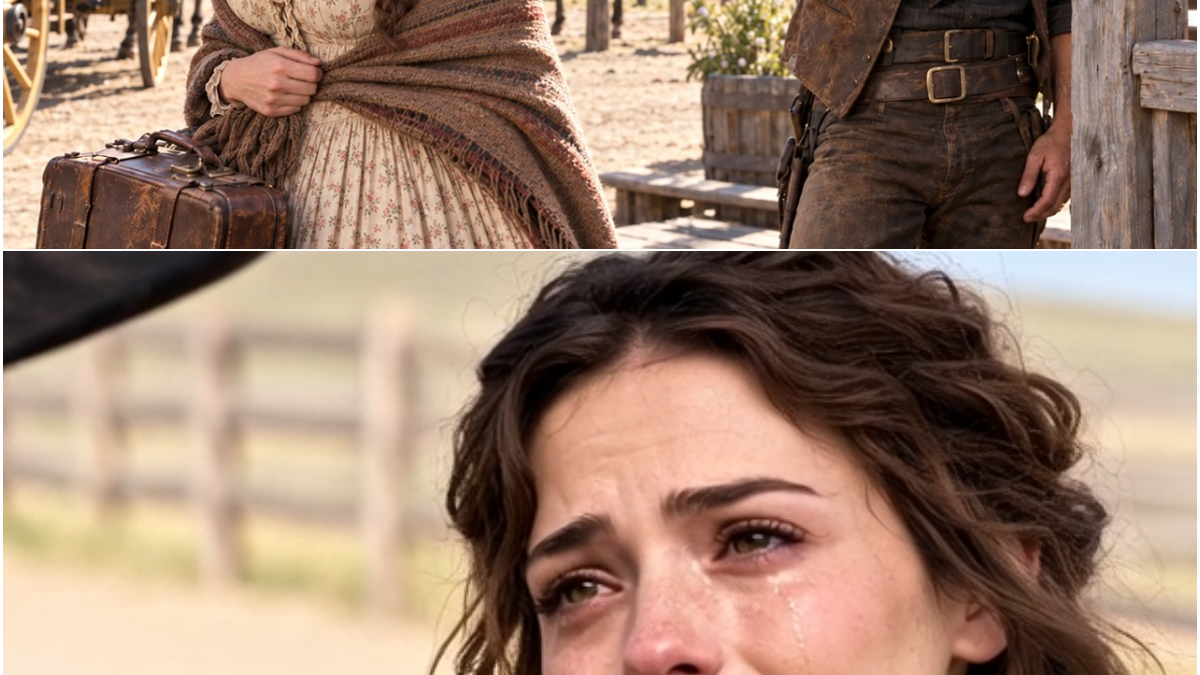
Riverstone Ranch, Colorado, 1884. The morning Ada Finch was supposed to leave, the mountains disappeared behind a wall of snow clouds, and Nate Callaway discovered that the words he had kept buried for weeks might be the only things capable of changing her mind.
Frost covered the fence rails, the grass crunched beneath every step, and the horses shifted restlessly beside the waiting coach.
Ada’s trunk was already tied behind it. Her travel bag rested in her hand, and the brass handle of the coach door waited inches from her fingers.
Nate stood near the gate, watching the woman who had brought warmth into a house he had never realized was cold.
For ten days, he had rehearsed what he might say. He had imagined asking her to stay, explaining what she meant to him, promising that Riverstone could become a home where she would never have to earn her place.
Yet every time he pictured the conversation, his fear found a reason to keep him silent.
Now the driver was impatient, the weather was turning, and Ada had already made her decision.
She looked at Nate with a gentle expression that hurt more than anger ever could.
“You were kind to me, mr. Callaway. Kinder than I expected.” Nate opened his mouth, but no answer came.
Ada glanced toward the road to Alamosa. “But kindness is not the same as being wanted.”
Then she asked the question he had avoided for weeks. “Do you want me, Nate, or do you only want the woman who made your house easier to live in?”
And with the snow beginning to fall, Nate finally had to decide whether silence was worth losing her.
Six weeks earlier, Riverstone Ranch had been a place where everything had its purpose and almost nothing had its softness.
Nate Callaway, thirty-six years old, liked his world that way. He had cattle to feed, fences to mend, horses to train, and accounts to keep.
His ranch lay beneath the Colorado mountains, far enough from town that visitors could be seen approaching long before they reached the gate.
Nate appreciated the distance. It meant fewer interruptions, fewer questions, and fewer people expecting him to explain himself.
He had built the log house with his own hands. He had raised the barn, repaired the corrals, and watched the pastures change through seasons of hard work.
His cattle were healthy, his horses were strong, and his land was worth more than he had ever imagined owning when he was younger.
By every practical measure, he had done well. His sister Margaret, who lived in Denver, believed he had neglected one important part of life.
Three weeks before Ada arrived, a letter had come from Margaret. She knew a young woman in Missouri named Adah Finch.
Ada was educated, unmarried, sensible, and in need of somewhere to go. Margaret had spoken with Ada’s family and described Nate as an honorable rancher who might be interested in marriage.
The arrangement had been made without asking either person. Nate’s reply had been short and unmistakable.
“You had no right to promise anything on my behalf. I will send her back.”
Margaret did not answer. Then, on the morning of September 15th, a coach appeared through the dust on the road.
Nate stood beside the gate with his arms folded. His ranch dog, Chester, sat at his boots, while Lou, one of the ranch hands, watched from the barn.
The coach stopped with a groan. A young woman stepped down, carefully placing her feet on the frozen ground.
She looked about twenty-five. Her brown traveling dress was covered in dust, and loose strands of dark hair had escaped around her face.
A black smear marked one cuff. She looked tired, but there was a steadiness in her expression that made Nate reconsider the speech he had prepared.
The driver lowered a narrow pine trunk, climbed back into his seat, and urged the horses forward.
Within moments, the coach was disappearing down the road. Ada watched it go before turning toward Nate.
“You have the expression of a man who wishes I were still on that coach.”
“I was not consulted about this,” Nate said. “Neither was I.” Her answer caught him off guard.
“What do you mean?” “My uncle arranged everything with your sister. He told me I could come west or find another place to live before October.”
Nate’s anger shifted. He had imagined Margaret arranging an unwanted visitor, but he had not considered that Ada might have been given no meaningful choice either.
“How long have you lived with your uncle?” “Since my parents were gone. Eleven years.”
“And after all that time, he sent you across the country to a man you had never met?”
“He called it an opportunity.” Ada looked down the road again. “Your sister called it Providence.
I called it a train ticket with my name already written on it.” Nate had no answer.
For a moment, he was ashamed of how quickly he had assumed Ada was the problem.
“I want one thing understood,” he said. “I did not ask for a bride. Margaret had no right to promise anything.
You are under no obligation to me.” “I know.” “I will not pretend this was my idea.”
“Neither will I.” Ada closed her eyes briefly. When she opened them, her exhaustion was plain.
“I have eleven dollars, aching bones, and three days of railroad dirt in my hair.
I do not need another speech about obligations. Right now, mr. Callaway, I need a chair, something to eat, and perhaps one hour when the ground does not feel like it is moving.”
Before Nate could respond, Chester rose and walked directly toward her. The dog sat in front of Ada and waited.
She looked down at him, then back at Nate. “Your dog appears to have made his decision.”
“Chester likes nearly everyone,” Lou called from the barn. “Not the Hendersons,” Nate replied. “Nobody likes the Hendersons,” Lou said.
Ada crouched and offered Chester her hand. He sniffed her fingers before leaning his weight against her skirt.
A small, genuine smile appeared on her face. Nate noticed it immediately. “Where is the kitchen?”
She asked. He carried her trunk. Ada carried her bag. Chester followed them inside as though he had been appointed her personal guard.
The kitchen was orderly, polished, and cold in the way of rooms that were used only for necessities.
Copper pans hung neatly on the wall. The stove was clean, and the table was bare except for a few cups.
Nate poured coffee and placed two biscuits on a plate. Ada drank half the coffee before touching the food.
She broke one biscuit, and it crumbled in her fingers. “I can cook,” she said.
Nate sat across from her. “Better than this?” Ada looked carefully at him. “Who made these?”
“I did.” Her expression changed. “They are not terrible.” “That was not your first thought.”
“No.” “What was your first thought?” She studied the crumbs. “They are sturdy.” “Sturdy is a good quality in a fence poSt.”
For a moment, Nate stared at her. Then laughter escaped him, surprising even himself. Outside the window, Lou made a startled sound.
“You need something?” Nate called. “No,” Lou answered. “Just checking whether I remembered what your laugh sounded like.”
Ada lowered her eyes, but Nate saw the smile she was trying to hide. Something about it unsettled him.
Not because he disliked it, but because he wanted to see it again. He asked what she intended to do after resting.
“I do not know,” she replied. “Then do not decide today.” Ada lifted her eyes.
“What are you offering?” “The south room. It has a lock, and the key will be yours.
Rest until you decide where you want to go.” “And what do you expect from me?”
“Nothing.” She studied him for a long moment. “A woman staying in your house will give people plenty to discuss.”
“I had not thought that far ahead.” “Clearly.” Nate explained that mrs. Bell, Lou’s aunt, lived down the creek and had been trying to supervise his household for years.
If Ada wanted work, he would pay her wages. If she wanted to leave, he would pay her fare to wherever the railroad could take her.
“I will not be kept,” Ada said. “I am not trying to keep you.” “And I will not work until you decide I have earned the right to leave.”
“Then we will write everything down. Wages every week. Your travel money set aside immediately.
You can leave whenever you choose.” Ada’s expression softened slightly. “The kitchen needs work,” she said.
“The kitchen is fine.” Her eyes moved toward the broken biscuit. Nate followed her gaze.
“The kitchen may need some work.” That evening, mrs. Beatrice Bell arrived with a carpetbag, a knitting basket, and enough authority for three households.
She greeted Ada warmly, inspected the kitchen, and immediately began making plans. After supper, Nate sat alone at the table and wrote to Margaret.
He told his sister that Ada Finch was not a parcel to be sent wherever someone pleased.
He asked Margaret to help her find honest work in Denver or Alamosa, and he insisted that Ada be given a choice rather than another arrangement made for her.
He finished with one final sentence. “Write your apology to her, not to me.” Three days later, Ada came downstairs wearing a blue work dress.
“I have rested,” she announced. “I want our agreement in writing.” Nate opened the ranch ledger and recorded their arrangement.
Ten dollars a month, room and meals included, with travel money kept separately in the desk.
Ada would hold the key. She read every line twice before signing. “Careful,” Nate remarked.
“Alive,” she replied. He raised an eyebrow. “The two are often connected.” Then she went to the kitchen and began making biscuits.
That evening, Lou took one bite and closed his eyes as though he had been waiting years for the experience.
Pete, the youngest ranch hand, ate two before speaking. “Ma’am,” Lou said, “where have you been all our lives?”
“Missouri,” Ada answered. “You have never been there,” Nate said. Lou pointed at his biscuit.
“I know what it kept from us.” Ada laughed, and Nate found himself watching her longer than he should have.
By the beginning of October, Riverstone Ranch no longer felt like the same place. Ada had not changed it through grand gestures.
She simply noticed what was needed and quietly made things better. She moved the flowers closer to the window, hung the ladles beside the stove, and placed the coffee above the cups.
A cracked jar Nate had been using for nails became a place for dried flowers.
Nate noticed every change, though he rarely commented. One morning, Ada entered the kitchen before sunrise and stopped.
A new pine shelf had been built along the wall. She ran her fingers over the smooth wood.
“You could have told me you agreed,” she said. “I built it.” “Some people use words.”
“Some people prefer evidence.” Ada looked at him over her cup. “A convenient philosophy for a quiet man.”
“Coffee?” “That depends. Did you make it?” “Yes.” She took a careful sip. “You are improving.”
“I had a good teacher.” Neither looked away quickly enough. The moment lasted only a few seconds, but Nate carried it with him all morning.
Ada soon discovered that Riverstone needed more than a better kitchen. While checking the ranch accounts, she found that Nate had paid the same feed bill twice.
She carried the ledger to the barn, where Nate was repairing a stall hinge. “You paid Henderson Feed forty-two dollars in August,” she said.
“That sounds right.” “You paid them forty-two dollars twice.” His hammer stopped. “That does not sound right.”
“There is also a delivery fee.” “They delivered it.” Lou looked over from the next stall.
“No, they did not. We collected it ourselves.” Ada closed the ledger. “I believe someone in town owes you money.”
Lou pointed at Nate. “I have been telling him for years not to trust the Hendersons.”
“You tell everyone not to trust the Hendersons,” Nate replied. “Because I am usually correct.”
Nate wiped his hands and looked at Ada. “I hired you to help with the house.”
“Then you are getting more for your money.” She held his gaze until the corner of her mouth lifted.
Nate smiled back. After that, he began finding reasons to enter the kitchen even when he did not need anything.
Sometimes Ada was kneading bread. Sometimes she was writing figures into the ledger. Sometimes she was sitting with Pete at the table.
Pete was nineteen and could repair nearly anything made of leather, iron, or wood. Reading was another matter.
When words became difficult, he hurried through them and pretended he understood. Ada noticed, but she never embarrassed him.
Instead, she began asking him to help her read cattle prices in the Denver newspaper.
At first, Pete struggled. Ada waited patiently. “Take your time.” He sounded out each part.
When he finished correctly, she simply moved to the next word. Within days, he began bringing the newspaper to her himself.
One evening, Nate stopped in the hallway. Ada and Pete were sitting beside the lamp.
Pete was struggling with the word irrigation. He failed once, then again, and his face tightened with frustration.
“Again,” Ada said gently. Pete tried once more. This time he got it right. Ada nodded as though she had expected nothing else.
Nate remained in the dark hallway longer than he intended. Later, when Pete had gone, he found Ada writing in a small notebook.
“You should have been a teacher,” he said. Her hand stopped. “I wanted to be.”
“Why weren’t you?” Ada closed the notebook. “My uncle needed help in his store. Then his wife needed help.
Then his daughters needed someone to care for them. There was always something someone needed more than I needed anything.”
Nate leaned against the doorway. “And now?” Her eyes moved toward the desk where her travel money was locked away.
“Now I have not decided.” The answer troubled him. He wanted to ask what would make her stay.
He wanted to tell her that Riverstone already felt quieter whenever she left a room.
But he remembered why she had come. Her uncle had decided for her. Margaret had decided for her.
Nate refused to become another person deciding what Ada should do. At the time, he believed silence was respect.
The first hard storm arrived before he understood his mistake. Rain struck the house after midnight, and the wind rattled the shutters.
Nate woke when someone pounded on the back door. He pulled on his boots and opened it to find Pete soaked through.
“The gray mare is hurt. A branch came down across the corral.” Nate was running before Pete finished speaking.
Inside the barn, lantern light swung across frightened horses. The gray mare pressed herself against a stall wall, blood running down one front leg.
Nate approached slowly. “Easy, girl.” Thunder rolled across the valley. The mare jerked, and the barn door opened behind him.
Ada entered carrying a lantern and clean cloth beneath her shawl. “Go back to the house,” Nate said.
“mrs. Bell is heating water.” “This horse may kick.” “Then do not give her a reason.”
Before Nate could argue, Ada moved carefully along the edge of the stall. She spoke to the mare in the same patient voice she used with Pete.
“No one is going to hurt you.” The horse’s ears turned toward her. Ada held out her hand.
The mare sniffed her fingers and lowered her head. Nate stared. “My uncle kept two mules,” Ada explained.
“Compared with them, she is perfectly reasonable.” He knelt beside the injured leg and began cleaning the cut while Ada kept the mare calm.
Then thunder exploded so close that the barn seemed to shake. The horse lunged. Ada caught the halter, and Nate rose to help her.
Their hands met. For one breath, they stood close beneath the mare’s neck. Ada’s face was only inches from his.
Wet strands of hair clung to her cheek, and her fingers were cold beneath his.
Neither moved. The mare settled. Ada slowly lowered her hand. “You can finish now,” she said.
Nate’s voice sounded rough. “Yes.” When the horse was safe, they crossed the muddy yard through the rain.
Warm kitchen light spilled across the porch. Nate stopped before they went inside. “You were good in there.”
Ada pulled her shawl closer. “I was useful.” Something in the way she said it made him uneasy.
“That is not all you are.” She looked directly at him. “What else am I?”
Nate knew the answer. She was the reason he came into the house earlier. The reason he listened for laughter from the kitchen.
The reason the ranch no longer felt empty. He should have told her. Instead, fear closed his throat.
“You are cold,” he said. “Go inside.” Ada’s expression changed. The warmth left it quietly.
“Good night, mr. Callaway.” She stepped through the door, and it closed between them. Two weeks later, Nate found her in the aspen grove above the ranch.
The leaves had turned bright gold, and snow covered the highest mountain peaks. Chester sat beside Ada while she watched the valley.
“I did not know a place could look like this,” she said. Nate stood beside her.
For a while, neither spoke. Then Ada began telling him about her uncle’s house. She had spent eleven years trying to be grateful for a roof and a place at the table.
She kept the books, cooked meals, helped with the store, and cared for the children.
She had worked hard enough that no one could accuse her of being a burden.
“But I was always there because of an arrangement,” she said. “I was needed.” Her fingers tightened around her shawl.
“But I was never chosen.” The words stayed between them. Nate could have crossed the distance.
He could have told her she had already become more than useful to him. Instead, he remembered the train ticket bought without her consent.
“Whatever you do next,” he said, “will be your choice.” Ada gave a sad little smile.
“You are very determined to give me freedom.” “You deserve it.” “Yes,” she replied. “I do.”
Four days later, a letter arrived from Denver. It was addressed to Ada. Margaret apologized for what she had done, and the envelope contained more than an apology.
A girls’ school in Denver needed a teacher. The position began in November and included wages and a room.
Inside was a train ticket. Ada found Nate repairing a harness in the kitchen. “Did you ask Margaret to arrange this?”
“I asked her to give you options.” “You found me a way to leave.” “I found you a choice.”
Her voice became quieter. “Do you want me to take it?” Nate stopped breathing for a moment.
This was the question he had feared. “I want you free to decide.” Ada’s fingers tightened around the ticket.
“That is not what I asked.” “It is the only answer I have the right to give.”
“No,” she said softly. “It is the safest answer.” She folded the letter. “The coach for Alamosa comes on November 3rd.”
Nate stared at her. “I am taking it.” Something inside him seemed to drop. He forced himself to nod.
“If that is what you want.” Ada held his gaze. “It is what I have decided.”
Then she walked upstairs, and Nate realized that giving Ada the freedom to leave might cost him the one person he had already begun to love.
The next ten days changed Riverstone more than Ada’s arrival had. Nothing was actually different, and that was the problem.
Ada still came downstairs before sunrise. She still prepared breakfast, checked the accounts, and helped Pete with the newspaper.
Nate still rode the north pasture each morning and returned before dark. But the small things between them vanished.
Ada no longer saved the crisp end of the bread for him. She stopped leaving coffee warm when she knew he would return late.
She no longer walked to the aspen grove in the afternoon. Instead, she packed. A dress disappeared from its hook, then another.
Books were stacked beside her trunk. Her notebook vanished from the kitchen table. Every evening, the south room looked less like hers.
Chester noticed before anyone said anything. The dog began sleeping outside Ada’s bedroom door. mrs. Bell noticed, too.
At supper, she knitted so fiercely that Lou leaned toward Pete and whispered, “If she pulls that yarn any harder, she may strangle somebody with it.”
mrs. Bell looked up. “I heard that.” Lou lowered his eyes. “I assumed you would.”
Pete barely spoke. Nate spoke even less. He told himself he had done the right thing.
Ada had wanted a choice. He had given her one. She wanted to teach, and Denver offered her that chance.
She would have wages that did not come from him, a room that did not belong to him, and a future no man could claim he had handed her.
It was exactly what Nate believed she deserved. So why did every day feel like losing something?
Two mornings before Ada was supposed to leave, Nate was in the barn replacing a board beside the stall door.
Lou walked in and watched him hammer three nails into perfectly good wood. “There is nothing wrong with that board,” Lou said.
“There would have been eventually.” Lou folded his arms. “You planning to rebuild the whole barn before she leaves?”
“I have work.” “You have fear.” The hammer stopped. Nate looked at him. Lou rarely pushed when Nate’s expression looked like that.
This time, he did. “You built her a road out of this place,” Lou said.
“She needed one. Fine. But you never gave her a reason to turn around.” Nate dropped the hammer onto the workbench.
“I will not use her gratitude to keep her here.” “Then don’t. Wanting someone is not the same as owning them.”
Nate looked away. “She came here because people decided her life for her. I will not become another man doing the same thing.”
Lou’s voice softened. “Do you think telling her you want her is the same as chaining her to the place?”
“It could feel that way.” “Or it could be part of the choice.” Nate said nothing.
Lou looked toward the house. “That woman has spent her whole life being useful to people who never told her she mattered beyond what she could do for them.
You gave her money, a key, and a way out. Good. But you never gave her yourself.”
Nate stared at him. “Giving someone freedom does not mean hiding half the truth,” Lou continued.
Then he walked away. Nate remained beside the stall. For weeks, he had believed his silence protected Ada.
Now he wondered whether it had protected only himself. The next morning was her last full day at Riverstone.
Snow clouds pressed low over the mountains. Ada spent most of the afternoon packing. Nate saw her through the south room window while crossing the yard.
For one second, she stood holding the blue dress she had worn the morning she first asked for written wages.
Then she folded it into her trunk. Nate stopped walking. He remembered the first biscuit she had insulted, the shelf he had built, the rain-soaked barn, her cold hand beneath his, and the word she had spoken in the aspen grove.
Chosen. He finally understood that she had never asked him to decide for her. She had wanted to know whether staying could mean something other than another arrangement.
Every time she had given him a chance to answer, he had hidden behind caution.
That evening, supper was almost silent. Pete pushed potatoes around his plate. Lou drank coffee.
mrs. Bell knitted. Ada sat across from Nate. “The accounts are finished through Friday,” she said.
Nate nodded. “Henderson returned the duplicate payment.” “I heard.” “Pete understands the market column now.”
Pete looked down. “Will you write?” He asked. The question stopped the whole table. Ada looked at him.
“If you want me to, I will.” “Then I will.” Pete nodded quickly and stared at his plate again.
Later, Nate found Ada alone on the porch. The valley had gone dark, and a thin line of moonlight rested on the mountain snow.
Her coat was wrapped tightly around her. “You will have bad weather tomorrow,” Nate said.
“The driver expects to reach Alamosa before it turns.” “If the road looks wrong, wait another day.”
Ada glanced at him. “Would that make a difference?” The question held more than the weather.
Nate knew it. Still, old fear reached for him. He almost gave another safe answer.
Instead, he said, “Yes.” Ada turned fully toward him. Nate’s heart pounded, but the kitchen door opened before either could speak.
mrs. Bell appeared. “Ada, I need your opinion before Lou ruins another pie cruSt.” From inside came Lou’s offended voice.
“I was told to stir it.” “You were told not to touch it.” Ada looked back at Nate.
For one painful second, he believed she might wait. Then she went inside. The moment was gone.
Nate stood beneath the cold night sky and hated himself for needing interruptions to understand how little time remained.
Ada’s coach arrived shortly after eight the next morning. Frost whitened the gate, and the wind smelled of snow.
The driver climbed down and looked toward the mountains. “We should move quickly. The storm will be here before noon.”
Pete carried Ada’s pine trunk outside. Lou tied it behind the coach. mrs. Bell hugged Ada tightly and whispered something that made her laugh through tears.
Pete hugged her next, awkwardly at first, then fiercely. “Keep reading,” Ada told him. “I will.”
“And slowly.” Pete smiled. “Yes, ma’am.” Chester refused to move from Ada’s feet. She knelt and wrapped her arms around the old dog.
“You were the first one here to choose me.” Chester licked her cheek. Ada laughed softly, and Nate had to look away.
When she finally stood, Lou called Chester back. Ada walked toward Nate with her travel bag in one hand.
She held out the south room key. “The key belongs to you.” Nate stared at it.
He did not take it. Ada placed it on the fence post between them. “The accounts are settled.”
“I know.” “Pete knows where everything is.” “I know.” Her eyes moved toward the house.
Morning light touched the south window. For six weeks, that room had belonged to her.
Now it looked empty already. Ada faced him again. “You were kind to me, mr. Callaway.
Kinder than anyone had a right to expect.” Nate’s chest tightened. “Ada.” “But kindness is not the same as being wanted.”
The driver gathered the reins. “Miss, we need to move.” Ada put one hand on the coach door.
Then she looked at Nate for what felt like the last time. “They sent me here because no one wanted me,” she said.
“I will not stay somewhere simply because I learned how to make myself useful.” The coach door opened.
Nate saw the road beyond her, Denver, the school, and a new life. Then Lou’s words returned.
You never gave her a reason to turn around. Nate stepped forward. “I do.” Ada stopped.
Her hand remained on the brass handle. Slowly, she turned. “You do what?” Nate’s throat tightened.
For once, he refused to hide. “I want you.” Ada’s eyes filled with something he could not yet name.
Hope, fear, perhaps both. But she did not move toward him. Instead, she asked the question he should have been ready to answer weeks earlier.
“Me, Nate? Or the life I built inside your house?” Nate did not look toward the road or the waiting coach.
He did not look at Lou, Pete, mrs. Bell, or even Chester. For once, he looked only at Ada.
“The ranch worked before you came,” he said. “It would keep working if you left.”
Ada remained beside the coach. “Lou would complain more. Pete would probably ruin the coffee.
I might pay Henderson twice again.” Behind him, Lou muttered, “Probably.” Nate ignored him. “I can hire someone to cook.
I can hire someone to keep the books. I can hire someone to clean this house.”
His voice became quieter. “But I cannot hire someone to be you.” Ada’s fingers loosened slightly from the coach handle.
“I cannot replace the woman who stands at the kitchen window every morning looking at those mountains like she has never seen sunrise before.
I cannot replace the woman who taught Pete without ever making him feel ashamed. I cannot replace the woman who tells me when I am wrong, even when I am too stubborn to listen.”
Ada’s eyes shone, but she still did not move. Nate took another step. “You asked whether I want you or the life you built inside my house.
I want you. Riverstone was already my home before you arrived, but after you came, I started wanting to return to it.”
Ada’s chin trembled. “When I ride out in the morning, I wonder what you will be doing when I come back.
When I hear someone laugh from the kitchen, I hope it is you. When the house is quiet, I notice because you are not speaking.”
Snowflakes drifted between them. “If every biscuit you made burned until spring, I would still want you sitting at my table.
If you never touched another account book, I would still want to hear your footsteps in the hall.”
He moved close enough to see the tiny snowflakes melting in her hair. “You are not useful to me, Ada.
You are important to me.” For several seconds, she could not answer. “Why did you never say any of this before?”
She whispered. Nate looked down once, then forced himself to meet her eyes. “Because I was afraid.”
“You?” “Yes.” “Of what?” “Of becoming another person who pushed you somewhere you did not choose to go.”
The wind moved through the frozen grass. “Your uncle sent you weSt. My sister arranged your future without asking.
I thought if I told you I wanted you here, it might become another weight on your back.
I told myself keeping quiet was honorable.” He shook his head. “But it was not honor.
It was cowardice. I was afraid that if I told you the truth and you still left, I would know exactly what I had loSt.”
Ada listened silently. Then she looked toward the trunk tied behind the coach. “The position in Denver is still mine.”
“Yes.” “I would have my own wages.” “Yes.” “My own room.” “Yes.” “A life that does not depend on you.”
Nate nodded. “Yes.” She looked directly at him. “And if I still choose that life?”
The question hurt, but Nate answered immediately. “Then I help you onto this coach. I will write to make sure you reach Denver safely, and I will never tell myself I had the right to stop you.”
Ada searched his face. “Then what are you asking me to do?” Nate reached into his coat and pulled out the south room key.
Ada stared at it. “I found it on the desk this morning.” He opened his hand.
The small key rested in his palm. “I am asking you to stay because you know you can leave.
Keep your wages. Keep the travel money. Keep this key. mrs. Bell can stay as long as you want.”
mrs. Bell called from behind him, “I had intended to.” A quiet laugh moved through the group.
Nate kept looking at Ada. “You said you wanted to teach.” Her face softened. “You remembered.”
“I remember nearly everything you tell me. If you want to teach, then teach. Fort Garland, Alamosa, wherever there is a school that needs you.
I do not want you to trade one life for another just because of me.”
Ada’s eyes lifted. “Then what would staying mean?” “Stay through winter. Let me court you properly.
Not because Margaret arranged anything. Not because your uncle put you on a train. Not because you owe me.
Stay because I am asking, and because you are free to tell me no.” Ada looked at Nate’s open hand, then at the road, then at Riverstone Ranch.
The house stood beneath the gray sky, smoke rising from the chimney. Chester waited near the porch.
Pete stood with his hat in his hands. mrs. Bell was openly crying now and making no effort to hide it.
Lou watched the coach driver as if daring him to interrupt. Ada turned back to Nate.
“And if I say yes?” Nate almost smiled. “Then I spend every day proving I meant what I said.”
“What did you say?” He knew exactly what she meant. “I do.” Ada’s face brightened, and she suddenly laughed.
It was not the careful smile she had given Nate on her first morning. It was a real laugh, warm and free.
She reached for the key. Nate placed it in her hand. Ada closed her fingers around it, then turned toward the driver.
“Please take my trunk down.” Pete shouted before catching himself. Lou slapped him on the shoulder.
mrs. Bell closed her eyes. “Thank the Lord.” Chester barked and ran around the coach.
The driver stared at all of them before climbing down. “I swear every strange thing on this road happens at Riverstone.”
He began untying Ada’s trunk. When the coach finally rolled away toward Alamosa, Nate and Ada remained beside the gate.
Snow covered the road behind it. Ada watched until the coach disappeared, then faced him.
“I have one condition.” Nate became serious immediately. “Name it.” “You will stop deciding that silence is somehow noble.”
Nate nodded. “I will.” “If you are angry, you tell me.” “Yes.” “If you disagree with me, you tell me.”
“I suspect that will happen often.” Ada smiled. “And if there is something you want, you say it.”
Nate stepped closer. “I can do that.” She looked up at him. “What do you want now?”
Nate hesitated for only one heartbeat. “To kiss you.” Color rose into Ada’s cheeks, but she did not look away.
“That,” she said softly, “was a much better answer.” She touched the front of his coat.
“You may.” Nate kissed her beneath the Riverstone Ranch sign while snow covered the road where the coach had disappeared.
Their courtship lasted through the winter. It was not filled with grand gifts or dramatic promises.
It was built from smaller things: questions asked honestly, answers given clearly, Sunday walks through the snow, and coffee before sunrise.
Nate learned to speak before fear could stop him. Ada learned that being loved did not mean surrendering her freedom.
She continued receiving her wages. Her travel money remained locked in the desk, and the key stayed hers.
Nate never suggested that she give up the choices she had finally been able to make for herself.
In January, a school committee from Fort Garland offered Ada a position teaching twelve children.
When spring arrived, she accepted. Not because Nate wanted it, and not because Margaret had arranged it, but because Ada wanted it.
Nate built her a small writing desk beside the kitchen window. Before cutting the wood, he showed her the drawing.
“Is this height right?” Ada smiled. “You are learning.” In February, Nate took her back to the aspen grove.
The branches were bare, and snow covered the ground. He carried no flowers and no ring he had chosen without her.
He carried only a question. “Adah Finch.” She turned toward him. “I choose you. Will you choose me?”
Ada looked down at Riverstone, at the house, the barn, and the road she was still free to take.
Then she looked at Nate. “I already did.” She smiled. “But yes.” They married in March.
Lou and Pete stood beside Nate, and mrs. Bell cried throughout the ceremony. Margaret came from Denver after Ada invited her.
Before the wedding, Margaret asked Ada for forgiveness without making excuses. Ada gave it, not because she had forgotten what happened, but because this time the decision belonged entirely to her.
When the preacher asked Nate whether he freely chose Adah Finch as his wife, Nate did not search for words.
He looked straight into her eyes. “I do.” Ada smiled. “I do, too.” Weeks later, spring began moving into the valley.
Snow pulled back from the meadow, water broke free beneath the creek ice, and pale green buds appeared on the aspens.
One morning, Ada stood at the kitchen window before sunrise. Nate came beside her. “You still watch the mountains every morning,” he said.
“Every morning.” “Do they ever look the same?” “Never.” The peaks changed from gray to rose, then rose to gold.
Nate watched Ada instead. “What do you see?” She thought of Missouri, her uncle’s house, the ticket bought without asking, and the long journey weSt. She remembered the key Nate had placed in her hand and the coach she had nearly taken away.
Then she looked at the schoolbooks waiting on her new desk, at Chester sleeping beside the stove, and at Nate standing quietly beside her.
He was not keeping her. He was not deciding for her. He was choosing her, and she was choosing him.
Ada smiled as the first sunlight filled Riverstone Ranch. “Everything I chose.” Outside, the mountains entered the full light of morning, and the ranch that had once belonged to one lonely man woke around two people who had finally chosen each other.
Disclaimer: This content may be created by Al for entertainment purposes. Any resemblance to real persons, events, or places is coincidental.








