They Said Hens Won’t Lay in a Barn That Cold — Then Her Wagon Filled With Eggs by Dawn
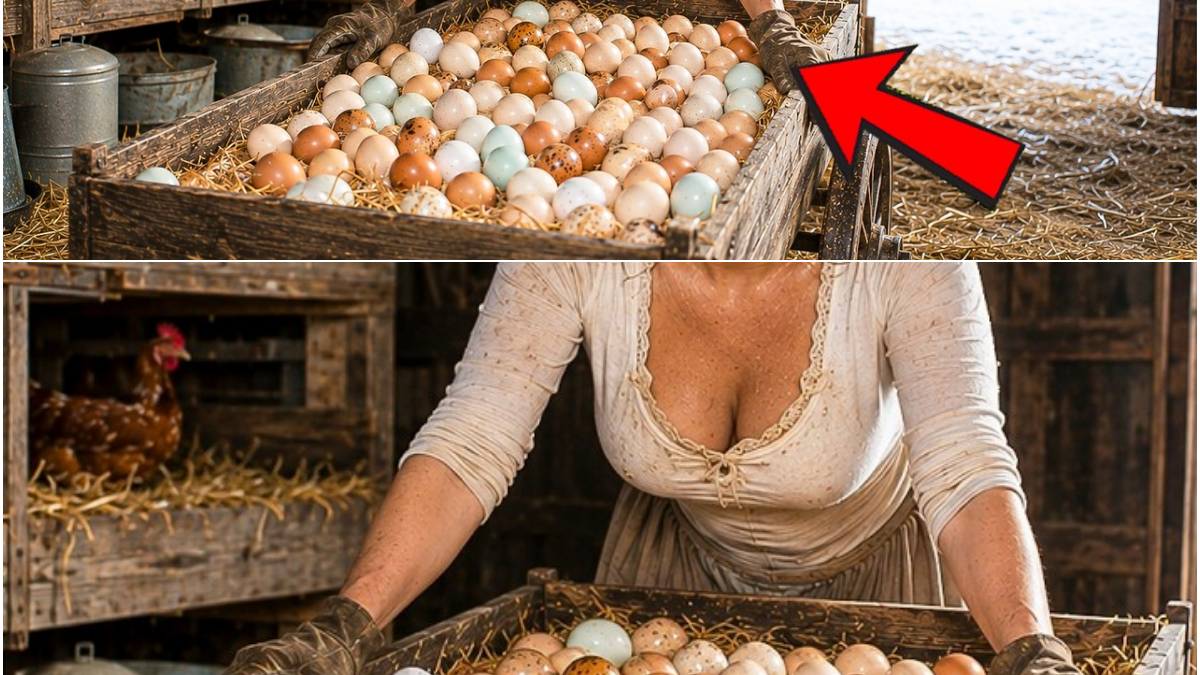
The barn stood at the end of Kettle Moraine Road, outside Two Rivers, Wisconsin, where winter could turn an ordinary morning into a test of patience and endurance.
Its tin roof was covered in frost, its wooden doors had begun to warp, and its empty stalls had not held livestock for decades.
Yet during the third week of January, something unusual was happening inside. Thirty-one hens were laying eggs in a building that most people would have considered completely unsuitable for keeping chickens through a Wisconsin winter.
Before sunrise, a single light glowed behind the barn windows, and the faint sound of movement carried across the frozen ground.
By February, a handwritten sign appeared beside the driveway, offering fresh eggs to anyone who wanted them.
By March, an old red Radio Flyer wagon stood near the mailbox every morning, filled with eggs so recently collected that some were still warm beneath their wrapping.
Neighbors slowed their vehicles to look. Some laughed, others shook their heads, and a few stopped to ask how it was possible.
Everybody in Manitowoc County knew that hens struggled to produce eggs during the coldest months.
Short days, freezing temperatures, and poor conditions could reduce a flock’s production almost to nothing.
Yet Verleen Kettering’s hens were doing something that contradicted everything people expected. Verleen herself had no agricultural degree, no commercial poultry experience, and no elaborate equipment.
She was a forty-four-year-old former factory supervisor who had lost her job and found herself responsible for a house, a mortgage, two sons, and eleven acres of land she barely knew how to use.
She had started with six chickens almost by accident. Now she was building a business around them.
But how had a woman who knew almost nothing about raising hens managed to turn an abandoned dairy barn into a productive winter operation?
Fourteen months before those first winter eggs began attracting attention, Verleen had been working as a line supervisor at the Two Rivers plant that manufactured plastic components for outboard motors.
She had held the position for nineteen years, beginning when she was young enough to believe that a dependable job would remain dependable as long as she performed it well.
She understood the production line, knew how to identify problems before they interrupted the schedule, and could manage workers through difficult shifts without losing control of the operation.
Her supervisors trusted her judgment, and she had spent years developing a reputation for being practical, organized, and reliable.
Then the company moved the production line to Mexico. The announcement came with a severance check and a pamphlet about writing resumes.
For Verleen, it was difficult to understand how nineteen years of experience could become irrelevant in a single meeting.
Her husband had already left two years earlier. People in town sometimes described the end of her marriage as the greater hardship, but Verleen saw things differently.
Relationships could change, and sometimes people decided they could no longer remain together. A job she had spent nearly two decades mastering was something she had expected to continue doing.
Now she was unemployed, living in a house with a mortgage, and raising two teenage boys.
The property included eleven acres and an old dairy barn that had been standing empty since the 1950s.
The barn was sturdy enough in some places but neglected throughout. Its roof needed attention, the doors were difficult to move, and the interior had become a storage space for things nobody had found a reason to throw away.
At first, Verleen considered the land an additional responsibility rather than an opportunity. She had no farming experience and little interest in becoming a full-time farmer.
She needed an income, not another complicated project. Then her younger son, Danny, came home with six chicks from a 4-H fundraiser.
He liked the idea of raising chickens. The chicks were small, inexpensive, and appealing enough that he convinced himself he would take care of them.
Verleen agreed, partly because the birds seemed like a manageable responsibility and partly because she did not want to discourage him from learning something new.
Danny built a small chicken tractor and helped move the birds around the property during the warmer months.
By August, however, his enthusiasm had faded. The chicks had grown into six loud, energetic hens that required daily attention, and the responsibility gradually became Verleen’s.
She decided to keep them through winter, collect whatever eggs they produced, and reconsider the arrangement when spring arrived.
She had no idea that the chickens would become the center of her next several years.
Her first season was filled with mistakes. The earliest problem appeared in October, when Verleen noticed that the hens were producing fewer intact eggs than expected.
She had assumed that a flock of six would need very little space, so Danny’s coop had been built for four birds.
The extra two seemed insignificant at firSt. But the cramped conditions made it difficult for the hens to move comfortably, and the nesting area became crowded.
One afternoon, Verleen found a broken egg in the nesting box. She cleaned up the mess and assumed that one of the hens had accidentally stepped on it.
A few days later, another egg was broken. Then the problem became regular. She eventually learned that chickens could develop egg-eating behavior when broken eggs were left where the birds could reach them.
Once a hen discovered the contents, she could begin deliberately pecking at eggs, and other birds could learn the same habit.
The behavior spread quickly enough that Verleen lost several weeks of production. She initially suspected that something was wrong with the birds themselves.
She watched them closely, inspected the nesting boxes, and tried to determine whether one particular hen was responsible.
The answer came from a woman working at a feed store in Mishicot. The clerk listened to Verleen’s description and explained that overcrowding, broken eggs, and delayed collection could encourage egg eating.
“They’re not being mean,” the woman said. “They’re being efficient. You’ve got to be more efficient than they are.”
Verleen took the advice seriously. She improved the nesting arrangements, collected eggs more frequently, and made sure broken shells were removed immediately.
The problem gradually disappeared. The experience reminded her of the factory floor, where a small production problem could spread if nobody corrected its cause.
The hens were not behaving according to human expectations. They were responding to their environment.
If she wanted consistent results, she had to understand the conditions that produced them. The next failure came in January.
Verleen had assumed that keeping the coop warm meant sealing every opening that might allow cold air inside.
The building Danny had constructed had a solid wall and almost no ventilation. Verleen closed the remaining gaps before winter, believing that the birds would be more comfortable in a tightly enclosed space.
Instead, moisture began accumulating inside. The hens’ breathing and droppings introduced water vapor into the air.
With insufficient ventilation, that moisture collected on the walls and surfaces and remained inside the coop.
The cold made the situation worse. One morning, Verleen discovered that three of her six hens had frostbite on the tips of their combs.
The affected areas had turned dark, and the birds appeared uncomfortable. She had never expected that an attempt to keep the coop warm could contribute to the problem.
After speaking with people familiar with poultry keeping and reading about winter housing, she learned that cold itself was not necessarily the greatest threat.
Moisture and direct drafts could create serious problems. A properly ventilated coop allowed damp air to escape through openings near the roof while protecting the birds from cold air blowing directly across their roosting area.
The distinction was important. She had been thinking about ventilation as a way to let warmth escape.
Now she understood that ventilation also protected the flock from moisture accumulating in an enclosed building.
She modified the coop, moving the vents higher and making sure the openings did not create a direct draft where the hens slept.
The damage from that first winter could not be undone, but she had learned something that would influence every future decision.
The cold could be managed. The hidden moisture had to be controlled. Then came the predator problem.
In February, Verleen discovered that two of her hens were missing. Something had entered the coop during the night.
She suspected a mink because of the circumstances, although she never identified the animal. She had believed that a latched door was sufficient protection.
It was not. After investigating the building, she discovered a gap beneath the floor joiSt.
She had not considered it large enough to be a serious opening, but small predators could squeeze through surprisingly narrow spaces.
She began reading state extension material about predator-resistant poultry housing and learned that doors, vents, flooring, and the perimeter all needed attention.
She installed quarter-inch welded hardware cloth where appropriate and buried protective material around the coop’s perimeter to discourage animals from digging beneath the walls.
She also inspected the building more frequently, looking for loose boards, damaged mesh, and openings that might appear harmless.
By spring, she had lost two hens to the predator incident and three others had suffered from the consequences of her early housing mistakes.
Only four remained. The coop had been rebuilt twice, and Verleen had spent more time repairing the small structure than she had expected to spend caring for the birds.
Yet she found herself becoming increasingly interested. It was not sentimental intereSt. She did not spend hours naming the hens or treating them like household pets.
What interested her was the practical challenge. There were problems, and there were explanations. The chickens needed particular conditions, and she could learn what those conditions were.
For the first time since losing her factory job, she had found a problem that seemed capable of being understood through careful observation and effort.
She began keeping notes. She recorded temperatures, egg production, feed purchases, and changes in the flock’s behavior.
She also began reading about commercial laying operations, nutrition, housing, and seasonal production. Her interest became serious enough that she started thinking about whether the empty dairy barn might eventually house a larger flock.
That was when Elmer Vosberg began visiting. Elmer was eighty-one and lived about half a mile down Kettle Moraine Road.
He had raised laying hens commercially from the 1950s through the late 1970s, when many small Wisconsin farms kept several hundred birds alongside dairy operations.
He had not maintained a flock in more than twenty years. Verleen had lived near him for a decade and barely knew him.
They exchanged occasional greetings across the road, but their conversations rarely lasted more than a few words.
One April afternoon, Elmer stopped beside her fence while she was repairing the north wall of the coop.
He watched her work for several minutes before speaking. “You’ve got the vents too low,” he said.
Verleen straightened up. “What do you mean?” “Heat rises. Moisture rises with it. Put your vents up under the eaves, above where they roost, and leave the low gaps for nothing but a breeze in July.”
Then he walked home. Verleen stood there thinking about his advice. She had already begun suspecting that her ventilation arrangement was wrong, but hearing the explanation from someone who had managed hundreds of laying hens through Wisconsin winters made it feel more certain.
She moved the vents. The hens made it through the next winter without another case of frostbite.
Elmer began stopping by roughly every ten days. He never announced his visits, and he rarely stayed long.
He would look at the birds, inspect some part of the building, and offer a few sentences about whatever caught his attention.
His advice came in pieces. He explained that laying hens needed adequate light exposure to maintain consistent production through winter.
As the days shortened, natural light became insufficient to maintain the same laying rhythm in many flocks.
A light on a timer could extend the birds’ day, but it needed to be managed carefully.
Leaving lights on all night was not the answer because hens also needed darkness and a regular resting period.
He recommended that Verleen study layer feed and its protein content. For many laying flocks, a ration containing approximately sixteen to eighteen percent protein was appropriate, depending on the birds and the formulation.
Calcium was equally important. He explained that oyster shell could be offered separately so hens could consume additional calcium when needed.
Without sufficient calcium, eggshells could become thin or weak, and some eggs could be produced with only a soft membrane surrounding the contents.
Verleen remembered the first time she found one of those soft eggs. It had looked so unusual that she had briefly worried the hen was seriously unwell.
Elmer explained that the problem could be nutritional, although other causes were possible, and encouraged her to monitor the flock’s feed and health.
He also taught her about molting. Every year, many hens shed old feathers and grow new ones.
During that period, egg production commonly declines or stops for several weeks. Verleen initially worried that the first major molt meant her birds were becoming unproductive.
Elmer reassured her that it was a normal part of the laying cycle. He explained that the length and intensity of molting varied, and that production could recover after the birds completed the process.
His advice helped her distinguish ordinary seasonal changes from problems that required attention. But one statement stayed with her more than the others.
“The cold doesn’t kill layers, wet does. Keep them dry and keep them fed right, and the barn temperature can do what it wants.”
At first, Verleen understood the sentence as practical advice about ventilation. She would eventually recognize that it also described a much larger part of her own experience.
By her second winter, the four surviving hens had been joined by additional birds. Verleen had eighteen hens and a plan to expand.
The small chicken tractor was no longer adequate, so she began converting the old dairy barn.
The building had been empty for decades, but its basic structure was useful. The walls needed repairs, the interior required cleaning, and the floor had to be prepared for poultry housing.
Verleen began by removing debris and inspecting the barn for openings that might admit predators or allow excessive drafts.
She repaired damaged boards, strengthened the doors, and planned the ventilation around the roofline. The packed dirt floor presented another challenge.
She learned about deep litter, a bedding management method that uses layers of suitable material to absorb moisture and support gradual decomposition.
She spread clean straw across the floor and began monitoring the bedding regularly. Properly managed litter could help reduce moisture and make the environment more comfortable.
The gradual breakdown of organic material could also generate a small amount of heat, although she did not rely on it as a substitute for appropriate housing and ventilation.
She learned to pay attention to ammonia. Fresh droppings could release ammonia as they broke down, and poor litter management could allow concentrations to build up.
The gas could irritate a hen’s respiratory system, especially when birds were exposed to it over extended periods.
Verleen developed a habit of crouching down to inspect the barn at bird height. The air could seem perfectly acceptable to an adult standing near the door while being unpleasant close to the floor.
She turned the bedding when necessary, removed wet areas, and maintained airflow. The barn gradually became a workable poultry building.
The biggest surprise, however, came from the cost of feeding a growing flock. During her second autumn, prices for major feed ingredients rose sharply.
Corn and soybean meal became more expensive following a difficult Midwest growing season and changes in demand.
Verleen had been purchasing commercial feed in fifty-pound bags from a local retail outlet. That arrangement had made sense when she had six hens.
With thirty or more birds eating every day, the cost became difficult to manage. Her feed bill nearly doubled over four months.
She had not planned for such a large increase because she still thought of the operation as a hobby that happened to produce some grocery money.
Elmer looked at her calculations and immediately recognized the problem. “You’re buying like somebody with six hens,” he told her.
“You don’t have six hens anymore.” He recommended that she contact a feed mill and investigate bulk purchases.
He also suggested asking about a custom mix that could provide the nutrients her flock needed without paying the retail premium associated with small bags.
Verleen drove approximately forty minutes to a mill in Kiel. She explained the size of her flock, her production goals, and the type of birds she was keeping.
The mill helped her compare formulations and prices. When she began purchasing in larger quantities, her cost per pound fell by nearly a third.
The savings changed the way she thought about the operation. She realized that scaling up did not simply mean buying more chickens.
It meant reconsidering every expense and understanding how purchasing decisions affected the cost of each dozen eggs.
A hobby could absorb inefficiencies because its purpose was enjoyment. A business could not ignore them indefinitely.
Around that time, Verleen began selling eggs. The first customer was Carol Anhalt, a retired schoolteacher who lived across the road.
Carol had noticed the growing flock and asked whether she could purchase a dozen eggs.
She liked the range of shell colors. Some eggs were pale cream, others were medium brown, and several were a deep terracotta shade.
One Ameraucana cross occasionally laid a pale blue-green egg that caught people’s attention. Carol told two friends.
Within a month, Verleen had eight regular buyers. She began selling eggs from a cooler on her porch for three dollars a dozen.
The arrangement was informal, but it provided her first evidence that people would pay for what her flock produced.
The customers appreciated the fresh eggs, the variety of shell colors, and the convenience of buying directly from someone nearby.
Verleen began collecting more regularly and keeping track of which hens produced which colors. But the next problem was not about the birds.
It was about handling the eggs after collection. Verleen had read that unwashed eggs retained a natural protective coating called the bloom, which helped limit the movement of bacteria through the shell.
She therefore stored some eggs unwashed at room temperature in the mudroom. But when eggs needed washing, she was inconsistent.
Sometimes she used hot water. Other times she used cold water. She had not yet learned how water temperature could affect the washing process.
A cold wash could create a pressure difference as the egg cooled, potentially drawing contaminated water through the shell.
The washing water needed to be warmer than the egg, and washed eggs needed appropriate refrigeration afterward.
Verleen did not understand the details until a customer complained. One of Carol’s friends had purchased a batch in July.
Within days, several eggs smelled unpleasant when cracked. The customer was polite but firm. She would not order again until Verleen could explain what had happened and demonstrate that the problem had been corrected.
The complaint embarrassed Verleen. It also reminded her that customers did not judge a business by the amount of effort its owner had invested.
They judged the product they received. She returned to the extension material and studied egg handling.
She learned to use an appropriate washing temperature, avoid temperature mistakes, and refrigerate washed eggs promptly.
She also established a consistent process for collecting, sorting, and storing eggs. The complaints stopped.
More importantly, she developed a system she could explain to customers and follow every day.
Then came an opportunity that could have changed the size of the business. The Beacon Cafe, a diner in Two Rivers, contacted her.
The owner had heard about the eggs from a regular customer and wanted to try buying directly from a local producer.
He proposed an order of ten dozen eggs per week. For Verleen, the number felt enormous.
She had been selling a few dozen at a time from her porch. Now she had the possibility of becoming a regular supplier to a restaurant.
She accepted. The first delivery nearly ended the arrangement before it began. Verleen loaded the eggs into cardboard flats and placed them in the back of her station wagon.
She had not considered carefully enough how the cartons would shift during transport. On Highway 310, she hit a pothole.
The flats moved, several cartons struck one another, and nearly two dozen eggs cracked. When she arrived at the diner, she had a damaged order and an apology.
The owner was understanding, but he explained that he needed consistent deliveries. A breakfast business could not simply improvise when an ingredient arrived short.
He could not depend on a supplier who might deliver fewer eggs than promised. Verleen lost the account.
For several days, she considered whether she had taken on more than she could manage.
She had enough eggs to supply the diner, but producing them was only one part of the responsibility.
She had to collect, store, transport, and deliver them in a condition the customer could use.
The failure pushed her to improve her packing system. She began arranging the flats tightly so they could not slide around.
She loaded them flat, considered the suspension of her station wagon, and adjusted her delivery route to avoid rougher stretches of road when possible.
She also began checking each order before leaving the property. A month later, she contacted the Beacon Cafe again.
She explained the changes she had made and asked whether the owner would consider another trial delivery.
He agreed. This time, the eggs arrived intact. The diner became her first dependable wholesale customer.
Ten dozen a week became fourteen as the owner increased his orders. The regular income gave Verleen more confidence to expand the flock.
She no longer had to wonder whether she could sell every egg her hens produced.
The following summer, she began attending the Two Rivers Farmers Market. The market introduced her to a different kind of customer.
Restaurant buyers wanted reliable volume, predictable delivery, and eggs that performed consistently in the kitchen.
Market shoppers were often interested in variety, local production, and the person behind the product.
Verleen discovered that she could sell eggs for five dollars a dozen at the market while receiving three dollars and fifty cents per dozen from the diner.
She began sorting the flock’s output into different packages. The pale blue-green eggs, deep browns, and other unusual colors went into mixed rainbow dozens.
Those sold out first most weeks. Standard brown and white eggs went to the diner, where shell color mattered much less than consistent supply and quality.
The distinction helped her make better use of the flock’s production. She also learned how to talk about the hens without exaggerating.
She explained the feed, housing, and seasonal challenges honestly. Customers began returning because they appreciated knowing where their eggs came from and how they were produced.
By the third year, Verleen had more than sixty hens. The old barn needed another improvement.
Her original nesting boxes were functional, but collecting eggs from them took time and sometimes resulted in cracked shells or dirty eggs.
Elmer remembered a design from his commercial operation. He described nesting boxes with sloped floors that allowed eggs to roll gently toward a protected collection trough.
The design reduced the chance that hens would step on eggs or leave them exposed in the nesting area.
Verleen asked him to draw the arrangement. He sketched it on the back of a paper feed sack.
She took the drawing to a barn salvage yard in Kiel and purchased suitable lumber.
Then she built the new nesting system herself. It was one of the most satisfying projects she had completed.
She had started the operation with discarded materials and a building that nobody considered useful for livestock.
Now she was using reclaimed lumber to improve the efficiency of an egg business that depended on an old dairy barn.
The work was practical, but it also felt like a fitting continuation of the original idea.
A discarded building could still have a purpose if someone understood how to use it.
The next opportunity came from a restaurant an hour south of Two Rivers. A chef at a farm-to-table restaurant in Elkhart Lake had eaten breakfast at the Beacon Cafe during a trip through the area.
He asked the owner where the eggs came from. The owner gave him Verleen’s information.
A few days later, the chef drove to Kettle Moraine Road without an appointment. He found Verleen collecting eggs and asked about her feed.
He wanted a richer orange yolk for a dish featuring soft-poached eggs and morel mushrooms.
He also wanted the color to remain consistent through winter, when hens naturally had less access to green forage.
Verleen had never supplied a restaurant with that kind of specific requirement. She understood that yolk color could be influenced by the pigments in the birds’ diet, but she wanted to avoid changing the feed carelessly.
She asked Elmer. He remembered that some commercial operations had used dried marigold petals and paprika-derived ingredients to influence yolk color.
The pigments could deepen the appearance without replacing the nutritional requirements of a balanced layer ration.
Verleen investigated the ingredients and tried a carefully measured addition to the winter feed. She monitored the flock and compared the results.
The yolks gradually developed the deeper color the chef wanted. The restaurant placed a standing order for eight dozen eggs a week at a price nearly double what the diner paid.
It was another important step. She now had three distinct ways to sell her production.
The farmers market provided direct retail customers. The Beacon Cafe supplied dependable wholesale demand. The restaurant account paid a premium for a particular product characteristic and consistent seasonal performance.
Each market had different expectations. Verleen began planning the flock’s production and her own schedule around those differences.
The business was becoming more complicated, but it was also becoming more predictable. Then the barn produced something she had never considered selling.
CompoSt. The deep litter had been accumulating and breaking down for nearly three years. Straw and manure had gradually become a dark, crumbly material.
Verleen had initially thought of the litter as something she would eventually have to remove and dispose of.
But after it had been composted and screened, she realized that it had value as an aged soil amendment.
A greenhouse and nursery outside Valders needed a dependable source of composted manure for its potting mixes.
The nursery was interested in material that had been aged and processed rather than fresh manure.
Verleen arranged to have part of the barn litter removed, screened, and evaluated. The nursery liked the result.
They contracted to purchase compost by the pickup truckload. It was a byproduct of the poultry operation, but it generated additional income and helped offset part of the feed bill.
The barn was now producing eggs for three different markets and compost for another business.
The material that had once seemed like waste had become an additional product. Verleen had not designed the operation with compost sales in mind.
She had simply managed the bedding responsibly, and the accumulated material turned out to be useful to someone who needed it.
The idea reminded her of how the whole project had started. She had never expected to become a poultry farmer.
She had inherited six hens from a son whose enthusiasm had faded. She had made mistakes that nearly ended the project, and she had spent months learning basic information that experienced poultry keepers took for granted.
But she had continued paying attention. That habit became the most important part of her work.
She no longer treated problems as isolated inconveniences. When production declined, she checked light, nutrition, age, and seasonal changes.
When eggs were damaged, she examined the nesting system and collection routine. When costs increased, she looked at purchasing arrangements and feed formulation.
When customers complained, she examined the process rather than dismissing the criticism. The operation gradually became more reliable because each part was connected to a system she understood.
The people around her began noticing the changes. The feed store clerk in Mishicot, who had first explained egg eating, started directing new chicken owners to Verleen when they asked how to manage small flocks.
Carol Anhalt became an informal helper at the farmers market. When Verleen had a delivery conflict or another commitment, Carol sometimes watched the stall and helped customers choose their eggs.
The Beacon Cafe continued buying regularly, and the restaurant account became an example of what a small producer could accomplish with careful planning.
Even the men who had joked about the chicken lady down on Kettle Moraine Road began asking how the operation was doing.
They wanted to know how many hens she had, whether the barn remained productive through winter, and how she managed the feed costs.
Some had been skeptical because they assumed the old barn could never support a commercial flock.
Now they saw the wagon by the mailbox and the steady movement of customers. The business had become part of the neighborhood.
For Verleen, the most important change was not the number of people who praised her.
It was the fact that she had begun to trust her own judgment again. The factory closure had left her feeling as though nineteen years of experience could be erased by a decision made in another office.
The poultry business gave her a different kind of work, one where her observations and decisions had visible consequences.
She could see when the bedding was too wet. She could measure the feed. She could inspect the eggs.
She could change the layout and observe whether collection became easier. There was no guarantee that every experiment would work, but there were ways to learn from the results.
Her sons eventually grew older and became more independent. Danny still joked about the six chicks he had brought home from the 4-H fundraiser.
He reminded her that he had originally intended to care for them himself. Verleen reminded him that the chickens had become her responsibility long before they became her business.
They laughed about the early mistakes, although she never forgot how serious they had seemed at the time.
The frostbite had been particularly difficult. She had wanted to protect the hens and had accidentally created conditions that harmed them.
She had also been frustrated by the predator incident, the egg-eating problem, and the lost diner delivery.
Each failure had made the business seem more difficult than she had imagined. But she had gradually learned that difficulty was not the same as impossibility.
Some problems required better equipment. Others required a change in routine. Still others demanded more knowledge than she currently possessed.
She did not have to know everything at the beginning. She had to be willing to learn what she needed before the next decision.
By the beginning of her fifth year, the barn was operating at a scale that would have seemed unbelievable when she had first inherited the six hens.
The flock was producing eggs for regular customers, wholesale accounts, and a restaurant that valued the color and consistency of the yolks.
The compost operation had developed into another source of income. The farm was still modest compared with a large commercial poultry business, but it had become an established operation.
Then, in March of Verleen’s fifth year, Elmer Vosberg’s long life came to its end.
He had been eighty-five. His funeral was held at the Lutheran church in Two Rivers, attended mostly by family and a small group of older farmers who had known him for decades.
Verleen went to the service and brought eggs for the reception. She left them with his daughter because she could think of no more appropriate way to honor the man who had helped her understand the work.
Afterward, she stood in the gravel lot outside the church and remembered the advice he had given her.
The cold doesn’t kill layers, wet does. Keep them dry and keep them fed right, and let the barn do what it wants.
For years, she had understood the words as instructions for managing poultry through winter. Now she saw something else in them.
The obvious threat was not always the one that caused the most damage. The cold was visible.
It covered the roof, froze the ground, and made every trip outside uncomfortable. Moisture was harder to notice.
It accumulated quietly in a sealed coop, collected on walls, and created conditions that could harm the birds while the person responsible believed she was protecting them.
Verleen had once closed every opening because she thought that was the safest choice. The decision had nearly ruined her first winter.
Afterward, she had learned to leave the right vents open. She realized that she had made a similar choice in her own life.
Losing her job had made her want certainty. She wanted a dependable paycheck, predictable expenses, and a clear path forward.
When those things disappeared, she could have withdrawn from every uncertain opportunity. Instead, she had learned to remain open to possibilities without abandoning careful judgment.
The farmers market had seemed uncertain until she understood its customers. The diner account had appeared beyond her abilities until she improved her handling and delivery systems.
The restaurant order had seemed too specialized until she learned how to adjust the winter ration appropriately.
The compost had looked like waste until another business recognized its value. Being open did not mean accepting every risk.
It meant looking closely enough to distinguish a worthwhile opportunity from a problem that needed to be corrected.
That was the lesson Elmer had been teaching her, whether he had intended to or not.
By the following winter, Verleen had one hundred and ten hens. She maintained three regular accounts, sold at the Saturday farmers market, and continued offering eggs directly from the driveway.
The market table sold out most weeks before nine in the morning. Her old red Radio Flyer wagon still stood beside the mailbox at dawn.
It had become more battered over the years. One wheel had been replaced, and the paint had faded in several places.
But it remained useful. Every morning, Verleen filled it with eggs collected from the barn and pulled it down the gravel driveway.
Some customers arrived before the roads became busy. Others came later, depending on their schedules.
The wagon made it easy for people to collect their orders without interrupting the morning work.
It also became a familiar sight to neighbors. The light in the barn still appeared before sunrise.
Inside, the hens moved around their nesting boxes, ate from their feeders, and settled into the familiar rhythm of the building.
Verleen checked the ventilation, inspected the bedding, collected eggs, and monitored the flock. The work had become ordinary in the best possible way.
She no longer had to invent a solution every morning. She had routines that worked, equipment that supported the flock, and a growing understanding of what the hens needed.
Her sons continued teasing her about the winter when she had nearly frozen half the flock.
She let them. The memory had become part of the family’s story, and she had earned the right to laugh at it.
But when she looked at the barn, she still remembered how uncertain she had been.
She remembered the empty building, the neglected coop, and the first broken eggs. She remembered the cold morning when she discovered the frostbite and realized that her efforts to keep the birds warm had made their conditions worse.
She remembered the advice from the woman at the feed store, the short visits from Elmer, and the first time the Beacon Cafe agreed to give her another chance.
She remembered how close she had come to deciding that the entire project was too difficult.
The difference between those early months and the operation she now managed was not that she had become someone who never made mistakes.
She had become someone who knew how to recognize them, understand them, and change the process before they became permanent problems.
Her barn was not impressive from the road. The roof still carried frost on winter mornings.
The building still looked old, and the driveway remained uneven. But the light in the windows had become a familiar sign that something useful was happening inside.
People no longer stopped because they could not believe hens were laying eggs in January.
They stopped because they knew the eggs would be ready. They knew the wagon would be waiting.
They knew Verleen had spent years learning how to manage the flock, the feed, the housing, and the deliveries.
The old dairy barn had become an operation built around knowledge accumulated one mistake at a time.
And the woman who had once received a pamphlet about writing resumes had built a business that supported her household and supplied several other local businesses.
She had not accomplished it through a single lucky decision. The six chicks had not magically become a successful farm.
The barn had not suddenly become suitable for winter production. Every improvement had required attention, time, and money.
She had needed help from people who understood poultry keeping, and she had needed the humility to ask questions when she did not know the answers.
She had also needed the patience to repeat ordinary tasks correctly, even when the work seemed endless.
The most important change had been her willingness to stop treating every difficulty as proof that she was failing.
A broken egg had taught her about nesting arrangements. Frostbite had taught her about ventilation.
A missing hen had taught her about predator protection. Rising feed costs had taught her about buying at scale.
A spoiled batch had taught her about handling. A damaged delivery had taught her about transportation.
And a growing pile of bedding had eventually taught her that the business could produce something valuable beyond eggs.
By the time she reached one hundred and ten hens, she understood that a successful operation was not a collection of perfect conditions.
It was a collection of carefully managed conditions, each supported by routines and decisions that could be improved.
She could not control the Wisconsin winter. She could control the ventilation, the feed, the bedding, and the way she prepared the barn.
She could not guarantee that every customer would remain forever. She could provide reliable eggs, communicate honestly, and deliver what she promised.
She could not undo the early mistakes. She could make sure they informed the decisions she made next.
The red wagon was still waiting at the mailbox when the next winter arrived. Its paint was worn, its wheel creaked, and its sides carried the marks of years of use.
But every morning, Verleen filled it with fresh eggs and pulled it down the same gravel driveway.
The neighbors who once doubted the operation now recognized the routine. The barn that had stood empty since the 1950s was producing something people wanted.
The hens were laying through the cold because their housing, feed, light, and daily care had been planned around the conditions they actually faced.
And Verleen, who had once believed her working life had ended when the factory moved its production line, had built a new one in the place where nobody expected to find it.
The wagon continued creaking toward the mailbox, carrying eggs from the old barn to the people waiting along Kettle Moraine Road.
The winter remained cold. The work remained demanding. But the system held, and every dawn offered another quiet demonstration of what patience, practical knowledge, and a willingness to keep learning could accomplish.
Disclaimer: This content may be created by Al for entertainment purposes. Any resemblance to real persons, events, or places is coincidental.








