They Released Water Buffaloes on a DEAD Island — 5 Years Later, The Impossible Happened
For decades, Ermakov Island seemed to be beyond saving. Deep inside the Danube Delta, the land had once moved with the river, flooded each spring, carried fresh silt into its channels, and opened shallow pools where fish could gather and birds could feed.
Then people built dikes around it. Pumps pushed the water away. Fields appeared where wetlands had once shifted with every season, and when farming eventually failed, the people left behind something far more permanent than their crops.
The walls remained. Water stopped moving. Reed spread across the island until almost every open space disappeared beneath a towering green barrier.
Fish lost their breeding grounds. Birds lost their feeding areas. The island remained green from a distance, but underneath that green was a landscape almost completely stripped of variety.
Then, in 2009, the first breach was made in the old Soviet dike, and the Danube began flowing across Ermakov again.
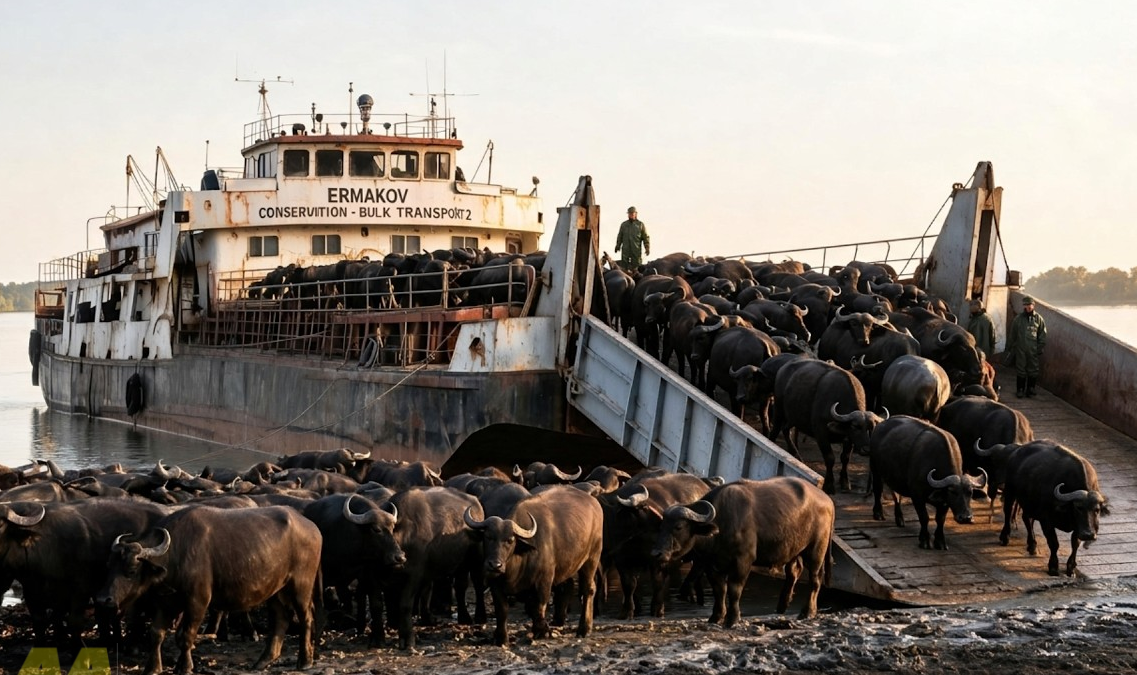
Ten years later, in the spring of 2019, seven water buffalo arrived on a barge.
They were unloaded onto the island and simply allowed to roam. There were no engines cutting through the reed, no endless crews clearing vegetation, and no complicated machinery waiting to reshape every corner.
There were only seven animals, two females and five males, and one of the females was pregnant.
Five years later, researchers returned to see what those animals had actually changed. What they found suggested that the island had never needed to be controlled more aggressively at all, but had instead been waiting for something that had been missing for centuries?
Long before anyone drew boundaries around Ermakov, the Danube Delta operated according to a rhythm that was almost impossible to stop.
Every spring, the river rose. Water spread outward through channels and across low ground, carrying fresh silt, nutrients, seeds, and young fish into places that would otherwise have remained separated from the main river.
When the water withdrew, it left behind shallow pools, muddy edges, patches of grass, and countless temporary habitats.
The island was never supposed to remain unchanged. That was the secret of its richness.
Water moved. Plants grew. Animals grazed. Mud was disturbed. Openings appeared and disappeared. Then the twentieth century brought a different idea.
Under the Soviet Union, engineers surrounded Ermakov with earthen dikes and cut the island away from the river.
Pumps drained the land, and agriculture replaced the natural flood cycle. On paper, the transformation represented progress.
The water that had shaped the island for thousands of years was treated as an obstacle.
The fields worked for a time. Then the farming faltered. Eventually, the people left. But unlike the people, the dikes remained.
Ermakov entered a strange period of abandonment. It was no longer a functioning agricultural landscape, but it was not a functioning wetland either.
The river had been kept outside. The old flood cycle had been interrupted. And nature did not simply return to the condition that existed before the machinery arrived.
Instead, one plant discovered that the abandoned landscape suited it remarkably well. Common reed. Reed had always belonged in the Danube Delta.
In a healthy wetland, it was simply one component of a much larger community. But Ermakov was no longer a healthy wetland.
The water was stagnant. The open spaces were disappearing. There were no large herds moving through the vegetation to continually disturb it.
Nothing was breaking the reed into patches. Nothing was creating pathways. Nothing was opening pools.
So the reed expanded. Two meters. Three meters. In places, four meters high. It became so dense that moving through it could feel like trying to push through a living wall.
From the air, Ermakov looked green. That appearance was deceptive. Under the canopy of reed, sunlight struggled to reach the water.
Aquatic plants needed that sunlight. Without enough light, they became scarce. Then, each autumn, the reed itself collapsed.
The dead stems accumulated in the water. As organic material broke down, oxygen levels were affected.
The wetland became increasingly uniform. And uniformity was exactly what the island could not afford.
Fish needed shallow, open areas where they could reproduce. Amphibians needed small pools. Insects needed varied vegetation and water conditions.
Wading birds needed mudflats and open shallows where prey could be seen. Ducks needed open water.
Pelicans needed feeding grounds. The great white pelicans that had once been associated with the richness of the Danube Delta found fewer reasons to return.
The island had become a strange contradiction. It was covered with life, yet supported far less variety than before.
The reed was not the real cause. It was the visible consequence. The deeper problem was that something had disappeared from the system.
For thousands of years, European wetlands had been shaped by large grazing animals. Wild horses moved across open ground.
Red deer passed through marshes and forests. Wild boar disturbed soil. Aurochs, the enormous wild cattle of ancient Europe, grazed vegetation and moved through wet landscapes.
In warmer wetlands, wild water buffalo and related animals performed similar work. They did not think of themselves as conservationists.
They were simply feeding. But their feeding changed the landscape. A large grazer could enter a dense stand of vegetation and consume part of it.
Another section might be trampled. Mud could be churned beneath heavy hooves. Paths appeared. Small pools formed.
Plants that had been suppressed beneath a uniform canopy gained access to sunlight. Seeds were carried from one location to another.
The result was not a perfectly maintained meadow. It was something much more complicated. A patchwork.
Tall vegetation beside short vegetation. Open mud beside shallow water. Grass beside reed. Dense cover beside exposed ground.
That mixture created opportunities for many species at once. Then Europe lost most of its large wild grazers.
The aurochs disappeared from the landscape, with the last known individuals surviving in a Polish forest in the early seventeenth century.
Wild horses were pushed away from many of the places where they had once moved freely.
Other large herbivores were hunted, confined, or excluded from wetlands. The animals vanished gradually enough that people could forget what work they had once performed.
But the landscape remembered. When Ermakov was isolated behind its dikes, there was no large herd waiting to enter and keep the reed from dominating the island.
The machinery had removed the river. History had removed the grazers. The island was missing both.
The restoration effort therefore began with the first missing piece. Water. In 2009, conservationists cut into the old Soviet dike.
The opening was not dramatic compared with the enormous engineering project that had originally surrounded the island.
But it changed everything. The Danube entered. Water began moving across ground that had spent decades separated from the river.
Old channels filled. Stagnant areas were connected. Fresh silt and nutrients arrived. Fish could move through the reopened waterways.
The island began receiving the seasonal influence that had shaped it for thousands of years.
Open water expanded to roughly twice its former area. Oxygen conditions improved. The wetland began functioning more like a wetland again.
For a moment, it might have seemed that the problem had been solved. But the reed remained.
The water could flow around it. It could refill channels. It could restore fish movement.
But it could not walk through the dense vegetation. The reed still covered enormous portions of Ermakov.
The island needed another missing force. This time, that force had four legs. The organizations behind the project, including Rewilding Ukraine and the wider Rewilding Europe network, began considering an unusual solution.
If the island had lost its large grazers, perhaps a large grazer needed to return.
The original aurochs was gone. The truly wild horses that had once occupied the region were no longer available for this role.
So attention turned toward water buffalo. At first, the idea sounded almost too simple. Bring buffalo to an island.
Let them wander. Wait. But the choice was based on the animal’s biology. Water buffalo are remarkably comfortable in wetlands.
They can move through deep water. They tolerate muddy ground. They feed on coarse vegetation that many ordinary cattle avoid.
And they do not need a perfectly managed pasture to function. They can simply graze.
For Ermakov, that mattered. The project was not looking for animals that would behave like lawnmowers.
It needed animals that would behave like animals. The first herd came from the Ukrainian countryside.
The buffalo were checked and prepared for the journey. Eventually they reached the edge of the Danube Delta.
There, they were loaded onto a flat river barge. Seven animals stood on the deck.
Five males. Two females. One of the females was pregnant. The barge moved through the delta toward Ermakov.
It was an unusual restoration operation. There were no enormous excavators waiting on the shore.
No fleet of machines. No industrial equipment designed to remove every reed stem. Just seven buffalo traveling across the water.
In the spring of 2019, they stepped onto Ermakov Island. Then they were released. There were no barns waiting for them.
No permanent feed operation. No machinery following behind them. They were simply given space. And they began doing what water buffalo have always done.
They wandered. They grazed. They pushed through vegetation. They entered wet ground. They rested in mud.
They moved again. At first, the change was difficult to see. Seven animals cannot transform an entire island overnight.
But restoration was never about what happened in one day. It was about what happened every day afterward.
A buffalo entered a reed bed and began feeding. Another followed. A path opened. A small patch became shorter.
Another patch remained tall. The animals moved again. Their grazing was uneven. That unevenness became the key.
A machine can create an even cut. A buffalo does not. An animal feeds where it wants, rests where it wants, moves toward water, searches for fresh vegetation, and changes direction according to conditions.
The result is unpredictable in the best possible way. Instead of one enormous wall of reed, Ermakov slowly began developing different kinds of spaces.
Tall reed remained in some areas. Short vegetation appeared elsewhere. Bare mud emerged. Grass expanded.
Open water became more visible. The island began breaking into pieces. Not broken pieces. Different pieces.
That distinction mattered. A wetland with many habitat types can support far more life than a wetland dominated by one plant.
And the buffalo were creating those differences without being instructed to do so. But grazing was only the beginning.
Water buffalo also have another habit. They like mud. During warm weather, they enter shallow water and create wallows where they can rest and cool themselves.
Every wallow leaves a small depression. Water gathers there. A depression becomes a shallow pool.
A shallow pool becomes a new habitat. Frogs and toads can use it. Dragonfly larvae can develop there.
Beetles and other insects find new places to live. Birds can search along the muddy edges.
One animal rolling in mud can therefore create a habitat for dozens of other organisms.
Then there is another contribution that is easy to overlook. Dung. As the buffalo move across Ermakov, they leave manure behind.
That material becomes part of the food web. Insects arrive. Beetles break it apart. Other organisms feed on those insects.
Fish, amphibians, and birds can eventually benefit from the expanding insect community. The buffalo are therefore not simply removing vegetation.
They are adding material back into the ecosystem. And they are also carrying seeds. A buffalo feeding on wetland plants can consume seeds and later transport them to another part of the island.
The seeds emerge somewhere new, accompanied by natural fertilizer. A plant that had been crowded out in one location can appear somewhere else.
The buffalo become accidental gardeners. They do not know that they are restoring plant diversity.
They do not need to. Their ordinary behavior performs the work. This is what separates rewilding from traditional mechanical restoration.
A machine can remove vegetation. A machine cannot graze selectively according to instinct. A machine cannot create wallows while cooling itself.
A machine cannot spread seeds through its digestive system. A machine cannot deposit dung that feeds insects.
The buffalo do all of these things simply because they are buffalo. And slowly, the island began to change.
The herd grew. Calves were born on Ermakov. The original seven animals became a couple of dozen, with additional animals later introduced to maintain a healthy breeding population.
The number mattered, but the behavior mattered more. The buffalo were creating disturbance. Disturbance had once been considered a problem.
On Ermakov, disturbance was becoming the solution. The reed no longer controlled every part of the island.
The Danube could move through open channels. Sunlight could reach the water. Plants returned to places where they had been absent.
Small fish entered the shallows. Amphibians found new pools. Insects returned. Birds noticed. And when birds notice a wetland becoming productive again, they do not need an invitation.
They arrive because food is there. Mudflats provide feeding areas. Shallow water exposes prey. Vegetation provides nesting opportunities.
The island becomes useful again. The return of birds was one of the clearest signs that the restoration was changing the ecosystem rather than simply changing its appearance.
From above, Ermakov no longer looked like one continuous green carpet. It was becoming a mosaic.
Water. Mud. Grass. Reed. Open patches. Dense patches. Shallow pools. Channels. That complexity was precisely what had been missing.
The transformation also placed Ermakov inside a much larger European experiment. Across the continent, conservationists have increasingly explored a concept known as trophic rewilding.
The basic idea is that ecosystems sometimes lose not only species, but functions. When a large herbivore disappears, the vegetation changes.
When a predator disappears, prey behavior may change. When beavers disappear, waterways lose natural dam builders.
Restoring the species can restore the function. In the Netherlands, Oostvaardersplassen became a major example of a landscape where hardy horses and cattle were allowed to shape a wetland environment.
In southern England, the Knepp project transformed a failing farm by allowing longhorn cattle, ponies, pigs, and other animals to move across the landscape.
Beavers have also returned to rivers in various parts of Europe, where their dams can create wetlands and change the movement of water.
Each project is different. None can simply be copied onto another landscape. But the underlying principle is similar.
Sometimes nature needs fewer instructions and more of the missing participants. Ermakov offered a particularly powerful example because its history was so clear.
First, the river was removed. Then the large grazers were absent. Then reed expanded. Then the island became increasingly uniform.
Restoration reversed the sequence. The river came back. Then the grazer came back. Then the landscape began becoming diverse again.
The important point was not that buffalo were magical. They were not. They were simply suited to a job that had been left empty.
But the recovery was not perfect. It could not be. Since 2022, the war in Ukraine has affected the region around the delta.
Monitoring an isolated wetland is difficult under normal circumstances. In a conflict affected border region, it becomes substantially harder.
Researchers cannot observe every change. They cannot always reach every location. And conservation work becomes more complicated when the surrounding landscape itself is unstable.
The herd is also still relatively small. The buffalo have transformed parts of Ermakov, but they do not yet graze every area that could benefit from their presence.
And then there is climate. The Danube Delta is expected to face hotter and drier conditions in coming decades, along with longer periods of drought and less predictable flooding.
That creates a difficult question for a restoration project built partly on the return of water.
What happens if the river becomes less reliable? What happens if the seasonal rhythm that restored Ermakov begins changing again?
No herd can control the climate. No dike breach can guarantee a permanent flood cycle.
No restoration project can promise that a recovered landscape will remain unchanged. That is why Ermakov is not a finished story.
It is an experiment still unfolding. But perhaps the most remarkable part is that the experiment began with such a small number.
Seven. Seven water buffalo. They were not introduced as symbols. They were not expected to solve every ecological problem.
They were simply capable of performing a role that had been missing. And once they began performing it, other processes could follow.
The river supplied water. The buffalo created disturbance. Plants returned. Insects responded. Fish used reopened habitat.
Amphibians found pools. Birds followed the food. One change unlocked another. That is how healthy ecosystems often work.
Not as machines where one component can be replaced by another identical component, but as networks where one action creates opportunities for many other processes.
The old approach to conservation often focused on control. Cut the reed. Pump the water.
Build the barrier. Remove the unwanted species. Plant the desired species. Manage every detail. Ermakov offered another possibility.
Restore the conditions. Bring back the missing ecological roles. Then allow the landscape to respond.
That does not mean abandoning management completely. The island still requires monitoring. The buffalo herd still requires attention.
Environmental changes still have to be measured. The consequences of war still have to be considered.
But the restoration does suggest that human beings do not always need to perform every ecological task themselves.
Sometimes the better approach is to create the conditions in which natural processes can return.
The seven buffalo became part of that process. Their tracks crossed the island. Their grazing opened the reed.
Their wallows filled with water. Their dung supported insects. Their movements carried seeds. And with every ordinary action, the island became slightly less uniform.
The most surprising thing about Ermakov is therefore not that seven buffalo changed a landscape.
It is that the landscape had been waiting for them. For decades, people had looked at the island and seen an overgrown wetland that needed to be cleared.
The buffalo revealed something different. The island did not necessarily need to be cleared. It needed to be disturbed in the right way.
It needed water. It needed grazers. It needed space for natural processes to interact. Once those conditions returned, the island began doing much of the work itself.
Imagine standing on Ermakov now. The Danube moves through channels that had once been isolated.
Reed still grows, because reed belongs here. But it no longer has the entire island to itself.
There are open patches. There are shallow pools. There are muddy edges. There are grasses.
There are insects moving through vegetation. Fish moving through the water. Birds searching the shallows.
And somewhere among all of it, a buffalo lowers its head and begins feeding. It has no idea that researchers are watching.
It has no idea that its ancestors helped shape wetlands long before modern borders existed.
It does not know that seven animals arrived on a barge in the spring of 2019.
It does not know that people once believed the island required more machines. It simply walks.
And that may be the deepest lesson of Ermakov. The island was damaged not because nature stopped working, but because too many of the forces that had once shaped it were removed.
The flood was removed. The grazers were removed. The disturbance was removed. The landscape became simpler.
Then restoration began by putting some of those forces back. Water returned in 2009. Buffalo returned in 2019.
The island responded. Not instantly. Not perfectly. But visibly. And that makes Ermakov more than a successful wetland project.
It becomes a reminder that landscapes have histories. A marsh can look natural while missing the animals that once shaped it.
A green island can appear healthy while supporting very little variety. A river can be nearby while its water has been prevented from reaching the land.
Sometimes the missing piece is not something new. Sometimes it is something old. Something that used to be there.
Something ordinary. Something as simple as an animal walking through the reeds. The seven buffalo did not rebuild Ermakov with technology.
They did not follow a blueprint. They did not know where the restoration boundaries were.
They simply occupied the landscape and performed the behaviors their species had evolved to perform.
And those behaviors began connecting pieces of the ecosystem that had been separated for generations.
The island is still vulnerable. The herd is still growing. The climate is changing. The region remains difficult to monitor.
There is much more work ahead. But when researchers look across Ermakov today, they can see something that was almost impossible to imagine when the island sat behind its old dikes.
Movement. Water moving through channels. Fish moving through shallows. Birds moving across open water. Insects moving through vegetation.
And buffalo moving through the reed. The landscape is no longer frozen into one shape.
It is changing again. And perhaps that is what recovery was supposed to look like all along.
Not a perfect return to the paSt. Not a landscape controlled into permanent stability. But a place where water can move, plants can compete, animals can disturb the ground, and countless smaller organisms can respond to those changes.
Ermakov was never rescued by a single heroic machine or a spectacular engineering project. Its recovery began when people recognized what had been missing and then gave those missing forces room to work.
First came the river. Then came seven buffalo. And after them came a much larger cast of animals, plants, insects, fish, and birds that could finally find opportunities on an island that had spent decades waiting for them.
The strangest part is that none of it required the buffalo to understand what they were doing.
They only had to be allowed to roam. And perhaps that is why Ermakov remains such a powerful experiment.
Because sometimes restoring a landscape does not begin by asking what humans should build next.
Sometimes it begins by asking what was taken away, and whether there is still a way to let it return?
Disclaimer: This content may be created by Al for entertainment purposes. Any resemblance to real persons, events, or places is coincidental.








