They Released Thousands of Piranhas to Eliminate the Snakes in the Rice Paddies — What Happened Next
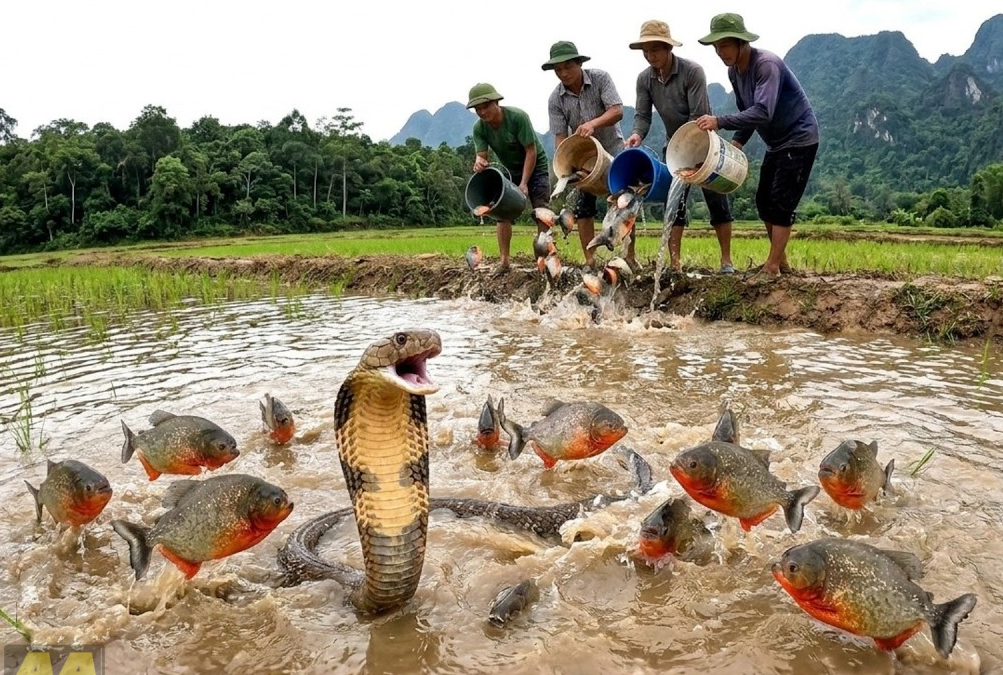
The water looked harmless from a distance. Across the flooded rice fields of South Asia, the morning light spread over thousands of shallow paddies until the whole landscape seemed to become one enormous sheet of silver and brown.
Farmers stepped into it every day, trusting ground they could no longer see. Beneath the surface, however, the mud was moving.
Something had been watching from between the rice stems, something built for warm water, darkness, and sudden movement.
The danger was not visible until the moment a bare foot pressed into the mud beside it.
Then everything could change in seconds. During the wet season, the fields became a maze of submerged paths, low banks, drainage channels, and hidden pools.
Snakes followed the water into places where people worked, while farmers continued their routines because the rice could not wait for the water to recede.
The problem seemed impossible to solve. The fields could not simply be drained, the snakes could not be found one by one, and every ordinary solution seemed too slow for a danger that could appear beneath the next step.
Then someone proposed an idea that sounded almost perfectly designed for the problem. If people could not see what moved beneath the water, perhaps another predator could find it for them.
Thousands of red bellied piranhas from the Amazon could be released into the flooded paddies and allowed to hunt whatever moved beneath the surface.
It sounded simple. But what happens when the hunter cannot tell the difference between the target and everything else?
The first mistake began long before the piranhas ever touched the water. It began with the assumption that a flooded rice field was a simple environment.
It was not. Across South and Southeast Asia, rice paddies were not merely fields. They were temporary wetlands created by people for agriculture, but they also became living systems filled with fish, frogs, insects, snails, shrimp, rodents, birds, and reptiles.
When the monsoon arrived, the boundaries between one part of the landscape and another became less important.
Water moved through channels, overflowed low banks, collected in shallow depressions, and connected places that looked separate from the ground.
For the farmer, this water was essential. For the snake, it was opportunity. Cobras and other snakes adapted to the seasonal landscape could move through flooded fields with surprising ease.
The water brought warmth and food. Small fish appeared in greater numbers. Frogs gathered around the edges.
Rodents found shelter among vegetation and raised banks. The flooded landscape created cover almost everywhere.
The farmer entering that same field faced a completely different reality. Visibility could be almost nothing beneath the muddy surface.
A person could feel the bottom with their feet but could not reliably distinguish a submerged root from a branch, a clump of vegetation, or a snake resting in the mud.
The danger was hidden inside the same environment that provided the farmer with a livelihood.
A snake disturbed beneath the water had very little reason to remain still. That was the central problem.
The person could not see the snake. The snake could feel the person. A sudden step could turn a quiet patch of water into a moment of panic.
The snake reacted defensively, and the person often had no warning until the encounter had already happened.
The biological weapon proposal seemed to solve the visibility problem. Red bellied piranhas had evolved in the murky waters of the Amazon basin.
They did not depend entirely on clear vision to detect movement. Along the sides of their bodies, the lateral line system allowed them to sense pressure changes and vibrations in surrounding water.
A snake moving through water produced exactly the kind of signal a fish could detect.
The proposal therefore appeared almost elegant. Release the piranhas into flooded fields. Let them find the snakes.
Allow the dry season to remove the water. Then collect whatever fish remained. The idea depended on one assumption after another, each one appearing reasonable when examined alone.
The piranhas would stay in the paddies. The snakes would be their preferred prey. The native fish would somehow survive the introduction.
The dry season would prevent the piranhas from spreading. The surrounding waterways would remain separate.
And most importantly, the predator would behave exactly as people wanted it to behave. That last assumption was the most dangerous.
Predators do not understand human targets. They understand opportunity. Imagine a piranha entering a flooded field.
Ahead of it is a cobra. The snake is large, fast, defensive, and capable of striking back.
Nearby are small carp, shrimp, young fish, snails, and other creatures that offer far less resistance.
There is no reason for the piranha to choose the dangerous meal firSt. It chooses what is easieSt.
The first wave of feeding therefore moves through the ecosystem in a direction nobody intended.
The small fish disappear. Then the shrimp become scarce. Then other small aquatic animals become difficult to find.
The piranhas have not solved the snake problem. They have simply removed the animals that were easier to catch.
That changes everything. A rice field is full of creatures that perform quiet ecological work without anyone noticing.
Small fish consume mosquito larvae. Amphibians consume insects. Aquatic organisms break down plant material. Fish move nutrients through the water and into the food chain.
Remove enough of those organisms and the field begins behaving differently. The water that once contained countless small predators now offers more room for mosquito larvae to develop.
What had been an agricultural wetland becomes a much more favorable nursery for insects. The consequences do not arrive all at once.
That is what makes ecological disruption so difficult to recognize. One day there are fewer small fish.
A week later, someone notices more insects. Later, the fish catches become smaller. Then families begin traveling farther for food.
One change follows another until the original decision is almost forgotten. The farmers who were supposed to benefit from the piranhas begin losing some of the most useful resources in the fields themselves.
For many rural families, fish from rice paddies, irrigation channels, ponds, and nearby waterways are not luxury food.
They are affordable sources of protein. A small catch can become part of a family’s meal without requiring expensive equipment, long travel, or a large financial investment.
When those fish disappear, the impact reaches the household. The piranhas have not only entered the water.
They have entered the food system. And still the snakes remain. At first, the piranhas avoid them because the fields are full of easier prey.
But eventually the easy prey becomes scarce. The predator now faces a different environment. The buffet is gone.
The snakes remain. That is when the relationship changes. The piranhas begin harassing larger animals that they had previously ignored.
A snake moving through shallow water is no longer simply another resident of the field.
It becomes one of the few remaining sources of movement and food. But a large snake is not the same as a small fish.
The encounters become chaotic. Instead of a clean hunt, there are repeated attacks and frantic movements through the water.
Snakes are forced away from places where they would normally reSt. Their movements become less predictable.
Their normal patterns of feeding and shelter change. And this creates another problem. The snakes begin looking for safer ground.
The flooded fields are no longer comfortable. The water itself has become dangerous. So the snakes move outward.
Some move toward field margins. Some move toward drainage channels. Some move toward nearby buildings.
And some enter villages. That is where an agricultural problem becomes a household problem. Certain snakes in South Asia are especially associated with human settlements because houses can provide warmth, shelter, and access to prey.
During the night, a snake may enter a building through a small opening and remain hidden beneath furniture, inside piles of material, or near bedding.
The danger is made worse by darkness. A person sleeping cannot see what has entered the room.
A person walking barefoot at night cannot easily distinguish a snake from a shadow or piece of debris.
The piranhas were introduced to push snakes away from people. Instead, they could push some snakes toward the places where people were least prepared to encounter them.
And then came the problem that could not easily be reversed. The fields were never isolated.
During the monsoon, water levels rise. Channels fill. Drainage systems connect. Banks overflow. A paddy that looks like a separate pool from above may be connected to another paddy, then a ditch, then a canal, and eventually a permanent river.
The piranhas did not understand the boundaries humans had drawn across the landscape. They followed the water.
That was all they needed. A fish released into a field could move through a drainage channel during high water.
From there it could enter a larger stream. A stream could lead into a river.
A river could carry an entire population far beyond the place where the original release occurred.
The dry season was supposed to be the reset button. But the dry season only works as a reset when the water remains isolated.
Once the piranhas reached permanent waterways, the plan changed forever. Now there was no single field to empty.
There was a connected aquatic system. A river does not care where a biological experiment was supposed to end.
The piranhas could feed, move, reproduce, and spread. A temporary pest control program had become an invasive species problem.
At that point, removing them would require an enormous effort, and almost every method would create another problem.
Nets could catch some fish. They could not remove an entire river population. Poison might affect the piranhas.
It would also threaten the native organisms living in the same water. Draining one field would not solve the problem because the animals had already moved beyond it.
The original idea had depended on control. The landscape had produced spread. History had already shown how dangerous that difference could be.
During the nineteenth century, small Indian mongooses were introduced to various islands and agricultural regions because people hoped they would reduce rats damaging crops.
The mongoose was fast and adaptable. But its habits did not match the problem it was brought to solve.
The rats were often active at night. The mongooses were largely active during the day.
The predator therefore found other things to eat. Birds. Lizards. Frogs. Eggs. Small native animals.
The target remained. The ecosystem changed. Australia experienced another famous example in 1935 when cane toads were introduced in an attempt to control beetles affecting sugar crops.
The toads did not solve the problem as intended. Instead, they spread across enormous areas.
Native predators that had no evolutionary experience with the toad could be affected when they attempted to consume it.
The lesson was not that every introduced predator behaves identically. The lesson was that ecosystems do not obey the purpose assigned to an imported species.
A creature cannot be instructed to attack only the problem humans have chosen. It responds to food, shelter, temperature, competition, reproduction, and opportunity.
The piranha proposal depended on the opposite assumption. It assumed the predator would remain focused.
Nature does not work that way. The deeper problem was not simply the piranha. It was the idea that one species could be inserted into a complicated ecosystem and expected to perform a single task without touching anything else.
Every predator is connected to prey. Every prey species is connected to vegetation. Every aquatic animal is connected to water quality.
Every small fish is connected to insects. Every insect is connected to birds, frogs, and other predators.
Change one level and pressure moves outward. Ecologists call one form of this process a trophic cascade.
The phrase sounds technical, but the mechanism is simple. Change who eats whom, and the consequences travel.
Remove small fish and mosquito larvae may increase. Reduce aquatic food sources and snakes may change their movements.
Alter snake movements and encounters with people may shift. Introduce a new predator and competition may change.
Connect that predator to permanent waterways and the entire scale of the problem changes. A field becomes a river.
A river becomes a region. The original target becomes almost irrelevant. The most troubling part of the scenario was that none of these steps required the ecosystem to behave strangely.
The ecosystem only had to behave normally. The piranhas fed. The fish responded. The snakes responded.
The water moved. The animals followed food and shelter. People continued working. Every piece followed its own rules.
The human plan failed because the plan assumed the rules could be overridden. But there was another way to look at the original snake problem.
Instead of asking how to remove snakes, ask why the encounters were happening. The answer leads away from exotic predators and toward practical protection.
Farmers work in flooded fields because rice requires water. That cannot simply be changed. But people can reduce exposure.
High topped rubber boots can place a physical barrier between feet and hidden animals. A flashlight can reveal movement that would otherwise be invisible at night.
A stick can be used to disturb vegetation and check the path ahead. Raised sleeping platforms can reduce the chance of snakes entering bedding.
Bed nets can create another barrier. Better lighting around homes can make movement easier to see.
Education can teach people how to respond after a bite instead of wasting precious time on harmful traditional methods.
And then there is antivenom. The existence of effective treatment changes the entire problem. The question is not simply whether medicine exists.
The question is whether the correct medicine can reach the right person quickly enough. Antivenom is a biological product that requires careful storage.
A rural clinic without reliable electricity may struggle to maintain the necessary conditions. A hospital may have supplies but be many kilometers away.
Roads that are usable during the dry season can become difficult during heavy rain. A patient can lose valuable time simply trying to reach medical care.
There is also another complication. Different snake species produce different venoms. Antivenom must therefore be appropriate for the species involved.
Having a vial somewhere in a district does not automatically mean the right treatment is available at the moment it is needed.
The World Health Organization recognized snakebite and envenoming as a neglected tropical disease in 2017.
That recognition reflected a problem much larger than any single rice field. The issue was not merely snakes.
It was poverty, transportation, healthcare access, storage, education, protective equipment, and the distance between rural workers and reliable medical treatment.
Those problems do not produce dramatic footage. There is no giant predator swimming through a flooded field.
There is no cinematic moment when a shipment arrives from the Amazon. There is simply a clinic refrigerator working through another hot afternoon.
There is a farmer pulling on protective boots before entering the water. There is a flashlight placed beside a bed.
There is a road kept open during the rainy season. There is a medical worker who knows which treatment is appropriate.
These solutions appear ordinary because they are ordinary. But ordinary does not mean insignificant. The most effective answer to a complicated ecological and public health problem is often the one that respects the complexity instead of trying to overpower it.
The piranha plan promised a shortcut. Shortcuts are tempting because the original problem is frightening.
A farmer wants to know what is under the water. A planner wants a solution that works across thousands of fields.
A government wants something that can be announced and measured. A predator appears to offer all of that in one package.
Release it. Wait. Let nature do the work. But nature does not perform the work according to a human contract.
The piranha does not know that the snake is the intended target. The snake does not know that the piranha was introduced as a control measure.
The fish does not know that it represents a family’s dinner. The mosquito does not know that its larvae were supposed to be controlled by native fish.
The river does not know where the experiment was supposed to end. That is the deeper lesson.
An ecosystem is not a machine with one damaged component. It is a web of relationships operating at different speeds.
Some changes happen in hours. Others take weeks. Others take an entire season. And some consequences do not become obvious until the original decision has disappeared from public attention.
A piranha entering a rice field may look like one small event. A piranha entering a river system is something else.
The difference is scale. The same principle appears everywhere humans have tried to solve ecological problems with imported species.
A predator can become prey. A pest can become a food source. A food source can disappear.
A river can become a highway. A field can become a nursery. A solution can become a new problem.
None of this means people should simply accept the danger posed by snakes. It means the response has to account for the entire system.
The farmers in the rice fields do not need a dramatic monster. They need protection that works.
They need access to treatment. They need roads, communication, electricity, storage, training, and practical tools.
They need solutions that reduce encounters without creating another ecological crisis. And that requires a different kind of thinking.
Not less ambitious thinking. More careful thinking. The most powerful intervention may be the one that changes the fewest things while solving the actual problem.
A pair of boots does not alter a river. A flashlight does not replace a native fish community.
A functioning clinic does not compete with a local predator. A reliable road does not become an invasive species.
A refrigerator does not reproduce. That is why the quiet solutions matter. They solve the human problem without asking the ecosystem to absorb another uncontrolled change.
The flooded rice field will continue to transform with the monsoon. Water will arrive. Rice will rise.
Fish will move. Frogs will call from the banks. Snakes will search for shelter. Farmers will enter the fields again.
The goal is not to make the landscape behave as though snakes never existed. The goal is to make the people working there safer while allowing the ecosystem to remain intact.
The piranha idea began with a simple question. How can one predator remove another? The better question is harder.
How can people reduce dangerous encounters without destroying the relationships that keep the landscape functioning?
That question does not have the drama of thousands of exotic fish arriving from another continent.
But it has something more important. It starts with reality. And reality is where every successful solution has to begin.
The water was never empty. The field was never simple. The snakes were never the only problem.
The fish were never just fish. The canals were never just drainage channels. Every part was connected to something else, and once a new predator entered the system, those connections became the path along which the consequences traveled.
The mistake was believing that the water could carry a solution without carrying everything else with it.
It could not. The same current that moved the piranhas would move the problem. The same flooded channels that connected the fields would connect the consequences.
And the same ecosystem that had made the rice fields productive would respond in ways no human plan could fully command.
That is why the most important lesson from the piranha proposal is not about piranhas at all.
It is about restraint. When a problem appears to have one obvious enemy, removing that enemy can feel like progress.
But before introducing something new, the first question should always be what else depends on the thing we are about to change?
And before releasing a predator, another question matters even more? What happens when it stops doing the job we gave it and starts doing the job nature gave it?
The rice fields already had an answer. Nature always does.
Disclaimer: This content may be created by Al for entertainment purposes. Any resemblance to real persons, events, or places is coincidental.








