They Put Giant White Dogs With Sheep Surrounded by Coyotes — What Happened Next Was Incredible
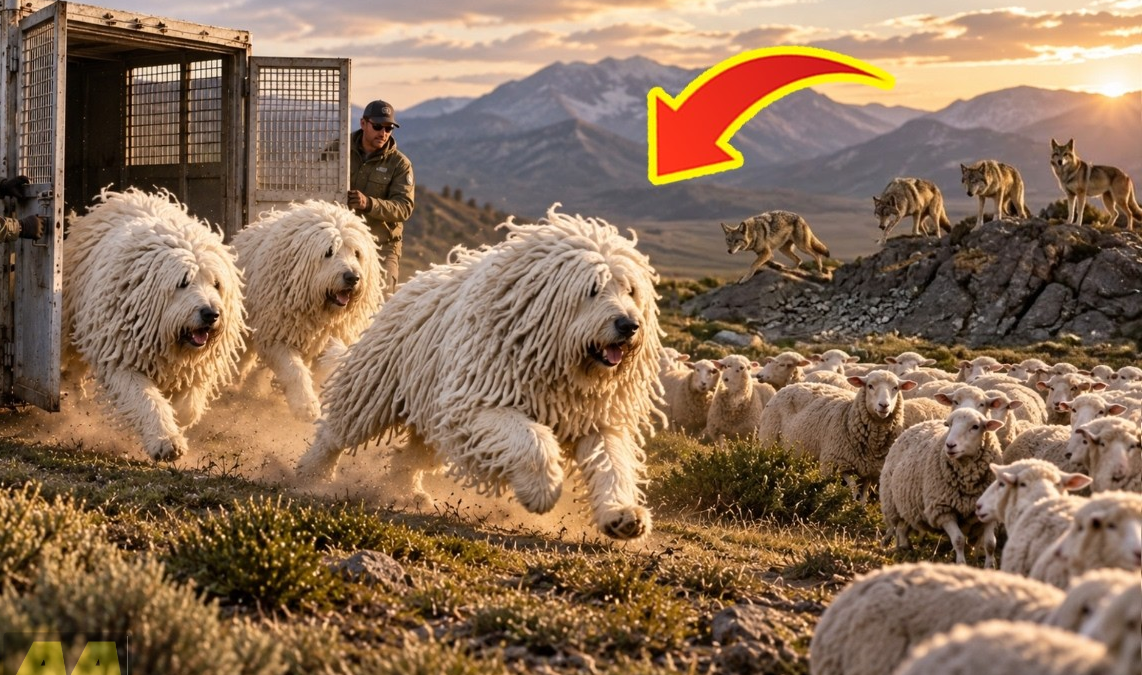
The first time the coyote came close, nobody moved. It stood beyond the sheep, its gray shape almost invisible against the Idaho grass, watching from the edge of the enclosure.
Inside 160 acres of open ground, nine Commandor dogs were scattered among the flock. They were not chained.
They were not being directed by a shepherd. No one shouted an order. Then the coyote took another step.
One of the dogs lifted its head. Another turned. A third began walking. Within seconds, a dog had placed itself between the predator and the sheep, creating a quiet line that neither animal seemed willing to cross.
There was no gunshot, no trap snapping shut, no helicopter overhead. There was only a dog standing in the grass, waiting.
The researchers watching from a distance wrote down what happened. Then it happened again. And again.
Over the course of the experiment, the coyote would approach the flock 79 times. On 75 of those occasions, a dog moved between it and the sheep or forced it away.
Not one sheep was lost while a guardian was nearby. Across the enclosure, the control flock had no such protection.
More than 40 percent of those animals were lost during the same experiment. The numbers were so clean that they seemed almost impossible.
A dog could replace a weapon. A dog could make a predator change its calculation.
But if the evidence was already this powerful in 1982, why did the breed at the center of the experiment almost disappear from American ranching?
In 1970, the answer to that question would have seemed very different. Robin Giles stood on Hillington Ranch in Kerr County, Texas, watching the morning light spread over the Edwards Plateau.
The landscape had always demanded patience. Limestone stretched beneath the grass. The country could look peaceful from a distance, but anyone who depended on sheep and goats knew how quickly a quiet pasture could become a place of constant calculation.
Water had to be watched. Fences had to be checked. Lambs and kids had to be counted.
And then there were coyotes. Giles watched his flock shrink throughout the year, not because the land had suddenly stopped producing, and not because the animals had forgotten how to survive on the range.
The problem came after dark. A lamb would disappear. Then another. Sometimes the signs were obvious.
Sometimes they were not. By the end of a single year, Giles had lost more than 400 sheep and goats.
At the time, that represented about $10,000. Adjusted for inflation, that would be more than $82,000 today.
Nearly 70 percent of the ranch’s potential income had been taken away through repeated losses.
Giles needed something that would work. Like many Texas ranchers in that decade, he hired a trapper.
The trapper removed 14 coyotes from the property. For a short time, the pasture became quieter.
Then the coyotes returned. They were remarkably adaptable. They moved through the darkness, found vulnerable lambs first, and disappeared before morning.
Giles would walk the pastures at dawn and discover another part of the flock missing.
The trapper could remove individual animals. The range kept producing more. And across the Edwards Plateau, Giles was far from alone.
During the 1970s, American sheep producers were reporting annual predation losses exceeding $20 million. Coyotes represented the majority of those losses.
Texas was among the states carrying some of the greatest burdens. For ranchers, this was not an abstract wildlife question.
It was a business problem repeated night after night. Every missing animal represented money that could not be recovered.
Every new lamb or kid meant another vulnerable animal entering the pasture. And every coyote removed seemed to create an empty space that another coyote could eventually occupy.
The tools available to ranchers were becoming increasingly aggressive. Traps were used. Rifles were used.
Poison was used. Compound 1080, sodium floracetate, had become one of the most powerful chemical tools available for predator control.
But its effects did not stop with coyotes. Other animals could encounter it. Eagles could encounter it.
Foxes could encounter it. Domestic dogs could encounter it. In 1972, President Nixon signed an executive order banning its use on federal lands, and the EPA followed with a full ban.
Other methods continued. Aerial gunning used helicopters to locate predators across open country. M44 cyanide ejectors were placed in the ground and baited with scent.
When an animal pulled at the bait, the device could release sodium cyanide. Steel jaw leg hold traps remained another tool.
The federal government continued spending enormous amounts of money on predator control. Yet the basic problem remained.
The coyotes were still there. There was another problem hidden beneath the surface. Removing predators could change the structure of the population itself.
When packs and territories were disrupted, surviving females could reproduce earlier and produce larger litters.
The result was compensatory reproduction. The more pressure placed on a population, the more rapidly the remaining animals could fill the available space.
The rancher could win one night and still face the same problem the next year.
By 2020, coyotes had expanded their range across all 48 contiguous states. They had become one of the most adaptable predators in North America.
At Hillington Ranch, the next generation watched the same cycle continue. Grant Giles had grown up around the problem.
He understood what coyotes meant to a working ranch. He also understood that the old approach had limits.
At one point, Grant saw a coyote defecate directly on top of an M44 device.
To him, it seemed almost like a message. The equipment was there. The coyote understood that something about it was dangerous.
The ranch needed another answer. Then, in the late 1970s, a rancher named Bob Buckolds tried something that many people in the Texas Hill Country considered unusual.
He bought five Great Pyrenees. The breed came from the mountains between France and Spain and had been developed for one purpose above nearly everything else.
Living with livestock. Protecting livestock. Staying with livestock. Buckolds placed the dogs with his sheep.
Then he did something even more unusual. He slept outside in the pasture. He wanted to see what happened when darkness arrived and the flock was left to itself.
He watched the dogs. He watched the sheep. He watched the edges of the pasture.
And what he saw changed the direction of his work. The dogs did not behave like ordinary farm dogs waiting for a human command.
They bonded with the flock. They remained near the animals. They watched the perimeter. When something approached, they responded.
The behavior seemed less like training and more like an inherited relationship between guardian and livestock.
The dog did not need to be convinced that the flock mattered. The flock became its world.
For thousands of years, certain breeds had developed alongside livestock in places where shepherds could not remain beside every animal every hour of the day.
The dogs learned to become part of the herd. They learned when to stay. They learned when to move.
They learned when presence alone was enough. But Texas created another problem. The Great Pyrenees had been built for mountain climates.
Their double coat was ideal for cold winters. Texas could remain above 100 degrees for weeks.
The same coat that protected the dog from mountain weather could become a burden under the Texas sun.
Buckolds began crossbreeding. He used Akbash. He used Pyrenees. He used Anatolian Shepherds. He selected for heat tolerance, a leaner build, endurance, and the same instinct that made a guardian dog remain with livestock.
The crosses began working. Over the next four decades, Buckolds refined his breeding lines. His dogs eventually reached ranches throughout central Texas.
Hillington Ranch became one of those places. Beginning in 2021, Grant Giles began using them.
But while Texas ranchers were discovering what guardian dogs could do, researchers in Idaho had already been asking a much more precise question.
Could a dog protect sheep under conditions that could be measured? The answer had been waiting in an Idaho enclosure.
In the late 1970s and early 1980s, researchers at the United States sheep experiment station outside Dubois, Idaho, began examining livestock guardian breeds.
The question was simple. Could a dog stand between sheep and a coyote consistently enough to change the outcome?
The researchers chose the Commandor. The breed had a long history in Hungary. It had arrived with the Cumans, Turk nomadic people who had moved west while fleeing the Mongol invasions of the 12th and 13th centuries.
The history of the breed reached back centuries. The earliest written record dated to 1544.
It appeared again in texts from 1673. In 2004, the Hungarian Parliament declared the Commodore a national treasure and banned modification to the breed standard.
But its history was only part of what made the dog unusual. The coat was the feature nobody could ignore.
During the first two years of a Commandor’s life, its outer fur tangled with the undercoat and gradually formed hundreds of dense cords.
The cords became long. They became heavy. Eventually, they could hang almost to the ground.
The result made the dog resemble a walking mop. But the appearance concealed a remarkable form of protection.
The cords could absorb the force of a predator’s bite before it reached the dog’s skin.
On Hungarian grasslands, that coat had served a practical purpose. The dog did not need to outrun a wolf.
It needed to remain between the flock and the threat. The coat was part of that strategy.
American researchers wanted to know whether that ancient working system could be demonstrated scientifically. In the summer of 1980, John Mcgru and Cindy Blakesley designed a controlled study at the USDA sheep experiment station.
Nine Commandor dogs were selected. Each was 26 months old. The dogs were placed in fenced enclosures covering more than 160 acres.
Sheep were placed inside. A coyote was introduced. The coyote was three years old, male, and had a documented history of approaching sheep.
This was not a rancher watching his pasture from the porch. It was an outdoor laboratory.
The researchers could observe the animals. They could record behavior. They could count approaches. They could compare the flock with guardian dogs against a control group without dogs.
Then the observations began. The coyote approached the flock 79 times. In 75 of those approaches, a Commandor moved between the coyote and the sheep or chased the coyote away.
That represented an interception rate of 95 percent. More importantly, not one sheep was lost while within range of its guardian.
The control flock provided the comparison. Without guardian dogs, 37 of 89 sheep were lost during the experiment.
More than 40 percent. The difference was not based on a story handed down from one rancher to another.
It was measured. The researchers watched what the dogs did. And the dogs did something remarkably simple.
They stayed. On average, each Commandor spent 74 percent of its time within 100 yards of the densest cluster of sheep.
It did not need to chase every coyote across the landscape. It did not need to run continuously.
It positioned itself near the flock. When a coyote circled closer, the dog moved toward the edge.
It became a coSt. The coyote approached. The dog responded. The coyote had to reconsider.
That was the principle. A guardian dog was not a fence. It was not a trap.
It was not a rifle. It was a living presence that made approaching the flock less attractive.
The researchers had numbers to describe it. The ranchers had a different way of understanding it.
A coyote did not need to be removed from the landscape. It only needed to decide that another meal would be easier to find somewhere else.
Mcgru and Blakesley published their findings in the Journal of Range Management, volume 35, number six.
The paper became one of the most tightly controlled American studies of a livestock guardian breed.
The evidence was remarkably clear. The Commandor worked. But that was where the story took an unexpected turn.
The problem was no longer whether the dog could protect sheep. The problem was whether American ranchers could live with the dog that had proven it.
The same coat that protected the Commandor in Hungary created difficulties in Texas. A full cord coat trapped heat.
It could hold moisture against the skin. If the cords were not separated regularly by hand, they could mat together.
The work required was substantial. A working Commandor was not simply a dog that could be turned loose and forgotten.
Each cord had to be separated from neighboring cords. The work began at the base.
It continued through the length of the coat. A complete separation could take hours. If a rancher waited too long, cords could fuse into heavy plates.
In a Texas summer, that was more than an inconvenience. It became a management problem.
A rancher working thousands of acres could not always spend hours maintaining one dog’s coat.
The Great Pyrenees had a different advantage. It shed. The Anatolian Shepherd shed. A shedding guardian could regulate its coat naturally while remaining in the pasture.
That difference sounds small until it is multiplied across a commercial operation. A rancher managing 2,000 sheep across 10,000 acres has fences to inspect, water systems to maintain, animals to count, feed to arrange, and weather to monitor.
The ranch does not stop because a guardian dog needs grooming. That was the gap between laboratory proof and commercial reality.
The Commandor had demonstrated the principle. Other breeds made the principle easier to operate. As more ranchers selected Great Pyrenees, Akbash, Anatolian Shepherds, and purpose bred crosses, those breeds became easier to find.
More breeders maintained working lines. More ranchers shared information. More puppies entered ranching operations. The Commandor became increasingly rare.
Fewer ranchers selected it. Fewer working breeders maintained it. The cycle continued. Eventually, the breed that had produced some of the cleanest experimental evidence in American livestock guardian research became one of the least common guardian breeds on American ranches.
The irony was difficult to miss. The science had worked. The dog had worked. The system had worked.
The market simply preferred another version of the same solution. At Hillington Ranch, the story came full circle.
Robin Giles had once watched more than 400 sheep and goats disappear from the ranch in a single year.
Decades later, Grant Giles was watching guardian dogs move through the same country. Beginning in 2021, Grant adopted Buckolds cross dogs.
The ranch began using a method based not on removing every coyote but on making the pasture a place where approaching the flock became difficult.
The coyotes did not vanish. They still lived around the ranch. Grant could still hear them at night.
But their calculation had changed. The dogs were there. And the dogs did not need to win every encounter.
They only needed to make the flock a harder target. That principle gradually spread beyond individual ranches.
By 2017, Texas A&M University had opened a university program dedicated to livestock guardian dog research and training.
By 2019, nearly 30 percent of American sheep producers reported using some form of guardian dog.
That was a dramatic change from the 1970s. Guardian dogs were no longer viewed simply as an old European ranching tradition.
They had become part of a modern livestock management strategy. The same country that had once relied heavily on traps, rifles, chemical controls, aircraft, and specialized devices was increasingly experimenting with animals that could remain in the pasture every night.
Even the federal wildlife management system began supporting guardian dog placements. The irony remained. The same federal system involved in predator control was also helping ranchers use guardian dogs.
The goal had shifted. Instead of trying to remove every predator, the focus could be placed on protecting livestock directly.
At Hillington, Grant could see the difference. Before guardian dogs, lamb and kid losses could reach 20 percent in some years.
By 2025, Grant reported a kid crop of 154 percent, meaning the average doe raised more than one and a half surviving kids per season.
The pasture had not changed completely. The coyotes had not disappeared. The landscape was still the same limestone country.
The difference was what stood among the livestock. Dogs. Guardian dogs. Animals bred for centuries to stay when other dogs would chase.
That was what Buckolds had discovered when he slept beside his flock. That was what Mcgru and Blakesley measured in Idaho.
And that was what Grant Giles eventually saw on the same Texas ranch where the problem had once seemed impossible to control.
The Commandor remained part of the story. Somewhere in the United States, on one of the few farms still maintaining working Commandors, a dog in a rope coat could still be doing what its ancestors had done for centuries.
Standing between a flock and whatever approached in the darkness. No researcher might be watching.
No paper might be written. No camera might record the encounter. The dog would not care.
It would simply remain there. That is what made the Commandor so important. It did not fail because the experiment was wrong.
It did not disappear because the breed could not perform its purpose. It became uncommon because the same characteristic that made it remarkable also made it difficult to operate in another environment.
The coat was the answer in one landscape. The coat was the problem in another.
That distinction explains much of the history of livestock guardian dogs in America. A scientific experiment can establish whether something works.
A ranch must establish whether it can work every day. Those are different questions. The Idaho researchers answered the first one.
The ranchers answered the second. And the answer took decades to become visible. The livestock guardian revolution did not depend on one breed.
The Commandor demonstrated that a dog could stand between a predator and a flock and change the outcome.
Great Pyrenees demonstrated that a similar system could operate in a hot environment with less maintenance.
Anatolian Shepherds brought another combination of endurance and heat tolerance. Akbash brought another working tradition.
Purpose bred crosses allowed ranchers to combine traits for their particular landscapes. The concept became larger than the breed that had first provided such clear experimental evidence.
At its center was one simple idea. Do not make the predator disappear. Make the flock a difficult choice.
That idea changed the way many ranchers approached the problem. A coyote does not need to be convinced that a pasture is forbidden.
It only needs to decide that another pasture offers an easier opportunity. The guardian dog changes that decision without changing the landscape.
The sheep remain. The coyote remains. The dog remains. And the encounter ends before the flock pays the price.
Forty years after the Idaho experiment, the original numbers still tell the story. Seventy nine approaches.
Seventy five interceptions. A 95 percent interception rate. Zero sheep lost while a guardian was nearby.
Thirty seven of 89 animals lost from the control flock. Those figures came from nine dogs in an Idaho enclosure.
The experiment did not predict everything that would happen on an American ranch. It did not solve the problem of heat.
It did not solve the problem of grooming. It did not create a national supply of working Commandors.
It simply demonstrated what happened when a livestock guardian dog was placed between sheep and a predator.
The rest of the industry built upon that discovery in its own way. By 2025, Grant Giles could stand on Hillington Ranch and hear coyotes in the distance.
The sound was familiar. His family had heard it for generations. But the meaning of the sound had changed.
A coyote calling from the darkness no longer automatically meant that a rancher had to reach for the old tools.
The dogs were already outside. They were already moving through the flock. They were already watching the edges of the pasture.
The solution had become part of the landscape. And that may be the strangest part of the entire story.
The ranch did not need fewer coyotes to become safer. It needed a different relationship between coyotes and livestock.
The Commandor had revealed that possibility in Idaho. Buckolds refined another version of it in Texas.
Grant Giles carried it forward at Hillington Ranch. The breeds changed. The climate changed. The ranching methods changed.
But the principle remained remarkably simple. A predator sees an opportunity. A guardian sees the flock.
The guardian moves closer. The opportunity becomes harder. The predator moves on. For generations, ranchers had tried to solve the problem by removing what approached their animals.
The guardian dog offered another approach. Instead of asking how to remove the predator, ask how to protect the livestock.
Instead of trying to control every acre of open range, place a guardian where the flock already is.
Instead of relying entirely on a tool that must be activated at exactly the right moment, use an animal whose entire purpose is to remain present.
That was the lesson hidden inside the Idaho numbers. It was also the lesson hidden inside the Texas pasture.
The Commandor proved the concept. The Great Pyrenees, Akbash, Anatolian Shepherd, and purpose bred crosses made the concept practical across a much larger part of America.
The breed that produced the original evidence became rare. The idea it demonstrated became common.
And that is why the Commandor remains such an unusual chapter in the history of American ranching.
It was not the dog that conquered the market. It was the dog that helped prove why the market changed.
Tonight, somewhere beyond the fences of a Texas ranch, the coyotes will probably still call.
A guardian dog will probably hear them. The flock will probably keep grazing. And between the sound in the darkness and the animals in the pasture, there will be a dog standing quietly in the grass.
Not chasing. Not searching. Not waiting for someone to tell it what to do. Just standing there.
Because sometimes the most powerful solution is not the one that removes the problem. Sometimes it is the one that makes the problem decide to go somewhere else.
And that is how nine dogs in an Idaho enclosure helped change the way American ranchers thought about the night.
Disclaimer: This content may be created by Al for entertainment purposes. Any resemblance to real persons, events, or places is coincidental.








