They Laughed When the girl Took Their Dead Pumps — Until the Water Ran Again Behind the Barn
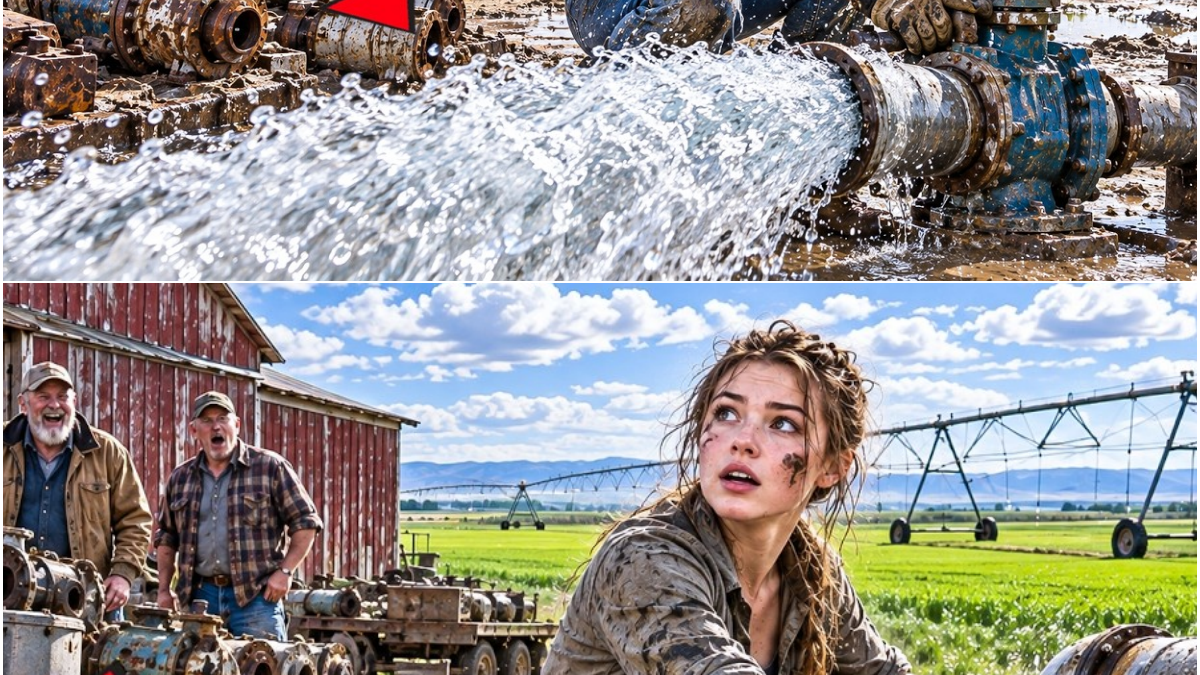
The trailer rattled across the frozen ruts behind Wendell Cruz’s machine shed, its wheels crunching through dead grass as Maddie Ostrander backed it into position.
The late March wind swept across the Kansas high plains, carrying dust and the sharp smell of cold earth.
There was nothing to slow it for miles. Behind the shed stood a mountain of discarded irrigation equipment, a collection of burned motors, rusted housings, seized shafts, and pumps that had once kept entire fields alive.
To Wendell, it was worthless clutter. To his hired hands, it was a joke waiting to happen.
To Maddie, it was something else entirely. She was nineteen, with grease in the creases of her fingers, a faded feed store cap on her head, and a habit of looking at broken machinery as if it were trying to tell her something.
Wendell had offered her the entire pile for free, certain she would soon discover what everyone else already knew.
But Maddie had spent years learning that a machine could stop working for a dozen different reasons, and only a few of them meant it was finished.
She had a trailer, a small workshop behind her family’s barn, and no guarantee that any of her plans would work.
What she did have was a question she could not leave alone. How much of this so-called junk could be brought back to life, and what might happen if she succeeded?
Maddie had been backing trailers since she was twelve. She could judge the angle of a hitch, the distance between a tire and a fence post, and the amount of pressure needed to correct a turn without looking at a mirror.
Wendell watched her guide the trailer into the narrow space behind his shed, his thumbs hooked into the belt of his canvas coat.
He had the satisfied grin of a man who believed he had just solved a problem without spending a cent.
“You’re welcome to every bit of it, sweetheart,” he called. “Take the whole trailer load, and I’ll throw in lunch.”
“I might take you up on the lunch,” Maddie replied. She was already examining a centrifugal pump lying on its side.
Its casing was covered in rust and old grease, and the shaft would not turn.
She pressed her thumb against the impeller through the intake opening, testing the resistance. It moved perhaps a fraction of a degree before catching.
The bearings might still be good, she thought. The shaft seal was probably corroded into the sleeve.
If the shaft itself had not been damaged, the repair could be straightforward. Dean and Cody, Wendell’s two hired hands, leaned against the shed door.
Both were enjoying the spectacle. “She’s diagnosing it like a doctor,” Dean said. “Finey County’s raising quite the mechanic,” Cody added.
“Girl hauls off dead pumps like they’re worth something.” Maddie straightened and wiped her thumb against her jeans.
She looked at the three men without appearing offended. “They are worth something,” she said.
“Just not to you.” Then she returned to loading. There was no reason to explain the reSt. Not yet.
They would not understand why a burned-out submersible pump might still contain a useful motor, why a seized shaft did not automatically mean a ruined impeller, or why a cracked housing could be less important than the condition of the components inside it.
They saw a pile of discarded machinery. Maddie saw parts, problems, and possible repairs. Across the surrounding farms, irrigation was becoming more difficult every year.
The Ogallala Aquifer supplied water to wells that supported enormous stretches of farmland, but the water table was falling in many places.
Farmers had to lift water from greater depths, and their pumps had to work harder to deliver it.
A system that had operated reliably for years could suddenly struggle as conditions changed. During the hottest weeks, when crops needed water most, a failed pump could turn an entire season into a financial disaster.
A farmer could replace a pump with a new one, but the price was often several thousand dollars, sometimes more when installation and related work were included.
A working rebuilt pump, properly matched to a well, could be valuable. Maddie believed the scrap pile behind Wendell’s shed might contain enough usable equipment to prove it.
Her father, Gordon Ostrander, was less certain. When Maddie brought the loaded trailer home, Gordon came out of the machine shop wiping his hands on a rag.
He had spent more than thirty years working with farm equipment, wells, and the difficult realities of agriculture.
He knew how quickly a promising repair could become an expensive mistake. He studied the trailer for a while.
“You planning on doing something with all that?” “Getting some of them running.” “Going to put your name on people’s irrigation systems?”
“If they’ll let me.” Gordon looked toward the barn, where Maddie had already started collecting the equipment she needed for a test stand.
“I’ve watched water and weather break better men than either of us,” he said. “You put your name on somebody’s irrigation and it fails in the middle of the season, that’s their crop and your reputation gone in the same week.”
“I know, Dad.” “You don’t yet.” He did not say it cruelly. Gordon had taught her to use nearly every tool in his shop, and he knew she could work.
His concern was that knowing how to repair a machine was not the same as knowing how it would behave under the pressure of a real farm’s water system.
He had seen good equipment fail because someone misunderstood the well, the water level, or the demands of the field.
“I’m not going to stop you,” he continued. “I’m just telling you what happens when you get it wrong.”
Then he returned to the shop. He did not offer to unload the trailer or help build the test stand.
Maddie understood the message. If she wanted to prove the idea, she would have to take responsibility for it herself.
Her mother, Arlene, came outside carrying a plate of cornbread. She examined the collection of rusted equipment and then glanced toward Piston, the gray donkey who had already begun investigating the trailer.
“At least tell me they don’t leak anything that’ll hurt the dog,” she said. “Piston isn’t a dog,” Maddie replied.
“He behaves like one when there’s something new to inspect.” Piston pushed his nose toward a loose piece of pipe and snorted at the sound it made against the trailer bed.
He had a settled conviction that every new object on the property existed for his personal inspection.
Maddie suspected the pumps would not be an exception. Behind the barn, she began building a test stand from whatever she could afford or salvage.
She used an old stock tank from a defunct feed lot, forty feet of salvaged PVC and galvanized pipe, and a hand-me-down five-horsepower motor Gordon had let her keep from a replaced well.
She bought a new pressure gauge because one part of the project needed to be dependable.
A faulty gauge could make a bad pump look good or a good pump look bad, and she had no intention of guessing at the results.
The first week was spent studying. She read pump manuals recovered from Wendell’s shed and downloaded irrigation engineering bulletins from the county extension office.
She searched well-driller forums where experienced workers argued over impeller wear rings, shaft seals, suction conditions, and net positive suction head.
Some discussions were difficult to follow. Others contradicted each other. She kept notes, compared explanations, and tried to understand why one repair worked in one situation but failed in another.
No one sat her down and gave her a complete education. She assembled it herself from manuals, technical documents, and the arguments of people who had spent years working underground and around irrigation systems.
Her first attempt failed in less than ten minutes. She had chosen one of the better-looking centrifugal pumps from the pile.
Its shaft had been frozen, but after applying penetrating oil and working patiently, she had managed to free it.
She installed a new mechanical seal, assembled the pump, and connected it to her test stand.
She was excited to hear it run. The motor started. The pump screamed for four seconds, then made a harsh grinding noise that sounded like gravel being spun inside a metal container.
Maddie shut it down immediately. When she opened the housing, she found that the impeller vanes had been badly damaged.
Their edges were eaten away, leaving thin, ragged shapes where solid metal should have been.
She sat on the workshop floor with the ruined impeller in her lap. At first, she assumed the pump had contained more damage than she had noticed.
But the pattern did not look like ordinary wear. That night, while reading a well-driller discussion, she encountered a word that changed the way she understood the failure.
Cavitation. When the suction side of a pump cannot supply enough water, pressure near the impeller can fall low enough for vapor bubbles to form.
As those bubbles move into higher-pressure areas, they collapse. The repeated impacts can damage the metal surfaces, gradually eating away at the impeller.
Maddie looked again at her test stand. The suction pipe was too long. It rose too high before dropping into the tank.
Its arrangement created a restriction and allowed air to collect in places where it should not have been.
She had built a setup that could starve the pump of water. The pump had not failed because it was beyond repair.
It had failed because she had connected it incorrectly. She shortened the suction line, lowered the inlet, and eliminated the high points where air could become trapped.
Two days later, she installed another pump and started the test again. This one ran properly for six minutes.
Then the motor began to smell like burning hair. She shut it off, but the damage was already done.
The motor had overheated because she had been testing pressure with the discharge valve closed.
A centrifugal pump operating with little or no flow cannot carry away heat in the same way it does during normal operation.
Depending on the design and conditions, it can overheat quickly. The lesson cost her a motor she could not afford to replace.
She tried rewinding it herself, following a video and working through the process with more determination than experience.
The result was imperfect. The motor ran roughly for the rest of its working life, but it ran.
More importantly, Maddie understood that getting a pump to spin was not enough. She needed to understand what happened when it operated under real conditions.
Her third mistake came from matching a pump by feel rather than calculation. It worked on the stand, but the test setup could not reproduce the demands of a deep irrigation well.
Forty feet of pipe and a stock tank could tell her useful things about the pump, but they could not fully imitate a well several hundred feet deep, especially one whose water level changed during the day.
She began studying total dynamic head. Head represented the resistance a pump had to overcome, including the vertical lift from the water surface to the discharge point and the friction losses created as water moved through the system.
The pump also had to deliver the required flow, measured in gallons per minute. A pump undersized for the actual head might fail to maintain enough pressure at the far end of a center pivot.
The near end could receive water while the outer sections received too little. An oversized pump could waste electricity and potentially pull water faster than the well could supply it.
Maddie realized that matching a pump to a well was not simply a matter of horsepower or pipe size.
It was a calculation involving the well, the water level, the irrigation system, and the conditions under which everything had to operate.
By the second week of April, she had one rebuilt three-phase submersible pump ready for a serious teSt. She had replaced the seal and bearings, dressed the impeller by hand with a file, and tested the motor insulation using a megohmmeter borrowed from the county extension office.
She lowered the rebuilt unit into the stock tank and connected the piping. Piston had established a permanent position near the shop doorway, where he could supervise the operation.
He was particularly interested in the tank and objected whenever Maddie left a bucket within reach.
On a Thursday evening, with the sun sinking orange over the fields, she flipped the breaker.
The motor hummed, caught, and settled into a steady sound. Then the pump began moving water.
A strong silver stream surged through the pipe and arced into the dirt behind the barn.
It was the first water that particular pipe had delivered in years. Piston brayed so loudly that the sound echoed off the shed.
He continued braying at intervals, as if the successful test required his official commentary. Gordon came out of the house and stood at the corner of the barn.
He watched the water arc through the evening air, his hands in his pockets. He did not say anything, but he stayed there for a long time.
Maddie did not ask what he thought. For now, the pump was running, and that was enough.
News traveled through Finey County. Dean mentioned the test at the co-op. Someone repeated it to a neighbor, who told another farmer.
By the following week, Maddie had hauled a rebuilt pump to a nearby well to check its fit.
Wendell Cruz came out to watch. He stood with his arms crossed, quieter than he had been in March.
He did not laugh. Royce Dillard, however, had a different reaction. Royce operated the only established irrigation service outfit across three counties.
He had worked in the business for twenty years and drove a truck with his company name airbrushed on the doors.
When someone mentioned Maddie at the co-op, he laughed loudly enough for people several aisles away to turn around.
“A girl running pumps,” he said. “That’s adorable, sweetheart. Call me when you flood a field or dry one out.”
Maddie happened to be standing nearby buying fittings. She paid the counter clerk, collected her receipt, and looked at Royce.
“I’ll keep your number,” she said. Her first real customer arrived in early May, at a moment when the consequences of a broken pump could hardly have been worse.
Alma Reinhardt was a widow managing 240 acres on her own. Her well pump stopped working on a Tuesday morning just as her corn needed its first serious irrigation set of the season.
She called Royce out of habit, but he told her he could not get there for five days.
Alma did not have five days to spare. A neighbor mentioned Maddie Ostrander, the young woman who had been rebuilding pumps from Wendell’s scrap pile.
Alma was unsure what to expect, but she called anyway. Maddie drove out that afternoon.
She examined the well system, checked the equipment, and began tracing the failure. Within twenty minutes, she had identified the problem.
The pump had been running dry intermittently for weeks. As the well was drawn down during the day, the water level fell faster than it could recover.
Eventually, the motor overheated and failed. The impeller was still in good condition. The motor was not.
Fortunately, Maddie had already begun keeping a small inventory of rebuilt motors. She had one with the correct horsepower and voltage in her truck.
She replaced the damaged motor, checked the installation, and confirmed that the existing pump size was appropriate for the well’s measured head and the field’s flow requirement.
By six that evening, Alma’s irrigation system was operating again. Maddie charged $480 for parts and labor.
A comparable new pump and installation would have cost Alma more than $3,000. Alma stood at the edge of her field, watching water reach the corn that had been curling at the leaf edges that morning.
She wrote the check and thanked Maddie. Then she told two neighbors about the repair before the week was over.
The next jobs came through the same network. A farmer named Auststeramp lost a pump to a seized bearing in June.
Maddie rebuilt it in a day, charged a reasonable price, and began keeping a running order book on a legal pad in her truck.
After her first six jobs, she bought a used pipe-threading machine and a proper hydrostatic test pump.
By the beginning of July, she had more calls than she could comfortably handle. Her promise was simple: inexpensive, fast pump rebuilds, often at about half the cost of new equipment, with same-day service whenever possible.
The promise brought customers. It also created a problem she did not yet recognize. The second week of July brought a heat wave that settled over western Kansas.
Temperatures reached 104 and then 106 degrees, day after day. Rain was absent from the forecast, and the fields were already struggling.
Every center pivot seemed to be running constantly. Wells were being pushed hard at precisely the time the water table was least forgiving.
Maddie had around twenty rebuilt pumps operating in the field. Her business had grown quickly, and she had begun making the kind of shortcuts that often accompany rapid success.
She was rebuilding pumps to get them back into service as cheaply and quickly as possible.
She matched equipment closely enough on paper, but she had not consistently designed each installation around the most demanding conditions it might face.
She had considered the average well. She had not fully accounted for sustained peak demand, falling water levels, and extreme heat happening together.
The first failure came at Patrick’s farm. Patrick was a young farmer whose well drawdown had become worse than anyone had measured in years.
During the heat wave, nearby farms were drawing from the same part of the aquifer.
Their pumps were operating simultaneously, and the water level in Patrick’s well fell faster than the pump’s intake could remain submerged.
The pump began pulling a mixture of water and air. The suction conditions deteriorated, and cavitation damaged the impeller.
It continued for two days before the falling pressure became obvious enough to demand attention.
When Maddie pulled the pump, the impeller was ruined. It looked almost exactly like the first impeller she had destroyed on her test stand.
Only this time, the damaged equipment belonged to a customer, and the field depended on it.
The second failure happened at Yodar’s farm. His well could not recharge quickly enough to keep pace with the demand during the hottest part of the day.
The water level dropped below the pump intake, leaving the motor without the cooling flow it needed.
The pump continued operating. No protection system stopped it. The motor overheated, the windings failed, and the equipment had to be pulled from the well.
Maddie recognized the failure mechanism immediately. It was the same kind of overheating she had caused on her own test stand when she ran a pump against a closed valve.
The third failure was different. At Krenler’s farm, Maddie had installed a pump that was too small for the conditions that developed as the season progressed.
She had based the selection on a head measurement taken in May. She had not allowed enough room for the increase in vertical lift that would come as the water level dropped through July.
In May, the pump had maintained sixty pounds of pressure. By mid-July, it could no longer hold forty.
The center pivot still moved, but the pressure was insufficient to distribute water across the entire field.
The near section received water, while much of the outer portion did not. On a Saturday morning, Krenler walked his cornfield and saw the damage extending hundreds of yards beyond the point where the irrigation system was reaching effectively.
Three farms. Three different failures. All within nine days of the hottest week anyone could remember.
And all three farmers had trusted Maddie because of Alma Reinhardt’s recommendation and her promise of cheap, fast repairs.
The calls coming into her truck changed. Instead of asking for service, people wanted explanations.
Some were angry. Others were quiet, which was harder for Maddie to handle. She knew that the equipment had failed under difficult conditions, but that did not change the fact that she had accepted responsibility for systems she had not adequately prepared.
Royce Dillard heard about the failures within two days. He made sure people at the co-op heard about them, too.
“Told you,” he said near the feed bins. “Cute story while it lasted.” Maddie did not spend time arguing with him.
She had too much work to do and too much to reconsider. One night, she sat alone in the shop with Patrick’s ruined impeller in her hands.
She had held another impeller damaged in almost the same way during her first week of testing.
Back then, the mistake had taught her to examine suction conditions. Now the lesson was larger.
She had been selling cheap repairs and quick turnaround. She had not consistently been selling the thing an irrigation business needed to provide above everything else: dependable water delivery.
A farmer did not need a pump that worked well on a mild day and failed when the field needed it moSt. The farmer needed a system designed to keep working under the actual demands of the well and the season.
Maddie could not undo the failures, but she could change the way she worked. The first change was how she measured wells.
She stopped relying on a single measurement taken when a well was drilled or last serviced.
She began conducting drawdown tests under load, tracking how far the water level fell over several hours.
Instead of treating the static water level as a permanent fact, she recorded how it changed while the well was pumping.
She began sizing equipment for the worst credible conditions, rather than the average conditions that looked acceptable on a worksheet.
The second change was protection against low water. Maddie started installing dry-run and low-water protection systems, using float switches and probe-based controllers where appropriate.
These devices could interrupt power when the water level fell below the safe operating point.
The goal was to prevent a pump from continuing to run without sufficient water and damaging itself.
The added equipment cost farmers money, but it was far less expensive than replacing a motor after an uncontrolled dry run.
The third change involved variable speed drives. For farms where water levels were falling year after year, Maddie began evaluating systems that could adjust pump speed to changing demand.
A properly selected and configured drive could help regulate pressure and reduce unnecessary power use when full flow was not required.
It also gave her more flexibility than a fixed-speed system when operating conditions changed. The fourth change was preventive maintenance.
Instead of waiting for a failure, she began checking amp draw, pressure at the far end of the pivot, and bearing temperature.
She learned to notice the early signs of trouble: a seal beginning to leak, a bearing developing an unfamiliar sound, or a motor drawing more current than expected.
She also made sure to keep two or three rebuilt pumps ready for emergency swaps.
A farmer did not care how persuasive her explanation was while the crop was losing water.
The immediate need was to get the irrigation system operating again. The fifth change was paperwork.
Maddie began taking Kansas water regulations and local groundwater district requirements more seriously. She checked the applicable well permits and water rights, making sure that the pump installations she recommended respected authorized flow rates instead of simply trying to satisfy the maximum demand of a field.
She understood that a business could not build long-term trust by ignoring the rules that governed the water it was moving.
Then she returned to the three farms where her equipment had failed. At Patrick’s place, she replaced the damaged impeller and corrected the installation so the pump could operate safely with the well’s actual intake conditions.
At Yodar’s, she installed dry-run protection and evaluated a variable speed drive for the changing supply conditions.
At Krenler’s, she resized the pump using a more realistic drawdown estimate and the higher head expected under peak demand.
She paid for the necessary corrections herself. At each farm, she explained what had gone wrong and what she had changed.
“I sold you a cheap fix,” she told them. “I should have sold you a system that doesn’t quit.
Here’s what I’ve changed, and here’s how we’re going to keep checking it.” She did not ask them to pretend the failures had never happened.
She asked them to judge the work she did afterward. The rest of that summer was difficult.
The repairs consumed money she had planned to use for inventory and equipment. She spent long days measuring wells, checking installations, and revisiting farms where the conditions had changed.
Some customers waited before calling her again. Others gave her another chance because they had seen her take responsibility.
By the following spring, the words on the side of her truck had changed. Cheap, fast pump rebuilds was gone.
In its place was a simpler promise: Your water never stops. It was not a guarantee that no component would ever fail.
Maddie knew better than that. It was a statement about the work she intended to do: measure carefully, size correctly, protect equipment, and maintain the systems she installed.
The business began growing again, this time at a pace she could support. The first major improvement came through service contracts.
Instead of waiting for a farmer to call after a breakdown, Maddie offered annual maintenance agreements.
She would inspect pumps twice during the season, whether they had shown signs of trouble or not.
A dozen farms signed up. Then two dozen. The steady income made it possible to invest in a proper shop building outside Garden City.
She put down a payment on the space and installed a real hoist, a dedicated seal and bearing press, and shelves for motors, impellers, and electrical components.
She also bought a service truck and stocked it with spare parts and controllers rather than relying on whatever could fit into the pickup bed.
The shop made it possible to handle more work without sacrificing the careful inspections she had learned were necessary.
During her second full year, she hired her first employee. His name was Ruben Diaz.
He had been laid off from a well-drilling outfit two counties away after the company that employed him folded.
Ruben knew casings, screens, and grouting. He understood how a well was built and how its construction affected the equipment operating inside it.
Maddie had learned pumps through manuals, tests, and mistakes. Ruben had learned wells from the ground up.
Their knowledge fit together. He taught her how well construction could influence performance and how to recognize problems that were not caused by the pump itself.
She brought the equipment knowledge and the practical experience she had developed rebuilding and testing systems.
The combination improved the business. Maddie hired a second worker the following spring and a third the year after that.
She trained them to measure before recommending equipment, document the conditions of each well, and explain to customers why a particular repair or upgrade was necessary.
By her fourth year, Ostrander Pump and Irrigation Service had become a recognized operation across two counties.
The company had thirty-one standing farm accounts, covering just under 19,000 irrigated acres. Maddie and her crew rebuilt or serviced around 140 pumps each year.
They kept six rebuilt units ready for emergency swaps and ran a maintenance route that reached every contracted well at least twice per season.
Revenue cleared just over $310,000 that year. Much of the money went straight back into the company.
Maddie bought more inventory, added a second service truck, and expanded the shop. She resisted the temptation to treat every increase in revenue as money she could take home.
The business had grown because it had learned to prepare for problems before they became emergencies.
The change in how people regarded her was gradual. Wendell Cruz was among the first doubters to become a customer.
Two years after giving Maddie the scrap pile, he called her because a new pump he had purchased from a dealer in Dodge City had begun cavitating.
The water level in his well had fallen further than the original installation had accounted for.
Maddie inspected the system, measured the conditions, and resized the equipment. She also put Wendell on her preventive maintenance schedule.
He still told the story about the trailer at the co-op, but he told it differently now.
Instead of laughing at the girl who had hauled away his junk, he sounded almost proud that he had been present at the beginning.
“Told you that girl would figure something out,” he said. Maddie never corrected him. Royce Dillard lost accounts one at a time.
Farmers who had waited five days for service during the heat wave remembered what that delay had meant.
When another pump failed, they began calling the number on Maddie’s truck. She did not go out of her way to take his customers.
She simply answered the phone, asked questions, and tried to arrive when she said she would.
Royce never apologized to her face. He did not need to. The work had become the answer.
Gordon took longer to change his attitude, partly because his original concern had never been about Maddie’s ability to repair machinery.
He had taught her to use the tools and knew she could learn difficult things.
What worried him was the cost of being responsible for a system that could not always be controlled.
He understood water and weather as forces that demanded humility. A person could work carefully and still encounter conditions that no repair could overcome.
But as Maddie’s business became more dependable, Gordon began to see that she had learned the lesson he wanted her to understand.
She was no longer treating each pump as an isolated machine. She was treating the entire well and irrigation system as something that had to be measured, maintained, and respected.
During her fourth summer, he began riding along on service calls. Maddie did not need him to do the work.
She had Ruben and the rest of the crew. But Gordon wanted to see what she had built, and she was glad to have him there.
One early morning in August, they stood together at the edge of a field belonging to Halverson.
Maddie had serviced the well the previous week. She had resized the pump, installed a new low-water cutoff, and checked the system under sustained operation.
The pressure gauge now held steady at sixty-eight pounds, and the reading had not changed for six days.
The center pivot moved slowly across the field. Water fell in even arcs over corn that looked unusually green against the dry gold stubble beyond the fence line.
The sun had just risen. Long bands of golden light stretched across the ground, and the pivot’s motor hummed steadily in the quiet morning air.
Gordon stood with his hands in his jacket pockets. He watched the water for a long time.
Then he said four words. “You were right, Maddie.” She looked at him. He did not add a speech or explain himself.
He did not need to. The words carried everything he had been unable to say when she first arrived home with a trailer full of broken pumps.
He had been afraid that she would take on more responsibility than she could handle.
He had worried that one mistake could cost a farmer a crop and cost his daughter the business she hoped to build.
Now he was standing beside a working irrigation system that she had measured, repaired, and protected.
Maddie watched the water continue across the field. “I had to learn a few things first,” she said.
Gordon nodded. They stayed there together until the pivot had moved farther across the corn.
That evening, Piston greeted the service truck as it pulled into the shop yard. He brayed at the sound of the engine shutting off, just as he had four years earlier when Maddie first tested a rebuilt pump behind the barn.
The donkey had not become any more impressed with the business. He still inspected unfamiliar objects, shoved his nose into unattended buckets, and treated the workshop doorway as his personal station.
Maddie was glad some things had not changed. The original pumps from Wendell’s scrap pile still stood in a row along the back wall of the new shop.
They were no longer being used for parts. Maddie had kept them as reminders of where the business began.
They were battered, rusted, and beyond the point where rebuilding them made practical sense. But they represented the first questions that had led her into the work.
Why had the shaft seized? Why had the motor burned out? Why had the impeller worn away?
What had caused the pump to stop delivering water, and what would have to change to make the next one reliable?
The questions had carried her through failed tests, damaged equipment, disappointed customers, and the difficult summer when her first promise proved inadequate.
They had also carried her from a small workshop behind the barn to a proper service operation supporting thousands of acres.
Maddie still liked visiting wellheads before sunrise. She liked the quiet before the pumps started, the faint smell of wet soil, and the feeling of checking a system when the surrounding fields were still dark.
She still measured drawdown by hand some mornings, even when newer equipment could make the process easier.
She trusted the numbers, but she also trusted the habit of looking closely at the actual conditions.
She had learned that a pump could be rebuilt and still be wrong for the well.
A motor could run perfectly and still be in danger because the water supply could not keep up.
A pressure reading could look acceptable in May and become useless by July if no one accounted for the changing water level.
Most importantly, she had learned that the value of a repair was not measured only by the parts replaced or the hours spent in the shop.
It was measured by what happened when the farmer needed the system to keep working.
In March, Wendell had given away a scrap pile because he wanted the space back.
Dean and Cody had laughed because they saw no reason anyone would bother with broken pumps.
Gordon had warned Maddie because he understood what failure could coSt. All of them had seen something real.
The pumps were old. The work was risky. The water table was falling. The business could not succeed on enthusiasm alone.
But Maddie had seen something real, too. A burned motor was not necessarily a ruined pump.
A seized shaft did not always mean the entire assembly was useless. A damaged impeller could teach her more than a successful teSt. And a mistake, if she studied it honestly, could become the beginning of a better method.
She had started with no established customers, no proper shop, and no guarantee that her repairs would survive the demands of a Kansas summer.
What she had was a trailer, a collection of discarded equipment, and the patience to keep asking why.
The pumps that once sat behind Wendell’s shed had become the beginning of a business built around keeping water moving.
And every time a farmer’s pivot crossed a field without losing pressure, Maddie had another reason to believe the work mattered.
Disclaimer: This content may be created by Al for entertainment purposes. Any resemblance to real persons, events, or places is coincidental.








