They Laughed When She Bought 11 “Worthless” Mares for $7,150 — Then One Foal Changed Everything
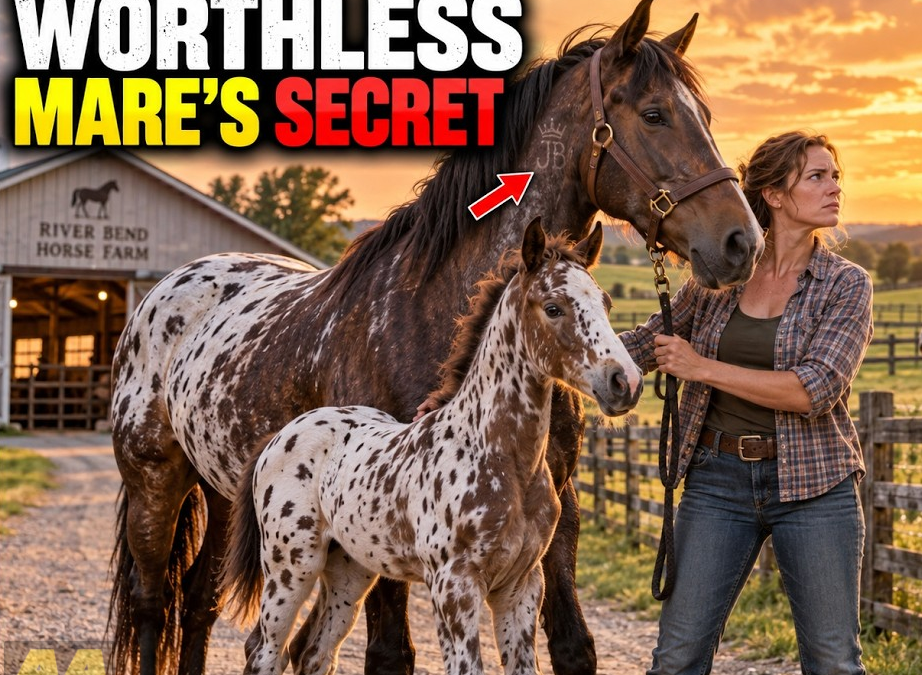
The auction barn was already laughing before Rachel Mercer raised her bidder number. Eleven thin Appaloosa mares walked through the ring beneath harsh February lights, their winter coats dull, their spots faded, their ribs showing beneath months of neglect.
They did not look like valuable broodmares. They looked like horses people had forgotten. Grant Holloway, the largest Appaloosa breeder in western Missouri, leaned back in his chair and watched them pass.
When Rachel lifted her number at $650 a head, he turned toward three rows of spectators and asked whether she was opening a retirement home for circus ponies.
The room laughed. Rachel kept her number raised. She was thirty four years old, raising her eight year old daughter Ellie, and she had come to the Walter Dobbins dispersal sale with $9,000 she could not afford to waste.
She had expected to leave with one decent mare. Instead, she was about to take home eleven horses without registration papers, uncertain breeding records, rough feet, and one secret that nobody in the auction barn seemed to know existed.
Seven months later, a colt would arrive in a drafty foaling stall behind Rachel’s house, and the veterinarian would stare at him long enough to forget what he had been about to say.
Three weeks after that, a man would drive 540 miles from Texas simply to stand outside Rachel’s pasture for twenty minutes.
Then another breeder would come from Colorado. Then one from Kentucky. But on that cold February afternoon, when the auctioneer called for $650 and nobody else moved, Rachel had only one question in her mind.
What was everybody else seeing that she was not? The auctioneer looked around the barn.
“Six fifty a head?” Nobody answered. Rachel kept her card up. “Six fifty?” Silence. The auctioneer glanced toward the ring and then back at the bidders.
“Sold.” The gavel came down. Eleven mares. Seven thousand one hundred fifty dollars. Rachel lowered her number.
For several seconds, she simply sat there. She had intended to keep most of her $9,000 available.
Her truck had 168,000 miles on it. The transmission slipped when cold. Property taxes were due in May.
Ellie needed braces. The barn roof leaked over the tack room whenever rain came from the west.
Now she had eleven horses. Rachel wrote $7,150 on her yellow legal pad and circled it twice.
The auction barn slowly returned to its usual noise. People were already discussing the next lot.
Grant Holloway turned around in his chair. He was fifty two, tall, gray at the temples, and dressed like a man who had spent his life around expensive horses.
Holloway Appaloosas had 1,800 acres, three stallions standing to the public, customers in fourteen states, and a show barn with heated wash racks.
Rachel had none of that. She had twenty seven acres she owned outright, another forty she leased from an elderly neighbor, four stalls, one good gate, two bad gates, and a daughter who liked horses enough to believe every horse could become something better.
Grant looked at the mares. Then at Rachel. “You buying horses?” Rachel did not answer.
He smiled. “Or just collecting spots nobody else wanted?” A few people laughed. Rachel folded her legal pad.
She had learned something during twelve years working for a veterinary supply company. Some people made remarks because they wanted an argument.
Others made them because they wanted an audience. Grant wanted an audience. She would not give him one.
Outside, the February air was sharp enough to sting. Rachel had to make two trips because her borrowed trailer held only six horses.
On the second trip, she noticed Grant standing beside the loading area. He was not laughing anymore.
He was watching one mare. Rachel followed his gaze. The mare was dark bay with a white blanket over her hips.
Only a few dark spots showed through it. Her mane was thin from years of rubbing.
She had a narrow blaze and an old mark over her right eye. She did not look impressive.
Grant watched her for about ten seconds. Then Rachel shut the trailer door. By the time she pulled onto the county road, she had already forgotten about him.
dr. Sam Vickers came four days later. Sam was forty six and had been treating horses around Maple Ridge since 1981.
He had a habit of never appearing impressed. He examined all eleven mares. Three needed dental work.
Four were carrying worms badly enough to explain most of their weight loss. One had an old suspensory injury that would keep her from hard riding but would not prevent her from living comfortably in pasture.
Two had mild thrush. That was about it. “No disasters,” Sam said. Rachel looked down the fence line.
“So I did not buy a traveling medical bill?” “You bought eleven horses somebody stopped spending money on.”
He paused. “There is a difference.” The dark bay mare came laSt. Sam estimated her at nine years old.
She was thin, but beneath the poor condition was a short back, deep heart girth, broad hindquarters, and remarkably clean legs.
Rachel lifted the mane to check the skin underneath. There was a pale mark no bigger than two fingers.
D31. Rachel rubbed the hair backward. “Mean anything to you?” Sam looked. “Dobbins marked a lot of young stock years ago.
I do not know his system.” Rachel wrote D31 in her notebook. She had been calling the mare Birdie because of a small bird shaped white mark near the base of her tail.
So Birdie became her name. By early March, everyone around Maple Ridge knew about Rachel’s auction mares.
Horse people had a way of spreading information without admitting they were gossiping. A farrier mentioned something to a trainer.
A trainer mentioned it at breakfaSt. By noon, six barns knew. At the feed store, a man Rachel barely knew asked how her rejects were doing.
Rachel smiled and kept loading feed. Two weeks later, Grant Holloway showed up. He helped Rachel load fifty pound bags of alfalfa pellets into her truck.
He asked about Ellie. Then he asked about the mares. Finally, his voice changed. “If you get tired of feeding them, I might take the whole group.”
Rachel looked at him. “All eleven?” “All eleven.” “You said they were junk.” Grant smiled.
“I said they were not breeding stock I would build a program around.” “That sounds pretty close.”
“I have more pasture than you do.” He offered $700 a head. Seven thousand seven hundred dollars.
Rachel could have made $550 in less than a month. Instead, she asked, “Why all eleven?”
Grant shrugged. “Numbers. Recipients. Trail horses. Whatever works.” Then his voice became softer. “You do not have enough hay put up for eleven extra horses next winter.”
Rachel said she would manage. Grant leaned against the truck. “Pride is expensive, Rachel.” Then he mentioned Ellie.
Not cruelly. Almost kindly. He said an eight year old girl might get more use from a college account someday than her mother would get from feeding horses without papers.
Rachel thanked him. She drove home angry. Halfway there, the anger moved aside. Something else took its place.
A question. Grant had spent a month allowing people to laugh about those mares. Now he wanted every one of them.
Rachel had worked around horse people long enough to understand something. People with money did not buy eleven useless horses because they felt sorry for someone.
That night, she wrote one sentence on the last page of her notebook. Why does Grant want all eleven?
She did not have an answer. In late April, Birdie started getting wider. Rachel blamed spring grass.
Sam did not. He palpated the mare and stepped back. “She is pregnant.” Rachel stared.
“How pregnant?” “Six months. Maybe a little more.” Rachel did the arithmetic. If Sam was right, Birdie had been bred around October of 1997.
Walter Dobbins had still been alive. Birdie had been carrying the foal for almost four months when Rachel bought her.
Rachel did not own the stallion. She did not know the stallion. There was no breeding certificate.
No registration document. Nothing except D31 beneath the mare’s mane. The information traveled through Maple Ridge quickly.
Three days later, Rachel heard that Grant had said a grade mare bred to an unknown stallion was still a great mare, only more expensive to feed.
Rachel might have ignored it. But she could not ignore the offer for all eleven.
She began making calls. The auction company had no additional records. One of Walter’s sons said boxes of old paperwork had been thrown away while cleaning the office.
The Appaloosa registry could find several Dobbins horses. But not from a freeze mark alone.
Rachel called former employees. She called trainers listed in old sale programs. She called a feed dealer who had delivered to the Dobbins farm during the early 1990s.
The sixth call gave her a name. Naen Price. Naen was sixty three and lived in Sedalia.
For nineteen years, she had kept Walter Dobbins’ breeding records, part time at first and then nearly full time during breeding season.
Rachel called her on a Sunday evening. Naen listened quietly. When Rachel mentioned D31, she stopped her.
“Say that again.” “D31.” “Dark bay?” “Yes.” “White blanket?” “Yes.” “Narrow blaze?” “Yes.” There was a long pause.
Then Naen said, “Do not sell that mare.” Rachel sat straighter. “What?” “Do not sell her this week.
Do not sell her next week. If somebody offers you money, tell them you need time.”
“Why?” “I need to find something.” “What?” “My 1997 breeding ledger.” Naen explained that she had taken several old notebooks home after Walter closed his breeding office in 1995.
Most were in plastic tubs in her brother’s basement. She had not opened them in years.
Rachel asked what D31 meant. Naen would not say. “I remember too much and not enough,” she said.
“Let me find the book before I put a story in your head.” That night, Rachel walked to the pasture twice after midnight.
Birdie stood apart from the others. Her head was low. Her tail lifted occasionally. By one thirty in the morning, Rachel knew the foaling was close.
She brought Birdie into the smallest foaling stall. The stall was twelve feet by fourteen.
One light worked. The other had not worked since Christmas. Rachel spread three fresh bales of straw and sat outside the stall door.
At 3:48 in the morning on May 19th, 1998, Birdie lay down. At 4:06, the foal was on the ground.
A colt. Dark bay. Long legged. White over the hips. Rachel cleared his nose while Birdie began licking him.
At 4:19, he tried to stand. At 4:27, he stayed upright. Rachel had seen enough newborn foals to know what awkward looked like.
This colt did not. His front legs came down straight. His pasterns were strong. His shoulder had more angle than Rachel expected from Birdie.
His hip looked almost too large for the rest of him. And beneath the wet newborn coat, another pattern was beginning.
A white blanket. Dark spots inside it. A few lighter hairs scattered forward over the barrel.
Rachel stood in muddy boots at 4:30 in the morning. One thought came to her.
“That is the nicest foal I have ever had on this property.” Ellie named him Jasper before breakfaSt.
Sam came at noon. He examined Birdie. Then the colt. Heart. Lungs. Eyes. Joints. Umbilicus.
He watched Jasper walk around the stall. Then he returned to Birdie and lifted her mane.
“D31.” Rachel waited. Sam looked toward Jasper. “You need to pull hair.” “For what?” “Parentage testing.”
Rachel laughed once. “With what parent?” Sam explained that horse parentage testing was increasingly using genetic markers.
If Birdie had ever been recorded under another identity, testing might connect her to old records.
If the possible sire had genetic material on file, Jasper might be compared against it.
“It is not magic,” Sam said. “It might prove nothing.” Rachel pulled the hair anyway.
Thirty hairs from Birdie’s mane. Thirty from Jasper. Roots attached. Sam helped with the forms.
The samples went out the next morning. Rachel also took a photograph of Jasper at five days old.
He stood in the morning sun beside Birdie. His ears were forward. His legs were square.
His spotted blanket was already becoming clearer. Rachel mailed copies to two friends and placed one at the feed store bulletin board.
Three nights later, her phone rang. Grant Holloway. His voice sounded different. No joking. No easy friendliness.
“I heard Birdie foaled.” Rachel gripped the receiver. Birdie. He had called her Birdie. Rachel had never told Grant that name.
The auction paperwork called the mare lot 47 D. “How do you know I call her Birdie?”
Silence. Then Grant asked, “Colt or filly?” Rachel did not answer. “Grant, how do you know that name?”
Another pause. “Colt or filly?” “Colt.” Grant breathed out. Then he made an offer. Eighteen thousand dollars for Birdie and Jasper together.
Pickup that week. Cashier’s check. No veterinary examination. No conditions. Rachel sat at the kitchen table.
She had paid about $650 for Birdie as part of the eleven mare lot. Now Grant Holloway was offering $18,000.
“Why?” “It is a fair offer.” “It is twenty seven times what I paid for the mare.”
“You bought eleven horses in one lot.” “You said she was not worth breeding.” “I said you did not know what you had.”
“That is not the same thing.” Grant’s voice hardened. “Rachel, take the money.” She declined.
Two weeks later, he offered $45,000. Rachel sat in her kitchen for a long time after the call ended.
Forty five thousand dollars could change her life. It could pay down the mortgage. Replace the truck.
Buy Ellie her braces. Put hay in the barn for years. Rachel almost said yes.
Then Naen Price pulled into her driveway in a 1986 Oldsmobile. Two plastic storage tubs sat in the back seat.
She walked past the house without stopping. “Show me the mare.” Birdie stood beneath a cottonwood.
Naen reached the fence. She stared. Then covered her mouth. “That is Dobbins Bluebird 31.”
Rachel said nothing. Naen looked at Jasper. Then back at Birdie. “Oh, Walter.” They spent the afternoon at Rachel’s kitchen table.
Naen opened a blue spiral notebook dated 1997. The pages were filled with breeding dates, heat cycles, veterinary checks, shipment numbers, and notes written in tiny block letters.
Birdie was there. Dobbins Bluebird 31. Foaled April 7th, 1989. Her maternal line went back to a mare Walter had bought in Idaho in 1972.
The family had never been famous. That was the first thing Naen made clear. They were not the extreme, heavily advertised Appaloosas people remembered from magazine covers.
Their spots varied. Some foals barely colored out. What Walter valued was underneath the color.
Good feet. Strong bone. Deep bodies. Quiet minds. Mares that remained fertile and useful for years.
Naen said Birdie’s dam had produced twelve live foals in fourteen breeding seasons. Her granddam had remained on the farm to twenty six.
Then Naen turned to October 1997. There was D31. Breeding date October 11th. A shipment number.
And a stallion. Ravenwood Legacy. Rachel had heard the name before. Naen looked at her.
“You know who he was?” “Not really.” “Grant Holloway did.” Everybody at the top end of the Appaloosa breeding business knew Ravenwood Legacy.
By 1994, he had become one of the most discussed breeding stallions in his part of the industry.
He combined color, structure, movement, and disposition. In 1996, a breeding season to Legacy cost $8,500.
That was more than Rachel had paid for all eleven mares. Naen explained that Walter had bought one breeding.
Rachel stared at the notebook. “Why would Grant know Birdie?” Naen closed the ledger. “Because Holloway owned part of the Legacy syndicate.”
Rachel looked toward the pasture. Now the pieces were beginning to connect. Grant watching Birdie at the trailer.
Grant wanting all eleven mares. Grant suddenly offering money after Jasper arrived. The answer from the laboratory came twelve days later.
Sam called Rachel at 6:40 in the morning. “Are you sitting down?” “No.” “Sit down.”
Rachel sat on the bottom step of the porch. Sam told her Birdie’s sample matched the recorded maternal profile associated with Dobbins Bluebird 31 strongly enough for the registry to begin correcting her missing documentation.
Then he read the second result. Jasper’s genetic markers were consistent with Birdie as his dam and Ravenwood Legacy as his sire.
Rachel did not speak. Sam repeated it. “Rachel, the colt is by Legacy.” By Friday, Grant Holloway was no longer the only person calling.
A breeder from Texas offered $70,000 for Jasper. A Colorado breeder wanted a partial intereSt.
A Kentucky farm asked whether Rachel would consider a future breeding arrangement once Jasper matured.
One man drove nine hours, looked at Jasper for thirty five minutes, and never asked what Rachel wanted.
He asked about the other ten mares. That bothered her. Nobody had checked them yet.
By August, strangers were driving slowly past her farm. People who had laughed at the February auction suddenly remembered that Walter Dobbins had always bred useful horses.
Rachel found that almost funny. AlmoSt. Then Grant arrived with a legal envelope. The letter came from a Kansas City firm.
It claimed Holloway Appaloosas had held a financial interest in the Ravenwood Legacy breeding syndicate.
It suggested certain rights associated with stored semen, breeding certificates, and resulting foals might have survived Legacy’s passing.
Rachel read it twice. Grant waited beside his truck. “You bought the mare,” he said.
“That does not automatically mean every contract attached to the breeding disappeared.” “Did Walter own the breeding?”
“That is what lawyers are for.” Grant looked toward the pasture. “You can be right and still spend yourself broke proving it.”
That sentence stayed with Rachel. She did not have money for a legal battle with Grant Holloway.
Grant owned more land, more horses, more barns, and more customers. Rachel returned to the auction papers.
The invoice was clear. All mares sold with any unborn foal unless specifically excluded. No exclusion appeared on the paperwork.
She called the auction company. The manager remembered the Dobbins dispersal. Two days later, he provided a signed statement confirming no unborn foal had been excluded from lot 47.
Useful. But Rachel still needed the original breeding contract. Naen went searching. For eight days, nobody heard from her.
Then she called. “I found it.” She arrived with a manila folder that smelled like basement duSt.
Inside was an invoice dated September 26th, 1997. Ravenwood Legacy frozen semen breeding. Dobbins Bluebird 31.
Fee $8,500. Paid in full. Attached was the breeding agreement. Rachel read every line. The stallion syndicate guaranteed only that the semen had been properly stored before transfer.
There was no live foal guarantee. No refund provision. No retained ownership. Then Rachel reached paragraph 11.
Any resulting foal would be the sole property of the recorded owner of the mare at the time of foaling, subject only to payment in full of the breeding fee.
The syndicate retained no ownership interest, breeding interest, or right of first refusal in the resulting offspring.
The fee had been paid. Walter had owned the breeding. The auction had transferred the pregnant mare and her unborn foal to Rachel.
Grant had no ownership interest in Jasper. Rachel paid a local attorney $600 to review everything.
He sent copies to the Kansas City firm. Rachel added one handwritten note. “Please identify the contract language under which Holloway Appaloosas owns any part of this colt.”
Nine days later, the claim was withdrawn. No apology. No explanation. Just a short letter saying Holloway Appaloosas would not pursue the matter.
The next morning, Grant called. “One hundred seventy five.” Rachel thought she had misheard. “What?”
“$175,000 for the colt.” Jasper was four months old. Rachel stood at the kitchen counter and looked toward the pasture.
Grant continued. “You got lucky, Rachel.” She said nothing. “You did not breed the mare.
You did not choose Legacy. You did not build the female line. You bought the last horses through the ring after everybody else had gone home.”
Still, Rachel said nothing. “I have the mares to use him on. I have the customers.
I have the advertising. I have the facilities. That colt could be something here.” “And at my place?”
Grant paused. “At your place, he is an expensive lawn ornament until you figure out what you are doing.”
The words stayed with Rachel. Part of it was true. She had not created Jasper’s genetics.
She had not chosen the mating. Luck had put her bidder number in the air at exactly the right auction.
Pretending otherwise would have been foolish. But selling Jasper simply because Grant believed she could not build anything around him felt just as foolish.
Three breeders gave Rachel three different kinds of advice. The Texas breeder told her to take the money.
“You can buy a whole farm with that kind of money,” he said. “You cannot buy groceries with potential.”
The Colorado breeder offered a partnership. Jasper would stand at her facility when he was old enough.
Rachel would keep forty percent. Then a seventy year old breeder named Frank Delaney drove over from Illinois.
Frank had bred Appaloosas since 1963. He owned fewer than twenty horses. He had never had a glossy sale catalog.
He spent almost an hour looking at Jasper. Then he asked Rachel for coffee. At her kitchen table, he said, “You can sell him.”
Rachel waited. “And if you do, nobody sensible will blame you.” “I thought you were going to tell me not to.”
“I did not say that.” Frank looked toward the pasture. “In three years, if he stays sound and grows into what he looks like he might become, somebody will build a program around him.”
Rachel nodded. “If Grant buys him, it will be Holloway breeding.” “Yes.” “If Texas buys him, it will be theirs.”
“Yes.” Frank set down his cup. “But you still have ten mares out there nobody has identified.”
That sentence changed Rachel’s plan. She did not reject the money because money was beneath her.
Money was exactly what she needed. Instead, she spent six nights working out how not to trade the entire opportunity for one check.
First, she corrected Birdie’s registration. Then Jasper’s. She hired an experienced horseman to evaluate Jasper every six months.
Feet. Hocks. Shoulders. Back. Movement. Temperament. If Jasper became unsound, he would never stand at stud.
If his temperament changed, he would never stand at stud. If he matured into an ordinary horse, Rachel would accept that.
No story was worth breeding poor qualities into another generation. She also tested the other mares.
Four of the eleven could eventually be connected to old Dobbins records with reasonable certainty.
Birdie was the most valuable. Two others came from old working Appaloosa families that had produced sound ranch horses for decades.
One was registered but ordinary. Seven could never be conclusively identified. Rachel kept five. She sold six after they gained weight and received proper training evaluations.
Nobody became rich. That mattered. The story people later told around Maple Ridge made it sound like Rachel had bought eleven worthless mares for $7,150 and suddenly become wealthy.
That was not what happened. By the end of 1998, she still drove the same truck.
She still compared hay prices. She still watched every dollar. She still repaired fences herself.
What changed was that people began calling her before she called them. Jasper grew. At one year old, he still had clean legs.
At eighteen months, his back remained level. His chest widened. His spotted blanket became darker and more defined.
His temperament remained quiet. Rachel took him to two independent evaluations. She did not advertise the scores.
She wanted people to see the horse, not a number. By spring of 1999, she had a plan.
She would not sell Jasper. She would not offer unlimited breedings. If he passed his final veterinary evaluation at three, she would offer a limited number of contracts each season.
Twenty five the first year. No more. Mares would have to meet basic health requirements.
Rachel priced the first contracts below what Grant told people she could have charged. That confused almost everyone.
Frank Delaney understood. “You are not selling the most expensive breeding,” he told her. “You are trying to build the next ten years.”
“Exactly.” Rachel saw Grant again in October of 1999 at a regional horse expo. Jasper was not there.
Rachel had gone to watch a halter class and pick up supplies. Grant found her near the warm up ring.
“Still got him?” “Yes.” “Waiting for two hundred?” “No.” Grant looked amused. “Everybody has a number.”
Rachel watched a young gelding jog paSt. Then she said, “I think that is the part you never understood.”
“What part?” “I was not holding him until somebody offered enough.” Grant waited. “I was holding him until I knew what I had.”
For once, Grant did not answer immediately. Then he asked about the weather in Maple Ridge.
A minute later, he walked away. He never offered to buy Jasper again. In March of 2000, Naen finished sorting the last surviving Dobbins records.
Of Rachel’s original eleven mares, four had now been positively identified. Two more had probable identities, but not enough documentation to correct their papers.
Five remained exactly what they had appeared to be on auction day. Unregistered mares of uncertain breeding.
Good horses. Nothing rare. Nothing magical. Rachel liked that result more than she expected. It made the truth cleaner.
She had not discovered eleven secret champions. She had bought eleven neglected mares. Most were ordinary.
A few were unusually good. One carried a piece of breeding history nobody in the room had bothered to identify before the hammer fell.
By then, people around Maple Ridge had stopped calling them Holloway’s rejects. The joke had reversed itself.
Now people told the story of Grant Holloway sitting less than thirty feet away when Dobbins Bluebird 31 sold for roughly $650.
That detail followed him because horse people remembered missed opportunities almost as clearly as victories.
Grant still had more land. More horses. More customers. More money. Nothing about Rachel’s success ruined his.
It simply meant he no longer got to decide what her horses were worth. Two years after the auction, Rachel walked outside before sunrise on a cold February morning.
Jasper stood in the far paddock. Frost covered his back. He had grown to a little over fifteen hands.
His chest had filled out. His legs remained clean. The spotted blanket over his hindquarters looked almost black and white in the early light.
Rachel’s phone rang inside the barn office. A woman from Oregon had gotten her number from Frank Delaney.
She wanted to know when Jasper’s first breeding contracts would open. Rachel told her June 1St.
“Is there a waiting list?” “Yes.” “How long?” Rachel looked at the sheet hanging beside the phone.
“Thirty seven names for twenty five contracts.” The woman laughed. “Well, put me on it anyway.”
Rachel wrote down the name. Then she walked outside. Birdie was fifteen now. She was healthy.
Sound. And carrying another foal. Rachel stood at the gate and watched her. The entire story seemed impossible when viewed from there.
The February auction. The laughter. The eleven mares. Grant’s first offer. Birdie’s hidden identity. The laboratory report.
The old breeding contract. The $175,000 offer. All of it had started with a bidder number raised in a room where almost nobody believed the horses were worth feeding.
Rachel thought about something she had once believed. She had spent years thinking the important part was that everybody else had been wrong.
Now she knew better. Grant had been right about one thing. Rachel had gotten lucky.
Ravenwood Legacy had already been Jasper’s sire before Rachel ever saw Birdie. Walter Dobbins had planned the breeding.
Naen had written it down. The genetics existed whether Rachel understood them or not. If Grant had raised his hand at the auction, Jasper still would have been born.
Maybe in a heated foaling barn. Maybe under cameras. Maybe with three people watching instead of one tired woman sitting on an overturned bucket.
Rachel had not created the valuable part. What she had done was simpler. She had looked at eleven horses on the worst afternoon of their lives.
Thin. Dirty. Unpolished. Missing papers. Standing beneath ugly auction lights while a room full of experienced people had already decided what they were worth.
And she had noticed that they still moved sound. She had read the invoice. She had kept the paperwork.
She had asked why a wealthy man suddenly wanted something he had publicly called worthless.
Then, when the answer became valuable enough to frighten her, she kept asking questions. That was the difference.
Not genius. Not revenge. Attention. Patience. Paperwork. And the willingness to admit that she did not know what she had until she had done the work to find out.
A truck slowed on the county road. Rachel heard the engine before she saw it.
A dark pickup turned into the gravel driveway pulling a two horse trailer. Illinois plates.
She did not recognize the driver. Five years earlier, a strange trailer coming up her road would have meant somebody was loSt.
Now Rachel picked up her coffee and walked toward the gate. The driver rolled down his window.
“You Rachel Mercer?” “That is me.” He pointed toward the paddock. “Is that Jasper?” Rachel looked over.
The young stallion had lifted his head. Frost rose from his back in little clouds as he walked toward the fence.
“That is him.” The man shut off the engine. “I have been trying to get on your breeding list for three months.”
Rachel smiled. Two years earlier, people had laughed because she raised her bidder number for eleven mares nobody wanted.
Now people drove hundreds of miles hoping she would put their name on a list for one breeding.
Rachel opened the gate. “Come on in.” And nobody who came up that gravel road anymore asked why she had bought those horses.
Disclaimer: This content may be created by Al for entertainment purposes. Any resemblance to real persons, events, or places is coincidental.








