They Laughed At Her For Buying 50 Junk Trailers from Junkyard — Until She Builds Food Trucks…
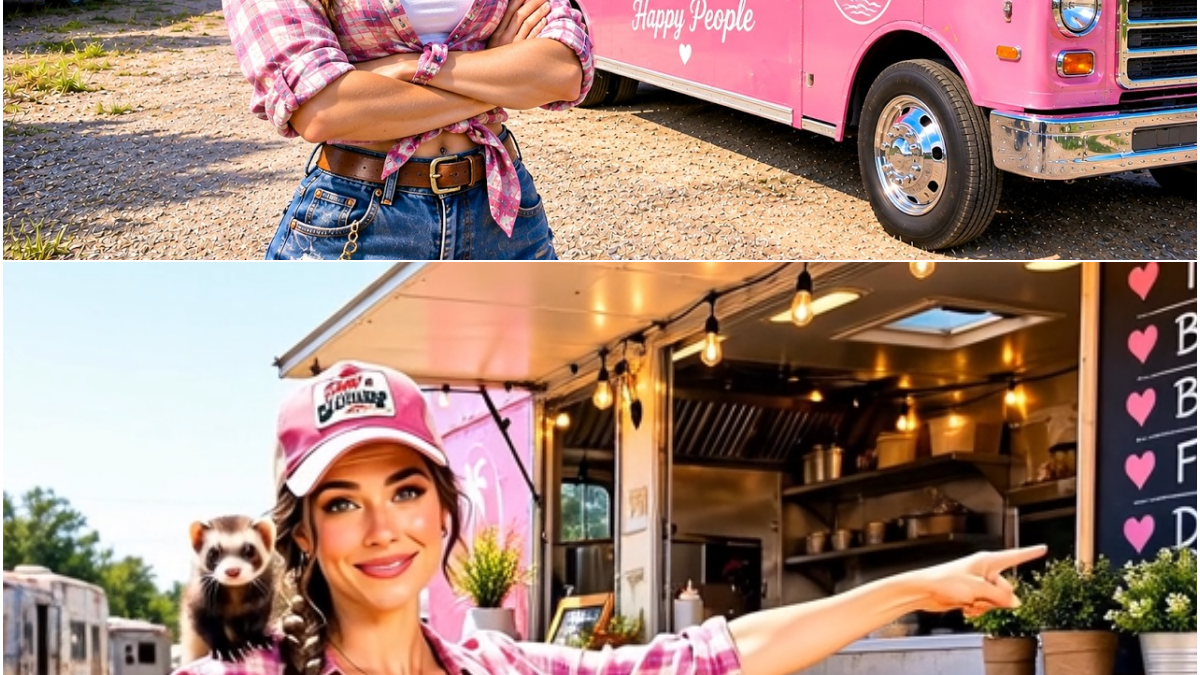
The auction took place on a gravel lot outside a county impound yard in central Texas, where the October heat still rose from the ground in shimmering waves.
Fifty abandoned trailers stood in uneven rows, their tires deflated, their paint faded, and their metal frames covered in ruSt. To the scrap buyers gathered nearby, the trailers were little more than piles of steel waiting to be weighed, crushed, and forgotten.
But to Georgie Cain, a twenty-eight-year-old welder with grease beneath her fingernails and a faded ball cap pulled over her dark hair, they represented something nobody else could see.
They were fifty chances to build a business from nothing. She had spent months searching for a way to turn her welding skills into a living, and now she was standing in front of the biggest gamble she had ever considered.
When the auctioneer announced lot forty-four, offering all fifty trailers together, Georgie raised her hand.
The bidding moved quickly, but she refused to back down. When the final price reached eight thousand dollars, she had won.
The men around her laughed, calculating how little she would earn even if she sold every trailer for scrap.
One told her she had just bought herself a mountain of expensive problems. Georgie signed the paperwork without arguing.
She had no customers waiting, no established company, and no guarantee that her idea would work.
All she had was experience, determination, and a question that had followed her for months.
What if the things everyone else had abandoned were exactly what she needed to build the future she wanted?
Six months before the auction, Georgie had been working at Denton Cross Auto Body in Fab, a small shop outside town that specialized in collision repairs and custom metal fabrication.
She had started there when she was nineteen, learning everything from experienced mechanics and fabricators who expected her to work hard and pay attention.
Over the years, she became one of the most dependable people in the building. She could operate a MIG, TIG, or stick welder, cut and bend sheet metal, straighten damaged frames, and fabricate complicated brackets from nothing more than a rough drawing.
Her father, Marty Kaine, had introduced her to welding when she was twelve. He had spent thirty-one years working on diesel engines and understood machinery in a way that made complicated repairs seem ordinary.
He taught Georgie to respect measurements, inspect every connection, and never assume a repair was finished simply because it looked good.
But even years of experience could not protect her from what happened when the shop’s owner decided to sell the building to a self-storage company.
The employees received two weeks of severance, and the doors closed. Georgie suddenly found herself without a paycheck in a town where the remaining body shops already had full schedules.
She applied for positions, called former customers, and contacted other fabricators. Some promised to keep her number.
Others explained that they could not afford another employee. None offered the steady wages she needed.
Her savings began disappearing. She moved into the apartment above her parents’ garage, where her mother, Pam, made sure there was always something available for dinner.
Georgie appreciated the help, although accepting it made her feel as if she had moved backward instead of forward.
Marty did not criticize her unemployment directly, but his silence sometimes felt heavier than an argument.
He believed in working hard, finding dependable employment, and avoiding unnecessary financial risks. Georgie understood his reasoning, but she also knew that another ordinary job might not give her the opportunity she wanted.
The idea of building food trucks came from a conversation with a former customer who had recently purchased a used concession trailer.
The customer complained about how expensive commercial conversions had become and how difficult it was to find someone willing to customize an older trailer.
Georgie began researching the industry. She discovered that many aspiring food truck owners could afford a modest business but could not justify spending thirty thousand or forty thousand dollars on a new vehicle and professionally installed kitchen.
She also realized that she already possessed several of the skills needed to build one.
She understood metal fabrication, mechanical repairs, and structural work. What she lacked was experience with commercial kitchens, plumbing systems, food safety requirements, and the regulations governing mobile restaurants.
The possibility frightened her, but it also gave her something she had not felt since losing her job.
She had a direction. When she told Marty she intended to buy abandoned trailers and convert them into affordable food trucks, he laughed before she finished explaining the plan.
“You bought fifty junk trailers?” “I bought fifty starts, Dad.” “I have scrapped nicer trailers than what’s sitting in that impound lot.
You can’t polish a junk trailer into a business.” “Watch me, Dad.” Marty shook his head, picked up his coffee, and returned to the garage.
Georgie knew he considered the idea reckless. She also knew that arguing would not change his mind.
If she wanted him to believe in the business, she would have to build something that worked.
Her mother approached the situation differently. Pam never pretended that the project was guaranteed to succeed, but she also avoided reminding Georgie how much money she had at risk.
She kept the refrigerator stocked and occasionally brought food downstairs when Georgie worked late. The fifty trailers were delivered to a half-acre lot Georgie rented cheaply on the edge of town.
The property had a gravel entrance, uneven ground, and a pole barn that had once housed a lawn and garden business.
It was not an impressive location, but it offered enough room for storage, fabrication, and future projects.
Georgie arranged the trailers in rows and began inspecting them individually. Some were concession trailers with damaged interiors.
Others were cargo haulers with missing doors, broken windows, and badly worn tires. A few had suffered years of neglect, leaving their frames and floors in questionable condition.
For several evenings, she walked between them with a flashlight and a legal pad, recording their condition and identifying possible candidates for conversion.
Eventually, she selected a sixteen-foot cargo trailer with a boxy design and tandem axles. Its walls were relatively straight, the roof had only a few minor leaks, and its overall structure appeared more promising than most of the others.
She towed it into the pole barn and began taking measurements. The first inspection revealed that the trailer was in much worse condition than it appeared.
Its plywood subfloor had rotted through in three places. Several steel crossmembers beneath the floor were heavily corroded, and some had deteriorated so badly that a screwdriver could penetrate them.
Georgie immediately understood that she could not simply cover the damaged floor with new plywood and continue building.
The underlying steel had to be inspected, repaired, or replaced. Otherwise, the new floor would conceal structural damage rather than solve it.
She spent the first nine days removing the old floor, cutting away weakened metal, grinding the remaining frame back to sound steel, and installing new eleven-gauge crossmembers where necessary.
She treated salvageable areas with a phosphoric acid rust converter and inspected every weld before moving forward.
The work took almost twice as long as she had expected, but it established the first principle of her business.
Every trailer had to be structurally sound before it could become a commercial kitchen. She wrote the rule on a piece of cardboard and taped it to the pole barn wall.
You do not build on ruSt. The next challenge was understanding what made a food truck legal and practical.
Georgie had initially imagined that the process would involve installing a few stainless-steel counters, a stove, a refrigerator, and some storage cabinets.
Instead, she discovered that the kitchen requirements were far more complicated. She spent evenings studying county regulations, state requirements, commercial kitchen plans, and discussions among experienced mobile food vendors.
By the end of her first week of research, she had pages of notes covering sinks, water tanks, ventilation, sanitation, plumbing, electrical loads, and fire protection.
A food truck was not simply a vehicle with cooking equipment. It was a commercial kitchen that happened to be mobile.
The distinction changed everything. Her first major requirement was a three-compartment sink. One basin was for washing, another for rinsing, and the third for sanitizing.
The basins had to accommodate the largest utensils and containers the kitchen would use. She also needed a separate handwashing sink positioned so employees could reach it without crossing contaminated work areas.
All food-contact surfaces needed to be appropriate for commercial use, and stainless steel became the obvious choice for counters and many of the kitchen’s working surfaces.
Then there were the water systems. The freshwater tank needed enough capacity for the expected operation, while the gray water tank had to hold more than the freshwater tank.
Every drop of wastewater had to be collected and disposed of properly. A water heater was also essential because the kitchen needed hot water for washing and sanitizing.
Georgie sketched her first layout on a large sheet of paper and began marking the locations of every appliance, counter, sink, and storage compartment.
She believed she had planned everything carefully. Then she asked a friendly health inspector to conduct an informal walkthrough.
His name was Reuben Castanos, and he had spent enough time inspecting mobile kitchens to recognize problems before they became expensive.
He studied the layout, walked through the trailer, and stopped beside the handwashing sink. “This placement won’t work,” he explained.
Georgie looked at the drawing. “What’s wrong with it?” “Someone working on the cook line would have to pass your preparation area to reach it.
You don’t want employees crossing through that space every time they wash their hands.” He described the contamination path created by her design.
Georgie stared at the sink, realizing that she had focused on making everything fit without thinking carefully enough about how employees would move through the kitchen.
She had to remove the sink, revise the plumbing, and rearrange part of the interior.
Four days of work disappeared, along with a stainless-steel basin she could not return. The mistake was frustrating, but Reuben’s explanation helped her understand that a successful food truck had to be designed around actual working conditions, not just measurements.
She moved the handwashing sink to the entrance of the cook line, where employees could reach it immediately.
After that, she began thinking about every kitchen as a sequence of movements. Ingredients, equipment, dishes, and employees all needed designated paths that supported cleanliness and efficiency.
Her next challenge was propane. Unlike the visible equipment, a gas system could conceal dangerous problems inside connections and fittings.
Georgie studied the requirements for securing propane tanks outside the vehicle, providing appropriate ventilation, protecting the storage compartment, and installing approved gas lines.
She learned the importance of regulators, shutoff valves, suitable piping, and bulkhead fittings where lines passed through structural walls.
For her first installation, she carefully assembled the system and pressurized it. Then she checked every connection using soap and water.
At one flare fitting, tiny bubbles began forming. The leak was small, but it revealed a mistake in her installation.
She had tightened the fitting by feel instead of following the required torque specifications. She replaced the connection, checked the entire system again, and began using a proper manometer and documented pressure-testing procedure on every subsequent build.
From that point forward, no truck left her lot without a verified gas system. The commercial exhaust hood presented another major expense.
Georgie initially underestimated how much the ventilation and fire-protection equipment would coSt. She knew that cooking generated heat and smoke, but she had not appreciated the requirements for a commercial exhaust hood, properly installed ductwork, and an automatic fire-suppression system.
The hood needed to cover the appropriate cooking equipment. The suppression system had to be designed to protect the cooking line and operate automatically when required.
The installation also needed to satisfy the fire marshal’s requirements before the kitchen could receive the necessary approvals.
The total cost approached four thousand dollars, an expense she had not included in her original calculations.
It consumed much of the profit she had expected to earn on the first truck.
Electrical work introduced another set of problems. Georgie initially purchased a four-thousand-watt generator because it was inexpensive and appeared adequate for the equipment she intended to install.
It was not. When she attempted to run the fryer, flat top, and reach-in refrigerator together, the generator could not handle the combined demand.
She learned to distinguish running wattage from startup requirements and began calculating the electrical load of every appliance before selecting a generator.
Eventually, she replaced the undersized unit with a seven-thousand-watt generator that provided additional capacity. She also incorporated appropriate GFCI protection near water sources and paid close attention to grounding, wiring routes, and electrical connections.
By then, the first trailer had become a classroom, a workshop, and a collection of expensive reminders.
There was, however, one other presence in the pole barn that Georgie had not anticipated.
Bolt. Bolt was a ferret technically owned by Pam, although the animal had temporarily moved into the workshop because Pam’s new dog would not leave her alone.
The little animal quickly established herself as an unofficial member of the business. Unfortunately, Bolt’s preferred contribution was stealing hardware.
She could remove a loose bolt from a workbench, carry several hose clamps across the floor, and disappear into an unfinished wall before Georgie realized anything was missing.
Her favorite hiding places were the cavities between the trailer’s interior panels and structural supports.
Georgie began counting hardware before closing walls, checking trays, and keeping small components inside covered containers.
Even that did not always work. During the first build, she installed much of the exterior skin before discovering that one five-sixteenths bolt was missing from a hood mounting bracket.
She searched the floor, checked her toolbox, and eventually removed a section of interior paneling.
Inside the wall, she found the missing bolt, eleven others, four sockets, and a shop rag arranged inside Bolt’s hidden collection.
“You’re not helping,” Georgie told her. Bolt looked delighted. The first truck took four and a half months to complete.
By the time Georgie added the cost of stainless steel, appliances, ventilation, fire protection, electrical equipment, plumbing, and the original trailer, she had invested approximately eighteen thousand dollars.
She sold it to a customer who planned to operate a snow cone and shaved ice business.
The selling price was eleven thousand dollars. After materials and equipment, Georgie had earned almost nothing for four and a half months of labor.
Marty did not let her pretend otherwise. “You built a truck for free, Georgie?” “I built a truck for tuition, Dad.
Different thing.” He looked unconvinced. But Georgie had learned more during those months than she could have learned from reading a hundred pages of regulations.
She understood the construction sequence, the cost of unexpected repairs, and the amount of time required to fabricate a commercial kitchen.
She also knew that the next truck would be better. The second conversion took ten weeks.
Georgie had become faster at planning layouts, purchasing materials, and organizing the work. She still encountered new problems, including the difficulty of fabricating stainless steel efficiently and a damaged brake press at a metal supplier that delayed several important components.
Nevertheless, she completed the truck and sold it for fourteen thousand dollars. The improvement was encouraging.
More importantly, people had begun asking questions. Some had seen her working at the pole barn.
Others had heard about the first two conversions from people who knew her family or had purchased equipment from her.
Her operation was still small, but the idea was beginning to attract attention. That was how Andre and Marisol Vega found her.
The couple had spent two years saving money for a birria taco truck. Both had day jobs, and they had carefully calculated how much they could afford to invest without exhausting their savings.
They had also heard about Chuck Danvers, a local builder known for producing polished food trucks from new trailers.
Chuck’s conversions were attractive and professionally finished, but his prices generally started around thirty thousand dollars and could rise beyond thirty-five thousand.
The Vegas could not afford that. They also knew Chuck had criticized Georgie’s business, telling a mutual acquaintance that converting scrapyard trailers was a recipe for structural problems.
Still, they visited her lot. Georgie listened carefully as Andre described the menu and Marisol explained how they imagined the kitchen operating during a busy service.
They needed space for a propane range with two burners, a flat top, refrigeration, preparation counters, and the equipment required to serve birria tacos and consommé.
Georgie quoted them nineteen thousand dollars. The price included the three-compartment sink, separate handwashing sink, propane system, fire suppression, a tested used reach-in refrigerator, and the other necessary components of the kitchen.
She promised to complete the work within six weeks so they could prepare for their planned grand opening.
The project was demanding, but Georgie had enough experience by then to build an efficient kitchen without repeating her earlier layout mistakes.
She measured everything twice, fabricated the counters, installed the plumbing, and tested the electrical system.
Reuben Castanos inspected the layout and found no corrections necessary. The fire marshal also approved the suppression system.
For the first time, Georgie felt that she had delivered a conversion that reflected the standards she had been trying to establish.
Unfortunately, she made one decision that would change the business. She examined the trailer’s original axles, bearings, and brakes.
They appeared serviceable. The wheels turned freely, and the trailer had arrived at her lot without any obvious difficulty.
The schedule was tight, and her profit margin was already narrow. She convinced herself that the running gear did not need immediate attention.
She would inspect it more thoroughly on the next project. It was an assumption she would regret.
On the morning of the Vegas’s grand opening, Georgie decided to tow the finished truck to the event herself.
She wanted to see it parked at the site, its equipment ready, and its new owners beginning the business they had spent two years preparing for.
The trip began normally. The truck followed her vehicle smoothly as she traveled toward the site.
Then, approximately forty minutes into the drive, she felt a vibration through the hitch. At first, she thought the road surface might be uneven.
Within moments, the vibration became a pronounced shimmy. A grinding sensation traveled through the trailer and into the tow vehicle.
Georgie immediately began slowing down. The left wheel bearing had seized. The old grease inside the bearing had deteriorated, and the damaged assembly could no longer rotate properly.
The wheel locked, the axle twisted under the sudden force, and the trailer lurched sideways.
Georgie fought to control the vehicle and guided the rig onto the interstate shoulder. By the time she stopped, the axle had collapsed, and the damaged wheel had scraped the pavement.
The truck was stranded. Traffic moved past while other drivers slowed to look at the disabled trailer.
Georgie checked the damage and understood that the problem could not be repaired quickly beside the highway.
She looked at the time. The Vegas were scheduled to open in four hours. Andre had arranged a surprise mariachi performance through his cousin.
Marisol had already announced the opening on social media, and their family and friends were gathering at the location.
Georgie called Andre. She had to tell him that the truck was not coming. The conversation was difficult.
Andre had worked for two years toward this moment. Marisol had prepared the menu, organized supplies, and invited people who wanted to support their new business.
Now they had no truck to serve from. The grand opening was postponed. For Georgie, the breakdown was more than a mechanical failure.
It was proof that she had ignored one of the most important responsibilities of her work.
The incident spread quickly through the local food truck community. Chuck Danvers heard about it and repeated his earlier criticism.
He told people that he had warned them about conversions made from abandoned trailers. Soon, the story became simplified.
Georgie had bought junk trailers, built a taco truck, and watched it fall apart on Interstate 35.
A prospective customer who had already placed a deposit on the third truck requested a refund.
Someone left a one-star online review describing the axle failure and encouraging potential customers to ask around.
For approximately two weeks, Georgie struggled to imagine how she would recover. She spent long evenings in the pole barn, studying the damaged axle she had brought back from the highway.
Bolt occasionally curled up in the pocket of her coveralls while Georgie worked, but even the ferret’s presence could not distract her from what had happened.
She was angry with herself. She could have argued that the trailer had been old when she purchased it.
She could have pointed out that mechanical failures happened to vehicles of every age. But neither explanation changed the fact that she had delivered a commercial kitchen without adequately rebuilding its running gear.
The Vegas had trusted her. She had promised them a truck that could begin their business, and she had failed to deliver it when they needed it.
Instead of defending herself, Georgie drove to their house and sat with them at the kitchen table.
She explained exactly what had gone wrong. She admitted that she had examined the old components, decided they appeared adequate, and moved forward without rebuilding them.
Then she offered to replace the entire running gear at her own expense. New axles, bearings, brakes, and a breakaway system.
She would rebuild the undercarriage from the frame back and test the truck herself before it returned to the highway.
Andre listened quietly. Marisol looked exhausted and disappointed, but she also understood that Georgie was accepting responsibility rather than making excuses.
They agreed to let her complete the repairs. The work took three weeks. Georgie stripped the damaged undercarriage, inspected the frame, and prepared the mounting areas for replacement components.
She installed new axles rated for seven thousand pounds, fitted new bearings, and installed new electric brakes and a breakaway system.
She packed the bearings herself and documented the work. After the installation, she did not immediately return the truck to the Vegas.
Instead, she loaded it and spent two full days driving it on back roads and highway on-ramps.
After each section of the test drive, she checked the hub temperatures with an infrared thermometer.
She inspected the brakes, listened for unusual sounds, and examined the components again before continuing.
The testing was slow, repetitive, and expensive. It was also necessary. Only after the running gear passed her inspections did she consider the truck ready.
The Vegas finally opened five weeks later than originally planned. There was no mariachi trio this time.
Their family and friends still came, and the first customers arrived gradually. The truck was painted red and cream, with a hand-lettered logo designed by Marisol.
Its first service was busy enough to encourage the couple, and the quality of their birria began attracting customers from nearby neighborhoods.
The food became the truck’s reputation. The story of the breakdown and repair became part of it.
People learned that Georgie had rebuilt the running gear at her own expense and changed her construction process afterward.
For some customers, the story demonstrated something more important than a perfect record. It showed that she understood the consequences of her decisions and was willing to correct her mistakes.
Georgie changed the way she built every subsequent truck. From then on, each trailer underwent a complete structural and mechanical assessment before any kitchen equipment was installed.
Frames, axles, bearings, brakes, tires, and suspension components were inspected. Anything that did not meet her requirements was repaired or replaced.
Every finished truck underwent a road test before delivery. She explained the policy to every customer who visited her lot.
“A food truck that can’t get to the festival is worthless, no matter how nice the fryer is.”
The sentence eventually became a familiar part of her sales conversations. It also distinguished her from Chuck.
He built attractive conversions from new trailers, relying on their relatively recent mechanical condition. Georgie built from older equipment and refused to assume that any component was sound simply because it looked acceptable.
Her approach required more time and more money, but it also gave her a clear standard to follow.
The Vegas’s truck became one of her most effective advertisements. Its popularity attracted other aspiring business owners who wanted something affordable but functional.
A couple interested in operating a small coffee cart came next. They wanted a compact design with efficient storage, refrigeration, and a simple service counter.
Georgie helped them plan a layout that would work in a limited space without making the preparation area uncomfortable.
Then came Dutch Ferris, a retired lineman who had spent years imagining a brisket business.
Dutch had a pension, a collection of recipes, and a modest budget. He wanted a truck that could handle a smoker, refrigeration, preparation, and the practical demands of serving barbecue.
Other builders had quoted prices beyond what he could afford. Georgie listened to his requirements and designed a conversion that matched his available funds.
After Dutch, a college student arrived with an unusual idea. He wanted to sell Bura Ramen.
He had eaten at the Vega truck three times before deciding to approach Georgie, and he wanted a kitchen capable of handling his particular menu.
Each new project gave her another opportunity to improve her process. She developed more detailed worksheets, standardized several construction steps, and began tracking the time required for each type of installation.
She also became more selective about which trailers she accepted for conversion. The original fifty had taught her that not every piece of equipment was worth saving.
Some frames were too badly damaged. Others had suffered years of exposure and neglect that made extensive reconstruction financially impractical.
She learned to distinguish between a trailer with cosmetic problems and one whose structure could no longer justify the cost of repair.
By the end of her second full year, Georgie was completing approximately ten trucks annually.
Her prices ranged from sixteen thousand dollars for a basic setup to twenty-eight thousand dollars for a more complicated kitchen with multiple stations.
The waiting list had grown to five months. Of the original fifty trailers, thirty-one had become finished food trucks.
Others had been sold, scrapped, or left untouched. Six were too deteriorated to save. Their frames had suffered extensive corrosion, and some had cracked through critical sections.
Georgie sold them to a scrapyard for eleven cents per pound. The result amused her because it represented the exact outcome the scrap buyers had predicted for the entire lot.
Only a portion of the trailers had ended up as scrap. The rest had become working businesses.
She also sold several untouched trailers to other small operators around the state. By then, Georgie understood the value of a sound used trailer and refused to price one carelessly.
She had learned that a good frame could save someone an enormous amount of time and money, while a bad one could consume an entire budget before the first appliance was installed.
Three trailers remained parked at the back of her lot. She kept them deliberately. One was the sixteen-foot cargo trailer that had become her first project.
Its rotted floor had been cut away during those first nine days, and its frame had been repaired before the kitchen was ever considered.
Tia Brooks, Georgie’s first employee, once asked why she kept an unfinished shell that occupied valuable space.
Georgie explained that the trailer reminded her what a cheap purchase actually coSt. The original price was only one part of the investment.
The rest was the labor, the materials, the mistakes, and the knowledge required to make the finished product safe.
Tia understood. She had joined the business after being laid off from a pipeline fabrication outfit.
At twenty-four, she was already an accomplished welder, particularly with a TIG torch, and she had the patience Georgie sometimes lacked when dealing with paperwork.
Their skills complemented each other. Georgie handled much of the structural planning, customer communication, and mechanical work.
Tia became increasingly responsible for fabrication and the detailed stainless-steel work that required steady hands and careful measurements.
A year later, Georgie hired a second assistant to manage more of the plumbing and stainless-steel installation.
The additional employees allowed her to accept more projects without sacrificing the inspections and testing that had become central to her business.
By the third year, revenue exceeded two hundred and ten thousand dollars before accounting for the cost of trailers and materials.
The figure did not make Georgie wealthy, but it represented a major change in her circumstances.
She could pay her employees fairly, cover the business expenses, and save money for the first time since losing her job.
Her company had become something stable. Marty still rarely discussed the business directly. He did not suddenly become enthusiastic about every decision Georgie made, and he never turned into the kind of father who offered speeches about believing in dreams.
Instead, approximately two and a half years after the auction, he arrived at the pole barn one Tuesday morning carrying his own toolbox.
He placed it beside an axle stand and began pressing a wheel bearing. Georgie looked at him but said nothing.
Marty continued working. The next morning, he returned. After that, he began showing up most days, often without announcing when he would arrive.
He checked components, helped with repairs, and occasionally offered a correction when he noticed Georgie doing something inefficiently.
He worked beside her with the same quiet concentration he had shown when teaching her to weld as a child.
For Marty, that was a considerable statement. He had spent months questioning the business, but now he was contributing his own time and experience.
Georgie did not demand an apology for the earlier arguments. She understood what his presence meant.
Chuck Danvers eventually visited the pole barn near the end of the third year. By then, the waiting list covered an entire section of the wall, with customer names written several months into the future.
Chuck studied the board and walked through the shop. He inspected several nearly completed trucks and asked questions about the way Georgie handled the mechanical work.
Eventually, he asked whether she might consider accepting some of his overflow projects when his schedule became too crowded.
Georgie told him she would think about it. For her, that was practically a warm embrace.
She did not need to win an argument with Chuck. Her business had already answered the questions that mattered.
Still, the moment that stayed with her longest did not involve a competitor, an inspector, or a new customer.
It happened at the Vegas’s anniversary celebration. The couple had returned to the same location where their truck had originally been scheduled to open.
String lights hung above the serving area, and customers waited along the sidewalk. The red-and-cream truck looked well used but carefully maintained.
Andre found Georgie near the register toward the end of the evening. He told her they had made their final payment on the truck that week.
They had paid it off early. Marisol came over and hugged Georgie so tightly that she nearly lifted her off the ground.
For a moment, nobody said anything. Georgie looked at the truck, the customers, and the couple who had trusted her with their savings.
The original breakdown had nearly ruined their opening. Now the business was established, the equipment was paid for, and the couple had a future they had worked hard to create.
Georgie thought about the day she bought the fifty trailers. She remembered the laughter, the calculations, and the certainty with which the scrap buyers had decided she had made a terrible mistake.
She also remembered how little she had known about food truck construction. The first project had required her to learn about kitchen layouts, sanitation, plumbing, propane, ventilation, electrical systems, and fire protection.
The second had taught her to organize the work more efficiently. The Vegas project had taught her that a beautiful kitchen meant very little if the trailer could not safely reach its destination.
Each lesson had become part of the business. Every truck that left the pole barn carried the benefit of the work that had come before it.
The health inspector who once corrected her first sink placement continued to visit the shop.
Reuben Castanos never described himself as a mentor. He usually claimed that he was simply trying to avoid unnecessary return visits.
But he began stopping by during later projects, offering observations before problems became expensive. Georgie appreciated his help and kept a second folding chair near the coffee pot for him.
The fire marshal’s office also became familiar with her work. After several clean inspections, the marshal responsible for signing off on her suppression systems joked that she was making inspection day boring.
Georgie considered that an excellent compliment. Boring meant that the equipment worked, the installation was correct, and nobody had to spend another afternoon removing a completed wall to repair an overlooked connection.
Bolt remained active, too. Even after several years, she continued stealing small pieces of hardware whenever Georgie or Marty left an opportunity.
During the Vegas truck’s rebuild, she managed to hide an entire collection of stainless-steel self-tapping screws inside a wall cavity.
Eight months later, Andre called because he had noticed a rattling sound behind the preparation counter.
Georgie drove out expecting to find a loose bracket. Instead, she removed a handful of missing screws, a shop rag, and one of Marty’s reading glasses from the cavity.
Marty took the discovery surprisingly well. By then, he had developed a system of leaving a small pile of loose washers at the far end of the workbench.
The washers served as a decoy collection for Bolt. The arrangement worked approximately half the time.
Georgie considered that a reasonable compromise. By the fourth year, the waiting list had become a record of people who had learned about the business through previous customers.
One new request particularly amused her. A young man introduced himself as Dutch Ferris’s grandnephew.
He wanted a food truck of his own so he could serve his uncle’s brisket recipe two counties away.
Georgie realized that her work was beginning to outlast the original transactions. The trucks were becoming part of family plans, recipes, and local businesses.
People who had once needed an affordable starting point were now recommending her to relatives and friends who wanted to follow similar paths.
She had never expected that the trailers would become part of something larger than her own employment.
The business had not made her rich in the way people sometimes imagined successful entrepreneurs becoming rich.
It had made her solvent, respected, and busy with work she had chosen for herself.
She no longer had to spend every evening wondering how long her savings would laSt.
She had employees who depended on her, customers who trusted her, and a workshop full of projects that would continue into the coming months.
The original fifty trailers had become a practical education in what could be repaired and what should be abandoned.
They also changed the way Georgie understood value. A trailer that looked terrible could still have a solid frame beneath its faded paint.
A vehicle that appeared attractive could conceal serious mechanical problems. A cheap purchase could become expensive when the buyer ignored the work required to make it safe.
And an expensive mistake could become useful if the person responsible learned from it instead of repeating it.
Georgie kept the first trailer at the back of the lot because she never wanted the success of the business to erase the memory of how it began.
She remembered the rotted floor, the weak crossmembers, the failed sink layout, the undersized generator, and the hours spent learning requirements she had not even known existed.
She remembered the interstate shoulder and the phone call to Andre. Most of all, she remembered the decision she made afterward.
She could have tried to protect her reputation with excuses. Instead, she accepted responsibility and repaired what she had failed to inspect.
That choice became the foundation of the business almost as much as the steel frames she rebuilt.
The trailers had arrived at her lot as other people’s unwanted property. Some were genuinely beyond repair, and she learned to recognize when saving something would cost more than replacing it.
Others only needed careful work and a person willing to see their potential. The difference between those categories mattered.
Georgie never believed that every discarded object could be transformed into something valuable. She had spent too much time cutting apart damaged frames to believe that.
What she learned was that appearances alone were not enough to determine what something was worth.
A person had to inspect, measure, calculate, and understand the work involved. The same principle applied to her own circumstances.
Losing her job had left her frightened and uncertain. It had not erased the skills she had spent years developing.
The closed body shop had removed her paycheck, but it had not removed her ability to weld, fabricate, repair, or learn.
When she looked at the fifty trailers, she was not simply imagining a successful company.
She was looking at a way to use the knowledge she already possessed while developing the knowledge she still needed.
The road from the auction to the fourth year had been full of setbacks, but each stage had given her a clearer understanding of the business she wanted to operate.
The first truck taught her that fabrication was only one part of the job. The second taught her to work more efficiently.
The Vegas truck taught her that responsibility continued long after a customer signed the paperwork.
The later projects taught her that a successful business depended on systems, careful employees, repeat customers, and honest communication.
By the time the waiting list reached five months, Georgie no longer thought of herself as someone trying to prove that the auction purchase had been a good idea.
She was running a business. The trailers were simply the material she worked with. Her real product was a dependable starting point for people who wanted to build something of their own.
Some customers wanted tacos. Others wanted coffee, barbecue, shaved ice, or ramen. Their menus were different, their budgets varied, and their plans belonged to them.
But they shared one important requirement. They needed a truck that could safely support their work.
Georgie could not guarantee that every new business would succeed. She could not control the weather, the customers, the local economy, or the countless decisions an owner would make after taking delivery.
What she could control was the quality of the structure, the installation of the equipment, the condition of the running gear, and the care with which the truck was tested before leaving her lot.
That was enough to build her reputation. On many evenings, after the employees had gone home and the equipment had been put away, Georgie walked between the trailers and checked the next day’s schedule.
Sometimes she stopped beside the first cargo trailer and looked at the old floor repairs.
The steel was no longer impressive to her. She knew exactly where the original crossmembers had failed and how much work it had taken to replace them.
But she also knew that without that first project, she might never have learned what she needed to build the business.
The trailer remained unfinished, deliberately preserved as a reminder. At the auction, fifty trailers had seemed like a ridiculous purchase to nearly everyone watching.
For Georgie, they had been an opportunity that required more work than she could initially imagine.
She had paid eight thousand dollars for them, but the money was only the beginning.
She invested months of labor, years of accumulated knowledge, and the willingness to admit when she had made a mistake.
The first customers had taken a chance on her. The later customers came because the earlier ones had something useful to say about the work.
Her father eventually joined her because the business had become real enough to earn his respect.
Her employees helped turn an individual project into a dependable operation. And the couple whose opening day had been postponed became part of the story that explained why Georgie insisted on testing every axle and brake.
The success did not come from finding value in everything everyone else discarded. It came from learning how to identify the things that could still be made useful, understanding what they required, and refusing to ignore the work that stood between an idea and a finished product.
In the end, the fifty trailers were never the entire story. They were simply where Georgie began.
The real achievement was what happened afterward, when she turned her welding skills into a business, accepted the cost of learning unfamiliar trades, and built a process that helped other people pursue their own plans.
Every customer who drove away with a completed truck received more than a converted trailer.
They received the benefit of mistakes Georgie had already made, problems she had already solved, and standards she had learned not to compromise.
And every time one of those trucks reached its destination with its brakes tested, its axles sound, and its kitchen ready for work, the original auction became a little less important.
What mattered was what the people inside those trucks did next.
Disclaimer: This content may be created by Al for entertainment purposes. Any resemblance to real persons, events, or places is coincidental.








