They Gave Their Biggest Albino Bull to a Young Farmer Girl She Turned Him Into the Countys Best Sire
The morning Harold Voss brought the white bull to Carter Farm, Emily Carter understood that some people could deliver a burden and call it an opportunity.
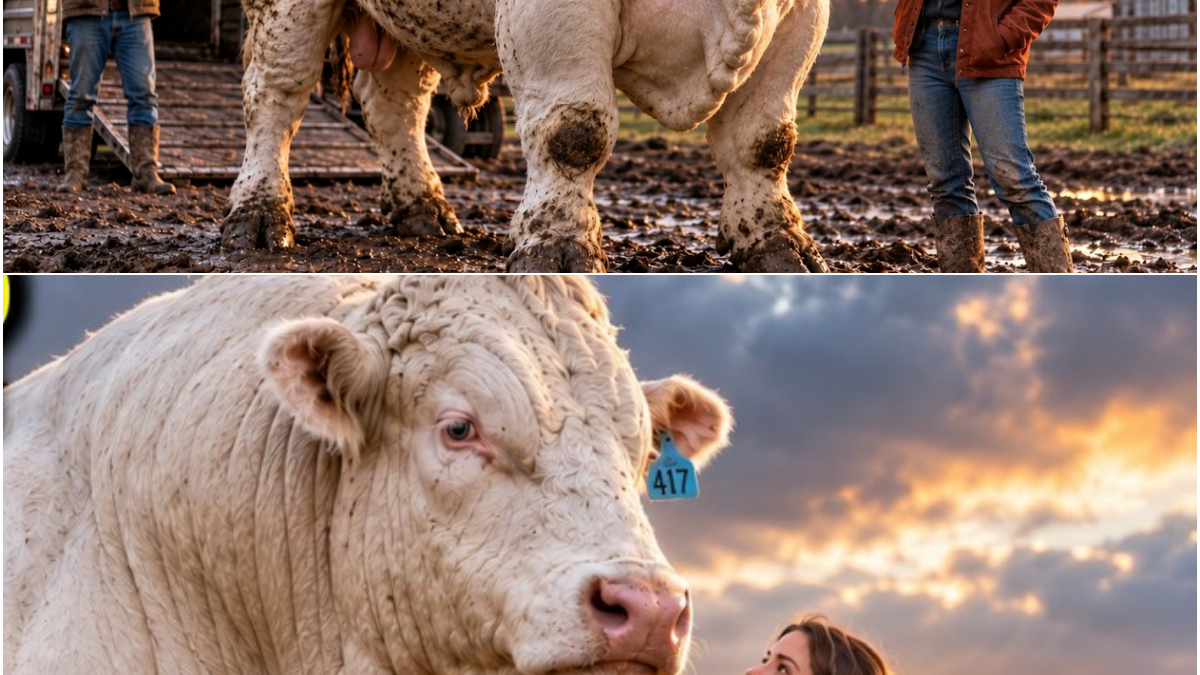
The animal stood inside the livestock trailer like a wall of pale muscle, nearly 2,000 pounds of broad shoulders, a thick neck, and a coat that caught the gray March light like silver.
Six grown men had struggled to unload him, and none of them looked particularly eager to try again.
Mud clung to their boots. The trailer groaned whenever the bull shifted his weight. Someone had already decided the animal was dangerous, someone else had decided he was worthless, and by the time the men began laughing, the bull had acquired a name that would follow him around McLean County: the albino bull.
Emily was twenty-three, and she had spent the last three years trying to keep her family’s farm from slipping beyond her reach.
She had twelve cattle, an equipment shed leaning toward collapse, a tractor older than she was, and a bank loan that seemed to grow heavier every month.
Her checking account held $1,186. She had no spare pasture, no spare money, and certainly no room for a nearly two-ton animal that another cattleman did not want.
Yet when the bull stepped off the trailer, Emily noticed something the others had missed.
He was not looking for a fight. He was trying to escape a corner that frightened him.
She watched his feet, the old scar beneath his shoulder, and the careful way he approached her.
Then she wondered what kind of history could turn an animal that large into somebody else’s unwanted problem.
And why, of all the farms in the county, had Harold Voss brought him to hers?
Harold stood beside the trailer with his arms folded, looking as if the entire business had already become tiresome.
He was sixty-one, owned Voss Creek Cattle Company, and had spent enough years buying and selling cattle to know how to make a decision sound final.
“We need somewhere to keep him through spring,” he said. Emily kept her eyes on the bull.
“Why here?” “Because nobody else will take him.” The bull struck his shoulder against the trailer wall.
The metallic crash made one of the handlers jump backward. Emily saw the animal pull his hind leg away from the rear corner, then shift his weight toward the ramp.
“Open the lower gate,” she said. Harold frowned. “The back one?” “Don’t open that one yet.”
“Emily, we don’t have all morning.” “Then let me do it right.” A handler hesitated, looking between them.
Emily pointed to the lower latch again. At last, the man released it. The bull backed away from the corner, lowered his head slightly, and tested the ramp with one front hoof.
He paused, breathed, and stepped down into the mud. There was no charge. No sudden swing of his head.
He simply stood in the yard, looking around as if he had arrived somewhere unfamiliar and was waiting for the next instruction.
Then he walked toward Emily. He stopped when he was close enough that she could see the pale pink around his eyes and the faded blue tag hanging from his left ear.
Beneath his right shoulder, an old scar interrupted the smooth coat. A circular patch of thin hair surrounded it.
Emily crouched to examine the mark. “You’ve been tied there,” she murmured. Harold’s expression tightened.
“He’s been handled plenty.” “Not gently.” “Just keep him alive until May.” The words settled between them.
Emily looked up and saw no generosity in Harold’s face, no expectation that she might improve the bull or discover something valuable.
He had brought her a problem because he believed her farm was too small and her finances too weak to refuse him.
She could have said no. She could have pointed toward the broken shed, the crowded pasture, or the loan statement on her kitchen table.
But the bull stood quietly in front of her, and she had already seen enough to know that his behavior deserved a closer look.
“North pasture,” she said. “He stays there until I decide otherwise.” Harold gave a short nod, as if the matter had been settled in his favor.
By sunset, the bull was inside the north pasture, and Emily had given him a name.
Atlas. That evening, Emily expected him to spend his first hours searching the fence line or standing nervously near the gate.
Instead, Atlas walked past the mineral feeder and crossed toward the oldest section of the hayfield.
He stopped over a patch of ground that looked nearly dead, pawed at it three times, and lowered his nose.
Emily followed him through the fading light. The surface was dry and pale, but when she pressed her fingers into the soil, she found darker earth beneath it.
It was moist, loose, and almost black compared with the surrounding ground. Atlas pawed again, scattering a little dirt.
Her grandfather had once told her that cattle sometimes noticed pasture problems long before a farmer noticed them in a notebook.
He had said it while showing her how to read grazing patterns, though she had been young enough then to think the lesson was mostly about knowing where to put a fence.
She looked at the patch, then at Atlas. He had been on the farm less than a day and had already led her to a place she had stopped paying attention to.
The next morning, she called Dennis Cole at the county extension office. Dennis was fifty-four and had spent three decades advising cattle producers.
He knew the local operations, the common mistakes, the successful breeding programs, and the ways a farm could lose money without realizing exactly where it was going.
When Emily told him that Harold Voss had left a giant white bull at Carter Farm, Dennis laughed.
“That one?” “Yes.” “You paid for him?” “No.” “Then maybe you got exactly what he’s worth.”
Emily glanced through the kitchen window. Atlas stood beneath the old cottonwood, his pale body almost blending into the morning sky.
“What makes you say that?” “Genetics, temperament, breeding history. A big frame doesn’t make a breeding bull.
Has he ever proved himself?” “He hasn’t been aggressive.” “That doesn’t make him valuable.” Dennis advised her not to breed Atlas.
If he produced poor calves, Emily might not know until the following year. By then, she could have spent money on feed, fencing, veterinary care, and lost pasture that she could not afford to waste.
Emily listened without arguing. She knew Dennis was not trying to insult her. He was giving her the kind of advice that kept small producers from making expensive mistakes.
But after the call, she remained at the kitchen table, thinking about the old records box beneath the porch.
It had belonged to her grandfather. She had not opened it since his funeral. It was made of thick wood, with a brass latch and faded marks where years of handling had worn away the finish.
Inside were decades of handwritten breeding notes, calving records, pasture rotations, weights, illnesses, sales, and observations written in pencil and blue ink.
Emily carried it inside and spread the contents across the table. At first, the pages seemed like an enormous collection of ordinary farm details.
Her grandfather had recorded the weather, the feed, the behavior of individual cows, and the condition of their pasture.
He had written down small things that Emily would once have considered unimportant, such as which animals stood quietly during handling and which ones tended to leave the mineral feeder until laSt.
Halfway through one ledger, she found a name. Silverbell. Beside it, her grandfather had written, “Best maternal line we ever owned.
Never sell the daughters.” Emily turned another page. The name of Silverbell’s sire appeared in the margin.
Her grandfather had added a note beneath it. “Exceptional feed conversion. Quiet temperament. Heavy weaning weights.”
She searched for Atlas’s birth year, expecting to find a reference that connected the bull to the old line.
But the pages she needed were missing. They were not scattered or torn at random.
The exact years that should have contained the most useful information were gone. Emily checked the next ledger, then the one beneath it.
She found more references to the same family, more notes about the cows and their daughters, and several reminders to preserve the line.
But the records stopped before she could establish Atlas’s full breeding history. That afternoon, Harold returned.
He stood outside the north fence while Atlas grazed on the other side. Emily approached with the ledger held against her jacket.
“How’s he doing?” Harold asked. “Why did you really bring him here?” Harold gave her a faint smile.
“Already solving mysteries?” “I found his breeding records.” The smile vanished. “Those records don’t mean much.”
“Why?” “He never proved himself.” Emily looked toward Atlas. “Then why do you care whether I try?”
Harold glanced at the farm. The patched fence, the leaning shed, the weathered house, and the old tractor were all visible from where he stood.
“You have twelve cows and a bank breathing down your neck. Don’t turn this into something it isn’t.”
He walked away before she could answer. Minutes later, Atlas returned to the same dry patch in the field.
He pawed the ground, and something bright flashed beneath the dirt. Emily hurried over and knelt.
She scraped away the loose soil until she uncovered an old brass cattle tag. 417.
The number was familiar. She had seen it in her grandfather’s notes, written beside Silverbell and repeated in the margins of several breeding records.
Before sunrise the following morning, Emily carried a shovel to the pasture. Atlas was already standing near the spot.
She began digging through six inches of ordinary soil before the shovel struck something flat and hard.
It was black plastic, covering an old concrete marker. Emily brushed away the remaining dirt.
Carved into the surface were three words and a number. 417, Silver Bell Line. She sat back in the frozen grass.
At 7:40, her kitchen table was covered with photographs and records. She had found a picture dated September 2004.
Her grandfather stood beside another massive white bull with a broad forehead, deep chest, and pale eyes that looked remarkably like Atlas’s.
On the back, he had written, “Cedar Ridge 417. Do not lose this line.” Emily knew the name.
Older cattlemen in the county still mentioned Cedar Ridge 417, a natural service sire that had supposedly produced unusually good calves before disappearing from local breeding programs.
At ten that morning, she drove her father’s pickup to the extension office and placed the photograph in front of Dennis.
He stopped talking. “Where did you get this?” “My grandfather’s box.” Dennis studied the picture for a long time.
Then he looked up. “Your grandfather bred Cedar Ridge 417?” “I think so.” Dennis sat down.
“That bull changed his herd.” “How?” “Good feet. Quiet temperament. Strong growth. Efficient cattle. Your grandfather was selecting for a combination of traits that wasn’t getting much attention around here.”
“Then why did the line disappear?” Dennis looked toward the window. Before he could answer, the office door opened.
Harold Voss walked in, saw the photograph, and stopped. “Where did you get that?” Emily did not move.
Dennis stood. “You know what this is?” Harold ignored him. “Some things should stay buried.”
Emily held his gaze. “What happened in 2004?” Harold stared at the photograph. His jaw tightened.
“Your grandfather trusted the wrong people.” Then he left. Dennis would only tell Emily one thing.
“Call your grandmother.” Her grandmother had moved to Iowa years earlier and rarely discussed Carter Farm.
Emily had spoken with her occasionally, but most conversations stayed close to the weather, family news, and the ordinary details of daily life.
When Emily said the name Cedar Ridge 417, silence filled the phone. Finally, her grandmother spoke.
“Your grandfather always hoped somebody would finish what he started.” She explained that Emily’s grandfather had built a small herd around the 417 bloodline.
He believed the cattle could maintain strong growth and maternal performance without depending on expensive feed.
He had spent years selecting animals that could thrive on the forage his land produced.
Then came a bad winter. Feed ran short. Debt tightened. The bank demanded that assets be sold, and Emily’s grandfather tried to keep the breeding females that carried the line.
He lost the argument. “Who bought them?” Emily asked. Another silence. “Voss.” Emily looked through the kitchen window.
Atlas stood at the fence, watching the house. “Harold?” “Yes.” That night, the story seemed almost simple.
Atlas was a surviving piece of something her grandfather had loSt. But the farm gave Emily no time to become sentimental.
The next morning, three cows had swollen udders, and one had stopped eating. A veterinarian checked them and found no obvious infection.
He asked about pasture changes, feed, and minerals. Emily answered that nothing had changed. Then he looked toward the barn.
“Test the water.” The old cattle trough was supplied by a shallow well that had been used for decades.
Emily had trusted it because her family had always used it. When she pumped water into a jar, it ran brown for several seconds before clearing.
The county test showed elevated nitrates. The concentration was not high enough to immediately kill healthy cattle, but it could interfere with performance over time.
Emily stood beside the technician holding the sample jar, looking at the water as though she had never seen it before.
“How long could this have been happening?” “Years.” She looked toward the north pasture. Atlas rarely drank from that trough.
He had been drinking from a shallow spring near the fence, the same spring he had found or chosen during his first hours on the farm.
The bull everyone had called unmanageable had been avoiding the farm’s worst water source from the day he arrived.
Emily moved the cows toward the spring. Within two days, they were eating normally again.
It did not prove Atlas was valuable as a sire. It did prove Emily had been wrong about something more basic.
She had inherited land she believed she knew, but she had stopped asking why the animals made certain choices.
The spring pasture created another problem. It was too small. Even if Atlas proved useful, twelve cows would never generate enough income to clear the debt.
Emily drew up a plan to expand toward twenty-five cattle. She needed fencing, water lines, and breeding infrastructure.
The cost came to about $18,000. The bank refused. The loan officer studied her paperwork, then looked at the photograph of Atlas.
“You’re asking us to finance an expansion based on an unproven bull.” “I’m asking for one season.”
“A bull is not collateral.” “He is if the calves are worth more than the debt.”
The officer slid the proposal back across the desk. “No.” Emily carried the rejection letter into a cold March rain.
Before she reached the truck, Dennis called. “I finished tracing the records.” Emily stopped beside the driver’s door.
“And?” “Atlas isn’t just related to Cedar Ridge 417. He’s the closest living descendant I can find in this county.”
She tightened her grip on the phone. “You’re sure?” “I checked twice.” Dennis paused. “Your grandfather might have been selecting cattle that could outperform ordinary commercial animals on less expensive feed.”
Emily looked down at the rejected loan. The debt still existed. The fences still needed repair.
Atlas still had not produced a single calf. But for the first time, the farm’s future felt less like a wall and more like a question.
She went home and pulled the old 1964 tractor from the shed. Its paint had faded.
One headlight was gone. Electrical tape wrapped the steering wheel. The engine would not start.
Emily opened the hood, found the clogged fuel line, cleared it with wire, climbed back onto the seat, and tried again.
The tractor coughed. Then it roared awake. For three days, Emily rebuilt fence, ran water line toward the spring, and divided pasture into rotational paddocks.
She could not afford a complete modernization, so she worked with what the farm already had: old pasture, old pipe where it was still usable, her grandfather’s breeding records, a tractor everybody else would have sold, and one unwanted bull.
In early April, she chose eight cows for Atlas. They were not the largest or the prettieSt. Emily selected for sound feet, calm temperaments, good maternal histories, and cows that held condition well.
Her grandfather had written the same principle repeatedly. Protect the strengths. Breed away from the weaknesses.
The first cow entered the pasture. Atlas approached slowly, without rushing or throwing his head.
He did not charge the animal or crowd her. By afternoon, all eight cows were with him.
Emily should have felt relieved. Instead, she noticed Atlas staring toward the north fence. A man stood there.
Harold Voss carried an old photograph. Emily walked toward him, and he held it through the fence.
“Your grandfather kept one copy,” he said. Then he pulled another photograph from his coat.
The edges were scorched. On the back was Emily’s grandfather’s handwriting. “417, 418, 419, daughters.”
Harold finally told her the reSt. When the bank forced the Carter herd to be sold, Voss Creek bought cattle from the line.
Harold expanded his own operation while Carter Farm shrank. Most of the animals were eventually sold into three states.
“I could have returned some,” he said. “You didn’t.” “No.” “What happened to them?” “Most were sold into three states.”
“And Atlas?” “One of the last surviving daughters produced him.” Emily stared at Harold. “Then you knew exactly what he was.”
“I knew what his blood might be.” “Why send him here?” Harold looked toward Atlas.
“Because I thought you’d fail.” The answer was ugly, but at least it was honeSt. Harold had regarded Atlas as too costly, too uncertain, and too troublesome to justify more investment.
Emily’s failing farm had been a convenient place to send him. But years of watching commercial cattle become larger and more expensive to maintain had made Harold question something he had dismissed in Emily’s grandfather.
“Your grandfather selected for efficiency,” he said. “I thought he was being stubborn.” “And now?”
Harold watched Atlas graze. “Now I think he may have been early.” Dennis arrived that afternoon carrying forage samples.
He had compared Emily’s north pasture with samples from three larger commercial operations. The result did not make Carter Farm magical.
The pasture was not richer in every category, but its spring mixture of cool season grasses and legumes provided a better mineral balance than Harold’s expensive ration had supplied Atlas.
“Part of the bull’s problem may have been the system around him,” Dennis said. Harold shook his head.
“Only part.” Dennis nodded. “The rest may be genetics.” Emily did not celebrate. She had learned that a promising observation was not the same as proof.
A week later, one of the eight cows miscarried. The veterinarian found no infection. Emily’s first thought was Atlas.
If the pregnancies were failing, the experiment could end before it began. Dennis helped pregnancy check the remaining cows.
Seven were carrying calves. One loss. Seven chances. That was all. By May, gossip about the giant white bull had spread.
At the feed store, one man called Atlas a snowball big enough to eat Carter Farm.
Emily paid for fencing staples and walked out without answering. Dennis waited beside her pickup.
“You going to prove them wrong?” Emily opened the truck door. “No.” He looked surprised.
“I don’t need to prove them wrong,” she said. “I need the calves to prove something.”
The first calf arrived in June, a black and white heifer weighing eighty-eight pounds. She stood quickly and nursed without difficulty.
The second weighed eighty-four pounds. The third weighed ninety-one. Then came an eighty-six-pound calf. By the seventh birth, Emily’s notebook was filling with numbers.
Birth weight. Time to stand. Time to nurse. Dam behavior. Weather. Pasture condition. Supplemental feed.
Growth. She did not record them because she wanted a trophy. She wanted to know whether the story she had inherited from her grandfather was true.
As the calves grew, a pattern emerged. They gained well while consuming less supplemental feed than comparable calves nearby.
Emily calculated the difference at roughly eighteen percent. Harold came to the farm and stood at the fence watching for almost an hour.
“How much less?” He finally asked. “About eighteen percent.” “That doesn’t sound right. I weighed the feed.”
Harold watched the calves. He did not laugh. That summer, rain stopped. By July, neighboring pastures had browned, and hay feeding began earlier than usual.
Carter Farm suffered too, but the north pasture held longer. Legumes remained green beneath taller grass.
Rotational grazing gave sections time to recover. The spring provided cleaner water than the old well.
Emily still bought feed. She still watched every dollar. Nothing had become easy. But for the first time, the farm had several systems supporting one another instead of one expensive input carrying the whole operation.
Then the county announced its summer livestock showcase. The prize for best young sire was $7,500.
Emily entered Atlas. Harold entered Kingmaker, a massive black Angus bull with an established reputation.
At the weigh-in, Atlas attracted attention because of his size and pale color. But the judges did not care much about appearance.
They examined his feet, back, hind legs, teeth, movement, and temperament. Then they asked to see progeny.
Seven calves entered the ring. They were uniform enough to show a pattern, but different enough in color to make clear that Atlas was not simply stamping out copies of himself.
The calves were sound, quiet, and healthy. One judge crouched beside the smallest heifer and ran a hand down her shoulder.
“What are these cattle eating?” Emily answered, “Mostly pasture, grass, legumes, mineral, some supplemental feed.”
The judge looked at the calves again. Kingmaker was heavier than Atlas, but Atlas moved easily.
His feet were square. His calves had arrived at moderate birth weights and were growing efficiently.
When the announcer named the finalists, Emily felt the brass 417 tag in her pocket.
Kingmaker. Atlas. The envelope opened. “Best young sire, Atlas.” For several seconds, Emily did not move.
The crowd clapped. Harold approached and removed his hat. “I was wrong.” Emily shook his hand.
But the trophy mattered less than what happened after the show. A geneticist from the University of Illinois asked permission to collect DNA samples from Atlas and his calves.
“We think this bloodline may contain a combination of traits breeders have been trying to select for,” she told Emily.
“Which traits?” “Not a miracle. Not a super bull. A useful combination. Feet, temperament, maternal ability, growth, feed efficiency.
Traits that matter because they work under your management and on your land.” Then the geneticist gave Emily a second piece of news.
Atlas was not the only surviving male from the line. Another registered bull had been found.
His name was White River 417, and he was scheduled to sell that Saturday at Bellwether Stock Farm, forty-seven miles south.
Emily drove there before sunrise. White River was older than Atlas and smaller, with scars across his hide.
Most buyers barely looked twice. Emily did. He had the same pale eyes, broad forehead, and calm watchfulness.
The bidding began. Within minutes, Emily knew she could not afford him. Harold entered the bidding.
For a moment, Emily thought he might buy the bull and return another piece of the bloodline to Carter Farm.
But the price climbed, and Harold finally stopped. An Iowa cattleman bought White River 417.
Emily watched the trailer leave. For the first time since Atlas had arrived, she felt real loss.
“One bull isn’t enough,” she told the geneticiSt. “No,” the woman said. “It isn’t.” That night, Emily spread her grandfather’s records across the kitchen table again.
Near Silverbell’s name, she noticed a note she had read before but never understood. “Preserve through daughters.
Do not concentrate too heavily.” Her grandfather had never intended to build the future around a single champion.
He wanted a population resilient enough to survive drought, market pressure, disease, bad decisions, and time.
Atlas was not the answer. He was access to the answer. The next morning, Emily called the geneticiSt.
“I want to test the daughters.” “All of them?” “Every one I can afford.” From then on, Carter Farm changed slowly.
Emily stopped chasing size. She selected for fertility, sound feet, temperament, maternal ability, calving ease, forage performance, and animals that held condition without excessive purchased feed.
She recorded everything: pasture recovery, calf weights, supplemental feed, water quality, pregnancy rates. Atlas remained central to the breeding program, but he was no longer treated as a miracle animal.
He was one part of a larger system. The summer of 2023 brought another drought.
Winter arrived early. Neighbors hauled more hay and purchased expensive feed. Emily still needed stored forage, but rotational grazing and careful stocking allowed her herd to depend less heavily on purchased inputs than before.
The next spring, Atlas’s daughters began calving. The first delivered without assistance. Then the second.
Then the third. Their calves stood quickly. The cows remained calm. Dennis visited in April and walked the north pasture.
He crouched, pushed his fingers into the soil, and studied the grass. “Your grandfather would recognize this,” he said.
Emily smiled. “The cattle?” Dennis shook his head. “The farm.” By 2024, buyers were arriving from Missouri, Indiana, and Iowa.
They were not coming because Atlas was the largest bull they had ever seen. They were coming because his daughters were becoming useful cows.
Some buyers wanted breeding contracts. Emily accepted only what fit the program. Her grandfather’s warning remained in her mind.
The line had nearly disappeared once because too much had depended on too few animals and too few people.
She was not going to rebuild it the same way. At the county livestock showcase, Atlas returned older and heavier.
This time, the crowd already knew his name. His offspring stood around him, red, black, white-faced, different in appearance, but similar in the traits Emily had measured.
One of the judges from his first show walked over. “You changed the county’s breeding program.”
Emily looked past him toward the cattle. “No.” The judge waited. “We finally started measuring the right things.”
That evening, Harold Voss came to Carter Farm. He found Atlas near the fence and rested one hand against the bull’s neck.
“I sent him here because I thought you couldn’t handle him,” Harold said. Emily waited.
“I was wrong twice. About Atlas and you.” He gave her an envelope. Inside was another photograph of her grandfather with Cedar Ridge 417.
Emily turned it over. The handwriting was unmistakable. “One day someone will understand why this mattered.”
She read the sentence twice. Harold looked toward Atlas’s daughters. “I want to buy one.”
Emily raised an eyebrow. “For money,” he added. “Not a favor.” She agreed. Five years after Atlas first backed out of that muddy trailer, Carter Farm no longer looked like a place waiting to disappear.
The equipment shed had been repaired. The fences stood straight. The north pasture was green.
The old well was no longer trusted simply because it had always been there. Emily tested the water twice a year.
The rotational paddocks had become routine. The debt was gone. Her herd had grown from twelve cattle to eighty-six.
But those numbers were not the part Emily valued moSt. Young farmers began coming to ask about grazing and record keeping.
Older farmers brought breeding ledgers from their own barns. The extension office used Carter Farm as a local case study in selecting cattle for performance within a specific forage system rather than simply chasing size.
At Dennis Cole’s retirement dinner, he raised his glass toward Emily. “I spent thirty years telling farmers what land ought to do.”
He smiled. “She reminded me to watch what it was already doing.” Atlas never became famous far beyond Illinois.
He did not need to. His daughters entered other herds, then his granddaughters. One granddaughter won the county’s best maternal cow award.
Another produced a ninety-two-pound calf that reached six hundred pounds on pasture before weaning. The old 417 line was no longer a single bull hidden inside someone else’s herd.
It had become distributed again, useful again, measured again. One cold November morning in 2027, Emily crossed the north pasture alone.
Mist hung over the grass. The ground was soft beneath her boots. Atlas was old now.
His gait had slowed, and the white coat across his shoulders had yellowed with age.
But when he saw Emily, he lifted his head. She walked to him and rested a hand against his neck.
Behind him, three generations of his descendants grazed across the field. Emily thought about the day Harold’s trailer had arrived.
The jokes, the bank debt, the bad well, the rejected loan, the buried brass tag, her grandfather’s ledger, seven calves, eighteen percent less supplemental feed, the drought, the show ring, and all the years afterward, when the important work turned out not to be winning anything, but continuing to test what the land and cattle were telling her.
Atlas had never saved Carter Farm by himself. Neither had old genetics. Neither had rotational grazing.
Neither had a forgotten notebook. The farm had recovered because Emily learned to connect them.
A bloodline suited to the forage. Cleaner water. Better pasture management. Careful selection. Records instead of assumptions.
Old knowledge tested against new evidence. Things the farm already possessed, but had stopped seeing as resources.
Atlas lowered his head and began grazing. Emily remained beside him for a while, listening to the soft movement of cattle across the field.
The wind stirred the grass, and the mist began to lift from the pasture. Across the field, the repaired 1964 tractor sat near the barn.
Its paint was still faded. The steering wheel was still wrapped in electrical tape. It was not a new machine, and it had never been an impressive one.
But it had carried her through the work that mattered. A few minutes later, Emily climbed onto the seat and turned the key.
The engine rolled once, then started. She let it idle while she looked across the north pasture.
The cattle moved steadily through the grass, and Atlas stood among them, no longer an unwanted burden or a mystery waiting to be solved.
He was part of a living line that had survived because somebody had finally paid attention.
Emily eased the tractor forward. There would be more records to keep, more calves to weigh, more water to test, and more decisions that would not have easy answers.
The farm would still depend on weather, markets, and the patience to learn from mistakes.
But the future was no longer a thing she had to face with nothing but a bank statement and a broken fence.
It was there in the pasture, spread across generations, growing quietly under the same wide Illinois sky.
Disclaimer: This content may be created by Al for entertainment purposes. Any resemblance to real persons, events, or places is coincidental.








