They Gave Her a Blind Dragon to Make Her Fail — It Followed Only Her Voice Through the Final Trial
The other candidates had dragons already, bright scaled creatures trained to answer flags, bells, whistles, and shouted commands.
Thea Marsh had only a gray coat, a travel bundle, and a release paper waiting for her signature.
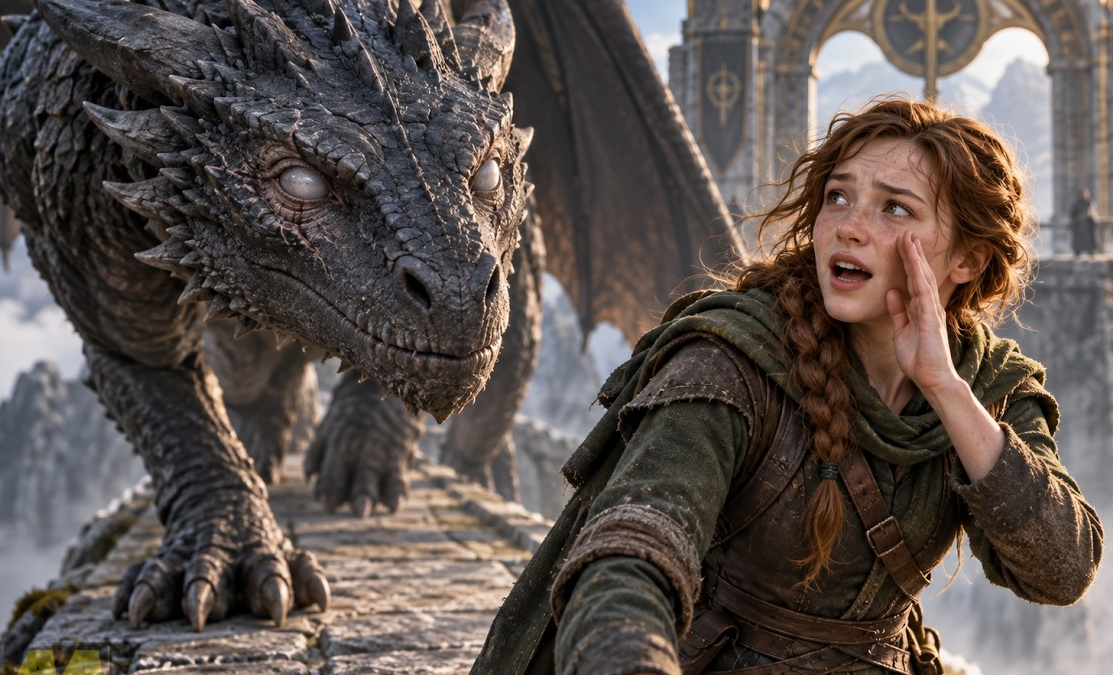
Then the far gates opened. The dragon that emerged was enormous. Gray green scales covered a body built for hauling stone, with one shoulder marked by an old scar and wings folded tightly against his sides.
His eyes were milk white and completely still. A handler pulled the lead rope, and the dragon turned toward the sound, missed the handler by several feet, and struck a water barrel with his tail.
The benches erupted in laughter. Thea did not laugh. She had seen that kind of movement before.
Not in a dragon, but in frightened animals that were surrounded by too many voices and expected to understand every one of them.
The dragon lowered his head. His foot slipped near the drainage cut. The handler pulled harder.
Thea said his name. “Barrow.” The huge head stopped. The laughter faded. She said nothing else.
For several seconds, the dragon stood completely still. Then he turned toward her, not toward the handler, not toward the benches, but toward the quiet place where her voice had been.
Three deliberate steps followed. Thea felt every eye in the yard settle on her. She had come to the keep that morning expecting to leave with a signed release and a seat on the lime cart down the hill.
Instead, a blind dragon had just answered her voice in front of the entire royal testing ground.
And if he could hear her when nobody else could reach him, what exactly had the keep been failing to hear?
Thea Marsh had spent most of her life being told that she waited too long.
She waited before opening stable doors. She waited before moving frightened animals. She waited beside sick lambs until their breathing settled.
She waited beside carts when wheels sank into mud, because pulling harder did not make the ground firmer.
At the dragon keep, waiting had another name. Hesitation. The first examiner had written it beside her name two years earlier.
The second examiner had written it again. By the time she returned to the keep with her release paper folded inside her coat, the word had become almost official.
No aptitude for dragon work. The paper had been prepared in the muster room that morning.
Two clean lines, a place for a signature, and nothing more. Thea wanted that signature badly.
She had no family position to protect, no influential sponsor, and no reason to remain at the keep.
A granary near the river had offered her work. The owner needed someone who could keep records, count deliveries, and manage animals when the carts came in late.
It was ordinary work, which suited Thea perfectly. She had nearly reached the small gate when Warden Devryn stopped her.
“You cannot leave yet.” “The release is ready.” “I know.” “You said the second assessment was final.”
“It was.” “Then why am I still here?” Devryn looked toward the far gates. “Because one dragon remains unpaired.”
Thea followed his gaze. The heavy gates were still closed. She understood immediately. “No.” “That is not a refusal until you say it on the sand.”
“I already failed.” “You failed the assessment.” “That means I failed.” Devryn shook his head.
“It means the assessment says you failed. The charter says an unpaired dragon remains on the roll.
You may claim the final trial or refuse it publicly.” “And if I refuse?” “You leave.”
Thea looked at the release paper. “And the dragon?” Devryn did not answer. That was answer enough.
The gates opened. Barrow came through. Thea had heard stories about him. Everyone had. Eight years hauling cut stone from the quarry.
Two winters ago, an accident in the kiln shed had left his eyes useless. Since then he had worked only in familiar yards, dragging sledges over known ground.
He had never been paired again. The keep had kept him because he was strong.
It had not known what else to do with him. Now the capital was arguing over the cost of second claims.
The benches were full. The examiners were watching. The handlers were tense. And Barrow was standing in the center of the sand with a rope around his neck while everyone waited to see whether a blind dragon could be made useful on a route designed for sight.
A handler pulled the rope. Barrow stepped backward. The handler pulled harder. Barrow turned sharply and smashed the water barrel.
Someone laughed. Thea stepped forward. “Let the ropes go slack.” The handler stared at her.
“Do it.” Thea had no authority to give the order. Perhaps that was why he obeyed.
The ropes dropped loose. Barrow stood with one hind foot partly over the drainage cut.
Thea said his name. “Barrow.” His head turned. She waited. Three breaths. Then she said it again.
“Barrow.” His claw touched the stone. Twice. He moved away from the cut. The yard became silent.
“Walk,” Thea said. Barrow took two steps. Then stopped. Thea did not repeat herself. The dragon shifted his weight.
His foot searched the sand. He found level ground. Only then did he continue. Warden Devryn came down from the rail.
“He answers a quiet voice.” Thea nodded. “The causeway is not quiet.” “No.” “The gallery echoes.”
“I know.” “The bells ring.” “I know.” “There are four hundred feet of fog beneath it.”
“I know.” Devryn studied her. “The trial is in six days.” Thea looked at Barrow.
“I will take it.” Six days. That was all they had. The first morning, Thea walked the causeway before the crews arrived.
She had seen it many times from below, but never as something she might have to cross.
It stretched between two towers above the gorge. The stone span was only two paces wide.
Three great arches stood along its length. The signal gallery hung over the middle section, where eight bronze bells were mounted above the walkway.
Four hundred feet of fog moved below. Thea stood at the edge and listened. The gorge gave almost nothing back.
A man with a chalk stick was striking each slab with a hammer handle. “You are the second claim,” he said without looking at her.
“Thea Marsh.” “Reese.” He struck another slab. “Root master.” “What does that mean?” “I decide whether the route is sound.”
He struck another stone. “This one is hollow.” Thea looked down. The slab looked perfect.
Reese marked it with chalk. “Your dragon cannot see that.” “No.” “He cannot see the flags.”
“I know.” “He cannot use the bells.” “I know.” “He cannot tell which voice belongs to which person once he reaches the gallery.”
Thea looked toward the arches. “What can he use?” Reese finally looked at her. “That is what you are supposed to find out.”
Thea returned to the low stable yard. She did not begin with the causeway. She began with a wall.
Barrow walked with one claw brushing the stone. Whenever he approached an unfamiliar surface, he tapped it firSt.
One tap. Sometimes two. He never placed his full weight until he knew what answered.
Thea watched him for hours. Then she took him to the granary court. There was a drainage gutter along one side beneath several loose boards.
She led Barrow toward it. He stopped. “Walk.” Nothing. “Walk.” Still nothing. She looked at the boards.
Then at Barrow. She removed one. The stone underneath was cracked. The nearest board tipped in her hands.
The dragon had been right. Thea sat on the edge of the court for a long time.
That evening she returned to the stable and changed her method. “Walk.” Silence. Barrow moved.
“Hold.” He stopped. She waited. He breathed deeply. A low sound moved through his cheSt.
Then she gave the next command. “Walk.” He moved again. One word. A pause. His answer.
Another word. That was the beginning. On the second morning, Reese watched them in the granary court.
Two stable boys struck buckets against the wall. Barrow stopped. Thea waited. The low sound came.
She said, “Walk.” He moved. Reese folded his arms. “Again.” The boys struck harder. Barrow stopped.
Thea waited. The sound came. “Walk.” He moved. Reese nodded. “The halt is clean.” “The turn?”
“Late.” Thea frowned. “Can I fix that?” “Maybe.” She took Barrow to the first section of the causeway that afternoon.
He reached the edge of the familiar tower stone. Then he stopped. His claw tapped the new surface twice.
Thea waited. Barrow stepped onto the causeway. They moved slowly. Four joints passed beneath each foot.
Thea began to understand. He was counting. Not numbers. Distance. The seams in the stone gave him a map.
At forty paces, Barrow stopped. Thea waited. He made no sound. Reese approached and struck the next slab with his hammer.
Hollow. He looked at the stone. Then at Barrow. “Take him back.” They returned the same way.
The next morning, Reese wrote something into his route book. “You give him one thing,” he said.
“Yes.” “And then you stop.” “Yes.” “You wait for him to answer.” “Yes.” “What is the answer?”
“A sound.” Reese shook his head. “That is what you hear. What does he give you?”
Thea thought about it. “I do not know.” “You should.” So she watched. She listened.
She learned. Barrow’s answers were not always sounds. Sometimes his answer was a claw against stone.
Sometimes a change in breathing. Sometimes a shift in weight. Sometimes refusal. That last one mattered moSt.
On the fourth morning, Barrow stopped at the mouth of the gallery. The bells hung above them.
The walls were close. The air carried every sound in two directions. Thea said, “Step.”
Barrow moved forward. “Step.” Another pace. Then another. He entered the gallery. The bells remained silent.
They went four paces in. Then back out. Thea should have been pleased. Instead, she felt uneasy.
She had asked him to move past a refusal. She had not listened to it.
The next day, the bells were rung. Ten pulls. The entire gallery became noise. Thea gave the command.
“Hold.” Her voice returned from the walls. “Hold.” Another echo arrived. Barrow turned. Thea repeated the command louder.
He turned toward the wall. Three steps carried him toward the open edge. A keeper shouted.
Barrow turned toward the new voice. His shoulder moved over the edge. Reese grabbed the keeper and pulled him back.
The bells stopped. Barrow froze. One forefoot searched empty space. Thea wanted to shout. Instead, she closed her mouth.
She walked to his shoulder. She placed her palm against his hide. Barrow remained still.
She waited. Slowly, he brought his foot back. One inch. Then another. He returned to the stone.
They walked out. Nobody spoke. The keeper would not look at Barrow. Devryn came toward Thea.
“You obeyed the animal.” Thea stared at him. “I pushed him past his refusal.” “Yes.”
“I should not have.” “No.” Devryn looked toward the gallery. “That matters.” Thea expected anger.
Instead, Devryn said, “The permit is suspended.” Thea nodded. “I understand.” “There is a petition.”
“How many names?” “Eleven.” Juna found Thea later that afternoon. She was one of the strongest candidates in the keep.
Six years of training. A scarlet cord. A young dragon that followed flags as naturally as breathing.
“I did not sign the petition,” Juna said. “Why?” “I want to see the route from inside the gallery.”
Thea looked at her. Juna continued. “If Barrow cannot manage it, then he cannot. But I want the record to say why.”
“You think the route is wrong?” “I think the route was built for dragons who see.”
“That is not the same thing.” “No.” Juna looked toward the causeway. “That is why I did not sign.”
That evening, Thea returned to the granary court. She watched Barrow move. He found the walls.
He found the cracks. He found the boards. He knew the world through surfaces and sounds.
Then she understood something. The gallery was asking him to trust a voice that had become several voices.
The problem was not volume. It was shape. One command became four echoes. Four commands became four possible directions.
Thea needed something the walls could not copy. She tried a new signal. A tap.
She struck the stone twice with her boot. Barrow turned his head. She waited. Nothing.
Again. Nothing. Eleven times. On the twelfth attempt, Barrow struck the stone twice with his claw.
Thea sat down. For the first time in days, she laughed. Not because anything was easy.
Because they had finally found something they could both understand. She created a rule. No second word until the tap came.
Not louder. Not faster. No second word. If Barrow did not answer, Thea moved herself instead.
They practiced for hours. She learned to stand on the same slab. She learned to feel his answer through her boot.
Reese watched. Then he joined her. “Teach me the signals.” “No.” He raised an eyebrow.
“Why?” “Two voices caused the problem.” Reese considered that. Then nodded. “Fair.” They practiced in silence.
The fifth day came. The gallery was opened for a full rehearsal. Two keepers. Two clerks.
The bells. The benches. The wind. Everything. Thea and Barrow entered. Word. Pause. Tap. Step.
They moved steadily. The bells began. Ten pulls. The bronze sound filled the gallery. Thea stopped speaking.
She waited. The tap came. She stepped. Another tap. Another step. They reached the turn.
Barrow stopped. Thea waited. Four seconds. Then she moved three paces forward. She gave the signal.
The tap came. Barrow turned. They continued. Nobody spoke. At the far mouth, Reese watched them emerge.
He did not smile. He simply opened the route book. “Again tomorrow,” he said. Thea nodded.
That night, Juna found her near the tower. “The final gate closes on twenty.” “I know.”
“It does not wait.” “I know.” “The wind will be stronger tomorrow.” “I know.” Juna looked at Barrow.
Then at Thea. “Good.” Thea frowned. “Good?” “You finally sound like someone who knows what she is doing.”
Thea almost smiled. At dawn, the wind arrived. It came through the gorge from the weSt.
It pushed the signal flags sideways. It carried voices away. Thea stood on the span and called.
Barrow did not move. She shifted upwind. Called again. The tap came. They practiced twice.
Then the ninth bell approached. The candidates assembled. The benches filled. Nine hundred people came to watch.
Juna went before them. Her dragon crossed the first arch beautifully. The second. The third.
The final gate opened. They passed through at sixteen. The crowd cheered. Then the steward called the second claim.
Thea walked onto the span. Barrow followed. The brass speaking collar hung unused at her side.
It was standard equipment. Thea had tried it. It destroyed the shape of her voice.
She had requested permission to carry it without using it. Devryn had approved the requeSt.
The record would show that she had refused the standard tool. She accepted that. “Walk.”
Pause. Tap. Step. Barrow moved. The first arch passed beneath them. The wind struck. Thea shifted upwind.
“Hold.” She stopped speaking. Tap. Step. Barrow moved. The second arch opened ahead. The count had started behind them.
Thirteen. Fourteen. Thea ignored it. The gallery waited. They entered. The bells rang. Ten pulls.
The sound became enormous. Thea said nothing. Her boot remained flat against the stone. Tap.
Step. Tap. Step. The echoes came. Four voices. Five. Six. None of them mattered. Only the tap mattered.
At the turn, Barrow stopped. Thea waited. Nothing. The crowd began to murmur. The examiner called for the attempt to close.
Devryn raised one hand. The clerk stopped writing. Thea moved two paces. She waited. Nothing.
She moved one more. A claw struck stone. Twice. Thea smiled. “Step.” Barrow turned. They crossed the shifted slabs.
Four stones were uneven. Barrow knew before she did. He refused the dangerous line. She moved with him.
The count reached seventeen. The final gate was open. Eighteen. The wind struck her back.
She turned. Then she ran. Not away from Barrow. Ahead of him. She stayed upwind.
Her boots struck the stone in the rhythm they had practiced. Word. Tap. Step. Tap.
Step. Nineteen. The gate stood open. Thea crossed firSt. She kept speaking from the far side.
Barrow followed. The count reached twenty. The gate closed behind him. Silence filled the tower.
Then Barrow lowered his head. His claw struck the stone twice. Thea answered with two taps of her boot.
The benches erupted. Juna was standing on the arch shoulder. Reese had dropped onto the stone step.
Devryn walked onto the causeway himself. He reached Thea and opened the route book. “Entered as passed.”
Thea looked at Barrow. Devryn continued. “Full bells. Wind. No collar. On the count.” He closed the book.
Then he looked at her. “I was wrong about the animal.” Thea said nothing. Devryn looked at Barrow again.
“And I was wrong about you.” Thea nodded. That was enough. Nothing about Barrow changed that day.
His eyes remained milk white. He still tapped unfamiliar stone. He still preferred walls. He still stopped when something felt wrong.
The keep changed instead. The role of guide was rewritten. A dragon unable to use visual signals could be entered as voice paired.
The pairing had to work in both directions. The guide had to demonstrate that they could listen as well as speak.
Reese wrote the new rule into the route book. Then he underlined the word listen.
Barrow became a working dragon of the route. He hauled timber for repairs. He moved stone.
He knew the yard by its joints. He knew the stair by its echoes. He still said no when he meant no.
Thea became his guide. Then she became a guide for others. Candidates who shouted too much were sent to her.
Candidates who thought louder meant clearer were sent to her. Candidates who believed every pause was weakness were sent to her.
She taught them the same lesson. One word. Wait. Listen. Then move. Juna sent the most stubborn candidates.
Two of the eleven who had signed the petition eventually came to Thea for instruction.
She helped them both. The release paper remained on the clerk’s table for another week.
Two clean lines. An empty space at the bottom. Thea finally took it. She folded it carefully.
Then she put it inside her coat. She never signed it. A few evenings later, Reese found her in the granary court.
He carried the route book beneath one arm. “There is a low road beneath the causeway,” he said.
Thea looked up. “You never told me.” “I wanted to see if you would ask.”
She smiled. “Where does it go?” “You can see the piers from below.” “And?” Reese stopped.
He waited. Thea recognized the silence. He had learned. “I wondered whether you would walk it with me.”
Thea let the pause remain. Behind her, Barrow stood beside the wall. He waited too.
Thea looked at Reese. Then at Barrow. “Yes,” she said. Barrow tapped the stone twice.
And this time, nobody in the yard mistook the sound for hesitation. It was an answer.
Disclaimer: This content may be created by Al for entertainment purposes. Any resemblance to real persons, events, or places is coincidental.








