They Dumped 500 Junk Engines on Her Yard… 6 Months Later She Owned an Empire!
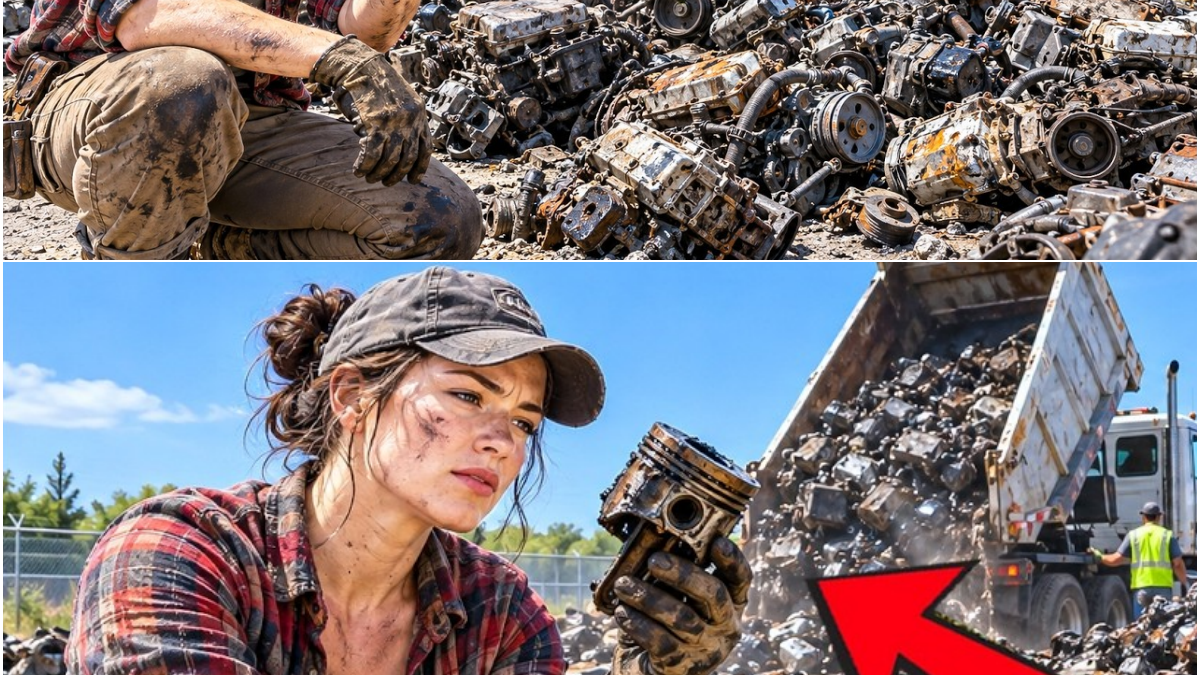
At ten minutes past six on a gray October morning in Michigan, Ray Tomlin stopped her truck in the middle of the road because she could not tell where her driveway ended and the pile began.
Engines covered the fenced half acre from the front gate to the back fence, stacked in uneven towers three and four high.
There were hundreds of them, perhaps five hundred, though she would count them twice over the next week and never arrive at the same number.
Oil pans leaked onto the gravel. Rusted bell housings hung from engines that had been cut apart carelessly.
Some crankshafts were frozen so tightly that no ordinary wrench could turn them. The air smelled of sour motor oil, old coolant, and diesel fuel.
To anyone else, it was a hazardous mess left behind by a man who wanted to make sure she could never compete with him again.
Ray was twenty-six, short-haired, strong from years of stubborn mechanical work, and accustomed to being underestimated.
She had a small repair business, a modest lot, and barely enough money in her account to keep the lights on.
The man responsible for the pile owned the largest engine operation in three counties. He expected the cleanup costs to crush her, the county to shut her down, and the property to become his at laSt. But Ray had spent four years learning what happened inside an engine when it stopped running.
She knew that a seized block could still have value, that a damaged machine could contain parts worth saving, and that the word worthless often meant somebody had stopped looking carefully.
Then she spotted a familiar gray-brown goose standing on top of the engines, wings spread and hissing at the morning air.
Ray smiled. What if the mountain meant to bury her was actually the beginning of her business?
Ray Tomlin had not expected to find five hundred engines on her property when she arrived that morning.
She had expected an ordinary October day, a few repairs, and the usual struggle to keep her small operation moving.
Instead, she stood at the entrance to her fenced lot and stared at a mountain of iron that had appeared while she was away.
The engines filled every available space. Some were piled neatly enough to suggest that whoever delivered them had planned the arrangement.
Others had been dropped carelessly, leaving blocks tilted at awkward angles and accessories crushed beneath heavier castings.
A few still had sections of wiring harness hanging from them. Several wore faded manufacturer labels, and others had no identifying marks at all.
Ray had been in business for four years. She knew what an engine looked like when it had been neglected, and she knew what a neglected engine could coSt. But she had never seen so many abandoned powerplants in one place.
The goose was the only creature on the property who seemed pleased. Ray called her Gasket.
The bird had wandered onto the lot eight months earlier and decided to stay. Nobody had invited her, but she had discovered that the raised ground near the back fence contained an excellent patch of weeds.
She had claimed the place with the confidence of a creature who had never encountered a convincing argument against her ownership.
Now she stood on a stack of engines, honking at Ray as though the entire delivery had been arranged for her personal convenience.
“Morning to you, too,” Ray muttered. She looked across the lot again. The engines were not simply old.
Many were contaminated with oil and coolant, and their condition made moving them safely difficult.
The county would have questions. The cleanup could cost thousands of dollars, perhaps much more.
Ray did not need to ask who had arranged it. Colton Hargrove ran Hargrove Salvage and Reman on Route 9.
His operation was the largest engine business in three counties. He employed forty people, operated a fleet of rollback trucks, and owned industrial equipment that smaller mechanics could only dream about.
He also had a habit of treating independent operators as temporary inconveniences. Twice, he had made offers on Ray’s property.
Both were low enough to make clear that he was not interested in paying its real value.
He wanted the lot because it occupied a useful corner, and he wanted Ray out of the way.
She had refused him both times. The engines were his answer. Dumping them on her property created an immediate environmental problem.
Old oil and coolant had to be drained and contained properly. Improper disposal could bring serious penalties, and the cost of cleaning up hundreds of contaminated engines could overwhelm a small business.
The county might not care who had delivered the engines. The property belonged to Ray.
The responsibility would fall on her unless she could establish what had happened and persuade the authorities to recognize it.
By noon, the town had heard the story. People drove past the lot to look.
Some stopped near the road and stared through the fence. Others called friends and described the mountain of engines in increasingly dramatic terms.
Most had already reached the same conclusion. Ray Tomlin was finished. She would either sell the property to Hargrove for whatever he offered or spend everything she had trying to clean up a mess she had not created.
Ray did not spend the morning arguing with anyone. She climbed onto the pile. Her boots found a foothold on a Ford 5.4-liter engine with a cracked exhaust manifold.
She stepped across a Chevrolet flywheel housing and worked toward a diesel block partly buried beneath two smaller engines.
She wiped the deck surface with her thumb, found a cylinder bore, and examined it with the flashlight on her phone.
The bore showed no obvious scoring. There was no deep rust pitting beyond the crosshatch pattern, and the corrosion around the upper ring travel looked consistent with ordinary storage.
Ray sat back on her heels. Then she began to laugh. The people watching from the road could not understand why.
Ray knew something Hargrove had apparently forgotten. In engine remanufacturing, an old engine was not necessarily garbage.
It could be a core, the starting point for a product that would sell for considerably more than the scrap value of its metal.
A remanufacturer could not build an engine from nothing. The original block and major components were essential.
A casting was expensive to produce, and reusing a sound one was a major reason remanufactured engines could be sold for less than new replacements.
That was why auto parts stores charged core deposits. Depending on the application, a returned engine might be worth fifty dollars, several hundred dollars, or considerably more for certain diesel and specialty models.
Hargrove had access to most of the region’s cores. Local scrapyards sold to him first because he offered regular volume and had built relationships that had lasted for years.
He had become so accustomed to controlling the supply that he had stopped thinking about what the cores actually meant to a smaller operation.
Ray looked across the pile and saw an inventory problem that had already been solved for her.
She still had to make the engines safe, identify which ones could be used, and learn how to remanufacture them properly.
But the raw material was sitting on her property. She stood up and whistled sharply.
Gasket answered with an angry honk. Then Ray called toward the neighboring junkyard. “Conquo! You got a forklift I can borrow for a week?”
Scio Conquo came out with a coffee cup in his hand. He was fifty-one, broad through the shoulders, and had spent three decades working around transmissions, engines, and scrap equipment.
He also had a long history with Hargrove, who had squeezed his business on core prices for years.
Conquo looked at the pile, then at Ray standing above it. “You’ve lost your mind.”
“Probably,” she said. “You got a forklift or not?” He had one. That was the first crack in the arrangement Hargrove thought he controlled.
Four days later, the county sent an inspector named Delaney Marsh to examine the lot.
Marsh was polite, professional, and clearly uncomfortable. Everyone in town knew that Ray had not ordered the engines, and nobody seemed confused about who had arranged their delivery.
But the property was still hers, and the county had to address the fluids. Marsh gave her thirty days to drain the engines and properly contain the oil and coolant.
If she failed, the fines could reach five figures. Ray did not waste time arguing about the deadline.
She bought a fifty-five-gallon drum, a manual fluid extractor pump, and a pallet of oil-dry absorbent on credit from Griff Castellin, the older man who owned the local auto parts store.
Griff knew her father before he had passed away, and he had watched Ray work through years of difficult repairs.
When she explained what she intended to do, he looked at her plan, considered the scale of the problem, and extended the credit with a handshake.
For twelve straight days, Ray drained engines. She removed drain plugs, cracked oil pans that would not empty properly, and dealt with fasteners that had rusted into place.
When a plug could not be removed safely, she found another controlled way to release the trapped fluid.
She worked through the pile one engine at a time. The job was dirty, repetitive, and physically exhausting.
She wore gloves, kept absorbent material close, and separated the fluids according to the requirements she had learned from the county and local disposal services.
She also kept records. A used laptop she had bought for forty dollars became the center of her operation.
Every engine received an entry with its approximate type, visible condition, and the fluids removed from it.
She noted cracked housings, missing components, unusual corrosion, and anything that might affect whether the engine could be reused.
The work was not glamorous, but it was the first thing that had to be done.
An engine full of old oil was dangerous to handle. Coolant could contaminate runoff and create a serious risk if it reached a storm drain.
Moving the pile without addressing the fluids would only spread the problem. Ray understood that if she wanted to turn the delivery into inventory, she had to make the lot safe firSt.
Twelve days after beginning, she had drained four hundred eighty engines. They were no longer stacked in one unstable mountain.
They stood in rows, arranged so she could reach them, inspect them, and begin sorting.
When Delaney Marsh returned, the inspector walked the property and checked her records. “This is the cleanest response to a dumping incident I’ve seen in eleven years,” Marsh told her.
Ray had bought time. Now she had to turn that time into a business. Until then, she had mostly repaired and resold used engines.
She could replace a water pump, repair a timing chain, swap accessories, and get an engine running well enough to sell for six or eight hundred dollars.
Remanufacturing was different. A used engine was sold with its existing wear and uncertain remaining life.
A rebuild usually meant taking the engine apart and replacing components that were visibly worn or damaged, sometimes without correcting the dimensions of the block itself.
A remanufactured engine required a more complete process. The block had to be restored to factory specifications.
Wear surfaces had to be measured. Dimensions outside acceptable limits had to be corrected through machining.
Wear components were replaced whether or not they looked obviously damaged, and the finished engine had to be tested before it could be sold with a meaningful warranty.
Ray began teaching herself from factory service manuals purchased secondhand from a retiring mechanic in Saginaw.
She read technical discussions on engine machinist forums, studied measurement procedures, and asked questions whenever she could find someone willing to answer them.
She learned by doing the work, and sometimes by ruining parts that should have been saved.
Her first major task was teardown. Every bolt had to be accounted for. Every part needed to be labeled and stored in a way that preserved its original position.
Pistons and connecting rods could not be mixed carelessly, because components that appeared identical might have developed different wear patterns.
Ray created a procedure and followed it on every engine. She removed the accessories, drained the remaining fluids, separated the cylinder heads, and dismantled the rotating assembly.
She bagged fasteners and marked components by cylinder position. Then came cleaning. The bare block had to go through a hot tank, where a heated caustic solution removed accumulated oil, carbon, sludge, and grime.
A block could not be inspected or machined properly if its internal passages were still coated with years of residue.
Ray did not own a hot tank. At first, she rented time at a nearby operation for fifteen dollars per engine.
She hauled the stripped blocks over on a borrowed hand truck and returned them to her lot once they were clean.
She saved every dollar she could until she had enough to purchase a used tank of her own.
The next step was inspection, and it was where she made one of the most expensive mistakes of her early career.
A block could look perfectly clean and still contain a hidden crack. Heat and age could create hairline fractures in the water jacket or around the cylinder walls.
Once the engine returned to operating temperature and load, coolant could leak into the oil or combustion chamber.
The proper inspection for certain iron castings involved magnetic particle testing, commonly called magnafluxing. The block was magnetized, then coated with fine magnetic particles suspended in fluid.
Cracks disturbed the magnetic field, causing particles to collect along the damaged area and reveal defects that could not be seen with the naked eye.
Ray did not have a magnaflux setup during her first month of remanufacturing. She knew the test mattered, but she was in a hurry.
On her third build, she inspected the clean block visually and decided it looked sound.
She completed the engine and sold it to a customer two towns away for nine hundred dollars.
Six weeks later, he called. Coolant had entered the oil. The engine was unusable, and the customer was furious.
Ray had to provide a replacement. Between parts, labor, and the lost sale, she was out four hundred dollars, along with a portion of the trust she had been trying to build.
She drove eighty miles round trip to a machine shop in Flint, where the owner allowed her to rent time on the magnaflux equipment.
Six months later, she bought a secondhand unit for eleven hundred dollars. From then on, every block received the proper inspection, no matter how clean it looked or how urgently a customer wanted the finished engine.
The next part of the work was machining. Cylinder boring required cutting the cylinder walls to a precise diameter, removing wear and damage so that correctly sized pistons could be installed.
But each engine had limits. On many applications, boring more than thirty thousandths of an inch over the original size could leave the cylinder wall too thin.
Ray learned that limit the hard way. On her second block, the wear pattern was worse than she wanted to accept.
She bored the cylinders forty thousandths over, hoping to save the casting rather than scrap it.
The block cracked under compression on the test stand. The sound was sharp enough to make her dive behind a tire barrier she had stacked for protection.
When she came back to inspect the damage, a two-inch split ran through the deck.
The block was finished. She had lost the casting, the labor, and most of a morning.
She wrote the rule down in her notebook: beyond thirty thousandths, do not force the block.
If the application justified it, sleeve the cylinder. Otherwise, scrap it. No exceptions. Crankshaft grinding demanded another kind of precision.
The journals had to be machined to remove grooves and wear, then matched with bearings sized for the finished dimensions.
Clearances mattered down to fractions of a thousandth of an inch. Too much clearance could reduce oil pressure and allow the crankshaft to hammer against the bearing.
Too little could starve the bearing of its protective oil film and create destructive friction.
Ray learned that lesson on one of her fifth or sixth full remanufactured engines. She had completed the assembly many times by then and felt confident in her hands.
She torqued the main caps without checking the bearing clearance with Plastigage, a thin measuring strip used to reveal the actual space between a bearing and its journal.
The engine ran for forty seconds on the test stand before a deep knock appeared.
When she dismantled it, one of the main bearings was already worn through its surface layer.
She had to rebuild the engine again. After that, she checked every main and rod bearing with Plastigage.
She wrote the instruction on the shop wall in red marker. Check it or it’ll cost you the engine.
Decking the block came next. The upper surface had to be machined flat so the cylinder head could seal correctly.
Even a slight warp could create leaks between combustion chambers, coolant passages, and oil passages.
At first, Ray sent blocks to a machine shop forty minutes away. The work cost sixty dollars per engine.
As production increased, she eventually bought her own surface grinder. Reassembly required new bearings, rings, seals, and gaskets.
Ring gaps had to match factory specifications so the rings could expand properly as the engine warmed.
Cylinder heads needed a proper valve job, with the seats cut and valves fitted to produce a reliable seal.
Every fastener had to be tightened to the correct torque and in the specified sequence.
A careless tightening pattern could warp a surface she had just paid to machine. Incorrect torque could leave a gasket poorly clamped or stretch a fastener beyond its usable limit.
Ray followed the service manual every time. Only after the engine was assembled did it go to the test stand.
She built the stand herself from welded angle iron, adding an electric motor and the necessary fuel, oil, and cooling systems to operate the engine under controlled conditions.
Each engine had to run for at least thirty minutes while she monitored oil pressure, temperature, noise, and leaks.
If anything sounded wrong, she stopped it and investigated. If anything leaked, it went back for correction.
Only when the engine passed did she stamp it complete and attach the warranty card.
Gasket made the test stand her favorite place to sit. Whenever an engine warmed up, the goose climbed onto the hood or valve cover and settled there as though guarding the machine.
She hissed at anyone who approached too closely. Ray had long since stopped trying to move her.
By the time she had inspected the entire delivery, she had divided the engines into three categories.
About one hundred forty were suitable for remanufacturing. They included small-block Chevrolets, Ford 5.4-liter and 4.6-liter engines, several six-cylinder applications, and a particularly useful group of Cummins 5.9-liter diesels.
Roughly two hundred more were useful for parts. Their blocks might be cracked or worn beyond repair, but their heads, crankshafts, accessories, and other components could still serve mechanics who needed replacements.
The remaining engines were genuine scrap. There were close to one hundred sixty of them, and Ray sold them by weight to a metal recycler for a little over two hundred dollars per ton.
Even the unusable portion of the delivery brought in a few thousand dollars. The numbers changed her understanding of the whole operation.
Her cost to remanufacture a small-block engine, once she counted machine work, replacement parts, and labor honestly, came to about eleven hundred dollars.
A comparable new crate engine might cost four thousand to six thousand dollars, depending on the application.
Ray began selling warrantied remanufactured engines for roughly twenty-two hundred to twenty-six hundred dollars. She offered a twelve-month or twelve-thousand-mile warranty, depending on the application and terms.
Customers were not simply paying for an engine. They were paying for a process that could be documented, inspected, tested, and backed by a written promise.
Her first major sale from the pile came through Curtis Bllelock. Curtis ran a small delivery fleet of eleven box trucks.
He had been spending heavily on new crate engines whenever one of his older vehicles suffered a major failure.
He did not trust used engines, but he could not keep buying new ones at the rate his trucks needed replacements.
He had heard about the dumped engines and driven past Ray’s lot out of curiosity.
He found her working on a Ford 5.4-liter short block. Gasket was stationed on the fender of Curtis’s own truck, staring at him with the fierce attention of a bird who had already decided he was not welcome.
Curtis watched Ray for a while. “You seriously stand behind these?” “Twelve months, twelve thousand miles,” Ray said.
“It’s in writing. If it fails inside that period because of my work, I fix it or replace it.”
He bought one for twenty-two hundred dollars. It was nearly four thousand dollars less than a new engine, and Curtis needed the truck back in service.
He told Ray that he expected to return in a month with a complaint. He did not.
The engine ran for eighteen months before it needed anything beyond routine oil changes. Curtis bought three more engines that year and began recommending Ray to other fleet owners.
Word spread through the local business community. A tow yard two counties away started calling her before contacting Hargrove whenever it had an engine that needed a quick, dependable replacement.
Independent mechanics began asking about her inventory. Conquo also began sending customers her way when he could not supply what they needed.
By spring, Ray was remanufacturing six engines a month, then eight. She was selling nearly everything she completed.
For several months, the engines Hargrove had dumped on her lot became the best opportunity she had ever received.
Then she ran out of cores. By early summer, she had worked through almost all one hundred forty remanufacturable blocks from the original pile.
Demand had increased, and fleet customers were asking when the next engines would be ready.
The business had become successful enough to create a new problem. Without cores, there was nothing to remanufacture.
Hargrove recognized the weakness. He controlled the large scrapyards in the region because many had exclusive arrangements with him.
They sold their cores to his operation in exchange for regular business, favorable volume pricing, and the convenience of dealing with one large buyer.
He began making calls. The message was simple enough. Yards that supplied Ray Tomlin would find their own accounts with Hargrove Salvage becoming less accommodating.
Two yards that had been selling Ray small batches stopped returning her calls. A third told her directly that it could not risk losing its established account.
For six weeks, the pressure worked. Ray had orders she could not fill. The shop grew quiet, and the production schedule became a list of customers waiting for engines that were not available.
She sat on an overturned bucket one evening in July, with Gasket dozing near her boots, and worked through the numbers on a legal pad.
If she could not find a steady supply of cores within two months, she would lose the fleet accounts she had spent so much time earning.
She needed another source. That spring, she had met Owen Delvecio, Griff Castellin’s brother-in-law. Owen was a retired machinist who had spent thirty years running the machine shop floor at a plant in Flint before the facility closed.
Ray had gone to him more than once with technical questions she could not resolve through manuals or online discussions.
One afternoon, she complained about Hargrove’s pressure on the scrapyards. Owen listened, set down his coffee, and said, “Man who controls the yards controls the yards.
He doesn’t control the mechanics.” Then he returned to his coffee. Ray thought about the sentence for two weeks.
Eventually, she understood what he meant. Hargrove controlled the big scrapyards, but he had never bothered with the small operators.
Independent mechanics working out of two-bay garages often had dead engines sitting behind their shops.
Backyard rebuilders had old blocks rusting in the weeds because transporting them somewhere else cost more than they could earn from the scrap value.
Nobody had organized those scattered sources into a reliable supply network. Hargrove did not want to spend time buying individual engines from people who might have only one or two.
Ray could. She began calling it her exchange program. The offer was simple. Anyone who brought her a dead engine core in reasonable condition would receive a fair flat payment on the spot.
Depending on the engine, she offered sixty to one hundred fifty dollars. No complicated negotiation.
No waiting for a monthly account settlement. No low offer followed by a second offer after the engine was unloaded.
Cash or check, same day. If the person later bought a remanufactured engine from her, she would provide an additional seventy-five-dollar core credit.
The program gave small mechanics a reason to bring their unwanted engines to her instead of leaving them behind their shops.
Ray printed flyers on Griff’s copier and posted them at independent garages, farm supply stores, diners, and community boards within forty miles.
She also drove to shops personally. Some had never heard of her. Others knew about the dumped engines but assumed she had closed her business.
She explained the offer, looked at the cores they had available, and made arrangements to collect them.
The first regular supplier was a mechanic in the next county who had four old engines behind his shop.
He had been meaning to move them for years but had never found a buyer willing to make the effort worthwhile.
Ray collected all four in one week. A month later, the same mechanic called to buy a remanufactured engine for a customer.
A backyard rebuilder near Bay City began calling her whenever he pulled a failed engine from a vehicle.
Conquo, who had spent a decade selling surplus cores to Hargrove because he had few alternatives, shifted most of his supply to Ray’s program.
She paid fairly, paid promptly, and treated him like a business partner. Within three months, he was sending her some of the best cores in the county.
By autumn, a year after the original delivery, Ray had more than forty regular suppliers.
Some were small repair shops. Others were farm mechanics, independent rebuilders, and businesses that serviced older commercial vehicles.
The network was not built around exclusive contracts or threats. It was built around an exchange that worked for both sides.
Hargrove tried pressuring a few of the smaller suppliers, but the approach had little effect.
They had never depended on him for volume pricing. They had never needed his account.
Now they had a buyer who paid them immediately and offered a discount when they purchased finished engines.
His leverage had limits. Ray’s business began growing again. Curtis Bllelock’s eleven-truck operation became the starting point for standing arrangements with four regional fleets.
Those contracts guaranteed a baseline number of engines each month, reducing the uncertainty of relying entirely on individual sales.
The steady core supply meant Ray could plan production instead of waiting for the next usable block to appear.
That winter, she hired her first employee. Gene Petrochelli was a machinist in his fifties who had been laid off eight months earlier when a large remanufacturing plant two hours south shut down.
He knew crankshaft grinding and cylinder honing better than anyone Ray had met. He also understood the discipline required to make the same engine correctly over and over again.
When Gene toured her shop, he studied her process sheets, inspected her work areas, and read the red-marker rule on the wall about checking bearing clearance.
“You’re running a tighter operation than the plant that just laid me off,” he told her.
Ray appreciated the compliment, but she cared more about what he could teach her. Gene helped refine the machining process and improve production scheduling.
He showed her ways to reduce wasted movement, organize tooling, and identify small errors before they became expensive problems.
Within a year, two former co-workers joined him. Ray used the new contracts and more predictable core supply to secure a small business loan, with Griff Castellin helping her obtain the financing.
She bought a proper CNC boring machine and began expanding the shop. The lot that Hargrove had buried beneath five hundred dead engines became a two-acre facility with a pole barn, a proper hot tank, a magnaflux station, and a growing machining operation.
The original half acre was still there, but the business had spread beyond its old boundaries.
Ray had four employees besides herself, more than sixty regular core suppliers, and a production run of roughly seventy remanufactured engines each month.
The product mix included small-block gasoline engines and the diesel work Gene had developed into a specialty.
Annual revenue in the third year reached a little over 1.1 million dollars. For Ray, the figure was not an abstract measure of success.
It was a number she could point to on a tax return, built engine by engine from material that had arrived on her property as an attempt to ruin her business.
Hargrove’s core supply began thinning during those same years. The change was gradual. One yard chose Ray’s exchange program.
Then a mechanic who had once sold everything to Hargrove began bringing her his surplus.
Another small supplier decided that immediate payment mattered more than the possibility of receiving a slightly better deal from a larger account.
Eventually, Conquo was sending Ray the best cores in the county before anyone else had a chance to inspect them.
The arrangement was not complicated. She treated him fairly, paid him promptly, and helped him find the finished engines his customers needed.
Hargrove never came to the lot to discuss the business. He never apologized for the delivery, and Ray did not wait for him to.
The mechanics and yard owners had begun making their own decisions about where to sell.
A business built around controlling supply could lose that control without a dramatic confrontation. It could happen one phone call at a time, as people quietly discovered that they had another option.
By the fourth year, Ray had become the person other operators contacted when they needed an engine they could truSt.
She still kept her notebooks and records. She still examined cores herself when an unfamiliar application arrived.
She still insisted on testing each finished engine before it left the shop. The procedures she had developed after her early failures remained in place.
Every block was inspected. Every critical dimension was measured. Every bearing clearance was checked. Every engine was tested before receiving its warranty.
She had learned that a promise was only as strong as the process behind it.
One ordinary Tuesday afternoon, Gene rolled a finished long block off the production line. It was a Cummins 5.9-liter engine built from a casting that had been part of the original pile.
Ray had deliberately saved that block because she wanted to finish one of the first engines from the delivery and see how far the business had come.
The engine was assembled, inspected, and ready for the test stand. Gasket, older and heavier but no less determined, waddled over and climbed onto the warm valve cover.
Gene shook his head. “She thinks she owns the place.” “She does,” Ray said. They connected the engine to the test equipment and checked the fuel, oil, and cooling systems.
Ray stood beside the controls while Gene reviewed the measurements. Then they started it. The engine turned, caught, and settled into a clean, even idle.
Oil pressure held steady. Temperature rose as expected. There was no knock, no visible leak, and no unusual vibration.
Gasket hissed contentedly at nobody in particular. Ray crossed her arms and listened. She remembered the morning she had arrived at the lot and found engines stacked to the fence.
She remembered the county inspector, the drums of drained oil, the damaged blocks, the failed bearing, and the customer who had called about coolant in his oil.
She remembered the first time she had sold an engine with a written warranty, and the fear she had felt when she signed the paper.
She remembered the weeks when she had no cores and the evenings when she had wondered whether the business would survive.
Now the shop was producing seventy engines a month, and the block running on the test stand had come from the very pile that was supposed to end her operation.
The engine did not know anything about the arguments, the paperwork, or the years of work that had brought it there.
It only had to run properly. And it did. Ray had never believed that every broken engine could be saved.
Some castings were cracked beyond reasonable repair. Some were too worn, too damaged, or too poorly suited to the market to justify the cost of machining.
She had learned to distinguish between a machine that needed attention and one that needed to be taken apart for parts.
That distinction had become the foundation of her business. The original pile had contained valuable blocks, useful components, and genuine scrap.
The important thing was not that everything had been worth something. The important thing was that she had examined each part carefully enough to find out.
Hargrove had expected the mountain to become a burden she could not carry. Instead, it had supplied her first large inventory, helped her develop a remanufacturing process, and introduced her to the work that would eventually define her company.
But the engines alone had not built the business. Ray had learned how to handle hazardous fluids, how to inspect castings, how to machine within safe limits, how to measure bearing clearances, and how to test finished products.
She had learned to offer a warranty she could honor and to build a supplier network that did not depend on one powerful buyer.
She had learned to turn individual relationships into a dependable operation. And she had learned that being underestimated could become an advantage when it gave her room to work without having to explain every decision.
The people who had watched her climb the pile that first morning had seen a young mechanic behaving irrationally.
Ray had seen five hundred opportunities that needed to be sorted. The difference was not luck alone.
It was knowledge, patience, and a willingness to do the unglamorous work before attempting anything impressive.
The engines had arrived as a challenge she had not chosen. What she did with them was her decision.
At the end of the afternoon, the finished Cummins completed its test run. Gene shut down the equipment and checked the final readings.
Ray signed the inspection sheet and attached the warranty paperwork. Gasket remained on the valve cover until Ray offered her a small piece of feed.
The goose climbed down, took it, and strutted toward the weeds as though she had personally supervised the entire operation.
Ray watched her go, then looked back across the shop. The test stand was ready for the next engine.
The machining area was busy. The parts shelves were labeled, the core deliveries were scheduled, and the production board showed work planned for the coming weeks.
Outside, the fenced lot that had once been filled with leaking engines had become a working industrial facility.
A man had delivered five hundred unwanted engines because he believed they would overwhelm a young woman with a small business and little money.
What he had actually delivered was the raw material for a trade she would teach herself through hard work, careful records, and mistakes she refused to repeat.
He had been right about one thing. The pile could have ruined her. He had simply misunderstood what she was capable of doing with it.
Disclaimer: This content may be created by Al for entertainment purposes. Any resemblance to real persons, events, or places is coincidental.








