They Chose Her Sister for the Royal Dragon — It Walked Past Her and Followed the Rejected Girl Home
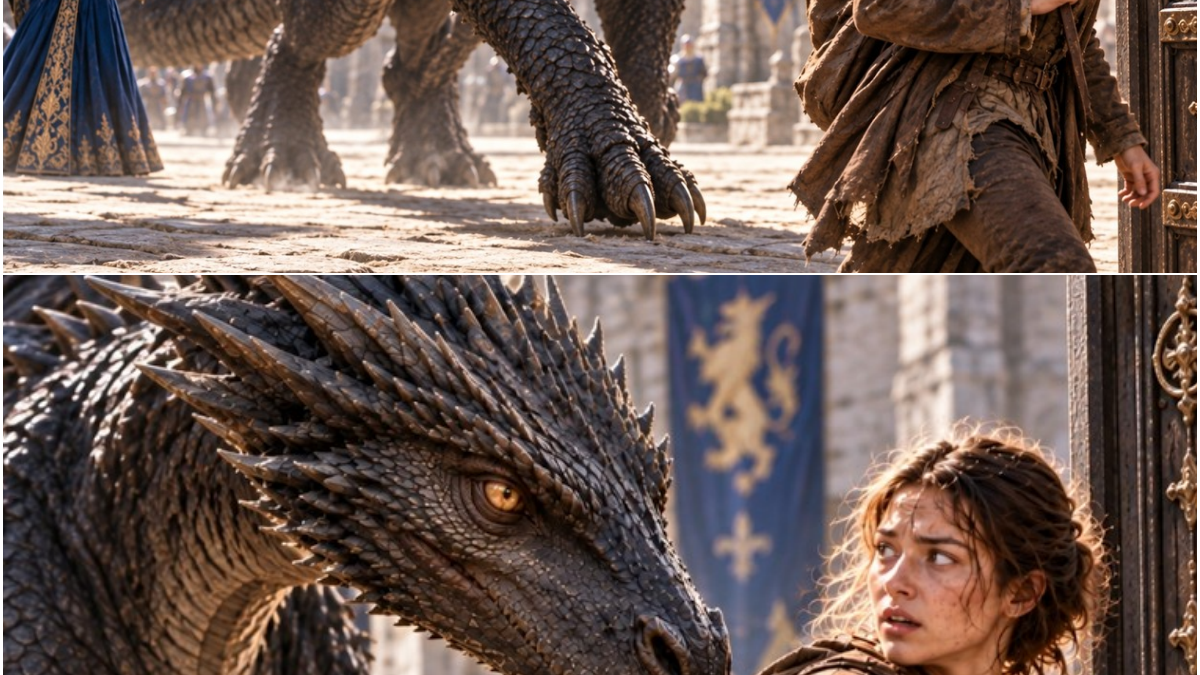
The royal dragon was not looking at her sister. He was looking past the white line, past the gathered court and the polished ranks of the queen’s riders, toward the service gate where Cella Ardan stood among the stable hands.
Her sleeves were rolled to her elbows, and fish oil still clung to her fingers.
She had no place in the ceremony except as one more pair of hands ordered to remain behind the water butts.
Yet Karth, the crown’s dragon, had turned his great slate-and-copper head toward her and held it there.
For eleven years, Karth had carried the royal standard. He knew the ceremony, the mounting block, the familiar commands, and the throat band waiting on its stand.
He knew the rider chosen to sit upon him. He knew, too, the old scar beneath his left jaw, where the scales had grown together in a thick, stiff seam.
But now, as the Lord Marshall read the final words of confirmation, the dragon watched a stable hand who had already been dismissed from the royal trials.
Cella glanced behind herself, expecting to find something that had caught his attention. There was only dry grass, a crow on the wall, and the empty track beyond the gate.
When she looked back, his gaze had not moved. At the gallery rail, a captain in a gray sash stopped watching the ceremony and began watching the dragon.
Merritt lifted her glove. The crowd waited for Karth to lower his head and accept his rider.
Instead, he stepped past her. And what could a dragon know about the one person the court had already decided was unworthy?
Six hours earlier, Cella had been on her knees in the low stalls, scraping the last of the dried mud from a drain.
It was the final shift of her final day at the academy. The hire had always been temporary, a place for a failed candidate to earn a little money while the chosen riders moved on to better things.
At fourth bell, she would collect her pay, nine crowns and four shillings, and return to the village of Fenmar.
It was enough to roof the goat shed behind her father’s forge, and there were already three farms in the valley that had asked her to examine animals nobody else could persuade to cooperate.
She had made a life out of being useful in places where nobody expected anything remarkable.
Gowen came down the row on his bad hip. He had worked at the flightyard longer than the board had existed, and his opinion of most official ceremonies could be measured by how quickly he wanted the stalls emptied.
“All hands were to be clear during the ceremony.” “The pens still need water,” Cella said.
He looked toward the third stall, where Pel stood with his left wing held a little too close to his body.
Pel was four years old, brown-green, and still growing into his long legs. His left wing joint had been troubling him again.
Cella had found it warm that morning, and the dragon had shifted whenever anyone approached.
She put her palm flat against the joint and waited. Pel’s movements gradually quieted. He lowered his head over her shoulder and breathed the smell of hay down the back of her neck.
“You’ve got no business with him,” Gowen said, though there was no sharpness in his voice.
“I’ve got a pail.” Gowen watched her for another moment, then continued down the row.
The crown’s dragon occupied the long flight pen at the top of the yard, alone as he had been for eleven years.
Cella took the feed cart along the fence. Karth came away from the far wall and paced her from one end of the rail to the other.
When she stopped, he stopped. It was the third time that month. She had decided it was the feed cart he wanted.
The other explanation was too ridiculous to entertain, especially for someone whose name had been crossed off the candidates’ register two years earlier.
She poured his ration into the trough. Karth watched the food fall, but did not lower his head to eat.
His hide was slate along the back and copper around the ribs, with the dull sheen of old metal where the sunlight reached him.
The left wing membrane carried an old mend, a pale line through the darker webbing.
Beneath his left jaw ran a scar two fingers wide. The scales had grown back thick and fused, losing the fine overlapping edges that allowed the skin to move freely.
Cella had seen the state harness laid out that morning. Its throat band would sit directly across that scar.
She knew better than to involve herself in the crown’s equipment. She was only the hand who filled the troughs and cleaned the stalls.
Whatever happened during the choosing belonged to the board. She was hanging the cart traces when Merritt found her in the tack room.
Her sister was already wearing the writer’s coat. Four years of drill, two winters of night watches, and every examination the academy could devise had gone into earning it.
The coat fit her shoulders perfectly. Her hair was pinned neatly away from her face, and her gloves were folded in her left hand exactly as the drill required.
“You’re still here until sixth bell,” Merritt said. “They’ll want the yard clear.” She placed something on the bench between them.
It was their mother’s collar pin, brass, with a little tongue that had been mended once with uneven solder.
“Take it,” Merritt said. “You should keep it.” “You’ll only leave it in the loft.”
“It’s yours.” “It’s ours. And I can’t wear brass with the coat.” Cella picked up the pin.
The metal was warm from Merritt’s hand. “Come to the back of the ring,” Merritt said.
“Be somewhere I can find you afterward.” At the door, she paused without turning around.
“Two years,” she said. “Nobody talks about the third trial anymore. You could have asked for a reassessment, and you never did.
Today isn’t the day I’m going to ask why.” Then she left. So Cella stood at the back of the ceremony ring with the pin in her pocket when the Lord Marshall named Merritt Ardan to the service of the crown’s dragon, Karth.
The courtyard made the noise courtyards made when an important decision became official. People applauded, benches creaked, and the banners shifted in the wind.
Merritt climbed the mounting block with her glove held flat on her palm. A rider offered.
A dragon chose. Nobody reached toward the other. Karth stood slowly, like a great building rising out of the ground.
His weight came onto the boards with a deep wooden groan that quieted the applause.
He lowered his head toward Merritt until his breath stirred the fur at her collar.
Cella saw her sister’s shoulders relax. Then Karth stepped past her. He did not turn away or retreat.
He walked around the mounting block, careful of Merritt, careful of the boy carrying the ribbon dish, and descended onto the sand.
“Rider,” the Lord Marshall called. “Recall him.” Merritt turned, her glove still extended. “Karth. Stand.”
He did not stand. He crossed the ring at an unhurried walk, his great feet pressing deep marks into the sand.
Banners tore from the rail as he passed. A parasol slipped beneath one foot, and he stepped over a fallen courtier without touching him.
The guards ran in from the wall with their pikes crossed. The captain in the gray sash came down from the gallery.
“Points down.” The pikes lowered. Karth stopped six feet short of the guards and waited.
“Close the east gate,” the Lord Marshall ordered. Two men hurried to the gate and dropped the bar.
Karth walked up to it, looked over the top, then turned his head toward Cella.
Every face in the yard followed his gaze. Two years earlier, three hundred people had watched a clerk write failed beside Cella’s name on the trial sand.
She had thought nothing could be worse than that. Now she stood with a royal dragon between her and the only way out of the ceremony ring, while the court tried to understand why he had ignored the rider they had just confirmed.
Her name rose from the benches in fragments. The sister. The other Ardan. The one who had failed.
The Lord Marshall came down from the platform. “You, hand. Get out of the yard.”
“The gates are barred, my lord,” Cella said. “Then unbar them and take yourself out of it.”
She lifted the heavy bar and walked onto the cart track, her coat over one arm and her heart beating so hard it seemed to shake her ribs.
Behind her, the gate did not close. Twenty paces down the track, she understood that the sound following her was not the crowd.
It was slow, heavy, and matched the pace of her own steps. She stopped. The sound stopped.
When she turned, Karth filled the gateway. Dust drifted from his shoulders. His wings were folded flat against his back, and his head was lowered.
The stable hands called that posture asking. Cella had never seen a royal dragon use it with a person.
“Go back,” she said. “That’s your rider in the coat. Go back.” Karth blinked. Riders came through the gate along the wall, carrying lines.
One of them tried to pass in front of the dragon. Karth moved his head six inches, and the loop fell harmlessly into the duSt. He did not snap or threaten.
He simply looked down the road and waited. Cella started walking, because standing still was worse.
It was two miles from the academy gate to Fenmar. She walked every foot of it with the road trembling behind her.
The miller stopped in his doorway with a sack over his shoulder and forgot to put it down.
Children were pulled out of the lane. A cart horse broke its traces and ran through a hedge.
Twice, Cella stopped and told Karth to return to the academy. Twice, he stopped, waited, and continued after her.
After that, she let him have the road. Her father’s forge stood at the low end of Fenmar, where the lane opened into the ashfield.
Tobin Ardan came out holding his tongs. He saw Cella, then the enormous shape behind her, and carefully set the tongs on the step.
“Is he chasing you?” “No,” she said, and heard the truth in her own voice.
“He’s following me.” Karth came through the yard gate, which was too narrow for him, and took the gatepost with him.
He crossed the yard, placed the goat shed between himself and the road, and lay down along the south wall.
His tail curled around the trough. The shed roof came beneath his shoulder, leaned under his weight, and held.
Then the crown’s dragon shut his eyes in a smith’s yard and refused to move.
By full dark, forty people had gathered in the lane, along with eleven riders and enough torches to illuminate the whole village.
They tried the recall horn. They tried Merritt’s voice, which cracked on the second call and steadied afterward.
They tried lines and fresh meat and every command the academy had taught them. Karth lifted his head once for the horn.
Then he put it down and ignored everything that followed. Cella stood at the gate with her father’s yard turning into a spectacle behind her.
A little later, the captain in the gray sash arrived from the capital road on horseback.
His name was Dne, captain of the queen’s riders, answerable under the board’s charter for the safety of any beast carrying a crown rider.
He looked at the torches and ordered half of them extinguished. Then he approached the gate.
“You’re the hand, Cella Ardan.” “Captain Dne.” He looked past her at the dragon lying beside the shed.
“How long has he been down?” “Six hours. He hasn’t eaten or drunk. He lifted his head for the horn once.”
“You know what a royal dragon is worth.” “I know what he weighs.” “Those are the same problem,” Dne said, without unkindness.
“I have a beast of state lying against a smith’s shed in a village of ninety souls.
He walked past his confirmed rider in front of the court. I’m not handing a crown dragon to a stable hand because of a gesture at a ceremony.
That isn’t spite. That’s how people get hurt.” “I’m not asking for him.” “Then what are you asking for?”
“I want everyone out of my father’s yard.” Dne’s eyebrows moved slightly. “Say the reSt.”
“He put a building between himself and the road. He’s been watched by torchlight for six hours by men throwing rope at him.
He won’t eat with an audience, and neither would you. Pull everyone back past the mill.
Leave the meat inside the gate. Give me one lantern and nobody standing behind me.”
“And if he goes over the wall into the village?” “Then I’ve been wrong, and he’ll do it either way.
You’d rather learn that now than at three in the morning with eleven tired riders in the lane.”
Dne studied her for a long moment. Then he turned and cleared the lane. The ration wagon left two quarters of mutton inside the gate and pulled back.
The torches disappeared up the road. Cella set the lantern on the trough, walked to the middle of the yard, and sat on an upturned pail with her back to the dragon.
She looked at the wall of her father’s house. For a long time, nothing happened.
Then the ground shifted as Karth adjusted his weight. There was the sound of his jaw working, followed by the scrape of a bone being lifted from the earth.
Cella did not turn around. That was the entire skill, and it had cost her a career.
He ate both quarters and drank half the trough. When she finally went inside, he watched her reach the door and let her go.
Her father made tea that nobody drank. Merritt did not come. At sunrise, the Lord Marshall arrived with two clerks and the board seal.
His name was Halbrook, and he stood in the ashfield where the wet ground could not reach his boots.
“Four days,” he said. The queen’s progress would leave the capital on the fifth morning.
Karth was expected to fly the standard at its head, and only a rider certified by the board could do so.
On the fourth day, at noon, before the queen and the court, Cella would fly the certification course around the weather tower, through the bell arch, over the river, and back to the ringline.
She would fly it safely, or she would not be certified. “And if I don’t?”
Cella asked. “Then the dragon goes to your sister, who trained four years and earned him.
He goes in a check harness, conditioned by men who have done this before. You are struck from the royal stables permanently, which, given your record, is a formality.”
Halbrook looked at her over his gloves. “Now hear the part you won’t like. That beast carries the queen’s standard over a bridge with nine thousand people underneath it.
If he decides that morning he doesn’t care for the bells or for you, there is no charter or affection that will get nine thousand people out from under him.
A check harness will. That is what it is for. You may find me cold.
I would rather be cold than counting the cost afterward.” Cella stood in the wet grass with her hands tucked into her sleeves.
“You’re not wrong about the bridge.” “No,” Halbrook said. “I am not.” He returned to his coach.
The clerks wrote down the date and hour, and by breakfast the whole valley knew Cella had four days.
Karth would not walk back for the riders. He ignored the horn, the lead line, and the wagon of fresh meat sent down on Dne’s order.
He lay beside the shed and watched them try. Then Cella came out in her coat and started up the lane on foot.
Karth rose and followed her, matching her pace for the entire two miles. The escort trailed far behind.
Nobody had commanded the arrangement, and everybody seemed to agree to it. At the top of the hill, the academy yard was waiting.
The gallery was full, and grooms stood ready at the state stall. The stall had stone walls on three sides, oak beams overhead, a chain hoist, and padded rails that swung inward to hold a beast still for shoeing.
It was where Karth had lived for eleven years. The stall stood open. “Take him in,” Halbrook said from the gallery.
The grooms reached for the rails. Cella stood at Karth’s shoulder and gave the familiar word for walking forward, with the flat pressure on his shoulder plate that went with it.
He looked at the beams. He looked at the rails. Then he planted all four feet and became a hill.
Cella knew the manual. She could have run a line under his jaw, turned his head, and used his own weight to guide him sideways into the stall.
She had performed the maneuver in an examination at seventeen. Instead, she removed her hand from his shoulder and stepped back.
“He says no,” she said. A clerk’s pen continued scratching. “Open the west paddock,” Cella ordered.
“Straw along the south rail where the sun hits. Fill the trough. Nobody inside the fence.”
The grooms looked toward the gallery. The gallery did not stop them. The gate opened, and Karth walked into the paddock by himself.
He lay down along the south rail, his back to the wall and his head turned toward the way he had entered.
“Enter it in the daybook,” Halbrook said. “First morning the handler failed to place the beaSt.”
“Enter that he was asked and refused,” Cella said, “and that nothing was broken.” “Those are the same entry, girl.”
“No, my lord. They are not.” She went down the paddock steps with her hands shaking and found Merritt waiting at the end of the tack row.
Her sister was no longer wearing the writer’s coat. She stood in yard leathers, her hair tied back for drill, and her face had the same terrible stillness Cella remembered from the night their mother had become ill.
“They cheered,” Merritt said. Cella waited. “Not straight away. Somebody laughed in the third row, and it went around.
I stood on that block with a glove in my hand until the marshall took me off it.”
“Merritt, I’ve been up all night with the board.” “They asked me whether there was history between you and the beaSt. Whether you’d been feeding him.
Whether you’d done something clever. I defended you in front of nine men at four in the morning because I knew you hadn’t.”
Her voice was steady, and that made it worse. “Then I walked out and thought about it properly.
She didn’t even want him, and he walked past me anyway. That is the exact shape of my whole life.”
“I’m not taking anything from you.” “You’ve never had to take. That’s the part nobody sees.”
Merritt picked up her gloves from the rail. “They’ve offered me the fitting if you fail.
Four days. Everyone has been very kind about explaining it to me.” Then she walked out through the archway into the light.
On the second morning, Cella asked the board for permission to inspect Karth. It was granted on the condition that Dne remain inside the fence with her.
He came carrying a lantern and no rope. “Tell me what you want done,” he said.
“I’ll do that and nothing else.” It was not what she had expected from a man in a gray sash.
“Stand at his shoulder where he can see you. Don’t come around his head. If he stands, don’t back away quickly.”
“Why not?” “Running is information.” Dne took the place she gave him and held the light where she asked.
He did not speak while Cella approached Karth. She laid her palm against the dragon’s jaw and waited eleven seconds for permission.
Dne waited too. Then she examined him the way Gowen had taught her when she was fourteen.
Four feet, claws, the webbing between the toes, the girth line, the old mend in the wing membrane, the hot places and the cold ones.
Under the left jaw, she stopped. The scar was thicker than it had appeared from the fence.
It ran from the corner of the jaw beneath the throat, in a band as wide as her hand.
The scales were coarse and fused without their fine overlap. The muscle underneath had shortened and knotted as it healed.
When she asked Karth to turn his head left, he moved as far as he could and stopped.
The stop was not stubbornness. Cella placed her fingers against the knotted muscle and felt the tight wall beneath the skin.
“Captain, bring the state harness to the rail,” she said. “Don’t put it on him.
Don’t come through the gate. Just hold it up where he can see it.” Dne fetched the harness and stood outside the fence with the throat band hanging from his fiSt.
Karth sprang to his feet so quickly that the fence posts shuddered. He did not charge.
He threw his head up and back, put the entire width of the paddock between himself and the band, and stood with his wings half open, breathing hard through his nose.
Dne laid the harness face down in the grass and walked away from it. Karth returned to the rail.
He looked at the harness lying flat and harmless, then lowered himself to the ground facing it.
“That isn’t temper,” Dne said quietly. “No. It’s an old burn that healed badly under a strap.”
Cella kept her voice level. “Every time he lowers his head into that throat band, it pulls on a scar that can’t stretch.
He can’t turn his head far to that side anymore, and it hurts him to try.”
“You could still condition him to it,” Dne said. “He might carry the standard over the bridge.”
“He might. He’d do it with his throat hurting. Somewhere along the course, with the bells going, he’d have one bad moment.”
She looked at Dne. “And you’d be counting people anyway.” Gowen was at the rail behind them.
He had come up on his bad hip without either of them hearing him, as he had been doing to people at the academy for forty years.
“Two winters back,” he said, “after the last rider was invalidated, the board sent men to put the check on him for reschooling.
It took four days. I was on the ropes for three of them. On the third day, I said I wouldn’t hold another.”
He looked toward the scar. “That’s my rope work you’ve got your hand on, girl.”
Cella did not answer. “You’ll want the other thing, too,” Gowen continued, “since the captain’s standing here, and it’s the only time anybody official is going to listen to me.”
He told them Karth had been in the North Pen during Cella’s third trial. The pen shared a fence with the trial sand.
Karth had stood there for the entire exercise while Gowen held the head of a young dragon.
Cella remembered the day as if the sand were still bright in front of her.
The examiner had ordered her to drive Pel through the gate exercise twice at speed in the afternoon heat.
Pel had been two years old, his left joint already warm from the morning runs.
He planted his feet in the sand and shook, carrying one wing wrong. The examiner handed Cella the short curb and the flight whip.
She put both down. “He’s lame, sir. He’ll tear it if you run him again.”
“It is not your judgment to make.” She stood with her hands empty while a clerk wrote insubordination beside her name.
That had been the end of the future she had planned. Another candidate was assigned the exercise an hour later.
The joint was injured anyway. Cella heard about it that night and could not make herself walk down to the pens for a month.
“There was something at the fence,” she said slowly. “I remember a shape. I thought it was the inspection crew.”
“There was a shape at the fence,” Gowen said. “He watched the whole thing.” Cella thought of Karth pacing her along the rail three times in one month.
She thought of his head turning east over the white line, with four hundred court faces watching.
“He wasn’t choosing a stranger,” she said. “He was choosing the one he’d already watched do it.”
“Back when it cost her everything,” Gowen said, “and there was nobody standing there to be impressed.”
Dne was quiet for a while. Then he took out his own book, wrote the account in his own hand, dated it, and signed the page.
“None of that is on the record,” he said. “It should be.” At midday, the daybook went up to the gallery.
Halbrook read the entry about the throat band and drew the opposite conclusion from the one Cella had hoped for.
“You have told me the animal will not accept the crown’s harness,” he said in the long room with the board’s map on the wall.
“Not that he dislikes it. That he will not accept it.” “Captain, you witnessed this?”
“I did, my lord.” “Then we are not discussing a preference. We are discussing a beast of state that refuses the equipment of state in front of a queen, four days before a public flight.”
He ordered the check harness fitted at dawn on the fourth day, so that it would not be unfamiliar when Karth flew over the bridge.
Cella had two days left to prove that he could be flown. She went down to the paddock and watched him sleeping in the sun with his back against the stone wall.
Then she went to the tack room and took a plain schooling pad and a girth strap.
Dne caught her at the gate. “The board won’t certify a rig they haven’t approved.”
“The board won’t certify me standing on the ground, either. I need to know today what he’ll carry and what he won’t.
I’d rather find out forty feet over a paddock than four hundred over a river with the queen underneath.”
Dne watched her for a moment. “Fly it under my authority as safety officer. I’ll enter it as a supervised trial and take the argument upstairs.
In exchange, you fly the line I give you. If I call you down, you come down.”
“Agreed.” They worked in the sun while the yard watched from the gallery. The rig was simple: a pad, a girth, and nothing under Karth’s jaw.
Everything above his shoulder remained free. Karth watched Cella buckle the girth. When she tightened it to the last hole, he expanded his ribs and made her loosen it and begin again.
She laughed before she could stop herself. The first lift took them ten feet and forty yards and nearly slid her over his shoulder.
The second was steadier. The third put her flat on the pad with her hands gripping his neck plates and the ground falling away beneath them.
By the fifth attempt, she had found the place behind his plates where his stride traveled into her spine instead of across it.
She stopped riding him like a horse and began riding him like weather. They took Dne’s line over the ashfield, back above the hay barns, and toward the weather tower with its iron vein and flag.
The certification turn required a tight left curve, close enough that the rider’s knee passed within a length of the stonework.
Cella had watched that turn flown eighty times from the ground. She set Karth up for it, felt the moment, and gave him the shoulder and weight.
He did not turn. He continued straight into the still air behind the tower. The stone rushed past on their left, and she understood at speed what she had measured with her hands that morning.
Karth could not bring his head around far enough to see the line he was being asked to cut.
He would not throw his body into a turn he could not look into. He sheared right and upward instead.
The tower’s iron vein passed beneath her boot, close enough to catch the stitching. The scaffolding on the north face blurred past on the wrong side.
Then they were out over the paddock, the girth burning against her thigh and one leg out of position.
Karth put her down. He landed so hard and so carefully that Cella was standing on the grass before she understood they had come down.
Dne reached her at a run, his hat gone somewhere behind him. “You’re down. I called you down.”
“You called after I called.” He stopped and forced himself to breathe. “You had nothing under you on that left side.
If he’d rolled, you’d have gone into the tower.” “I know.” Her hands had begun to shake.
She put them on the girth buckle and made herself do something useful until they steadied.
“He didn’t roll,” she said. “He picked the only turn he could see, and he made room for me while he did it.”
“On the fourth day, the board will stand a queen and nine thousand people beneath that turn.”
“Then we don’t fly that turn. We find one he can fly. We make it legal, and we do it in two days.”
Karth lowered his head over her shoulder and shut his eyes. They built the new course on the third day, using chalk on a stable door and eleven hours in the air.
The rules said the tower had to be passed before the bell arch. They did not say from which side or at what height.
Cella proposed approaching high, climbing the final hundred feet with the tower beneath Karth’s right shoulder, rolling off the top, and descending past it on his good side.
“It’s steep with a rider up,” Dne said. “If he’s half in it, you’ll stall on top of a tower.”
“Then he has to be able to tell me he doesn’t want it.” That was the part they built that nobody had thought to put in the manual.
Two flat taps on the shoulder plate meant climb. Three meant down. A dip of the right wing, held for one beat and then leveled, meant no.
No was answered by turning away. Every time. No second request, no heel, and nothing in Cella’s voice that suggested he had disappointed anyone.
“He’ll use it to get out of everything,” Gowen said from the fence. “Then we’ll know that by tonight,” Cella replied.
She buckled the girth. He used the signal four times before noon. The first time, she took him wide and let him fly a slow circuit, asking nothing more.
The second time, she brought him down, dismounted, and left him alone in the paddock for a quarter of an hour.
A clerk recorded that the handler had ceased work, which was true. The third time, Cella was already turning away before his wing came level.
Dne watched from the marker post and said nothing. He put his flag down. The fourth time was different.
They were on the long approach, the tower ahead of them, and Cella’s hand lay flat on Karth’s plate, ready to ask.
Before she moved, he lifted beneath her. The force of his climb traveled through her seat and spine, hard and clean.
The tower dropped beneath his right shoulder. He rolled off the top and descended on his good side.
Cella came out laughing into the wind. She had not asked. He had chosen the line and told her he was taking it in the language they had built that morning.
It had cost her nothing but an entire day of being willing to hear no.
They flew the course eleven times before dark. On the last two attempts, she took her hand off the plate and let him decide.
Both times, he chose correctly. Gowen leaned on the fence with his hat off. “Forty years I’ve been in this yard,” he said.
“I’ve never once seen one of them ask for a thing twice.” Halbrook watched the final runs from the gallery.
He went inside without speaking to anyone, which Dne said was considerably worse than shouting.
That evening, Cella sat on the paddock rail with her legs trembling from the day.
Dne came over and rested one boot on the bottom rail. For a while, neither of them spoke.
They were becoming good at that. Then he said, “I want to tell you something you’ll hold against me.”
“All right.” “Two winters ago, a coast dragon panicked in a squall. The rider and a signal man were lost from the patrol.
I wrote the safety instruction afterward. Nine pages. Page four recommends that any crown beast under reschooling be worked in a check harness.”
He looked toward Karth, who lay along the south rail with one eye open. “That scar under his jaw is page four.
That’s mine. I didn’t hold the rope, and I didn’t need to.” Cella considered the words before answering.
“Did the rule help anyone?” “Probably. That’s the difficulty. It probably did. And it did that to him.
Both things stay true.” He looked at her. “I’ve spent two days watching a stable hand get further with him in an hour than my nine pages managed in a winter.
I read your record before I met you. I thought reckless girl, no discipline. I was comfortable thinking it because the alternative was that the manual was wrong, and I wrote part of the manual.”
He drew a breath. “That squall was my patrol. I’ve been signing rules ever since, so I’d never have to be that afraid again.”
“And you let him tell you no four times in one day.” Dne shook his head.
“I don’t know how a person does that.” “Practice,” Cella said. “And I’m afraid the whole time.”
He laughed under his breath. The sun slipped off the tower, and the yard turned blue.
Their shoulders stayed an inch apart on the rail. Merritt came down after dark, when the yard had emptied.
She stood by the fence for a long time before speaking. “Grail,” she said. Cella waited.
“My third trial. The gate exercise. Same examiner, same sand, eighteen months after yours. He was sour that morning, and Grail wouldn’t go through.
They handed me the short curb.” Her hands were flat on the rail. “I looked at that man and thought they broke my sister over this, and they won’t break me.
So I put it on. He went through, and I passed with a commendation.” She looked toward the fourth row.
“Grail is there tonight, carrying his head at an angle. He has never once come to the rail when I walk paSt. Four years.
Not once.” “Merritt—” “Don’t be kind about it. I’ve been so angry with you that I could barely look at you, and it was never about the coat.
It was that you got to be the person who put the whip down, and I got to be the person who passed.”
She turned away, then looked back. “And then he walked past me in front of the whole court.
Every person in that yard thought the same thing at the same time. The worst part is that so did I.”
Cella made herself hold still. “I put the whip down, and Pel’s joint was injured anyway.
An hour later, somebody else’s hands. He’s four now and limps in the cold. I have never been able to tell myself that I saved him.
I lost my whole future in one afternoon and didn’t even get to keep that.”
Her voice faltered. She waited for it to return. “You worked,” she said. “I’ve watched you work since we were children.
Whatever happens tomorrow, you earned the coat. And he walked past you anyway. Both of those things are true.
Only one of them is fair.” Merritt wiped her face with the back of her wriSt.
“The marshall is coming down tonight,” she said. “He told me to tell you they’re prepared to be generous.”
He arrived within the hour with a lantern bearer and no clerks. That was how Cella knew it was an offer rather than an instruction.
It was, in its way, a very good offer. The check harness would go on at dawn as ordered.
Cella would fly the noon course with the curb slack, never used, purely as a condition of certification.
The board would enter her as writer of record. There would be a commission, a house allowance, and a formal reassessment removing insubordination from her file.
Merritt would stand as second writer on the progress. Everyone in the county would say the Ardan girls had come through the matter well.
“The strap need never be pulled,” Halbrook said. “It is a formality.” “He’ll know it’s there,” Cella replied.
“He is an animal.” “He’s an animal who spent two winters learning what that bar means.
He watched me hand it to your grooms this afternoon.” She looked at the lantern instead of the marshall.
“You’re offering me everything I wanted at seventeen. I want you to understand that I know exactly what I’m putting down.
If I fly him in that rig, I’ll have the commission, and he’ll have a rider who did to him precisely what the last one did.
The only reason he walked out of that gate was that he’d seen me refuse to be that person once before.”
“And if you refuse, and he is given to your sister in the rig regardless, what precisely have you bought him?”
“One more day of being asked,” Cella said. “That’s all I’ve ever had to offer him.
He keeps taking it.” Halbrook stood in the lantern light, the wet grass darkening his boots.
Whatever he thought of her answer, he carried it back up the hill. Cella slept four hours in the loft above the tack room.
The board’s men came into the yard while it was still dark. Lamps were lit in the stone stall at the head of the row.
Merritt spoke first, in front of the grooms, the padded rails, and her commanding officer.
She would not hold a line on the fitting. They could strike her from the progress if they wished.
They did not strike her. They fitted the harness anyway. Poles, a choke line, six men, and eleven minutes in a stall built to hold a beast still.
Cella stood at the rail and watched. She did not look away, because looking away would have been for her comfort, not his.
When the fitting was finished, Karth lay on the straw with the bar beneath his jaw and would not lift his head.
Dne filed a written proteSt. The board overruled it inside the hour. He could make the conditions honeSt. He could not make them kind, and he knew the difference.
He found Cella in the tack room afterward, with the signal note spread across the bench.
“You can still take the offer,” he said. “It stands until noon. I’m not advising you to refuse it.”
“And if I do?” “I’ll call the marks honestly. Nobody touches that flag but me.”
She looked up at him. “That’s the only thing I need from anybody today.” He nodded once and went out to hang the flags.
At the eleventh bell, the crowd came up the hill from the village. The ring filled, and the queen’s awning went up on the east side of the sand.
By noon, it was fuller than it had been on the day of the choosing.
The queen sat beneath the awning with the board on her left. Merritt stood at the head of the west stables, wearing the second rider’s sash, her jaw set.
Dne stood at the marker post with the coarse flags in his hand and his eyes fixed on the stall.
Karth lay on the sand in the check harness. The bar rested beneath his jaw, and the line ran back to a ring bolt sunk into the stone.
He had not raised his head since dawn. Cella walked across the sand with nothing in her hands.
She did not go to the mounting block. She went to Karth’s head and knelt in front of nine hundred people.
She placed her palm against the plate at his shoulder and waited eleven seconds. She waited until he let out his breath and moved his jaw an inch into her hand.
Then she opened the buckle at his cheek. The gallery rose from its seats. Somewhere above her, a clerk shouted something nobody heard.
Cella opened the second buckle, then the third. She lifted the bar from beneath Karth’s jaw and laid it on the sand where the court could see its shape.
She drew the check line off him, forty feet of it, hand over hand, and dropped it in a heap.
Halbrook’s voice carried across the ring. Cella did not stop. She did not answer him.
She pulled the rig backward over Karth’s plates and threw it as far as she could.
It landed in the sand, looking exactly like what it was. “Captain,” she said, “open the ring gates.
Both of them.” “On what grounds?” Halbrook demanded. “Safety of the ground and the crowd,” Dne replied.
He gave the order. The great gates swung open. Beyond them lay the cart track, the ashfield, and the hills rising gray and green toward the coaSt. Nothing stood in the way for forty miles.
Cella stepped back from Karth. Ten paces, then fifteen. Far enough that nobody watching could tell themselves she was holding him by anything.
“Go if you want to,” she said. “Nobody’s asking.” For three heartbeats, he did not move.
Then Karth put his feet beneath him and rose. He turned toward the open gate and walked out.
His pace became a run, and the sound of his great feet shook the ring.
The crowd flinched as one. He climbed over the ashfield, growing smaller beneath the clouds.
Then he passed over the ridge. Then he was gone. The ring fell silent. Cella stood in the middle of it with sand blowing against her shins and everything she had left in the world moving away over a hill.
Her father covered his eyes. Merritt stood at the head of the west stables without moving.
The queen leaned forward beneath her awning and said nothing. “Enter the failure,” Halbrook said at laSt.
His voice was not triumphant. It was tired. “Bring the recovery lines up. Rider Ardan, take a mount and go after him.”
Merritt did not move. “Rider Ardan,” Halbrook repeated. “He’ll come back, my lord, or he won’t.
But you will not put me in the air behind him with a rope. Not today.”
The marshall looked at her, then at the empty gate. For the first time in four days, he had nothing to say.
A clerk’s pen scratched twice and stopped. Cella heard Karth before anyone saw him. The air changed first, a low pull that reached the benches, the awning ropes, and the flags along the wall.
Then his shadow passed over the west wall. He dropped into the ring so hard that sand rose in a wave.
Half the court sat down without meaning to. Karth came through his own dust at a walk.
He passed the ruined harness, passed the Lord Marshall, and stopped in front of Cella.
Then he folded his left wing down onto the sand. Cella picked up the schooling pad from the rail where she had left it.
Karth stood while she fitted it and drew the girth tight. He blew out his ribs and made her do it twice.
Nine hundred people watched a dragon make a joke. She climbed his wing, found the place behind his neck plates, and settled herself into the seat she had learned through practice.
She laid her hand flat on his shoulder plate once. It meant only that she was there.
Dne dropped the flag. They rose into the long approach with the entire ring craning after them.
Cella never asked for the climb. Karth lifted into it himself, hard and clean. The tower dropped beneath his right shoulder.
He rolled off the top and descended past it on his good side. The flag man stood with his arms raised.
They flew out over the river into the noon light. The water flashed beneath them, and the bell arch rose ahead, stone and bronze, with a hundred feet of open air between its sides.
Karth went through with the bells swinging on either side. He did not flinch. He had chosen the run, and nobody had made him take it.
Cella kept her hand open against his plate. She used it once, and he answered.
They turned for the ring with the wind off the water pushing them home. They came in on the standing descent, wings cupped and tail lowered, just as the manual showed.
Sand rose around them as they landed on the line. For one breath, there was silence.
Then the third row began the applause, exactly as it had begun four days earlier.
This time, the whole yard rose like a struck bell. The board certified Cella that afternoon.
With nine hundred witnesses, the course completed in order and on time, and Dne’s marks recorded, there was nothing else it could honestly do.
Halbrook signed the certification himself. He did not congratulate her, and he did not sulk.
Instead, he asked her in front of his clerks to write down the signal system so it could be taught to other handlers.
“I’ll do it on one condition,” Cella said. “What condition?” “The entry begins with the word no.
It begins with what a writer is required to do the moment a dragon says it.”
Halbrook considered her for a long moment. Then he nodded. The queen’s progress left over the river on the fifth morning, the royal standard flying above the riders and the bells ringing along the bridge.
The people beneath it looked up at the procession, unaware of how close the ceremony had come to taking a different course.
The west paddock gate remained unbarred that night, at Cella’s request and with the captain’s signature.
Karth could have walked out whenever he liked. Most mornings, she found him along the south rail in the sun.
Some mornings, he was not there. He always returned before the feed cart, which Gowen said was the least surprising thing he had ever heard.
Merritt came down to the stables on the sixth day, out of uniform, and stood in the doorway of the fourth row with her hands in her pockets.
“Grail won’t come to the rail,” she said. “I’ve tried for four years.” “Then we’ll stop trying,” Cella replied.
“We’ll stand where he can see us and let him get bored of us.” They stood by the stall and talked about nothing much.
They did not call Grail. They did not offer him food or reach over the rail.
They simply stayed where he could see them. An hour passed. Then the old dragon raised his crooked head over the rail.
Merritt made the small sound she had made on the forge step when they were children.
This time, Cella was close enough to catch hold of her. They stayed in the fourth row long after that.
It was a beginning, and both sisters knew it. Dne waited at the yard arch when Cella came out with the daybook under her arm.
He had no particular reason to be standing there, and no official business to discuss.
“May I walk down with you?” He asked. He asked firSt. By then, it was the only thing Cella had ever wanted anyone to do.
“Yes,” she said. And they went down the hill together, with the light stretching long across the ashfield.
Disclaimer: This content may be created by Al for entertainment purposes. Any resemblance to real persons, events, or places is coincidental.








