They Chained the Dragon in the Village Square — She Brought It Water Every Night in Secret Tonight
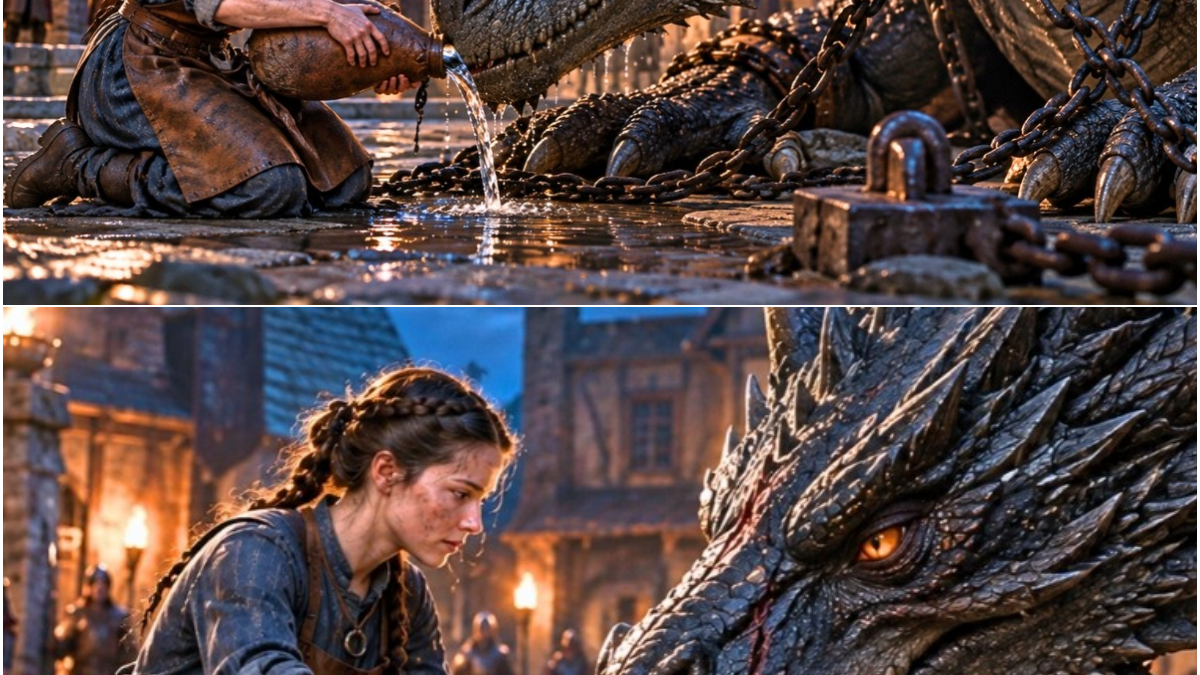
The chains announced Emperor Stellin’s presence long before anyone dared look toward the center of Greywick’s market square.
Every morning, before the bakery opened and before the first carts rattled along the provincial road, iron scraped against stone in a slow, relentless rhythm.
It was the sound of a powerful creature being reminded that strength meant nothing when someone else controlled the ground beneath his feet.
Oilia Winters knew that sound better than anyone. She had forged the chains herself, shaping every link, hammering every rivet, and finishing each length of iron without understanding what the counselor intended to do with it.
Now the emperor lay beneath the morning sky, his wings pinned against the old market stones and his golden scales dulled by hunger.
Villagers gathered to stare, while Counselor Bram Pharaoh climbed his wooden platform and turned the prisoner’s suffering into a lesson about provincial authority.
Oilia watched from the doorway of her father’s smithy, unable to forget the part her own hands had played in creating the spectacle.
Each time Stellin opened his molten eyes, she felt the weight of the iron as though it were wrapped around her own wrists.
She had once believed that a blacksmith’s work was simple: metal entered the forge, received its shape, and became whatever the world needed.
But some creations demanded more than skill, and some mistakes could not be corrected by looking away.
The question that followed her through every sleepless night was no longer whether she could break the chains.
It was whether she could free the emperor without becoming another victim of the men who had ordered them forged.
Barnaby Winters had operated the only forge between Greywick and the Milroad for thirty years.
His workshop stood beside the bakery, its chimney sending a thin column of smoke above the village rooftops whenever the weather allowed.
The building was modest, with a broad front door, a soot-darkened interior, and a workbench crowded with tools that had belonged to Barnaby’s father before him.
Oilia had grown up among those tools. She had learned to recognize different metals by the sounds they made when struck.
She could distinguish a well-made horseshoe from a poor one before examining its shape, and she knew how long a piece of iron needed to rest before it could be worked again.
By twelve, she could repair a wagon wheel without assistance. By twenty, she could produce nails faster than her father, a fact Barnaby mentioned to customers whenever he wanted them to understand how capable his daughter had become.
He rarely spoke about affection directly. Instead, he showed his pride by trusting her with difficult commissions and allowing her to handle work that once belonged exclusively to him.
Oilia had believed she understood the limits of her craft until Counselor Bram Pharaoh arrived four months before the emperor was brought into the square.
Pharaoh came accompanied by two guards and a covered wagon. He wore the dark formal coat of the provincial council, with a silver clasp at his throat and an expression that suggested he expected every person he met to appreciate the importance of his time.
He wanted chains. Not ordinary chains for hauling timber or securing gates, but hundreds of feet of identical links made from an unfamiliar gray ore.
The material arrived in sealed sacks, and the counselor insisted that nobody outside the smithy should examine it.
When Oilia first opened a sack, she noticed something unusual in the metal. Tiny flecks caught the torchlight with a faint shimmer, almost like scales seen beneath dark water.
She asked what the ore contained. Pharaoh answered that it was a special mineral gathered from an eastern quarry and that its unusual appearance had nothing to do with the finished product.
Barnaby was not convinced. He examined a handful of the material, turning it slowly between his fingers.
The ore felt heavier than ordinary iron and seemed reluctant to warm evenly in the forge.
“This is strange stock,” he told Pharaoh. “It is valuable stock,” the counselor replied. “That is why I have brought it to you.”
The payment was substantial. The previous harvest had been poor, and the Winters family needed enough coin to purchase fuel, food, and replacement tools before winter.
Refusing the order would have left the forge struggling through the coldest months. Barnaby accepted the commission.
Oilia did most of the fine work herself. Each link had to be shaped with unusual precision, its ends joined without leaving a weakness that could be exploited by a creature stronger than any ordinary animal.
She heated the ore, hammered it into shape, and checked every finished piece against the others.
Pharaoh demanded that the chains be quenched twice. The first quench used ordinary water. The second required a thick paste that the counselor mixed himself from a sealed jar.
He would not allow Oilia or Barnaby to prepare it independently, and he kept the container under his personal supervision whenever he visited the forge.
The paste had a strange smell, sharp and mineral, and it left a faint gray residue on the edges of the finished links.
Oilia worked for weeks. Her wrists ached. Her palms blistered, healed, and blistered again. The sound of her hammer became so familiar that she sometimes continued hearing it after she had left the workshop.
She never asked what the chains were intended to hold. She told herself that a blacksmith did not need to know every purpose behind every commission.
A farmer might order a blade without explaining what he planned to cut. A merchant might purchase a lock without revealing what he intended to secure.
But the thought that she might have been deliberately avoiding the truth stayed with her.
When the finished chains were collected, they were loaded into the covered wagon and taken away under guard.
Oilia watched them disappear down the road and felt relieved that the exhausting work was over.
Three weeks later, she learned what she had made. Soldiers marched into Greywick with Emperor Stellin bound in the chains.
The dragon’s enormous body occupied nearly the entire square, and the iron stretched across his throat, his legs, and the bases of his wings.
Stakes had been driven deep into the old market stones to hold him in place.
The sight stunned the village. Stellin had ruled an empire built around the power of dragonkind.
His name appeared on official proclamations, military standards, and the documents that governed distant provinces.
Many people in Greywick had never seen a dragon outside an illustrated book, much less an emperor.
Now he lay in their market square, unable to spread his wings. Pharaoh had arranged a raised platform opposite the well.
Twice each week, he climbed its scaffolding and addressed the villagers, describing the chained emperor as a warning against a distant crown that had forgotten the provinces supporting it.
He spoke of taxes, neglect, and the right of Greywick and its neighboring settlements to defend themselves against imperial authority.
He called Stellin’s imprisonment proof that even a mighty ruler could be brought under control when the provinces worked together.
Some villagers cheered. Others listened quietly, uncertain what they were supposed to feel. Children were hurried past the square.
Dogs avoided the stakes. Travelers stopped to stare, then continued along the road carrying stories that would reach other settlements before the next market day.
Oilia stayed near the smithy. She swept the floor, tended the forge, and worked on ordinary commissions while trying not to look toward the center of the village.
Yet she could feel the chains in every movement of her hands. She knew the shape of their links and the weight of their iron.
She knew exactly how much force each joint could withstand. She also knew that an ordinary dragon could break ordinary iron.
Stellin should have been able to tear himself free. The fact that he could not troubled her more than anything else.
At night, after the guards had settled into their rounds and the square had fallen quiet, Oilia watched from the window above the forge.
Stellin lay motionless beneath the open sky, his body surrounded by iron and his wings held flat against the stones.
His ribs gradually became more visible beneath his scales. His breathing grew so shallow that she sometimes had to watch for several minutes before she could be certain his chest had risen.
She began to hate the sound of the chains. Eventually, she asked her father what they had really made.
The forge had gone cold that night. Barnaby was sitting near the workbench, oiling a blade that had been brought in for repair.
Outside, the village was dark, and the square was quiet. “Ordinary chains wouldn’t hold him for an hour,” Oilia said.
“You know that.” Barnaby’s hands slowed. “Ordinary iron wouldn’t.” “Then what did we use?” He remained silent for a long time.
Finally, he put the blade down. “Pharaoh called it bound iron.” Oilia leaned closer. “What does that mean?”
“The paste he brought. I saw it once before he covered the jar. It was made from something that looked like ash, but it caught the torchlight in the same way the dragon’s scales do.”
Her stomach tightened. “Dragon scale?” “That’s my guess. Taken from him when they captured him.
Ground fine and mixed into the quench.” Oilia stared at the workbench. Barnaby rubbed his hands together, as though trying to remove a substance that had already settled too deeply into his thoughts.
“The chains don’t only restrain his body,” he explained. “They carry something that was taken from him and pressed against his hide.
The metal is bound to that taking. That’s why his fire can’t burn through it the way it would burn through honest iron.”
Oilia looked toward the window. She imagined the strange gray flecks in the ore, the counselor’s sealed jar, and the repeated quenching process.
Suddenly, the entire commission seemed different. They had not merely forged chains. They had made a prison from the emperor’s own strength.
“Then there must be a way to undo it,” she said. Barnaby’s expression changed. “Don’t.”
“If the chains are bound to what was taken from him, perhaps they can be separated from it.”
“Put that thought away.” His voice carried a sharpness she had rarely heard. “Pharaoh has guards watching the square day and night.
He has already shown that he is willing to make an example of anyone who challenges him.
The creature is being kept hungry on purpose, Oilia. You understand what that means.” She did.
But she could not forget the sight of Stellin lying beneath the open sky. She looked down at her hands.
They were small compared with the emperor’s claws, but they had shaped every link that held him.
If her hands had helped create the prison, they had to be capable of making something that could open it.
She waited two nights before approaching him. The guards followed a regular pattern around the square, but Oilia did not trust what she could see from her window.
She watched their movements for a week, counting the minutes between their appearances and learning which corners were most difficult to observe.
She waited until her father was asleep. Then she filled a waterskin, wrapped a heel of bread in cloth, and crossed the square beneath her shawl.
The night air was cold. Each stone seemed to amplify the sound of her footsteps.
She kept close to the well until the nearest guard turned toward the tannery, then hurried across the open ground.
Stellin raised his head as she approached. His eye opened slowly, revealing the molten gold beneath his heavy lid.
“Come to watch?” His voice was rough from hunger, but it still carried the depth of a bell struck beneath water.
“You should come during the day if that’s what you want. There’s less kneeling in the dark.”
“I’m not here to watch you.” She stopped beside the length of chain that crossed his throat.
“I’m here because I forged some of what is holding you down.” His eye narrowed.
“I see.” “I didn’t know what the chains were for when I made them.” “And now you do.”
“Yes.” She knelt and held up the waterskin. “I couldn’t sleep another night without knowing whether you were still breathing.”
For a moment, he did not answer. Then he lowered his head enough for her to bring the water to his mouth.
She tipped it carefully, allowing him to drink without forcing him to lift his injured throat against the iron.
He swallowed slowly. When the waterskin was empty, he rested his head against the stones and looked at her again.
“You are the smith’s daughter.” “Oilia Winters.” “I have watched you at the window.” She stiffened.
“I assumed you came to admire your work,” he continued. “I hate the chains.” The words came out more sharply than she intended.
“I’ve hated them since the first morning I saw you wearing them.” Stellin watched her.
“You could have looked away.” “I tried.” “And?” “I couldn’t.” His gaze remained fixed on her face.
“What is your name again?” “Oilia Winters.” He repeated it slowly, as though committing each syllable to memory.
“I am called Emperor by men who have never brought me water,” he said. “You may call me Stellin.
It is a smaller name, but it belongs to me.” She nodded. “Then I’ll call you Stellin.”
She left before the guards returned to the well. That night, she barely slept. She was frightened of being discovered, frightened of the consequences for her father, and frightened of the possibility that the chains could not be broken.
But beneath all those fears was a strange warmth. For the first time since the emperor had been brought into the square, someone had looked at her not as the blacksmith’s daughter or the woman responsible for an expensive commission, but as a person whose presence mattered.
She returned the following night. And the night after that. At first, she brought only water and bread.
When she could spare more, she brought dried meat or a little broth wrapped in a covered pot.
She never carried enough to attract attention, and she learned to hide the empty containers beneath her shawl.
Stellin began to recognize the sound of her footsteps. Sometimes he lifted his head before she reached the edge of the square.
Sometimes he remained still until she spoke, unwilling to reveal how closely he had been listening.
Their conversations began cautiously. He asked about the village, the weather, and the work at the forge.
Oilia asked about the mountains where he had grown up, the places he had flown before becoming emperor, and the distant lands that appeared on the maps hanging in the council hall.
He described valleys where the morning clouds gathered below the peaks, and forests whose tallest trees barely reached the height of his wings.
He spoke of the wind moving through mountain passes and the feeling of rising above the clouds until the world below seemed quiet and small.
Oilia listened with fascination. She had never traveled beyond the provinces surrounding Greywick. Her knowledge of the empire came from merchants, official notices, and the occasional traveler who stopped at the forge.
Stellin’s descriptions made the world seem impossibly large. In return, she told him about the smithy.
She described how Barnaby had taught her to judge the heat of iron by its color, how the bakery filled the morning air with warm bread, and how the old market stones had been laid long before anyone in Greywick remembered.
She told him about the small things that made the village feel like home. Stellin listened more carefully than she expected.
He had spent much of his life among people who wanted to discuss military matters, trade, or the management of the empire.
Oilia spoke about ordinary work as though it deserved the same attention as a royal decree.
He found himself looking forward to every detail. “You’re wasting away trying to keep me fed,” he told her one evening when she brought less bread than usual.
“I’m not wasting away.” “You’ve brought less than yesterday.” “The bakery had a poor batch, and my father needed the rest for breakfaSt.”
“You should keep your own portion.” “I am a blacksmith’s daughter. We’re sturdier than court dragons think.”
A low sound came from his cheSt. It was almost a laugh. Oilia smiled. “I didn’t know emperors could laugh.”
“I didn’t know blacksmiths could argue with them.” “Then we’re both learning.” The visits continued for weeks.
By the third week, word of the chained emperor had spread beyond Greywick. Carts arrived from distant settlements, including places Oilia had previously known only by name.
Travelers came from Coldbrand and the Fairy Downs, bringing stories and questions about the dragon who had been made a public prisoner.
Pharaoh welcomed the attention. He climbed his scaffolding and delivered longer speeches, presenting Stellin as evidence that provincial unity could overcome imperial power.
But the crowds did not always respond as he expected. Some watched quietly. Others began questioning the purpose of keeping a powerful creature hungry in the middle of a village.
A traveling weaver from Coldbrand reportedly remarked that a council willing to make a spectacle of a starving prisoner had little right to lecture anyone about justice.
The comment spread. Flowers began appearing near the stakes. Pharaoh ordered them removed, but the next day more flowers arrived.
Oilia noticed that some villagers had stopped cheering during his speeches. Others watched Stellin with a concern that had not been there during the first week.
The emperor did not beg. He did not lower his head in submission or provide the council with the public collapse it seemed to expect.
Even weakened, he continued to hold himself with a dignity that made the chains look increasingly shameful.
The guards noticed the growing sympathy. Captain Urine Slate, who supervised the watch around the square, began paying closer attention to the village’s supplies.
He noticed that a water barrel behind the bakery emptied faster than expected and that a sack of grain in the council storehouse had become lighter.
He did not believe in coincidences. By the fifth week, he had doubled the guards and changed the rounds.
Oilia discovered the difference on her first attempt to cross the square. The familiar opening near the well had disappeared.
A second guard now remained near the tannery long after the hour when the corner had previously been clear.
She waited behind the smithy until the lanterns moved away, but the patrols overlapped in a way she had not seen before.
At last, she slipped toward the well. A lantern appeared around the far corner. Oilia dropped behind the low stone wall, pressing herself against the cold surface.
The waterskin beneath her shawl felt impossibly heavy. Bootsteps approached. She recognized the young guard as Pel Daws, whose footsteps still had a springy rhythm unlike the heavier tread of the older soldiers.
He paused only a few strides away. Oilia stopped breathing. The guard hummed softly while examining the square.
His lantern moved over the well, the bakery wall, and the open ground beyond it.
For a moment, the light seemed to rest on the stone where her fingers were gripping the edge.
Then he continued toward the far side of the market. Oilia remained hidden until the sound of his footsteps disappeared.
Her knees had begun to ache by the time she finally moved. When she reached Stellin, her hands were trembling so badly that she spilled water across his jaw before she could guide the waterskin properly.
“You’re shaking,” he said. “They’ve changed the patrols.” “Slate suspects someone has been taking supplies.”
“I think he suspects more than that.” Stellin watched her carefully. “If they catch you here, they will punish you.”
“I know.” “You could be placed in chains yourself.” She looked at him. For weeks, she had tried to imagine what would happen if the guards discovered her visits.
She had considered the danger to her father, the loss of the forge, and the possibility that Pharaoh would use her as another example.
But she had never considered turning away. “I forged the chains that hold you,” she said.
“I don’t get to decide that the risk is no longer worth taking simply because it has become frightening.”
Stellin’s expression softened. “I would rather endure a hundred more nights than see you standing where I am.”
Oilia looked down at the water in her hands. His words were not an order.
They were not a threat or a bargain. They were a plain expression of concern from someone who had no reason to expect anything from her.
She refilled the waterskin from the small amount she had brought for herself. “Then you’d better hope I’m careful.”
She returned home before the next patrol. The following morning, she found her father waiting in the forge.
He had not slept well. She could see it in his face, and she knew he had heard her moving around the workshop during the night.
He did not ask where she had been. Instead, he placed a small piece of gray metal on the workbench.
“Pharaoh’s ledger was left open after the council meeting,” he said. Oilia stared at him.
“You read it?” “I read enough.” He turned the metal over with one finger. “The chains were made from scale ash.
It was taken from Stellin during the capture and ground into the paste used for the second quench.”
Oilia felt the room narrow around her. “What else?” Barnaby’s expression was grim. “The ledger says the bound iron cannot be broken by the dragon’s own fire because the metal carries something taken from him.
It says he cannot answer the binding with anything he still possesses.” Oilia repeated the words silently.
Anything he still possesses. She thought about the first time she had seen Stellin in the square.
His wings had been pinned, his throat held down, and his strength had been turned against him.
Then she thought about the strange gray ore and the way the counselor had guarded the paste.
The answer began to take shape. “If the chains hold because of something taken from him,” she said, “perhaps they can be broken by something given freely.”
Barnaby looked at her. “That’s what I was thinking.” “Given by whom?” “The person who made them, perhaps.
If the offering is genuine.” Oilia glanced at the scrap bin. Barnaby followed her gaze and began searching through the discarded metal from Pharaoh’s commission.
He found a handful of unused gray ore, enough to shape a small object. “A key,” he said.
“Small enough to fit against the central link.” “And it must be quenched differently.” Oilia understood before he explained.
The original chains had been treated with something taken from Stellin. To undo the binding, they would need something freely given in return.
Her own blood could serve as the first part of the offering. But the metal also needed to be heated by the very power it had been designed to resiSt.
“Dragon fire,” she whispered. Barnaby nodded. “His fire, given willingly.” They looked at each other.
The emperor had been starved for seven weeks. His strength had diminished, and every movement cost him more than it should.
There was no guarantee that he could produce enough flame. Yet the small amounts of food and water Oilia had carried to him every night had kept him stronger than the council expected.
His body had not recovered, but he had endured. She thought of his steady gaze and the way he had refused to lower his head.
For the first time in weeks, she felt something besides fear. Hope. The next two days passed in a blur of preparation.
Barnaby worked beside her, shaping the gray ore into a narrow pin with a sharp edge and a small rounded head.
They kept the forge fire low during the day and completed the finer work after the village had gone quiet.
The pin had to be small enough to rest against the central link where the chains met at Stellin’s throat.
It also had to be strong enough to withstand the heat required for the final step.
While they worked, rumors spread through Greywick. The crowds had become larger, and Pharaoh’s speeches had grown more forceful.
He could no longer depend on the villagers’ enthusiasm, so he began accusing distant imperial sympathizers of trying to undermine the provincial council.
But the people continued leaving flowers near the stakes. Some brought bread and placed it on the stones, although the guards removed it before Stellin could reach it.
Others stood silently near the edge of the square, refusing to cheer when Pharaoh demanded their approval.
The emperor had become a symbol, but not the one the counselor had intended. He represented something the council could not easily explain away: a powerful creature being held by a prison designed to make his suffering useful to someone else’s ambition.
Pharaoh decided that the spectacle had lasted long enough. Oilia learned that Stellin would be moved to the capital’s gates as a trophy.
The transfer would take place at dawn, and the emperor would be loaded onto a heavy wagon reinforced with bound iron.
The news reached the smithy the evening before the scheduled departure. Barnaby closed the workshop door and looked at his daughter.
“Two days,” he said. “That’s what we have before they move him.” Oilia glanced at the unfinished pin on the bench.
“We have tonight.” She worked alone after her father banked the house fire and went upstairs.
The pin was nearly finished, but the final quench remained. She heated the metal until it glowed, then drew the small blade she used for trimming hide.
Her hands were steady. She made a careful cut across her palm, just deep enough to draw a little blood.
Holding her hand above the trough, she allowed the water below to take on the faintest copper tint.
Then she lowered the hot pin into it. Steam rose. The sound was different from the hiss she remembered from the original chains.
This time, she felt no satisfaction in the finished shape, no pride in the precision of the metal.
She felt only the weight of what she was asking it to do. When the pin had cooled, she wrapped it in a clean cloth and tucked it inside her coat.
The square was nearly empty when she crossed it. The guards were alert, but the village had grown accustomed to the sight of people gathering near the emperor’s chains.
Oilia kept her head down and moved steadily, carrying no visible food or water. Stellin lifted his head as she approached.
He was weaker than he had been a week earlier. His scales had lost more of their shine, and his breathing was slow and shallow.
Yet his eye remained steady. “They mean to move you at first light,” she said.
His expression changed. “I suspected as much.” “I need to ask something of you.” “Ask.”
She knelt beside the central link at his throat and unwrapped the small pin. “I need your fire.”
He stared at the metal. “For what?” “To break the binding.” For a long moment, he did not speak.
Oilia placed the pin against the central link where the chains crossed and locked together.
“I made this from the same gray ore,” she explained. “I quenched it with something freely given.
My blood.” Stellin looked at her hand. “You did this for me.” “I helped make the chains.
I need to help undo them.” His eye returned to the pin. “And you believe my fire can finish it?”
“I believe it is the only chance we have.” He lowered his head. “Then tell me what to do.”
Oilia swallowed. “You need to breathe flame against the pin. Not against the chain itself.
The metal must receive your fire willingly.” Stellin’s chest moved with a slow, strained breath.
He had not produced a full flame in many weeks. The hunger had weakened him, and the chains had drained what strength remained.
Oilia could see the effort in his body as he gathered himself. “Stand back,” he said.
She moved away from his throat but stayed close enough to watch. A faint heat began building beneath his scales.
It spread through his chest and climbed toward his jaws. His breathing grew rougher, and the muscles around his neck tightened.
Then he spoke. “Every night you came here, I told myself you were bringing water.”
Oilia watched him. “I understand now that it was never only water.” His eye held hers.
“You have been giving me the strength to reach this moment since the first night.”
“I didn’t know that would happen.” “Perhaps it was better that you didn’t.” The heat intensified.
“Whatever happens next,” he continued, “I want you to know that I would have remembered you even if the chains had remained.”
Oilia’s throat tightened. “Then remember me standing here when they fall.” Stellin drew a deep breath.
A thin line of gold flame emerged from his mouth. It was smaller than the fire of a healthy dragon, trembling at its edges and barely bright enough to illuminate the stones.
But it reached the pin and held against the metal. For an instant, nothing changed.
Then the pin began to glow. The central link warmed, softened, and shuddered. A faint crack appeared along its surface, spreading through the bound iron like a line of light beneath dark water.
Stellin kept the flame steady. The effort was immense. His body trembled, and his claws pressed against the stone.
Oilia wanted to tell him to stop before he exhausted himself, but she knew the pin had to remain hot long enough for the binding to break.
The crack widened. Then the central link gave way. The sound was sharp and sudden, like a breath released after being held too long.
The chains fell. One by one, the lengths of iron slipped from Stellin’s throat and legs.
The cuffs around his wings dropped away, and the stakes that had pinned him to the market stones became useless.
Iron struck stone across the square. The ringing awakened the village. Doors opened. Lanterns appeared in windows.
Guards shouted to one another as they rushed toward the market. Stellin rose. For the first time in seven weeks, Emperor Stellin stood without iron holding him down.
His wings trembled as he unfolded them. He was still weak, still hungry, and still unsteady from the effort of freeing himself.
But he was no longer bound. Oilia stood before him. The first guards reached the square with their weapons raised.
Stellin did not attack. He simply placed himself between Oilia and the approaching soldiers, his great body shielding her from their line of sight.
Captain Slate arrived with a lantern in one hand and a drawn blade in the other.
He stopped when he saw the fallen chains. For several seconds, nobody moved. Then Counselor Pharaoh appeared in his night cloak, his expression hardening as he took in the scene.
“What have you done?” No one answered. The villagers had begun gathering at the edges of the square.
They had heard the chains fall, and many had already guessed what it meant. Pharaoh stepped toward the dragon.
“Stand down.” Stellin raised his head. The movement was slow, but the authority in it was unmistakable.
The counselor stopped. He looked toward Slate, expecting the captain to restore order. But Slate’s attention had shifted to the crowd.
People were standing between the guards and the open road. Some held lanterns, others carried tools from their homes, and many simply stood with their hands at their sides, refusing to move.
They had watched the emperor suffer for seven weeks. They had listened to Pharaoh explain why his imprisonment was necessary.
Now they had seen the chains fall, and they were no longer willing to pretend that the spectacle had been justice.
Slate lowered his blade. One guard followed. Then another. The rest gradually lowered their weapons as the crowd held its ground.
Pharaoh’s face tightened. “You are allowing an imperial creature to escape.” A woman near the well answered before anyone else could.
“He was already here.” The counselor looked toward the villagers, but their expressions had changed.
The fear and uncertainty that had filled the square during the first weeks had given way to something more settled.
They were not cheering for Stellin. They were refusing to help Pharaoh hold him. The counselor had built his authority on the belief that the village would accept whatever explanation he offered.
Now the people had witnessed the difference between a warning and a prison, between provincial independence and the abuse of someone who could not defend himself.
His platform stood empty behind him. Stellin remained between Oilia and the guards. The emperor was free, but the effort of breaking the chains had taken nearly everything he had.
His wings shook, and his breathing was uneven. Oilia stepped closer. “You could fly to the capital tonight,” she said.
“You could return to your court and take back whatever they think they’ve taken from you.”
“I could.” He lowered his head. “But there is one thing I would ask firSt.”
She looked up at him. “What is it?” Before she could hear his answer, his body began to change.
The great shape of the dragon folded inward. Wings drew close, scales shifted, and his enormous frame became smaller until a man stood where Stellin had been.
He was tall, but the weeks of hunger had hollowed his cheeks and weakened his posture.
His shoulders were bare, his golden eyes unchanged, and his breathing came in short, careful pulls.
He swayed. Oilia caught his arm before he could fall. “I wanted you to see me without a square between us,” he said.
His voice was rough, but unmistakably his. “Just once.” She held him steady. “You didn’t need to do this.”
“I wanted you to know that I trusted you with something I could not show the others.”
Oilia looked into his eyes. “I didn’t care whether you were a dragon or a man when I came here.
I cared that you were suffering and that I had helped make it worse.” Stellin’s expression softened.
“I know.” “I came because I couldn’t bear the sound of the chains. I stayed because I wanted you to be here when the morning came.”
He almost smiled. “And now?” “Now I want you to have the chance to choose what happens next.”
For a brief moment, he stood with her beside the fallen iron, his arm supported by her hand.
Then the transformation began to reverse. His human form gave way to scales and wings, and the great golden dragon returned to the square.
The change left him exhausted, but his eye remained fixed on her. “I am glad,” he said, “that it is the dragon you came to know.”
Oilia laughed. It was the first real laugh the square had heard from her in seven weeks.
It surprised even her, rising from somewhere beneath the fear and exhaustion that had followed her every night.
She placed her palm against Stellin’s jaw. “My mother used to read to me from a book when I was little,” she said.
“There was a line about not being afraid of storms because you were learning how to sail your own ship.”
She looked across the square. The broken chains lay scattered over the stones. Pharaoh stood near the edge of the crowd, surrounded by the people who had once applauded his speeches.
Slate had lowered his weapon, and the guards were no longer advancing. Oilia thought about the weeks she had spent carrying water across the square, the nights she had hidden from patrols, and the hours she had worked at the forge to shape a small piece of metal that might never have succeeded.
For a long time, she had believed she was trapped by the consequences of her own work.
Now she understood that she could not change what her hands had already made, but she could decide what they would make next.
“I think I finally understand that line,” she said. Stellin lowered his head. “Then sail toward me.”
His voice was weak, but the promise beneath it was steady. “And whatever storms remain, we will meet them together.”
Oilia rested her forehead against his warm scales. She did not promise that she would follow him to the capital or abandon the forge.
She did not ask him to remain in Greywick forever. Neither of them knew exactly what the coming days would demand.
But she knew that the chains were gone. She knew that the emperor had trusted her with his freedom, and that he had chosen to stand between her and the soldiers when he could barely remain upright.
And she knew that whatever came next would not be decided by the counselor’s speeches or the weight of iron alone.
By morning, news would travel along the provincial road. The council’s prisoner had broken his chains, the guards had lowered their weapons, and Greywick had refused to help drag him away.
The story would be told in distant settlements, carried by merchants and travelers, repeated in workshops and kitchens, and discussed by people who had never seen a dragon.
Some would remember the emperor’s strength. Others would remember the crowd that stood aside for no one.
But in Greywick, the sound that people remembered most clearly was not the crash of iron against stone or the shouting of the guards.
It was Oilia Winters laughing beside a dragon who was finally free. The square had once known Stellin by the dragging of his chains.
From that morning forward, it would know him by the steady beat of his wings, the warmth of his presence, and the quiet certainty that he had not forgotten the woman who had carried him water when the whole village watched from a distance.
And Oilia, who had once believed that her hands were only capable of making chains, discovered that they could also make keys, open doors, and begin something neither of them had known how to ask for.
For the first time, the market square belonged to neither a prisoner nor a counselor.
It belonged to the people who had finally chosen what they would stand beside.
Disclaimer: This content may be created by Al for entertainment purposes. Any resemblance to real persons, events, or places is coincidental.








