They Called It Rusted Junk — She Turned $5.10 Into a Honey Business With 118 Bee Colonies
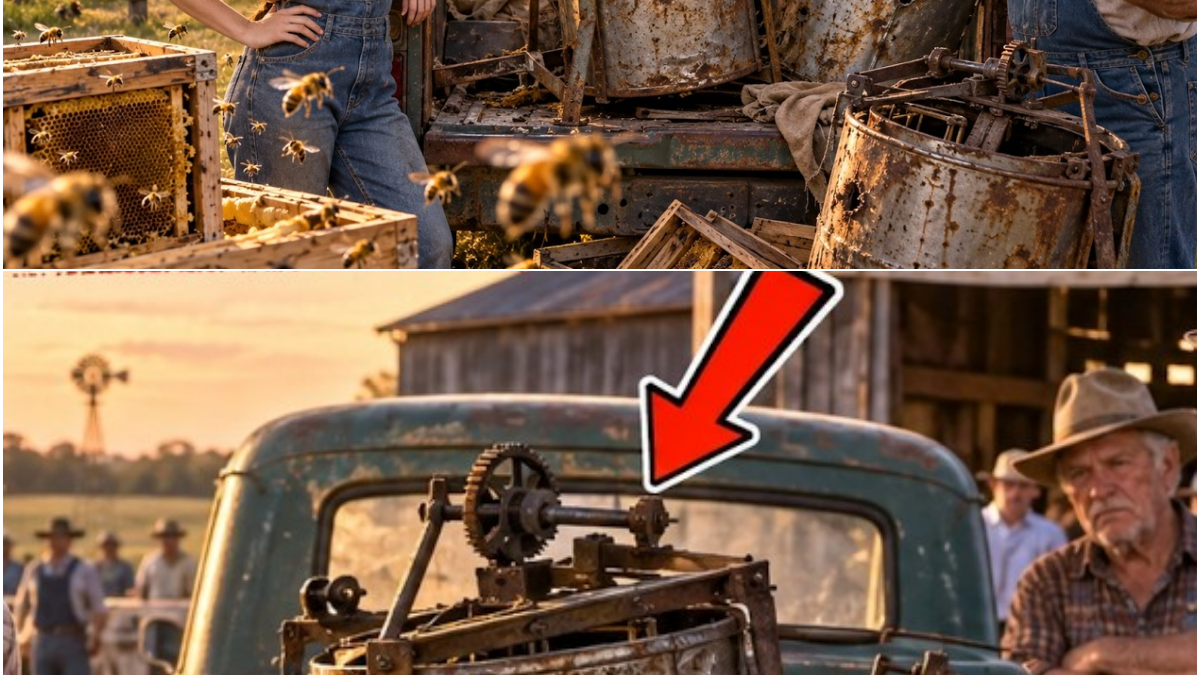
In the autumn of 1962, eleven miles west of Mountain Grove in Wright County, Missouri, a fifteen year old girl stood in a farmyard full of things nobody wanted and raised her hand for three broken honey extractors.
She had come to the Holloway Farm dispersal sale in the back of her grandfather’s pickup, sitting on an overturned milk crate because the cab was already occupied by her grandmother and two cousins.
Inside a flower sack tied beneath her coat were six dollars and seventy five cents, every cent she had earned picking blackberries and sorting tomatoes at the Roper place that AuguSt.
The three extractors sat in weeds beside the smokehouse. One had a split drum. One had no crank.
The third had a basket so badly bent that it scraped the inside of its tank whenever anyone tried to turn it.
Nobody wanted them. The auctioneer, Warren Sutter of Mansfield, had already moved through the useful machinery and livestock.
He had been calling farm sales across the eastern Ozarks for nineteen years, and he knew when a crowd had decided something was worthless.
“Lot 62, three honey extractors. Who’ll give me a dollar?” Silence. “Fifty cents?” The girl raised her hand.
Sutter looked directly at her. Then, somehow, he heard the wrong number. “Sold, 510.” The crowd laughed.
The girl did not. She had six dollars and seventy five cents, but she had also noticed something nobody else seemed to notice.
The machines were broken in different places. And if the pieces could be made to fit together, what might three useless machines become?
That question followed June Mercer home from the auction, and over the next twenty years it would turn a fifteen year old girl with a flower sack full of berry money into the owner of one of the largest small honey operations in the Ozarks.
June Mercer had not gone to the Holloway Farm sale intending to buy machinery. She had gone because her grandfather was already driving there and because she wanted to see what was being sold.
Her grandmother Mabel sat in the passenger seat. Two cousins filled most of the cab.
June had been given the milk crate in the truck bed, where she sat with one hand around the side rail whenever they took a bend too quickly.
She had no intention of spending her money. That money had taken weeks to earn.
During August she had picked blackberries until her fingers were stained dark and had sorted tomatoes at the Roper place until her back hurt.
She had saved every coin. The plan was to keep it. Then she saw the extractors.
The first thing June noticed was not that they were rusty. Rust did not bother her.
The first thing she noticed was that the three machines were broken differently. The drum on the first was damaged, but much of the outer housing looked sound.
The second had a missing crank assembly, yet parts of the internal mechanism appeared usable.
The third looked worse than either of them, but the basket itself contained several pieces that were still straight.
June walked around them twice. She touched the edge of the first drum. She turned one of the loose gears.
Then she looked underneath the third. She did not know exactly how she would repair them.
She only knew she could probably find out. Warren Sutter called the lot. “Lot 62, three honey extractors.
Who’ll give me a dollar?” Nobody answered. “Fifty cents?” June raised her hand. Sutter looked at her as though a piece of scenery had unexpectedly moved.
Then he called out the price incorrectly. “Sold, 510.” June could have corrected him. She did not.
She counted out the money. Mabel Mercer watched from beside the pickup. She said nothing while June and her grandfather lifted the three extractors into the truck.
Only after the last one had been secured did Mabel speak. “Those won’t turn straight.”
June wiped her hands on her overalls. “I know.” That was all. Mabel knew her granddaughter well enough to understand that the answer meant the work had already begun.
The story leaving Holloway Farm that afternoon was different. People said the Mercer girl had spent her berry money on three rusted honey cans.
By Monday, the story had reached the feed store. By Wednesday, it had reached the produce counter in Mansfield.
Someone added that June had cried when one of the machines rolled against her leg.
She had not. She had spent the ride home studying them. By the time Amos Mercer backed the pickup into the family yard, June had already decided that two of the three machines could probably be combined into one useful extractor.
Her grandfather watched her unload them. He was sixty eight years old and had farmed the ridge west of Mountain Grove for thirty seven years.
He knew machines. He also knew his granddaughter. He did not ask whether she understood what she had bought.
He knew she would discover that for herself. June’s knowledge of bees had come from her grandmother’s older sister, Lahi Vance, who lived fourteen miles south on a limestone ridge.
Lahi had kept between eight and twelve colonies behind her smokehouse from the year she married in 1928 until the winter of 1961.
June had spent parts of six summers there. Lahi never taught by sitting a child down and explaining everything.
She put on her veil. She lit the smoker. She opened a hive. June watched.
Then Lahi handed her the hive tool and walked away. If June made a mistake, Lahi returned.
If she did not, Lahi let her continue. One afternoon when June was twelve, Lahi looked into a brood box and said something that stayed with the girl.
“The difference between a colony that makes honey and a colony that only survives is usually one condition, and you can often change it if you notice it early enough.”
June wrote the sentence in the small notebook she kept in her overalls. She wrote it down not because she expected to forget it, but because writing something down forced her to decide whether she really understood it.
Lahi had a narrow honey room beside the smokehouse. It had a concrete floor, one west facing window, shelves for jars and lids, stacks of empty supers, spare frames, smoker fuel, and foundation.
Every hive had a number painted on the front. Every hive had a corresponding page in Lahi’s ledger.
The ledger recorded spring strength, queen age when known, supers added, pounds harvested, jars sold, and every dollar received.
June read that ledger whenever she visited. To her, it was more interesting than any storybook.
It showed that the honey room was not a hobby room. It was a business.
A small business, perhaps. But a business all the same. When Lahi’s time of working the hives came to an end in January of 1961, she left June two colonies, her veil, her smoker, her ledger, and a note written on the back of a seed company invoice.
“The hive wants to work. Let it.” June was thirteen. She moved the two colonies home in her grandfather’s truck on a cold evening when the bees were clustered.
She placed them beside the garden fence where the morning sun reached firSt. Then she began learning.
The bees corrected her. If she moved too quickly, they told her. If she opened a colony at the wrong time, they told her.
If she disturbed the wrong frame, they told her. June listened. By September of 1962, those two colonies had already produced ninety six pounds of surplus honey.
She had sold seventy one pounds in one pound jars to Calvin Baird, who ran a grocery in Mountain Grove.
She had deposited eighteen dollars and thirty five cents in savings at Wright County Bank.
And then she had spent six dollars and ten cents of her available cash on three broken honey extractors.
She had no extractor that worked. That was the problem. So she built one. The work took nearly four weeks.
After school, she went to the bench her grandfather had built against the back wall of the machinery shed.
She had a ball peen hammer, two files, a hacksaw, a hand drill, and a small vise borrowed from Amos.
She took the sound outer drum from one extractor. She salvaged the crank gear and basket hub from another.
From the third, she recovered two basket arms, a lower bearing, six usable brass fasteners, and enough straight steel from the handle bracket to make a spacer.
The replacement shaft came from discarded pump rod behind the barn. She cut it. Filed it.
Tested it. She rolled it across a piece of window glass her grandfather kept for carburetor work.
If the shaft rocked, she knew it was not straight enough. She filed it again.
She checked the bearing. She filed again. Finally, the shaft rolled smoothly. June assembled the machine.
The basket turned. It did not scrape. She added forty eight cents worth of food grade grease from a hardware store in Mountain Grove.
The total cost of the repaired extractor was $5.58. Her grandfather watched her work for two evenings.
On the third, he finally asked a question. “How’d you know where that shaft was throwing?”
June looked at the machine. “I watched which side touched firSt.” Amos nodded. Then he went toward the house.
It was the kind of answer he respected. The extractor went into service that October.
June had already finished the main harvest, but she now had a machine she could use the following year.
More important, she had learned something. Broken equipment was not always worthless equipment. Sometimes the failure was concentrated in one part.
Sometimes the part could be replaced. Sometimes another machine already contained what was missing. And sometimes the most useful thing on an auction lot was the thing everybody else had stopped looking at.
The following winter, June began looking for bees. She heard about colonies living in walls, trees, sheds, abandoned structures, and old boxes behind farms.
Most people considered such colonies useful only when they stayed where they belonged. If bees occupied a wall near a house, the usual solution was to make them leave.
June offered something different. She would remove the colony without charging for the work if she could keep the bees.
The first call came from Harold Massie, who owned seventy four acres south of Mansfield.
There was a colony inside the wall of an equipment shed. Harold had planned to deal with it before spring.
Instead, he let June take it. She made five trips between November and the following April.
She brought home four colonies. The last came from a hay barn during a cold rain.
Removing them was not simple. The comb inside old structures did not run neatly. It crossed itself.
Honey stores sat beside brood. Wax connected one section to another. June cut brood comb to fit empty frames and tied it in place with cotton string.
She worked alone. An easy colony could take four hours. A difficult one could take nearly a full day.
She kept records. By spring, she had spent 127 hours transferring the four colonies, repairing equipment, cleaning boxes, and rebuilding frames.
Three colonies established successfully. One failed after the queen was loSt. June now had five established colonies.
In the following summer, those five produced 286 pounds of surplus honey. Calvin Baird bought it.
He paid thirty four cents a pound. He did not pay because June was a local girl.
He paid because her jars were clean, the weight was consistent, and she delivered when she said she would.
Those details mattered. A grocery store could not depend on a supplier who delivered one week and disappeared the next.
June understood that. By the autumn of 1964, she was seventeen. She had bottled and sold 734 pounds of honey.
She had ninety six dollars and twenty cents in her savings account. She had a second extractor operating in the smokehouse.
That machine had cost $8.65 in parts collected from four auctions. She had spent thirty six evenings putting it together.
The people around Mountain Grove had started noticing. The story had changed. It was no longer that June Mercer had wasted her money on junk.
Now people said she kept bees. That was closer to the truth. But it was still incomplete.
June was learning that a business could grow quietly. The important changes did not always happen in front of an audience.
Sometimes the change was one more colony. One more customer. One better frame. One repaired machine.
One entry in a ledger. She began studying honey itself. She noticed that honey harvested at different times of year behaved differently.
Spring honey had one character. Late summer honey had another. Color changed. Flavor changed. Granulation changed.
Moisture changed. June started recording the conditions around each harveSt. Calvin Baird noticed the differences too.
One day he told her that one of her pale batches stayed clear longer than honey he received from Springfield.
June went home and thought about that for two days. Then she checked the harvest dates.
The pale batch had been harvested earlier. The weather had been hotter and drier. The moisture reading had been lower.
She wrote the observation in her log. It was another lesson from Lahi. Do not merely notice what happened.
Find out why. At eighteen, June went to the Mountain Grove Public Library and asked for everything they had on beekeeping and honey marketing.
Ruth Ellison, the librarian, found four books, two Missouri agricultural bulletins, a Department of Agriculture pamphlet, and a beekeeping manual printed in 1952.
June read them. Then she asked whether the library could request material from the agricultural library at the University of Missouri in Columbia.
Ruth said it could. June requested three items. They arrived two or three weeks later.
She read them twice. One discussed small apiary economics. Another covered honey moisture and granulation.
The third covered queen replacement and colony increase. In February of 1966, June sat at the kitchen table with Lahi’s old ledger and her own records.
She was nineteen. She had seven established colonies and three more boxes ready for spring splits.
She had agreements with six landowners who would call her when they found bees. She had regular orders from Calvin Baird and a roadside market near Springfield.
Her figures showed something important. The colonies were no longer simply producing enough honey for June to sell.
They were producing enough to justify more equipment. The problem was that equipment cost money.
June solved that problem the same way she had solved the extractor problem. She looked for things other people no longer valued.
In 1967, Calvin Baird asked whether she could guarantee eighty pounds a month during the coming winter if the summer crop was strong.
June said she could guarantee sixty by August and eighty by October if she could add six colonies.
Calvin asked what she needed. “Boxes, queens, and about three weeks.” Calvin told her his brother had unused shallow supers stored in an old poultry house.
She could have them if she hauled them away. June brought home fourteen supers and sixty three usable frames.
The sound wood gave her enough material for eight complete supers. The rest became division boards and feeder rims.
Her operation grew to thirteen colonies. By September, she was supplying Calvin Baird, the Springfield roadside market, and a seller in Ava.
She had graduated from high school in May. Her mother, Clara Mercer, once asked whether she had considered nursing school in Springfield.
June said she had considered it. Then she explained that the operation required her to stay close to the colonies.
Clara nodded. She did not ask again. By January of 1968, June had sixteen colonies and three apiary sites.
Her savings account stood at $512.70. She had regular monthly orders totaling 122 pounds. But she had reached a new limit.
The bees could make more honey than one person could comfortably extract and bottle. She needed larger equipment.
So she spent four months attending farm and estate sales within fifty miles. In May, she found a four frame extractor at an estate sale in Texas County.
It stood behind a feed bin in a shed. The crank handle was missing. The lower bearing was frozen.
The machine had not been used for at least twelve years. The auctioneer had placed it in a lot with bee escapes, a broken smoker, a wax press, and stacks of old comb.
June bought the entire lot for $7.40. She found the replacement bearing through an Iowa supplier.
The parts cost $3.22 including postage. She fitted the bearing at a Mountain Grove repair shop after the owner agreed to let her use the equipment after closing.
When the machine finally turned, June knew she had solved another problem. The extractor could handle four frames at once.
It did not make the bees produce more honey. It simply allowed June to process what they already produced.
By July of 1968, she could extract roughly 180 pounds in a full working day.
Her smaller machines had managed between seventy five and ninety. The difference was enormous. The operation reached twenty one colonies.
Production capacity approached 1,150 pounds of surplus honey in a normal season. June could realistically bottle about 1,000 pounds after leaving enough stores and accounting for handling losses.
The business began producing money that was no longer pocket money. By November, her savings had passed $700.
She was twenty one. The honey room had changed too. It held three working extractors.
Shelves lined two walls. Clean jars were stacked by size. Supers were organized by apiary and harveSt.
Tools covered the workbench. A chair sat beside the ledger. June often sat there at the end of the day and reviewed every figure.
She knew which colony was strong. Which one needed attention. Which customer wanted more. Which machine needed repair.
Which expense could wait. Which expense could not. In February of 1969, she recognized a problem she had been avoiding.
The business could grow beyond what one person could do. But more people meant training.
Training meant time. And time spent teaching was time not spent working. She sat in the chair for nearly an hour.
Then she opened the ledger and wrote a sentence she had not written since she was thirteen.
“The hive wants to work. Let it.” She understood the sentence differently now. The business was moving.
Her job was not necessarily to keep it small enough for one person. Her job might be to make room for the work.
The first person she trained was Beth Carver. Beth was sixteen and lived three miles eaSt.
She had been coming to watch June work on Saturday mornings. She rarely asked questions.
She watched. June recognized the habit. She had done the same thing at Lahi’s place.
One Saturday, June handed Beth a smoker and hive tool. Then she walked away. Six minutes later, the outer cover hit the box too hard.
June returned. She adjusted Beth’s grip. Then she walked away again. Five Saturdays passed like that.
On the sixth, Beth opened the colony without disturbing the bees. June watched from across the yard.
After twenty minutes, she looked at the frames. They were not arranged perfectly. But the brood was together.
The frames had stayed covered. The colony remained calm. June said one sentence. “Keep the brood together.
Everything else is easier if the brood stays together.” Beth asked, “How do you know when they’re getting upset?”
“You’ll hear it.” That was the training. No lecture. No long explanation. Watch. Try. Listen.
Correct. Try again. By the summer of 1970, Beth could inspect colonies without June standing behind her.
June paid her eight cents for every full super she uncapped and extracted correctly. A Saturday could earn Beth between two and three dollars and twenty cents.
For a seventeen year old girl, it was worthwhile work. For June, it was proof that the method could be passed on.
The next several years moved steadily. Twenty seven colonies in 1970. Thirty four by 1972.
Beth eventually left for nearly two years after marrying Russell Dayne. Then she returned and asked whether June still needed help.
June did. Beth brought Alice Dayne with her. Alice had never handled a frame of bees.
June handed her a veil. Then a smoker. Then a hive tool. The same process began again.
By 1975, the honey room had become two rooms. The operation had thirty eight colonies.
The old four frame extractor was still working. Two smaller extractors handled special harvests. A used steam uncapping knife had been repaired and added to the equipment.
The apiaries now occupied seventeen farms in Wright, Douglas, and Texas counties. Honey production averaged about 2,700 pounds in a normal year.
June could bottle approximately 2,350. She had four regular customers and a new account with a specialty food distributor in St. Louis.
The distributor had heard about the pale Ozark honey and asked whether June could send samples.
She sent six jars. Two from each major harvest period. The response came back with an offer.
The distributor wanted one hundred pounds a month. June accepted the arrangement at forty three cents a pound.
She filled every shipment. Then, in the spring of 1974, the distributor wrote again. Several stores in St. Louis had begun asking specifically for the pale Ozark honey.
Could June supply two hundred pounds a month? She could not. Not yet. She calculated the colonies, equipment, labor, and harvest schedule.
Then she wrote back. She could provide 150 pounds beginning in January of 1975 and 200 the following January.
The distributor agreed. June put the letter in her correspondence drawer. Then she began looking for workers.
She found two at the Wright County Fair in August of 1974. June had brought an observation hive.
People gathered around it. Two women asked whether she taught beekeeping. June said she did not teach exactly.
She said they could come watch the work. One was Miriam Holt. The other was Rose Tatum.
Both stayed. Miriam learned hive work. Rose became exceptionally careful with bottling and grading. By January of 1976, the operation had four regular workers besides June.
There were fifty two producing colonies. Three extracting machines. Apiary sites on twenty one farms.
Standing orders from five customers totaling slightly more than 400 pounds a month during the selling season.
The business account held $3,860.25. The county finally began to understand what had happened. Not because June announced it.
Not because she held a meeting. It happened at the feed store. Floyd Keller was speaking with Ruben Moss one Friday morning in March of 1976.
Floyd mentioned that June was paying five dollars for a good swarm. Ruben stared at him.
“Paying for bees?” “Five dollars if they’re healthy and you call her before spraying.” Ruben repeated the figure.
“Five dollars?” “Five.” Neither man spoke for a moment. The number was strange because people had spent years treating wild colonies as nuisances.
Now somebody was paying for them. The story spread. This time, the story was accurate.
June Mercer had been running a honey business for fourteen years. She had apiaries across three counties.
She shipped honey to St. Louis. She had employees. She had customers who waited for her product.
And it had all started with three broken extractors that nobody else wanted. Warren Sutter heard about it in Mansfield.
He was sixty nine by then. He remembered Lot 62. He remembered the girl raising her hand.
He remembered calling the price incorrectly. So he drove to the Mercer farm. June answered the honey room door.
“I called the Holloway sale in sixty two,” he said. “I know.” “Sold you those three extractors.”
June looked at him. “I don’t think I knew what I was selling.” June glanced back into the room.
The extractors were there. The shelves were there. Workers were moving between the equipment. Cases of honey stood ready for shipment.
Sutter looked around. “I suppose that’s true.” He stayed less than ten minutes. Then he left.
There was no ceremony. June returned to work. By 1979, she needed another machine. This time she wanted something motorized.
She found a twenty frame radial extractor at an apiary in Kansas that was closing.
The machine cost $1,250. She went to Wright County Bank. The loan officer, Paul Henley, had watched the business account grow for years.
June brought the ledger. She brought the customer records. She brought production figures. She brought the shipment history.
Paul looked through them. “I don’t believe I need much more than the ledger.” “Neither do I,” June said.
The loan was approved. The extractor arrived in April. It was installed in the largest room of the farmhouse.
When it ran for the first time in May, the entire room seemed to vibrate.
June stood beside it for one complete cycle. Then she went outside to inspect a colony that was preparing to swarm.
The machine was useful. The bees still required her attention. By 1982, Mercer Honey supplied eight customers in three states.
Six women worked regular schedules during the main season. The operation managed 118 colonies on thirty four farm sites.
A good year produced more than 8,000 pounds of marketable surplus honey. The business account held $27,600.
The radial extractor had already paid for itself. But June had never forgotten the first machine.
The three extractors from Holloway Farm were still on the property. Two remained usable. The third had been rebuilt more than once.
It stood beneath the west window of the old honey room. June still used it for small batches.
It was slower. It was less efficient. But it was the machine that had taught her the first important lesson.
She had looked at something broken and asked what part of it still worked. That question had become the foundation of everything else.
One September afternoon in 1982, Ellen Holt, Miriam’s fourteen year old daughter, stood beside one of the colonies near the garden fence.
She had been watching June work since she was eleven. Now she wore a veil.
She held the smoker. She lifted the cover. She paused. She gave two light puffs.
She moved the frame carefully. June was working another hive across the yard. She heard the familiar sounds.
No sharp disturbance. No careless strike against the box. No sudden rush of bees. She did not walk over.
There was nothing to correct. Ellen was learning. The same way Beth had learned. The same way June had learned from Lahi.
Watch until the movement makes sense. Then put your hands into the work. The afternoon settled around them.
Warm September air moved across the grass. The bees worked. The extractor waited inside. The old ledger sat on the workbench.
And for a moment, June could see the entire distance between the Holloway Farm sale and that afternoon.
A fifteen year old girl sitting on a milk crate in the back of a pickup.
Six dollars and seventy five cents in a flower sack. Three broken machines in the weeds.
A crowd that laughed. A grandmother who looked at the rust and knew the machines would not turn straight.
A girl who knew that was not the same thing as saying they could never turn.
Twenty years later, the farm had thirty four apiary sites, 118 colonies, six regular workers, eight customers, and a motorized extractor worth more than the entire operation June had possessed when she raised her hand at Holloway.
But the old machine was still beneath the window. June walked inside. She ran her hand over the repaired drum.
The metal was scarred. The paint was long gone. The shaft she had made by hand was still there.
She turned the basket once. Smooth. Centered. No scraping. She smiled. Not because the machine had become valuable.
It had not. Its value had always been somewhere else. It had taught her to look twice.
At the auction in 1962, everyone else had seen three broken honey extractors. June had seen three different problems.
She had understood that one machine had a good drum. Another had a useful gear.
The third had pieces that could be saved. The machine did not have to be restored exactly as it had been.
It only had to become useful again. That idea had followed her into every part of the business.
A neglected colony did not have to remain neglected. A wild swarm did not have to be a nuisance.
A broken frame did not always belong in the fire. An old piece of machinery did not necessarily belong in a scrap pile.
And a small farm business did not have to remain small simply because that was how it began.
Ellen closed the hive. She looked across the yard. June nodded. Ellen carried the smoker toward the shed.
June returned to the honey room. On the workbench was Lahi Vance’s old ledger. Beside it was June’s first notebook.
Beside that was the business ledger from 1982. The handwriting had changed over the years.
The numbers had changed. The operation had changed. But one sentence had remained. “The hive wants to work.
Let it.” June closed the ledger. Outside, the colonies continued moving through the warm September afternoon.
The same work that had begun in a smokehouse on a limestone ridge fourteen miles south was now being carried by another generation.
And beneath the west window, the first machine still waited. Three broken extractors had entered the Mercer farm in 1962.
Only one had needed to survive. June had learned that sometimes the difference between something worthless and something useful was not the object itself.
It was whether somebody was willing to look closely enough to see what remained.
Disclaimer: This content may be created by Al for entertainment purposes. Any resemblance to real persons, events, or places is coincidental.








