They Called Her 22 Horses Worthless — 18 Months Later, Buyers Fought Over Their Foals
The laughter started before Lena Ortiz even raised her bidding card. It came from somewhere near the front of the auction barn, then spread across the wooden seats until nearly everyone seemed to be laughing at the same thing.
Twenty two mares stood behind the holding rails, their winter coats hanging dull against bodies that had been given too little feed for too long.
One gray mare had hips sharp beneath her coat. A bay kept her head low.
Another shifted her weight every few seconds, as if standing still was becoming difficult. The auctioneer looked across the room and called for a bid.
Nothing happened. Wade Mercer leaned against the rail and smiled. He owned more horses than Lena’s family owned acres, and everyone in that barn knew it.
“Eighteen thousand dollars for horses that can barely stand?” He called. More laughter followed. Lena did not look at him.
She studied the mares instead. She watched their feet, shoulders, eyes, breathing, and the way they reacted when another horse moved beside them.
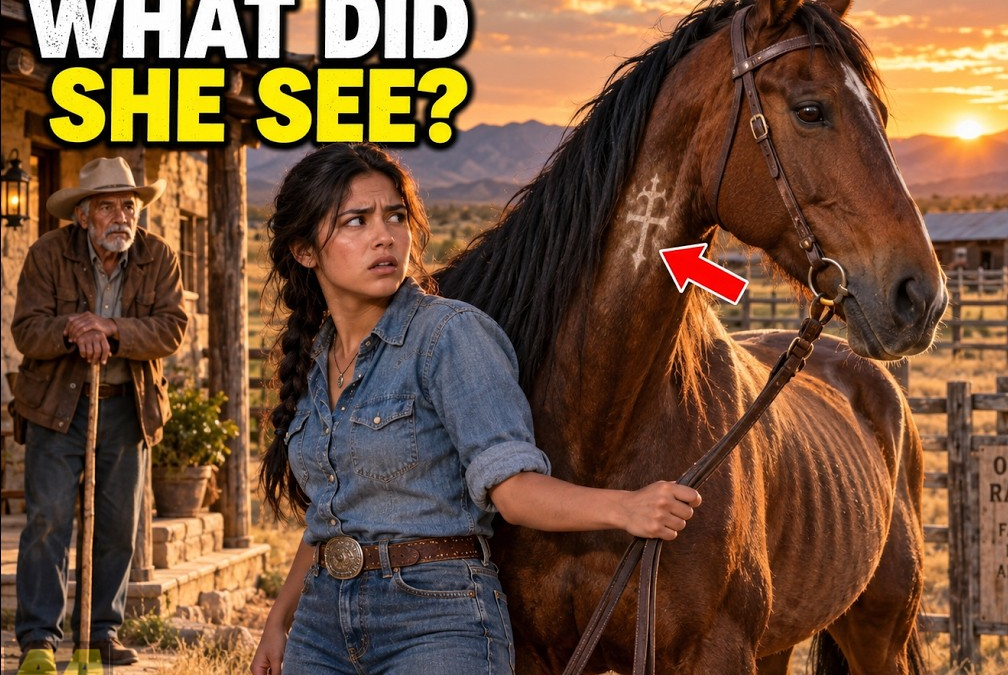
Then she noticed something beneath the dirty manes of several mares, small white marks that did not belong to Red Mesa Outfitters.
The horses looked exhausted, but they did not look defeated. There was something in their eyes that did not match the condition of their bodies.
Lena pressed her card against her leg. Her grandfather Miguel said nothing beside her. The auctioneer lowered the price.
Another buyer raised a hand. Lena looked once more at the mares. Then she raised her card.
What had she seen that everyone else in that barn had missed? Lena Ortiz was twenty years old when she made that bid, but she had already spent most of her life learning how to read horses.
She had grown up on the Ortiz ranch in New Mexico, a hard piece of country where the grass was sparse, the summers were severe, and every useful thing had to earn its place.
Her great grandfather had bought the first one hundred and sixty acres in 1952. Her grandfather Miguel added another one hundred and twenty in 1971.
The land was not rich. It was covered in grama grass, rabbit brush, cactus, stone, and stretches of ground where a person could walk for half an hour without seeing anything that looked particularly useful.
But it was home. By 1998, home was becoming harder to keep. Miguel was seventy three.
Arthritis had twisted his hands, and years of welding and dust had left his breathing worse than it should have been.
Lena’s mother worked in Los Cruus and sent money whenever she could, but the ranch itself had been losing money for three years.
A second mortgage taken after a difficult cattle year in 1993 was still hanging over the property.
The Ortiz family had learned to make every dollar travel a long distance. That was why Lena had been saving for college.
She had already been accepted into the animal science program at New Mexico State University for the fall of 1999.
The money had been building since 1987. Her mother started the account. Her father added to it whenever construction work was good.
When Lena’s father was lost after a fall at a job site in Albuquerque in 1994, part of the insurance money went into the same account.
Everyone knew what the money was for. College. Miguel kept the paperwork inside a folder in his filing cabinet.
Lena had seen the word written across the front many times. She also knew something else.
If the ranch continued losing money, she might graduate from college only to come home to land that no longer belonged to the Ortiz family.
That thought bothered her more than she admitted. On October 17th, 1998, she drove into town in a 1984 Ford pickup with 286,000 miles on it.
Miguel sat beside her. The heater worked only when the truck was moving. The passenger window had to be held shut with a folded feed receipt.
Under Lena’s seat was an envelope containing a cashier’s check for $18,240. That money represented years of work and sacrifice.
It was supposed to pay for her education. It was not supposed to buy horses.
The auction was for the remaining property of Red Mesa Outfitters, a ranch that had operated west of Sakuro, New Mexico, since the early 1970s.
For years, Red Mesa had made money taking tourists into the desert, renting horses to movie crews, and leading trail rides through country beautiful enough to make visitors forget how little grass grew there.
But the business had weakened by 1995. By 1997, the ranch was carrying too much debt.
Then came a dry spring. Then a worse summer. The owner kept insisting another season would fix everything.
It did not. The bank took control in August of 1998. The best riding horses were sold privately.
So were the trucks, trailers, saddles, and tractors. What remained went to auction. That was how Lena found herself standing inside a crowded auction barn on October 17th, staring at twenty two thin mares.
Before the mares entered the ring, Lena had watched several horses sell. A twelve year old sorrel gelding brought $3,800.
Two trail horses sold together for $6,100. Three younger mares went to a buyer from Arizona.
The prices were reasonable. The horses looked healthy. Then the back gate opened. Twenty two mares entered.
The atmosphere changed immediately. They were not pretty. Their coats were long and dull. Several had rain rot.
Two moved with slight stiffness. Most appeared to have body condition scores somewhere around two or three on the nine point scale.
Someone behind Lena whispered that they belonged in a feedlot. Lena ignored him. She had spent six summers working for dr. Rebecca Shaw, an equine veterinarian who covered ranches from Truth or Consequences to Bin.
At fourteen, Lena cleaned stalls. At fifteen, she held lead ropes. By seventeen, Rebecca trusted her to record temperatures, check gums, weigh feed, photograph hooves before trimming, and recognize when an animal needed professional attention.
Lena had learned that a horse could be thin without being broken. She had also learned that a horse could look impressive while hiding serious problems.
So she watched. The first mare walked through. Short stride, but even. The second followed.
Similar movement. The third had thin soles, but Lena saw no obvious sign of founder.
The fourth was straight through the knees, with a good shoulder and deep chest hidden beneath too little flesh.
Then Lena noticed the eyes. Bright. Alert. Annoyed. The mares were watching the people watching them.
That mattered. Lena leaned forward. A black mare turned her neck. Something white appeared beneath the dirty mane.
Lena stared. Then another mare passed. The same kind of mark appeared beneath her mane.
Lena counted silently. One. Two. Three. Then four. Then six. “What is that?” She whispered.
Miguel narrowed his eyes. “Old ranch brand.” “Not like any ranch brand I know.” Miguel kept looking.
The auctioneer started the group at $30,000. Silence. “Twenty five?” Nothing. “Twenty?” A man coughed.
The price dropped again. “Fifteen thousand?” Wade Mercer shook his head. He was fifty four, tall, clean shaven, and dressed in boots that looked as though they had never spent a morning in mud.
Mercer owned more horses than Lena’s family owned acres. His operation, Mercer Valley Horses, specialized in registered quarter horses.
His stallions appeared in glossy catalogs. His yearlings sold across Arizona, Texas, Oklahoma, and Colorado.
He had three barns, two full time trainers, a breeding operation outside Santa Fe, and enough money that people listened whenever he spoke.
He leaned against the rail. “Feed bill will be fifteen before Christmas.” Several people laughed.
Lena kept watching the mares. The number dropped to $12,500. A buyer Lena recognized as a horse dealer from West Texas raised his hand.
The auctioneer took the bid. “$12,750.” “Thirteen.” The buyer shrugged. “Thirteen two fifty.” Nobody moved.
Lena looked at Miguel. He did not tell her yes. He did not tell her no.
That somehow made the decision harder. “Grandpa.” Miguel kept his eyes on the horses. “Your father used to get real quiet before he bought a horse.”
Lena looked at him. “That is supposed to help me?” “No.” He finally turned toward her.
“It is supposed to remind you that if you do something stupid, I have seen it before.”
Lena almost laughed. The auctioneer called $13,500. The West Texas buyer raised his card. Lena raised hers.
$13,750. The other buyer hesitated. “Fourteen.” Lena raised again. “Fourteen two fifty.” The buyer scratched his chin.
Then he lowered his card. The auctioneer called once. Then twice. The hammer came down.
Sold. Lena stopped breathing for a moment. The final cost, after commissions and fees, came to $15,684.
Twenty two mares. The college fund was almost gone. They loaded the horses that afternoon.
One thin dun mare backed away from the trailer twice before finally stepping inside. Wade Mercer watched.
Then he looked at Miguel. “You should have stopped her.” Miguel leaned on his cane.
“From what?” “Burning eighteen years of savings.” Lena turned toward him. “It was not eighteen years of your savings.”
Wade smiled. “No, it was not.” He looked at the trailer. “Call me in February.”
“For what?” “When you are feeding twenty two empty mouths and the bank starts asking questions, I might take the pasture off your hands.”
The Ortiz ranch shared nearly two miles of fence with Mercer land. Wade had been trying to buy part of the Ortiz property since 1996.
Everyone knew it. Lena stepped closer. “The trailer needs to leave.” Wade looked at her for a long moment.
Then he tipped his hat toward Miguel. “February.” The first ten days were difficult. Lena had known they would be.
She had also known that feeding severely underconditioned horses required patience. A horse that had adapted to scarcity could not simply be given unlimited rich feed.
Too much grain or too rapid a change could bring serious digestive and hoof problems.
So Lena started slowly. She bought alfalfa by the bale because she could not afford a full truckload.
She divided the mares into four groups. Small meals. Six times a day at firSt.
No grain. Plenty of water. Salt. Minerals. Observation. She sold her motorcycle for $1,900. Most of that money went into fencing and two additional water troughs.
At 4:30 every morning, Lena walked the pens with a flashlight. At 7:00, she drove thirty four miles to a feed store outside Los Cusus and worked the counter until four.
Then she drove home. She fed again. Checked manure. Checked wounds. Checked temperatures. Checked feet.
Checked eyes. At ten each night, she usually sat at Miguel’s kitchen table with a spiral notebook.
Every mare had a number. Feed offered. Feed eaten. Water. Manure. Attitude. Lameness. Coat. Weight tape.
Anything unusual. Nothing was too small to record. On the eighth day, the gray mare went down.
Lena found her lying flat in the dirt shortly after midnight. The mare tried to rise and could not.
Lena’s stomach tightened. She called Rebecca Shaw. Rebecca arrived forty minutes later wearing sweatpants beneath her coveralls.
They worked until nearly four in the morning. Fluids. Pain control. Warm blankets. Slow movement when the mare finally managed to stand.
Just before sunrise, Rebecca leaned against the fence. “She may be all right.” Lena stared at the mare.
“May?” Rebecca looked at her. “That is the word.” Lena looked exhausted. Rebecca smiled faintly.
“You want another word?” “What?” “Expensive.” Lena laughed once. This time it almost felt funny.
Rebecca examined every mare over the following week. Teeth. Feet. Blood. Eyes. Heart. Lungs. Reproductive tract.
When she finished, she closed her medical bag. “I do not see anything contagious.” Miguel nodded.
“That is good.” “It is.” Rebecca looked toward the pens. “But you bought a lot of work.”
“I know.” “I mean a lot.” “I know.” Rebecca glanced at the mares again. “Here is the part I do not understand.”
Lena waited. “Several of the sales sheets list these horses as seventeen to twenty years old.”
“Yeah.” Rebecca pointed toward the dun mare. “That one is maybe twelve.” Lena looked at her.
“The black mare with the white sock is eleven, maybe thirteen.” “So the paperwork is wrong?”
“Either wrong or lazy.” Rebecca pulled the black mare’s mane aside. “Somebody saw poor condition, looked at worn teeth, and guessed high.”
Lena stared at the mare. “If they are five or six years younger than listed, everything changes.”
“Not everything.” “No.” Rebecca smiled. “But something.” By December, the mares began changing. Their backs filled in.
Their hips softened. Their coats became healthier. The dun mare started kicking at anything that crowded her around the trough.
Lena considered that excellent news. Healthy horses had opinions. The county noticed. Someone started calling them Lena’s skeletons.
The name spread. A customer at the feed store asked whether she was running a rescue project.
“They are not a rescue.” The man laughed. “Sure.” Another man asked Miguel whether his granddaughter had always been horse crazy.
Miguel told him Lena was only crazy around stupid questions. That story traveled through the county in a day.
Lena ignored most of it. She kept writing. On January 6th, 1999, Rebecca returned to float the teeth of three mares.
While they worked, she stopped beside the black mare. “What is this?” She lifted the mane.
The white mark was clearer now. CR 7114. Lena pointed toward another pen. “Fourteen of them have something like that.”
Rebecca frowned. “Fourteen?” “Same prefix. Different numbers.” “You write them down.” That night, Lena opened a fresh page.
CR7. Numbers from 103 to 161. Not consecutive. But close enough to make her curious.
By March, the mares looked completely different. They were not show horses. They were not polished sale horses.
They were horses. Strong backs. Good bone. Hard dark feet. Several stood barely fourteen hands.
Their heads were narrower than most commercial quarter horses. Their movement was efficient. They did not waste energy.
Miguel noticed it before Lena said anything. “They look old fashioned.” “What does that mean?”
“It means they look like horses in pictures from before everybody started breeding for photographs.”
On April 12th, Wade Mercer came to the ranch. He drove a 1998 Dodge that still had the shine of a vehicle that had not spent much time on a ranch.
Lena was replacing a float in the south trough. Wade walked toward Miguel, who was sitting beneath the porch shade.
“Afternoon.” Miguel nodded. Wade looked toward the mares. “I will say this. They cleaned up better than I expected.”
Lena set down the wrench. Wade opened a leather folder. “I might be able to help you out.”
He placed a contract on the porch rail. “I will give you $21,000 for the lot.”
Lena stared at him. That was more than $5,000 above what she had paid. It could restore the college account.
It could cover months of ranch expenses. Miguel said nothing. Wade pushed the contract toward her.
“Clean transaction. I haul them this week.” Miguel picked up the contract. Then he handed it to Lena.
She began reading. Page one looked simple. Twenty two mares. Purchase price. Transfer. Transportation. Page two was different.
Paragraph six gave Mercer Valley Horses first rights to purchase any foals produced from the mares for thirty months.
Paragraph seven gave Mercer an option on breeding offspring directly descended from mares carrying the CR identification.
Lena read it twice. Then she looked up. “You only want first rights on foals from the branded mares.”
Wade shrugged. “Standard language.” “No, it is not.” “That is how my attorney writes livestock agreements.”
“Then why does it say CR series?” Wade did not answer immediately. That was the answer.
Lena folded the contract. “In October of 1998, you said these horses would eat us broke.”
“They might.” “You also said they were old.” “They looked old.” “So why are you writing contracts about foals they have not even produced?”
Wade looked toward Miguel. “Young people get attached.” Miguel pointed toward Lena. “Business is standing right there.”
Wade looked back at her. “What do you want right now?” “Yes.” “I want to know what CR7 means.”
For the first time, Wade stopped looking comfortable. Only for a second. Then the expression returned.
“No idea.” Lena smiled. “Then I guess you do not need those rights.” She handed the contract back.
That night, she wrote three words across the top of a fresh notebook page. Find CR7.
In 1999, there was no quick search that solved a mystery in ten minutes. Lena called breed associations.
She called the state livestock board. She called the New Mexico Department of Agriculture. She sent faxes.
She mailed photographs. She drove to the county records office and spent four hours going through old brand books.
Nothing. Then an old farrier named Raymond Pike called the feed store. “You are the Ortiz girl asking about Red Mesa horses?”
“Yes.” “You remember CR7?” There was silence. “Maybe.” “What was it?” “Not Red Mesa.” “Then what?”
Raymond sighed. “There was a horse project up near Canyon Rojo. University people, ranch people, preservation folks.
Late seventies into the nineties.” “What kind of project?” “Old Spanish type horses.” Lena stopped writing.
Raymond continued. “Small ones. Tough ones. They were trying to keep certain lines from disappearing.”
“What happened to them?” “Money happened.” Two weeks later, Lena found the name. Canyon Rojo Conservation Herd.
The project had begun in 1978. It had received private foundation support beginning in 1981.
The group collected small numbers of horses from remote New Mexico ranches where Spanish type horses had been maintained with limited outside breeding.
In 1987, the program held sixty three horses. By 1992, funding was weakening. The foundation withdrew support in 1994.
Records showed thirty one mares had been transferred. The destination page was missing. Lena drove three hours north to meet a retired ranch manager named Harold Vance.
Harold was eighty one. He lived in a small house with two broken tractors sitting in the yard.
When Lena showed him the photograph of the freeze brand, he sat straighter. “Where did you get her?”
“Red Mesa.” “How many?” “Fourteen with the mark.” Harold removed his glasses. “Fourteen?” “Yes.” He stared at the photograph.
Then he said something Lena did not expect. “Those horses were not bred for the market.”
“What were they bred for?” “Survival.” Harold explained the Canyon Rojo project. They did not care about height.
They did not care about color. They did not care whether a horse won a halter class.
They cared about endurance. Feet. Fertility. Heat tolerance. And keeping old maternal families separate. “CR meant Canyon Rojo,” Harold said.
Lena pointed toward the seven. “What did seven mean?” “Band seven.” “What happened to band seven?”
“Sold after the funding collapsed.” “Where?” “I heard Red Mesa bought some.” “Why would a trail riding ranch buy conservation mares?”
Harold gave her a tired smile. “Because they were cheap.” He looked at the photograph again.
“And because those little mares could live on country that made bigger horses struggle.” On the drive home, Miguel said almost nothing.
Twenty miles from the ranch, he finally spoke. “Mercer knows.” “Yeah.” “How much does he know?”
“That is the part I do not know.” The pressure around the Ortiz ranch began changing.
Their hay supplier stopped extending thirty day credit. A farrier who had worked for Miguel since 1989 suddenly had no openings for six weeks.
The local bank declined a $12,000 operating note. The reason given was uncertain livestock exposure.
Nobody mentioned Wade. Nobody needed to. Mercer bought hay by the truckload. He sent horses to major trainers.
He financed deals through the same bank. He did not have to make a threat.
People simply knew who had money. By June, Lena had $640 in checking. Then Miguel needed surgery.
His breathing had worsened throughout the spring. A specialist in Albuquerque found an obstruction that required treatment.
The estimated cost was nearly $8,000. Miguel wanted to wait. Lena refused. She sold her father’s silver mounted saddle for $3,200.
Miguel barely spoke to her for two days. Then July arrived. The mares were in breeding condition.
That created another decision. If Harold was right, the mares mattered because of what they could produce.
But Lena could not afford a suitable stallion. Rebecca introduced her to a preservation breeder in Arizona named Thomas Bell.
Thomas owned a colonial Spanish stallion named Lucero. Lucero had been DNA typed. His documented line was unrelated to the known Canyon Rojo records.
Thomas agreed to lease him for one breeding season for $2,400 plus insurance. Lena wrote the check.
She felt sick doing it. She bred sixteen mares. Fourteen carried the CR marks. Two unbranded mares also had ages, conformation, and background that made Rebecca suspicious they might have come from the same source.
Then they waited. The first snow arrived on November 3rd, 1999. By Thanksgiving, nighttime temperatures were falling below fifteen degrees.
Hay reached $168 a ton. Then $181. Then $196. Lena had twenty two mares, one leased stallion waiting to return to Arizona, a grandfather recovering from surgery, and no income coming from the horses.
On December 14th, the county horse association held its annual meeting. Wade Mercer gave a talk about professional breeding standards.
He never said Lena’s name. He talked about people who confused sentiment with management. He talked about backyard breeders.
He talked about young owners who did not understand that good intentions were not a business plan.
Everyone understood who he meant. Lena sat in the third row. Afterward, an older breeder named Sam Keller stopped her.
“You got enough hay to make April?” Lena looked at him. “I am working on it.”
Sam nodded. He did not sound cruel. That made it harder. “I thought so.” Across the room, Wade watched.
Pregnancy checks were scheduled for January 8th, 2000. The morning began at twelve degrees. Rebecca arrived before sunrise with the ultrasound equipment.
The mares came through one at a time. The first was open. Lena wrote it down.
The second was open. The third was pregnant. The fourth was open. The fifth was open.
Rebecca looked at Lena. “Early ones may not have settled.” Lena was already counting. The sixth was open.
Four open out of six. Then the seventh was pregnant. The eighth was pregnant. The ninth was pregnant.
Lena stopped looking at the page. The tenth was pregnant. The eleventh was open. The twelfth was pregnant.
Rebecca examined another. Then another. By May 16th, thirteen of sixteen mares were confirmed pregnant.
Lena wrote the number down herself. Thirteen. Eighty one percent. Rebecca leaned against the chute.
“For mares that looked like walking fence rails fifteen months ago, I would have been happy with eight.”
Lena looked at the page. She called Miguel from the barn phone. “Thirteen.” There was silence.
Then Miguel said, “Do not tell anybody.” “Why?” “Because Wade still thinks we are desperate.”
They told no one. For the next month, the county assumed Lena had a pasture full of mares eating money.
That suited her. In February, she spent money she absolutely did not have. Rebecca drew blood from all fourteen CR mares.
Samples went to an equine genetics laboratory in Kentucky. The first test cost $1,860. Lena paid for it by selling a small stock trailer.
The initial report showed a pattern of genetic relatedness consistent with a managed subpopulation. Several mares carried uncommon maternal markers.
The laboratory recommended comparison against archive samples from heritage horse collections. That comparison cost another $2,700.
Lena did not have $2,700. Miguel disappeared into his bedroom. He returned holding a wooden box.
Inside was his father’s 1946 Omega watch. Miguel’s father had worn it when he bought his first welding truck.
“No.” Miguel put the box on the table. “Sell it.” “Grandpa.” “That watch is sitting in a drawer.”
“It belonged to great grandpa.” “He bought tools with money.” Miguel pushed the box toward her.
“Tools made money. Money bought land. Land raised you.” Lena looked at him. “A watch that never leaves a drawer is not helping anybody.”
The watch brought $3,100 from a collector in Albuquerque. Lena hated selling it. Then she used the money.
The second report arrived by FedEx on March 27th, 2000. Rebecca came over. Miguel sat at the kitchen table.
Lena opened the envelope. The results did not say the mares were priceless. They said something more useful.
Twelve of the fourteen CR mares matched maternal lines found in preserved Canyon Rojo samples collected between 1984 and 1991.
Nine carried mitochondrial variants rarely represented in the commercial horse population tested by the laboratory.
The mares also showed no evidence in the tested parentage markers of the quarter horse stallions Red Mesa had used heavily during the 1990s.
The Canyon Rojo group had remained more separate than anyone expected. The laboratory director added one handwritten sentence beneath the report.
If your identification records are authentic, this is a breeding group worth preserving intact. Lena read the sentence three times.
Then she understood Wade’s contract. He had never wanted twenty two cheap mares. He wanted the fourteen branded ones.
More importantly, he wanted their foals. If he could buy the group before Lena understood what she had, Mercer Valley Horses could introduce an unusual documented heritage line into its program for a fraction of the price of a high end breeding horse.
He would own the story. He would own the future offspring. And nobody might remember where the horses came from.
The first foal arrived on April 19th. A dun filly. Lena found her standing beside her mother.
She was long legged, alert, and carried faint stripes across her shoulders. Miguel watched from the fence.
“That one looks old.” Lena laughed. “She is six hours old.” “You know what I mean.”
More foals followed. A bay colt. A filly. Two chestnuts. A black colt with a small star.
One mare struggled during foaling and Lena lost that foal despite Rebecca’s efforts. The setback hurt.
But the remaining mares continued. By June 2nd, twelve healthy foals were running beside their mothers.
Lena photographed every one. She made documentation packets. Freeze brand number. Mare age. Veterinary records.
Canyon Rojo archive information. Laboratory results. Stallion information. Breeding date. Foaling date. Management records from October 1998 onward.
She mailed twenty seven packets. The first call came from Colorado. The second from Texas.
Then California. Then Arizona. Then Wyoming. Nobody asked whether Lena wanted to sell the mares.
They asked about the foals. On June 18th, Wade Mercer returned. This time he brought his attorney.
They sat at the Ortiz kitchen table. Miguel sat at one end. Lena sat across from Wade.
The attorney opened a folder. “mr. Mercer is prepared to purchase all twelve foals for $72,000.”
Lena felt her pulse in her neck. Six thousand dollars per foal. More than four times what the entire mare group had coSt.
The attorney continued. “In addition, Mercer Valley Horses would receive first right of refusal on the next four full crops.”
Lena looked at Wade. “In October of 1998, you said these mares would eat us broke.”
Wade leaned back. “Circumstances change.” “In April of 1999, you offered $21,000 for all twenty two.”
“That was a fair offer.” “You also told my grandfather I was attached.” Wade looked at her.
“You were.” “And now you are offering $72,000 for twelve foals.” Wade’s expression hardened. “Do you want the money or not?”
Lena closed the folder. “No.” The attorney blinked. Wade did not. He had expected that answer.
“What are you planning?” “A sale.” “When?” “AuguSt.” “You think people are flying to New Mexico for those horses?”
“No.” Lena stood. “I think they are driving.” She spent the next six weeks preparing.
The Ortiz Heritage Horse Sale was scheduled for August 12th, 2000. Lena offered seven foals.
She kept five. That decision confused some people until they understood it. A desperate owner sells everything.
A breeder building a program keeps the animals she believes cannot easily be replaced. Every serious buyer understood the message.
Lena printed one hundred twenty catalogs. She expected forty people. Seventy three arrived. Trucks came from five states.
Thomas Bell drove from Arizona. Two university researchers attended. A representative from a conservation organization in Colorado stood near the back taking notes.
Sam Keller came. So did half the people who had spent nineteen months calling the mares Lena’s skeletons.
Wade Mercer arrived thirty minutes early. He brought a checkbook. The first foal was the dun filly born on April 19th.
The auctioneer opened at $3,000. Wade immediately bid five. A Colorado breeder bid six. Wade went seven.
Arizona went eight. Colorado went nine. Wade went ten. The auctioneer barely had time to point.
Eleven. Twelve. Thirteen. The filly sold for $14,500. Not to Wade. The second brought $11,200.
The third brought $16,000. Wade bought the fourth for $13,750. By then, nobody was laughing.
Buyers were flipping through Lena’s documentation and asking detailed questions. Which mare family? Which maternal line?
What was the dam’s condition score in January 1999? What feet had required corrective trimming?
Had the foal been handled daily? What was the sire’s relationship to the archived Canyon Rojo animals?
Lena had answers. That mattered almost as much as the horses. Sam Keller bought the sixth foal.
Afterward, he found Lena beside the barn. He removed his hat. “I thought you were in over your head.”
Lena smiled. “I was.” Sam laughed. “No, you know what I mean.” “I do.” He nodded toward the sale ring.
“I was wrong.” That stayed with Lena longer than the price. Seven foals sold for a combined $91,600.
After sale expenses, veterinary certificates, transportation arrangements, and commissions, the Ortiz family cleared a little more than $82,000.
It was more money than the ranch had seen at one time in decades. Wade bought one foal.
He lost six. When the last trailer left, he asked Lena if they could speak inside.
No attorney this time. Miguel had gone to reSt. Wade sat at the same kitchen table where Lena had opened the genetic report.
He removed a check from his pocket. He signed it. Then he placed it in front of her.
The amount line was blank. Lena looked at it. “What is this?” “You tell me.”
“For what?” “All fourteen CR mares.” “No.” “All remaining foals.” “No.” “Next year’s crop.” “No.”
Wade stared at her. “I am not finished.” “I am.” He slid the check closer.
“Put a number on it.” Lena did not touch it. Wade continued. “I will buy the breeding group, the remaining foals, and the Ortiz Heritage name.
You can stay involved as manager if you want.” That almost made Lena laugh. Then she realized he was serious.
She looked at the blank line. She could write two hundred thousand dollars. Maybe three hundred thousand.
Enough to clear the mortgage. Enough to replace the truck. Enough to repair every fence.
Enough for Miguel’s medical care. Enough for college. For about thirty seconds, Lena imagined what it would feel like to stop being afraid of bills.
Then she imagined the south pasture empty. No mares. No foals. No breeding program. The Canyon Rojo line had already disappeared once because somebody ran out of money and sold the horses.
She was not going to find it again just to sell it. She pushed the check back.
Wade looked genuinely confused. “You have not even written a number.” “That is because there is not one.”
“Everything has a price.” “Maybe.” Lena looked through the kitchen window toward the pasture. “But not everything should be sold.”
Wade sat back. “You are twenty two.” “Twenty one.” “That is supposed to make me feel better?”
“No.” Lena folded her hands. “In 1998, you thought I was too young to know what I was buying.”
Wade said nothing. “Now you think I am too young to know what I own.”
The kitchen became silent. Wade finally picked up the check. He folded it once. Then he placed it in his pocket.
He left. He never made another offer for the mares. The story people told afterward became cleaner than the real one.
People said Lena had spent her college money on failing horses and gotten rich. That was not what happened.
She did not suddenly become rich. The August sale paid Miguel’s medical balance. It cleared the ranch’s short term debt.
Lena paid off the remaining $31,400 on the second mortgage in November of 2000. They drilled a new well in 2001.
They replaced 3,600 feet of failing fence. They bought a used stock trailer. The Ford pickup survived another two years out of what seemed like pure stubbornness.
Lena kept thirteen of the original CR mares. One was retired from breeding. The rest became the foundation of a small preservation program.
In 2001, nine more foals were born. In 2002, eleven. Lena never produced huge numbers.
That was not the point. She kept records. She tested parentage. She tracked mare families.
She avoided breeding simply for color or fashion. She preserved the characteristics that had made the mares valuable long before anyone in that auction barn understood them.
And she kept the old freeze brands in every photograph. In January 2001, a letter arrived from New Mexico State University.
An animal science professor had received one of Lena’s sale packets from a buyer. The department offered her a scholarship and helped arrange a schedule that allowed her to spend part of each week at the ranch.
She enrolled that fall. Miguel framed the acceptance letter. Lena told him it was embarrassing.
He framed it anyway. By 2003, the Ortiz ranch was still small. Mercer Valley Horses was still much larger.
Wade still had better barns, newer trucks, more employees, and more land. None of that changed.
What changed was the direction of the conversation. There had been a time when Lena needed people like Wade Mercer to take her seriously before banks, suppliers, and breeders would do the same.
Now serious buyers called the Ortiz Ranch directly. Researchers asked to see Lena’s records. Preservation breeders asked about future foals.
Nobody needed Wade’s opinion firSt. One September afternoon, Lena and Miguel stood along the south fence.
Miguel was seventy eight. He walked slowly. Some days he used a cane. The mares were moving toward the water, healthy bodies kicking dust into the afternoon light.
A dark mare came closest to the fence. CR 7114. One of the first brands Lena had noticed in the auction barn in 1998.
The mare stopped and looked at them. Miguel rubbed his jaw. “That one cost you college.”
Lena smiled. “She got me back there eventually.” “Still a bad deal.” “Terrible.” They watched the mare walk away.
The brand was faded now. White hairs surrounded the old mark. Lena could have covered it.
She could have registered the mare under a cleaner modern identification system and allowed the old brand to become irrelevant.
She never did. That little mark had survived a collapsed conservation project, bad records, a ranch liquidation, years of poor condition, and a room full of people who looked at twenty two thin mares and decided they already knew what those animals were worth.
Lena had nearly made the same mistake. The difference was that she had looked longer.
She had watched the feet. The eyes. The shoulders. The way they moved. The way they responded.
And the faded white mark beneath a dirty mane. Sometimes a thin horse is simply a thin horse.
Sometimes an old looking horse really is old. Sometimes a set of bad records really is nothing more than bad records.
But sometimes the easiest thing to see is the least important thing to understand. A truck slowed near the ranch gate.
Lena straightened automatically. For years, strangers had arrived asking the same questions. Was Miguel around?
Who owned the place? Could they speak to whoever handled the horses? A man in his forties stepped from the truck.
He closed the door and walked toward the fence. He nodded to Miguel. Then he turned toward Lena.
“Miss Ortiz?” “Yes.” “My name is Daniel Reeves. I am from Colorado.” Lena waited. He looked toward the mares.
“I was told you are the person to talk to about getting on the 2004 foal liSt.”
Lena glanced at Miguel. He was trying not to smile. She looked back toward the pasture.
Five years earlier, twenty two mares had walked into an auction ring with hollow flanks, dull coats, and almost no value in the eyes of the people watching.
Nothing about their heritage had changed that day. Nothing about the generations behind them had changed.
Only their condition had changed. And because condition was the easiest thing to see, almost everyone in that room had mistaken it for value.
Lena had not. She had seen tired horses. She had seen horses that needed feed, medicine, patience, and time.
But she had also seen good feet. Alert eyes. Efficient movement. Strong shoulders. And fourteen faded marks that suggested a story nobody in that room had bothered to ask about.
She had spent everything she had because she believed there was more to those horses than what appeared in an auction ring.
The decision nearly cost her college. It nearly cost her the ranch. It required years of work before the first real return arrived.
But the fourteenth mare with the CR mark had not changed because people suddenly decided she was valuable.
She had always carried that value. Lena had simply been willing to look long enough to find it.
She opened the gate. “Come on in, mr. Reeves.” Daniel stepped through. Behind them, CR 7114 lowered her head into the good grass.
She kept eating while the conversation began, completely unconcerned with the fact that five years earlier, an entire auction barn had laughed when someone suggested that twenty two horses like her could be worth eighteen thousand dollars.
Lena watched her for a moment. Then she smiled. The mare did not look back.
She did not need to. She had already proved what she was worth.
Disclaimer: This content may be created by Al for entertainment purposes. Any resemblance to real persons, events, or places is coincidental.








