They Called A Woman Crazy for Buying a $3500 Farm — Until She Started Digging Up Gold
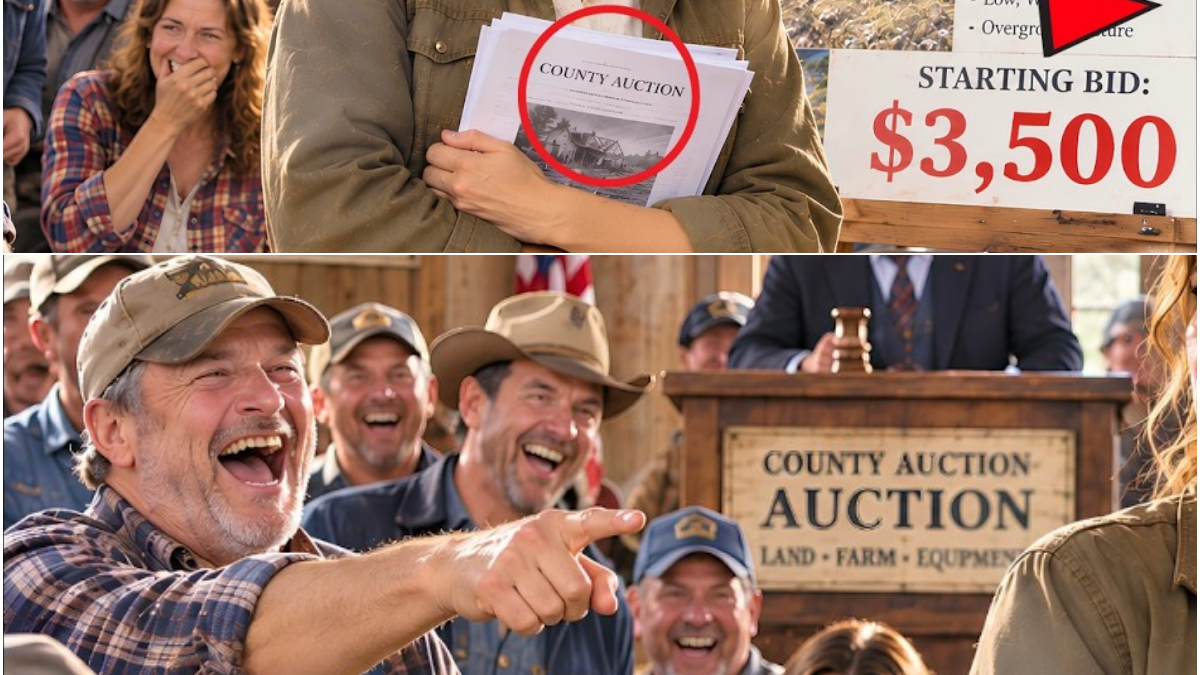
“Three thousand five hundred dollars for a swamp,” the man called from the back of the auction room.
“That isn’t investing, sweetheart. That’s a donation to the county.” A few people laughed. Hannah Brooks did not.
She stood near the front table with one hand resting on the paperwork and the other holding the bidder number she had just used.
Outside, nearly 60 acres of neglected farmland waited beneath a gray morning sky. The farmhouse was failing.
The barn had lost part of its roof. The old well had produced almost nothing for more than a decade.
Twenty acres at the rear had become a shallow wetland where dark water collected among willows and sedge grass.
To everyone in that room, the property had already explained itself. It was too wet.
Too neglected. Too expensive to restore. Too far gone. Hannah saw something different. She had spent four years studying soil and water systems across three states.
She had learned that land rarely told its whole story from the surface. Sometimes the most important information was hidden beneath a layer of compacted clay, beneath a failed well, beneath vegetation that everyone else considered weeds.
She had walked the eastern edge of the property the day before. She had pushed a soil probe into the ground.
She had watched heavy particles settle in dark sand. And she had noticed the pattern nobody else had mentioned.
When the auctioneer brought the gavel down, the laughter grew louder. “Sold.” Hannah gathered her papers.
The man who had mocked her shook his head. “Enjoy your mud.” She walked outside without answering.
But as she started her truck, she looked once more toward the flooded back section.
She had not spent her last 3,500 dollars buying mud. So what exactly had she just bought?
Hannah Brooks was 28 years old when she bought the farm. She had a degree in soil science and water resource management and four years of field experience with an agricultural consulting firm.
Her work had taken her across three states, where she assessed underperforming farms, investigated water sources, studied soil conditions, and helped landowners design restoration plans.
She had become good at recognizing problems other people overlooked. More importantly, she had learned how often the visible problem was not the real problem.
A field that produced poorly might have a drainage issue. A failed pasture might have compacted soil.
A dry farm might simply have a well in the wrong location. A piece of land that looked useless could sometimes be suffering from one mistake repeated for years.
Hannah had always wanted land of her own. Nothing enormous. Nothing impressive. She wanted something she could walk across and understand.
Something where the decisions belonged to her. Then the consulting firm restructured. Her entire division disappeared.
Hannah had been left with 11,000 dollars in savings, a truck, her field equipment, and a plan that suddenly had to happen much sooner than expected.
When she found the auction notice in the county register, she nearly ignored it. The property was nearly 60 acres.
The minimum opening bid was 3,500 dollars. The description was brutally honeSt. Deteriorated structures. Nonfunctional wells.
Significant low lying area. Seasonal flooding. The property had already been offered twice without receiving a serious bid.
Hannah drove out the morning before the auction. The farmhouse sat at the end of a rutted gravel drive.
Its porch sagged at one corner. Two windows were boarded from the inside. The barn stood behind it with a large section of the eastern roof missing.
Old irrigation lines remained partially buried along the south field, but many were cracked and disconnected.
Rust covered the fittings. The pasture had become a mixture of scrub and tall grass.
The back 20 acres were the part everyone talked about. Water collected there during the wet season.
Willows had taken over the old fence line. Sedge grass grew in thick patches. The ground looked more like a shallow marsh than farmland.
The listing agent walked with Hannah for a while. He seemed tired of explaining why nobody wanted the place.
“The well hasn’t produced meaningful water in over a decade,” he said. He pointed toward the flooded section.
“And that back acreage is basically useless.” Hannah looked at the ground. “Can I walk the rest of it myself?”
The agent shrugged. “Sure.” He returned to the farmhouse. Hannah headed north. She wasn’t looking at the buildings anymore.
She was looking at the vegetation. A narrow line of willows followed a natural depression from the higher ground toward the wetland.
Beside them were clusters of sedge and a low spreading grass she recognized as a moisture indicator.
The vegetation formed a remarkably consistent path. It wasn’t random. Something was moving beneath the surface.
Water. Hannah stopped and opened the back of her truck. She retrieved her soil probe.
She pushed it into the ground. The first few inches were dry and compacted. Then the resistance changed.
The soil became darker. Cooler. At approximately 4 feet, the probe came back damp. Hannah tried another location.
The same thing happened. She moved farther along the vegetation line. Again. The same transition.
Dry surface. Dark lower soil. Moisture underneath. She looked back toward the old well. It was located beside the farmhouse.
That explained the failure. The well had been placed where it was convenient, not where the land indicated water was available.
She walked farther south. Near the edge of the wetland, she crouched beside the shallow water.
She pushed a stick through the sediment. Dark sand appeared beneath the surface. A narrow band of black sand followed the submerged edge.
Mixed through it were angular fragments of white quartz. Hannah stirred the material again. Several dense particles settled immediately.
They did not float away with the disturbed sediment. They dropped. Heavy material. She knew what that could mean.
She also knew better than to turn a clue into a conclusion. There was no guarantee.
No promise. Only a possibility. Hannah stood and wiped the mud from her hands. The next morning, she went to the auction.
There were about 20 people in the room. Local landowners. A few developers. Several people who seemed to be there mostly because they wanted to see what happened.
When the bidding opened at 3,500 dollars, nobody moved. Hannah raised her hand. Silence. She waited.
No one countered. The auctioneer called the price again. Still nothing. Hannah raised her hand once more.
The gavel came down. Sold. The laughter started almost immediately. Dale Pritchard, a local landowner who operated three larger farms, was the loudeSt.
He had inspected the property before and decided against it. Now he leaned toward someone beside him and spoke loudly enough for Hannah to hear.
“Three thousand five hundred dollars for a swamp?” People laughed. Hannah gathered her paperwork. Dale continued.
“That isn’t investing, sweetheart. That’s a donation to the county.” Hannah looked at him once.
“I saw something worth buying.” Dale smiled. “You saw dirt and dead grass.” He shook his head.
“Same as everybody else.” Then he walked away. Hannah didn’t argue. She paid. Then she drove straight to the farm.
That afternoon, she began working. The barn was the first place she inspected. The roof damage had allowed rain to enter for years.
The rear wall was partially covered by collapsed shelving. Hannah moved one section aside. Something scraped against the floor.
She stopped. Behind the shelving was a wooden crate. It was about the size of a milk crate.
The wood was dark with age. A simple metal latch held the lid closed. Hannah carried it outside.
She placed it on her truck’s tailgate and opened it. Inside were documents. Not random papers.
Organized records. Topographic maps. Rainfall logs. Drainage sketches. Soil samples. Grid coordinates. Field notes. At the bottom, wrapped in canvas, were several pieces of rock.
Hannah unfolded the fabric. Quartz fragments. Dark mineral inclusions. Each piece had a small handwritten label.
The name on the documents was Arthur Bell. Arthur had owned the property for nearly 30 years beginning in the 1950s.
Hannah spread one of the older maps across the truck bed. It showed the land before the back section had become wetland.
A small tributary had once crossed the property. The stream had been redirected after a major flood event in the early 1900s.
The original channel had slowly filled with sediment. The low section became the wetland Hannah had inspected the previous day.
Arthur had marked locations along the old channel. Each had a number. Near the center of the channel, one location had been circled in red.
Beside it were two words. Bar three. Black sand. Hannah stared at the notation. Then she looked at the quartz fragments.
The material matched what she had seen in the wetland. She packed everything carefully into the cab.
That night, she spread Arthur’s maps across her kitchen table. She opened aerial images of the property on her laptop.
She traced the old channel. It followed almost exactly the path she had predicted from the vegetation.
Then she found Bar 3. It corresponded almost perfectly with the southern berm where she had found the heavy black sand.
Hannah leaned back in her chair. She had gone to the auction thinking about water.
Now she had another possibility to investigate. The following week, she bought classifier screens and a small submersible pump.
She found a used sluice box through a prospecting supplier two counties away. She paid cash.
Before sunrise, she drove back to the farm. She began at the northern end of the old channel.
She worked south. Her process was careful. She collected subsurface material. She recorded the depth.
She noted the soil composition. She ran the material through the classifier. Then she processed it through the sluice.
The first week produced almost nothing. There were traces of iron. Some black sand. Small concentrations of magnetite.
Nothing that justified excitement. Hannah didn’t change her method. She continued. Arthur’s records became her guide.
She tested each marked location. Some were completely unproductive. Others contained enough black sand to confirm that the old channel was behaving the way the records suggested.
The neighbors noticed. People always noticed when something unusual happened on a property everyone had already decided was worthless.
By the end of the second week, stories were circulating. Hannah had lost her job.
She had spent her savings on a swamp. She was digging holes because she didn’t know what else to do.
Someone told someone else that she had become obsessed with finding something underground. Hannah ignored all of it.
She had worked on too many struggling farms to care about roadside opinions. Recovery work required discipline.
You collected information. You tested it. You recorded the result. Then you adjusted your approach based on evidence.
Not gossip. Not embarrassment. Not someone else’s confidence. Arthur Bell had understood that too. The more Hannah studied his records, the more impressed she became.
His notes were remarkably precise. He had mapped the old channel. He had identified areas where heavy minerals accumulated.
He had documented changes in substrate depth. He had apparently understood the property much better than the listing description suggested.
Then Hannah found something she had initially overlooked. On one of the older maps, near the center of the old channel, Arthur had written two small words.
Deep pocket. There was no numerical designation. No detailed sample record. It looked more like a personal reminder.
Hannah returned to the location. She set up the pump. She began removing the upper material.
At 18 inches, the compacted silt changed. At 30 inches, the material became coarser. Rounded quartzite cobbles appeared.
Hannah continued. Just under 2 feet, the material changed again. The gravel became darker. Denser.
Stained by minerals. She recognized the structure from geological descriptions of ancient stream pavement. She collected a sample.
Then another. She processed them carefully. The first batch showed little. The second produced a faint concentration in the sluice.
Hannah leaned closer. She ran the third batch. This time, the riffles held tiny pieces of gold.
She stopped. She checked the equipment. Then she ran the material again. More. Not just isolated specks.
Fine gold concentrated through the gravel. Hannah sat back on her heels. She had expected traces.
She had hoped for something useful. She had not expected this. She collected the material and sent a sample to a certified assay laboratory in Columbus.
Then she waited. Eight days later, the results arrived. The gold was real. The concentration was significant.
More importantly, the material was recoverable with equipment within Hannah’s financial reach. She sat at her kitchen table holding the report.
For several minutes, she did nothing. The 3,500 dollar farm had just become something very different.
But Hannah did not rush. She expanded the testing program. Over the next 3 months, she worked through Arthur’s remaining locations.
She found productive material at four more sites. Two were richer than the firSt. She kept the operation small.
One person. Basic equipment. Careful records. She processed material during the week. On weekends, she repaired the barn and continued the agricultural assessment she had planned from the beginning.
By the end of those 3 months, Hannah had enough recovered gold to create meaningful capital.
She wasn’t suddenly living extravagantly. She had something more important. Options. Her first major investment was not another piece of prospecting equipment.
It was water. She hired a hydrogeological consulting firm from Columbus. Two engineers spent four days on the property.
They surveyed the terrain. They studied Hannah’s vegetation maps. They drilled test points. They reviewed the failed well.
Their report confirmed her original observation. A productive aquifer existed beneath the northern section. It was between 60 and 80 feet deep.
The existing well had been placed in clay-dominant ground with little water-bearing capacity. It had simply been drilled in the wrong location.
Hannah hired a well driller. The new well went in where the consultants recommended. At 64 feet, they hit water.
The flow rate tested at more than 12 gallons per minute. That was enough for agricultural use across the property.
When the pump was installed, Hannah stood beside the wellhead. Water flowed clear. She watched it run.
She did not think about the gold. Not then. This was the moment that mattered.
Water changed everything. She spent the following weeks mapping the property’s drainage patterns. She identified natural collection areas.
She designed small storage structures to capture seasonal runoff. She worked through the required water rights permits.
While waiting for approval, she repaired the barn. She graded the access road. She began improving the south field.
The soil was compacted and depleted. Hannah worked organic material into the upper layer. She tested it repeatedly.
She
Disclaimer: This content may be created by Al for entertainment purposes. Any resemblance to real persons, events, or places is coincidental.








