These 3 WILD DOGS TRAVELED 2,500 Miles Looking for Mates — What They REVEALED SHOCKED Scientists
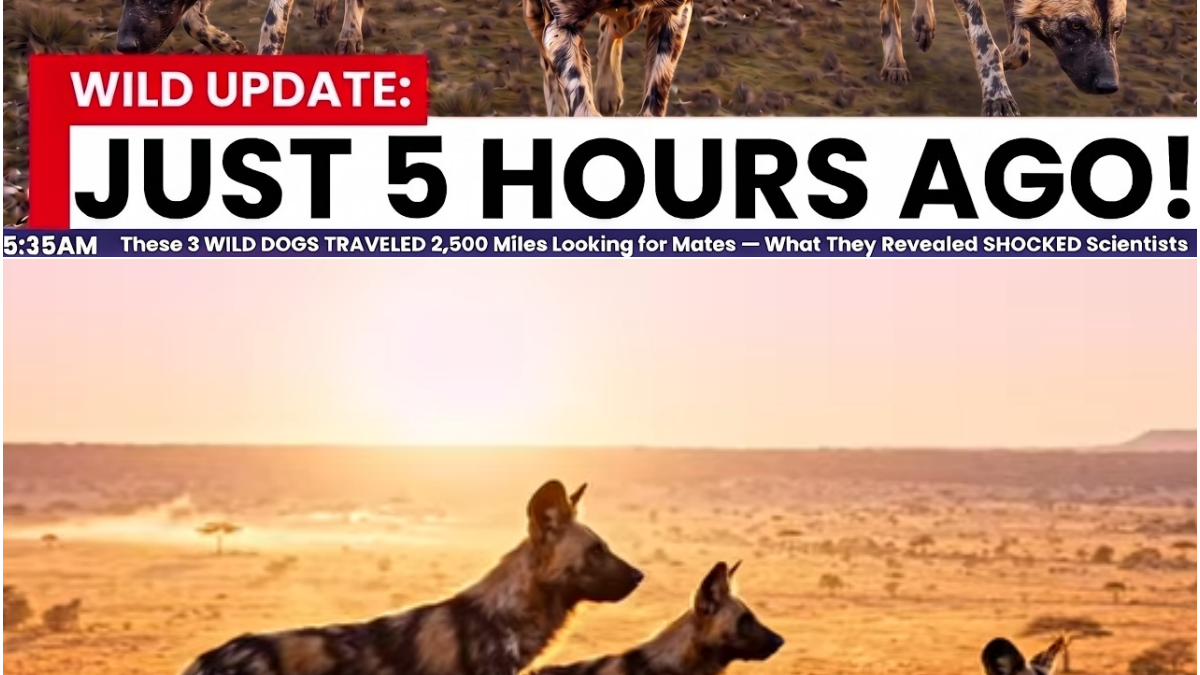
The first signal arrived in the darkness, faint and ordinary, one small pulse traveling through the night from somewhere beyond the roads and farms of Zambia.
Then another came. And another. On a research screen far from the animal itself, a tiny point moved across a map of Kafue National Park and continued southward.
The young African wild dog wearing the collar was not supposed to be making a journey like this.
He was supposed to remain somewhere within the broad wilderness where he had been born, perhaps finding a nearby territory when the time came, perhaps joining another group within a familiar stretch of woodland.
Instead, the signal kept moving. Night after night, it traveled farther from Kafue. The route bent around roads, settlements, reservoirs, and industrial land.
It crossed landscapes that should have stopped a small predator in its tracks. Yet the signal continued, joined by two brothers traveling beside him.
Weeks became months. The map grew crowded with lines showing every turn they had made.
What began as an ordinary dispersal slowly became something researchers had never seen recorded before in Africa.
The three brothers were not following a seasonal migration. They were not returning to a known destination.
They were searching for a future somewhere beyond the place where they had been born.
And if the landscape between Kafue and their eventual destination was already so divided by human activity, how far could three young wild dogs really travel before the last open path disappeared?
African wild dogs have always lived by movement. Their lives depend on cooperation, family, and enormous areas of land.
A single pack may travel across a territory that would seem impossibly large to animals living in more familiar environments.
They hunt together, rest together, raise young together, and follow one another through changing seasons.
But there is another part of their lives that begins when a young animal reaches maturity.
Leaving is necessary. Within a wild dog pack, breeding is generally concentrated in a dominant pair.
Other members contribute to the life of the group, helping care for young and participating in hunts, but their own opportunity to establish a family may require them to leave the pack in which they were born.
For three brothers in the Mayukuyuku pack, that moment arrived when they were about three years old.
They had grown up in Kafue National Park, one of Africa’s great protected wildernesses. The park offered woodland, grassland, water, and prey across an immense landscape.
It was the kind of place where an animal could disappear into the distance without ever encountering a town.
There was no obvious reason to expect these three brothers to travel extraordinarily far. Researchers had expected dispersal, but dispersal did not necessarily mean an epic journey.
A young wild dog could move away from its birth pack, search through surrounding habitat, and eventually encounter other animals with which to form a new group.
The researchers fitted one of the brothers with a GPS collar. Then the brothers left.
At first, nothing about their movements seemed impossible. They traveled south. The collar sent its signals.
The brothers continued. Days became weeks, and instead of settling in a relatively nearby area, they kept moving.
The line on the researchers’ map stretched farther away from Kafue. Then it stretched farther still.
The three animals were entering a landscape very different from the protected wilderness in which they had been born.
Farms appeared. Roads became more common. Human settlements interrupted the woodland. Industrial areas expanded around Lusaka.
Yet the brothers did not simply move directly through everything in front of them. Their route curved.
They skirted Lusaka and the industrial areas around the capital. Instead of passing directly through the most heavily developed parts of the landscape, they moved around them.
For researchers watching the collar, the pattern became increasingly difficult to explain as ordinary wandering.
The brothers seemed to be navigating. They encountered obstacles and changed direction. They found openings between areas of development.
They continued through stretches of land where a mistake could have ended the journey. Then came the reservoirs.
The three brothers crossed two large bodies of water, adding another layer of difficulty to a journey that had already carried them far beyond their birthplace.
The map continued to change. South became eaSt. East became north. The brothers climbed toward the edge of the Great Rift Valley escarpment.
They were hundreds of miles from Kafue now. Still, the collar continued transmitting. For the researchers, every new signal carried the same strange message.
The animals were still moving. One month passed. Then another. Then another. The journey had stopped looking like a simple search for nearby territory.
It was becoming a remarkable exploration of the remaining connected spaces across Southern Africa. Wild dogs are built for endurance.
Their bodies are light and athletic, their legs long, and their social lives depend on coordinated movement.
But physical ability alone could not explain what was happening. The brothers needed a landscape that allowed them to keep going.
They needed prey. They needed water. They needed places where they could avoid the most dangerous obstacles.
And above all, they needed some form of connection between the pieces of wild country scattered across the region.
That connection was far less visible than a road or a fence. It was a corridor.
Sometimes it was a strip of woodland. Sometimes it was farmland that still allowed animals to pass.
Sometimes it was a narrow opening between settlements. Sometimes it was simply enough undeveloped land for a wild animal to move through without being forced into a dangerous human environment.
The three brothers kept finding those openings. The journey continued for eight months. Then nine months.
Eventually, the movement slowed. The brothers reached an area near South Luangwa and the Lower Zambezi, close to border regions shared with neighboring countries.
The researchers examined the route. The destination was not as far from Kafue as the journey itself suggested.
Measured in a straight line, the distance between their birthplace and their new area was about 260 miles.
But the brothers had not traveled in a straight line. They had moved around obstacles.
They had followed openings. They had crossed reservoirs. They had changed direction repeatedly. When the entire route was measured, the total came to roughly 4,100 kilometers.
More than 2,500 miles. For an African land mammal searching for a mate, it was an extraordinary distance.
The number immediately changed the way researchers understood the species. Seasonal migrations are common in Africa, and some animals travel enormous distances as they follow rainfall, food, and water.
Wildebeest can travel roughly 400 to 1,800 kilometers during their movements across East Africa. Those journeys, however, are different.
They are seasonal patterns. Animals move with environmental conditions and often return through the same broad system again and again.
The three wild dog brothers were doing something else. They were dispersing. They were moving away from their birthplace with no requirement to return.
Their journey had a destination only in the broadest sense. They were searching for an opportunity to establish a future beyond the pack in which they had grown up.
That made the 4,100 kilometer route especially remarkable. Only gray wolves tracked over an entire year of roaming had recorded movements that approached such a scale, and even that comparison involved a longer period.
The brothers had traveled their extraordinary distance in roughly eight to nine months. But their achievement could not be separated from the risks revealed by the same research.
The researchers were not tracking only these three animals. Across the wider study, they fitted collars to 19 dispersing groups.
The purpose was to understand how wild dogs moved through fragmented landscapes and whether populations that appeared isolated might still be connected.
The results were not all successful journeys. Some of the collared animals encountered wire snares.
These inexpensive traps are widely used for bushmeat and are indiscriminate. They cannot distinguish between an animal intended by the person setting the trap and an endangered predator simply passing through the same landscape.
The researchers saw the consequences in their tracking data. A trio of sisters appeared to be attempting a journey of their own.
They moved across the landscape in a way that suggested they too were searching for a new opportunity beyond their birth area.
They came remarkably close to matching the brothers. Then one of the sisters encountered a snare.
Her journey stopped there. The contrast was impossible to ignore. One group of young animals threaded its way across thousands of kilometers and reached another region.
Another group came close to making a comparable journey but could not complete it. The difference was not necessarily the strength of the animals.
It was the landscape. Every road, fence, farm, settlement, and snare represented another point of difficulty for an animal trying to move between distant populations.
For years, conservationists had worried about precisely this problem. African wild dogs remain one of the rarest large carnivores on the continent.
Their populations are scattered across protected areas and surrounding landscapes. If those populations became completely isolated, animals born in one region would have fewer opportunities to encounter animals from another.
Over time, that could reduce the exchange of individuals between populations. The result would be a collection of separate groups rather than a wider connected population.
Conservation plans therefore often focused on protecting large reserves. But a reserve is only one part of the picture.
What happens between reserves can matter just as much. The three brothers offered an extraordinary answer.
They showed that a wild dog born in Kafue could travel far beyond the boundaries of its birthplace and reach another major wildlife region.
The journey was difficult. It was complicated. It was not something conservationists could assume would happen every time.
But it was possible. And that possibility changed the meaning of the land between protected areas.
Researchers began examining the routes of the other collared groups more closely. The brothers were not an isolated example.
Four separate groups pushed to within a few kilometers of Angola, Zimbabwe, and Malawi. The animals were moving toward international borders, exploring the spaces between major wildlife populations.
Their movements suggested that the landscape might be more connected than it appeared on a conventional map.
A map drawn for people tends to emphasize borders. A road map shows cities. An agricultural map shows farms.
A political map shows countries. A wild dog experiences none of those boundaries in the same way.
For the animal, the important question is whether there is a path through. Can it move through woodland?
Can it find water? Can it find prey? Can it cross without encountering a barrier?
Can it pass around a town? Can it avoid a dangerous road? Can it continue long enough to find another group?
The three brothers had answered those questions one signal at a time. Their route also drew attention to one of the largest conservation experiments on the continent.
The Kavango Zambezi Transfrontier Conservation Area spans five countries and covers roughly 520,000 square kilometers.
Its basic idea is simple even though its geography is enormous. Wildlife does not recognize international borders.
Species that naturally move across great distances require landscapes larger than individual parks. A network of protected areas and corridors can give wide ranging animals room to move between populations.
For wild dogs, this concept may be especially important. The species does not live comfortably inside small isolated pockets.
Its social structure, dispersal behavior, and hunting strategy all depend on space. The three brothers became a kind of moving test of that idea.
Their GPS collar transformed their journey into a trail that scientists could examine afterward. Instead of guessing whether wild dogs could cross fragmented landscapes, researchers could watch the process happen.
Professor Scott Creel of Montana State University had studied African wild dogs since 1991 and led the research behind the discovery.
The findings suggested something much larger than a record distance. Creel and his team considered it plausible that virtually every major unfenced wild dog population across Eastern and Southern Africa could potentially remain connected to others.
That did not mean every population was constantly exchanging animals. It did not mean every corridor was safe.
It did not mean every dispersing wild dog would reach its destination. It meant that the apparent islands might not be as isolated as they looked.
A wild dog born in one protected area could potentially cross the spaces between reserves and reach another population.
The genetic future of the species could therefore depend not only on protecting individual parks, but also on keeping the wider landscape permeable.
That idea made the brothers’ route more significant than a record in a scientific paper.
The 4,100 kilometers represented a demonstration of possibility. The animals had shown that distance itself was not necessarily the final barrier.
The landscape could still connect them. But the same journey also demonstrated how fragile that connection was.
The brothers had traveled around Lusaka. They had avoided industrial areas. They had crossed reservoirs.
They had navigated farmland and roads. They had spent months moving through terrain where every decision mattered.
Their success did not mean the landscape was easy to cross. It meant the landscape still contained enough openings for the journey to continue.
That distinction mattered. Conservation could not simply celebrate the record and assume the problem was solved.
The sisters made that clear. So did the other collared groups. For every remarkable movement recorded by a GPS collar, there were animals whose journeys stopped before they reached another population.
The wire snares were one example. Roads and fences could create other barriers. Human settlements could force animals into narrower and more dangerous routes.
The brothers had not discovered an empty wilderness. They had navigated a landscape shared by people and wildlife.
That may have been the most important part of the story. For much of human history, the movement of large animals across Africa happened without being recorded in detail.
An animal left one area and appeared somewhere else. People could see the result, but they could not reconstruct every kilometer between the two points.
GPS collars changed that. A single signal could reveal a hidden route. A series of signals could reveal a corridor.
Nineteen dispersing groups could reveal a pattern. And three brothers could reveal just how far an animal might travel when the need to find a new social opportunity becomes strong enough.
The technology was small compared with the journey. A collar around the neck of one young wild dog became a window into a landscape stretching across thousands of kilometers.
Researchers could watch the animal move at night. They could see when the route slowed.
They could see when the direction changed. They could compare the animal’s movements with roads, farms, settlements, reservoirs, protected areas, and national borders.
The map became a record of choices. The brothers did not move randomly. Their path repeatedly bent around the most heavily developed areas.
That pattern suggested a level of spatial awareness that researchers found particularly interesting. Whether the animals understood human geography in anything like the way people do is impossible to know.
But their movements showed that they could respond to the structure of the landscape. They avoided certain areas.
They used others. They kept moving through the spaces that remained available. The result was a route that looked almost deliberate when viewed from above.
On the ground, however, the journey would have been far less orderly. The brothers would have experienced woodland, open country, water, unfamiliar smells, prey, rival predators, livestock areas, human activity, and countless other details that never appeared on the researchers’ maps.
The GPS signal reduced all of that complexity to a series of points. Point after point.
Night after night. Month after month. Together, those points created the longest recorded dispersal of an African land mammal.
The number was astonishing, but the story behind it was even more revealing. The brothers did not travel because the landscape was untouched.
They traveled because enough of it remained connected. That difference is critical. A conservation corridor does not have to look like a perfect wilderness to function.
Sometimes it can be a patchwork. A protected woodland here. A stretch of natural vegetation there.
A passage between farms. An unfenced section beside a road. A river corridor. A large area of land where animals can move without being forced into the most dangerous human spaces.
To people looking at a satellite image, these pieces may appear disconnected. To a wild dog on the ground, they can form a route.
The three brothers found that route. They followed it for more than 2,500 miles. Eventually, their movement settled near South Luangwa and the Lower Zambezi.
The map stopped expanding. After months of travel, the extraordinary line drawn across Zambia finally had an endpoint.
The brothers had gone from young animals leaving their birth pack to travelers connecting one major wildlife region with another.
Their journey had started with a simple biological need. Leave. Search. Find another opportunity. But the result became a lesson about an entire continent.
Wild dogs need more than protected areas. They need connections. They need the spaces between those protected areas to remain usable.
And they need those spaces to be safe enough for young animals to cross them.
The story also showed why conservation can never be measured only by the number of animals inside a reserve.
A park can be large and healthy while the surrounding landscape becomes increasingly difficult to cross.
A population can appear stable while young animals have fewer and fewer routes through which they can disperse.
A corridor can exist on a map but become useless if fences, roads, development, or snares close the openings animals depend on.
The three brothers turned that abstract concern into something visible. Their route was proof that connection still existed.
It was also a warning that connection could disappear. Scott Creel described conservation as a story where the glass can be half empty and half full at the same time.
The brothers represented the full side of that image. They showed extraordinary endurance. They showed that a wild dog could cross a fragmented landscape over many months.
They showed that distant populations may not be as isolated as researchers once believed. But the sisters represented the other side.
They had traveled far. They had nearly matched the brothers. Then a single snare changed everything.
The two stories belonged together. One could not be understood without the other. If researchers had studied only the successful journey, they might have concluded that wild dogs were more resilient to fragmentation than expected.
If they had studied only the unsuccessful journeys, they might have underestimated the remaining strength of the landscape.
Together, the records told a more complicated story. The corridors were functioning. But they were fragile.
The connections existed. But they were not guaranteed. And the ability of wild dogs to travel extraordinary distances did not make the threats along those routes disappear.
The three brothers had simply shown what was possible when enough of the path remained open.
That may be why their journey continues to matter. It was not merely a record.
Records can eventually be broken. Another animal may one day travel farther. Another species may produce an even more astonishing movement.
The important discovery was the map. Thousands of kilometers of movement revealed that Southern Africa still contains hidden pathways connecting places that appear separate when viewed through human boundaries.
The brothers followed those pathways without knowing what researchers would later learn from them. They did not know they were carrying a GPS collar.
They did not know scientists were watching the route from a computer screen. They did not know their journey would become evidence for a much larger idea about conservation.
They simply kept moving. The first signal had been a small blinking point in the darkness.
Months later, it represented a line stretching across much of Zambia. Behind that line were three brothers who had left Kafue National Park, crossed reservoirs, skirted Lusaka, passed through landscapes shaped by farms and roads, climbed toward the Great Rift Valley escarpment, and finally reached a region near South Luangwa and the Lower Zambezi.
Their straight line distance was about 260 miles. Their actual journey was roughly 4,100 kilometers.
More than 2,500 miles. Nine months of movement had turned a routine dispersal into a record.
But the most important distance was not the number on the map. It was the distance between two ideas.
The first idea was that protected wildlife populations were isolated islands. The second was that the land between them might still function as a living network.
The brothers moved through that network and made the invisible visible. Every turn in their route showed that a connection remained.
Every obstacle they avoided showed what could interrupt it. Every signal that arrived was evidence that the landscape still offered another step.
For wild dogs, the future may depend on whether those steps remain available. The young animals that leave their birth packs in years to come will not have the benefit of a map showing where their predecessors traveled.
They will simply move. They will search for food and water. They will follow paths through woodland.
They will avoid roads and settlements when they can. They will cross whatever landscape remains open.
And somewhere, perhaps far from Kafue, another collar may one day begin sending the first signals of another extraordinary journey.
The three brothers showed that the journey can be much longer than anyone expected. They showed that a wild dog can cross thousands of kilometers when the landscape still gives it a way forward.
And they showed something even more important. The great wild spaces of Southern Africa are not connected only by the borders drawn around national parks.
They are connected by every remaining corridor between them. By every stretch of woodland left open.
By every passage between farms. By every landscape where an animal can move from one region to another.
The brothers found those connections because they were still there. Their record was measured in kilometers, but its meaning was measured in possibilities.
A young wild dog left Kafue looking for a future. Three brothers crossed a continent of obstacles.
A satellite followed them. And for thousands of kilometers, one small signal after another proved that the path between distant wild places had not yet disappeared.
Disclaimer: This content may be created by Al for entertainment purposes. Any resemblance to real persons, events, or places is coincidental.








