The Wild Bunch Saw a Widow Being Thrown Off Her Ranch — What They Did Stunned the Whole Town
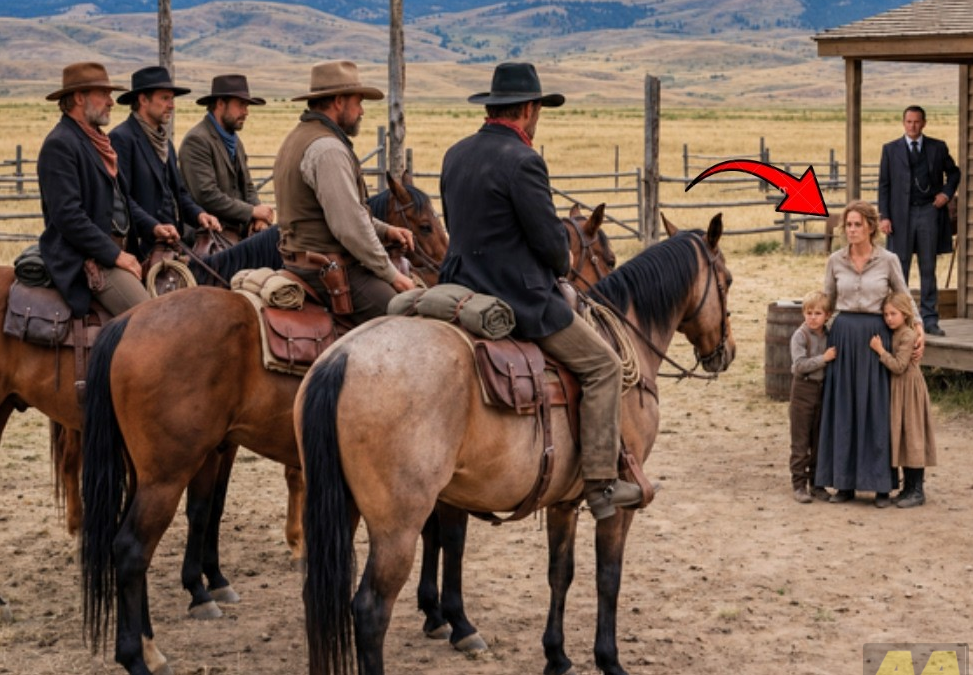
The wagon was already loaded when the five riders appeared on the ridge. Ruth Hargrove stood in the cold morning light with one hand resting on her little boy’s shoulder and the other gripping her daughter’s fingers.
Behind them, two strangers carried her kitchen table through the front door as though the house had already stopped belonging to her.
A deputy stood on the porch reading from a folded paper, his voice loud enough to reach every corner of the yard.
“By order of the Johnson County District Court, this property is to be surrendered to the Anglo Wyoming Cattle Company per writ of possession, effective immediately.”
Ruth stared at the paper. She had heard the words before. She simply could not make them belong to her life.
The house had been built by her husband. The fence had been repaired by his hands.
The fields had been cleared by their labor. Yet now a company man in a gray coat stood beside a waiting buggy while strangers decided which pieces of her home were worth taking.
Then five horses stopped on the ridge. Will Carver saw the fresh paper. Ben Kilpatrick saw the fence line.
Kid Curry saw the little boy trying not to cry. Sundance watched the men carrying away the furniture.
And Butch Cassidy noticed all of it. He leaned forward in the saddle. “Well, that’s a poor way to spend an afternoon.”
They had come to Johnson County, Wyoming, in the fall of 1900 for money. Instead, they had found a widow being pushed from her home.
And suddenly the five wanted men had a choice to make. Would they ride away and leave the matter behind, or would they stop long enough to discover why a piece of paper could take a house from the people who had built it?
The five riders remained on the ridge. Butch Cassidy had heard about the Anglo Wyoming Cattle Company through a man in Buffalo who owed him a favor.
The company was moving a payroll through Cottonwood Flats, and according to the information Butch had received, the safe would be lightly guarded.
It was supposed to be simple. Four days. Ride in. Study the town. Study the roads.
Study the bank. Take what they came for. Ride out. Nobody had mentioned Ruth Hargrove.
Nobody had mentioned a court order. Nobody had mentioned a kitchen table being carried away while two children watched.
Curry shifted in his saddle. “Ain’t our business.” “No,” Butch said. His eyes remained on the yard below.
“It ain’t.” None of them moved. Below, Deputy Otis Reed finished reading the order. He was young, perhaps younger than the men standing around him expected a deputy to be, and he looked uncomfortable with every word that came from his mouth.
Ruth looked at him. “My husband never sold this place.” Reed lowered the paper. “I am only carrying out the order, mrs. Hargrove.”
“The order says my husband signed the deed?” “Yes.” “He did not.” The company men continued loading furniture.
An older man in a gray coat stood beside a buggy. Sundance nodded toward him.
“That the company man?” “Looks like it,” Butch said. The man in gray did not help with the furniture.
He watched. “Cyrus Wren,” Sundance said. Butch glanced at him. “You know him?” “No.” “Then how do you know his name?”
“I asked around before we came down.” Butch smiled faintly. “That is why I keep you around.”
Sundance gave no answer. Ben Kilpatrick pointed toward the western fence. “That line was different in May.”
Butch looked. “How different?” “Thirty yards.” “Sure?” “I rode this valley in May. Fence was farther weSt.”
Carver leaned forward. “New posts too.” Curry frowned. “A fence proves somebody moved a fence.”
“Exactly,” Carver said. Butch looked back toward Ruth. “Let’s have a look.” Curry sighed. “You said this wasn’t our business.”
“I did.” “And?” Butch turned his horse toward the ranch. “And now I want to know why the fence moved.”
They rode down. Five armed strangers approaching a ranch in the middle of an eviction made the company men stop working.
Reed reached toward his sidearm. Then he thought better of it. Butch lifted his hand from the saddle.
“Afternoon.” Nobody answered. Butch touched his hat. “Looks like you are having a difficult day.”
Cyrus Wren stepped forward. “This is company property now.” Butch looked at the house. “Seems the lady might disagree.”
“Her disagreement does not change a court order.” Wren spoke with the confidence of a man accustomed to having papers settle arguments before people could finish making them.
“Cyrus Wren,” he added. “Land agent for the Anglo Wyoming Cattle Company.” “Butch Cassidy.” Wren stared at him.
For the first time, the confidence left his face. Sundance smiled. Curry looked amused. Ben remained expressionless.
Carver simply watched. Butch took off his hat. “Now that introductions are done, mind if I see the order?”
Wren hesitated. Reed looked at him. Wren nodded. The deputy handed the document over. Butch read it.
The writ directed the sheriff of Johnson County to place the Anglo Wyoming Cattle Company in possession of the Hargrove parcel.
The document referenced a deed signed by David Hargrove. The date on the deed was the 11th of February, 1900.
It had supposedly been recorded the following week. But David Hargrove had been gone from the ranch by March.
Ruth stepped closer. “My husband never sold this land.” Wren pointed toward the document. “The deed says otherwise.”
“My husband could not have kept that secret from me.” “That is not a legal argument.”
Ruth looked toward the house. “He built it.” Wren shrugged. “He owned it.” “And now?”
“Now the company owns it.” Butch looked down at the paper again. “What about this?”
Ruth answered before Wren could. “I have the original land patent.” Wren’s expression tightened. “mrs. Hargrove.”
“She has the right to fetch it,” Butch said. Wren looked at him. Butch smiled.
“Unless the court order says she cannot walk inside her own house.” The company agent said nothing.
Ruth went inside. She returned moments later holding a folded document. Its edges were soft from years of handling.
Butch nodded toward Carver. Will Carver took it. He opened the document carefully. “Land patent.”
He examined the seal. “Signed and dated 1894.” Ruth nodded. “That is the original.” Carver looked toward Butch.
“Proves the homestead claim.” Wren stepped closer. “Nobody disputes that.” Butch folded the patent. “Then why does a later deed suddenly appear?”
“Because mr. Hargrove sold the land.” “When?” “February 11th.” “Five weeks before he left this world?”
Wren stiffened. Butch corrected himself. “Before his final illness.” Wren said nothing. Butch looked again at the paper.
The notary’s name was Elias Roark. Something about the signature bothered him. Not the handwriting.
The date. The more he looked at it, the less comfortable he became. “Where was this deed recorded?”
“Buffalo.” “When?” Wren answered. “July.” Butch looked up. “July?” “Yes.” “But the deed is dated February.”
“That is not unusual.” “Maybe.” Butch handed the writ back. “Maybe not.” Wren folded it.
“This matter is settled.” Butch mounted his horse. “For now.” The five riders left the ranch.
They did not go far. That night they camped beneath a line of cottonwoods a mile from the road.
Curry sharpened his knife. Sundance watched the fire. Ben studied the fence post he had brought back from the ranch.
Carver ate jerky. Butch sat with the deed details written in his mind. “We have a payroll job,” Curry said.
“Yes.” “And a train schedule.” “Yes.” “And we are spending the evening discussing a widow’s land.”
Butch looked at him. “You want to ride away?” Curry stared into the fire. “No.”
“Then quit complaining.” “I am not complaining.” “You are sharpening that knife like the knife owes you money.”
Curry looked down. He stopped sharpening. Sundance chuckled. Butch turned to Ben. “What did you find?”
Ben held up the fence poSt. “Fresh cut.” “How fresh?” “Six weeks. Maybe less.” “The fence moved around the same time as the deed?”
“That is what I think.” Carver leaned forward. “Deed dated February. Recorded July. Fence moved sometime after spring.”
Butch nodded. “A company sure of its paperwork does not need to move a fence early.”
Curry frowned. “What are you saying?” “I am saying somebody wanted the ground to look settled before the paperwork was questioned.”
“That still ain’t proof.” “No.” Butch stood. “It is enough for me to look.” He looked toward Buffalo.
“We go there tomorrow.” Curry sighed. “And the payroll?” “We have four days.” “We are spending one in Buffalo.”
“Yes.” “Fine.” They rode north. Buffalo was half a day’s journey. The courthouse and land office stood along the same dusty street.
Butch went into the land office alone. He returned an hour later. Sundance studied his face.
“What?” “The Hargrove patent is clean.” “So the land was legally his?” “Yes.” “And the company got it afterward?”
“That is what the deed says.” Butch looked toward the courthouse. “That is where the trouble starts.”
They entered the county clerk’s office. The clerk’s name was Halloran. He was nervous from the moment Butch mentioned the Hargrove deed.
Butch placed a coin on the desk. Halloran looked at it. “I cannot discuss private records.”
Butch placed another coin beside the firSt. Halloran looked toward the door. Then he opened the deed book.
The Hargrove entry was there. Recorded in July. Five months after the date written on the deed.
Butch pointed to the notary. “Elias Roark.” Halloran nodded. “Roark worked here two years ago.”
“And his commission?” Halloran hesitated. “It had expired.” “When?” “The previous winter.” Butch leaned back.
“So he was not authorized to notarize this deed.” Halloran looked uncomfortable. “I file what comes in.”
“Did anyone check the commission?” “Apparently not.” Butch studied him. “Apparently?” Halloran swallowed. “I was not here when it was filed.”
“Who was?” Halloran did not answer. Butch did not push. He did not need to.
The answer was already sitting between them. Outside, Carver was waiting. He had spent the morning at the newspaper office.
“Four other homesteads,” he said. Butch looked at him. “Same pattern?” “Close enough.” Carver handed him a folded newspaper.
“Company buys land through deeds. Some were signed by men who were no longer around to explain them.”
Butch read. “Four families.” “Maybe five.” “Any notary names?” “Not yet.” Ben joined them. “The fence posts match the same kind of wood used around another property east of here.”
Butch folded the newspaper. “This is bigger than Hargrove.” Curry looked toward the street. “Then why does the company want this much land?”
“Cattle.” “That simple?” “Land is money.” Sundance nodded. “Especially land beside good water.” Butch looked at him.
“Exactly.” That afternoon, they returned to Cottonwood Flats. Rumors had already started. People knew five strangers had been asking questions.
Some knew exactly who those strangers were. Others knew only that they were wanted men.
Sheriff Purdy did not appear impressed. He was a heavy-set man with a tired face and a habit of trusting paperwork more than rumor.
When Ruth asked him to review the deed, he shook his head. “The court issued the writ.”
“My husband did not sign it.” “That is something the court must determine.” “The court already did.”
Purdy nodded. “That is my point.” Ruth looked at him. “So you will put my children out of their home?”
“I will enforce the order.” She said nothing. Three days had taught her that paper could be harder than stone.
That evening, Cyrus Wren rode to the ranch. He found Ben Kilpatrick sitting on the porch.
Ben held a fence poSt. Wren stopped. “You have no business here.” Ben looked at the poSt.
“New wood.” “I know.” “Cut clean.” Wren said nothing. “Who moved this fence?” “The company surveyor.”
“Before the court order?” Wren’s jaw tightened. “The boundary was established.” “By whom?” “Survey.” “When?”
Wren did not answer. Ben looked at him. “You know there is a difference between a boundary being surveyed and a boundary being moved.”
Wren’s expression changed slightly. “You are an outlaw.” “That does not make a crooked fence straight.”
Wren turned his horse. Ben watched him ride away. When the others returned to camp, Ben told them what happened.
Curry laughed. “You lectured the land agent?” “No.” “What did you do?” “Asked questions.” “That sounds worse.”
Butch smiled. “Maybe he is beginning to think.” Sundance looked toward the fire. “Wren?” “Yes.”
“You think he knew?” “I think he believes the paperwork.” Carver nodded. “That matters.” “How?”
“If he believes it, then somebody fooled him.” Curry frowned. “And?” “And if we show him how, he might stop defending it.”
Butch nodded. “We need him looking in the right direction.” The fourth night, Ruth Hargrove came to their camp.
She arrived alone. Butch stood when she approached. “You should not be here.” “I know.”
“Why come?” She held a folded letter. “There is something I did not tell the sheriff.”
Butch accepted the letter. “My husband’s cousin, Elias, worked in the county office two years ago.”
“Elias Roark?” She nodded. “He wrote me in June.” “After the deed?” “Yes.” “What did he say?”
Ruth shook her head. “I did not understand why he was asking about David’s papers.”
Carver took the letter. He studied the handwriting. Then he looked at the copy of the deed.
“This is his handwriting.” Ruth’s face tightened. “Are you certain?” “Not completely.” Carver compared the signatures.
“But close.” Butch read the letter. Elias Roark had asked questions about the ranch records.
He wanted to know whether Ruth still had the original patent. He wanted to know whether David had ever discussed selling the land.
Butch looked up. “He was checking whether you could prove the deed false.” Ruth lowered her eyes.
“I thought he was only being nosy.” “He was not.” Sundance looked at Butch. “Then Roark may have made the deed.”
Curry leaned back. “Or helped make it.” Butch folded the letter. “We do not need a confession.”
“What do we need?” Ruth asked. “Something the sheriff cannot ignore.” She looked at him.
“What?” “A record.” The next morning, Carver returned to the county clerk. Halloran had become less nervous.
Perhaps he understood that the men asking questions already knew enough to make silence useless.
Carver asked to see the deed book. The Hargrove entry was out of sequence. Two July deeds came before it.
One July deed came after it. The Hargrove entry sat between them despite being marked with an earlier date.
Carver copied the sequence. Then he brought it to Butch. “There.” Butch studied it. “Somebody inserted the deed after the others were already recorded.”
“Looks that way.” “Can Halloran swear to it?” “He can swear to the order of the pages.”
“Good.” Friday morning arrived cold. Two days remained before Ruth’s deadline. By nine o’clock, people were gathered around the sheriff’s office.
The rumor had spread that the Wild Bunch would be there. Sheriff Purdy stood on the boardwalk.
Two deputies stood beside him. Cyrus Wren arrived in his gray coat. Ruth stood across the street with her children.
Butch and the others rode into town together. They stopped in front of the sheriff’s office.
Butch dismounted. “mr. Wren.” Wren looked at him. “Cassidy.” “I want to discuss the Hargrove deed.”
“The court has already ruled.” “The court ruled on a document.” “Yes.” “A document dated February 11th.”
“Yes.” “Recorded in July.” Wren said nothing. Butch continued. “Notarized by Elias Roark.” Wren’s face changed.
“The same Elias Roark whose notary commission had expired the previous winter.” The crowd became quiet.
Sheriff Purdy stepped forward. “That is enough.” Butch looked at him. “No.” Purdy’s hand moved toward his belt.
Butch raised both hands. “I am not drawing anything.” Carver stepped forward with Halloran’s written statement.
“The deed was recorded out of sequence.” Purdy frowned. “What does that prove?” “Not enough by itself.”
Carver handed it to Wren. Wren read it. Butch said nothing. Then Ruth stepped forward.
She handed Wren the letter from Elias Roark. Wren read it. His face changed. “Where did you get this?”
“My husband’s papers.” Wren looked at the signature. Then at the deed. Curry watched him closely.
“You knew Roark?” Wren nodded slowly. “The company recommended him.” Butch asked, “For the notary work?”
“Yes.” “Who recommended him?” Wren hesitated. “A company office in Cheyenne.” Butch nodded. “So the company trusted him.”
“Yes.” “Did you know his commission had expired?” “No.” Wren looked toward the sheriff. “Did you?”
Purdy said nothing. The crowd murmured. Butch turned toward them. “Four other homesteads have deeds with similar problems.”
Purdy’s eyes narrowed. “That does not prove the company took them unlawfully.” “No.” Butch pointed toward the papers.
“But it proves somebody should examine them.” Wren looked at Ruth. Then at the papers.
Then at the crowd. He had a choice. He could defend the company. Or he could admit that he had carried a document he had never truly examined.
Finally, he spoke. “I will ask Judge Whitfield to stay the writ.” Purdy stared at him.
“Wren.” “I said I will ask.” “The court already ruled.” “On the papers we were given.”
Wren turned toward Butch. “If this is a trick, Cassidy, it will not end well for you.”
Butch smiled. “I am counting on you finding that out.” The crowd laughed nervously. Purdy did not.
Two weeks later, Judge Alden Whitfield ordered an independent examination. The examination found serious problems with the Hargrove deed.
The expired notary commission mattered. The irregular recording mattered. The connection to Elias Roark mattered.
The company withdrew its claim to the Hargrove parcel. It also withdrew claims against the other four homesteads connected to the same pattern.
Ruth returned to her house. Her kitchen table came back through the front door. Her children slept in their own beds again.
The fence was moved back to the proper line. The Anglo Wyoming Cattle Company did not make a public apology.
Cyrus Wren was transferred to an office in Denver. Elias Roark disappeared before investigators could question him.
The five riders were already gone. They had not touched the payroll. They had not robbed the bank.
They had spent four days in Johnson County and gained nothing that could be placed in a saddlebag.
Except perhaps the knowledge that they had noticed something most people had ridden paSt. At dawn, Ruth met them at the edge of her property.
Her little boy stood beside her. Her daughter held her skirt. Curry looked at the children.
Then he looked away. Ruth spoke softly. “I do not know what to call what you did.”
Curry shook his head. “Do not call it anything.” He turned his horse. Ben rode past the corrected fence.
He looked at the new posts. Straight this time. He nodded once. Sundance was already watching the road ahead.
Carver folded a copy of the Buffalo newspaper and handed it to Ruth’s daughter. “Keep that.”
She looked at him. “Are you in it?” “Maybe.” “Will it tell the truth?” Carver smiled.
“Newspapers rarely get everything right.” The girl looked at the paper. “What should I remember?”
Carver glanced toward Ruth. “The way it happened.” He rode away. Butch remained behind for a moment.
He looked at the Hargrove house. Smoke rose from the chimney. The kitchen table was visible through the window.
The little boy stood near it. Ruth stepped onto the porch. Butch touched his hat.
“Ma’am.” She smiled faintly. “mr. Cassidy.” It was the first time anyone in Cottonwood Flats had spoken his name to his face without fear.
Butch smiled. Then he turned his horse north. Five riders disappeared beyond the ridge. The payroll remained untouched.
The town remained behind them. And the Hargrove ranch remained where it belonged. Butch had entered Johnson County looking for money.
He left with something he had not expected to find. A reminder that sometimes a man can spend four days gaining nothing for himself and still leave richer in a way no bank ledger can record.
Will Carver had noticed the paper. Ben Kilpatrick had noticed the fence. Kid Curry had noticed the child.
Sundance had noticed the company man. Butch Cassidy had noticed everything. That was the difference.
The widow had never needed five outlaws to save her. She had needed somebody to look closely enough to realize that the paper everyone trusted did not tell the whole story.
And once five men saw the wrongness in it, none of them could quite convince themselves to ride away.
The American West had plenty of laws. It had courts, clerks, judges, land offices, deeds, patents, fences, sheriffs, and companies with enough money to hire men who understood all of them.
But paper was only as honest as the hands that prepared it. A fence could be moved.
A signature could be copied. A record could be placed where nobody thought to look.
And sometimes the difference between losing everything and keeping a home was simply whether somebody cared enough to ask one more question.
Ruth had asked. Butch had listened. Carver had checked the records. Ben had measured the fence.
Sundance had watched the people. Curry had watched the child. Together, they had found the truth hiding behind a document that nearly everyone else had accepted.
None of them would call themselves heroes. They were still wanted men. They still had warrants waiting in other counties.
They still rode under assumed names when it suited them. Their own choices had consequences that would follow them long after Johnson County disappeared behind another ridge.
But on that cold morning in the fall of 1900, five riders left a Wyoming ranch knowing that one family would still have a home when winter came.
The road stretched north. The mountains waited in the distance. Butch raised his hat against the wind.
Curry rode beside him. Carver followed. Ben checked the horizon. Sundance watched the trail. Five horses moved steadily across the open country.
Behind them, smoke continued rising from the Hargrove chimney. And for once, nobody in the group needed to say what they had done.
They already knew.
Disclaimer: This content may be created by Al for entertainment purposes. Any resemblance to real persons, events, or places is coincidental.








