The Widow Hired the Nameless Gunman to Defend Her Land A Legend Armed With Two Fast Colts
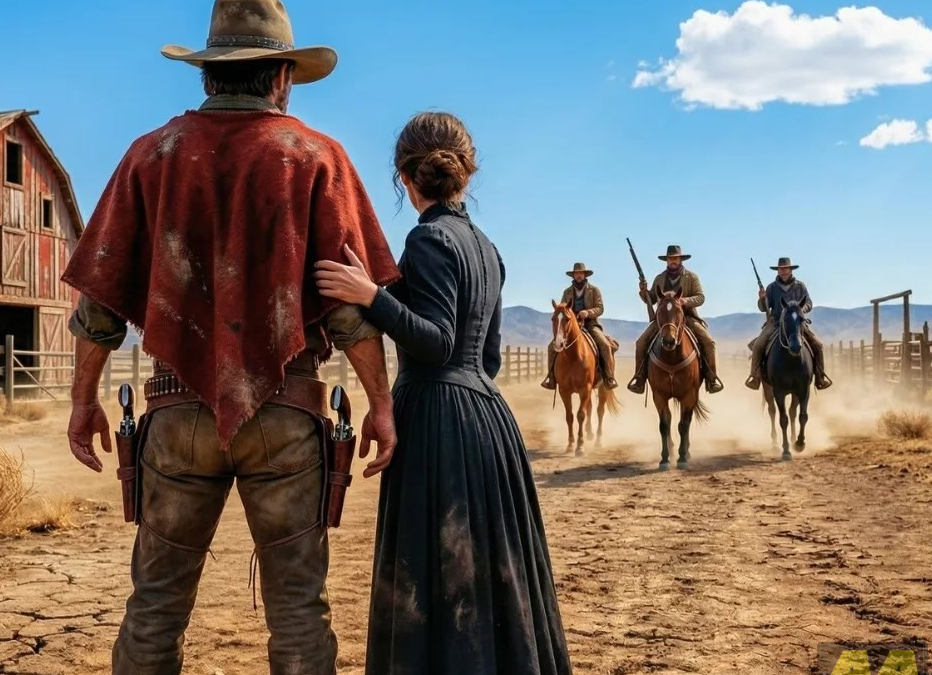
Tuesday had begun like every other morning for the man who rode into Mill Haven with nothing planned beyond breakfast and the road north.
Scout was watered, the saddle was secure, and the familiar rhythm of leaving was already waiting for him.
He had made a life out of moving on. A hundred towns had seen him arrive, work, and disappear again.
A hundred roads had carried him away from places that might otherwise have become memories.
He never stayed long enough for anyone to ask where he had come from, and he never gave anyone a reason to expect him back.
That was how he liked it. A man with no name had fewer promises to keep.
Then he turned the corner onto the main street and saw a woman standing outside the general store.
Two large men had stopped her. She held a folded list of supplies so tightly that the paper had begun to wrinkle beneath her fingers.
The men spoke quietly, almost politely, but the quietness was what caught his attention. There was no shouting.
No scene. Just the unmistakable confidence of men who believed the person in front of them had nowhere else to turn.
He watched for ten seconds. That was enough. He had seen that expression before in other towns, on other faces.
It was not panic. Panic still expected something to happen. This was different. It was the stillness of someone who had learned to endure pressure without showing it.
He changed direction. He walked toward the three of them without hurrying. The men noticed him.
Their eyes moved from his worn poncho to the scar near his jaw, then to the twin Colts resting in their holsters.
The conversation ended. The two men left. The woman watched them disappear before turning toward him.
“You are the one they call the nameless gunman?” “I’ve been called that.” “My name is Catherine Aldridge.
I own the Aldridge Ranch twelve miles south of here. I need help.” He studied her carefully.
She was tired, but she was not asking for pity. She was asking for someone who could stand beside her.
“Buy me breakfast,” he said. “Then tell me everything.” He had no idea that those words would keep him in Mill Haven far longer than he intended.
He had no idea that the road north would become less important than the road leading twelve miles south.
And he certainly did not know that a woman who had spent three years refusing to surrender what she had built would become the first person in a very long time who could make a man who never stayed anywhere wonder whether leaving was still the right thing to do?
The breakfast place was two doors down from the general store. It was small, plain, and already busy enough that nobody paid much attention to the man in the corner booth or the woman sitting across from him.
Coffee steamed between them. Morning light came through the front windows. Outside, Mill Haven was beginning its daily routine.
Catherine Aldridge did not waste time. “My husband Thomas and I built the ranch together,” she said.
“He was gone three years ago. Since then, I have kept it running.” The stranger said nothing.
She continued. “Fifteen years of work. Cattle, horses, six hands during the busiest months. We built the fences ourselves before we could afford hired labor.
Thomas handled the markets. I handled the books, supplies, and household. We both knew every acre.”
She folded her hands around her coffee. “After he was gone, people expected me to sell.”
“Why?” “Because they thought I would eventually understand that a woman could own land but could not manage what came with it.”
Her expression remained calm. “I did not sell.” The stranger looked at her. “And that caused trouble?”
“Not at firSt.” She explained how the pressure began slowly. Credit became difficult. Supply deliveries arrived late.
Cattle buyers offered less than the prices paid for comparable herds owned by men. Nothing happened that could easily be placed before a judge.
Nothing was dramatic enough to demand immediate attention. That was precisely what made it effective.
“They wanted me tired,” Catherine said. “They wanted me to believe selling was easier than continuing.”
“And you did not.” “No.” The stranger drank his coffee. “Then came the Calloway gang.”
Catherine nodded. “Twelve men. Organized. They are not wandering troublemakers. They work for someone.” “Who?”
“I do not know.” “How long?” “Six weeks ago, four of them came to the ranch.”
“What did they want?” “They told me I had sixty days to sell.” The stranger calculated silently.
“Two weeks remaining.” “Yes.” He looked at her. “What happens after two weeks?” “They come back.”
“What happened to the three ranches that sold?” Catherine paused. “One of the ranch hands at the Macalester place was caught in a situation that was later called an accident.”
The stranger studied her face. “You do not believe that.” “No.” “Why not?” “Because Crane was there.”
The name meant something. He had heard it before. “Tell me about Crane.” “He was the one who spoke for them.
About forty years old. Lean. Dark eyes. Very precise. He never raised his voice. He said exactly what he intended and nothing more.”
“Professional?” “Yes.” “Dangerous?” Catherine looked directly at him. “Yes.” The stranger finished his coffee. “Why did you not go to the sheriff?”
She looked toward the window. “The sheriff has been very busy.” “With what?” “Everything except the things that matter.”
She lowered her voice. “He has a new horse. Six months ago he did not have it.”
The stranger understood. “About the time the Calloway gang arrived?” “About then.” He leaned back.
“Take me to the ranch.” The expression on Catherine’s face changed slightly. Not relief. She had lived too long without allowing herself to depend on relief.
It was something quieter. Hope, perhaps, but hope kept under strict control. “When?” “This afternoon.”
Twelve miles south of Mill Haven, the land changed. The town disappeared behind them. The road narrowed.
Grass spread across the open country, green in places where the water reached the roots and pale where the soil was drier.
The Aldridge property stood in the middle of it, surrounded by fences that had been built to laSt.
The house was two stories. The barn was large. The herd in the southern pasture looked healthy.
At first glance, everything seemed fine. The stranger slowed Scout before reaching the main gate.
He looked at the ground. Then the water trough. Then the barn. Catherine noticed. “What?”
He pointed toward the trough. “Wrong position.” She frowned. “It has been there for years.”
“It should not be there.” He dismounted. He walked to the barn doors. “They open outward.”
“Yes.” “Most people here would build them to open inward.” “Thomas preferred them this way.”
The stranger nodded. He walked along the north approach. Three fence posts were newer than the others.
Fresh wood had been placed into old holes. He crouched beside one. The angle was wrong.
Someone had replaced the post without understanding why Thomas had originally placed it where he had.
“They have been looking at the property,” he said. Catherine stared toward the fence. “They have been here twice that I know of.”
“Probably more.” They rode into the yard. That evening, Catherine told him everything she could remember.
The first visit. The man called Crane. The exact words he had used. The places where strangers had been seen.
The cattle that had wandered from fenced fields. The supply wagon that had arrived four days late.
The accounts that no longer seemed to balance. The stranger listened. He asked precise questions.
He did not interrupt. When the fire burned lower, the conversation moved away from the Calloway gang.
They spoke about Thomas. Catherine described the way he built fences. How he measured twice before cutting once.
How he had insisted the western barn be placed where it was because the morning wind moved differently there.
“He understood the land,” she said. The stranger looked at the fire. “You do too.”
“I had a good teacher.” “Thomas?” “Yes.” The room became quiet. She looked at him.
“You never say much.” “I say enough.” “That seems to be true.” A faint smile crossed her face.
It disappeared almost immediately. The stranger noticed. He also noticed that he had noticed. That bothered him more than it should have.
The next day, he returned to Mill Haven. He asked questions. He listened in saloons.
He spoke with stable hands, freight drivers, storekeepers, and men who knew how to keep their opinions quiet.
By evening, he had a name. Crane. No first name. No last name. Just Crane.
Some men acquired names like that because their real names stopped mattering. Crane had worked with the Calloway gang for years.
Twelve men. A clear chain of command. He was not the loudeSt. He was the one who decided what happened next.
The stranger learned something else. The three ranches that had sold recently had all been purchased by the same land company registered in St. Louis.
That company appeared ordinary. Too ordinary. He sent a telegram to a contact at the federal land office.
The answer came on the fourth day. The land company was controlled through two intermediary corporations by a group of railroad investors.
The land itself was not the real prize. The water was. The South Range controlled water access that larger operations depended upon during dry years.
The Aldridge Ranch sat in exactly the wrong place for anyone hoping to control that resource.
The stranger took the information to Catherine that evening. They sat on the porch. “The ranch is not the problem,” he said.
She looked at him. “What is?” “The water rights.” She was silent. “Thomas knew.” The stranger waited.
“He talked about it before he was gone. He said whoever controlled the Aldridge water rights would control the South Range.”
“He was right.” She looked toward the pasture. “He called it a responsibility.” “It is also an asset.”
Catherine turned toward him. “Thomas would have hated what they are trying to do with it.”
The stranger looked at her. “Most people who build something hate watching someone else change its purpose.”
She studied him. “You have done this before.” “What?” “Stayed somewhere long enough to understand what matters.”
He looked away. “I do not stay.” “I noticed.” She smiled faintly. He did not know what to say to that.
The next morning, he followed the tracks of the Calloway men. He did not ride toward their camp directly.
He followed the trail left by horses traveling between the three properties that had already changed hands.
By noon, Scout’s ears shifted. The horse had noticed the camp before the stranger could see it.
He reached the ridge. Twelve men were below. Their arrangement told him everything. They were disciplined.
Eight men near the main fire. Four farther out. A supply wagon positioned behind them.
Lookouts placed where they could see the approaches. Crane sat apart from the others. He was reading.
The stranger rode down. The camp changed immediately. Men stood. Hands moved toward holsters. Horses shifted.
He stopped twenty feet from Crane. Crane looked up. His eyes narrowed. “The nameless gunman.”
“You know why I am here.” “The Aldridge woman hired you.” “She did.” One of the men shifted his weight.
His hand moved three inches toward his holster. The stranger’s right Colt cleared its holster before the movement finished.
He did not aim. He held it down. The speed was the message. The camp became still.
“Tell him to stop,” the stranger said. Crane lifted one hand. The man froze. The stranger slowly drew his left Colt as well.
Crane watched. He was calculating. “You are here to deliver a warning,” Crane said. “No.”
The stranger’s voice remained calm. “I am here to deliver a fact.” Crane waited. “The Aldridge Ranch is not for sale.”
“That is not your decision.” “It is now.” Crane studied him for several seconds. “Do you know how many men work for Calloway?”
“Twelve.” “You counted?” “I count everything.” Crane’s eyes moved to the two Colts. “Then you know twelve against one is poor arithmetic.”
“Depends on the one.” Silence. Crane almost smiled. AlmoSt. “I will deliver the message.” “Good.”
“What happens after is not my decision.” “I know.” The stranger turned Scout. Then stopped.
“Tell Calloway something else.” Crane waited. “I will be at the ranch.” He rode away.
The remaining days passed quickly. He prepared the property. Gus took the north fence line.
Paul watched from the barn loft. Catherine remained in the house but refused to be treated as helpless.
The stranger showed her the safest routes between the house, barn, and south pasture. He checked every gate.
Every fence. Every approach. At night, he sat on the porch with Catherine. Their conversations became less about the coming confrontation.
They talked about the ranch. About Thomas. About what she intended to do with the property when the pressure was gone.
She wanted more cattle. A larger southern pasture. New fencing along the western boundary. A second barn someday.
She talked about the future as though it were something she could build with her hands.
The stranger listened. One evening, Catherine found him checking Scout’s saddle. “I looked you up,” she said.
He did not look around. “Did you?” “I asked around Mill Haven.” “And?” “Nobody knows your name.”
“That is usually the point.” “Nobody knows where you are from.” He said nothing. “Nobody knows where you go after you leave.”
Still nothing. She stepped closer. “Does that bother you?” He considered the question. “Being nobody’s history?”
He nodded. “Maybe.” She waited. Then he said quietly, “I’m somebody’s history. Just not anybody who’s looking.”
Catherine studied him. “Mine.” He looked at her. She walked away before he could answer.
Three days later, the Calloway men arrived before dawn. Scout noticed firSt. The horse’s ears lifted.
The stranger was awake before the first rider appeared. He stepped into the yard. The sky was still dark.
Twelve men approached from the northweSt. Eight came directly toward the house. Four moved along the western side.
A pincer movement. Professional. The stranger checked both Colts. Gus was at the northern fence.
Paul was in the barn. Catherine was inside. Scout stood beside the fence. The first rider entered the yard.
Then another. The stranger waited. The lead rider raised his weapon. The stranger moved. The first shot struck empty ground.
The stranger’s Colt answered. The formation broke. Two riders moved left. Scout slammed against the fence rail.
The loose section swung into the path of one horse. The rider lost his balance.
The stranger turned. Another shot. The western group moved in. Gus fired into the dirt ahead of the lead horse.
The animal reared. The formation collapsed. The stranger used the opening. Two more shots. Then silence.
The remaining riders stopped. Crane was behind them. He had not drawn. He had watched everything.
His expression had not changed. He looked at the stranger. Then at the men around him.
Then at the ranch. “How many rounds do you have left?” Crane asked. “Enough.” “For five men?”
“Find out.” Crane looked toward the western field. Then toward the men who remained. The arithmetic had changed.
He understood. “This job has stopped being worth the contract.” He turned his horse. The others followed.
The stranger watched them ride away. He did not fire. There was no need. The ranch became quiet again.
He reloaded both Colts. Scout walked over and pressed its shoulder against his arm. Catherine stepped outside.
She looked across the yard. Then at him. “Is it over?” “Crane is finished.” “And Calloway?”
“He may try something else.” She nodded. The answer was not comforting. But it was honeSt.
Four days later, a federal investigator arrived in Mill Haven. He carried documents connecting the St. Louis land company to the railroad investors.
The water rights claims were frozen. The land acquisitions were placed under investigation. The Calloway organization lost the protection that had allowed it to operate openly.
For the first time in months, Catherine could run her ranch without waiting for another interruption.
The stranger stayed two more days. The job was finished. He told himself he stayed because there were still details to settle.
That was not entirely true. On the final evening, he and Catherine walked the boundary of the property.
The same boundary he had inspected when he first arrived. But now he was not looking for threats.
He was looking at the land. The fence posts. The pasture. The barn. The house.
The work Thomas had started and Catherine had continued. They reached the northern fence as the sun dropped.
“It is good land,” he said. “It is.” “Thomas knew what he was doing.” “We both did.”
He looked at her. “Yes.” For a moment, neither spoke. Then Catherine said one word.
“Stay.” He looked toward the horizon. “I do not stay.” “I know.” “There are places that need what I do.”
“I know that too.” He turned toward her. “It is not about you.” “I know.”
Her voice was gentle. That made it harder. He had spent years believing that leaving was simple.
Ride into town. Do the work. Ride out. No promises. No attachments. No reason to look behind him.
But the Aldridge Ranch had changed the shape of that life. Not because Catherine had asked him to change.
She had never asked. She had simply given him a reason to consider it. He looked toward the house.
Then the pasture. Then back at her. “I will come back.” Catherine held his gaze.
“Do not say that unless you mean it.” “I mean it.” She nodded. The same quiet nod she had given him in Mill Haven when she first decided he was worth trusting.
He left before dawn. Scout stood quietly while he saddled. The barn was dark. He worked by touch.
When he led Scout into the yard, one upstairs window was lit. Catherine was awake.
He looked at the window for several seconds. Then he mounted. The road north waited.
It always had. He rode through the gate. At the top of the first rise, he stopped.
For most of his life, he had never looked back. This time, he did. The Aldridge Ranch was still visible in the darkness.
One window glowed above the house. He watched it. Then he turned Scout north. He had spent years believing that leaving was the same thing as being free.
Now he understood something he had never considered. A man could keep riding without belonging anywhere.
Or he could ride because somewhere behind him, there was a place worth returning to.
Scout carried him toward Mill Haven. The road stretched ahead. The country was wide. Other towns waited.
Other people would need help. There would always be another road. But for the first time, the stranger was not riding away from something.
He was riding toward a promise. And twelve miles south of Mill Haven, Catherine Aldridge stood beside an upstairs window until the last sound of hoofbeats disappeared.
She did not know exactly when he would return. She did not know whether it would be tomorrow, next month, or much later.
But she knew one thing. He had said he would come back. And for a man who had spent his entire life being good at leaving, that promise meant more than either of them was ready to admit.
The sun rose over the South Range. Catherine went downstairs. She opened the ranch ledger.
There were cattle to count. Fences to repair. Supplies to order. Plans to make. The ranch was hers.
It had always been hers. Now it was simply hers without someone waiting for her to surrender it.
Far to the north, Scout carried the nameless gunman along the road. He passed through Mill Haven without stopping.
For once, breakfast could wait. He kept riding. But every few miles, he found himself thinking about the ranch.
The porch. The northern fence. The woman who had looked at him in the middle of a crowded street and somehow seen past the name everyone else used.
He smiled once. Very slightly. Then he looked toward the road ahead. He had been called many things over the years.
Gunman. Stranger. Drifter. Trouble. Nobody had ever called him home. Not until Catherine Aldridge. And perhaps that was the real reason he knew he would return.
Disclaimer: This content may be created by Al for entertainment purposes. Any resemblance to real persons, events, or places is coincidental.








