The Whole Territory Knew He’d Never Marry — Until She Rode Onto His Land to Argue About Cattle
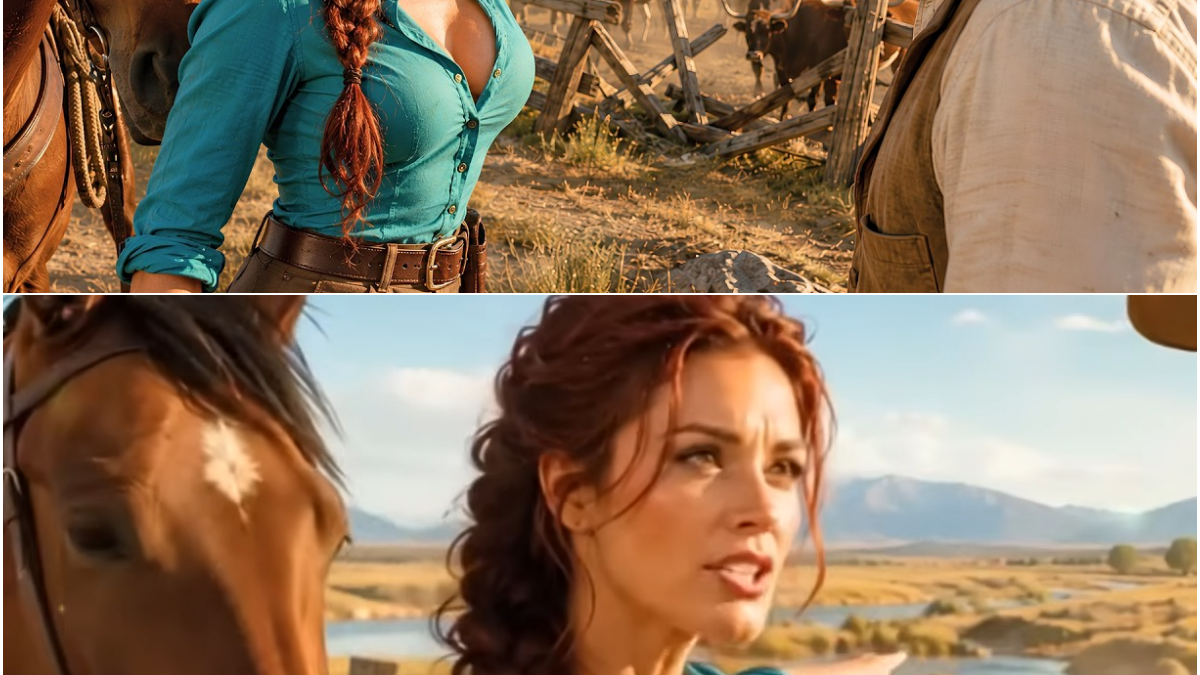
The first thing Josephine Hartwell noticed about Wade Coleman was that he had repaired the fence on his northern pasture but had left the boundary between their two ranches in such poor condition that his cattle could wander onto her land whenever they pleased.
The second thing she noticed was that he seemed perfectly content to let the problem continue.
By the time she rode toward the Bar C Ranch on a Wednesday morning in late April of 1883, she had already sent two letters, waited three weeks, and watched her patience disappear with every fresh hoofprint in her eastern pasture.
Wade Coleman had spent seven years avoiding the company of women, and Millbrook County, Montana Territory, had long since accepted that he intended to remain alone.
He was thirty-three, prosperous, stubborn, and known for speaking only when necessary. Josie was twenty-seven, determined, and not inclined to let a man’s reputation excuse his poor management.
She had no idea that the argument waiting for her beyond the ridge would change the shape of both their lives.
She only knew that her cattle needed their pasture, her accounts needed protecting, and a neighboring rancher had ignored a perfectly reasonable request for long enough.
What she could not have known was that the man she intended to confront had quietly stopped believing that anyone could make him want a different future.
And when two people who have grown accustomed to carrying everything alone finally meet, what happens when neither is willing to retreat?
Wade Coleman had built his life around the belief that solitude was easier than disappointment.
His ranch stretched across 2,200 acres of grazing country beside the Yellowstone River, and the Bar C supplied cattle to buyers who sent their wagons and shipments toward Bozeman.
He owned roughly 1,300 longhorns, employed three ranch hands, and relied on a cook named Otis, whose left hand had been missing two fingers since a threshing accident.
His cattle dog, Rex, slept near the foot of his bed and followed him through the ranch yard with the loyalty of a creature who asked nothing complicated of anyone.
Wade himself was not an unpleasant-looking man. He was broad through the shoulders, lean from years of riding and labor, and carried dark hair that curled at the back of his neck because he rarely bothered with a barber.
His eyes were pale gray, sometimes appearing almost silver when the light struck them. He had a quiet manner and a habit of listening longer than he spoke.
People who did not know him often mistook his silence for arrogance. Those who had known him for years understood that he preferred to keep his thoughts to himself.
The story of his broken engagement had become part of Millbrook’s local history. In 1876, a woman named Evelyn had come west from Chicago intending to marry him.
She had discovered that the Montana Territory was not the life she wanted. The distance from familiar places, the demanding work, the long stretches of open country, and Wade’s devotion to the ranch had gradually made her uncertain.
In the spring of that year, she boarded an eastbound stage and left. Wade watched it depart and returned to his ranch.
In the seven years that followed, he showed no interest in finding another wife. The women of Millbrook occasionally tried to draw him into conversation, and a few families suggested introductions, but he remained polite and distant.
He had decided that marriage was not necessary to a man who could manage his own affairs, and no one had yet persuaded him otherwise.
Josie Hartwell had little time for such decisions when they interfered with her business. Her father, Samuel Hartwell, had established the family spread on 1,100 acres bordering the southeastern edge of the Bar C.
Josie had grown up beside him, learning to ride, rope, brand, keep accounts, and judge the condition of grazing land.
After her mother had passed when she was ten, she and her father had become especially close.
Their ranch was not simply a possession. It was the work of their family, and she had no intention of letting it fall into disrepair.
Samuel had been gone for three years, and Josie had managed the spread ever since.
Her two ranch hands, Duke and Pete Callahan, helped keep the operation running. Duke was young, capable, and quietly dependable.
Pete was older, weathered by decades of outdoor work, and had been with the Hartwell family since before Josie was born.
Between them, they provided experience and labor, but the decisions and responsibilities belonged to Josie.
She was five feet five inches tall, with dark red hair usually braided over one shoulder and brown eyes that missed very little.
Her work clothes were practical, and she wore men’s trousers when the day’s duties made them more useful than a skirt.
The choice had caused gossip in Millbrook, but Josie had never considered other people’s opinions a good reason to make her work harder.
Her ledgers were precise, her horses well cared for, and her understanding of ranch business unusually thorough.
She had once prevented a land dispute from costing her 200 acres by spending three weeks studying legal references in the Bozeman library and presenting her argument at the land office.
She was not interested in proving that she could do a man’s work. She was interested in doing the work correctly.
The fence dispute was therefore more than an inconvenience. An old agreement between Samuel Hartwell and Elias Coleman had placed responsibility for the shared boundary fence on the Bar C.
Elias had died in 1879, leaving the ranch to Wade. The arrangement had never been written down, and Wade had apparently never made the repairs his father had promised.
For weeks, his cattle had been slipping through gaps in the fence. They had grazed across nearly thirty acres of Josie’s eastern pasture, which she had reserved for her own herd’s spring rotation.
Two of his bulls had also wandered among her cows before she intended to begin breeding.
The resulting uncertainty would complicate her plans for months. Josie had written twice. She had sent Pete to speak with one of Wade’s hands.
Nothing changed. On that Wednesday morning, she saddled her bay mare, Clover, and told Duke she expected to be back by noon.
Then she rode north. She found Wade in a pasture with his ranch hand Roy, inspecting a stretch of northern fencing that looked almost new.
The contrast with the neglected southern boundary irritated her more than she expected. Wade turned when he heard Clover approaching.
Surprise crossed his face, followed by recognition and the guarded expression she would soon learn to identify.
Josie stopped ten feet away. “mr. Coleman, I sent you two letters about the fence on our southern boundary.”
“I received them.” “And the fence is still broken.” “I’ve had my hands occupied with spring work.”
“So have I,” she replied. “While I’ve been occupied, your cattle have been grazing on my land, and two of your bulls have been visiting my herd.”
Wade studied her without interrupting. His expression was difficult to read, but she could tell he was considering the matter seriously.
“I’ll have Roy look at the fence this week,” he said. “Look at it, or repair it?”
“Repair it.” “By the end of the week?” He paused. Roy suddenly seemed very interested in the post beside him.
Josie continued before Wade could redirect the conversation. She explained the acreage affected, the grazing rotation she had planned, and the trouble caused by the bulls.
She did not ask for money. Instead, she requested permission to use Wade’s north meadow for two weeks in June, allowing her eastern pasture time to recover.
“I checked the meadow,” she added. “It borders the river, and you haven’t been using much of it in summer.”
“You checked?” “I wanted to know whether my request was reasonable.” For a moment, Wade’s expression changed.
It was not quite amusement, but it came close. “All right,” he said. “I’ll have the fence repaired by the end of the week.
You can use the north meadow in June. And I apologize for the bulls.” Josie had prepared herself for resistance.
The apology surprised her more than the agreement. “Thank you,” she said. “And I’m sorry for arriving without more notice.
I don’t particularly enjoy confrontations.” “You’re good at them,” Wade replied. A small smile appeared, brief but unmistakable.
Josie rode home thinking about it, despite her determination not to. She told herself that the problem had been resolved and that there was no reason to spend another thought on Wade Coleman.
By Friday, the fence was repaired. Pete returned from inspecting it with a report that the Bar C crew had replaced almost 200 yards of fencing, including several posts that had not strictly needed immediate attention.
Two days later, Wade rode over to see the work for himself. Josie was turning the soil in her kitchen garden when she heard his horse.
She came around the house holding her garden fork and found him mounted on a well-trained gray stallion.
“I wanted to make sure the fence was satisfactory,” he said. “Pete says it’s more than satisfactory.
You replaced the whole stretch.” “The old posts were rotting. There wasn’t much sense in doing half the work.”
She thanked him. He looked around the property, taking in the house, barn, corral, and garden.
“You’ve kept the place in good condition,” he said. “My father built it to laSt. I’ve tried to maintain it.”
“Your father was a good man.” “He was,” Josie said. “I was sorry to hear about yours.”
Wade looked toward the ridge. His father had passed in 1879, and the loss had left him with a large operation and no one to share its daily burdens.
Josie wondered whether that had been part of the reason he had become so withdrawn.
“You were here alone when your father died,” Wade said. “I remember that was a difficult winter.
I should have ridden over.” “You didn’t know we needed anything,” she replied. “And I didn’t ask.”
“You wouldn’t have.” There was recognition in his voice, as if he understood more about her than she had expected.
He rode away shortly afterward. Josie returned to her garden, but her thoughts followed him.
The man she had found was reserved, certainly, but he was not careless or unfair.
He had listened to her complaint, accepted responsibility, and done more than the minimum. She began to suspect that the town’s description of him left out important parts of his character.
The next time they met was at the annual spring gathering at the Doyle ranch in early May.
Robert Doyle owned one of the county’s largest spreads, and his wife, Margaret, organized the gathering with a thoroughness that made it useful for both business and social life.
Ranchers came to discuss water rights, cattle prices, trail conditions, and the coming drive to Bozeman.
Josie attended every year. She wore her good blue dress, with its white buttons, and spent the first part of the afternoon discussing the drive schedule with Margaret.
She soon noticed Wade standing alone near the paddock fence, holding a cup and looking as though he had attended only because it was expected.
Margaret noticed Josie’s glance. “You ought to speak with Wade about Northwater Crossing,” she said.
“Your cattle and his will be using it around the same time.” “I’ll remember that.”
“He’s right over there.” Josie suspected Margaret had a second purpose in mind, but she excused herself and went toward the food table.
She had just collected a plate of biscuits and dried apples when Wade appeared beside her.
“Margaret told you to talk to me.” “About the crossing,” Josie said. “She has been trying to introduce me to every unmarried woman in the county since 1880.”
“I’m sorry on her behalf.” “She means well.” “She does.” Wade glanced toward the paddock.
“The crossing is a real concern, though. I’ve been meaning to discuss it.” They began with the river and the cattle drive, then moved to grazing conditions, beef prices, and the new land assessor.
Josie found herself enjoying the conversation. Wade knew the country and understood its business, but he also had thoughtful opinions about matters that had little to do with cattle.
He spoke carefully, and she found herself listening for the next thing he would say.
“I intend to ride out and inspect the crossing next Wednesday,” he said. “You could come along and see the problem from my side.”
“Wednesday will suit me.” He nodded, and the arrangement was made. At the gathering, several people watched them talking.
Josie knew the conversation would be repeated in Millbrook, but for once she found the prospect amusing rather than irritating.
On Wednesday, she tied Clover beside a cottonwood and examined the river. Snowmelt had raised the water, and the current pressed against the banks with more force than it had in the previous autumn.
Wade arrived from the opposite side on his gray stallion and crossed carefully through the shallows.
“The water is higher than usual,” he said. “The bank on my side is eroding,” Josie replied.
She pointed to a section downstream where the soil had been cut away. “Another high-water season could leave me without access.”
Wade crouched to inspect the exposed earth. He picked up a handful of soil, rubbed it between his fingers, and let it fall.
“It needs riprap,” he said. “Stone packed along the bank will slow the erosion.” “I know what riprap is.”
“I didn’t doubt it.” She smiled at his restrained answer. Wade explained that he had several wagonloads of flat stone on his western slope, left over from a wall he had removed the previous autumn.
He offered it without payment. “The bank is shared,” he said. “If your side goes, mine will eventually have the same trouble.”
They walked along the river for nearly two hours, studying the crossing and discussing how the water moved through the valley.
Wade knew the history of the Yellowstone along that stretch, including a flood in 1877 that had destroyed the original crossing.
Josie told him how her father had once diverted a small channel to supply the kitchen garden.
Their conversation moved naturally between practical questions and memories. They spoke about the land with the seriousness of people who understood that a ranch was more than a collection of fields and buildings.
It was a responsibility that required attention every day. Wade eventually told her a story about his father’s prize bull getting stuck in river mud and requiring six men and a team of oxen to pull it free.
He described the whole affair with such dry humor that Josie laughed before she could stop herself.
Wade looked at her. “Sorry,” she said, still smiling. “Don’t be. I haven’t made anyone laugh in a while.
I’d forgotten it was a pleasant thing.” The words stayed with her long after they had finished inspecting the river.
They agreed to bring the stone in early May and repair the bank together. The work took three days.
Wade brought two wagonloads of stone and all three of his ranch hands. Josie supplied Duke and Pete.
They worked steadily, carrying and packing stone along the riverbank until the weakened edge was protected.
Wade worked beside his men rather than supervising from a distance. Josie respected that. He was capable of directing the operation, but he seemed to prefer taking part in it.
In the evenings, he stayed after the day’s work was finished. They talked beside the river as the light faded, sometimes about the work and sometimes about their families.
On the second evening, Wade told her about Elias Coleman, a methodical man who kept a journal and believed that land was held in trust for those who would come after its present owners.
Josie recognized the same devotion she had seen in her own father. On the third evening, she told Wade about the years after Samuel’s passing.
She described the sudden responsibility of managing the ranch, the decisions she had been forced to make, and the quiet fear of making a mistake that could cost her family land.
Wade listened without interrupting. “You carried it well,” he said when she finished. The simple praise touched her more deeply than she expected.
She looked toward the river until she could trust herself to meet his eyes again.
“Thank you,” she said. For a moment, neither spoke. The sky had turned pink above the hills, and the river moved quietly past the newly protected bank.
Josie felt the unspoken meaning between them, but Wade finally turned toward the work still to be finished.
“I’ll send Roy tomorrow to complete the upper section,” he said. “Pete will meet him.”
Wade rode home, leaving Josie beside the water with the growing certainty that her feelings had become something she could no longer dismiss as ordinary neighborly regard.
May gave way to June. The grass grew thick along the river bottoms, and Josie began using the north meadow as they had agreed.
She rode onto Wade’s land regularly to check her cattle, and Wade found reasons to visit the meadow several times during the first two weeks.
Every visit had a practical explanation. He inspected the grass, checked the water, or asked about the herd.
Yet each time, he stayed longer than the task required. They talked about the weather, the ranches, and whatever had occupied their thoughts that day.
Pete noticed. He said nothing, but his expression suggested he was enjoying a private understanding of the situation.
Then, during the second week of June, Josie received unwelcome news. Harlan Briggs, a rancher who had purchased cattle from her for two years, would not renew their agreement.
He had arranged to buy from a larger supplier in the Musselshell country instead. The decision was his right, and Josie could not challenge it.
But the lost sale would reduce her summer income and interfere with her plan to purchase new breeding stock.
She spent the evening at her kitchen table reviewing the figures. The lamp burned low, and she had been working for hours when someone knocked at the door.
Wade stood on the porch, holding his hat. “I heard in town that Briggs pulled out of your agreement,” he said.
“I wanted to see how you were managing.” Josie invited him inside. She showed him the ledgers, and he sat across from her at the kitchen table.
Together, they examined the figures and considered the options. “Bozeman is paying twenty percent more than last year,” Wade said.
“If you combine your drive with mine in September, we can negotiate a better transport rate.
That would recover most of what you’ve loSt.” Josie checked his arithmetic. It was sound.
“That’s not your obligation,” she said. “It benefits both of us. Shared transport costs, a better rate, and neither ranch loses.”
“Wade,” she said. It was the first time she had used his given name. They both noticed.
“I appreciate what you’re doing,” she continued. “I’ll accept the arrangement. But I want you to know I understand that it’s more than a business favor.”
He looked at her across the table. “What do you think it is?” “Kindness,” she said.
“And I’m grateful for it.” The room grew quiet. Wade looked down at the open ledger, then back at her.
“I should have come over when your father passed,” he said. “You didn’t know me then.”
“No,” he replied. “I didn’t know you then.” His expression was open in a way she had rarely seen.
Josie felt that something between them had moved beyond the careful boundaries they had maintained since April.
Wade left half an hour later. She remained at the table, looking at the figures they had worked through, and understood that the warmth she felt was no longer a passing thing.
Throughout June and July, their lives became increasingly intertwined. They coordinated grazing, shared the crossing, and planned the September drive.
Wade visited more often, and Josie found herself making excuses to ride near the north meadow.
Their conversations grew easier, and their silences became comfortable. In early July, a land speculator named Cyrus Vance arrived in Millbrook County.
He was buying water rights and small parcels near the Yellowstone, hoping to gain control over access to the river crossings.
He offered Josie a generous price for the northeast corner of her ranch, the section closest to the water.
She refused. Vance then approached Wade with a similar offer for part of the Bar C.
Wade rejected him just as firmly. According to Otis, who witnessed the conversation, Wade’s refusal was delivered in language unusually sharp for him.
The incident made Josie realize how much she and Wade had begun to regard their neighboring properties as connected.
They were still separate ranches, each with its own history and accounts, but their future depended in part on the land and water they shared.
In the third week of July, Josie was watching her cattle settle in the north meadow when Wade rode up from the river.
They walked along the edge of the pasture in the late afternoon. The grass moved gently in the breeze, and the hills were bright beneath the summer sky.
At one point, Wade reached out and touched her hand. She turned toward him. “I want to ask you something,” he said.
“Ask.” He looked at the ground, then at the meadow, then finally at her. “Would you come to dinner on Sunday?
At the house. Otis will cook.” Josie felt a rush of happiness that she did not attempt to conceal.
“Yes,” she said. “I’d like that.” Sunday arrived warm and clear. Josie rode to the Bar C in a simple dress and found Wade waiting near the house.
Otis had prepared a beef roast with root vegetables and cornbread, and the meal was better than Josie had expected.
Before dinner, Wade showed her the bookshelves in the main room. She was delighted to discover that he had read widely.
They discussed history, natural philosophy, and fiction. They shared an admiration for Mark Twain and disagreed gently about Nathaniel Hawthorne.
The conversation made the evening feel different from their previous meetings. They were not discussing the practical problems of two neighboring ranches.
They were discovering the private interests and habits that shaped each other’s lives. After dinner, they sat on the porch and watched the evening sky darken over the hills.
Wade spoke about the Bar C, his father’s hopes for it, and his own plans for the years ahead.
“What did you imagine when you were young?” Josie asked. “Did you always see the ranch as it is now?”
Wade was quiet for a moment. “I imagined it with more people in it.” She looked at him.
“I suppose you’ve heard about Evelyn,” he said. “I’ve heard something. I’d rather hear your version.”
He told her about the engagement, the year they had spent trying to build a future, and the way Evelyn had gradually understood that the life she wanted was not the life waiting for her in Montana.
He did not speak bitterly. He said she had been honest in the end, and he could not blame her for recognizing that she wanted something different.
But he had taken her leaving as proof that something in him was lacking. He had concluded that if he stopped wanting a family, he would never have to face that disappointment again.
Josie listened carefully. “That sounds like a man who was hurt and reached the wrong conclusion,” she said.
“I know how it sounds.” “It doesn’t sound like anything else.” Wade turned toward her.
The porch lamp cast a warm glow across his face, and his eyes held hers with an openness that made her heart quicken.
“You are not at all what I expected,” he said. “What did you expect?” “Nothing.
That’s the point. I had stopped expecting things.” “And now?” He reached across the space between them and took her hand.
His grip was gentle and sure. “Now I find that I’m expecting things again.” Josie held his hand and looked out across the land.
The ranches, the river, the meadow, and the hills seemed familiar, yet the future had taken on a new shape.
“I’m glad,” she said. She rode home knowing that she loved him. She had been moving toward that truth since the morning she had ridden north to argue about the fence.
The following month brought a change neither of them had planned. In the second week of August, Wade was working alone on his eastern range, pushing cattle away from a brushy draw.
His gray stallion stepped into a chuck hole hidden beneath the long grass and stumbled badly.
Wade was thrown clear, but he landed hard on his right shoulder. He was lying in the grass when Josie rode over the ridge on her way to inspect the crossing.
She saw the loose horse first, then noticed Wade on the ground. Her heart lurched.
She urged Clover into a gallop and reached him quickly. “I’m fine,” Wade said, though his face was pale and one hand was pressed against his shoulder.
“You are not fine. How long have you been lying here?” “Not long.” He tried to sit up, but pain stopped him.
“Don’t,” she ordered. “Stop trying to prove something.” She examined his shoulder and arm carefully.
It was badly injured, though she did not believe the shoulder was dislocated. He needed to get out of the sun and into the house.
“Can you ride Clover if I help you?” “I can ride my own horse.” “Your own horse is standing over there looking thoroughly offended.
We’ll come back for him. Can you get on Clover?” He did, with her assistance.
Josie steadied him and guided the mare toward the Bar C. Wade made no further protest, which told her that the pain was considerable.
Otis met them at the house, startled to see his employer returning supported by a neighbor.
He fetched water and bandages while Josie helped Wade into the main room and settled him in a chair.
She wrapped his shoulder and made sure Otis understood which symptoms would require an immediate trip to fetch dr. Foster from Millbrook.
Within twenty minutes, Wade had been placed in a proper sling. He looked at Josie with an expression she had never seen from him before.
His usual reserve had fallen away, leaving only gratitude and something deeper. “Thank you,” he said.
“You would have done the same for me.” “I would have. But that’s not what I mean.”
Josie sat across from him. The fear she had felt when she saw him lying in the grass had not entirely passed.
“Wade,” she said. “I know.” “Tell me anyway. I’d rather hear it clearly.” He looked at her for a long moment.
Then he made a decision. “I love you,” he said. “I’ve been falling in love with you since the morning you rode onto my land and told me to repair the fence.
I’ve been refusing to admit it because admitting it meant wanting something again, and I’d decided wanting was a risk I wasn’t going to take.”
He paused, gathering his thoughts. “I was wrong. And I’m not wrong about what I feel.”
Josie felt the words settle inside her with the certainty of something she had already known.
“I love you, too,” she said. “I’ve been trying not to, because I thought it would complicate everything.
But it has become impossible to pretend.” Wade let out a long breath. His good hand reached toward hers, and she took it.
“Complicated doesn’t frighten you?” “Not particularly.” They sat together in the warm afternoon light, his shoulder bandaged and their hands joined.
For Wade, the admission was a turning point. He had spent seven years avoiding the possibility of being hurt again.
Now he was willing to face uncertainty because the person beside him mattered more than the safety of remaining alone.
They did not rush into marriage or abandon the practical work of their ranches. Their September cattle drive was already planned, and they intended to complete it together.
The drive to Bozeman took seven days. It required careful coordination, steady riding, and patience with the cattle.
Wade and Josie worked alongside one another through dust, changing weather, and the long hours of trail life.
They learned how naturally they could depend on each other. Wade was patient with the herd and fair with the hands.
He made decisions when necessary without becoming rigid, and he kept an eye on Josie without questioning her ability.
She matched his work at every turn, and he took visible pleasure in seeing her handle the responsibilities she had carried for years.
At Bozeman, the combined drive brought a better price than either ranch had received the previous year.
Their shared transport costs also came down, just as Wade had calculated. They celebrated with dinner at the town’s hotel restaurant.
They were tired, dusty, and pleased with the outcome. The meal was simple, but the evening felt special because they were together.
Wade reached across the table and took Josie’s hand. “People will talk,” she said. “Let them.”
She smiled. The man who had once avoided every social invitation was now willing to let the whole county see that he had chosen her.
They returned to Millbrook in October beneath the first cold skies of autumn. The money from the drive was safely packed away, and their plans for the coming year began to take shape.
People did talk, of course. Margaret Doyle was especially pleased and made no effort to hide the fact that she had expected the relationship to develop since the spring gathering.
By November, Wade had decided he wanted to marry Josie. He had been planning the proposal for six weeks, and in October he had ridden to Bozeman under the pretense of a supply trip.
There, he visited Otto Kraus, the town’s jeweler, and spent considerable time choosing a ring.
On a Sunday in the first week of November, the first real snow of the season began to fall.
Wade rode to the Hartwell house with Rex following at his heel. He carried the ring in his coat pocket.
Josie welcomed him inside, made coffee, and sat with him at the kitchen table. Snow gathered on the windowsill while the room filled with the warmth of the stove and lamplight.
Wade took the ring from his pocket and placed it on the table. “Josie, I was a man who had decided not to want things,” he said.
“You rode onto my land in April to argue about cattle, and you entirely disarranged that decision.
I want to marry you. I want to build a life here with you. I want the whole of it, if you’ll have me.”
She looked at the ring. It was a simple gold band set with a dark red garnet.
“Why garnet?” She asked. “Your hair,” he said. “It reminded me of you.” She looked at him, at the snow beyond the window, and at the ring that represented a future neither of them had expected a year earlier.
“Yes,” she said. “Yes, I will have you.” She picked up the ring and placed it on her own finger.
Wade laughed, openly and warmly, and she came around the table to him. He stood, took her face in both hands, and kissed her.
It was their first kiss, and it was long, certain, and full of all the things they had been learning to say.
They married in the spring of 1884, on a Saturday in late April, almost exactly a year after Josie had ridden onto the Bar C to demand that Wade repair the fence.
Margaret Doyle organized the celebration, which was held outdoors at the Bar C beneath a brilliant blue Montana sky.
The ranch hands from both properties stood together in their best clothes. Pete quietly cried and denied it when anyone mentioned the matter.
Judge Amos Whitmore from Bozeman performed the ceremony with a brevity and sincerity that suited them both.
Wade spoke his vows in the steady voice Josie loved. She answered clearly and without hesitation.
When the ceremony was finished, he turned toward her with the contained smile she had come to treasure.
“Hello, mrs. Coleman.” “Hello, mr. Coleman.” The gathered community cheered. The two ranches remained separate in name and identity, but their management became a shared responsibility.
The Hartwell spread continued to operate under its own name, honoring Samuel Hartwell and the family history tied to the land.
Josie kept its ledgers, while Wade maintained the Bar C accounts. Once a month, they sat together at the large kitchen table and reviewed both operations, making decisions with an efficiency that surprised their neighbors.
They moved into the Bar C house, which offered more room for the family they hoped to build.
Pete and Duke moved into the Hartwell house, keeping the property active and preserving its familiar routines.
Pete was relieved that the land would not lose its name or character. Josie assured him that the Hartwell spread would remain what it had always been.
The summer of 1884 was not without difficulties. A late dry spell required careful water management, and an outbreak of bloat in Wade’s eastern herd cost him eight cattle before the problem was contained.
Yet the work felt different because neither of them was carrying the full burden alone.
They sat together on the porch in the evenings, discussing cattle, water, business, books, and the news that arrived from the East several days after it had been printed.
Wade began telling Josie about the small events of his day, discovering the pleasure of having someone who wanted to hear them.
Josie, who had always thought aloud, found in him a listener who gave her thoughts his full attention.
They disagreed sometimes. They argued over business decisions, water rights, and how to handle buyers who failed to honor their agreements.
But they treated each other with respect. Their disagreements were direct and honest, and the decisions they reached were often better than either person’s original idea.
In the third week of October, Josie told Wade that they were expecting a child.
They were sitting on the porch after dinner, with the autumn warmth lingering in the air.
Wade went quiet. His expression opened with such depth of feeling that Josie found herself watching him carefully.
He took both her hands in his. “Josie.” “I know,” she said softly. He drew her close, and she rested against him while the evening sky darkened over the hills.
“I had stopped imagining this,” he said. “I’d stopped imagining any of it.” “I know.”
“Thank you for riding over to argue about the cattle.” She laughed, and he smiled against her hair.
Their son was born in June of 1885 in the good bedroom of the Bar C house.
dr. Foster attended, with Margaret Doyle present to help. The baby arrived on a Thursday morning, under a sky filled with slow-moving white clouds.
They named him Samuel Elias Coleman, honoring both grandfathers. Wade held his son for the first time that afternoon in the main room.
Josie watched from the doorway as he studied the tiny face with wonder and careful attention.
The baby regarded him with the serious, unfocused gaze of a newborn. “He’s looking at you as if he’s already forming opinions,” Josie said.
“That’s your influence,” Wade replied. She crossed the room and sat beside him. Her husband, her son, the afternoon light, and the familiar sounds of the ranch came together in a moment of happiness so complete that she felt she could build the rest of her life upon it.
Pete visited the baby the next day and held him with enormous care. He told Samuel that the Hartwell land would be his someday, too.
Josie was touched by the promise and by the affection behind it. Duke, who was twenty-five, had been corresponding with a young woman in Helena.
He held the baby with a thoughtful expression, as if considering the shape of his own future.
Otis prepared a special dinner and pretended he had not gone to any particular trouble.
The years moved forward in the ordinary rhythm of ranch life. Cattle went to Bozeman each fall.
Prices changed with the market, weather shifted from one season to the next, and the Yellowstone rose and fell according to the snowpack in the mountains.
Wade remained a quiet man. He still spoke carefully and had little interest in public attention.
But the people who knew him understood that his life had changed. He was no longer closed off from the possibility of affection or family.
He had learned that solitude could feel safe while still leaving a person with an empty place in his life.
In March of 1886, their daughter was born during a late snowstorm. dr. Foster arrived with snow on his hat and steam rising from his horse.
They named her Grace, a name they had both liked from the first time they spoke it aloud.
Grace proved energetic from the beginning. She had Josie’s red hair and a determined expression that Wade recognized immediately.
“She is exactly like you,” he told Josie the evening after Grace was born. “Is that a complaint?”
“Emphatically not.” Samuel, still small enough to be mostly concerned with biscuits and attention, offered an indistinct sound from the floor.
By 1887, the Bar C had expanded its herd by 300 head. The Hartwell spread had developed a reputation for quality breeding stock, attracting buyers from as far away as Colorado.
Duke married his correspondent from Helena, Ellen, who came to the ranch with a sewing box, a practical nature, and a warm disposition.
She became a valued part of the Hartwell operation and a close friend to Josie.
Pete, who had spent years neglecting his own meals, found himself encouraged by Ellen to eat properly.
He accepted the change with the expression of a man who had been improved without quite understanding how it happened.
That autumn, Wade and Josie rode together to Bozeman for the cattle market. On their return, the aspens were golden on the hillsides, and the afternoon sky had the deep blue clarity that came with fall in Montana.
They rode side by side in a comfortable quiet. “Do you know what I was thinking about today?”
Wade asked. “Tell me.” “That first morning in April. When you came over the ridge.”
Josie looked at him. “I saw you on that bay mare and thought someone was coming to make trouble,” he said.
“I was right. But the trouble turned out to be the best thing that ever came onto my land.”
“You made it easy,” she said. “Eventually. I made it extremely difficult at firSt.” “You were honeSt. That’s worth more than easy.”
He looked at her with the same steady attention he had given her since the beginning.
His silver-gray eyes were clear in the autumn light. “I love you,” he said. “I love you,” she answered.
They rode home toward the Bar C, toward their children, the ranch hands, and the life they had built together.
The river crossing held steady behind them, its bank protected by the stone they had packed in May.
The fence ran straight and true along the boundary, marking two properties that had become one shared future.
The years brought more changes. In 1889, Montana became a state, and Wade and Josie marked the occasion with pride in the territory they had made their home.
Their children grew with the land around them. Samuel became serious and thoughtful, with his father’s gray eyes and his mother’s directness.
He learned to ride young and began asking questions about cattle prices before he was old enough to understand every answer.
Grace was energetic, affectionate, and determined to learn whatever Samuel could do. She practiced roping on fence posts with such dedication that three posts suffered indignities before she was satisfied with her progress.
In 1891, their third child was born, a boy named Henry. He had Josie’s brown eyes and Wade’s dark hair, and from the beginning he seemed comfortable in the world.
He grew up surrounded by the security of a family that knew how to work together and the affection of people who had made a home out of the ranch.
By 1893, the Bar C was among the respected cattle operations in Montana. The Hartwell spread continued to thrive, and Pete, now in his sixties with white hair and slower movements, still spent his evenings on the porch.
He had worked the Hartwell land for most of his life, and he remained proud of the fact that its name and identity had survived.
One September evening that year, Josie sat on the Bar C porch watching the sun descend behind the western hills.
The sky was filled with orange and red, and the last light turned the grass and the wooden buildings warm.
Samuel, eight years old, was in the barn doing the evening feeding with Duke. Grace, seven, had recently decided that she would become as skilled with a rope as her brother.
Henry, two, was asleep inside, leaving the porch unusually peaceful. Wade came out with two cups of coffee and handed one to Josie.
He sat beside her, and for a while they watched the evening settle over the ranch.
“Ten years ago,” Josie said, “this was two strangers’ land.” “You weren’t a stranger by April,” Wade replied.
“We’d exchanged a few polite words in town. That isn’t the same as knowing someone.”
“Fair enough.” She smiled into her coffee. “I can hardly remember what it felt like not knowing you.”
Wade was quiet for a moment. “I remember,” he said. “What did it feel like?”
“Empty,” he answered. “I convinced myself empty was acceptable.” He looked toward the land, then back at her.
“It wasn’t. I simply didn’t know that yet.” Josie reached for his hand. “Well, you know now.”
“I know now.” Their original cattle dog, Rex, had been gone for two years. A younger dog named Scout had taken his place and was learning the work with serious enthusiasm.
He lay at Wade’s feet, watching the evening with the calm assurance of a working dog who had finished his duties.
Samuel appeared from the barn and came across the yard. He leaned against the porch railing, looking at the sunset with the same thoughtful attention his father gave to the landscape.
“Otis says supper is almost ready,” he reported. “Tell him five minutes,” Josie said. Samuel turned and shouted the message toward the house.
The noise startled Scout and woke Henry, who soon appeared at the porch door in Grace’s arms.
She had apparently decided that her little brother needed company and had not considered what might happen when he woke.
“He was crying,” Grace explained. “Bring him here,” Josie said. Wade took Henry from his daughter and settled him against his shoulder.
The little boy immediately caught hold of his father’s shirt and rested his face against Wade’s neck.
Josie watched them. She had never stopped noticing the warmth in Wade’s expression when he held their children.
The man who had once decided that family was not for him now carried his whole world in his arms and never seemed to doubt that it belonged there.
The sun disappeared behind the hills. The sky deepened to purple and blue, and the lamps inside the house shone through the windows.
Their family stood together on the porch. Samuel at the railing, Grace beside her father, Henry settled against Wade, and Josie close enough to touch them all.
Beyond the yard, the land lay quiet beneath the September dusk. The north meadow rested near the river, the protected crossing held against the current, and the boundary fence ran straight between the two ranches.
“Come on,” Josie said, setting down her cup. “Let’s go in to supper.” Wade stood with Henry still in his arms.
Samuel held the door, Grace went inside talking about her roping practice, and Scout followed with the confidence of a dog who had never doubted his welcome.
Inside, the table was set, the lamps were lit, and Otis had supper ready. Pete would soon join them, and Duke and Ellen would bring their own news from the Hartwell spread.
The evening would fill with conversation, questions, laughter, and the familiar details of a life shared.
The whole territory had once believed Wade Coleman would never marry. They had known about Evelyn, remembered his long silence, and accepted his determination to remain alone as something permanent.
But they had not counted on Josie Hartwell, who had ridden onto his land to settle a fence dispute and refused to leave the matter unresolved.
She had come asking for fairness. She had found a man who was capable of kindness, even when he had forgotten how to offer it.
He had found a woman who could meet him as an equal, challenge him without cruelty, and recognize the good beneath his reserve.
Their life had not been built from grand declarations alone. It had grown through repaired fences, shared labor, careful accounts, long conversations, difficult decisions, and the steady choice to remain beside one another.
The ranches had prospered, the children had arrived, and the land had been cared for and passed forward.
Wade had once thought that wanting less would make life simpler. Josie had shown him that a life could be difficult and still be worth choosing, that responsibility could be shared, and that love did not require a person to surrender the parts of himself that mattered.
At the head of the table, Josie looked around at her husband, her children, and the people who had become family through years of work and loyalty.
She was no longer carrying the Hartwell spread alone, and Wade was no longer living behind the walls he had built after Evelyn left.
Outside, the fence stood firm. The cattle were where they belonged. The river moved through the valley, and the land waited for another season of work.
Inside the Bar C house, the family gathered in the warm light of an ordinary evening.
It was the life they had built, the life they had chosen, and the home they had made together.
It was enough. It was everything.
Disclaimer: This content may be created by Al for entertainment purposes. Any resemblance to real persons, events, or places is coincidental.








