The U.S. Released This Tiny Predator To DESTROY INVASIVE RED ANTS FROM WITHIN THEIR BODIES
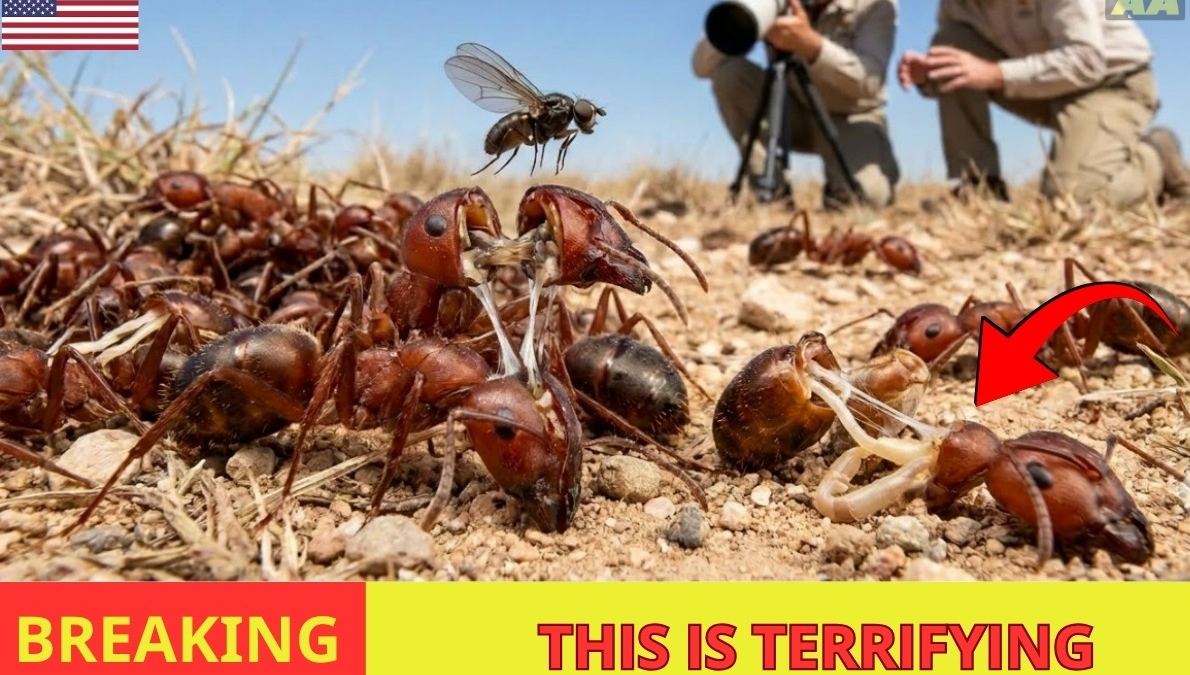
In July 1997, deep inside Canapah forest, a group of researchers gathered around a small container that held something almost impossible to see.
Sanford Porter, an entomologist who had spent 30 years studying the strange relationship between insects, stood with the team at a familiar site.
The researchers had come to the same kind of place many times before, but this release was different.
Inside the container were thousands of tiny insects raised specifically for this moment. Porter lowered the container close to the ground.
The lid opened. More than 3,000 tiny flies entered the warm air above a fire ant colony.
For a few seconds, almost nothing happened. The insects were so small that they seemed to vanish against the grass.
Below them, thousands of fire ants continued rushing over the mound, defending their territory and carrying on with the complicated work that kept their colony functioning.
Then the flies began to move. They hovered just above the ants, darting from one worker to another.
Every few moments, one would suddenly dive toward an ant, touch it, and disappear upward again before the ant could react.
The researchers had brought these flies here because they hoped they could help control one of America’s most persistent invasive insects.
But nobody standing around that nest could have known how strange the next few weeks would become.
The first signs appeared around the entrance to the mound. Ants began abandoning food. Workers wandered without purpose.
Some turned in circles or collided with other ants. Then, days later, something even more unusual appeared around the neSt.
Tiny ant heads lay scattered across the ground. What could possibly cause thousands of insects to behave this way, and how could something smaller than an ant’s head turn an entire colony into a biological battlefield?
To understand that moment, it helps to begin with the insect that created the problem in the first place.
Fire ants first appeared in the United States around 1930. Each worker is tiny, roughly the size of a sesame seed, but the colony surrounding that worker can be enormous.
A small opening in the ground can lead to a complicated underground network containing tunnels, chambers, food stores, developing young, and one or more queens.
A colony is not simply a collection of individual ants. It is a system. Workers search for food.
Others maintain tunnels. Others care for developing young. Some defend the entrance. The queen produces new generations of workers and reproductive ants, allowing the colony to continue expanding.
That organization is precisely what makes fire ants so difficult to control. A single queen can produce enormous numbers of offspring over time, and in some colonies the reproductive system allows new queens to establish additional nests.
Instead of one isolated mound, a landscape can gradually become covered by interconnected colonies. The insects can occupy pastures, lawns, agricultural fields, roadsides, parks, and areas surrounding buildings.
Their small size makes them easy to overlook. Their numbers make them difficult to ignore.
Fire ants can interfere with electrical equipment, disturb livestock, damage young animals, and compete with native insects.
They can also sting people who accidentally step onto a mound or disturb a colony.
For many people living in areas where fire ants became established, the problem was not something seen once.
It was something encountered repeatedly. A mound could appear beside a driveway. Another could appear near a fence.
Another could emerge in a pasture. Destroy one colony and another might already exist a short distance away.
The United States responded with one of the most straightforward strategies available. Poison. Baits were designed to be carried into colonies by worker ants.
Instead of treating every ant individually, the idea was to exploit the colony’s own social organization.
Workers collect food. Workers share food. If a toxic bait reaches enough members of the colony, the entire system can eventually collapse.
The approach could be effective locally. But fire ants possessed an advantage that chemical control could not easily overcome.
Reproduction. A surviving colony could produce new queens. Those queens could leave during mating flights.
They could travel. They could establish new colonies. The problem was therefore larger than the mound in front of a person.
It was the ability of the species to continually rebuild its population. Over decades, control efforts consumed enormous amounts of money.
More than a billion dollars was spent on various attempts to reduce the impact of fire ants.
Yet the insects continued spreading across the southern United States. Eventually they occupied hundreds of millions of acres.
The scale of the invasion forced scientists to reconsider the basic strategy. Perhaps the goal should not be to poison every colony.
Perhaps the goal should be to find the natural enemies that had kept fire ants under pressure in their original range.
That idea sent researchers south. Scientists traveled to South America, especially regions of Brazil and Argentina where fire ants had evolved.
There, the ants were surrounded by predators, parasites, pathogens, and competitors that had developed alongside them over enormous spans of time.
In their native environment, fire ants were not operating without opposition. One of the most unusual enemies researchers discovered was a tiny group of flies known as phorid flies.
Some species had evolved a remarkable relationship with ants. The flies were not large predators.
They were not powerful enough to fight ants directly. They did not need to be.
They had developed something far more specialized. They used the ants themselves as part of their life cycle.
When researchers first considered using the flies against fire ants in the United States, they faced an obvious problem.
Introducing one foreign species to control another could create an entirely new ecological problem. The solution could not simply be to find an insect that attacked fire ants.
Scientists needed an organism with a narrow enough range of targets to minimize the possibility of affecting native ants.
The flies therefore went through extensive testing. Quarantine facilities in Gainesville, Florida became part of the process.
Researchers exposed different species of ants to the flies and carefully observed what happened. The objective was simple.
If the flies attacked only fire ants and failed to develop successfully in native ants, they might be suitable candidates.
More than 200 larvae developed after flies attacked imported fire ants during testing. At the same time, no larvae were recorded developing in the native ant groups that were tested.
The results provided the evidence researchers needed to move toward field releases. Then came 1997.
In July, Sanford Porter and his team entered Canapah foreSt. Porter had already spent three decades involved in research connected to the project.
He knew the behavior of fire ants. He knew the risks of releasing a biological control organism.
And he knew that the tiny insects inside the container represented years of laboratory work.
The researchers disturbed an active fire ant mound. The response was immediate. Workers poured toward the surface.
They ran across the mound. They opened their jaws. They released chemical signals that told other ants something was wrong.
The colony had become agitated. That was exactly what the researchers wanted. The flies were attracted to those chemical signals and to the movement of exposed workers.
The container was opened. Approximately 3,000 flies were released. The insects rose from the ground and began searching.
A female phorid fly did not need to land on an ant for long. She could hover over a moving worker, suddenly dive, touch the ant, and immediately pull away.
The entire attack could take less than a second. The ant usually continued walking. Nothing dramatic appeared to happen.
That was the strange part. The fly had already accomplished its purpose. A female carries eggs inside her body.
When she attacks an appropriate worker, she uses a specialized egg laying structure to place an egg inside the ant’s thorax.
Then she leaves. The worker continues its normal activity. At least, it appears normal. It may walk back into the colony.
It may search for food. It may pass other workers. It may carry material. The egg, however, has already begun a completely different journey.
After several days, the egg hatches. A tiny larva develops inside the ant. It does not immediately destroy the hoSt.
Instead, it grows gradually, using resources inside the ant’s body. This slow process is one of the reasons the attack is so difficult to recognize.
There is no immediate collapse. There is no obvious external wound. The infected worker can continue moving through the colony.
The fly’s strategy depends on that. The worker is effectively transporting the developing fly into the center of its own society.
For roughly two to three weeks, the larva develops inside the ant. Then it begins moving toward the head.
This is where the biology becomes extraordinary. The developing fly eventually occupies the ant’s head region and affects tissues inside it.
The connection between the head and thorax weakens. The ant eventually becomes unable to continue normal activity.
Then the head separates from the body. This explains the strange piles of ant heads that researchers later found around colonies.
Those heads were not evidence of a conventional disease. They were part of the fly’s life cycle.
The larva remained inside the separated head. The empty space became a protective chamber. The developing fly used the head as a shelter while it transformed.
After roughly two to six weeks, an adult fly emerged through the ant’s mouth. The tiny insect flew away.
Somewhere nearby, another fire ant colony waited. The cycle could begin again. The name given to these insects was direct and unforgettable.
Fire ant decapitating flies. Yet the most important effect of the flies did not come from the number of ants they physically affected.
It came from what happened to the colony before the final stage. Researchers began noticing behavioral changes.
Workers that had been actively searching for food started abandoning their normal routines. Some stopped carrying food.
Others turned back toward the neSt. Some appeared confused. The colony’s supply chain began to weaken.
This mattered because a fire ant colony operates like a living network. Workers constantly collect resources.
Those resources are carried underground. Other workers distribute them. Developing young depend on that flow.
The queen depends on the colony. Nest maintenance depends on workers. When enough workers stop performing their usual tasks, the entire system becomes less efficient.
The flies were therefore doing something much more subtle than simply reducing the number of ants.
They were disrupting behavior. The effect became visible outside the neSt. Activity declined. Workers moved irregularly.
Some collided with one another. Others wandered in circles. The researchers sometimes described the insects as behaving almost like zombies.
But the explanation was biological rather than mysterious. The developing fly inside the ant was altering the system from within.
The first theory researchers considered was infectious disease. It was an understandable possibility. Fire ants live in dense colonies.
They touch constantly. They exchange food. They move through shared tunnels. A microorganism could potentially spread rapidly through such a population.
But disease did not explain the repeated appearance of separated ant heads. Another possibility was an ant predator.
Antlion larvae were obvious suspects. They are specialized ant hunters. An ant walking across sandy ground can fall into an antlion’s funnel-shaped trap.
The antlion waits below. Its jaws seize the insect. The encounter is highly effective. But antlions do not normally enter fire ant colonies and alter their behavior across an entire population.
They could explain individual missing ants. They could not explain the pattern researchers were observing.
The investigation returned to old footage. Then someone noticed something that had been present all along.
Tiny dark dots hovering above the ants. Phorid flies. The insects were almost insignificant in size compared with their hosts.
Yet they were repeatedly appearing around disturbed colonies. Researchers watched carefully. The ants seemed to recognize the threat.
Some workers raised their bodies. They pointed their heads upward. They opened their jaws. The flies were difficult to catch.
They could approach from above, touch an ant, and retreat almost instantly. The ant would react too late.
The speed of the interaction was one reason fire ants had difficulty defending themselves. The fly did not need to overpower the ant.
It only needed one moment. That moment was enough to place an egg. The researchers then had another question.
How could they make the flies useful outside a laboratory? A small research release required only a limited number of insects.
A national biological control program would require thousands upon thousands. Scientists developed methods for raising them.
The process began with the ants. Researchers needed live fire ants for the flies to attack.
They developed specialized containers known as attack boxes. The conditions were carefully controlled. Temperature could be maintained around 28 degrees Celsius.
Humidity could remain between approximately 80 and 90 percent. Inside each setup were shelters where the ants could retreat with their brood.
Researchers wanted to reproduce the agitation that occurred around an active fire ant mound. Every few minutes, the shelters could be manipulated so the ants had to move.
One shelter would rise while another lowered. The ants responded by carrying brood and moving between locations.
The movement created the kind of activity that attracted the flies. Then the flies were introduced.
They hovered over the ants and attacked. After several days, the exposed workers could be replaced with another group.
The system became a strange kind of biological production line. Instead of machines manufacturing identical parts, researchers were creating conditions in which one insect species could reproduce through another.
An improved attack box could produce more than 1,400 flies per day. By around 2000, the USDA laboratory in Gainesville could produce approximately 1,500 flies each day.
The insects could then be transported to different release sites. What had started as a small experiment was becoming a coordinated biological control program.
The scale changed again. Instead of releasing only a few dozen flies around a mound, researchers could distribute thousands.
Some releases involved roughly 2,000 to 20,000 flies at a time. In some cases, the flies were released directly into the environment.
In others, ants were exposed in controlled laboratory conditions before being returned to their colonies.
The methods varied according to the research site. But the objective remained the same. Establish a natural enemy that could reproduce without permanent human assistance.
That final point was crucial. Chemical bait must be manufactured. It must be transported. It must be applied again.
A biological control organism is different. If it establishes successfully, it can reproduce. The descendants continue the work.
That does not mean the biological control eliminates its target. It means the pressure can persiSt.
By the time the project expanded, researchers had released several species of phorid flies. Eventually, six species released by the USDA established populations in the United States.
At least three spread well beyond their original release areas. The experiment had become part of the ecosystem.
The flies were no longer simply laboratory organisms. They were reproducing in the wild. They were locating fire ant colonies without scientists carrying containers to every mound.
That was the real objective. But the outcome was more complicated than simply declaring victory.
Fire ants did not disappear. They remained widespread. The flies could reduce pressure in some areas, change ant behavior, and contribute to population control, but they could not eliminate the species from the United States.
The reason becomes obvious when the scale of the invasion is considered. An acre can contain dozens of fire ant mounds.
Under favorable conditions, the number can exceed 200. Individual colonies can contain tens of thousands of workers, with some reaching more than 200,000.
Queens can produce around 1,500 eggs a day. Mating flights can introduce new queens into areas where colonies have been disturbed.
A treated mound may therefore be only one part of a much larger network. Remove one colony and another may already exist nearby.
The realistic objective became control rather than complete eradication. That distinction changed the way researchers evaluated the flies.
The question was no longer whether the insects could make fire ants disappear. The question was whether they could add another natural pressure to a species that had escaped many of the controls present in its native environment.
That made the tiny flies valuable. But it also raised another question. Why use flies at all?
Why not introduce an animal that simply eats fire ants? The obvious candidates appear in nature.
Giant anteaters specialize in ants. A single animal can consume enormous quantities of insects. Aardvarks also feed heavily on ants and termites.
Pangolins are famous for their specialized diets. Armadillos dig into soil and consume many insects.
At first glance, these animals might seem like ideal biological control agents. But ecological systems do not work like a simple equation.
A large animal does not necessarily eliminate an insect colony. An anteater can tear open part of a mound, feed, and move on.
The remaining colony can rebuild. The same principle applies to many predators. They consume enough food to meet their needs.
They do not need to destroy every member of the colony. In fact, from the predator’s perspective, leaving part of the colony intact can be useful because it provides a future food source.
There is another problem. Moving a large animal into a new environment creates risks of its own.
A giant anteater is not a piece of equipment that can be deployed and removed easily.
It requires habitat. It needs food. It interacts with other animals. It reproduces. It can affect vegetation and soil through its behavior.
Scientists would have to monitor not only the target species but also the new predator.
The same would be true for aardvarks and pangolins. Armadillos present additional ecological and public health considerations because some populations can carry microorganisms of concern.
Introducing another large species would therefore create a new management problem. The flies are different.
They are tiny. They specialize in ants. Their life cycle is closely connected to fire ants.
They can be raised under controlled conditions. They can be transported. They can be released in limited numbers.
Most importantly, their effectiveness comes from specialization rather than strength. A fly does not need to consume thousands of ants.
It only needs to locate suitable hosts. Once established, its offspring continue searching. The strategy is based on reproduction.
That is the same force that makes fire ants difficult to control, turned in the opposite direction.
Fire ants use reproduction to expand. The flies use reproduction to follow them. This is why the story of the decapitating flies is more than a strange encounter between two insects.
It is a story about restoring ecological relationships. In the regions where fire ants evolved, they did not exist alone.
Predators and parasites interacted with them. Competitors challenged them. Environmental conditions restricted them. Other organisms exploited weaknesses in their biology.
When fire ants entered the United States, many of those natural pressures were missing. The ants encountered an environment where they could expand with far fewer biological checks.
Scientists could not simply recreate South America in the southern United States. But they could identify individual relationships that might be restored carefully.
The phorid fly became one of those relationships. The program also demonstrated why biological control requires patience.
A chemical application can produce visible results quickly. A biological control organism may require years to establish.
The flies must find hosts. They must reproduce. Their offspring must survive. They must spread.
The fire ant population must remain large enough to support the flies. The relationship develops gradually.
It is an ecological process rather than a single treatment. By the early years of the twenty first century, researchers had evidence that the flies could establish themselves.
They had survived outside laboratories. They had reproduced. They had moved beyond original release sites.
They had become another part of the southern landscape. But the fire ants remained. That was not necessarily a failure.
The objective had shifted. Instead of expecting one organism to solve an enormous invasive species problem, scientists could combine several approaches.
Baits could reduce colonies. Biological control could add natural pressure. Monitoring could identify new infestations.
Management practices could reduce opportunities for the ants to spread. Different tools could operate together.
The tiny flies became one tool among many. And perhaps that is the strangest part of the entire story.
The solution was never a giant predator. It was not an enormous machine. It was not a chemical capable of reaching every mound.
It was an insect so small that a person could easily overlook it. A female fly can spend only a moment above an ant.
She dives. She touches the worker. She rises. The ant continues walking. From the outside, almost nothing has changed.
But inside that ant, the next generation of flies has already begun. Days later, the colony begins to feel the effects.
Workers behave differently. Food collection becomes less efficient. The normal rhythm of the nest changes.
Eventually, a tiny head lies on the ground. Inside it is another stage of the fly’s life.
Then a new adult emerges. The cycle begins again. For a creature barely visible to the human eye, the strategy is remarkably precise.
And for scientists trying to manage one of America’s most persistent invasive insects, that precision is exactly what made the fly useful.
The story also offers a broader lesson about how ecosystems can be managed. Nature rarely provides simple solutions.
An invasive species does not usually exist in isolation. It is part of a network.
When a species moves into a new environment, it may leave behind predators, parasites, competitors, and diseases that once limited its population.
Restoring one missing relationship can sometimes help. But every introduction carries risks. The researchers working with phorid flies understood that.
That is why quarantine testing came firSt. That is why native ants were examined. That is why the flies were studied before field release.
And that is why the project took years rather than a single season. The tiny insects released in July 1997 were the product of that caution.
Sanford Porter and his team were not simply releasing insects into the woods and hoping for the beSt.
They were testing whether an ecological relationship from one continent could be carefully transferred to another.
The result was neither total victory nor complete failure. It was something more realistic. The flies established themselves.
They spread. They placed additional pressure on fire ants. And they became one component of a much larger effort to manage an invasive species that remains deeply established across the southern United States.
The fire ants are still there. The flies are still there. And the relationship between them continues.
A mound can look quiet from the outside. Beneath the surface, thousands of workers can be moving through tunnels, carrying food, tending brood, maintaining chambers, and responding to chemical signals.
Above the mound, a tiny fly may be hovering almost invisibly. The ant does not need to see the entire threat.
Neither does the fly. Each is following the biological rules written into its own species.
One searches for food. The other searches for a hoSt. One builds a colony. The other uses that colony to reproduce.
And somewhere in that complicated interaction lies the reason the fight against invasive species rarely ends with one dramatic solution.
Sometimes control begins by understanding what the invader escaped from. Then, instead of trying to overpower it, scientists look for a missing relationship.
A predator. A parasite. A competitor. A natural pressure. Something that can enter the system without becoming a new problem itself.
In 1997, the researchers at Canapah forest were watching thousands of nearly invisible insects begin that experiment.
They could not know exactly how far the flies would eventually travel. They could not know how many colonies they would influence.
They could not know whether the experiment would become a lasting part of American ecology.
But they knew one thing. The fire ants had spent decades spreading through an environment where their original enemies were largely absent.
Now one of those enemies had finally arrived. And it was small enough to disappear into the air before the ants could even understand what had touched them.
Disclaimer: This content may be created by Al for entertainment purposes. Any resemblance to real persons, events, or places is coincidental.








