The Tehran UFO Situation Just Got A LOT Crazier..
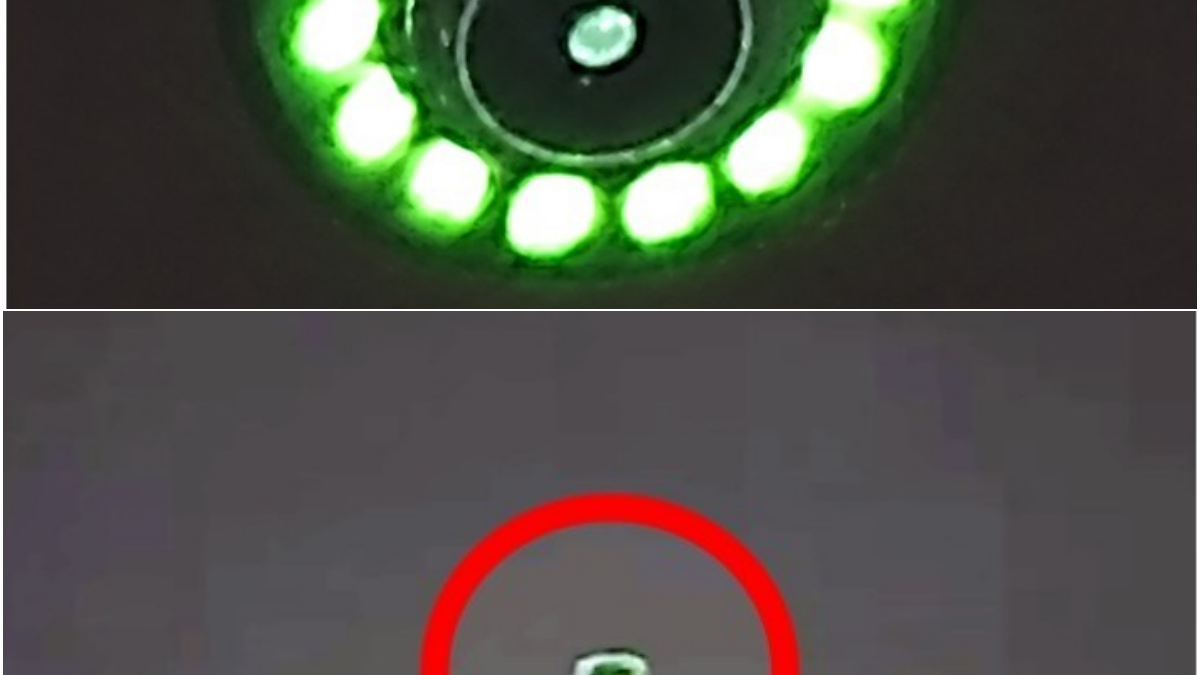
Over the last 24 hours, the night sky above Tehran has become the center of a mystery that seems to grow more extraordinary with every new image.
What began as a single unusual recording has reportedly developed into a collection of videos, photographs, and eyewitness accounts describing luminous objects moving above one of the largest cities in the Middle EaSt. Across different neighborhoods, people have supposedly looked upward and seen strange lights where ordinary aircraft should have been recognizable.
Some describe an enormous disc, others a triangular formation, and still others insist that the lights belong to a structure so large that its outline disappears into the darkness.
Then came the green circles. Photographs began appearing that seemed to show a luminous ring suspended above the rooftops, its bright points arranged with an almost mechanical regularity around a dark center.
The images added a new dimension to an already confusing story, raising questions about whether witnesses were seeing different parts of one object or entirely separate phenomena.
Meanwhile, claims that online posts and videos were disappearing began circulating alongside the footage, turning curiosity into suspicion.
The more people discussed the incident, the more the story seemed to divide between those searching for an ordinary explanation and those convinced that something extraordinary was unfolding.
Tehran has a history of famous aerial mysteries, making the new reports especially compelling to people familiar with the city’s paSt. But what could produce such a striking display above a modern capital, and why have so many different interpretations emerged from the same uncertain night?
The first recording reportedly appeared online before the wider collection of images began attracting attention.
It showed a series of brilliant lights moving through the darkness above Tehran. The points of illumination appeared unusually vivid against the night sky, with colors that seemed to shift or vary across the formation.
The person who recorded the footage reportedly described the sight as something unlike the familiar aircraft and helicopters regularly seen in the region.
At first, viewers concentrated on the lights themselves. They seemed to move together, maintaining a formation that gave the impression of a coordinated structure rather than several unrelated objects.
Some people watching the recording believed the lights outlined a large disc-shaped craft. Others thought they could see a triangular or V-shaped arrangement, with illuminated points marking the outer edges of a much larger silhouette.
Those descriptions might seem incompatible, but the angle from which an object is observed can radically change its apparent shape.
A broad structure seen from directly beneath could appear almost circular, while the same structure viewed from an angle might look elongated or triangular.
If the lights were arranged around a large frame, the visible pattern could change depending on the observer’s position, the object’s orientation, and the distance between the camera and the formation.
The first footage therefore left an important question unanswered. Were people recording one enormous object from different angles, or were they seeing separate lights that happened to move in a similar way?
As the recording spread, people began searching for additional footage. They looked through posts, shared clips, and discussed reports from other neighborhoods.
In a city as large as Tehran, the possibility of multiple witnesses recording the same event was especially interesting.
A single video could be misleading, but several recordings from different locations might offer a more complete picture of whatever had appeared.
Then the green lights entered the story. The newer photographs appeared to show a luminous green ring hanging against the dark sky.
In the more distant images, the formation looked like a small, bright circle suspended above the city.
It seemed isolated from the surrounding lights, with no obvious connection to a conventional aircraft or another recognizable object.
The closer photographs appeared to reveal a more complicated arrangement. Instead of one continuous green glow, numerous bright points seemed to be positioned around the circumference of a circular structure.
The individual lights appeared regularly spaced, creating an almost deliberate pattern. At the center was a darker circular area that seemed to separate the illuminated outer ring from whatever might have been behind it.
The effect was striking. The object appeared less like a random collection of lights and more like a carefully arranged system of illumination.
The green points seemed to define the outline of a circular structure, while the central darkness created the impression of an opening, a solid interior, or a shadowed section of a larger craft.
One photograph reportedly showed the formation above the roofline of Tehran. Buildings and streetlights remained visible below, giving the image a sense of place.
Another appeared to bring the ring closer, allowing individual points of light to be distinguished more clearly.
Together, the images seemed to create a visual progression. In the distant view, the formation was simply a small green circle above the city.
In the closer view, its apparent structure became more noticeable. The lights formed a regular perimeter, and the center remained unusually dark.
That progression made the photographs particularly memorable, but it did not necessarily establish that they depicted the same object.
Without reliable timestamps, precise locations, and original files, it would be difficult to determine whether the images were captured during the same event or from different perspectives.
Even photographs that appear similar can represent unrelated sources of light, especially when they are shared without their original context.
Nevertheless, people following the reports began treating the green ring as an important part of the larger mystery.
Some believed it was another view of the formation seen in the original video. Others thought it might be a separate object that had appeared later, perhaps connected to the same unusual activity above the capital.
The apparent scale became another source of debate. Witnesses reportedly described the formation as immense, suggesting that it was far larger than an ordinary recreational device.
The photographs themselves, however, offered no reliable measurement of its altitude or distance. Without a known object nearby for comparison, even a relatively small light source could appear enormous when photographed against a dark sky.
Early suggestions that the green formation might have been an illuminated kite reportedly met resistance from people who claimed to have watched it directly.
They argued that its lights remained in a rigid arrangement and that its apparent movement did not resemble the shifting or flexing they would expect from a kite responding to changing air currents.
A kite can move in surprising ways, particularly when its frame and lighting arrangement are designed to remain visible at night.
Wind, line tension, the angle of observation, and the camera’s exposure can all affect how stable it appears.
But the witnesses who rejected the kite explanation believed they had seen something much more substantial.
To them, the formation seemed to behave like one organized object. The lights appeared to maintain their positions relative to one another, and the entire arrangement seemed to travel through the sky without the uneven motion they associated with a lightweight device.
That impression became central to the way the story developed. If the lights were fixed to a single structure, then the green ring might represent only the visible perimeter of something considerably larger.
The central darkness could conceal the main body, while the lights marked the edges of a craft that was difficult to distinguish against the night.
The reported silence added another layer. People discussing the incident repeatedly emphasized that they had not heard the familiar engine noise or rotor sounds associated with ordinary aircraft.
The objects were described as moving above a densely populated city while producing remarkably little audible indication of their presence.
Silence, however, is difficult to establish through online reports. A recording made on a busy street might not capture distant engine noise.
Buildings can obstruct sound, while wind and traffic can overwhelm quieter sources. An aircraft at a particular altitude may also be difficult to hear, depending on its direction and the surrounding conditions.
Even so, the repeated emphasis on silence helped distinguish the reports from ordinary sightings. The witnesses were not simply describing unusual lights.
They were describing lights that seemed to move in an unusual formation without the sounds they expected to accompany them.
As the number of posts reportedly increased, another interpretation began gaining attention. Perhaps the individual lights were not separate objects at all.
Perhaps they were attached to a much larger aircraft whose main body was almost invisible against the dark sky.
This idea offered a possible explanation for the different shapes described by witnesses. A large craft could possess a broad, circular arrangement of lights that appeared disc-shaped from below.
Viewed from another direction, its outline might seem triangular or V-shaped. If the central body was difficult to distinguish, observers might see only the illuminated components and interpret them as separate points.
Some discussions went further, speculating about advanced optical concealment. Under this interpretation, the craft’s exterior might somehow absorb, redirect, or otherwise reduce the light reaching observers.
Only the brightest illuminated components would remain visible, creating the impression of disconnected lights surrounding an invisible structure.
The suggestion was imaginative, but the available photographs did not demonstrate that any such technology was involved.
Darkness, cloud cover, camera exposure, and the limited contrast of nighttime footage can all conceal an object’s outline.
A dark aircraft against a dark sky may appear to consist almost entirely of its lights, especially when the camera struggles to capture surrounding details.
The idea of an invisible or concealed structure nevertheless became an appealing explanation for people who believed the formation was too large and stable to be an ordinary device.
It seemed to account for the apparent size, the unusual geometry, and the absence of a clearly visible body.
The conversation was no longer focused only on what the lights might be. It was beginning to revolve around what might be hidden behind them.
Then came the reports of disappearing posts. People following the incident claimed that Tehran and the associated UFO footage had gained significant attention on social media, including Twitter.
Some users said that discussions of the event had appeared prominently before suddenly becoming difficult to find.
Others alleged that individual photographs, videos, and posts were disappearing after they had begun circulating.
The claims were difficult to verify from the descriptions alone. A post may vanish because its creator deletes it, an account becomes unavailable, a platform removes content under its moderation rules, or a link stops working.
Reposts can also replace original uploads, making it difficult to trace where a recording first appeared.
But the reports quickly became part of the mystery. For people already convinced that the aerial activity was unusual, the possibility that evidence was being removed seemed to suggest that another story was unfolding behind the visible one.
Some began asking whether the disappearing material indicated an attempt to control information about the sightings.
Others questioned whether the reports of deletion were being exaggerated as the story spread. Without a verified record of the posts, their original uploaders, and the reasons they became unavailable, neither interpretation could be established.
The uncertainty did not prevent speculation from growing. In fact, it gave the story a second mystery that could be discussed independently of the lights themselves.
Even someone unconvinced by the photographs could become interested in the claims about social media activity.
The alleged removals also introduced a question about the role of official institutions. Tehran is the capital of Iran and a major political and strategic center.
Its airspace is important to civilian aviation and national security, and unusual activity above the city would naturally attract interest from authorities responsible for monitoring aircraft.
If an enormous unidentified craft had genuinely crossed the capital at low altitude, people reasoned, military and aviation systems might have recorded information that ordinary mobile phones could never provide.
Radar observations could potentially help establish an object’s direction, speed, and altitude. Other surveillance equipment might offer additional information about its shape or movement.
Yet the public material described in the reports consisted primarily of fragmented recordings and eyewitness accounts.
The available images could not independently establish the object’s scale, distance, or exact route. Nor did they provide verified radar data or a confirmed statement from authorities identifying the source of the lights.
This gap between what witnesses believed they had seen and what could be established publicly became one of the central tensions surrounding the story.
Some people interpreted the lack of official detail as suspicious. They argued that an event attracting so much attention should have produced a clear explanation if it involved an ordinary aircraft, a coordinated display, or another familiar source.
Others pointed out that an absence of public information does not necessarily indicate that information is being concealed.
Authorities may not comment on unverified social media reports, and they may require time to assess an unusual claim before making a statement.
The distinction mattered. A lack of explanation could leave room for questions, but it could not establish that a cover-up was taking place.
Likewise, the disappearance of online material, if it occurred, would not by itself reveal who had removed it or what motivated the decision.
Still, the cover-up theory became increasingly connected to the aerial mystery. The lights were one part of the story, and the alleged disappearance of evidence was another.
Each appeared to strengthen the other in the minds of people already following the incident.
The location made the story especially compelling to anyone familiar with the history of UFO reports.
Tehran had already become associated with one of the most famous military encounters in the history of modern UFO research.
On the 19th of September, 1976, reports of an intensely luminous object above Tehran led to the dispatch of Iranian aircraft.
The incident became widely discussed because it involved civilian reports, military personnel, pilot observations, and accounts of unusual aerial activity.
According to the historical accounts surrounding that encounter, pilots described objects that appeared to move in unusual ways.
Some reported difficulties involving their aircraft systems while attempting to approach. The incident later became a significant reference point for people studying unidentified aerial phenomena.
The 1976 event and the modern reports share an obvious geographic connection. Both center on luminous objects reportedly appearing above Tehran, and both have attracted attention because witnesses described something they believed was unlike familiar aircraft.
But the similarities should not be mistaken for proof that the events have the same explanation.
The earlier encounter has its own historical documentation and controversies. The modern reports, as described, are developing through social media and a collection of images that have not been independently established as recordings of one object.
The date of the earlier encounter has nevertheless given the new story a powerful sense of historical continuity.
For some observers, the idea that another unusual aerial display could occur above Tehran almost exactly half a century later seems extraordinary.
The old reports provide a familiar framework through which to interpret the new ones. The modern technological environment has also changed the way an incident can spread.
In 1976, witnesses depended on conventional reporting, official statements, and later accounts to communicate what they had seen.
Today, people can record a light in the sky, upload it almost immediately, and compare it with recordings from other locations before the night is over.
That ability creates opportunities for verification, but it also creates opportunities for confusion. A recording can be copied, cropped, compressed, or reposted without its original timestamp.
A caption can be changed, and a video from one place can be mistakenly associated with another.
Several posts may appear to represent independent witnesses even when they all trace back to a single source.
The more rapidly material circulates, the more difficult it can become to distinguish original evidence from commentary and repetition.
A claim repeated by dozens of accounts may appear widely confirmed even if every account is referring to the same uncertain recording.
That is why the number of posts alone cannot establish how many independent witnesses observed the same event.
To determine whether separate recordings show one object, investigators would need the original files, reliable timestamps, and enough location information to compare the viewing angles.
If several people recorded the same formation from different parts of Tehran at the same time, their footage could potentially help reconstruct its apparent movement.
Differences in perspective might reveal whether the lights formed a ring, a triangle, or another arrangement.
Changes in their relative positions could indicate whether the object was rotating, changing direction, or simply appearing different because of the cameras’ positions.
The process would require more than comparing screenshots shared online. Original videos could preserve details lost during reposting, including frame timing, exposure changes, and the object’s apparent movement relative to stationary landmarks.
Even then, investigators would need to account for camera motion, lens distortion, and the possibility that the recordings showed different sources.
The green ring photographs are especially dependent on that kind of analysis. Their apparent regularity is visually striking, but a circular arrangement of lights can be created by many familiar objects.
A circular frame, a decorative installation, a drone formation, or an illuminated device could produce a similar pattern under some conditions.
The dark center is also ambiguous. It could represent the interior of a structure, an area without lights, or simply the night sky visible within a ring.
A photograph alone may not reveal whether the center contains a solid surface, a transparent section, or nothing at all.
Likewise, the appearance of a ring above rooftops does not establish its altitude. A small object close to the camera can appear comparable in size to a much larger object farther away.
Without known distances and reference points, apparent scale remains uncertain. The witness descriptions of an enormous craft therefore remain important as reports of perception, but they cannot substitute for measurements.
People may sincerely experience an object as immense while lacking the information needed to calculate its actual size.
An unfamiliar formation, viewed against a featureless sky, can be particularly difficult to judge. The claim that the formation remained rigid is similarly open to examination.
A set of lights might appear to preserve its shape because it was attached to a fixed frame.
It might also seem stable because of the distance, the camera’s limited resolution, or the short duration of the recording.
Longer, uninterrupted footage would make it easier to assess whether the lights changed their positions relative to one another.
The reported silence could also be investigated by comparing recordings made in different locations. If several independent videos captured the same event, their audio tracks might help establish whether any sound was audible.
But the absence of sound on a phone recording would still need to be interpreted cautiously, since microphones vary and urban environments can mask distant noises.
Each of these questions points toward the same need: reliable original evidence. A collection of images can be compelling, but its value depends on whether the images can be traced, compared, and examined without losing essential context.
That need has become especially important because the story includes claims of disappearing posts. If original material is becoming difficult to locate, preserving what remains could help prevent confusion over which versions are authentic and when they first appeared.
People who recorded the event could retain their original files, including metadata where available, rather than relying only on compressed copies circulating through social media.
Precise timestamps would be particularly valuable. The difference between recordings made several minutes apart could matter if the lights were moving across the city.
Accurate locations would also help establish whether two witnesses were observing the same object from different directions or recording unrelated phenomena.
Even apparently small details could prove useful. The direction a camera was facing, the presence of buildings or towers in the background, and the position of stationary lights might help determine the approximate part of the sky shown in a recording.
With enough independent information, it might become possible to test whether the images fit a single moving object.
But the story has not yet reached that stage. The reports describe a developing collection of photographs and videos, rather than a completed investigation with verified conclusions.
The objects’ identity, the relationship between the original multicolored footage and the green ring photographs, and the reasons behind the alleged disappearance of posts remain unresolved.
For those who believe the reports, the apparent scale and stability of the formation suggest something beyond ordinary aerial activity.
The idea of a large craft with a dark body and luminous components offers a way to connect the different descriptions.
The possibility of advanced concealment adds an explanation for why witnesses might see lights without clearly identifying the structure carrying them.
For those approaching the images more cautiously, several ordinary possibilities remain open. The recordings could show aircraft, drones, illuminated devices, or unrelated lights that appear connected because they were shared together.
The differences in the descriptions might reflect different objects, camera angles, or misunderstandings rather than a single enormous craft.
There is also the possibility that some of the material has been miscaptioned or taken out of context.
Online images can travel far from their original source, and the story attached to a photograph may change as it is reposted.
Without the original uploads, even a visually distinctive image may be difficult to place accurately.
The historical connection to the 19th of September, 1976, gives the reports a memorable setting, but it also makes careful comparison more important.
People familiar with the earlier incident may be inclined to interpret new lights through the expectations created by that history.
The resemblance between two stories can be interesting without demonstrating that they share a cause.
The alleged social media removals present a similar challenge. If posts were deleted, the reasons might range from routine account activity to platform moderation.
If posts merely became difficult to find because the conversation shifted or links changed, the appearance of disappearance could arise without any coordinated action.
Establishing what happened would require a documented record of specific posts and their availability over time.
The current uncertainty has not stopped the story from developing. Every new image can add a detail that changes the way people understand the earlier ones.
A distant photograph may seem unremarkable until a closer view appears. A green ring may look like a simple light pattern until another recording suggests that it moved across the sky.
A claim about silence may seem incidental until several witnesses repeat it. This is how a modern aerial mystery can grow.
A small number of uncertain observations become connected through captions, discussions, and comparisons. As more people encounter the story, they bring their own knowledge, expectations, and interpretations.
Some look for familiar explanations, while others see the reports as evidence of something unprecedented.
The result is not necessarily a clearer picture. Sometimes the accumulation of material makes the central question harder to answer because each new post introduces another version of the event.
A video may show one arrangement of lights, a photograph another, and an eyewitness description a third.
Unless those materials can be reliably connected, they may represent several separate observations rather than different views of one object.
The green ring remains the most distinctive image in the developing account. Its evenly spaced lights and dark center create an impression of order that is difficult to ignore.
The formation seems deliberate, almost architectural, as though each illuminated point has been placed to define a larger shape.
Yet a pattern that looks engineered does not necessarily indicate an extraordinary technology. Human-made devices often use regular arrangements of lights, and natural or optical effects can sometimes produce geometric appearances.
The image’s striking design is a reason to examine it carefully, not a conclusion about its origin.
The possibility of a larger dark structure is equally worth testing. If the lights were mounted on a craft, clearer recordings might reveal the body’s outline when the object passed in front of brighter parts of the sky or changed orientation.
If no structure could be seen, that absence would still need to be interpreted in light of the recording conditions.
The witnesses who described a triangular or V-shaped silhouette may have been observing a structure that appeared different from the circular formation in the photographs.
Alternatively, they may have been interpreting the same points of light according to different visual expectations.
The only way to distinguish those possibilities would be to compare the original recordings and the precise circumstances in which they were made.
For now, the mystery occupies a space between observation and interpretation. There are reports of luminous objects above Tehran, descriptions of unusual formations, and photographs said to show a green ring.
There are also claims about disappearing posts and questions about whether authorities possess information that has not been made public.
What remains missing is the verified connection between these elements. The available descriptions do not establish that every witness saw the same object, that the green ring belonged to the original multicolored formation, or that the disappearance of online material was coordinated.
Nor do they establish that an enormous unidentified aircraft was present above the capital. Still, the incident has captured attention because it combines several elements that make an aerial report difficult to ignore: multiple alleged witnesses, a distinctive visual pattern, a location with historical significance, and a rapidly developing online discussion.
The result is a story that seems to expand every time another recording is mentioned.
If the original files are preserved and independent recordings can be verified, the picture may eventually become more understandable.
Investigators could compare the positions of the lights, examine the movement of the formation, and determine whether the different descriptions are compatible with a single source.
Official information, if released, might provide another point of comparison. Until then, the images remain fragments of an event whose identity has not been established.
The green ring hangs above Tehran in the photographs like a question without an answer.
The first footage offers brilliant lights but no clear outline. The eyewitness descriptions provide impressions of scale and movement, but not measurements.
The online controversy adds another uncertainty without resolving the firSt. The city’s history ensures that the new reports will continue to be compared with the encounter of 1976.
Yet the modern recordings must ultimately be assessed on their own evidence, rather than on the reputation of the earlier case.
Similar locations and similar descriptions can create a compelling parallel, but they cannot determine what appeared in the sky during the last 24 hours.
And so the central mystery remains suspended above the rooftops, just as uncertain as the luminous formation itself.
Was the green circle part of a single enormous craft, a collection of ordinary lights viewed under unusual conditions, or something else entirely?
Until the recordings can be traced and examined together, the answer remains beyond what the images alone can show.
Disclaimer: This content may be created by Al for entertainment purposes. Any resemblance to real persons, events, or places is coincidental.








