The Starving Alien Girl Asked for Food — The Human Chef Offered Her a Job Instead
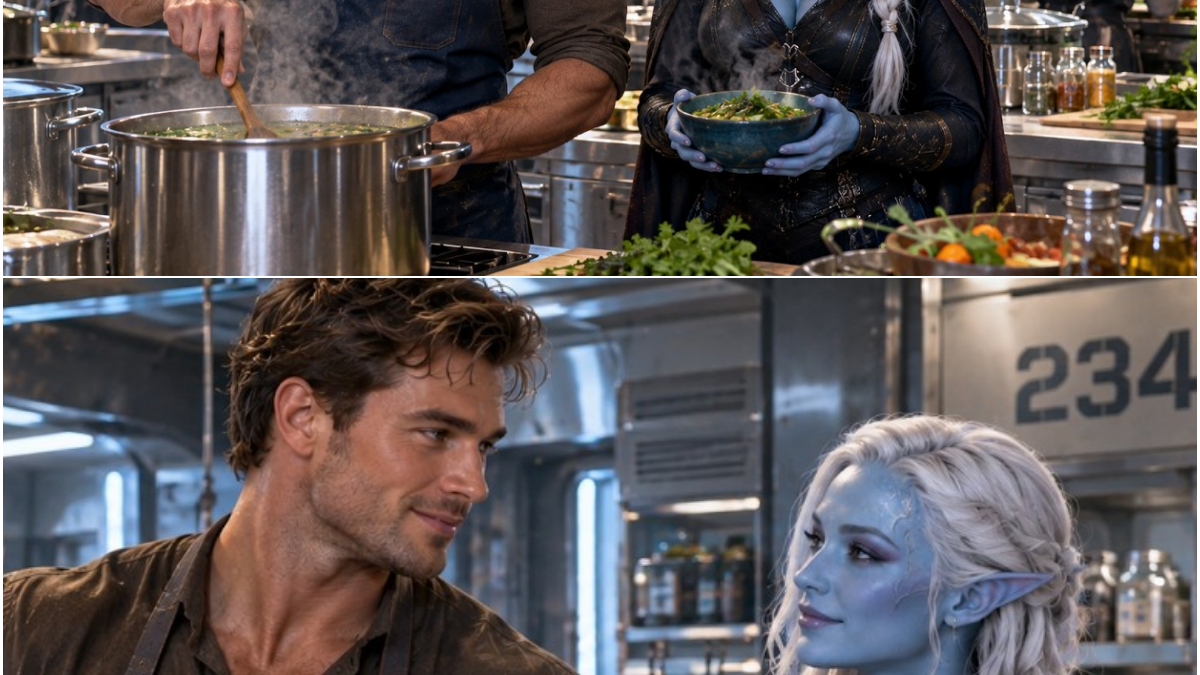
The door slammed open so hard that the bell above it struck the frame twice.
A stranger stumbled into my kitchen, caught the edge of my counter, and nearly fell into the pot of broth I had spent the morning preparing.
I dropped my knife and reached for her before she could hit the floor. Her hands were trembling, her breathing came in short, uneven bursts, and her enormous gray-blue eyes kept darting toward the entrance as if the darkness outside had followed her inside.
She was not simply frightened. She was running from something that had taught her to expect no mercy.
“Food,” she whispered. “Please. I have no currency.” I had served thousands of meals on Kessa Station, but I had never seen anyone look at a bowl of broth as though it were the difference between surrender and another chance.
I filled one, pushed it toward her, and told her to eat slowly. She barely managed to lift the spoon before the bell rang again.
Two debt enforcers stepped through my doorway. Their uniforms were clean, their expressions practiced, and their attention fixed on the woman at my counter.
“That one belongs to us,” the taller man announced. The stranger went perfectly still. I looked at the two men, then at the thin hands wrapped around my bowl.
I had spent fourteen years keeping my little stall open in a place where nearly everything had a price.
Yet suddenly, I found myself wondering what price a person could possibly put on another person’s freedom, and what I was prepared to do when someone tried to collect it.
My name is Daniel, and until that evening, I had believed the hardest part of running a kitchen was keeping it supplied.
The woman’s name was Vess. I learned it from the first broken sentence she managed to finish, although the name came out so quietly that I almost missed it beneath the hiss of the ventilation system.
She had collapsed against my counter shortly after the evening shift began, when the residential ring was crowded with workers returning from their assignments and the market corridors were filled with the familiar noise of station life.
Kessa Station was built around a small moon that had little to offer except mineral deposits and a dependable orbit.
The station had grown in layers over several decades, with commercial rings near the central docks, industrial levels farther out, and residential corridors squeezed wherever the engineers had found room.
People from dozens of worlds lived there, worked there, traded there, and occasionally stayed long enough to call it home.
It was not a gentle place, but it was predictable in the ways that mattered to people who had learned to survive.
Cargo arrived when the schedules held. The air processors kept turning. The lights followed their programmed cycles.
Contracts were signed, debts were recorded, and nearly every disagreement eventually found its way to someone with a badge or a legal department.
My stall occupied a narrow corner of the residential market. It had a metal counter, a battered cooking unit, six stools, and a sign that read Daniel’s Kitchen in letters I had painted myself.
The place was small, but it was mine. I had built the counter, repaired the ventilation hood, and spent years learning which ingredients could survive long transport without losing their flavor.
I had come to Kessa Station with little more than a knife roll, a few personal belongings, and a stubborn belief that good food could make an unfamiliar place feel less lonely.
My grandmother had run a diner on Earth for forty years. She taught me how to prepare a meal, but the lessons I remembered most had very little to do with cooking.
A kitchen, she used to say, was not a courtroom. You did not need to decide whether someone deserved to be hungry before you gave them something to eat.
I had carried that principle with me through fourteen years of business. It had earned me loyal customers, a few strange friendships, and more than one argument with people who believed generosity was simply another word for poor accounting.
It had never brought two debt enforcers to my doorway before. Vess sat on the stool nearest the counter, her shoulders drawn inward beneath a thin, worn garment.
Her skin had a faint silver undertone, and her long, pale hair was tangled around her face.
I had encountered her species only twice in my years on the station. Both times, they had been passing travelers, and neither had stayed long enough for me to learn much about their customs.
She looked as though she had traveled a considerable distance without proper reSt. Her clothes carried the dull stains of industrial corridors, and her wrists bore faint marks where restraints had pressed against them.
She held the bowl with both hands, not because it was heavy, but because she seemed uncertain she could keep her grip steady.
“Small sips,” I told her. “Give yourself time.” She followed the instruction. The first mouthful seemed to surprise her.
She closed her eyes briefly, then took another, more carefully than before. I was reaching for a clean cloth when the bell rang again.
The taller enforcer entered firSt. He was broad across the shoulders, with a shaved head and a scar cutting through one eyebrow.
His name tag read Kade Lauren. The woman behind him was shorter, with close-cropped hair and an expression that suggested she had already decided the evening was an inconvenience.
Kade did not look at me for long. He looked directly at Vess. “There you are,” he said.
“You have made this unnecessarily complicated.” Vess’s spoon stopped halfway to her mouth. Kade turned toward me.
“That one belongs to us. Contract violation. She ran from processing three levels down. Hand her over and we forget you interfered.”
I glanced at Vess. She was staring into the bowl, but her fingers had tightened around it so much that her knuckles looked pale.
“She’s eating,” I said. “You can wait until she’s finished.” Kade’s expression hardened. “You don’t understand the situation, cook.”
“My name is Daniel.” “I don’t care what your name is. She is under a station debt contract.
You are obstructing a lawful reclamation.” “My stall is licensed,” I replied. “And she is a customer.”
The woman enforcer shifted her weight. Her hand moved toward the stun baton at her hip, not quite reaching for it, but making sure I noticed the possibility.
Kade stepped closer to the counter. “She was sold into a labor contract eleven months ago.
Standard debt bond. She ran two days ago instead of completing her term. That makes her a fugitive asset.
She gets returned to the contract holder.” I had heard of debt bonds. Almost everyone on Kessa Station had.
They were presented as practical arrangements for people who needed transport, housing, or employment and could not afford the initial costs.
In theory, the worker agreed to repay the expense through a fixed term of labor.
In practice, the people who controlled the contracts often controlled the living conditions, the accounting, and the information available to the workers.
A person could spend months trying to understand a debt that seemed to grow every time they made a payment.
I had never been comfortable with the system, but I had also never seen someone arrive at my counter looking like Vess.
“What was the contract for?” I asked. “Not your business.” “It became my business when she collapsed in my kitchen.”
Kade’s jaw tightened. “You want to make this difficult?” “No. I want you to explain why you think she belongs to you.”
The woman enforcer spoke at laSt. “You have no authority to question a verified contract.”
“Then show me that it’s verified.” “That is not how this works.” “It might be how it works in my kitchen.”
Kade leaned over the counter, bringing his face closer to mine. I could smell the sharp chemical scent of his uniform’s cleaning agent.
“You have no idea what you are involving yourself in.” I had heard versions of that sentence before.
Usually, it came from someone who wanted the other person to stop asking questions. I turned toward Vess.
“Is what he said true?” She flinched when I spoke her name, as though she had expected me to forget it.
For a moment, she could not lift her eyes. Then she looked at me, and I saw something behind her exhaustion that had not been there when she first entered.
“They kept us hungry,” she said. Her voice was weak, but the words were clear.
“The processing dormitories. They gave us enough to remain useful, but not enough to become strong.
The food was counted as part of our debt. Every portion was recorded. Every day, the amount was added to what we owed.”
Kade made a dismissive sound. “Do not encourage her.” Vess continued, her gaze still fixed on me.
“Some workers became too weak to finish their shifts. Others could not stand for long.
I saw people collapse, and the supervisors only told us to keep moving. I ran because I knew I could not stay there.”
She paused, struggling to catch her breath. “I would rather try to escape than spend another day waiting for them to decide what happened to me.”
The kitchen seemed to shrink around us. The broth pot continued to simmer, and the ventilation fan hummed above the doorway, but the ordinary sounds of the stall felt distant.
Kade straightened. “Debt is debt. She signed the agreement. She comes with us.” “She said the conditions were unsafe,” I replied.
“She is a contract worker making excuses.” “Then the records should settle it.” The woman enforcer’s eyes narrowed.
“You are not an auditor.” “No,” I said. “I’m the person serving the meal she was too weak to ask for properly.”
Kade’s hand moved toward his baton. Before he could take another step, a familiar voice came from the doorway.
“Evening, Daniel.” Marcus Bell stood beneath the sign, his station security jacket unzipped and his identification badge visible.
He was a broad-shouldered man with a calm manner and a habit of listening longer than most people expected.
He had eaten at my stall three nights a week for two years. I knew his usual order, and he knew how I took my coffee.
His eyes moved from me to Vess, then to the two enforcers. “Kade,” he said.
“Didn’t expect to see reclamation agents working this deep into the residential ring without filing a notice.”
Kade’s confidence shifted, just slightly. “This is a private contract matter.” “Not when it happens inside a licensed business.”
Marcus stepped into the stall and took out a small data slate. “Show me the filed notice.”
“We don’t need to file notice for a fugitive retrieval.” “Actually, you do.” Marcus tapped the slate and turned its display toward Kade.
“Six months ago, the station council updated the reclamation rules after an incident on level nine.
Retrieval agents now have to file a notice before entering residential businesses or shared public facilities.
You would know that if you read the updates.” Kade’s mouth tightened. “That was a special case.”
“It was an ordinance. Special cases are how ordinances get written.” The woman enforcer looked toward the exit.
Kade remained still, but I could see him calculating what he could accomplish without making the situation worse.
Marcus kept his voice level. “Here is what happens next. You leave this stall. You file the notice through the reclamation office.
If the contract is legitimate and the retrieval conditions meet station requirements, you can return tomorrow with the correct paperwork.”
“You are obstructing a lawful recovery,” Kade said. “I am enforcing station procedure. Tonight, you have no notice, no retrieval authorization, and no reason to threaten anyone inside a licensed business.”
Kade stared at him for several seconds. “This is a mistake.” “Then take it up with the station council.”
The two enforcers stood in silence. At last, Kade turned toward the door. The woman followed, giving Vess one final look that made her grip tighten around the bowl.
The bell rang as they left. I did not realize how tense my shoulders had become until the doorway was empty.
Marcus waited until the sound of their footsteps faded. “You all right?” He asked. “I will be.”
His gaze moved to Vess. “And you?” She did not answer immediately. “I do not know.”
“That’s fair,” Marcus said. He pulled out a stool and sat at the end of the counter.
“I need to be honest with both of you. That notice requirement buys us some time, but it does not automatically void a contract.
If the bond is legitimate, they can come back with the correct paperwork.” Vess lowered her eyes.
“So it is not over.” “No,” Marcus said. “Not yet.” I looked at the woman sitting in front of me.
She had managed only a few spoonfuls of broth, and now she was holding the bowl as though it were the only solid thing in the room.
“Then we find out what makes it over,” I said. Marcus raised an eyebrow. “You have a plan?”
“I have the beginning of one.” “That sounds familiar.” “What makes a debt contract void under station law?”
Marcus leaned back, thinking. “Unsafe labor conditions can invalidate standard bonds. So can falsified accounting, coercion, or failure to provide the basic provisions required by the contract.
The trouble is proving it. Most people who sign those agreements do not have access to the records.”
Vess’s head lifted. “They kept ration records.” Marcus turned toward her. “What kind of records?”
“Daily distribution. Every worker had an intake entry. They counted the food because it was charged against the debt.”
“Do you remember where the records were kept?” “In the processing supervisor’s office. The slate was sometimes left open when the supervisors changed shifts.”
“Do you remember any names?” She nodded slowly. “The supervisor was called Oren Vale. Dormitory block C, room twelve.
I saw the distribution figures for our section. I do not know whether they kept the records after I escaped.”
Marcus was already typing. “If the records still exist, the audit team can retrieve them.
I can flag this as a possible labor violation instead of a contract dispute. That gives it a different priority.”
“How long?” I asked. “If I file it tonight and mark it urgent, the first review could happen by morning.”
“Then file it.” Marcus glanced at me. “I was going to.” He entered the information, asked Vess to confirm a few details, and submitted the requeSt. Then he looked up.
“I have wanted a reason to investigate that processing ring for months. Too many complaints have come through, but nobody has been willing to provide enough information for a formal audit.
This may finally give the council something concrete to examine.” Vess watched him, uncertainty still present in her expression.
“Why would you do that?” Marcus looked genuinely puzzled. “Because you told us something was wrong.”
“People tell authorities things all the time.” “And sometimes we listen.” “Sometimes they do not.”
“That is true,” he admitted. “But I am listening now.” She turned toward me. “Why are you doing this?”
I looked down at the counter. There was a small scratch near the edge where I had dropped a crate years earlier.
I had meant to repair it, but the mark had become part of the kitchen.
“Because you came in hungry,” I said. “And because somebody decided that your hunger was useful to them.”
She studied me. “You do not know me.” “No.” “You do not know what I have done.”
“No.” “You do not know what I might do if I am free.” “That is true, too.”
Her brow tightened. “Then why?” “Because I do not need a complete history of someone’s life before I can give them a meal.”
Marcus nodded. “And because what happened to you should not happen to anyone.” Vess looked between us.
Something in her expression seemed to loosen, though she still appeared unsure what to do with the feeling.
“Finish your broth,” I told her. “You need reSt. We can deal with the paperwork when it arrives.”
She returned to the bowl and took another careful spoonful. Marcus stayed for another half hour, checking the information he had entered and explaining what would happen if the audit team confirmed the violation.
If the records showed that the dormitory had kept workers below the minimum sustenance levels, the bond could be voided.
The contract holder could be required to answer for the conditions, and other workers might be eligible for review as well.
He did not promise a result. He did not pretend the process would be simple.
But he promised to follow the request and return as soon as he had news.
After he left, I locked the stall for the night. Vess remained seated near the back of the kitchen, wrapped in a thermal blanket I usually kept for cold-storage emergencies.
She watched me wipe down the counter, although I had already cleaned it twice. “You never answered my question,” she said.
“Which one?” “Why help someone who cannot repay you?” I set the cloth aside. “I thought I did.”
“You said it was not about repayment. That is an answer, but I do not understand it.”
I pulled out the stool opposite her and sat down. “Where I come from, there is an old idea.
Not everyone follows it, but it has survived a long time. If someone is hungry, you feed them.
You do not ask whether they have something to offer firSt.” “Why?” “Because one day you might be the hungry one.”
She looked at the bowl in her hands. “That sounds like a risk.” “It is.
People can take advantage of generosity. Some do. But if you stop helping everyone because a few people might misuse it, you end up building a world where nobody helps anyone.”
She was quiet. “My grandmother ran a diner on Earth,” I continued. “Forty years. She had regular customers who paid every week, travelers who came through once and never returned, and people who sometimes had nothing but a story and an empty stomach.
She fed them all when she could.” “Did they repay her?” “Some did. Some never had the chance.
She never made it a condition.” Vess lowered her eyes to the blanket. “I have encountered many species,” she said.
“Most treat kindness as a transaction. A favor is given, and a favor is expected.
Sometimes the payment is money. Sometimes it is loyalty. Sometimes it is obedience.” “Then maybe you have not met enough people yet.”
“Perhaps.” She looked around the kitchen, taking in the old cooking unit, the shelves of ingredients, the worn stools, and the little sign above the counter.
“This place is very small.” “It is.” “And you risked it for me.” “I risked an uncomfortable evening and possibly a legal argument.”
“Your business could suffer.” “It could.” “You might lose your license.” “I might.” She seemed to be searching for some hidden calculation in my expression.
I did not have one to offer her. “Get some sleep,” I said. “You have had a difficult few days.”
She hesitated. “Where?” “The back room. There is a narrow bed. It is not luxurious, but it is clean, and the door locks from the inside.”
“Why would you give me the lock?” “Because it is your room tonight.” She stared at me for a long moment.
Then she stood, slowly and carefully, and carried the empty bowl to the sink. “Thank you,” she said.
“You are welcome.” She paused before entering the back room. “I do not know how to live in a place where I am allowed to say no.”
“You can start by practicing.” She gave a small, uncertain nod and disappeared through the doorway.
I stayed in the kitchen for a while after that, listening to the station’s ventilation system and the distant movement of cargo trams.
I had spent years learning how to keep a business running through supply delays, equipment failures, and changes in the station’s market.
None of those problems had ever felt quite like waiting for a woman’s freedom to be decided by a collection of numbers on a data slate.
Morning arrived according to the station’s artificial lighting cycle. The ceiling panels brightened gradually, imitating dawn for residents who lived beneath the moon’s surface and rarely saw the real sky.
I had slept poorly. Vess had slept even less, judging by the faint sound of movement from the back room before the lights reached full brightness.
When she emerged, she had folded the thermal blanket neatly and placed it over one arm.
Her hair was still tangled, but her face looked less strained than it had the night before.
“Good morning,” I said. “Good morning.” “Would you like breakfast?” She looked toward the cooking station.
“I can help.” “You can eat firSt.” “I would rather work.” “Those are not the only choices.”
She considered that. “Could I do both?” “That sounds reasonable.” I gave her a small breakfast and showed her how I prepared the vegetables for the morning menu.
She worked slowly, careful with the knife and attentive to every instruction. Her movements were uncertain at first, but I noticed she was quick to recognize patterns.
By the time the first customers arrived, she had learned where I kept the clean utensils and which containers held the ingredients for the day.
She did not speak much. When she did, her questions were practical. “How long does the broth simmer?”
“Until the ingredients have given up what they have to offer.” “How do you know when that is?”
“You taste it.” “Every time?” “Every time.” She seemed to find that answer more interesting than it deserved.
The breakfast rush began. Dock workers came in for hot meals before their shifts. Two maintenance technicians ordered their usual bowls and complained about a broken lift on the outer ring.
A courier asked whether I had any fresh bread. I served them, kept the cooking station moving, and introduced Vess only as someone helping me for the morning.
Nobody asked questions. That was one of the things I liked about the regulars. They understood that not every stranger wanted to be the subject of a conversation.
Marcus arrived shortly before the rush reached its busiest point. He had a data slate in one hand and a tired expression that suggested he had spent the early hours dealing with more than one difficult report.
He waited until I had a moment to step away from the counter. “The record existed,” he said.
I stopped. “Where?” “Buried in the processing office archive. The audit team recovered four months of ration logs.
They were not erased. They were simply filed under a category that did not match the dormitory’s current registration.”
“Can they prove the amounts?” “Yes. The distribution entries show sustained intake nearly forty percent below the minimum survival thresholds for the species housed in that section.”
I glanced toward Vess. She had stopped peeling vegetables. Her knife rested on the board, and her attention was fixed on Marcus.
“What does that mean?” She asked. Marcus set the slate on the counter. “It means the audit team has confirmed a serious labor violation.
The contract conditions failed to meet the station’s required standards. Under the debt-bond rules, that makes the agreement void.”
Vess did not move. Marcus continued, speaking carefully so there could be no misunderstanding. “You are no longer bound by that contract.
You are not a fugitive asset. You are a free resident of Kessa Station, with the same basic rights as any other resident.”
The kitchen went quiet around us. Outside, the morning crowd continued moving through the market.
Somewhere beyond the stall, a cargo tram announced its arrival. A vendor called out the price of fresh fruit.
The ordinary sounds of the station carried on, unaware that a life had just changed inside my little kitchen.
Vess slowly set down the vegetable she had been holding. “Void,” she repeated. “That is correct,” Marcus said.
“They cannot claim me?” “No.” “They cannot add more charges?” “Not under that agreement.” “They cannot come back and take me?”
“Not lawfully. If they try, contact station security immediately.” She looked at him as if she had heard the words but could not yet make them fit into her understanding of the world.
Then she straightened. It was a small movement, but it changed the way she stood.
The woman who had collapsed against my counter the night before had seemed to occupy as little space as possible.
Now she lifted her head and let her shoulders settle naturally. “I am free,” she said.
Marcus nodded. “You are.” She looked down at her hands. They were still thin, and the faint marks at her wrists had not disappeared.
But she no longer held them as though she expected someone to seize them. For several seconds, she said nothing.
Then she asked, “What happens to the others?” Marcus’s expression became more serious. “The audit team is reviewing the entire processing facility.
The records may support additional cases. I cannot promise the outcome for every worker, but the investigation is no longer limited to your contract.”
“Can they get out?” “That will depend on their individual circumstances and what the review establishes.
But now there is evidence, and the council has opened a formal inquiry.” Vess closed her eyes briefly.
“I remember their names,” she said. Marcus leaned forward. “Would you be willing to provide them?”
“Yes.” “Then we can arrange a statement when you are ready. You do not have to do it this minute.”
She nodded. I could see how much it cost her to remain standing. The relief was real, but so was the exhaustion.
Freedom did not restore the strength that had been taken from her, and it did not erase the memories of the processing dormitory.
I set a fresh bowl of broth on the counter. “Eat something,” I said. She looked at it, then at me.
“You keep telling me to eat.” “Because you keep needing food.” A small smile appeared at the corner of her mouth.
“That is a very simple explanation.” “It is a very simple problem.” She sat down and began eating.
This time, her hands were steady enough to hold the spoon without gripping it tightly.
Marcus remained for another few minutes, helping her understand the next steps. The audit office would provide a written confirmation of the contract’s cancellation.
Security would record her new status, and she could request assistance finding permanent accommodation if she did not want to stay in my back room.
When he finished, he put away his slate. “For what it’s worth,” he said to me, “you did the right thing.”
“I mostly served soup.” “You asked questions when it would have been easier not to.”
“That seems like a low standard.” “It is a standard many people still fail to meet.”
He looked toward Vess. “And you did something difficult, too. You gave us information when you had every reason to believe nobody would listen.”
Vess lowered her spoon. “I did not know whether you would.” “I understand.” Marcus gave us both a nod and left the stall, already returning to the work waiting for him elsewhere on the station.
The morning continued. The customers came and went. The broth pot emptied, and I started another batch.
Vess learned how to portion the vegetables, how to keep the serving bowls warm, and how to tell when the cooking unit needed a slight adjustment.
She made a few mistakes, apologized for them, and then seemed surprised when I told her that mistakes were part of learning.
By lunchtime, she was moving around the kitchen with more confidence. She had begun to recognize the regular customers and remembered which ones preferred extra herbs or less salt.
A maintenance worker complimented her preparation of the root vegetables, and she looked so startled by the praise that I nearly laughed.
“You did well,” I told her after he left. “I only followed your instructions.” “You also paid attention.”
“Is that unusual?” “Not as unusual as you might think.” She glanced at the counter, then at the door.
“They will not return?” “Not with a lawful claim.” “But they might still be angry.”
“Probably.” “Does that concern you?” “It concerns me enough to keep the security number close.
It does not concern me enough to let them decide who eats in my kitchen.”
She considered that answer. “I would like to learn how you think.” I looked at her.
“About cooking?” “About people.” “That takes longer.” “I have time now.” The words were quiet, but they carried a weight that made me stop what I was doing.
She had time now. For eleven months, someone else had controlled the shape of her days.
They had decided when she worked, what she ate, where she slept, and how much of her own future she was allowed to imagine.
Now, for the first time in a long while, she could decide what came next.
It was not a small thing. I showed her how I planned the kitchen’s supply orders, how I kept track of the station’s market prices, and how I adjusted the menu when ingredients became scarce.
She listened with the same focus she had shown when learning the cooking routines. After a while, she asked whether she could stay and work with me.
I told her she could, if she wanted to. I also told her that she did not owe me for the meal, the room, or the help Marcus had provided.
If she chose to leave, I would not hold it against her. “Why would I leave?”
She asked. “Because you are free to.” She seemed to turn the idea over in her mind.
“I have spent so long trying to reach a place where I could choose,” she said.
“Now that I am here, I do not know what to choose firSt.” “Then do not choose everything today.”
“What should I choose?” “Lunch, for a start.” She looked toward the cooking station. “I choose to learn how to make the broth.”
“That is a respectable beginning.” We spent the afternoon preparing the next batch. I showed her how to balance the ingredients, when to add the herbs, and why the broth needed time rather than constant attention.
She followed each step, then asked to try a second version with a slightly different combination.
The result was not perfect. It was, however, very good. She tasted it carefully, then looked at me.
“Is this how your grandmother made it?” “Not exactly.” “Then what is it?” “Your version.”
She stared at the bowl. “My version?” “Your first recipe. You can change it as much as you want.”
She took another taste. “I would like to make it again tomorrow.” “Then we will.”
The words came easily. Only afterward did I realize how naturally I had begun to imagine her being there the next day, and the day after that.
By evening, the rush had faded. The market grew quieter, and the station’s lights shifted toward the softer setting used during the late cycle.
I closed the stall and began cleaning the cooking equipment. Vess stayed to help. She had no obligation to remain after her shift, but she seemed more comfortable with the familiar work than with the uncertainty waiting beyond the door.
I did not tell her to go. I simply let her decide. When we finished, she folded her apron and placed it beside the clean towels.
“Daniel?” “Yes?” “Would you teach me how to keep the accounts?” I looked up. “The business accounts?”
“Yes.” “Why?” “Because I would like to understand how a place like this survives. And because I do not want to be helpless if I need to make my own way.”
“That is a good reason.” She hesitated. “Would you also teach me how to speak to people without expecting them to demand something from me?”
I leaned against the counter. “I can teach you what I know. But you will have to decide what you believe about each person for yourself.”
“That sounds difficult.” “It is.” “Do you always trust people?” “No.” “Then how do you know when to help them?”
“I do not always know. Sometimes I get it wrong. Sometimes I help someone who does not appreciate it.
Sometimes I trust someone who turns out to be dishoneSt.” “Then why keep doing it?”
I thought about my grandmother’s diner again, about the people who had come through its doors and the meals she had served without asking what would happen afterward.
“Because the possibility of being wrong does not make kindness useless,” I said. “It just means you have to pay attention.”
Vess nodded slowly. “I think I understand.” “Good. Tomorrow, we start with the accounts.” “And the broth?”
“And the broth.” She smiled, and this time it did not seem uncertain. Over the next several weeks, the stall became a place where Vess could practice living without a contract defining her worth.
She learned the cooking routines, then the supply schedules, then the simple arithmetic of daily sales.
I taught her how to compare prices between vendors and how to recognize when a supplier was offering a deal that looked better than it really was.
She proved to be an excellent student. Her attention to detail was remarkable. She remembered orders after hearing them once and could identify small changes in ingredient quality that I sometimes missed.
She also had a talent for noticing when customers were uncomfortable, even when they tried to hide it.
At first, she treated every compliment as though it might be a trick. Gradually, she learned to accept ordinary kindness without searching for a hidden demand.
The changes were not dramatic every day. Sometimes progress was as simple as choosing a seat without checking whether someone else might object.
Sometimes it meant asking for a break before she became exhausted. Sometimes it meant telling me that she disliked an ingredient rather than eating it simply because I had served it.
I encouraged all of it. The audit continued beyond our stall. Marcus visited several times with updates, explaining that the station council had expanded its review of the processing facility.
The recovered ration logs had raised questions about other parts of the operation, including the way workers were charged for housing and basic supplies.
Vess provided her statement when she felt ready. She gave the audit team the names she remembered and described the routine in the dormitory as carefully as she could.
She did not have to speak for every worker, and nobody asked her to pretend she knew things she had not witnessed.
The review took time, but it no longer depended on her word alone. The records gave investigators something they could examine independently.
Kade Lauren and the other enforcer did not return to my stall. Marcus told me they had been instructed to suspend all retrieval activity connected to the processing dormitory while the council reviewed the evidence.
I did not know whether they were personally responsible for the conditions Vess had described, and I had no reason to invent an answer.
What mattered was that they no longer had a lawful claim over her. One evening, several weeks after the first encounter, Vess stood behind the counter while I prepared the final pot of broth for the day.
The market was quiet, and the kitchen smelled of herbs, warm vegetables, and the familiar richness of the stock.
She had been working beside me long enough that I no longer needed to explain every step.
She could prepare the ingredients, adjust the heat, and keep track of the serving bowls while I handled the orders.
She watched me taste the broth. “Is it ready?” “AlmoSt.” “What is missing?” I offered her the spoon.
She tasted it, considered the flavor, and reached for the herbs. “Now?” I tried it again.
“Now.” She looked pleased. Then she asked, “Do you think I will ever stop remembering the dormitory?”
I set the spoon down. “I do not know.” “Will it always be part of me?”
“Probably. But it does not have to decide everything about you.” She was quiet for a while.
“I used to believe the only way to survive was to become whatever they needed me to be.”
“And now?” “Now I think I might become someone they never expected.” I smiled. “That sounds promising.”
She looked around the kitchen, taking in the shelves, the counter, the cooking unit, and the small sign above the door.
“I did not expect to find a place like this.” “Neither did I, when I first arrived.”
“Why did you stay?” I considered the question. “Because I found work I cared about.
Because I met people who became friends. Because I built something here, even if it is small.”
“And because of your grandmother?” “Especially because of her.” Vess nodded. “I think I would like to build something, too.”
“You can.” “Perhaps a place where people can come when they have nowhere else to go.”
I looked at her, then at the little kitchen that had somehow become more than a business.
“That would be a good place.” She rested her hands on the counter. “Would you help me?”
“If you want to build it, I will help you figure out how.” She gave a thoughtful nod, as if she were already beginning to plan.
The next morning, she arrived before the station lights reached full brightness. She had chosen her own clothes, carried her own small bag, and brought a list of ideas for the future.
She placed it on the counter and began preparing the vegetables for breakfaSt. I read the list while the broth warmed.
It included a few practical plans for saving money, a proposal for learning more about station regulations, and an idea for setting aside a portion of the kitchen’s supplies for anyone who arrived without enough to pay.
At the bottom, in careful writing, she had added one sentence. No one should have to prove they deserve to eat.
I read it twice. Then I looked up at her. “That sounds familiar.” “It is your grandmother’s idea,” she said.
“But I believe it now, too.” Outside, Kessa Station continued its steady cycle. Cargo ships arrived, merchants opened their stalls, workers moved between levels, and the great machinery of the station carried on as it always had.
Inside my kitchen, Vess began another day. She had not forgotten what happened to her.
She did not have to. Her past was part of her story, but it was no longer the only part she could imagine telling.
And I had learned something, too. I had always believed a meal could offer comfort, but I had never fully understood how much a simple act could change when it was accompanied by respect, patience, and the willingness to stand beside someone after the first bowl was empty.
Vess never missed a shift after that. Neither did I.
Disclaimer: This content may be created by Al for entertainment purposes. Any resemblance to real persons, events, or places is coincidental.








