The Soldiers Needed Machinery to Move the Missile—The Human Carried It on His Back
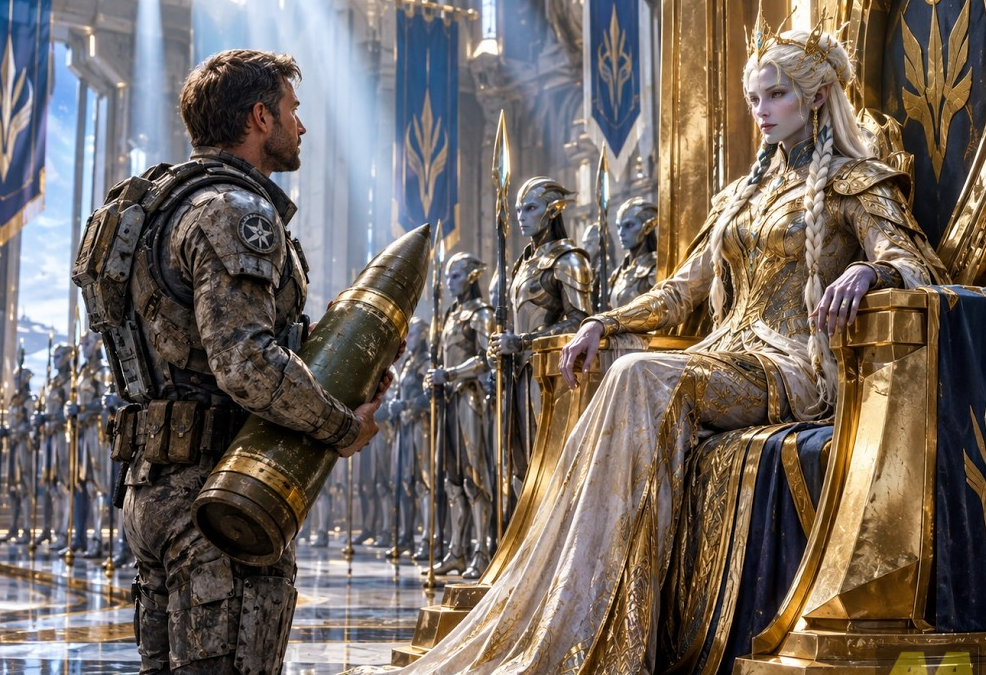
The ground moved beneath my feet before the sound reached me. For one impossible second, I thought the whole world had shifted sideways.
Then the bridge disappeared behind a wall of dust, stone and twisted metal, and every plan my unit had carried into the morning became useless.
I am Vec, sergeant of the Skarn infantry, and I had spent enough time in combat to know what a collapsing bridge meant.
We were trapped. The Thessian line was advancing from the eaSt. Our forward settlements were behind us.
Between those settlements and the advancing line stood one damaged relay station, a handful of exhausted soldiers, and a tactical warhead sitting two kilometers away inside a supply depot we could no longer reach by vehicle.
The grav sled assigned to transport it was gone. The tunnels were broken. The trenches were flooded.
The ridge road was buried beneath stone. Captain Irish was shouting instructions through the comm, but I barely heard him.
I stared at the map on my wrist and searched for another route. There was none.
Then Owen stepped beside me. He looked at the ruined bridge, then at the map.
“What happens if we cannot get the warhead here?” I told him. He was silent for several seconds.
Then he looked toward the depot. “I’ll carry it.” I laughed because there was no other response that made sense.
But Owen had already started walking. What I did not understand then was that humans sometimes make their hardest decisions before they ever ask whether those decisions are possible?
The Skarn had always considered humans physically unimpressive. That was not an insult. It was simply a measurement.
We were larger, stronger, heavier, and built for environments that would exhaust most human bodies within minutes.
Our infantry armor was designed around our proportions, our weapons required strength that most humans could not produce, and our endurance training was considered among the most demanding in the allied forces.
Humans were different. They compensated. At least, that was what our instructors told us. They were adaptable.
They were inventive. They were willing to use tools in unusual ways. I understood all of that before I met Owen.
What I did not understand was what happened when there were no tools left. Owen had been attached to our unit for several months.
He was not our commander. He was not even one of our senior soldiers. He was simply there.
A human in a Skarn infantry unit. He repaired equipment. He carried communications gear. He helped our engineers.
He knew how to operate almost every machine we used, and when something broke, he usually knew why before our technicians did.
I had watched him work many times. He was patient. Quiet. Annoyingly calm. He had a habit of looking at a damaged machine for several seconds before touching it, as though he were listening to the problem rather than examining it.
I had once asked him why. He had smiled. “Machines usually tell you what is wrong if you stop interrupting them.”
I thought that was a very human thing to say. On the morning the bridge collapsed, there was nothing for Owen to listen to.
The entire eastern route had been destroyed. Dust rolled through the relay station. Chunks of concrete continued falling from the damaged ceiling.
Our communications officer was trying to restore contact with the forward position. Captain Irish stood near the entrance, staring at the tactical display projected above his wriSt.
“The vehicle route is gone,” he announced. Nobody answered. We already knew. “The northern path?”
“Buried.” “The western tunnel?” “Flooded.” “Can we move the warhead manually?” One of our engineers shook his head.
“Not without the grav sled.” Captain Irish looked at me. I looked at the map.
The depot was two kilometers away. Normally, that distance meant nothing. With a transport vehicle, it would take minutes.
Without one, the route was almost impossible. There were collapsed tunnels between us and the depot.
A flooded trench. A ridge covered by loose rock. Open ground exposed to the eastern line.
And the warhead itself was not something a soldier simply picked up. It had been designed for mechanical transportation.
The cradle alone was heavy. The complete assembly required equipment. We had none. I told Captain Irish the truth.
“We cannot move it.” He stared at the map. Neither of us said what that meant.
The settlements behind our position were depending on us. If the eastern line reached the forward boundary, there would be nothing left to slow its advance.
The tactical device was our only remaining option. Then Owen arrived. He had been helping Grace with the communications equipment.
Grace was another human attached to our unit. She was a scout and systems specialist, though I had never understood how she managed to combine those two roles without constantly exhausting herself.
Felix was with her. He was younger than both of them and had joined the unit only a few weeks earlier.
The three humans had been working near the western wall when the bridge collapsed. Owen approached me.
“What is the plan?” “There is no plan.” He looked at the map. “Why?” “The bridge is gone.”
He waited. “The transport route is gone.” Another pause. “The grav sled is gone.” He looked toward the depot.
“How far?” “Two kilometers.” “Can we walk it?” “Not with the device.” He nodded. I expected him to walk away.
Instead, he said the sentence I would remember for the rest of my service. “I’ll carry it.”
I stared at him. “You cannot.” “I can try.” “No.” He looked at me. “Why not?”
I pointed toward the depot. “You have seen the cradle.” “Yes.” “You know its weight.”
“Yes.” “You are human.” He smiled slightly. “I am aware.” I did not find it funny.
“Owen, you will not make it.” He looked toward the eastern horizon. Then he looked at the settlement map.
“If nobody moves it, what happens?” I did not answer. He already knew. He turned around.
Grace followed him. Felix followed Grace. I stood there for several seconds before realizing I was following them too.
The depot was in terrible condition. The roof had partially collapsed. Crates were scattered across the floor.
Emergency lights blinked through the duSt. The tactical warhead remained inside its transport cradle, untouched.
Owen walked around it slowly. He examined the harness. Then he examined the frame. One of the engineers had prepared a lifting system for emergency use.
It was never designed for a human. Owen adjusted it anyway. He moved the straps.
Changed the angle. Tightened the supports. Shifted the weight toward the center. I watched without speaking.
Grace crouched beside him. “Your left side is carrying more.” “I know.” “Move the lower strap.”
Owen did. The balance changed. Felix looked at me. “Will that work?” “I do not know.”
Owen stood. For a moment, nothing happened. Then the cradle rose. His legs shook. His shoulders dropped.
I thought the weight would force him back down. Instead, he straightened. He took one step.
Then another. The room went silent. I had seen Skarn soldiers carry heavy equipment. I had seen engineers move machinery.
I had never seen a human do anything like that. Owen looked at me. “Which way?”
I pointed toward the northern tunnel. We moved. The first section was underground. The tunnel had been partially buried by the bridge collapse.
Concrete beams hung at strange angles. Dust covered everything. Some passages were barely wide enough for Owen and the cradle.
He had to turn sideways several times. The metal frame scraped against the walls. Every sound made me tense.
The device had been designed for machines. It had not been designed to travel through a broken tunnel on the back of one exhausted human.
Grace walked ahead with a scanner. She called out unstable sections. “Left side.” Owen moved left.
“Low ceiling.” He ducked. “Three meters ahead, broken floor.” He stopped. I looked down. A gap had opened across the tunnel.
Not wide. But wide enough. Owen lowered himself slightly. Felix moved beside him. “Wait.” Owen looked at him.
Felix reached toward the cradle. “I can take some of the weight.” Owen shook his head.
“You cannot hold it safely.” “I can try.” Owen smiled. “I know.” Then he stepped across.
The cradle scraped the ceiling. For one second, it caught. Owen stopped. His breathing became louder.
He shifted his shoulders. The metal moved free. We continued. The tunnel seemed endless. My wrist display said we had traveled only a few hundred meters.
It felt like much more. Owen’s breathing was now loud enough that I could hear it over the distant rumble of the eastern line.
I asked him if he wanted to stop. “No.” “You should reSt.” “If I stop, I may not start again.”
That answer made no sense to me. “You are exhausted.” “I know.” “Then reSt.” He shook his head.
“Stopping feels harder.” I remembered those words later. At the time, I thought they were simply exhaustion talking.
We eventually reached the flooded trench. Water filled the passage from wall to wall. It was deep enough to reach a human’s cheSt.
I looked at Owen. He looked at the water. Grace scanned it. “There is a stable path.”
“Where?” “Three meters left. Then straight.” I pointed toward the far side. Owen shifted his grip.
“How do you keep the cradle dry?” “Lift it.” I thought he was joking. He was not.
He raised the entire frame above his shoulders. His arms trembled. The water reached his cheSt.
He stepped forward. One step. Then another. The water pushed against him. He moved slowly.
Felix followed. Grace stayed close. I moved behind them. Halfway across, Owen stopped. His face tightened.
“What happened?” “My foot.” “Can you move?” He tried. The water shifted. He leaned sideways.
The cradle tilted. I moved forward immediately. So did Felix. Grace grabbed the harness. Owen pulled his foot free.
A piece of broken metal had caught his boot. He looked at us. “I am fine.”
I had heard soldiers say those words before. Usually they meant something different. “You should put it down.”
“No.” “Owen.” “No.” His voice was not angry. It was simply certain. He kept moving.
When he reached the other side, he lowered the cradle carefully. He did not set it down.
He rested it against his shoulder for a few seconds. Then he continued. I asked him why he was doing this.
He looked at me. “Because the line needs it.” “That is not enough reason to carry something you cannot physically carry.”
He smiled. “You have a strange idea of what physically possible means.” I almost argued.
Then I stopped. Maybe he was right. We continued toward the ridge. The rockslide was worse than the tunnel.
The entire hillside had collapsed across the route. There was no way around it. We had to climb.
I went firSt. Grace followed. Felix came behind Owen. Owen climbed with the cradle still secured to his shoulders.
Every movement sent small stones sliding beneath his boots. The frame shifted. He stopped several times to regain balance.
I wanted to take it. I could carry part of it. But the harness had been adjusted specifically for Owen’s size.
If we changed it, we risked losing control. So I watched. That was one of the hardest things I have ever done.
I was stronger than him. But strength alone did not solve the problem. Owen had decided the device would reach the forward position.
There was no argument that could change his mind. Halfway up, a rock moved under his foot.
He slipped. Everything happened at once. The cradle shifted. Owen twisted. Felix reached for him.
Grace shouted. Owen dropped one knee. The entire load tilted. For one terrible moment, I thought the frame would slide down the ridge.
Owen twisted his body again and caught the cradle against his shoulder. He held it.
He stayed still. Nobody moved. Then he slowly pushed himself upright. I climbed toward him.
“Give it to me.” He shook his head. “I can continue.” “You almost fell.” “I know.”
“Then let me help.” He looked at me. “You are helping.” “I am doing nothing.”
“You are keeping the path clear.” I had no answer. He continued upward. When we reached the top, he stopped.
For the first time, he leaned against a rock. His breathing was rough. His face was pale.
There was a cut along his jaw from the climb. Grace examined him. “You need a minute.”
Owen closed his eyes. “One minute.” He took three breaths. Then he stood. We crossed the ridge.
The forward position was still several hundred meters away. The sound from the eastern line was getting closer.
Smoke had begun spreading across the horizon. Captain Irish came through the comm. “Vec, status?”
I looked at Owen. Then at the device. “Approaching.” “Can you confirm?” “Yes.” There was a pause.
Then Captain Irish said, “Understood.” We kept moving. The last stretch was open ground. There was no cover.
Owen was slowing. His steps became shorter. Grace moved beside him. She began counting. “Ten.”
Owen stepped. “Nine.” Another step. “Eight.” I did not understand what she was doing. Later, I learned that humans sometimes count when their bodies are asking them to stop.
They make the next movement smaller. Then the next. Then the next. They do not think about the distance remaining.
They think about one step. Grace continued. “Seven.” Owen stepped. “Six.” Another. “Five.” The forward position was visible now.
Soldiers had gathered near the loading platform. They were watching. Nobody spoke. “Four.” Owen’s shoulders were shaking.
“Three.” Felix moved closer. “Two.” Owen stepped. “One.” They reached the position. Owen lowered the cradle.
Not dropped. Lowered. Slowly. Carefully. The weapons crew rushed forward. They secured the device. Checked the systems.
Locked the frame. Everything happened quickly. Owen finally sat down. He looked at the dirt.
Then he looked at me. “I told you.” I crouched beside him. “You did.” He smiled.
Then he closed his eyes. For several seconds, he simply breathed. The forward crew completed the final preparations.
The tactical strike followed. I watched the eastern horizon. The advancing line stopped. Our position held.
The settlements behind us remained protected. The battle that had seemed certain to overwhelm us was suddenly moving in another direction.
But I barely watched. I kept looking at Owen. The journey had taken less than an hour.
Two kilometers. That was all. Two kilometers of broken tunnels. Two kilometers of flooded ground.
Two kilometers over a collapsed ridge. Two kilometers carrying a load no human was supposed to carry.
Afterward, everyone wanted to know how he had done it. I did too. I found him near the relay station later that evening.
He was sitting against a wall, drinking water. I sat beside him. “You should have rested.”
“I am resting.” “You carried the warhead two kilometers.” “Yes.” “You nearly fell.” “Yes.” “You walked through chest deep water.”
“Yes.” “You climbed that ridge with the cradle on your back.” “Yes.” I stared at him.
He smiled. “What?” “How?” He looked confused. “How what?” “How did you keep moving?” Owen looked toward the horizon.
“I knew it had to get there.” “That is not an answer.” “It is for humans.”
I waited. He shrugged. “When there is something that has to happen, we start looking for ways to make it happen.”
“Even when the way is unreasonable?” “Especially then.” I thought about that. “So humans do not know when something is impossible?”
“We usually do.” “Then why did you continue?” Owen looked at me. “Because impossible and difficult are not the same thing.”
I remembered those words. They stayed with me. Later, I spoke with Grace. “You knew he could do that?”
She laughed. “No.” “You were not surprised?” “I was surprised.” “You acted like you expected it.”
She looked toward Owen. “Humans learn early that machines are not always available.” I did not understand.
She continued. “So sometimes you carry things.” “Not tactical warheads.” “Not usually.” Felix joined us.
I asked him the same question. “Why did you follow Owen?” He shrugged. “Because he was going.”
“That is all?” “That is enough.” I looked between them. There was something about humans I had been missing.
They did not always calculate whether a task was worth attempting. Sometimes they simply recognized that something needed to be done.
Then they went. That realization changed how I saw Owen. Before that day, I had considered him useful.
Afterward, I understood him as something else. Not stronger than us. Not tougher. Not immune to exhaustion.
He had felt every step. He had struggled with every meter. He had nearly fallen.
He had wanted to stop. But none of those things had changed the decision he had already made.
The next morning, I found Owen repairing a communications panel. His hands were still shaking slightly.
“You should not be working.” He looked up. “You sound like Grace.” “She is correct.”
“She usually is.” I sat beside him. “You knew you could not carry it easily.”
“Yes.” “You knew you might not make it.” “Yes.” “You still volunteered.” “Yes.” “Why?” He tightened a connector.
“Because someone had to.” I looked at him. “That is all?” He nodded. “That is all.”
I began to understand. For the Skarn, courage had always been associated with strength. With armor.
With weapons. With holding a position. Humans had another kind. They could be afraid and still move.
They could be exhausted and still move. They could understand that something was beyond their normal limits and still search for a way around those limits.
That did not make them invincible. It made them persistent. The difference was important. Weeks later, when the front finally stabilized, Captain Irish called a unit meeting.
He stood before the entire squad. Owen was there. Grace was there. Felix was there.
I stood beside them. Captain Irish looked at Owen. Then he looked at us. “I want everyone to understand what happened.”
Nobody spoke. “The tactical device reached the forward position because Owen carried it two kilometers.”
Owen shifted uncomfortably. Captain Irish continued. “He did not do it alone.” Grace raised an eyebrow.
Captain Irish looked at her. “Grace cleared the route.” She nodded. “Felix supported the carrier.”
Felix shrugged. “Vec coordinated the movement.” I looked away. Captain Irish returned his attention to Owen.
“But Owen carried the weight.” Owen did not respond. Captain Irish turned toward the entire squad.
“Remember that.” The meeting ended. Owen approached me afterward. “You did not need to say anything.”
“I did.” “Why?” “Because people need to understand what happened.” He smiled. “You understand?” I thought about the bridge.
The tunnels. The flooded trench. The ridge. The open ground. The final steps. “Yes.” He looked surprised.
“What changed?” I answered honestly. “I thought strength meant being able to carry something.” “And now?”
“Now I think strength may mean deciding that something must be carried and continuing until it reaches where it needs to go.”
Owen smiled. “That sounds human.” I laughed. “Do not tell the others.” He laughed too.
The war continued for some time afterward. There were other battles. Other difficult routes. Other damaged vehicles.
Other impossible assignments. But among the Skarn soldiers, Owen became a quiet legend. Not because he wanted attention.
He hated attention. If someone mentioned the two kilometer walk, he usually changed the subject.
If someone called him brave, he said Grace and Felix had helped. If someone asked how he carried the device, he explained the harness.
If someone asked why he volunteered, he simply said, “Someone had to.” That answer became famous.
New soldiers heard it before they met him. Some believed it was a joke. Then they met Owen.
And they understood. Months later, a new human unit joined our front. Their commander visited our position.
During the tour, she stopped beside the old depot. Someone told her the story. She looked at Owen.
“You carried it?” “Yes.” “How far?” “Two kilometers.” She nodded. “Good.” Then she continued walking.
I stared after her. I asked Owen why she was not impressed. He smiled. “She is human.”
That was when I finally understood. To me, what Owen had done was extraordinary. To him, it was simply what had been required.
That distinction stayed with me long after the battle. The bridge was eventually rebuilt. The tunnels were cleared.
The flooded trench was drained. The ridge path was stabilized. Machines returned. Vehicles moved through the route again.
The tactical device was replaced. The depot was repaired. Everything eventually returned to normal. But I never forgot the day when none of those things existed.
The day when the bridge was gone. The vehicles were useless. The grav sled was destroyed.
The tunnels were broken. The trench was flooded. The ridge had collapsed. There was only one option left.
A human. And two kilometers. Sometimes I still walk that route. I do it when new recruits arrive.
I take them through the tunnel. I show them the flooded trench. I point toward the ridge.
Then I tell them about Owen. I do not exaggerate. I tell them exactly what happened.
I tell them he was tired. I tell them he struggled. I tell them he nearly fell.
I tell them that Grace and Felix helped him. I tell them that I helped clear the route.
And I tell them that none of that makes his part smaller. It makes the story more important.
Because courage is not the absence of weakness. It is the decision to continue while knowing your limits.
The new recruits usually ask the same question. “Would you have done it?” I never answer immediately.
I look toward the ridge. Then I think about Owen. “I would have tried.” That is the truth.
I would have tried. But I do not know whether I would have made it.
Owen did. That is why I remember him. Not because he was stronger than every Skarn soldier.
He was not. Not because he never felt fear. I know he did. Not because he did not understand the risk.
He understood it better than moSt. I remember him because when the machines failed, he became the machine.
When the road disappeared, he became the transport. When the bridge was gone, he became the route.
He carried what needed carrying. And he kept moving. Years later, I still serve with humans.
I understand them better now. Mostly. They still surprise me. They still find solutions that make no sense.
They still attempt things I would consider unreasonable. But I no longer mistake their physical limitations for weakness.
I have learned that a species can be small and still carry enormous things. Not always with its muscles.
Sometimes with its choices. Sometimes with its loyalty. Sometimes with the simple refusal to stop when stopping would mean everyone behind you loses their chance to continue.
Owen taught me that. He never intended to. He never gave a speech. He never asked anyone to remember his name.
He simply picked up the load. And walked. Two kilometers. One step. Then another. Then another.
Until the thing everyone had decided could not be moved was exactly where it needed to be.
That is what I remember whenever I hear an alarm now. Not the strike. Not the machines.
Not the bridge collapsing. I remember a human standing beside a ruined depot, looking at a tactical warhead that was far too heavy for him, and saying four words that changed how I understood an entire species.
“I’ll carry it.” And after all these years, I still think about the same question.
When every machine fails, every road disappears, and there is no one left to carry the burden for you, what will you decide is worth carrying?
Disclaimer: This content may be created by Al for entertainment purposes. Any resemblance to real persons, events, or places is coincidental.








