The Shopkeeper Mocked Her Poverty—Then the Mountain Cowboy Stepped Out of the Shadows
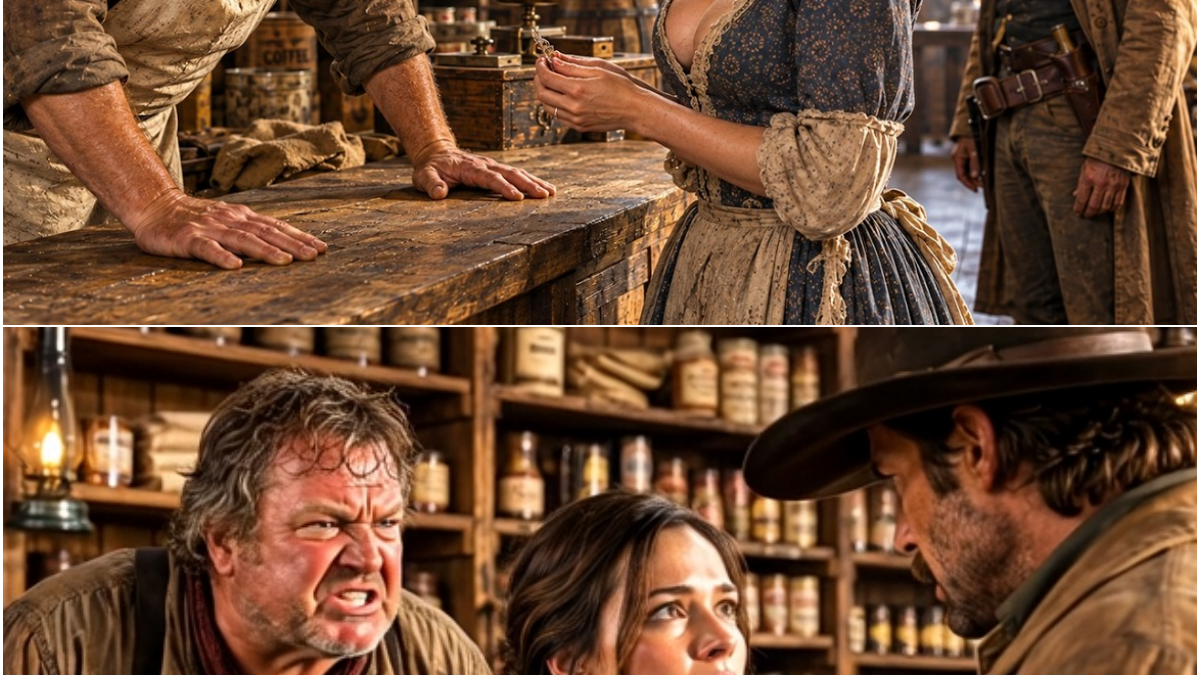
The laughter began before Ruth Bennett had even released her carpet bag. It rolled through the general store like a sudden summer storm, growing louder with every glance exchanged between the men near the counter.
Ruth stood beneath the hard September sun of Red Hollow, Colorado, with dust on her boots, twelve cents in her pocket, and a letter folded so many times that its edges had gone soft.
She had traveled nearly two thousand miles to marry a man she had never met.
By sunset, she would discover that the man had never existed. But the cruelest part of the journey would not be the deception, nor the money she had sacrificed, nor the terrifying uncertainty of having nowhere to go.
It would be the moment an entire room decided her misfortune was entertainment, while a mountain cowboy watched from the back of the store and said nothing.
His name was Cole Mercer. He was a man who had learned to keep his thoughts buried beneath silence, a man with a lonely ranch three miles above Granite Pass and a past he rarely allowed anyone to approach.
Ruth had no reason to expect kindness from him. She had no reason to trust anyone in Red Hollow.
Yet the stranger who watched her humiliation would soon offer her something she had not found in all the letters she had received from Nathaniel Crane.
He would offer her honest work, a roof, and a chance to begin again. But could a woman whose hopes had been shattered trust a man whose own heart had been closed for years?
Ruth had spent four months believing in Nathaniel Crane. His letters had arrived regularly, each one written in careful language that made his distant ranch sound like a place of peace and possibility.
He described quiet mornings, horses grazing in the pasture, and the empty chair across from him at supper.
He wrote that he had built a comfortable home outside Red Hollow and wanted a wife who would share it with him.
He said he was tired of eating alone and wanted someone to care for, someone who might care for him in return.
Ruth had believed him because she needed to believe that life could still offer her something good.
Her father’s farm in Ohio had gone to creditors after several difficult seasons. Her mother had been gone for six years, and her older brother had moved east and gradually stopped answering her letters.
At twenty-nine, Ruth possessed two dresses, a few household belongings, and a silver hairpin shaped like a small wild rose.
It had belonged to her mother, who used to wear it on Sundays and special occasions.
Ruth had supported herself through sewing, mending, and whatever work neighbors could offer. It was honest work, but the earnings were small, and the future seemed to grow narrower every month.
Then Nathaniel Crane had written. His letters made marriage sound like a doorway into a different life.
He promised a home where her labor would matter, where she would have companionship, and where the loneliness of recent years might finally ease.
When he asked her to send money for travel papers and legal arrangements, Ruth hesitated.
But he explained the expenses so confidently that she eventually sent him seventeen dollars, nearly every cent she had saved.
She packed her belongings, folded his letters into her bag, and boarded the stagecoach. Now she stood at the Red Hollow depot, waiting for a man who never came.
The driver finished watering the horses and looked toward her. “You waiting on somebody, ma’am?”
“Nathaniel Crane.” The driver’s expression changed. It was a small movement, but Ruth noticed it.
His eyes shifted away, and his mouth tightened before he answered. “Can’t say I know him.”
But his face suggested he knew more than he wanted to say. Ruth waited until the driver climbed onto his seat and the stagecoach rolled away.
Dust rose behind the wheels, then slowly settled over the road. She watched until the coach disappeared beyond the dry hills.
There was no one else to ask. She picked up her carpet bag and walked toward town.
Red Hollow was a modest settlement pressed between dry hills and distant mountains. A blacksmith worked beneath an open shed, striking iron with steady blows.
Horses stood tied outside the saloon, and a few men leaned against the boardwalk, watching the unfamiliar woman cross the street.
Across from the blacksmith stood Pike’s General Merchandise. Ruth stepped inside. A bell rang above the door.
Three men near the counter looked over, and a woman holding blue cloth turned from a shelf.
Behind the counter stood Amos Pike, a heavy man with thinning hair and a brown apron stretched across his stomach.
Ruth gave him the most confident smile she could manage. “Excuse me. I’m looking for Nathaniel Crane.”
Pike stared at her. Then he laughed. The sound was sharp and sudden. One of the men near a barrel of flour joined in, and another chuckled when he saw Ruth’s expression.
“Nathaniel Crane?” Pike repeated. “You came here to marry him?” “Yes.” Pike slapped the counter.
“Lord above. He caught another one.” The laughter spread. Ruth felt heat climb into her cheeks.
She looked from Pike to the other men, trying to understand what they found so amusing.
“What do you mean?” Pike leaned forward. “There ain’t any Nathaniel Crane ranch around Red Hollow.”
“That cannot be right. He wrote to me for four months.” “Then you’ve been writing to a swindler.”
Ruth’s fingers closed around the letter in her pocket. Pike explained that a man using the name Nathaniel Crane had been sending letters to lonely women across the country.
He described a ranch that did not exist, promised marriage, and asked for money to cover travel expenses and legal fees.
Once the money arrived, the letters stopped or the supposed rancher invented another reason to delay the meeting.
Ruth stood very still. “How much did he take you for?” Pike asked. She did not answer.
A man beside the flour barrel glanced at her carpet bag. “Looks like everything she had.”
The woman holding the blue cloth smiled behind her hand. Ruth wanted to disappear. She wanted to step outside, find a quiet place, and let the humiliation pass without another person seeing it.
But she had learned from her years on the farm that embarrassment did not fill an empty stomach or solve a practical problem.
She lifted her chin. “I need flour and salt.” Pike looked at her empty hands.
“With what money?” Ruth reached into her hair. Her fingers found the silver pin. She pulled it free, allowing her dark brown hair to fall loose around her shoulders, and placed the small ornament on the counter.
“What will this buy?” Pike picked it up and turned it beneath the light. For a brief moment, something changed in his expression.
Then he tossed it back onto the counter. “That? Wouldn’t trade you a cup of beans for it.”
Ruth knew little about the value of silver, but she remembered her mother’s warning. Never sell the pin unless staying alive depended on it.
Now staying alive might. “Please,” she said quietly. “Just flour.” Pike leaned closer. “You women keep coming west thinking some rich rancher is waiting to save you.”
Ruth’s jaw tightened. “I didn’t ask you to save me.” A few men laughed again.
Pike’s smile disappeared. “Then get out of my store.” Ruth reached for the pin. Before her fingers touched it, something heavy struck the counter.
A gold coin spun once against the wood and fell flat. The room went silent.
A tall man stood several feet behind Ruth. He wore a weathered brown coat, dusty boots, and a dark hat pulled low over his forehead.
His shoulders were broad, and his face had been shaped by mountain wind and long days outdoors.
Several days of beard shadowed his jaw. A Winchester rested against the shelves behind him.
His pale gray eyes were fixed on Amos Pike. “Cole,” Pike said, his voice suddenly uncertain.
The stranger walked forward. His spurs made a slow sound against the floorboards. He picked up Ruth’s silver pin, studied it briefly, and placed it carefully in her palm.
“Put that back where it belongs.” Ruth looked at him. “I can pay my own way.”
“Didn’t say you couldn’t.” He turned toward Pike. “Flour, salt, coffee, beans, bacon.” Pike remained still.
Cole’s eyes narrowed. “You lose your hearing?” The storekeeper hurried to gather the supplies. Ruth closed her fingers around the pin.
“I don’t take charity.” Cole looked at her properly for the first time. Up close, she saw something tired behind his eyes.
It was not the tiredness of a man who had simply worked too many hours.
It seemed older than that, as though he had carried some private burden for so long that it had become part of his face.
“Good,” he said. “Because I’m offering work.” Ruth studied him. “What kind of work?” “I have a place three miles above Granite Pass.
The herb garden is dying. The woman who planted it is gone.” His voice changed slightly on the last word.
Ruth noticed. “My mother grew herbs,” she said. “Rosemary, sage, feverfew, chamomile, mint. I know how to tend them.”
Cole’s attention sharpened. “You know how to bring them back if the roots aren’t dead?”
“I can find out.” He nodded toward the supplies. “Then earn your food.” Pike placed the sacks on the counter.
Cole pushed the gold coin toward him. Pike stared at it. “That’s worth ten times this.”
“Then perhaps next time you’ll remember what a poor woman looks like before you decide what she’s worth.”
Nobody laughed. Ruth took the supplies and followed Cole outside. She had no reason to trust him.
He was a stranger with a rifle and a hard expression, and she knew nothing about the ranch beyond the few words he had offered.
But behind her stood Amos Pike, who had just made it clear that he would not help her unless she could pay.
Beyond the store waited a town where she knew no one. And in her pocket lay a letter written by a man who had never existed.
Ruth slid her mother’s pin back into her hair. Then she followed Cole Mercer. His wagon waited beside the hitching rail.
A chestnut horse stood between the shafts, shifting its weight as the breeze stirred the duSt. Cole climbed onto the bench, and Ruth placed her carpet bag behind them before taking the empty seat beside him.
He flicked the reins. They left Red Hollow without another word. The road climbed steadily toward the mountains.
The sounds of town faded behind them, replaced by the wind in the pines and the steady rhythm of the horse’s hooves.
They crossed a narrow creek, followed a winding trail, and climbed through a forest where the afternoon light fell in long golden strips between the trees.
For nearly an hour, Cole said nothing. Ruth finally turned toward him. “Why did you help me?”
His hands remained loose on the reins. “Pike enjoys kicking people when they’re already down.”
“That isn’t an answer.” “No.” “Then what is?” Cole looked toward the mountains. “I know what that kind of laughter costs.”
Ruth waited, but he offered nothing more. She understood that some questions could not be forced.
She had learned the same lesson while caring for her father through the difficult years on the farm.
Sometimes a person needed time before words could come. The wagon continued upward until the trees opened onto a sheltered slope.
A log house stood near the base of a granite wall. A barn sat a short distance away, with a stone well beside it and several fenced fields stretching toward the lower valley.
The place was isolated but well maintained. The roof was sound, the fences had been repaired, and a neat stack of firewood stood beneath an overhang.
Yet Ruth barely noticed the house. Her eyes went to the garden. Dozens of plants covered the slope below the porch.
Rosemary branches had turned brown, sage had collapsed against the soil, and weeds had begun swallowing the beds.
A few old rose bushes remained, their twisted stems tangled beneath dead leaves. Ruth climbed down before the wagon had fully stopped.
She hurried into the garden and dropped to her knees. The earth was dry, but not entirely lifeless.
She brushed away the dead branches around a rosemary plant and dug carefully beneath the surface until her fingers found a root.
There, hidden beneath the brown growth, was a tiny green shoot. Alive. Ruth looked back toward Cole.
“This garden can be saved.” Cole stood beside the wagon, watching her. For several seconds, he looked past her toward the rows of plants.
His expression became still. “She used to say that, too.” Ruth slowly rose. “Who?” “My wife.”
He lifted Ruth’s carpet bag and carried it toward the house. “Come inside. I’ll show you where you can sleep.”
Ruth followed him through the front door. The cabin was clean, but it felt as though its warmth had been carefully removed.
Two chairs stood beside the table. One had worn marks on the arms from years of use.
The other looked almost untouched. A few dishes rested on a shelf, and a small collection of books sat beside the lamp.
Cole showed her a bedroom overlooking the garden. “You sleep here. Work starts before sunrise.
You work hard, I pay you. If you decide you want to leave, I’ll take you back to town.”
Ruth set her carpet bag beside the bed. “That simple?” “That simple.” Cole turned toward the hallway, then stopped.
At the far end stood a closed door. His eyes rested on it, and for the first time since Ruth had met him, she saw genuine fear cross his face.
“Anything else?” She asked. Cole looked back. “Yeah. Don’t open that room.” Then he walked away.
Ruth remained beside the bed as the light outside began to fade. She unpacked her dresses, placed the Bible on the small table, and set her sewing things near the window.
She tried to focus on the practical details of her new situation, but the closed door at the end of the hallway kept returning to her thoughts.
After a while, Cole went outside through the back door. The house grew quiet. Ruth was folding a dress when she felt a cold draft move through the hallway.
A faint smell drifted toward her. Lavender. She stepped outside her bedroom and listened. The scent seemed to come from the forbidden room.
As she approached, she noticed that the door stood open by an inch. Then she heard a soft sound from inside.
Something had fallen. Ruth stood barefoot in the hallway, listening for movement. Nothing followed. The lavender smell remained, delicate and familiar.
She knew she should go back to bed. Cole had given her one clear instruction, and she had no wish to begin her new life by ignoring it.
But something might have fallen and broken. She stepped closer and placed one hand against the dark wood.
“Cole?” No answer. She pushed gently. The hinges groaned, and moonlight slipped through a dusty window, spreading across a bedroom that looked untouched for years.
A faded blue quilt covered the bed. A Bible rested on a small table, and lace curtains hung beside the window.
A wooden wardrobe stood against the wall, while a vanity occupied the space beneath the glass.
Dust lay over everything. Ruth took one careful step inside. Then she saw what had fallen.
A silver hairpin lay on the floor. She bent and picked it up. It was shaped like a tiny mountain flower, delicate and finely made.
Its design reminded her of her mother’s wild rose pin. “Rebecca wore that every Sunday.”
Cole’s voice came from the doorway. Ruth turned quickly. He stood behind her, his face unreadable.
“I heard something fall,” she said. “I’m sorry. I should have stayed out.” Cole looked at the hairpin in her hand.
Ruth placed it carefully on the vanity. “I didn’t mean to intrude.” He did not answer at once.
Instead, he walked slowly into the room, his eyes moving over the bed, the curtains, and the Bible.
“My wife’s name was Rebecca.” Ruth remained silent. “Three years ago this winter, she got sick.
Started coughing one morning. By the fourth day, she could hardly stand.” His gaze settled on the quilt.
“Fever.” One word was enough. Ruth looked toward the garden through the dusty window. “She planted all of it?”
“Every row.” His voice softened. “She talked to those plants like they were children. Used to say each one had its own temperament.”
A faint smile touched his mouth, then disappeared. “I made fun of her for it.”
“What happened?” Cole looked at the bed. “She never got better.” Ruth understood the weight in his voice.
Her mother had also been taken by a fever, and she remembered the helplessness of watching someone grow weaker while the days continued to pass.
“My mother went through something similar,” she said. Cole looked at her. For the first time, neither of them turned away.
Something quiet passed between them, a recognition that did not need explanation. They were strangers, but they understood what it meant for a familiar room to become empty.
Cole walked toward the doorway. “Clean it if you want.” Ruth blinked. “You’re sure?” “She ain’t coming back.”
His jaw tightened. “Might be time I stopped pretending she could.” He left the room.
Ruth stayed for a long while, looking at the small hairpin on the vanity. She did not move anything else that night.
She simply stood in the room and allowed the silence to settle around her. The next morning, she began with the garden.
She carried one bucket of water, then another, then ten. By midday, her shoulders burned and her palms were sore.
She pulled thistles, loosened hard soil, and cleared away dead branches. She dug carefully around the roots of each plant, searching for signs of life beneath the brown growth.
Cole passed her twice during the morning. He said nothing. But that evening, when Ruth sat down for supper, she found a small tin of salve beside her plate.
She looked across the table. Cole kept eating. “For your hands,” he muttered. “Thank you.”
“Don’t make much of it.” “I wasn’t planning to.” A faint smile almost appeared on his face.
The days became weeks. The mountain air cooled, and the garden slowly began to change.
Rosemary pushed green shoots from old branches. Sage lifted its leaves toward the sunlight. Chamomile spread small white flowers across the beds, and the mint began growing so vigorously that Ruth had to keep it from spreading into the neighboring rows.
She worked from dawn until sunset. She cooked supper, cleaned the house, and gradually opened windows that had remained shut for years.
She washed Rebecca’s curtains and aired the blankets. She swept the unused bedroom and placed fresh flowers in a jar on the vanity.
Cole did not enter the room, but he stopped avoiding the hallway. Their silence changed, too.
At first, it had been the silence of two people who did not know one another.
Later, it became something comfortable. Sometimes Cole asked about Ohio, and Ruth told him about the farm, the seasons, and the work she had done with her father.
Sometimes Ruth asked about the mountains, and Cole described the trails, the streams, and the places where snow could remain long after spring had reached the lower valleys.
Once, she caught him watching from the porch while she worked among the herbs. He looked away immediately.
Ruth pretended not to notice. By late October, the garden was producing enough herbs to sell.
Ruth bundled rosemary with twine, sorted the sage, and gathered chamomile blossoms into clean cloth bags.
Cole examined one of the bundles. “Doc Lawson will buy everything you can grow.” “Then we should take it to market.”
He looked at her. Ruth knew he was thinking about Red Hollow. She remembered the laughter, the store, and the way Pike had tossed her mother’s pin onto the counter.
“I’m not hiding on this mountain because of him,” she said. Cole placed the bundle down.
“Market Saturday.” “Saturday morning.” Ruth prepared carefully. She washed her faded blue dress, repaired the hem, and brushed the dust from her boots.
Before leaving the cabin, she slid her mother’s silver pin into her hair. Cole waited beside the wagon, which was loaded with six crates of herbs.
Neither mentioned Amos Pike. The road down the mountain seemed shorter than it had on the day Ruth arrived.
Perhaps it was because she knew the turns now, or perhaps because she was no longer traveling toward a future she could only imagine.
When Red Hollow appeared below them, she felt her stomach tighten. She remembered standing alone outside the depot, holding a letter from a man who had never existed.
She remembered Pike’s laughter and the way he had looked at her pin as though it were nothing.
But this time, she carried something different. Behind her were six crates filled with rosemary, sage, mint, and chamomile, all grown with her own hands.
They set up beside the water trough. Cole unloaded the crates and arranged them near the table.
“You know the prices,” he said. Ruth looked at him. “You’re leaving?” “Feed store.” “Why?”
He pulled his hat lower. “You don’t need me standing beside you.” Ruth understood. He was giving her the chance to face the town on her own terms.
He had helped her when she had nowhere to turn, but he did not intend to make her dependent on his presence.
She nodded. “All right.” Cole walked away. At first, nobody came to the stall. People passed at a distance, glancing toward the herbs and then looking away.
Ruth arranged the bundles, straightened the labels, and waited. Eventually, an older woman approached. It was mrs. Lawson, the doctor’s wife.
She lifted a rosemary bundle and breathed in its fragrance. “My goodness. This is the finest rosemary I’ve seen since Rebecca Mercer was here.”
Ruth’s heart tightened. “I brought her garden back.” mrs. Lawson studied her face. “So you did.”
She bought four bundles. Then another woman approached. Then a rancher’s wife. Then a man who wanted mint for his kitchen.
By midday, Ruth’s table was surrounded by customers. People who had laughed at her on the day she arrived now stood in line to buy what she had grown.
Some avoided her eyes. Others acted as though they had never been present in Pike’s store.
Ruth remembered every face. But she treated them all the same. She weighed the herbs, accepted payment, and answered questions about planting and care.
She did not offer anyone a special price because they had been kind, nor did she charge more because they had once been cruel.
Her work was worth the same either way. Then the general store door opened. Amos Pike stepped outside.
Ruth’s hands stopped moving. Pike watched the crowd around her stall. His smile faded as he saw how many people had gathered.
After a moment, he began walking toward her. The street seemed to grow quieter. He stopped across the table.
“Well,” he said. “Looks like the mountain cowboy found some use for you.” The old anger rose in Ruth so quickly that she felt it in her throat.
Before she could answer, a voice spoke behind Pike. “She found use for herself.” Cole stood several feet away, carrying a sack of grain over one shoulder.
Pike turned. Cole lowered the sack to the ground. His gray eyes remained calm, and somehow that calm seemed to unsettle Pike more than anger would have.
“I was talking to her,” Pike said. Cole nodded. “Then talk respectfully.” Pike’s face reddened.
“This ain’t your business.” Cole stepped closer. “It became my business the day you laughed at somebody who had nowhere to go.”
Pike glanced around. People were watching now, including several who had joined in the laughter when Ruth first entered the store.
Ruth stepped out from behind her table. “Cole.” He looked at her. She shook her head.
“I can handle him.” Cole stepped back. Ruth faced Pike. “You were wrong about my pin.”
Pike’s eyes flicked toward the silver flower in her hair. “You were wrong about me, too.”
He opened his mouth, but Ruth continued. “I don’t need you to admit it.” She turned back to her customers.
“Are you buying rosemary, or are you blocking the table?” A woman near the stall laughed.
This time, nobody was laughing at Ruth. Pike’s face darkened. He looked around at the people watching him, then turned and walked away.
Ruth’s hands trembled after he left. She was surprised by how much the encounter had affected her.
She had believed that standing up to Pike would feel like a victory, but the old humiliation had not vanished simply because she had answered him.
Cole noticed. He said nothing. He simply placed the grain sack behind the stall and remained nearby until the market ended.
They sold almost everything. On the ride home, Ruth counted the coins in her pouch twice.
“I’ve never earned this much in one day.” Cole looked toward the road. “You earned more than money today.”
She smiled. “Was that a compliment?” “No.” “It sounded like one.” “Then you heard wrong.”
This time, she saw the smile he tried to hide. It was small and quick, but it was real.
They reached the ranch near sunset. Ruth climbed down from the wagon and took a few steps toward the house when the old sheepdog began barking at the road.
The sound was sharp and urgent. Cole turned. Hoofbeats thundered up the mountain trail. A young rider came around the bend, his horse covered in foam.
“Cole Mercer?” Cole stepped forward. “What happened?” The rider struggled to catch his breath. “Wagon went over near Blackstone Pass.”
Ruth felt a cold sensation move through her stomach. “Whose wagon?” The rider looked at her, then at Cole.
“Amos Pike. He’s alive, but badly hurt. Bandits robbed him before the wagon overturned. Doc Lawson is coming, but he won’t reach the pass before dark.”
Cole was already heading toward the barn. “Get the lantern.” Ruth did not move. For one long moment, the world seemed to narrow around her.
She remembered Pike’s laughter, his cruel smile, and the silver pin he had called worthless.
She remembered the shame of standing in that store with nothing to offer but the last thing her mother had left her.
Now Pike was lying injured in the mountains, alone and in need of help. Cole stopped at the barn door and looked back.
“Ruth.” She glanced toward the darkening trail. “Your choice,” he said. Ruth understood that he was not testing her.
He was giving her the freedom to decide what she could live with. She turned toward the house.
“Where are you going?” Cole called. “To get clean cloth.” She ran inside, took the largest lantern from beside the kitchen door, tore an old sheet into long strips, and packed them into a canvas bag.
She also gathered a small bottle of clean water and a blanket. When she returned, Cole had saddled his bay mare.
He mounted and reached one hand down. Ruth looked at it. “Still your choice,” he said.
She took his hand. Cole pulled her onto the horse behind him. Ruth wrapped one arm around his waist and held the lantern with the other.
They rode into the mountains. Darkness came quickly. The road narrowed between tall pines and broken rock.
Cold air cut through Ruth’s dress, and the horse climbed hard, its hooves striking sparks against the stone.
Neither spoke. At last, they rounded a bend and saw the overturned wagon below the road.
One wheel still turned slowly. Broken boxes lay scattered across the dirt, and flour had spilled across the ground in a pale trail.
The wagon’s side had split against a boulder, and one of its shafts was buried beneath a tangle of broken wood.
Cole stopped the horse. “There.” Ruth saw Pike lying near the wagon, half beneath a broken crate.
His face was covered with dirt, and one trouser leg was dark with blood. She climbed down.
For a moment, she could not move closer. The memory of the store returned in painful detail.
She remembered every laugh, every glance, every word that had made her feel small. Cole lit the lantern.
Yellow light spread across Pike’s body. His breathing was shallow and uneven. “I can lift the crate,” Cole said.
Ruth stared at Pike. “Do it.” Cole pushed his shoulder beneath the broken wood and lifted.
Ruth grabbed Pike beneath the arms. “Now.” Cole strained, and the crate rose several inches.
Ruth pulled Pike free. He cried out as his injured leg shifted, but she kept pulling until he was clear of the wreckage.
She dropped to her knees beside him. The cut on his leg was deep. Blood had soaked through his trousers and stained the dust beneath him.
Ruth pressed clean cloth against the wound. Pike’s eyes opened. At first, he seemed unable to recognize her.
Then his gaze settled on her face. His mouth moved. “You…” “Save your breath.” His eyes widened as she tightened the cloth around his leg.
“You could leave me.” Ruth paused. Pike’s voice was weak. “Wouldn’t blame you.” She looked at him for a long moment, then returned to the bandage.
“That would make me more like you than I ever want to be.” Pike closed his eyes.
Cole watched from beside the lantern but said nothing. They brought Pike back to the ranch before midnight.
Cole carried most of his weight while Ruth guided them through the door and prepared a bed in the small storage room near the end of the hallway.
She would not place him in Rebecca’s room. That space had been opened again for the living, but it still deserved care.
They laid Pike on the cot and removed his damaged coat. Ruth cleaned the wound with boiled water, packed fresh cloth around it, and covered him with a blanket.
Cole helped where he could, then went outside to settle the horses. Pike’s fever began before dawn.
By morning, the skin around the wound had turned red, and his breathing grew restless.
Ruth cleaned the injury again and used the herbs she knew, preparing a mild wash and keeping the bandage fresh.
She sent for Doc Lawson through a ranch hand who was heading toward town. The doctor arrived later that day and examined Pike.
“He needs rest, clean dressings, and careful watching,” he said. “The next few days will tell us how well he recovers.”
Ruth nodded. “I’ll watch him.” The first day passed slowly. Then the second. Pike barely woke.
At night, he muttered fragments of words that made little sense. Sometimes he spoke names.
Sometimes he seemed to be arguing with someone who was not there. Once, Ruth heard him whisper, “Don’t leave.”
She did not know who he was speaking to. On the third night, Cole brought her a cup of coffee.
“You need sleep,” he said. “So do you.” “I’ve survived worse.” Ruth looked at him.
“Have you?” Cole sat in the chair across from her. For a long time, neither spoke.
The lantern cast a soft glow across the room, and the wind moved gently against the window.
Then Cole looked toward the hallway. “Rebecca’s fever lasted five days.” Ruth lowered her cup.
“I kept thinking that if I stayed awake long enough, watched close enough, I could stop it.”
His hands tightened around his own cup. “Couldn’t.” Ruth did not offer a quick apology.
She knew that some losses could not be softened by a sentence. Instead, she asked, “What was she like?”
Cole looked surprised. Then, slowly, he smiled. “She sang terribly.” Ruth laughed softly. “Terribly?” “Couldn’t carry a tune if you put it in a wagon.”
“What did she sing?” “Hymns. Same three over and over.” “And you hated it?” “Every minute.”
His smile lingered for a moment before fading. Ruth understood that he was remembering something both precious and painful.
She could see the younger man he had been, sitting at the table while Rebecca sang, pretending to be annoyed while secretly enjoying the sound of another person filling the house.
Cole looked toward Ruth. “You brought something back into this house.” Her breath caught. “The garden?”
“No.” He stood before she could ask anything more. “I’ll watch Pike. Go sleep.” Ruth did.
The fever finally broke on the ninth night. When she woke, sunlight was crossing the floor, and Pike was staring at her from the cot.
His face looked thinner, but his eyes were clearer. “Where am I?” “Cole’s ranch.” Pike glanced around the room, then down at the bandage on his leg.
The memory of the overturned wagon returned slowly. His gaze moved back to Ruth. “You saved me.”
“Yes.” “Why?” Ruth poured water into a cup. Pike did not take it. “Why?” She set the cup beside him and folded her hands in her lap.
“I asked myself that, too.” Pike turned toward her. “My mother used to say you learn who you are when nobody would blame you for doing the wrong thing.”
His eyes lowered. “She sounds like she was a good woman.” “She was.” Pike swallowed.
“And I called her pin worthless.” Ruth said nothing. “I knew it was silver,” he continued.
Her expression changed. “What?” “I knew.” He looked ashamed. “I knew that pin was worth money.
More than enough for flour.” Ruth felt anger rise through her cheSt. “You lied.” “Yes.”
“Why?” Pike stared at his hands. “Because people laughed when I made you small.” The room became very quiet.
“And I liked how it felt,” he said. “Made me feel bigger.” He looked up at her.
“I’m sorry.” Ruth stood. “You almost let me go hungry because it entertained you.” “Yes.”
She wanted to hate him. Part of her still did. She remembered how powerless she had felt in his store, and she knew that no apology could return those moments to her.
But the man lying on the cot no longer looked powerful. He looked tired, ashamed, and uncertain about what kind of person he might become after this.
Ruth picked up the water basin. “Being sorry doesn’t erase what you did.” “I know.”
She stopped at the door. “But it can change what you do next.” Two weeks later, Pike could walk with a crutch.
One morning, Ruth found him dressed and sitting on the edge of the cot. A folded paper rested in his hands.
“I asked Sheriff Turner to come yesterday,” he said. Ruth frowned. “Why?” Pike held the paper toward her.
“Half the general store.” She stared at him. “What?” “The deed is legal. Half belongs to you.”
Ruth did not move. Pike explained that the store had been his livelihood for years, and that he had enough money to manage without owning every part of it.
He wanted to give her a share as repayment for the money he had taken and the humiliation he had caused.
Ruth looked at the paper. “I don’t want your store.” “It’s worth money.” “So was my pin.”
Pike flinched. Ruth stepped closer. “You still don’t understand.” “Then tell me what you want.”
“Nothing.” He looked confused. Ruth pointed toward the window. Outside, the garden moved beneath the morning breeze.
Rosemary, sage, mint, and chamomile grew in healthy rows, their leaves bright against the dark soil.
“I came here thinking some man I’d never met was going to give me a life,” she said.
“Turns out I needed to build one.” Pike looked down at the deed. Ruth took it from him.
For a moment, he thought she had accepted the offer. Then she folded the paper and placed it back in his hand.
“Keep your store.” “How do I repay you?” Ruth met his eyes. “Next time someone walks through your door with empty pockets, remember how you looked lying in that canyon.”
Pike’s face tightened. “That’s all?” “That’s enough.” He nodded slowly. Cole drove Pike back to Red Hollow that afternoon.
Ruth stood beside the porch while the storekeeper climbed carefully onto the wagon. His injured leg was still weak, and the crutch rested beside him.
Before Cole took the reins, Pike looked toward Ruth. “That silver pin…” She touched it in her hair.
“My mother’s.” “I know.” He cleared his throat. “It’s beautiful.” Ruth said nothing. Pike nodded once, then the wagon rolled down the mountain.
She watched until it disappeared beyond the trees. Cole returned near sunset. Ruth was in the garden cutting chamomile.
The evening light rested on the flowers, and the air carried the clean fragrance of herbs and damp earth.
“Pike made it home,” Cole said. “Good.” “Doc Lawson wants twice as much chamomile next spring.”
Ruth looked up. “Then you’d better start clearing another patch.” Cole raised an eyebrow. “You?”
“We.” She smiled. “Thought you said we.” Cole looked almost uncomfortable. “I did.” “And?” He rubbed the back of his neck and glanced toward the house.
The windows were open. The curtains in Rebecca’s old room moved gently in the evening breeze.
The cabin no longer seemed like a place frozen in an earlier season. It had become a home that could hold memories without being ruled by them.
Cole turned back to Ruth. “I’ve been thinking about that.” She waited. “This place was empty before you came.”
“The garden wasn’t empty.” “I wasn’t talking about the garden.” Ruth’s smile faded. Cole took a step closer.
“I don’t know what happens next.” “Neither do I.” “I’m not asking you to replace anyone.”
“I wouldn’t.” “I know.” He held her gaze. “But if you wanted to stay through winter…”
Ruth raised an eyebrow. “Just winter?” The corner of his mouth lifted. “Maybe spring.” “And after spring?”
“Could ask me again when the chamomile blooms.” Ruth laughed. Cole smiled, and the sound of her laughter seemed to surprise them both.
Behind them, the old sheepdog wandered into the garden and settled beside Ruth’s boots. The mountain sky turned gold above the pine trees.
Ruth reached up and touched her mother’s silver pin. Months earlier, she had stepped into Red Hollow believing it was the last valuable thing she owned.
Now she understood that its value had never been the most important part of the story.
Her worth had never depended on silver, or a husband, or the approval of people who knew nothing about her.
It had been in the hands that restored a garden everyone else had abandoned. It had been in the courage to stand before a laughing town and refuse to surrender her dignity.
It had been in the strength that carried a wounded man from a canyon, even when that man had once treated her cruelly.
And it had been in the patience to recognize that Cole Mercer was not simply a silent cowboy with a lonely cabin.
He was a man who had loved deeply, carried sorrow quietly, and slowly begun to believe that another person might belong beside him.
Cole reached down and offered his hand. Ruth looked at it. This time, there was no stagecoach waiting at the depot, no desperate road ahead, and no stranger promising to rescue her.
There was only a man asking her to walk beside him, with no promise that every day would be easy and no demand that she become someone else.
Ruth placed her hand in his. Together, they walked toward the house while the chamomile moved behind them in the mountain wind.
In the seasons that followed, the ranch became known for its garden and the welcome offered at its door.
Travelers who had been delayed by weather found warm food and a place to reSt. Neighbors came for herbs, advice, and help with difficult work.
Ruth’s bundles traveled to markets beyond Red Hollow, and people began asking for them by name.
Cole built another garden bed and repaired the fence along the lower field. Ruth taught him how to recognize the plants by their leaves before they flowered.
He learned to prepare the soil without disturbing the roots, and she learned which mountain paths were safest after the first snowfall.
They did not rush to name what was growing between them. Trust, like the garden, needed care.
Some days were easy, and others brought back memories neither could fully explain. Cole sometimes grew quiet when the house was too still.
Ruth sometimes woke remembering the laughter in Pike’s store. But neither was alone with those memories anymore.
They learned to speak when silence became too heavy. They learned to give each other space without turning away.
They learned that affection could be found in small acts: a cup of coffee set beside a tired hand, a repaired coat hanging near the door, a lamp left burning when someone returned late.
When winter came, the garden rested beneath a blanket of snow. Cole and Ruth worked together to prepare the cabin for the cold.
They stacked firewood, stored dried herbs, and checked the roof before the storms arrived. On the first evening of heavy snowfall, they sat beside the stove while the wind moved through the trees.
Ruth was mending a shirt. Cole was carving a small wooden box. After a long while, he looked up.
“Do you ever wish you had stayed in Ohio?” Ruth considered the question. “Sometimes I wish things had been different.”
“That isn’t the same.” “No,” she said. “It isn’t.” She set the shirt aside. “I wish I had never believed Nathaniel Crane.
I wish I had not sent him the money. I wish my father’s farm had survived the hard years.
But wishing those things had gone differently doesn’t mean I wish I were somewhere else now.”
Cole lowered his carving knife. “Even after Pike?” “Even after Pike.” She looked toward the window, where snow covered the garden beds.
“I thought losing everything meant I had no future. I was wrong.” Cole watched her for a moment.
“You found one.” “We found one.” He returned to his carving, but his expression had changed.
Ruth could see that the words mattered to him. The following spring, the first green shoots appeared beneath the old rosemary branches.
Ruth found them one morning while the sunlight was still low over the ridge. She called Cole outside, and together they knelt beside the garden bed.
“There,” she said. “It made it through.” Cole touched one of the small leaves with the tip of his finger.
“Rebecca would have liked that.” Ruth nodded. “I think she would have.” They sat quietly for a while, looking at the garden as it woke beneath the spring sun.
The memory of Rebecca remained in the house, in the hairpin on the vanity, in the books on the shelf, and in the plants she had once tended.
Ruth never tried to erase those things. Cole never asked her to. Instead, they made room for the past while continuing to build a future.
The garden grew thick again. Rosemary filled the air with its sharp fragrance, chamomile spread across the beds, and mint returned with its familiar determination.
Ruth expanded the rows and began preparing larger bundles for market. Cole watched her work one afternoon and shook his head.
“What?” “You’ve turned this mountain into a garden.” “Not all of it.” “Give you another year.”
Ruth laughed. “Then you’ll have to help.” He took the spade from beside the fence.
“I suppose I will.” By then, the people of Red Hollow had learned to speak of Ruth Bennett with respect.
They remembered the woman who had arrived with twelve cents, a carpet bag, and a letter from a man who did not exiSt. They remembered how she had faced Amos Pike without surrendering her dignity, and how she had later saved him when he had no one else to turn to.
But Ruth did not want her life remembered only through its hardest moments. She wanted people to remember the garden, the work, the warm meals, and the small kindnesses that made a lonely place feel welcoming.
She wanted the story to remind them that a person’s future could begin after disappointment, and that compassion did not require forgetting what someone had done.
Pike changed, too. He could not undo the cruelty of that afternoon in the store, but he could choose what happened afterward.
When women arrived in Red Hollow seeking work or a place to stay, he stopped treating their need as an opportunity for amusement.
He offered fair prices, gave honest directions, and sometimes set aside supplies for travelers who had been caught without money.
He never became a different man overnight. But he remembered the canyon, the bandage around his leg, and the woman who had saved him when he had given her every reason not to.
Sometimes he saw Ruth at market and touched the brim of his hat. She returned the gesture.
It was not friendship, exactly. Nor was it a promise that the past had vanished.
It was simply a sign that something had changed. And on the ranch above Granite Pass, Ruth and Cole continued making a life that neither had planned in quite the way it came to them.
They had begun as two people carrying different kinds of loneliness. One had been deceived and left without a home.
The other had built a home around an absence he could not bear to disturb.
They did not save each other by pretending the past had never happened. They helped one another by making the present worth living in.
Years later, travelers still told the story of the woman who had arrived in Red Hollow with almost nothing and left the town with a future she had built herself.
They spoke of her courage, her skill with herbs, and the way she had refused to let cruelty make her cruel in return.
Some remembered Cole Mercer as the silent cowboy who had placed a gold coin on Amos Pike’s counter and offered a stranger honest work.
Others remembered the way he had stood beside Ruth without trying to speak for her, and how he had learned that love was not the same as protection from every hardship.
But the people who knew them best remembered something quieter. They remembered the cabin with its open windows, the garden full of life, and the two chairs on the porch where Ruth and Cole sat together at the end of the day.
They remembered how the mountain air carried the scent of chamomile in spring and rosemary in summer.
They remembered that a person could arrive with an empty pocket and still have something valuable to give.
The West was full of stories about men who conquered difficult country and women who endured difficult lives.
Ruth and Cole’s story became something different. It was not about conquering another person or proving that one kind of strength mattered more than another.
It was about the courage to begin again. It was about a woman who refused to let a false promise define her, and a man who discovered that opening a door to another person did not mean betraying the memories he carried.
And it was about the simple truth that kindness could be stronger than humiliation, that respect could grow where loneliness had once lived, and that love could begin when two people stopped asking each other to be someone else.
Long after the laughter in Pike’s store had faded from the memory of the town, the garden above Granite Pass continued to bloom.
And every spring, when the first green leaves appeared beneath the old rosemary branches, Ruth remembered the day she had knelt in the dirt and found a living shoot beneath what everyone else had mistaken for a dead plant.
She had known then that the garden could be saved. Only later did she understand that the same possibility had been waiting for her, too.
Disclaimer: This content may be created by Al for entertainment purposes. Any resemblance to real persons, events, or places is coincidental.








