The Rasco Sisters of 1934 — What the Nurses Found in Their Ward Haunted the Town
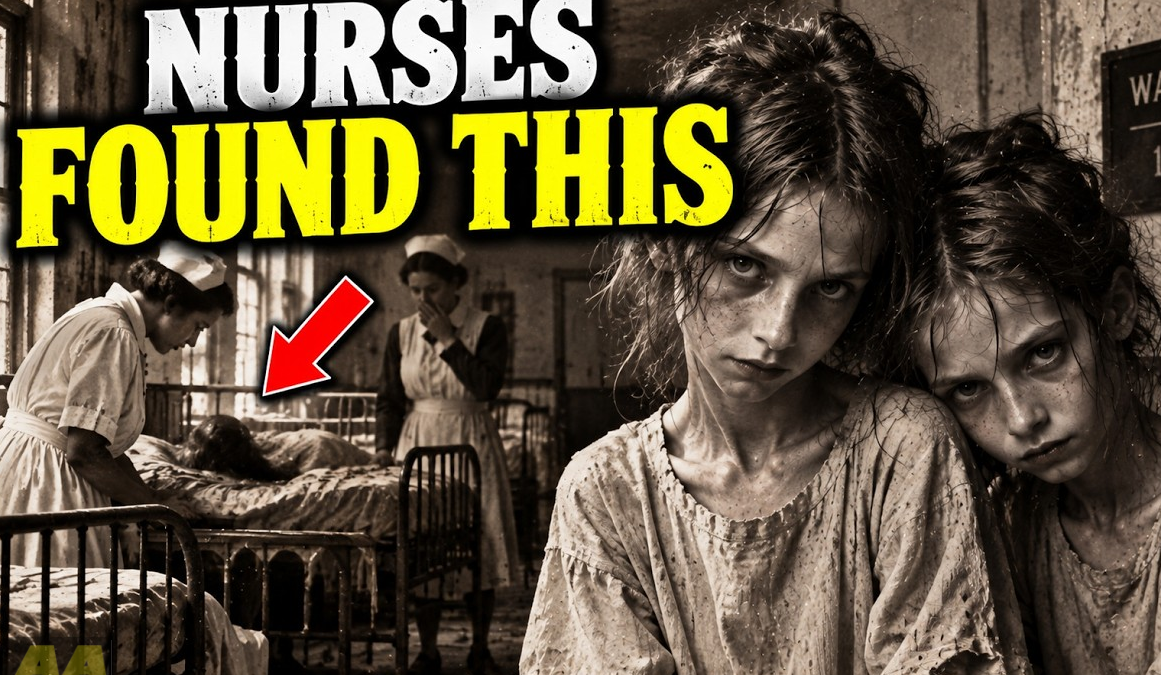
In the winter of 1934, when the country had learned to measure hardship in empty cupboards and unlit windows, two nurses working the night shift at a county home in Marrow Falls discovered a door that should never have existed.
It was hidden behind layers of plaster in the east wing, in a corridor they had walked hundreds of times, and beyond it was a staircase descending farther than any cellar beneath the building had any right to go.
At the bottom waited a ward filled with neatly prepared beds, spotless cups, folded linens, and strange lamps that produced a steady pale glow without flame, oil, wire, or heat.
The room looked prepared for patients who had simply stepped away. Then they found the calendar.
The year printed across its top belonged to a time before Marrow Falls officially existed.
Edith Rasco and Nora Rasco were sisters, trained nurses, practical women who understood the difference between exhaustion and imagination.
Neither had any reputation for inventing stories, and both had spent enough years around sickness and hardship to know what fear could do to the mind.
Yet what they discovered beneath that county home would eventually divide their lives forever. Nora left Marrow Falls within a year and refused to discuss that winter again.
Edith remained. She kept a notebook. Years later, after the county home had disappeared and the official records had been lost, that notebook was found sealed inside the wall of Edith’s house.
What it contained did not merely contradict the accepted history of Marrow Falls. It suggested that the town had been built over something much older, something deliberately forgotten, and something that had never stopped waiting beneath the ground.
To understand why two nurses opened that hidden door, you first have to understand the town above it.
Marrow Falls sat in a shallow valley where two rivers met before strangely separating again a mile downstream.
The official history was simple. A mill appeared on the near bank in the 1860s.
Families followed the work. A church was built, then a schoolhouse, then a courthouse and a main street lined with brick stores.
By the beginning of the twentieth century, Marrow Falls had become a modest county seat.
There was nothing unusual about the story. That was precisely what made it convincing. The town had dates for everything.
The mill was supposed to have been built in 1862. The courthouse came later. The county home stood on a low rise at the eastern edge of town.
It was a large stone building with a steep slate roof and tall arched windows.
In easier years, it had housed elderly residents, children without families, people who were ill, and anyone else with nowhere else to go.
By the winter of 1934, the building was overcrowded. The country had already endured four years of economic collapse, and Marrow Falls was struggling under the same weight as nearly every other community.
Food was scarce. Work was scarce. Money was scarce. The county had reduced the staff at the home until only a few people remained on the night shifts.
That was how Edith and Nora Rasco came to spend the longest hours of winter inside the building.
Edith was 31. She was tall, reserved, and methodical. She had a habit of checking everything twice.
If a patient needed medicine, she checked the bottle, the dose, and the name before handing it over.
Nora was 3 years younger. She was quicker to smile and quicker to worry. She talked with patients when Edith was busy with practical matters.
The sisters had grown up two counties away and trained at the same hospital. When work disappeared, they accepted the positions available in Marrow Falls.
The night shift was one of them. Their first strange discovery was not a sound in the corridor or a shadow near a window.
It was a number. Every night, before settling down, the nurses counted the residents. They walked through the wards, checked each bed, and recorded the final number in a ledger beside the front desk.
It was routine. That was why Nora noticed when the number stopped behaving normally. During the second week of December, she counted the east wing and found one more resident than the number of occupied beds.
She assumed she had made a mistake. The following night, the count was correct. Then it happened again.
This time Edith counted with her. They moved together from bed to bed, checking every sleeping figure.
When they reached the end of the ward, they had one extra. Neither woman had miscounted.
They returned to the beginning and counted again. The result was the same. At the far end of the corridor, beyond the last window, was a bed neither sister remembered seeing before.
It stood tucked into the corner. The blanket was folded neatly downward. The pillow was clean.
The mattress was empty. Yet somehow the bed belonged to the count. Nora stared at it.
“Where did that come from?” Edith did not answer immediately. She walked toward the bed and touched the frame.
It was cold. Not unusually cold for winter. Just cold enough to make her withdraw her hand.
The sisters checked the daytime records. There was no resident assigned to that bed. There was no bed listed in the inventory either.
They decided it must have been moved there during the overcrowding. That explanation worked for a few days.
Then Edith noticed something else. The east wing was longer on the inside than it was on the outside.
The difference was small. A room. Perhaps the width of a doorway. But it was there.
Edith measured the outside wall. Then she measured the corridor. The numbers did not match.
She measured again. The discrepancy remained. One evening, while the rest of the building slept, Edith ran her fingers along the wall beyond the final window.
She felt a seam. The plaster had been painted over many times, but underneath it was an outline.
A doorway. She pressed her palm against it. Cold air slipped through the smallest crack.
It was not the cold air of the winter night. It came upward. It smelled faintly of stone and clean water.
Edith told Nora. Neither contacted the county overseer. They had already learned that certain questions made his expression become strangely polite.
Instead, they waited. Near the end of December, they decided to open the wall. The building was quiet that night.
Edith brought a lamp. Nora brought a small pry bar. They removed the plaster carefully.
Flat pieces came away one after another. Behind them was a wooden door. It looked much older than the county home.
Dark wood. Iron bands. Heavy hinges sunk directly into the surrounding stone. Nora touched the latch.
It opened without resistance. A deep breath of cold air moved upward from the darkness.
The sisters looked at one another. Then they stepped inside. A staircase descended beneath the building.
It was not the cramped staircase of an ordinary cellar. It was wide enough for two people.
The walls were made from fitted stone. A smooth handrail followed the curve downward. They counted the steps.
Twenty. Thirty. Forty. Then they lost count. The staircase opened into a vast room. Edith raised the lamp.
Rows of beds stretched into the darkness. There were dozens. Every bed was prepared. Sheets were folded.
Blankets were turned down. Small tables stood beside each bed. Each table held a clean cup and a folded cloth.
There was no duSt. That detail disturbed Nora more than anything else. A sealed room should have been covered with duSt.
This room was spotless. Then Edith noticed the lights. They were mounted high along the walls inside glass fixtures.
There was no flame. No visible wire. No filament. Yet they glowed steadily. The light was pale and cool.
It did not flicker. It did not dim. It simply continued. Nora raised her lamp.
“Our building isn’t wired down here.” “I know,” Edith said. They walked farther into the ward.
At the end of the room hung a calendar. Nora approached it. The paper looked almost new.
The ink was dark. The year was printed clearly across the top. Nora stopped. Edith saw her expression.
“What is it?” Nora did not answer. Edith stepped beside her. She read the year.
It belonged to a period before Marrow Falls had supposedly been founded. Before the mill.
Before the courthouse. Before the church. Before the town existed according to every document they had ever seen.
The sisters said nothing. They returned upstairs. They closed the door. They replaced the plaster.
And neither spoke about the year. Not that night. The next morning, Edith began investigating.
She searched the county records. She examined building documents. She looked for construction permits and architectural plans.
She found nothing. The county home had no record of an underground ward. There was no mention of the staircase.
No mention of the lights. No mention of the old door. Edith became more determined.
She inspected the bed frames. There were no manufacturer markings she recognized. She searched for wires.
There were none. She searched for pipes. Nothing connected the ward to the building above.
Then she noticed a symbol carved into the stone above the staircase. A many pointed star inside a circle.
She copied it into her notebook. A few days later, she saw the same symbol on the courthouse.
It was carved above the main entrance. Edith stared at it for several minutes. Then she walked through town looking for it elsewhere.
It appeared above an old churchyard gate. It appeared on the stone bridge crossing the river.
It appeared on an iron railing beside the courthouse. Once she knew what to look for, she began seeing it everywhere.
Marrow Falls had been hiding the symbol in plain sight. There was something else that bothered her.
The oldest buildings in town seemed to be partly buried. Ground floor windows sat almost entirely below the current street level.
Some buildings had doors that opened several feet below the surrounding ground. The courthouse had finished stonework extending beneath the soil.
The county home had the same feature. Edith began studying the cemetery. The oldest graves were partially buried.
Some headstones disappeared almost to their upper edges beneath the soil. The dates carved into them were difficult to read.
The town claimed that its history began in the 1860s. But the cemetery appeared older.
Much older. Edith returned to the notebook. She wrote that the town might not have been built on empty ground.
It might have been built over something already there. Something had raised the ground. Something had buried the lower portions of the oldest structures.
And afterward, the people who lived above simply accepted the new level. The strange discovery in the county home began to look less isolated.
Then Edith noticed something about the children. The county home housed many young residents. Most had records.
Names. Ages. Places of origin. Family information. But there were several children whose files were almost completely empty.
Their records contained the same single word. “Received.” No parents were listed. No town was listed.
No institution was listed. Edith recognized that the word could have an ordinary explanation. Children had been moved through county institutions for generations.
There was a long history of orphan trains carrying children from eastern cities toward communities farther weSt.
Those records existed. But when Edith searched for the documents connected to the children at Marrow Falls, she found nothing.
No train. No organization. No receiving station. Nothing. Only the word. “Received.” Then she found photographs.
Every resident had a photograph attached to their file. The pictures were simple portraits. Edith compared the photographs of the children in the east wing with older county photographs.
Her hands began to shake. One boy appeared in a photograph from decades earlier. The same face appeared in a photograph taken in 1934.
Another child appeared in an even older photograph. The face had not changed. Edith began searching deeper.
She found more. The same small group of faces appeared throughout the county’s older records.
Children who supposedly belonged to different generations looked identical. She returned home that evening and wrote until the lamp burned low.
The children were quiet. Not simply shy. Quiet in a way that made Edith uncomfortable.
They did not behave like ordinary children. They listened. They watched. They seemed to know when adults were discussing things they should not hear.
One evening, Nora approached a little girl whose file identified her as Anna. “How old are you?”
The girl answered. “Nine.” “Where were you born?” Anna looked at her. Then she said, “Downstairs.”
Nora froze. She did not ask another question. That night, she wrote the words in Edith’s notebook.
The sisters returned to the underground ward. They stood at the entrance. The lamps were still glowing.
The beds were still made. Nothing had changed. But now the room felt different. They were no longer looking at an abandoned ward.
They were looking at a place that seemed to be waiting. They began studying the old county records more carefully.
The records had gaps. Years were missing. Names disappeared. The official history began abruptly. The mill appeared in 1862.
The church came afterward. The courthouse followed. But before those dates, there were references to buildings that supposedly did not exiSt.
There were family names that vanished. There were property lines that seemed to belong to people the official history had never mentioned.
The town appeared to have started in the 1860s because someone had decided that was where its story should begin.
The cemetery suggested something different. The oldest stones were partially buried. The lower floors of old buildings were buried.
The underground ward existed. And the calendar below the county home belonged to an era that Marrow Falls had erased from its own memory.
Edith began to believe that the town had inherited buildings from an earlier settlement. The flood of earth had covered portions of that earlier world.
The surviving residents had rebuilt above it. The old structures became foundations. The buried floors became cellars.
The forgotten population became a gap in the records. The official founding date became the beginning of the story.
And beneath everything remained the ward. There was still one problem. The lights. Nothing supplied them.
No wires. No oil. No fuel. Yet they remained bright. During thunderstorms, Edith noticed something strange.
The underground lights seemed brighter. The modern electrical lamps upstairs sometimes flickered. The old lights below never did.
The courthouse had a copper structure rising from its roof. The church had similar metalwork.
The bridge crossed the river with unusual stonework. Edith began wondering whether these features had once served a purpose that no one in 1934 understood.
She did not claim to know what that purpose was. She only knew that the old structures seemed to contain systems that had survived long after their original builders were forgotten.
Then she began watching Hollis Wend, the county home overseer. Wend had worked at the home for years.
He was polite. Careful. Reliable. He knew every corridor. Every resident. Every locked cabinet. Every ledger.
Nora noticed something unusual about him. He was always awake. Even during the deepest hours of the night, his lamp sometimes appeared in the east wing.
He would walk toward the hidden doorway. Then disappear. Several minutes later, he would return.
His coat sometimes carried a fine gray duSt. Nora recognized it. Stone duSt. She began watching him.
One night, she followed. Wend stopped before the hidden door. He touched the wall. The plaster shifted.
The door opened. He disappeared downstairs. Nora waited. She heard nothing. Then the door closed.
Wend returned several minutes later. He never knew she had seen him. The sisters realized that the hidden ward was not entirely forgotten.
Someone had been tending it. Someone had been keeping the beds ready. Someone had been maintaining the lights.
Someone had known about it for generations. The symbol on the courthouse suddenly made more sense.
The families who controlled Marrow Falls had remained powerful for generations. The same names appeared in county boards.
The same families owned the mill. The same families controlled the bank. The same names appeared in old documents.
The same symbol appeared on their buildings. They had preserved something. But Edith and Nora did not yet know what.
In early February, Wend was called away to another town. The sisters decided it was their opportunity.
They opened the hidden door again. This time they went farther. They walked past the first rows of beds.
Then more. Then more. The ward seemed to continue beyond what the building above could possibly contain.
The beds changed as they progressed. The newer iron frames gradually became older. The materials became unfamiliar.
The designs grew more elaborate. The deeper they went, the less the room resembled anything built in their century.
Finally, they reached another door. The same symbol was carved above it. The door was already open.
Beyond it was a circular chamber. At its center was a structure that resembled a well.
A cold current moved upward from it. Around the chamber were older beds. These were different from the others.
The linens were pale. The frames were made from a material neither sister could identify.
And some of the beds were occupied. The figures beneath the coverings were still. But not entirely still.
There was slow movement. Breathing. Nora could hear it. Edith could hear it too. They had found people sleeping beneath Marrow Falls.
People who appeared to have been there for far longer than the town’s official history allowed.
Nora moved closer to one bed. The figure beneath the covering shifted. Its face turned slightly.
She recognized it. It was Anna. The same girl from the east wing. But the face looked older.
Much older. Nora stepped backward. Edith caught her arm. Neither screamed. Neither ran. They simply stood there.
The meaning of the word “received” had changed. The children upstairs might not have been ordinary residents.
They might have been connected to whatever had existed below the town before Marrow Falls had a name.
They might have been sent upward for reasons the sisters could not understand. And the people beneath the earth had never stopped waiting.
They left the chamber. They walked back through the ward. They climbed the staircase. They closed the door.
They replaced the plaster. But Nora wrote that something had changed. It felt as though the room knew they had been there.
The sensation followed them upstairs. A pressure. An awareness. Something patient beneath the floor. The sisters knew they could not remain together.
If both left, their story could be dismissed as shared imagination. If one remained, there would at least be a witness somewhere.
Nora left Marrow Falls in the spring of 1935. Edith stayed. Nora never spoke about that winter again.
She moved away. She married. She raised a family. She lived an ordinary life. But she never liked basements.
She avoided buildings where the first floor sat below street level. And she never forgot the face of Anna.
Edith continued working at the county home. For another 11 years, she remained there. The official records described her as reliable.
Quiet. Unmarried. Somewhat peculiar in later years. She often walked through the old cemetery. She wrote constantly.
She rarely sent letters. Then, in the winter of 1946, Edith was found in her home.
The official record gave a simple explanation. Her house was cleared. Her belongings were removed.
The county home remained for several more years. Then, in the early 1950s, officials declared the old building unsafe.
A new facility was planned. The county home was scheduled for demolition. Before the building came down, a fire began in the basement.
The east wing was heavily damaged. The lower rooms were filled with debris. The site was eventually covered with earth.
Grass was planted. The county called the project an improvement. The old building disappeared. Marrow Falls moved forward.
The symbol above the courthouse remained. The cemetery remained. The buried windows remained. But the county home was gone.
Years passed. Then decades. No one remembered Edith Rasco. Almost no one remembered Nora. The town’s history became simpler with every generation.
The mill. The church. The courthouse. The founding date. The town park. Nothing beneath the surface.
Until a bundle was found inside the wall of Edith’s former house. It was wrapped in oilcloth.
Inside was a notebook. Edith’s notebook. The writing was careful at firSt. Then increasingly hurried.
There were measurements. Drawings. Names. Descriptions of the underground ward. Sketches of the symbol. Records of the children.
Notes about the cemetery. Notes about the buried floors. Notes about the lights. And near the end was a message intended for Nora.
It explained where the notebook had been hidden. It asked her to wait. So Nora waited.
For decades. In the 1970s, when she was 71, she finally wrote a letter to a young man who had once shown interest in old stories.
She told him about Marrow Falls. She told him about the wall. She told him where Edith had hidden the notebook.
Then she left the rest to him. What happened next is less certain. According to the surviving account, the young man traveled to Marrow Falls.
The old county home was gone. A park stood where the building had once been.
He found Edith’s former house. By then, renovation work had opened one of the walls.
Inside the debris was an oilcloth bundle. He took it. The notebook survived. The official history of Marrow Falls did not change.
The town still claimed to have been founded in the 1860s. The courthouse still stood.
The old cemetery still covered the hill. The symbol remained above the courthouse door. And beneath the park, whatever remained of the county home was still buried.
There is no way to prove every claim in Edith’s notebook. There is no way to know whether the lights were truly independent of the electrical system.
There is no way to establish what the underground chamber was built for. There is no way to know whether the photographs of the children were genuine matches or the result of old records being misidentified.
And there is no way to know what Edith and Nora actually saw below the county home.
But some details do not depend on the notebook. Old buildings really do contain buried floors.
Records really do disappear. The 1890 census was lost after a fire and subsequent disposal of surviving material.
The orphan train system really did move children across the country. The great exhibitions of the nineteenth century really did produce enormous temporary structures.
Old cemeteries really do contain stones that have become partially buried over generations. None of those facts proves what the Rasco sisters believed.
But they create the strange landscape in which their story can exiSt. Perhaps the hidden ward was nothing more than an abandoned structure whose purpose was forgotten.
Perhaps the lights had an ordinary explanation. Perhaps the children had been misidentified. Perhaps the calendar was placed there long after the room was constructed.
There are explanations for almost everything. Yet Edith never seemed interested in proving a fantastic theory.
She was interested in one simpler question. Why did the town’s physical remains tell a different story from its records?
Why were old floors buried? Why did the cemetery appear older than the founding date?
Why did the same symbol appear beneath the county home and above the courthouse? Why did the children have incomplete histories?
And why had someone worked so hard to make the underground ward disappear? Near the end of the notebook, Edith wrote something that became difficult to read.
The sentence was simple. “The town is not hiding the paSt.” The next line was darker.
“The town was built to cover it.” Nora added one final note years later. She remembered Anna.
She remembered the little girl standing in the east wing. She remembered the answer she had given.
“Downstairs.” Nora wondered what became of the children after the county home closed. The records did not say.
Some had been transferred. Some had been placed with families. Some simply vanished from the paperwork.
And because their original histories were incomplete, no one could trace them easily. Nora carried that question for the rest of her life.
Where did they go? Did they grow old like everyone else? Did they become part of ordinary families?
Did they forget the underground ward? Or did they remember it every night beneath their dreams?
Nora never found out. Perhaps no one ever will. The park in Marrow Falls remains ordinary.
People walk across it. Children play there. Visitors read the historical plaque. The plaque gives the founding date.
It mentions the mill. It mentions the early settlers. It tells the story the town has always told.
It does not mention Edith Rasco. It does not mention Nora Rasco. It does not mention the hidden staircase.
It does not mention the hundred prepared beds. It does not mention the pale lights.
And it certainly does not mention the room beneath the earth. But the oldest buildings of Marrow Falls still carry the same strange signs.
The ground around them is higher than the original entrances. Old windows remain partly buried.
The cemetery stones sit deep in the soil. The courthouse still bears the symbol. Perhaps all of it has an ordinary explanation.
Perhaps the Rasco sisters misunderstood what they saw. Perhaps the notebook preserved fear rather than fact.
Or perhaps they discovered something that the town had spent generations learning not to see.
The next time you walk through an old town, look carefully at the oldest building.
Do not begin with the roof. Look at the ground. Look at the windows. Look at the doors.
Look at where the walls disappear beneath the soil. Ask when the ground reached that height.
Ask why an old building would have finished rooms below the modern street. Ask why some towns have buildings that seem far too grand for the communities that supposedly built them.
And if you find a symbol carved into the stone, do not assume you already know what it means.
Because that was the mistake Marrow Falls made. It accepted the story that came after.
It stopped looking beneath the story that came before. And somewhere beneath the park, beneath the raised ground and the forgotten foundation, the old ward may still be there.
The beds may still be arranged in rows. The cups may still be sitting on their tables.
The lamps may still be glowing in that strange, steady way. And if Edith was right, the most frightening part was never that something was waiting beneath Marrow Falls.
It was that whatever waited there had already been waiting long before anyone thought to give the town a name.
What would you discover if the oldest building in your own town could finally tell you what was buried beneath its first floor?
Disclaimer: This content may be created by Al for entertainment purposes. Any resemblance to real persons, events, or places is coincidental.








