The Quarry Dumped Its Stone Dust at Her Gate for 14 Years — She Built a $400K Tile Brand
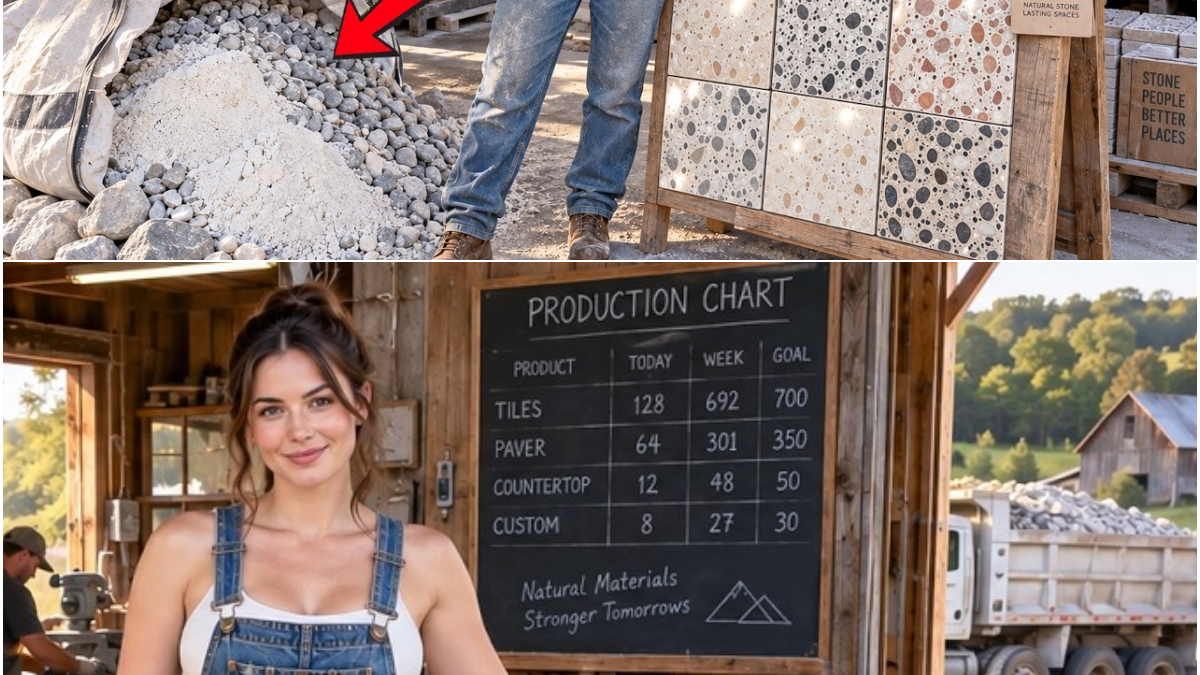
On a gray Tuesday morning in October, Nova Carr stood at her front gate with a cup of coffee cooling between her hands, staring at a mountain she had spent most of her life wishing would disappear.
Behind the sagging wire fence, the empty lot beside her lane had become a pale, towering landscape of limestone dust and broken stone.
It rose higher than the fence, higher than her father’s truck, and stretched across the ground like a small hill that had never belonged there.
For 14 years, the Wills Brothers Quarry had dumped its unwanted material at the end of the gravel lane, adding another load almost every week.
The pile had become part of the view, as ordinary and unwelcome as the potholes and weeds surrounding it.
Nova had grown up hearing complaints about it, watching her family argue over it, and seeing her father spend years trying to persuade the quarry to take responsibility for the mess.
But that morning, something about the pale powder caught her attention. She reached through the fence and let a handful slip between her fingers.
It was soft, fine, and strangely beautiful, with tiny chips of stone scattered through it.
She remembered polished terrazzo floors in Indianapolis showrooms, the expensive surfaces she had once admired while imagining a business she could never afford to start.
Then she looked back at the pile and began making a calculation that nobody else in the county had thought to make.
What if the thing everyone wanted removed was exactly what she needed? Nova was 28, tall and lean through the shoulders, with the build of someone who had spent years doing farm chores rather than sitting behind a desk.
A chipped front tooth from a childhood bicycle wreck gave her smile a slightly uneven look, though she rarely smiled at strangers.
Her pale gray eyes often made people think she was unimpressed with everything around her.
In reality, she noticed almost everything. She wore her hair tied beneath a bandana to keep dust and hay out of it, and she had a habit of studying ordinary objects as if they might reveal a secret if she watched long enough.
Eighteen months earlier, she had returned home after a small design business she tried to establish in Bloomington ran out of money.
She had hoped to make handmade home goods, build a recognizable name, and eventually sell through shops that valued original work.
Instead, she had exhausted her savings before she could establish steady customers. Back in Michigan, she lived in the run-down house at the end of the lane where she had grown up.
Three days a week she handled bookkeeping at the feed store, and two days she waited tables.
It paid enough to keep the lights on, but every week seemed to remind her how far she had fallen short of the life she imagined.
The limestone pile had always been a problem. Her father, Hugh Kerr, had spent years arguing that the quarry should stop dumping there.
Hugh was 61, broad and quiet, with hands marked by three decades of farm work, machinery repairs, and long days operating a bush hog.
He had also spent a decade trying to persuade the county to force the quarry to move its waste.
The Wills Brothers had continued dumping because the empty lot was convenient, the gravel lane was quiet, and hauling the material somewhere else would have cost money.
That evening, Nova brought her idea into the kitchen while her mother, Bev Kerr, fried pork chops.
Hugh listened without interrupting as Nova explained what she had seen in the duSt. She described terrazzo, cast stone, the mixture of aggregate and cement, and the way grinding could expose the stone inside a hardened tile.
She talked about showroom prices and the cost of raw materials, then pointed out that the quarry was already delivering the most expensive part of the process for free.
Hugh looked at her as if he were trying to decide whether she was serious.
“You want to make tile?” He said. “Out of the pile of dirt I’ve been trying to get Emmett Wills to move since you were 14?”
“That’s the plan, yeah.” “Nova, it’s dirt.” “It’s limestone fines, Dad. It’s the same stuff they sell for $400 a pallet in Indianapolis, minus the part where somebody mixes it with cement and polishes it.”
Bev slid pork chops onto a plate without looking up. “Eat something before you go start a tile empire,” she said.
It was as close as Bev came to blessing an idea. By the end of the week, the story had reached Otho Prine at the feed store.
Otho was somewhere in his seventies, wore suspenders, and laughed like a rusted gate. He had spent so many years watching people try and fail at ambitious projects that he considered skepticism a public service.
“How’s the dirt business, Nova?” He called across the counter one afternoon. “Making mud pies out of quarry sweepings?”
She raised her receipt book at him and kept working. Arguing with Otho only gave him a reason to keep going.
Nobody in the county made tile. There was no local craftsman who could show her the correct mix, no nearby workshop where she could watch a professional grind and polish stone.
What she had was an old shed behind the house, once used for her grandfather’s tractor implements, a laptop with a cracked screen, and an internet connection that worked well enough if she was patient.
She began reading late at night. Concrete Craft forums, terrazzo trade discussions, technical sheets from cement manufacturers, and old posts from hobbyists in Arizona, Oregon, and Nebraska filled her screen.
She learned unfamiliar terms one at a time. Portland cement. Aggregate to binder ratio. Slump.
Consolidation. Curing. Grit sequence. The vocabulary seemed endless, but the underlying process was straightforward enough to understand.
Terrazzo was stone aggregate suspended in a binder, usually Portland cement or resin. The mixture was poured into a mold, allowed to harden, then ground flat and polished until the stone chips became visible.
Cast stone tile used finer material, but followed a similar process. The challenge was not understanding the idea.
It was learning to make a tile that could survive real use. Her first batch came in November.
She mixed the material by instinct, shoveling limestone dust into a wheelbarrow, adding a bag of Portland cement that cost $11, and pouring in water until the mixture resembled cake batter.
She had built a wooden mold from scrap pine and filled it with the mixture, smoothing the top with a board.
Two days later, she removed the tiles. The corners crumbled. The faces were soft enough that she could press a thumbnail into them and leave a mark.
The tiles looked like something that might hold together if nobody touched them, but they had no real strength.
She had used too much fine dust and too much water, and nowhere near enough cement.
A Nebraska hobbyist’s post explained the problem. A workable mix might use one part Portland cement to two or three parts aggregate by weight, depending on the materials and intended result.
Water had to be carefully controlled. Too much diluted the cement paste and weakened the bond.
Too little prevented the mixture from flowing into the mold. Nova had made mud with a little cement in it and expected it to behave like stone.
She scraped the failed tiles into a bucket and started again. Batch two, in early December, was closer.
She increased the cement, added some larger chips from the quarry pile, and reduced the water.
The tiles held their shape when she removed them from the mold. For four days, she allowed herself to feel encouraged.
Then she cut one open. The cross-section was riddled with tiny holes. The surface was pitted, and when she tried to grind it, the machine sank into pockets of air and loose dust instead of cutting a solid surface.
The tiles had hardened, but they were full of weak places. The problem was trapped air.
Wet concrete could hold bubbles when it was poured and stirred. If those bubbles remained inside the mold, they became voids that weakened the finished tile.
Nova learned that the trade called the process of removing them consolidation. She began tamping the mixture down with a length of rebar, working in rows until she had pressed it into the corners and around the edges.
Then she needed vibration. At first, she lifted the molds and banged them against her workbench.
It helped, but the results were inconsistent. Eventually, she bought a $50 orbital sander and strapped it beneath the mold table.
The vibration shook the trapped air upward and allowed the mixture to settle. The first time she watched a rough mix of wet gravel turn into a smooth, level surface, she felt as though she had finally understood something that had been hiding in plain sight.
But the next problem arrived in January. The shed was unheated, and the cold slowed the hardening process.
Nova worried that the tiles would take too long, so she carried a tray outside on a weakly sunny day when the temperature reached 40°F.
She thought the sun and fresh air might help them along. Three days later, the faces were covered in hairline cracks.
When she tapped one with a fingernail, it made a dull sound instead of the firm knock she expected.
She had not simply made a surface defect. The tiles had failed throughout their structure.
A contractor’s forum post explained why. Cement did not dry in the ordinary sense. It cured.
Water and cement reacted chemically, forming structures that locked the aggregate together. The reaction required time and moisture.
If the surface dried too quickly, especially in direct sun or moving air, the reaction could stop before the material reached its intended strength.
The advice was simple. Keep the tiles damp, cover them, protect them from direct sun, and allow a full 28 days of curing.
Wet burlap or plastic sheeting could hold moisture around the material. A little water every day or two helped keep the surface from drying out.
Twenty-eight days felt like an unreasonable amount of time to a woman who had a bookkeeping job, waitressing shifts, and an entire shed full of experiments.
But she had learned what happened when she tried to shorten the process. Batch four cured slowly beneath plastic sheeting weighted with bricks.
When Nova finally removed it, the tiles were hard enough that a screwdriver could not scratch them easily.
Then came color. She wanted a soft, warm gray to complement the natural limestone tone.
She bought iron oxide pigment and began adding it by eye. Batch five came out darker than batch four.
Batch six was blotchy, with one corner noticeably darker than the reSt. She laid four tiles on her kitchen table and stared at the differences.
A floor was only as consistent as its most obvious mismatch. Nobody would buy an expensive tile installation if every third tile looked like it came from a different product line.
Nova bought a cheap kitchen scale. She began weighing pigment by the gram, cement and aggregate by the pound, and recording every recipe in a spiral notebook.
She tracked water, mixing time, tamping, vibration, curing conditions, grinding sequence, and sealing. If a batch worked, she wanted to be able to make it again.
Six ruined batches had taught her what a little discipline could have prevented. Grinding and polishing became their own education.
A cured tile straight from the mold looked dull, mostly like gray cement with a hint of stone.
The terrazzo effect appeared only when she ground away the top layer and exposed the aggregate.
She began with rough diamond pads to flatten the surface and uncover the stone. Medium grits removed the scratches from the first pass.
Fine grits followed, each step replacing the marks left by the one before it. The final pass could leave a surface smooth enough to reflect light.
Her first two attempts at grinding went badly because she worked dry. Fine silica dust filled the shed, the pads clogged with paste, and the tile faces ended up scratched and dull.
At 2:00 in the morning, she read an OSHA safety sheet about the hazards of airborne dust and went straight out the next day to buy a garden hose attachment for the grinder.
Wet grinding cooled the pad, flushed away the slurry, and kept the fine dust from filling the air.
It also made the work cleaner and the finish more predictable. Sealing was the final step.
Cement was porous. Without protection, a finished tile could absorb water, stain from coffee or wine, and develop efflorescence.
Moisture moving through the tile could carry dissolved salts to the surface. When the water evaporated, the salts remained as a chalky white haze.
Nova learned to apply a penetrating sealer only after the tile had fully cured and dried.
The treatment helped protect the surface against moisture and stains without changing the polished appearance.
By March, she had a repeatable process. The quarry dust cost nothing. Portland cement came to about $7 per square foot of finished tile, pigment added roughly another dollar, and her reusable mold had cost $15 in scrap lumber.
A batch of a dozen tiles took about 6 hours of hands-on labor, spread across mixing, tamping, grinding, and sealing, with the 28-day cure happening in the background.
She studied prices for comparable handmade and factory products and decided she could sell her work for $16 to $20 per square foot.
Designer showrooms charged $25 to $30 for factory terrazzo, and she believed her material could compete on appearance and durability if she kept the quality consistent.
The shed was becoming a workshop, and the workshop was becoming a business. She was not working alone, exactly.
Gravel, a guinea fowl Bev had bought years earlier to help control ticks, had adopted the stone dust pile and shed as her territory.
Gray and white speckled, round-bodied, and permanently offended by the world, Gravel possessed a shriek that could carry all the way to the county road.
She announced delivery trucks, strangers, the mail carrier, and occasionally nothing Nova could identify. She strutted through the yard as if she owned every square foot of it.
In April, Gravel walked directly across a tray of curing tiles and left three-toed prints across four surfaces.
Nova had to scrap the entire tray. The bird also had a habit of appearing underfoot when Nova was pushing a full wheelbarrow, creating several near disasters that made the work seem less like a business and more like an obstacle course.
The first sale came almost by accident. Nova had made coasters from leftover material cut off the edges of practice tiles.
They were soft gray, with pale stone flecks visible through the polished surface. She sealed them and placed six in a basket by the front door.
Bev’s sister came by in May, admired them, and bought the set for $24. She used them during a bridge night, where another woman asked where she had found them.
By June, Nova had sold $40 worth of coasters to people she had never met.
The profit amounted to perhaps $6 an hour after counting her time. It was not a business yet.
It was proof that someone besides her family could see value in what she was making.
The real opportunity came in AuguSt. Nova drove 2 hours to Indianapolis with a milk crate of sample tiles in the back seat.
She had spent days looking at tile and design showrooms online, studying their photographs and product descriptions.
One shop, Meade & Co., seemed particularly interested in unusual materials and local craftsmanship. She arrived without an appointment.
Yolanda Meade, the owner, was around 50, sharply dressed, and experienced at selling distinctive tile to homeowners who wanted something beyond the big-box selection.
She examined Nova’s samples, turned them over, and ran her fingers across the polished faces.
“These are handmade? Every one? Where’s the stone from?” “End of my driveway. The quarry has been dumping its waste fines there for 14 years.”
Yolanda laughed. It was the first genuine laugh Nova had heard from someone who was not making fun of the idea.
“Local, handmade, and free raw material. Homeowners are going to eat this up. I can move 50 square feet as a trial.
If it sells, we talk numbers.” The trial order sold in 11 days. Yolanda called back for 200 more square feet by October.
Nova quit waitressing that fall and kept the feed store bookkeeping for dependable income while the tile business grew.
Hugh did not announce that he had changed his mind. Instead, he spent a weekend building proper curing racks from 2-by-4s and chicken wire.
The racks allowed Nova to stack more trays beneath damp burlap without letting the tiles touch.
He never said the dirt pile idea had legs. He did not need to. The next spring brought an order that nearly undid everything.
A developer named Dominic Falk was finishing a boutique hotel renovation in a river town 40 minutes north.
He had seen a sample floor Yolanda installed in a client’s mudroom and wanted 1,100 square feet of Nova’s tile for the hotel lobby and bar.
The opening was tied to a deadline that could not move 6 weeks out. Nova knew immediately that the schedule was tight.
Her tiles needed 28 days of curing, followed by grinding, sealing, packing, and delivery. The order was eight times larger than anything she had made before.
She accepted it anyway. She was afraid that if she admitted the work could not be completed safely within the deadline, Falk would find another supplier.
The contract could put her name in front of designers throughout the region. It could change the scale of the business in a single season.
She ran three batches at once. The shed filled with molds, trays, tools, and stacked materials.
Her mixer worked harder than it had ever worked, and she began measuring each day against the installation schedule.
When batch two reached day 19, the deadline was approaching. Nova made the decision that would cost her more than any of the failed experiments.
She pulled the tiles early, misted them heavily, and shipped them. She told herself that 19 days was close enough to 28 that the difference might not matter.
It mattered. Six weeks after installation, Yolanda called. Her voice was tight, and she did not waste time on pleasantries.
Falk’s lobby floor was cracking. Fine fractures spread outward from the grout lines, and a chalky white bloom was appearing near the bar.
Under the track lighting, every guest checking in could see it. The tiles had not completed their cure.
They had not reached their intended strength. Some had also been sealed before the curing process was finished, trapping moisture that was now moving toward the surface and carrying salts with it.
The failure was public. Guests were photographing the floor and posting about how a beautiful new lobby was already falling apart.
The installation carried Yolanda’s showroom name, but the tiles were Nova’s. The problem was no longer confined to the shed or her own reputation.
Nova drove to the hotel that week. She walked the lobby with Falk, then knelt in the middle of the floor in her work boots.
She did not blame the humidity, the installer, the grout, or the stone. “I rushed the cure.
Cement needs 28 days, and I gave it 19 because your deadline scared me. This is on me, not the stone, not the mix.
I’ll remake the whole floor at my own cost, and I won’t touch your install date with anything that hasn’t had its full cure this time.
Even if that means we miss your grand opening on this section.” Falk did not dismiss her.
Later, he told her that the honesty had mattered. She had not tried to push responsibility onto someone else.
She had admitted exactly what she had done and offered to correct it. Nova remade all 1,100 square feet that spring.
She staggered the batches properly, kept them damp, and waited for every one to complete the full cure.
She paid for the replacement material and labor herself. The loss came to just over $6,000.
For an operation that size, it was a serious setback. It consumed money she had been saving and forced her to turn down smaller work while she rebuilt the hotel order.
But the replacement floor was installed that summer, and it held. It did not crack, bloom, or develop the dull patches that had ruined the first installation.
The experience changed the way Nova sold her product. From then on, she told every client that her tile took longer than factory tile because she would not rush the cure for anyone’s deadline.
She explained the 28 days, the grinding sequence, the sealing, and the testing. She made it clear that her product was handmade, but that did not mean she was willing to treat quality as a matter of luck.
Her guarantee became part of the product. Properly cured. Properly sealed. Tested before leaving the shed.
Designers began to understand that the waiting time was not wasted time. It was part of what they were buying.
By the second full year, the business grew in a way that each stage could support.
Yolanda’s regular orders led to two more design showrooms in Indianapolis and one in Louisville carrying the tile as a named line.
Nova called it Kerstoneworks. Every box carried a hand-stamped tag with the name in block letters.
A landscape architect working on a public plaza in a nearby town saw the hotel floor and contacted her.
The project called for a custom terrazzo bench top and a set of pavers. It was her first public-space commission, and it led to a small write-up in the county paper.
Otho Prine clipped the article and taped it to the register at the feed store, beside the receipt spike.
He never admitted he was proud of her. He simply left it there, where everyone could see it.
Online orders began arriving after Yolanda posted photographs of a finished kitchen backsplash. Most were for coasters, trivets, and small custom tile sets shipped in flat-rate boxes.
The work did not produce much profit per hour, but it helped keep money moving between the larger commercial jobs.
Then a national flooring distributor approached her through a regional representative. The offer was for a standing contract of 4,000 square feet a month.
It was more than triple anything she had produced in a season, and the price looked enormous on paper.
Nova turned it down. It took her longer to explain the decision to Hugh than it had to explain the tile itself.
“Four thousand square feet a month, I can’t cure that slow and honeSt. I’d have to cut the cure or hire people I haven’t trained and can’t watch closely enough.
And then I’m the girl whose hotel floor cracked, except now it’s every floor.” Hugh listened, then nodded once.
He had spent a decade trying to get the quarry dust removed from the lane.
He understood what it meant to build something slowly and what could happen when a person tried to force a result before the work was ready.
Nova chose to remain an artisan operation rather than become a factory. She kept her volume within the limits of what she and, eventually, two part-time helpers from town could properly cure and grind by hand.
She also protected the resource beneath the business. The pile at the gate had changed in one important way.
Cormac Wills now ran the quarry, after his father passed the operation to him. He had inherited the routine of dumping the waste at Nova’s lane, but once he understood what she needed, he began separating the material before delivery.
Nova needed fines graded by chip size and screened for consistency. She needed certain batches kept away from dirt and diesel drippings.
She needed the same kind of aggregate from one delivery to the next so her colors and surfaces would remain consistent.
Cormac began sorting the quarry fines to her specifications. The material that had once cost the quarry nothing to dump had become an important part of a paying customer’s business.
Nova was also telling architects and designers where her stone came from, and the quarry benefited from the attention.
Cormac was not inclined to turn down goodwill from a customer who spoke well of his operation.
By the close of her third full year in tile, Nova’s numbers were no longer hopeful estimates written in a notebook.
They were business records. She had sold just over 11,000 square feet of tile that year across four showroom accounts, one hotel replacement job, one public commission, and a steady stream of direct online orders.
Her average blended price was about $19 per square foot. Custom pieces took more labor than standard runs, and the costs varied from one project to another.
Cement, pigment, sealer, mixer maintenance, mold lumber, propane for the shed heater in winter, and the wages of her two part-time helpers all added up.
Revenue came in at just over $406,000. Material and overhead costs, including labor, came to just under $240,000.
For the first time since she had returned home feeling like a failure, she had a livable margin and a business that could support itself.
That November, Otho Prine bought a set of six coasters. He slid cash across the feed store counter as if the transaction embarrassed him.
“For the wife,” he said. “Not for me. I don’t need coasters.” Nova wrapped them without comment and charged him full price.
She let him keep his dignity, and he let her keep hers. One gray morning that winter, Nova stood at the front gate with coffee cooling in her hand.
It was not so different from the October morning when she had first looked at the pile and seen something beyond a nuisance.
A Wills Brothers truck backed up beside the lot and tipped another load onto the mountain.
Gravel stood a few feet away, puffed up and silent for once, watching the truck with the same suspicious attention she gave every visitor.
The pile looked exactly as it always had. Pale, chalky, and taller than the fence.
But Nova no longer saw an eyesore. She saw roughly $400 a ton of raw material arriving for free, just as it had for 14 years before she ever thought to run it through her fingers.
Hugh came out and stood beside her. He put his hands in his coat pockets and watched the truck finish unloading and pull away.
Then he looked toward the shed, where the curing racks stood neatly arranged beneath damp burlap.
“Well,” he said, “I was wrong.” That was the whole sentence. It was enough. The world was full of things people discarded and complained about for years without ever asking what they might become.
A pile of stone dust at the end of a lane. A nuisance the county had tried to force away.
An eyesore that three generations of one family had cursed every time they drove past it.
It had sat there for 14 years before Nova thought to run a handful through her fingers and recognize the raw material of something people in the city would pay a small fortune to have installed in their homes and businesses.
Kerstoneworks had not begun with a mentor, a loan, or a lucky break. It began with an observation, a failed batch, and a willingness to learn from each mistake without pretending the mistakes had not happened.
The quarry kept dumping its waste, week after week, on the same gravel lane. The same trucks came at the same hours, followed the same route, and backed into the same lot.
Nova started keeping a separate ledger in the back of her spiral notebook. She tracked the tonnage delivered against the tonnage used, much as her grandfather had once tracked rainfall.
It was not for the county, Cormac Wills, or a bank. It was for her.
Each entry connected the pile to a finished product. One load became a batch. A batch became a row of tiles.
Those tiles became a floor beneath hotel lighting, a kitchen backsplash, a public plaza, or a bench top where people sat and talked without knowing the material had once been unwanted waste.
That winter, Nova took on her first formal apprentice. Priya Wexler was 19 and lived two farms over.
She had seen the newspaper clipping at the feed store and arrived at the shed asking whether Nova had any work available.
Nova started her where she herself had started, with a small batch mixed too wet.
She did not do it to embarrass Priya. She wanted her to feel the difference between a mixture that would hold and one that would fail.
She wanted her to understand how the material moved under the trowel, how the water changed the consistency, and how the surface responded when it was tamped and vibrated.
There was no shortcut that could replace learning to recognize those things. Priya made mistakes, and Nova made her write them down.
They compared the failed tiles with successful ones and changed one part of the process at a time.
When a batch worked, they recorded the measurements and conditions. When it failed, they looked for the reason before mixing another.
Gravel took an immediate proprietary interest in the new worker. She followed Priya across the yard, shrieked at her toolbox, and once made off with a grinding pad that had been left unattended for 4 minutes.
Nova charged the incident to the cost of doing business with a guinea fowl on the payroll.
By spring, the curing racks Hugh had built were full most weeks. Damp burlap covered the trays, and the shed held the steady rhythm of a workshop that had found its pace.
Outside, the quarry continued delivering the same pale dust to the same place. Nothing about its routine had changed.
The pile still rose behind the sagging fence, and the trucks still came along the gravel lane.
But the material no longer waited there without purpose. It was measured, screened, mixed, pressed, cured, ground, and sealed.
It was packed into boxes and sent to showrooms. It became surfaces that caught the light and lasted because Nova had learned not to rush the work hidden beneath them.
She had spent years believing that returning home meant she had failed at the life she wanted.
Now she understood that the lane, the shed, the old house, and even the pile that had frustrated her family for 14 years had given her a place to begin again.
The pile kept growing, and Nova kept finding ways to use it. That was the part she came to love moSt. The quarry had not changed its habits.
The county had not suddenly discovered a new use for the fines. The stone itself had not become more valuable overnight.
Only the person looking at it had changed. And that was enough to turn an unwanted mountain into a business, a failed experiment into a process, and a long-standing family complaint into the foundation of something that could keep growing for years.
Disclaimer: This content may be created by Al for entertainment purposes. Any resemblance to real persons, events, or places is coincidental.








