The Mountain Man Sent for a Delicate Bride — But a Big, Strong Woman Shocked the Entire Prairie
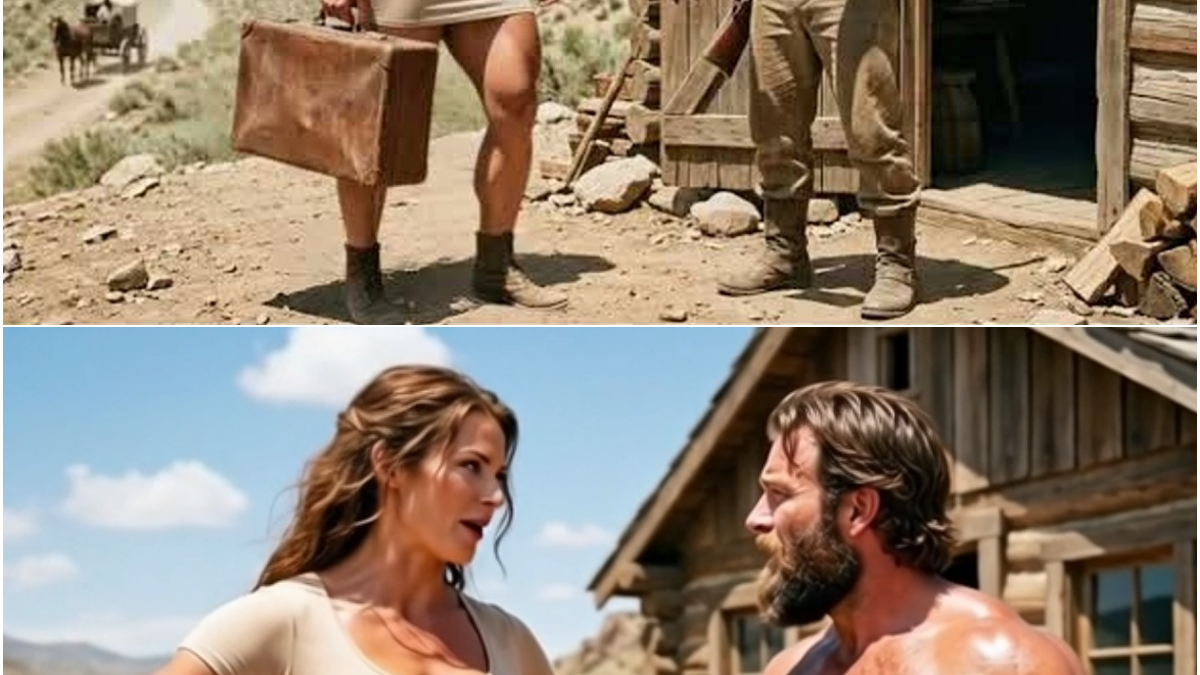
The mountains beyond Iron Ridge had a reputation that traveled farther than any stagecoach. People in Cedar Bluff said the high country did not welcome the weak, that its freezing winters and treacherous trails had broken men who believed themselves stronger than the world.
The few who lived there learned to depend on their own hands, their own judgment, and the silence that settled over the pines after sundown.
No one expected a mountain trapper to ask for companionship, least of all a man whose name had become a legend across three territories.
Yet one bright spring morning, a stagecoach rolled into Cedar Bluff carrying a letter that would turn the town’s quiet routines upside down.
It had come from Gideon Mercer, a giant of a man who had spent years alone in a cabin above the valleys.
He was searching for a bride, but his request was unlike anything the townspeople had heard.
He wanted a gentle woman, someone who could bring warmth and kindness into his lonely home.
The men in the post office read the letter twice, then passed it around as though it might contain a joke.
What sort of woman could possibly make a home beside a man who seemed carved from the mountains themselves?
And what would happen when the woman who answered his request arrived looking nothing like the delicate bride everyone had imagined?
Her name was Eleanor Briggs, and when she stepped down from the stagecoach in Cedar Bluff, the entire street seemed to forget what it had been doing.
She was a woman of remarkable height and powerful build, with broad shoulders, strong arms, and hands made rough by years of honest work.
Her dress was plain, her boots were sturdy, and her expression held neither apology nor challenge.
She had not traveled nearly fifteen hundred miles to be embarrassed by strangers, and she had no intention of allowing their astonishment to decide what kind of day she would have.
The driver lowered her two enormous trunks from the back of the coach. Before he could reach for the handles, Eleanor lifted one trunk in each hand and carried them away from the wheels.
A man standing outside the general store stopped with a sack of flour balanced against his hip.
Two cowboys near the hitching rail exchanged a look. A woman watching from the post office window leaned toward her companion and whispered something that made them both stare.
Eleanor heard enough to understand that the town had already formed an opinion of her.
She kept walking. For most of her life, people had mistaken her strength for a reason to overlook everything else about her.
They saw the broad frame before they noticed the thoughtful eyes, the capable hands before they recognized the gentleness in them.
She had grown accustomed to their conclusions. She had also learned that she did not need to correct every person who made one.
Her father’s farm in Missouri had once been a busy place, full of animals, crops, and the familiar work of every season.
Then sickness had swept through the household and left Eleanor carrying responsibilities that had once belonged to several people.
She had managed the farm, repaired fences, lifted wagon wheels, hauled water, and worked from sunrise until the evening light disappeared behind the fields.
When the farm could no longer support her, she had sold what remained and begun searching for a different future.
Gideon Mercer’s letter had offered something she had not expected to find so far from home.
It spoke of a quiet cabin, honest work, and a man who wanted kindness more than appearances.
She had written back. He had answered. And now she was standing in Cedar Bluff with two trunks and an entire town wondering whether the mountain man had been fooled.
Gideon Mercer was waiting beside an old chestnut horse at the edge of the street.
He was every bit as imposing as the stories suggested. His shoulders were wide, his beard thick, and his weathered face carried the marks of long seasons spent beneath open skies.
His coat was faded from years of use, and a hunting knife hung at his belt.
He looked like a man who could carry a fallen tree away from a trail without asking anyone to help.
When he saw Eleanor, surprise crossed his face. He had imagined a woman of delicate appearance, someone whose hands had never needed to lift anything heavier than a teacup.
He had pictured a quiet figure standing beside his cabin window, perhaps sewing while the wind moved through the pines.
Eleanor was not that woman. For a moment, neither spoke. The people nearby seemed to wait for Gideon to show disappointment, perhaps even anger.
A few had already decided that the arrangement would end before the afternoon was over.
But Gideon did not look at Eleanor’s size for long. He noticed how she stood, balanced and calm, with her attention on the horse and the mountain trail rather than the faces watching her.
He noticed that she had carried her own trunks without making a performance of it.
Most of all, he saw no fear in her. He had spent years among men who bragged about their courage and then grew uncertain when the weather changed or the trail narrowed.
Eleanor’s quiet confidence told him more than a dozen boasts could have done. “Miss Briggs?”
He asked. “Yes, mr. Mercer.” “I’m Gideon.” “Then I suppose you may call me Eleanor.”
He nodded and reached for the trunks. “I can manage them,” she said. “I can see that.”
There was no insult in his answer. For the first time since leaving the coach, Eleanor felt the beginning of a smile.
Gideon secured the trunks to the wagon and helped her climb onto the seat. The chestnut horse leaned into its harness, and the wagon rolled away from Cedar Bluff while the town continued watching.
The trail climbed steadily toward Iron Ridge. They passed tall pines whose branches stirred in the spring breeze, crossed a river that rushed over pale stones, and followed a narrow track between cliffs where eagles circled high above.
The country grew quieter with every mile. Soon the last roofs of Cedar Bluff disappeared behind the hills, and the only sounds were the wheels, the horse’s steady steps, and the distant movement of water.
Neither Eleanor nor Gideon seemed eager to force conversation. They had both spent long stretches of their lives alone.
Eleanor had known the silence of a farm after the people who filled it were no longer there to share the work.
Gideon had known the silence of the mountains, where even a familiar voice could become something remembered rather than heard.
After several miles, Eleanor studied the trail ahead. “You live far from everyone,” she said.
“Eight miles beyond the ridge from the nearest regular settlement. More if the weather makes the crossings difficult.”
“And you like it that way?” “I used to think so.” She looked at him, but he kept his eyes on the horse.
“What changed?” “Nothing yet,” he answered. “That may be why I sent the letter.” Eleanor understood more than he had said.
She had not traveled all that distance because she believed marriage would make every difficulty disappear.
She wanted a place where her work mattered and where she would not have to spend every evening wondering what came next.
“What did you mean when you wrote that you wanted someone gentle?” She asked. Gideon considered the question.
“I have lived around rough weather and rough men for a long time. I wanted someone who could make a place feel peaceful.
Someone who would care about a person without needing a reason to prove it.” “That sounds like a fair thing to want.”
“It may not have been fair to imagine what such a person would look like.”
Eleanor turned toward him. “Gentleness has very little to do with the size of a person.”
“No,” Gideon said. “I’m beginning to understand that.” They continued through the afternoon, and as the trail wound into a broad valley, they came upon a scene that changed the course of their journey.
Fresh wagon tracks crossed the narrow path. A broken crate lay beside the wheel ruts, and several barrels had been scattered across the duSt. One wheel had snapped, leaving splintered wood in the grass.
The horse tracks were confused, as though several animals had moved in different directions at once.
Gideon pulled the reins. He climbed down and examined the ground. His expression grew serious.
“Red Vipers,” he said. Eleanor stepped down beside him. “The gang?” He nodded. “Silas Crow’s men have been stopping supply wagons throughout the territory.
They take what they want and leave the travelers to manage the reSt.” “Has the sheriff caught them?”
“Not yet. The country is too wide, and Holloway hasn’t enough deputies to search every pass.”
Eleanor studied the broken crates. A faint sound came from the brush beyond the trail.
Gideon had been looking toward the wagon tracks and did not hear it. Eleanor did.
She moved carefully toward a cluster of fallen branches, keeping her hands visible and her voice soft.
“Is anyone there?” The bushes shifted. Two children emerged, a boy and a younger girl.
Their faces were dusty, and the girl clutched a torn piece of blanket against her cheSt. The boy stepped in front of her, trying to look brave despite the fear in his eyes.
Eleanor crouched so that she would not tower over them. “You’re safe for the moment,” she said.
“Can you tell me what happened?” The boy explained that their family wagon had been attacked that morning.
Their parents had tried to lead the children away while the riders chased them toward the hills.
The children had hidden beneath the branches and waited, afraid to make a sound. Gideon came over and listened.
He looked toward the higher ground, then at the wagon tracks. “We’ll find them,” he promised.
The boy’s eyes filled with uncertainty. “You know where they went?” “Not yet,” Gideon said.
“But we know where to begin.” Eleanor offered the children water from the wagon and wrapped the girl in her spare shawl.
Then the four of them began searching the nearby foreSt. The trail was difficult. Broken branches showed where the family had moved through the undergrowth, and the ground was steep enough to make every step uncertain.
Gideon searched ahead while Eleanor stayed near the children, guiding them around loose stones and fallen timber.
They eventually heard a faint call from a rocky slope above the valley. The children recognized their father’s voice.
He and his wife were beside an overturned wagon, both exhausted and injured. The father’s leg had become trapped beneath the wagon’s side, and his wife had been trying to keep him sheltered from the wind.
Their supplies were scattered across the hillside. Gideon hurried to the wagon and examined the position of the wheel and frame.
“We need to lift this side,” he said. He braced himself beneath the timber and pushed.
The wagon shifted, but not enough to free the trapped man. Eleanor stepped forward. “Tell me where to put my hands.”
Gideon pointed to a strong beam near the wheel. She planted her boots against the ground, bent her knees, and took hold of the timber.
“On three,” Gideon said. “One, two, three.” They lifted together. The wagon rose just enough for the father to pull his leg free.
Gideon helped him move away from the frame while Eleanor held the weight steady. When they lowered the wagon, her arms trembled from the effort, but she did not let go until Gideon confirmed that the man was clear.
The rescued family stared at her. The father thanked her again and again. His wife held both children close, unable to find words at firSt. Gideon watched Eleanor with quiet amazement.
He had known strong men who worked timber camps and hauled heavy loads for a living, but he had never seen anyone move such weight with such determination.
Eleanor only brushed the dust from her hands. “Let’s get you all somewhere safe,” she said.
They repaired what they could of the wagon and helped the family reach a nearby ranch, where they could rest and arrange for the damage to be fixed.
By the time Gideon and Eleanor continued toward the cabin, the sun had begun its descent behind the western peaks.
The story of the rescue traveled faster than the wagon. A ranch hand told it at a stage stop.
A driver repeated it in Cedar Bluff. A merchant carried it to Dry Creek, adding a little more wonder each time he told it.
Within days, people were saying that Gideon Mercer’s bride could lift a wagon, carry a tree, and climb a mountain without tiring.
Some claimed she could wrestle a bear. Others insisted she could lift a horse. Eleanor heard the stories when they reached the cabin and shook her head.
“I hope they run out of things to invent.” Gideon smiled faintly. “People enjoy a story.”
“They might enjoy a useful one.” “They’ll learn the truth in time.” The cabin stood against a steep granite wall overlooking a narrow valley.
A sturdy barn stood nearby, with a fenced pasture beyond it. A small garden occupied a sheltered patch of earth where the spring sun reached the soil for much of the day.
Six cattle grazed on the hillside, and a woodpile stood beside the cabin door. It was a practical home, built to withstand the weather rather than impress visitors.
The roof was sound, the windows were small, and the porch had been repaired so many times that no two boards seemed quite alike.
Inside, however, Eleanor found something she had not expected. The place was clean. The table had been scrubbed.
The iron stove was ready for use. A few books sat on a shelf beside a tin lamp, and a folded blanket rested on the spare bed.
There were tools arranged neatly near the back door and jars of preserved food stored along one wall.
Gideon had prepared for her arrival as carefully as he knew how. “I didn’t know what you’d need,” he said.
“So I made room for whatever you brought.” Eleanor looked around the cabin. “You made room for me.”
“I tried.” She turned toward him, and the gratitude in her expression made him look away.
That evening she cooked a simple supper from the supplies Gideon had gathered. He had expected to prepare the meal himself, but she insisted that they could share the work.
He cut vegetables while she tended the stove. He brought in water while she set the table.
The meal was quiet, but it was not uncomfortable. For the first time in years, Gideon sat across from someone who did not treat his silence as a problem to be solved.
After supper, Eleanor opened one of her trunks and took out a small bundle of belongings.
There were clothes, a Bible, a sewing kit, and a framed photograph of her family.
She placed the photograph on the shelf near the window. Gideon glanced at it. “Your people?”
“My father and the family who were with us before the hard years came.” He did not ask for more.
Eleanor appreciated that. Some memories needed room to breathe before they could be spoken aloud.
The next morning, she rose early and discovered that Gideon had already gone to the barn.
She made coffee, prepared biscuits, and set the table. When he came inside, he stopped in the doorway at the sight of breakfast waiting for him.
“You didn’t have to do all this,” he said. “I wanted to.” He sat down slowly, as though the sight had unsettled him more than any storm.
The biscuits were warm, the coffee was strong, and the cabin smelled of fresh bread instead of cold ashes.
Gideon ate in silence for a few moments. Then he said, “I had forgotten what mornings could feel like.”
Eleanor smiled. “Then we’ll have to make a habit of remembering.” Their days began to take on a rhythm.
Gideon worked the traps and checked the livestock. Eleanor tended the garden, repaired clothes, and helped with the heavier chores.
She was not content to remain inside while he did everything outdoors, and Gideon gradually stopped trying to protect her from work she was perfectly capable of doing.
They repaired the fence together, hauled supplies from the barn, and cleared fallen branches from the trail.
Eleanor learned where the spring water ran clearest and which part of the hillside held wildflowers after the rain.
Gideon learned that she sang softly while she worked and that she had a gift for making even a plain meal feel like an occasion.
There were evenings when the wind rattled the shutters and the mountains disappeared behind drifting clouds.
On those nights, Eleanor read aloud from a book she had brought, while Gideon sat beside the stove carving a spoon or mending a tool handle.
Sometimes they spoke about their younger years. Sometimes they did not speak at all. Neither seemed to mind.
But the peace of the cabin could not keep the world beyond the ridge from reaching them.
A few weeks after Eleanor arrived, a rider brought word that the Red Vipers had attacked another supply wagon.
The gang had taken food, ammunition, and several horses, then vanished into the hills before anyone could organize a search.
The rider also brought another piece of news. Silas Crow had heard about the enormous woman living with Gideon Mercer.
“He’s telling people you’ve got a fortune hidden up here,” the rider said. “And that you’re guarding it with nothing but a trapper’s rifle.”
Gideon’s expression hardened. “Crow likes to make trouble sound profitable.” “He’s been asking questions about your cabin.”
Eleanor looked toward the window. The valley lay quiet beneath the clear sky, but she knew that quiet did not always mean safety.
“Then we should prepare,” she said. Gideon nodded. They spent the next several days improving the cabin’s defenses.
Gideon cleared brush that might conceal approaching riders and strengthened the gate near the livestock pen.
He checked the sightlines from the porch and marked the safest route toward the upper ridge.
Eleanor organized the supplies, filled water barrels, and moved the heavier tools where they could be reached quickly.
She also made sure the animals had a clear path toward the far pasture in case the cabin became unsafe.
Gideon had survived many winters alone, but he had never prepared for danger with another person beside him.
He found that sharing the responsibility changed the way he thought. He no longer planned only for his own survival.
Every decision included Eleanor. One clear afternoon, while they were repairing a section of fence, Gideon noticed movement in the southern pass.
He raised his field glass. Seven riders were coming toward the valley. Each wore a red bandanna.
Gideon lowered the glass and turned toward Eleanor. “The Red Vipers.” She followed his gaze.
“How long before they reach us?” “Not long.” “Then let’s get ready.” There was no panic in her voice.
She gathered the livestock toward the protected side of the pasture while Gideon returned to the cabin for his rifle.
He knew the ground around the homestead better than anyone in the territory. The cabin stood in a natural bottleneck, with boulders and dense timber limiting the paths a rider could take.
The gang approached expecting an easy robbery. Instead, they found obstacles across the narrow trail and a cabin that offered no simple entrance.
Gideon fired a warning shot into the open ground before them. The sound rolled through the valley and came back from the cliffs.
The riders scattered. Dust rose around the boulders as they searched for cover. Their leader, Silas Crow, stayed near the front, studying the cabin and the steep slopes around it.
He had expected a solitary trapper and perhaps a frightened bride. He had not expected the careful arrangement of the ground or the steady rifle fire that kept his men from moving closer.
Gideon did not waste ammunition. He fired only when a rider exposed himself or tried to cross an open stretch of ground.
Crow realized that a direct attack would cost him too much. He signaled to two of his men, who turned their horses toward a narrow trail behind the cabin.
The path climbed through broken rocks and ran beneath an old stand of pine trees.
It offered a way around Gideon’s position if they could reach it unseen. But Eleanor had already noticed them.
She saw movement between the trees and understood what the riders were attempting. Near the woodpile lay a heavy logging chain used for dragging fallen timber.
She seized it, carried it toward the slope, and climbed to a point above the hidden trail.
The ground there was unstable. Loose rocks rested beneath the roots of an old pine, and years of rain had weakened the hillside.
Eleanor studied the position carefully. She did not want to harm the horses or bring the entire slope down.
She wanted to block the trail long enough to stop the riders from reaching the cabin.
She looped the chain around the old stump and braced her boots against the earth.
Below, the two outlaws guided their horses toward the narrow passage. Eleanor pulled. At first, nothing moved.
Then the old stump shifted, and the loosened rocks began to slide. A deep rumble rose from the slope as stones rolled downward, striking one another and breaking apart.
The riders heard the noise and tried to turn back, but the trail narrowed behind them.
The rocks came down across the path, forming a barrier that blocked their route without striking the horses.
The startled men pulled their animals away and hurried back toward the valley. Gideon heard the rumble and looked toward the slope.
He saw Eleanor standing above the blocked trail, the chain still in her hands. For a moment, he could only stare.
Then he returned his attention to the valley. The Red Vipers were losing their advantage.
Their horses were unsettled, their approach had failed, and the cabin remained beyond their reach.
Crow was still trying to decide whether to risk another attempt when distant rifle shots echoed from the far ridge.
Several riders appeared along the high trail. They were members of a nearby Native American community who had traded peacefully with Gideon for years.
They had seen the smoke and heard the shots from across the valley. Recognizing that trouble had reached the homestead, they had come to see whether help was needed.
Their arrival changed the balance of the encounter. Crow looked toward the ridge, then back at the cabin.
He had no interest in being trapped between two groups on unfamiliar ground. He shouted for his men to withdraw.
Before turning away, he pointed toward Gideon. “This isn’t finished, Mercer!” Gideon did not answer.
He watched the gang retreat into the trees until the last red bandanna disappeared from sight.
Only then did he lower his rifle. Eleanor came down from the slope. Her hands were scraped, and her breathing was heavy from the effort, but she was unharmed.
Gideon walked toward her. “You could have been hurt.” “So could you.” “That doesn’t make it wise.”
“No,” she agreed. “But neither does letting them circle behind us.” He studied her for a moment, then nodded.
“You saw what I missed.” “And you kept them from reaching the cabin.” For the first time since the riders appeared, Gideon felt the tension begin to leave his shoulders.
They had held their ground, but he knew Crow would not simply forget the encounter.
The gang had been embarrassed in front of men who knew the mountains. That was the kind of insult Silas Crow was unlikely to ignore.
The news reached Cedar Bluff before the week was over. Sheriff Nathan Holloway had been trying to gather enough men to track the Red Vipers for months.
He had deputies, but the territory was wide, the passes were difficult, and Crow had learned how to disappear whenever a search party came near.
Now the sheriff had a clearer reason to act. He organized a small posse, bringing together several ranchers whose property had been raided and a seasoned bounty hunter named Calvin Reese.
Reese had followed dangerous men across several territories and knew how to read the habits of those who believed themselves untouchable.
When Gideon rode into town to meet them, the sheriff greeted him with relief. “You know the high country better than anyone I can hire,” Holloway said.
“If Crow has a hideout up there, you may be able to lead us to it.”
“I can try.” “Will you come?” Gideon glanced toward Eleanor, who had ridden into town beside him.
“I will.” Holloway looked at her. “You too?” “If I’m needed.” One of the ranchers frowned.
“This isn’t a place for a woman.” Eleanor did not argue. She simply walked toward a supply wagon and lifted a large crate of rifle ammunition onto its bed.
Two men had struggled to move it earlier that morning. She set it down carefully and turned back.
“Anything else you need loaded?” The rancher stared at the crate. The sheriff cleared his throat.
“I believe that answers the question.” Eleanor joined the expedition, not because she wanted to prove herself to the men, but because she knew the gang had already made her and Gideon targets.
She would not sit safely in town while others risked themselves to protect the home they shared.
The posse left Cedar Bluff the following morning. Gideon guided them through a series of narrow passes and hidden trails known mainly to trappers.
They crossed crystal rivers flowing beneath towering cliffs, rode through meadows bright with wildflowers, and moved through canyons where every echo seemed to come from a different direction.
The landscape was beautiful, but the beauty offered no promise of safety. Loose stones could send a horse stumbling.
A sudden storm could turn a shallow stream into a dangerous crossing. A careless shout could reveal a party’s position to anyone hiding beyond the next ridge.
For three days, they followed the signs of the gang. They found abandoned camps, discarded food tins, and tracks where horses had been watered near the river.
Calvin Reese studied the evidence while Gideon compared it with the routes he knew. By the third evening, they discovered the place they had been seeking.
Crow’s hideout was an abandoned silver mine set into the side of a canyon. The entrance lay beneath a steep shelf of rock, and the surrounding cliffs offered a clear view of anyone approaching from the valley.
A few outbuildings stood near the mine, and smoke rose from a sheltered cooking fire.
A direct assault would be difficult. Sheriff Holloway examined the ground through his field glass.
“They’ll see us coming from the south.” “And the eastern trail is too narrow for a full group,” Calvin Reese added.
“We’d be forced into single file.” Gideon studied the cliffs behind the mine. “There may be another way.”
He pointed toward a series of dry channels that climbed behind the ridge. During the summer, stormwater ran through them from the upper slopes.
At this time of year, most were empty, but they offered a hidden route to the cliffs above the mine.
“We can climb here,” he said. “If we move before sunrise, we may reach the upper shelf before they know we’re near.”
The sheriff considered the route. “It’ll be steep.” “Yes.” “Dangerous?” “Yes.” Eleanor checked the ropes and supplies.
“Then we should leave early.” Before sunrise the next morning, the posse began its climb.
The trail was rough, and the narrow channels required careful movement. Eleanor carried ropes, water, and supplies that would normally have been divided among several pack animals.
She moved steadily, stopping when necessary to help secure a line or steady a man crossing a difficult section.
By midmorning, they reached the cliffs above the mine. From there, they could see the camp clearly.
Several men were gathered near the entrance, and a supply wagon stood beside a stack of crates.
Horses were tied near the outer buildings. Crow himself appeared briefly in the sunlight, speaking to two men before disappearing inside the mine.
The sheriff divided the posse. Several deputies would approach from above, while Gideon and Calvin Reese moved toward the lower entrance.
The remaining ranchers would cover the trails leading away from the canyon. The plan depended on surprise.
It lasted only a few minutes. A sentry spotted movement near the upper rocks and shouted a warning.
The camp erupted into confusion. Men ran for cover, horses pulled against their ropes, and the first shots cracked across the canyon.
The deputies advanced from above while Gideon and Reese moved toward the entrance below. Sheriff Holloway called for the outlaws to surrender, but the gang answered with more gunfire.
The canyon filled with echoes. Crow understood that the posse had closed the routes he needed for an easy escape.
He rushed toward a supply wagon loaded with stolen gold, weapons, and provisions. Two men tried to help him hitch the horses, but the animals were already frightened by the noise.
The wagon lurched forward before the team was properly controlled. It rolled downhill toward a narrow bend where the ground dropped sharply away.
Crow scrambled to the driver’s position, trying to turn the horses toward a safer route.
Eleanor saw the wagon. It was moving too quickly, and the horses were pulling in different directions.
The path ahead narrowed near a cliff edge. If the wagon continued, it would go over.
She ran toward it. Gideon shouted her name, but Eleanor was already moving downhill. She reached a solid outcrop beside the trail and braced her boots against the rock.
As the wagon passed, she caught the rear axle with both hands. The force dragged her forward.
She dug her heels into the earth and held on, muscles straining as the wagon continued to pull.
The wheels bounced over stones. One horse reared, and the other tried to turn away from the edge.
Gideon reached the team and seized the reins. He called to Eleanor to hold steady while he worked to free the horses from the wagon.
She kept the axle from swinging toward the drop. The wagon shuddered, slowed, and finally stopped against the outcrop.
Gideon cut the traces, and the horses sprang away from the vehicle, frightened but unharmed.
The wagon struck a boulder and settled at an angle. Its cargo spilled across the trail, but it had not gone over the cliff.
Crow stumbled out from behind the seat. He found Sheriff Holloway waiting a short distance away, handcuffs ready.
“Silas Crow,” the sheriff said. “You’re finished running.” Crow looked toward the mine, where the last of his men were being surrounded.
He glanced toward the upper cliffs, then toward the trail that had been blocked by the posse.
There was nowhere left to go. Holloway stepped forward and placed him in custody. The confrontation ended before the afternoon was over.
The Red Vipers were taken into custody, and the posse began gathering the stolen goods and securing the camp.
The victory meant more to the territory than the capture of one gang. For months, ranchers had worried about every unfamiliar rider on the horizon.
Stagecoach drivers had changed their routes, merchants had delayed shipments, and families living beyond the towns had kept watch long after sunset.
Now the gang that had caused so much trouble could no longer threaten the mountain roads.
The news spread through Cedar Bluff and beyond. Ranchers reclaimed stolen livestock. Merchants reopened routes that had been abandoned.
Stagecoaches resumed their regular journeys through the high country. Travelers began using the mountain trails without expecting an ambush around every bend.
And people began speaking about Eleanor Briggs in a different way. The same townspeople who had stared when she first stepped from the stagecoach now traveled miles to thank her.
The family she had helped rescue came to the cabin with food and a small carved keepsake for her.
Children asked her to tell them how she had lifted the wagon, and she answered their questions without exaggerating what she had done.
Women who had once whispered about her appearance began visiting the cabin to share recipes, sewing patterns, and news from town.
Men who had judged her strength as something strange admitted that they had misunderstood her.
Eleanor did not demand apologies. She had never come to Cedar Bluff seeking admiration. She had come hoping to find a home, a companion, and a place where she could make a useful life.
The people who changed their minds were welcome to do so, but she did not need their approval to know who she was.
She continued helping neighbors repair barns, rescue stranded wagons, and prepare supplies for travelers crossing the mountains.
When a family arrived late in the day with a broken wheel, she helped them settle their animals and made sure they had a warm meal before they continued.
When a child became frightened during a storm, she sat beside the bed and told stories until the thunder passed.
Her strength was never separate from her kindness. Gideon saw that more clearly with every passing week.
He had sent for a gentle woman because he believed gentleness would make his home feel less lonely.
He had imagined a delicate bride whose quiet presence would soften the hard edges of mountain life.
Instead, he had found a woman who could lift a wagon and comfort a frightened child with the same steady hands.
She could work through a long day without complaint, but she could also recognize when someone needed rest rather than another task.
She understood that strength was not only the ability to endure hardship. It was also the willingness to make room for another person’s troubles.
The cabin changed around them. Eleanor planted flowers near the porch and arranged the kitchen so that everything had a place.
She mended the curtains, filled the shelves with jars, and brought a few small comforts from town.
Gideon built a larger table and repaired the steps. They added a bench beneath the window and cleared a patch of ground for a proper garden.
The cabin that had once seemed like a shelter built for one became a home made for two.
Their evenings grew warmer. Sometimes Gideon read while Eleanor sewed. Sometimes she sang while he worked on a carving.
They talked about the future, about the seasons they would spend together, and about the things they hoped to build before winter returned.
One evening, as the last light settled over the valley, Gideon stood beside the porch and watched Eleanor tending the flowers.
He had spent years believing that a quiet life meant keeping the world at a distance.
He had thought that solitude protected him from disappointment and trouble. But the cabin no longer felt like a place where he hid from the world.
It felt like a place where someone would be waiting when he returned. “Eleanor,” he called.
She looked up from the garden. “Yes?” “I owe you something.” She brushed the soil from her hands.
“What might that be?” “The truth. When I sent that letter, I thought I knew what kind of woman I needed.
I was wrong about the shape of it.” She watched him quietly. “I wanted someone gentle,” he continued.
“I thought that meant someone who would need protecting. Someone whose life would be easier if I carried the hard parts for her.”
“And now?” “Now I know I needed someone who would stand beside me. Someone who would tell me when I was wrong, help me when I was tired, and remind me that a home is more than a roof and a stove.”
Eleanor’s expression softened. “You have stood beside me too.” “I hope I have.” “You have.”
Gideon looked toward the mountains. The evening breeze moved through the pines, and a hawk circled high above the ridge.
“I don’t want you to think I admire you only because of what you can lift or how much work you can do,” he said.
“I admire the way you treat people. I admire how you listen. I admire that you never needed to make yourself smaller so someone else could feel strong.”
Eleanor stepped closer. “And I admire that you learned to see me without asking me to become someone else.”
He took her hands. “I’m glad you came.” “So am I.” The years passed, and the Mercer homestead became one of the safest stopping places in the high country.
Travelers knew they could find shelter there when the weather turned. Cowboys, miners, sheriffs, bounty hunters, settlers, and stagecoach drivers all carried stories of the remarkable couple who had helped change the region.
Some spoke first of Gideon, the mountain trapper who knew every hidden pass and could guide a party through the roughest country.
Others told of Eleanor, the woman who had held a runaway wagon away from a cliff and lifted an overturned vehicle to rescue a stranger.
But the people who knew them best told a different story. They spoke of the warm meals waiting after a long ride, the clean blankets offered without questions, and the steady welcome that greeted anyone who arrived tired or troubled.
They remembered Eleanor’s patience and Gideon’s quiet generosity. They remembered that the couple never measured a person’s worth by appearance, reputation, or the strength of their hands.
In time, even the wildest versions of the story began to fade. People stopped claiming Eleanor could lift horses or wrestle bears.
They no longer needed to make her seem impossible in order to admire her. Her true character was remarkable enough.
Long after their hair turned gray, travelers still paused at Iron Ridge to look down toward the sturdy cabin overlooking the valley.
The garden had grown thick, the porch had been repaired many times, and the old chestnut horse had long since been replaced by younger animals.
The mountains remained as imposing as ever, and the spring rivers still rushed over the stones.
But the cabin no longer stood as a lonely shelter against the wilderness. It stood as a promise kept.
The story of Gideon Mercer and Eleanor Briggs was never really about a mountain man finding the delicate bride he had imagined.
It was about a man discovering that kindness could arrive in a form he had never expected, and about a woman refusing to let strangers decide what she was worth.
It was about courage that did not need to announce itself, strength that did not demand obedience, and love that grew from respect rather than expectation.
The mountains had taught Gideon how to survive alone. Eleanor taught him that surviving was not the same as living.
Together, they built a life in which neither had to carry every burden without help, and neither had to hide the parts of themselves that made them different.
Their greatest victory was not the capture of Silas Crow or the return of the stolen goods.
It was the home they made after the danger had passed, the welcome they offered to people who had nowhere else to turn, and the trust they built through ordinary days as surely as they had defended one another during extraordinary ones.
And whenever a traveler reached Cedar Bluff and asked whether the stories of the giant bride were true, someone would point toward Iron Ridge and answer that the stories had never been quite large enough.
Because Eleanor Briggs had not simply proved that a woman could be strong. She had shown that strength could be gentle, that gentleness could be fearless, and that a person’s true worth was never determined by the expectations of those who had not yet taken the time to know them.
And Gideon Mercer, who had once believed the mountains were the only companions he needed, had learned that the greatest blessing of his life had arrived on a stagecoach, carrying two enormous trunks and a kindness that would outlast every storm.
Disclaimer: This content may be created by Al for entertainment purposes. Any resemblance to real persons, events, or places is coincidental.








