The Mountain Man Paid Two Dollars for the Giant Girl No One Wanted — And Found the Family He’d Lost
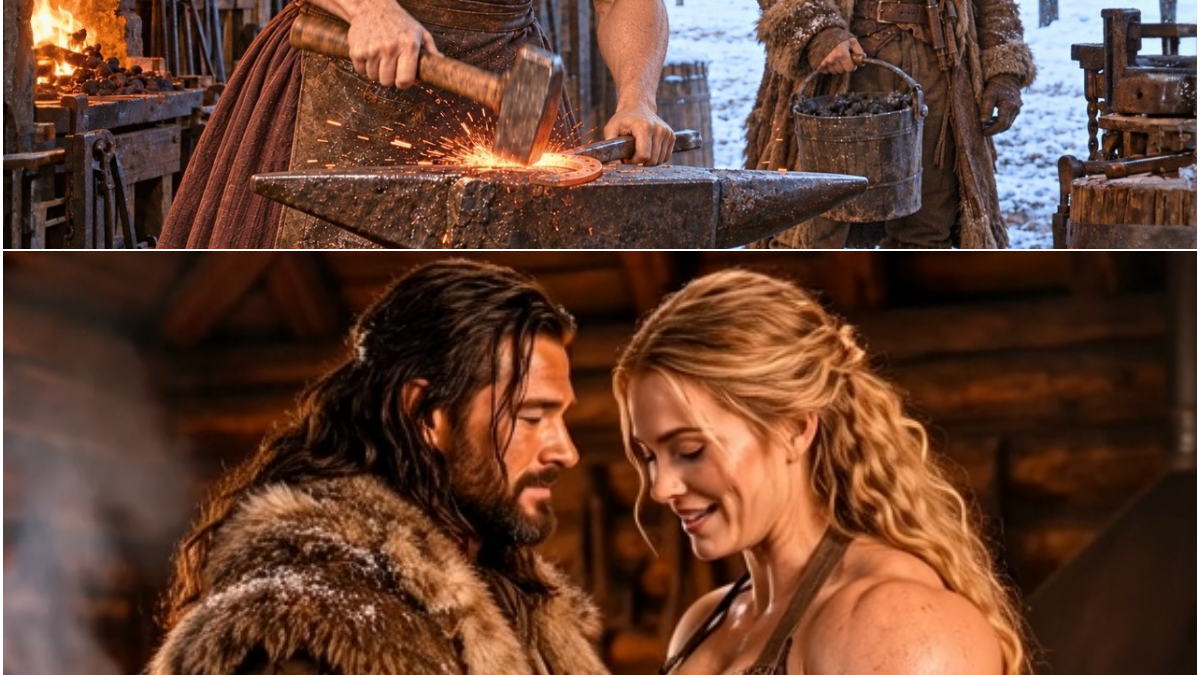
The Montana afternoon was quiet when Jonas Graves realized that two silver dollars could change the course of his entire life.
He had come to town with no intention of buying anything, carrying only the last money he had saved for the approaching winter.
But when a woman named Freya Bergstrom stepped onto an auction platform and faced a crowd that had already decided she was unwanted, Jonas found himself confronting a choice he could not ignore.
She was six feet two inches tall, broad shouldered, strong, and visibly exhausted from a journey across two thousand miles.
The men laughed at her appearance, questioned her usefulness, and refused to make even the smallest offer.
Freya stood without answering, her hands clasped tightly before her, determined not to let the crowd see how deeply its cruelty affected her.
Jonas knew that expression. He had worn it for three years, ever since his own life had fallen apart and the people around him had stopped expecting anything from him.
When the auctioneer lowered the price again and again, Jonas felt his fingers close around his final two dollars.
He knew what spending them meant. He also knew that walking away would leave him with something far worse than an empty pocket.
So he stepped forward and made an offer that turned every head in the room.
Two dollars. The laughter that followed was immediate, but Jonas remained still, looking directly at the woman everyone else had rejected.
Neither of them understood what that decision would eventually mean. Neither knew that the struggling ranch, the approaching winter, and the wealthy landowner waiting for Jonas to fail would bring them into a struggle neither could face alone.
And neither could have imagined that the smallest offer of the afternoon would become the beginning of a future neither had dared to want.
In Montana in 1873, people learned quickly that a person could have very little and still find something worth protecting.
Jonas Graves had spent eight years trying to build a life on the rough land near the foothills, but his efforts had brought him more hardship than comfort.
His cabin needed repairs, his livestock provided barely enough income, and the man who controlled the disputed property had given him ninety days to produce six hundred dollars.
Jonas had once believed that hard work would eventually solve every problem. That belief had weakened after his wife, Catherine, left him three years earlier.
She had wanted a comfortable home, security, and the promise of a better future. Jonas could offer none of those things.
She eventually went to Silver Creek with William Ashford, a wealthy timber businessman, and later sent Jonas divorce papers.
Since then, Jonas had learned to live without expecting much from anyone. He worked, repaired what he could, fed his animals, and avoided conversations that reminded him of the life he had loSt. His ranch had become both his responsibility and his refuge.
That afternoon, however, his quiet existence changed in a crowded hall where six women had arrived by train to meet prospective husbands.
The first woman attracted immediate attention. A banker offered three hundred dollars, and the agreement was completed without much discussion.
The second woman received two hundred and fifty dollars from a local blacksmith. The remaining women also found men willing to make financial commitments.
Then the auctioneer called for the sixth woman. Freya Bergstrom stepped forward with her eyes lowered.
Her dark blonde hair was tied tightly behind her head, and her dress appeared too small for her broad shoulders.
She was twenty six years old and had traveled from Stockholm, hoping to find a place where she could begin again.
Her height immediately attracted attention, but not the kind she wanted. Several men laughed before the auctioneer finished introducing her.
Others made comments about her strength, her appearance, and whether she would ever find a husband.
Freya did not respond. The auctioneer started at one hundred dollars, then reduced the amount when nobody expressed intereSt. Seventy five dollars brought no response.
Fifty dollars produced another round of jokes. Eventually, he lowered the offer to twenty five.
The room remained silent. Jonas watched the woman standing alone on the platform. He noticed the tension in her shoulders and the careful way she controlled her breathing.
He recognized the effort it took to remain composed when everyone around her seemed determined to make her feel small.
When the auctioneer prepared to end the proceedings, Jonas finally stepped forward. Two dollars, he announced.
The room erupted with laughter. Several men slapped their knees. One man compared the offer to the price of a broken mule.
Another joked that Jonas had finally found someone as unfortunate as himself. Jonas ignored them.
The auctioneer hesitated, but there were no competing offers. Two dollars were better than nothing, and the organizers had already spent the afternoon trying to find husbands for the women.
After a moment of uncertainty, the auctioneer accepted. Jonas walked to the front and placed his two silver dollars on the table.
They were the last money he had, intended to purchase cornmeal and other necessities before winter.
Now they were gone. He looked up at Freya. She studied him cautiously, unable to understand why a man with so little would spend his final money on someone he had never met.
The auctioneer presented the marriage documents. Jonas read them carefully before signing. The wording made him uncomfortable, particularly the language that treated the arrangement as a financial transaction.
He passed the pen to Freya. She hesitated. “You need to sign, too,” Jonas said gently.
“If you’re willing.” Freya gave him a bitter smile. “An interesting word for it.” “You don’t have to.”
“Where would I go?” Jonas had no answer that could make her situation easier. Freya eventually signed her name in neat handwriting, adding Graves after Bergstrom.
The agreement was complete. Outside, Jonas helped her carry her small trunk to his wagon.
The afternoon sun was bright, and the town seemed unusually busy as people gathered near the road to watch them leave.
Before Jonas could start the journey, a wealthy landowner named Silas Blackwood approached on a magnificent black horse.
Blackwood owned considerable property and had spent two years trying to obtain the timber rights associated with Jonas’s ranch.
His interest was not in the small cabin or the struggling livestock operation. The old pine trees on the property were valuable, and Blackwood believed he could make a substantial profit by acquiring them.
He greeted Jonas with a pleasant expression that did not reach his eyes. He had heard about the two dollar purchase and wanted to remind Jonas that the six hundred dollar lease payment was due in ninety days.
Blackwood glanced at Freya and made another insulting remark about Jonas’s decision. Jonas tightened his grip on the reins.
“I’ll have your money.” “I’m sure you believe that,” Blackwood replied. He then offered five hundred dollars for the property, suggesting that Jonas could take his new wife elsewhere and avoid the coming winter.
Jonas refused. The land was the only thing he still considered his own, and he was not prepared to surrender it simply because another man had more money.
Blackwood rode away, leaving Jonas and Freya to continue toward the ranch. For a while, neither spoke.
The wagon moved slowly across the open grassland, and the late afternoon light stretched across the hills.
Eventually, Freya asked how many cattle Jonas owned. He explained that he had no cattle.
Instead, he kept thirty eight goats, which provided wool and meat but produced little income.
His cabin had two rooms, and the barn required repairs. He had no hired workers and very little equipment.
Freya listened carefully. “You’re working this ranch alone?” “I was. Now there’s two of us.”
She looked toward the distant foothills. “Why did you bid on me?” Jonas considered his answer.
He could have claimed that he needed a wife to help with the household or that he expected her to contribute labor.
But neither explanation captured what had actually happened. “You were still standing,” he said. “After the journey, after all those men laughing at you, you were still standing.
That meant something to me.” Freya looked at him for a long moment. Then she admitted that she had nowhere else to go.
When Jonas asked about her father, she explained that he had been a blacksmith in Stockholm.
She had learned the trade from him beginning at twelve years old, but circumstances had eventually left her without a stable home.
Jonas did not press her for further details. By sunset, they reached the ranch. The cabin stood against the hillside with weathered walls and a roof patched with mismatched boards.
The barn leaned slightly to one side, and the goat enclosure needed repairs. An abandoned forge stood near the barn, its tools scattered and its chimney deteriorating.
Freya studied the property without making any immediate judgment. Jonas apologized for its condition. “It has walls,” she answered.
“And a roof. That’s more than I had this morning.” Inside the cabin, Jonas showed her the bedroom and offered to sleep near the fireplace.
Freya questioned why he should give up his own bed, but Jonas insisted that she needed proper rest after the long journey.
She reminded him that their marriage was a practical arrangement. Jonas admitted that he did not entirely understand what their relationship would become.
He only knew that they both needed an opportunity to start again. That evening, he prepared beans and salt pork.
Freya ate slowly, clearly exhausted and hungry. After the meal, she thanked him for the two dollars before disappearing into the bedroom.
Jonas slept on the floor beside the fireplace. For the first time in three years, the cabin no longer felt entirely empty.
The following morning, Jonas prepared breakfast while Freya emerged from the bedroom. She looked more rested, although the morning light revealed how much the journey had taken out of her.
She immediately offered to cook. Jonas told her that he had not purchased a servant.
Freya asked what he thought he had purchased instead. He admitted that he did not know yet, suggesting that they should work it out together rather than assume the worst about one another.
After breakfast, Freya asked him to explain the ranch’s financial situation. Jonas told her about the lease, the disputed property, and Blackwood’s demand for six hundred dollars.
He explained that the timber was the real prize and that Blackwood had little interest in allowing Jonas to remain on the land.
Freya quickly understood the problem. The goats could not produce enough income to meet the deadline.
Selling them would provide some money but leave Jonas without the livestock he needed to rebuild his operation.
Running away would also mean surrendering the land. Freya considered the possibilities and then looked toward the abandoned forge.
“Does it work?” Jonas admitted that he had never used it. Freya explained that her father had been a master blacksmith and that she had learned the trade from him.
She knew how to work iron, steel, and copper, and she believed the old forge could be repaired.
She had also heard that Silver Creek, twenty miles north, was expanding rapidly. The mining camp needed horseshoes, picks, shovels, nails, and other equipment that required regular replacement.
If they could restore the forge and secure enough materials, they might earn the money Jonas needed.
Jonas was uncertain about the coSt. Freya estimated that repairing the equipment would require forty to fifty dollars, far more than he possessed.
Rather than abandoning the idea, she suggested asking neighboring ranchers for small loans. In exchange, they could receive tools at reduced prices once the forge was operating.
Jonas was impressed by her determination. He asked why she was willing to fight so hard for a ranch that was not even hers.
Freya reminded him that he had treated her like a person when everyone else had treated her as a joke.
She wanted to repay that kindness by helping him keep the only home he had left.
They agreed to work together. Over the next three days, Jonas visited neighboring ranchers and explained their situation.
Some refused to help, but others understood what Blackwood was trying to accomplish. Miguel, an experienced rancher who had known the area for years, offered twenty dollars without intereSt.
Dakota Redfeather, a Lakota rancher and widow, contributed fifteen dollars and arranged for her sons to help repair the forge.
Augustus Hartwell, known as Gus, offered ten dollars despite his own financial difficulties. By the end of the first week, Jonas had gathered seventy three dollars.
Freya used the money to purchase coal, iron, leather, and replacement tools. She worked tirelessly to restore the abandoned smithy, directing the repairs and teaching Jonas what needed to be done.
Dakota’s sons helped rebuild the chimney and replace the damaged bellows. By the fourth day, the forge was ready.
Freya lit it at dawn. The first flames spread through the coal, and the heat gradually filled the workshop.
She placed a piece of iron in the fire and waited until it glowed. Then she lifted it onto the anvil.
The first strike of her hammer echoed across the valley. Jonas stood watching as she shaped the metal with practiced precision.
Her movements were confident and deliberate, and the uncertainty that had followed her through town seemed to disappear.
Within twenty minutes, she had produced a horseshoe. Jonas examined it with genuine admiration. “You’re incredible.”
Freya initially dismissed the compliment, explaining that it was only a horseshoe. But Jonas told her that it represented something much larger.
It was their first real opportunity. And they intended to make the most of it.
During the second week, Freya produced horseshoes, nails, and simple tools while Jonas managed the goats and assisted in the workshop.
Their work gradually became organized. Freya handled the metal, while Jonas prepared materials, maintained the fire, and learned how to support the production process.
They began selling their work to nearby ranchers and occasionally received orders from people traveling to Silver Creek.
Their savings grew slowly. After three weeks, they had accumulated one hundred and fifty dollars.
The progress was encouraging, but the deadline remained a serious concern. They needed another four hundred and fifty dollars, and winter was approaching.
Freya calculated that they would need to maintain their production and sales at a steady pace for more than two months.
Jonas believed they could do it. Freya was less certain, but she agreed to continue.
The fourth week brought unexpected difficulties. Freya’s hammer broke during a long working session, forcing them to spend two days replacing it.
Their coal supplier also refused to sell to them after receiving instructions from Blackwood. Jonas traveled to another town to find supplies, but the new supplier charged twice as much.
They adjusted their production, focusing on smaller items that required less fuel. Despite the setbacks, their savings continued to grow.
By the end of the month, they had reached two hundred and twenty five dollars.
Then Jacob Thornton arrived at the ranch with a warning. Jacob had occasionally worked for Blackwood, transporting timber and delivering supplies.
He admitted that Blackwood had been asking questions about the forge and its progress. Jacob was nervous because he believed Blackwood was preparing another attempt to stop them.
He also explained why he had been providing information. His wife was seriously ill, and Blackwood had promised to supply medicine in exchange for reports about the valley.
Instead, Jacob had received worthless liquid that did nothing to help her. He could no longer justify working for a man who had taken advantage of his family’s difficulties.
Dakota offered to visit Jacob’s wife and provide treatment. After confirming that Jacob was telling the truth, Jonas agreed to let him stay and help at the ranch.
Jacob became one of their most dependable workers. As the weeks passed, more neighbors began supporting the operation.
Miguel’s relatives helped transport supplies. Gus assisted with repairs. Dakota’s eldest son, Little Wolf, learned how to operate the bellows and prepare iron for Freya.
The forge gradually became a gathering place. People arrived with orders, food, firewood, and offers of assistance.
The ranch, once isolated and struggling, began to develop a sense of community. Miguel explained that Blackwood depended on people remaining divided.
When neighbors supported one another, his influence became less effective. Freya agreed and suggested that they organize a barn raising to rebuild the forge into a permanent structure.
They invited families from throughout the valley. The response was enthusiastic. While preparations continued, Freya increased her working hours.
She wanted to produce enough tools to meet existing orders and build a reserve before the deadline.
Jonas noticed that she was becoming exhausted. She sometimes worked sixteen or eighteen hours a day, refusing to stop even when her hands trembled.
One afternoon, he found her sitting outside the barn, staring into the distance. Freya admitted that she could barely think clearly.
She had nearly walked into the fire the previous day because she was too tired to recognize where she was going.
Jonas immediately insisted that she take a full day off. She argued that they could not afford to lose production time.
He reminded her that they needed her healthy and capable more than they needed another day of work.
Eventually, she agreed to reSt. That evening, Jonas spoke with Miguel and Dakota about his concern.
Dakota suggested that Freya was trying to prove she was worth more than the two dollars Jonas had offered for her.
She had spent much of her life being judged for her height and strength. The auction had reinforced the belief that other people considered her undesirable.
Now she was determined to demonstrate her value through her work. Jonas understood what Dakota meant.
He also realized that his feelings for Freya had grown beyond gratitude or partnership. He loved her.
But he did not know whether she felt the same way. The next day, Freya woke at noon.
Jonas prepared food and encouraged her to eat before discussing work. She thanked him for insisting that she rest, admitting that she had not realized how badly she needed it.
Jonas nearly told her how he felt, but fear stopped him. He worried that declaring his love might complicate their partnership or make Freya feel obligated to remain with him.
Instead, he suggested that they return to work gradually. Freya watched him thoughtfully, sensing that something had changed between them.
The barn raising took place on the forty second day. Fifty people arrived with lumber, tools, food, and the determination to help.
Together, they dismantled the damaged forge and constructed a stronger building with a stone foundation, reinforced walls, a proper chimney, and a durable roof.
By evening, the new workshop stood complete. Freya looked at the structure with tears in her eyes.
She had never expected so many people to care whether she succeeded. Miguel reminded her that the building belonged to everyone who had helped create it.
That night, the community celebrated with music, dancing, and shared food. Jonas danced with Freya beneath the stars.
She admitted that she could hardly believe what had happened. Only a few weeks earlier, she had been standing alone in an auction hall, uncertain whether anyone would offer her a place to stay.
Now she had a workshop, a business, and neighbors who considered her part of their community.
Jonas told her that she had given everyone something to believe in. Freya replied that they had accomplished it together.
The moment was interrupted when someone called Jonas away, but neither forgot the conversation. During the sixth week, a well-dressed stranger arrived at the ranch.
His name was William Cobb, a buyer for mining companies operating throughout the territory. He had heard about Freya’s work and offered them an exclusive contract.
The agreement guaranteed the purchase of two hundred items each month at four dollars per item.
The potential income was enormous. It would provide enough money to pay Blackwood and allow them to expand the business.
Cobb presented a written contract and requested a decision by the following day. Jonas was tempted to sign immediately, but the offer seemed unusually convenient.
He asked for time to discuss it with Freya. That evening, they examined the document together.
At first, the terms appeared reasonable. Then Freya discovered a clause buried in the seventh section.
If they failed to deliver the agreed items, Cobb could claim their materials and equipment as compensation.
The wording was vague enough to allow Blackwood to claim nearly everything they owned. Jonas suspected that Cobb had been sent to place them in an impossible position.
Miguel investigated and confirmed that Cobb was a real buyer but also owed Blackwood substantial gambling debts.
The contract was genuine, but the arrangement had been designed to benefit Blackwood. When Cobb returned, Jonas refused to sign.
He explained that the seventh section made the agreement unacceptable. Cobb’s expression hardened, but Jonas remained firm.
After Cobb rode away, Freya reminded Jonas that they had lost a potentially valuable opportunity.
Jonas admitted that they might have lost their last chance to secure the money. Nevertheless, he believed they had made the correct decision for themselves.
They would continue working rather than surrender control of the ranch through a questionable contract.
By the eighth week, they had saved four hundred dollars. They needed two hundred more and had only thirty days remaining.
For the first time, the goal seemed achievable. Then disaster struck. On the sixtieth day, the chimney of the new forge collapsed.
The structural flaw had gone unnoticed during construction, and the falling bricks destroyed the fire.
Freya narrowly escaped injury when Jonas pulled her away from the damaged structure. The workshop was unusable.
With only seven days remaining before the deadline, rebuilding was impossible. Freya stood among the broken bricks and admitted that she believed they had loSt.
Jonas tried to reassure her, but he could not identify a realistic solution. Miguel arrived and offered fifteen dollars from his savings.
Dakota contributed twelve dollars, and Gus brought twenty. Their friends had managed to provide another forty seven dollars, but even with the existing savings, they remained short of the required amount.
Freya and Jonas stood together, trying to decide what to do. That night, neither could sleep.
Freya eventually suggested selling the entire goat herd. Jonas initially resisted. The thirty eight goats represented eight years of work and were their only dependable source of income outside the forge.
Selling them would leave the ranch without livestock and make rebuilding far more difficult. Freya reminded him that keeping the goats would mean little if Blackwood took the land.
They could either sell the animals and attempt to save the property or lose both the ranch and the herd.
Jonas listened carefully. Then he agreed. They would sell every goat they owned. The following morning, Jonas and Miguel gathered the animals and prepared for the journey to Silver Creek.
Freya remained at the ranch with Dakota to protect the property. The drive was difficult.
The goats scattered repeatedly, wandered away from the group, and resisted being moved along the road.
Jonas and Miguel managed only twelve miles on the first day before stopping for the night.
Around the campfire, Miguel asked Jonas whether he loved Freya. Jonas admitted that he did.
Miguel told him that Freya’s commitment was clear to anyone who watched them together. He encouraged Jonas to remember that love was not simply about comfortable circumstances.
It was also about standing beside another person when everything became uncertain. The next day, they reached Silver Creek.
The mining camp was crowded and noisy, with hundreds of workers living in tents and temporary buildings.
Jonas approached a livestock buyer named Garrett and offered all thirty eight goats. Garrett inspected the herd and offered forty dollars.
Jonas protested that the animals were worth considerably more. Garrett explained that several other sellers had already brought livestock to the camp and that the market was temporarily crowded.
Forty dollars was his final offer. Jonas reluctantly accepted. The money was nowhere near enough to cover the remaining amount.
Nevertheless, he and Miguel completed the sale and immediately began the journey home. They rode hard, pushing through the night and reaching the ranch at dawn on the fifth day.
Freya saw Jonas’s expression and immediately understood that the sale had not produced enough money.
They were still one hundred and thirteen dollars short. With only two days remaining before Blackwood’s deadline, the situation appeared hopeless.
Freya admitted that they had done everything they could. Jonas apologized for failing to save the property.
She reminded him that he had already given her something more valuable than land. He had given her a place where she could work, make decisions, and be treated with dignity.
Before they could discuss what to do next, Dakota spotted a rider approaching from the eaSt.
It was Blackwood, arriving earlier than expected with six armed men. He dismounted and demanded the six hundred dollars.
Jonas explained that they had gathered four hundred and eighty seven dollars. Blackwood calculated the remaining amount and announced that the property would become his at noon on the seventh day.
He gave them until sunset to leave. Freya asked for another week. Blackwood refused. He explained that he had no intention of extending the agreement and reminded Jonas that he had already been given ninety days.
Then he revealed how valuable the timber would be once he controlled the property. The landowner rode away, leaving Jonas and Freya to prepare for departure.
They returned to the cabin and began sorting their belongings. Jonas collected important papers and discovered the wooden box where he had stored the two silver dollars he had once spent on Freya.
He had preserved them as a reminder of the decision that had changed his life.
Holding the coins, he realized how much had happened since that afternoon. He had spent his last money on a stranger and gained a partner, a friend, and a reason to hope again.
But he still believed he was about to lose the ranch. That afternoon, another rider appeared.
Unlike Blackwood, the newcomer wore a formal suit and carried official documents. He introduced himself as Edmund Price, an employee of the Territorial Land Office.
He had come to investigate an irregularity involving Blackwood’s deed. Price explained that the original homesteader had been a man named Thomas Bergstrom, who had filed a valid claim in 1867.
Thomas had fulfilled the territorial requirements and established residence on the property. When he died in 1870, the land should have passed to his next of kin.
Instead, a woman named Sarah Hendricks had sold the property to Blackwood despite having no legal ownership.
Price turned toward Freya. He asked whether she was the daughter of Thomas Bergstrom. Freya confirmed that she was.
Price explained that Thomas had intended to bring his daughter from Stockholm to join him in America, but he had never completed that plan.
The original homestead documents included a note identifying Freya as his intended heir. Because she was his sole surviving heir, the property had belonged to her since his death.
Freya stared at the documents in disbelief. The land she and Jonas had spent weeks struggling to save was already hers.
Jonas began laughing. The situation was so unexpected that he could hardly respond in any other way.
Freya joined him, followed by Miguel and Dakota. After everything they had endured, the discovery seemed almost impossible to believe.
Price watched them with concern, but Jonas assured him that they were simply overwhelmed. An hour later, the group traveled to town and went directly to the sheriff’s office.
Blackwood was there, drinking whiskey and speaking with the sheriff. When Price presented the documents, Blackwood immediately objected.
He insisted that he had purchased the deed legally. Price explained that the sale had been invalid because Sarah Hendricks had never owned the property.
The lease agreement with Jonas was therefore void, and Blackwood had no legal authority over the ranch.
Freya stepped forward. She informed Blackwood that she was the rightful owner and demanded that he leave her property.
She also requested compensation for the damage and interference caused by his actions. Jonas explained that several neighbors were prepared to testify about what had happened.
Blackwood realized that he could no longer control the situation. Eventually, he agreed to pay two hundred dollars in damages.
Price also informed him that his other property transactions would be investigated and that he could face restrictions on future purchases if additional irregularities were discovered.
Blackwood left the office furious and humiliated. Freya and Jonas walked outside into the afternoon sunlight.
For several moments, neither spoke. Then Freya looked down at the papers in her hands.
Her father had secured the property for her years earlier, hoping to create a future they could share.
She had spent her life believing she had lost everything connected to him. Now she had discovered that his efforts had given her a home.
Jonas put an arm around her. He told her that her father would have been proud of the way she had fought for the property.
Freya reminded him that they had fought together. The community celebrated for three days. Families from across the valley arrived with food, music, and stories about the struggle against Blackwood.
The forge was rebuilt, and the ranch finally had a future that did not depend on the goodwill of a wealthy landowner.
During the celebration, Jonas danced with Freya beneath the Montana stars. He had spent weeks trying to find the right moment to tell her how he felt.
Now he no longer wanted to wait. “I love you,” he said. Freya looked at him, surprised but not uncertain.
“I love you, too.” She admitted that her feelings had developed gradually, perhaps beginning the moment he offered those two dollars in the auction hall.
Jonas laughed at the thought that it had taken them so long to understand what had happened between them.
He kissed her beneath the stars while their friends celebrated nearby. Six months later, their lives had changed considerably.
The forge had become a thriving business, supplying tools to mining camps and ranchers throughout the territory.
Freya hired two apprentices and began teaching them the skills she had learned from her father.
Jonas rebuilt the goat herd and expanded the cabin, adding two new rooms and constructing a proper kitchen.
The ranch was no longer simply a place where they struggled to survive. It had become a home.
One evening, Jonas asked Freya to marry him again. They were already legally married, but he wanted a ceremony in which they could choose their own vows and celebrate their relationship with the people who had supported them.
Freya accepted. Two weeks later, they held a wedding beneath the Montana sky, surrounded by their friends and neighbors.
Jonas stood beside her and remembered the afternoon when he had spent his final two dollars on a woman the entire town had rejected.
He had thought he was making a desperate decision. Instead, he had found the person who would help him rebuild everything.
Two years later, Freya gave birth to a daughter. They named her Hope Margaret Graves.
Jonas held the little girl in his arms and looked toward Freya, who watched them with a smile.
Outside, the ranch was peaceful. The forge stood strong, the goats grazed across the property, and the community continued to grow.
Jonas thought about the two silver dollars that had started their story. They had not purchased a servant, a convenient arrangement, or a guaranteed future.
They had represented a choice to recognize another person’s dignity when everyone else had refused to do so.
Freya had turned that choice into a partnership, and together they had built a life neither could have imagined when they first met.
For Jonas, the greatest change was not the property, the business, or the money they eventually earned.
It was the knowledge that he no longer had to face every difficulty alone. And for Freya, the greatest discovery was that her strength had never been something she needed to apologize for.
She had always been capable of building a future. All she had needed was the chance to decide what that future would become.
Disclaimer: This content may be created by Al for entertainment purposes. Any resemblance to real persons, events, or places is coincidental.








