The Mother Dragon Dropped a Cracked Egg at Her Door — Something Inside Was Still Moving
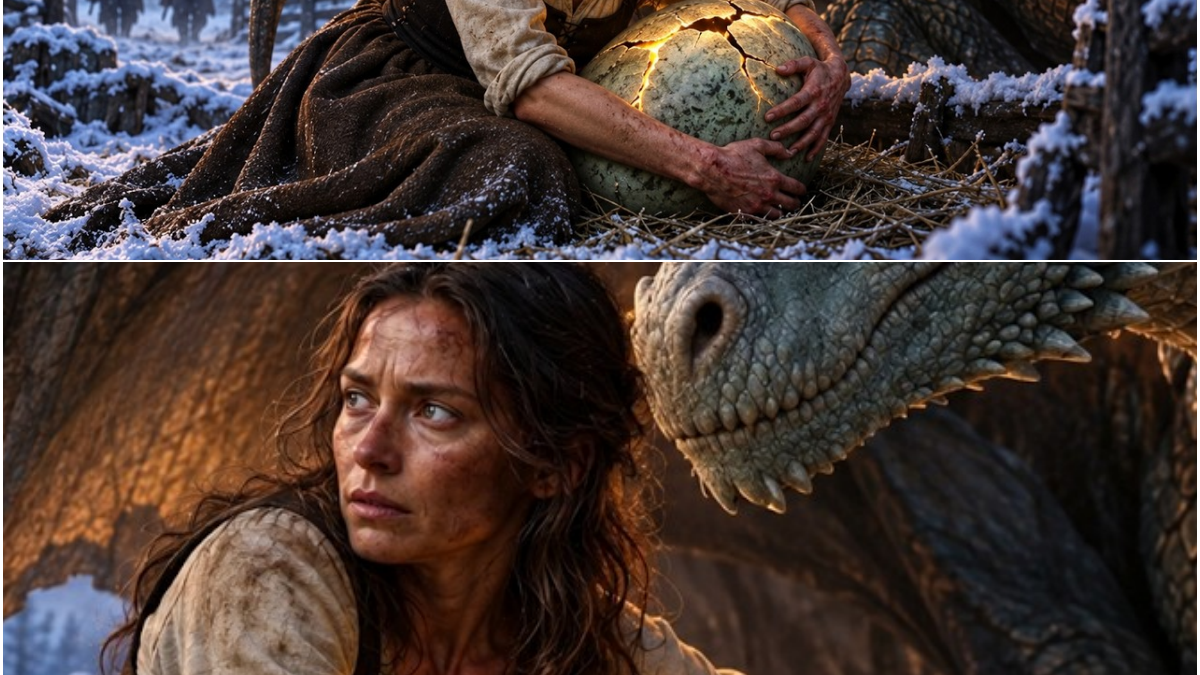
The dragon arrived beneath the moon with an egg that was already breaking, and Wena knew before she touched it that the creature inside might not have until morning.
Its mother lay across the threshold of the hatch house, her enormous gray body curled around the yard, her copper belly rising and falling with each careful breath.
One golden eye watched Wena as she knelt in the frozen mud and pressed her palm against the cracked shell.
Something moved beneath her hand. The egg was warm at its heart, but the warmth was escaping through a long black split that widened whenever the hatchling shifted.
Wena had spent her life keeping fragile things alive. She knew how to turn a tray of eggs, how to shelter a chick from winter, and how to mend a shell before its warmth was loSt. But she had never held an egg like this, and she had never faced a mother whose head was larger than a handcart.
The dragon had brought her young to Wena’s door, then lowered her chin and waited as though she had made a choice that could not be undone.
Wena could not repair the shell with wax. She could not keep it warm with fleece alone.
And the only person in the valley who could shape the metal she needed was a blacksmith who had barely spoken to her in four years.
Beyond the yard, villagers gathered with lanterns and weapons, while a man named Grow prepared to take the dragon’s young for himself.
Wena had no weapon, no help, and very little time. How could a woman who had spent her life tending eggs protect a dragon’s child from an entire village?
The dragon’s head rested across the threshold stone, and every breath from her nostrils sent a wave of dry warmth into the hatch house.
Wena could smell struck flint and something scorched. The dragon’s eye followed her as she struggled to lift the egg from the frozen mud.
It was nearly the length of her arm, gray-green and speckled with darker patches. Its surface resembled a weathered stone, the sort Lyken might have worked for a hundred years.
A long black crack ran from the broad end almost to the narrow one. At its widest point, the opening could have taken the blade of a knife.
Through it, Wena could see a pale membrane beginning to dry. She held the egg against her chest and froze when the dragon raised her head.
The creature’s nostrils flared. Heat rolled over Wena’s face, lifting the loose strands of hair at her temples.
The dragon made a low sound, like a heavy cart crossing a wooden bridge, then lowered her head again.
Wena stepped backward over the threshold. Nothing happened. She took another step, carrying the egg into the hatch house, and the dragon remained outside.
The doorway was too narrow for her enormous head, much less her body. She lay across the yard with her folded wings raised above her back like dark tents, her chin on the stone and her nostrils just inside the room.
The hatch house had been built by Wena’s mother. It was a long, low building of whitewashed stone beneath a thatched roof.
Shelves lined both sides, each holding trays of straw-bedded eggs. Along the back wall stood a clay hatching bench, warmed by a flue from the hearth.
It held the warmth steadily, as dependable as the body of a cow. Eleven trays of Price farm eggs sat on the bench.
They were the last of the season and due to hatch in four days. Wena set the dragon’s egg on the floor in front of the hearth, resting it on the sheepskin she used when kneeling.
She pulled the kerchief from her head and pressed it over the crack with both hands.
The cloth barely helped. Warmth slipped through the opening, and the shell felt cooler beneath her palms than it had in the yard.
Wena hurried to the shelf above the door, where she kept a pot of beeswax mixed with pine resin.
Her mother had used the mixture to seal small cracks in goose eggs that had been knocked in the neSt.
As she reached for it, her sleeve caught a curved gray flake that had been sitting on the shelf for weeks.
It clicked against the floor. Wena glanced down at it. She had assumed it was a piece of slate from the roof, although it had always seemed too smooth and curved.
There was no time to examine it now. She softened the wax over the hearth and fed the fire two cuts of peat.
Then she knelt beside the egg and waited for the mixture to become workable. She had sealed perhaps forty eggs in her life.
None had ever been cracked so badly. When the wax softened, she pressed it carefully into the opening, smoothing it against the membrane.
The creature inside went still beneath her touch. For one slow breath, the repair seemed to hold.
Then the shell shifted. The crack opened slightly, and the wax began to sag. The egg was moving from within, its shell flexing like a mouth.
A repair that could not bend with it would soon fail. Wena sat back on her heels.
It needed something rigid, shaped to the curve and secured around the shell. Something that could hold the two sides together without crushing what lay beneath.
“Iron,” she whispered. The dragon’s nostrils widened. Wena looked at the egg, then at the doorway, where the dragon’s head filled the lower opening.
She thought of the forge at the other end of Holland and its owner, Emilyn Hart.
She had known Emilyn all her life. In a village of forty houses, it was difficult not to know everyone’s history.
His father had been Owen Hart, who had gone with the autumn drove to Kell twelve years earlier and never returned.
Emilyn had inherited the forge and its debts, and he had spoken fewer than twenty words to Wena in the four years since he attended her mother’s burying.
Most of those words had concerned the price of hinges. Wena disliked asking anyone for help.
She had repaired the hatch house roof herself when the thatch needed replacing and fallen from the ladder in the process.
When the Price farm had delayed payment for three months, she had waited rather than complain.
But the egg was cooling. She wrapped it in fleece, pushed two hot hearthstones against either side, and stood in the doorway.
The dragon’s nose rested near her feet. “I’m going for help,” Wena said. “I’ll be back.
I’ll be quick.” She had no idea whether a dragon understood words. She did not know what she would do if this one did not.
She stepped over the long jaw, one foot and then the other. Her skirt brushed the creature’s scales, which were warm as baking stones.
The dragon did not move. Holland was a single street of stone houses following the beck down the valley.
The chapel stood at the top, the mill at the bottom, and the forge between them where the drove road entered from the eaSt.
By the time Wena reached the street, most of the village was awake. Bet Row stood in her doorway wearing her nightdress and holding a poker.
Old Crossley had a lamp raised above his head as though the light might help him see over the rooftops.
Near the plow, the landlord shouted for someone to fetch the reeve. Nobody stopped Wena.
Most did not even look at her. They were staring up the valley toward her house, where the dragon’s back rose above the wall like a mound of dark slate.
The forge doors were already open. Emilyn stood in the yard with a hammer in his hand, his shirt half tucked into his trousers.
He was a large man, broad through the shoulders, with old burn marks scattered across his forearms and reddish hair cropped short.
“Is that at your place?” He asked. “I need copper,” Wena replied. “Thin sheet. And someone who can shape it.”
He looked at her as though she had spoken in another language. “She’s brought me an egg,” Wena continued.
“It’s cracked almost the whole length. It’s losing heat faster than I can replace it, and wax won’t hold because the shell moves.
It needs plates, shaped to fit and bound around it. I can’t make plates.” Emilyn stared at her.
“There’s a dragon in your yard, and you’ve come for copper?” “Yes.” He put the hammer down on the anvil with great care.
“Wena, go to the chapel. Tell Heskith to ring the bell. Get everyone out of the houses near your end of the valley and down to the mill.
We’ll make enough noise to drive it away.” “She could bring my house down with one foot,” Wena said.
“She hasn’t. She’s lying in the yard with her nose in my doorway. She put the egg down like it was glass.”
Emilyn’s expression changed. “And when it loses its young?” Wena did not answer. He looked toward the valley.
For a moment, he seemed to have forgotten the hammer and the forge, and his shoulders sagged as though he had been carrying something heavy for years.
“They don’t grieve like cows,” he said quietly. “My father…” He stopped. Wena understood that there was more to the story, but she could not afford to ask.
“Help me keep it alive.” “I’m not going near that thing.” “You won’t have to go near her.
You’ll have to go near me.” Her voice sharpened, and she could not soften it again.
“I’m not asking you to like it. I’m asking for copper. Sell it to me.
I’ll pay at Candlemas.” “I know you’ll pay.” “Everyone in this valley knows you’ll pay,” he said, rubbing his face.
“How long has it got?” “Hours. Perhaps less.” The chapel bell began to ring, jerky and too faSt. Someone had started pulling it in a panic.
Emilyn stood motionless for another moment, then turned and went inside. Wena heard him move something heavy.
The forge bellows began to groan as he raised the fire from its banked embers.
She waited in the yard, listening to the bell and feeling the cold settle into her hands.
She could not tell whether he intended to help her or prepare himself to defend the village.
When he came back, he carried a leather tool roll, a coil of soft iron wire, and a sheet of copper wrapped in sacking.
“The fire will need half an hour before it’s worth using,” he said. “I want to see the crack firSt. I’m not cutting plates blind.”
He shouldered past her into the street and started uphill. After a few strides, he looked back.
“Well, come on. It’s your egg.” At Wena’s gate, the dragon raised her head. The full length of her became visible in the lantern light.
Her gray back was ridged with plates like roof tiles, and her chest and belly were the color of old copper.
Two long horns swept backward from her brow. Her tail curved around the side of the house and disappeared beyond the woodpile.
She was longer than the hatch house. When she opened her mouth, a dull orange glow shone deep in her throat, like peat embers seen through smoke.
Emilyn stopped. Wena could see the pulse in his neck. The dragon looked at the stones beside the threshold, then at Wena.
She opened her jaws slightly and breathed out a thick shimmer that made the air ripple.
Frost hissed away from the step. The stone turned dull red around its edges. Wena reached for it with the tongs, but the heat passed through the iron so quickly that she yelped and dropped them.
The stone cracked on the flags. The dragon made a sharp clicking sound. “Too hot,” Wena said.
“Too hot for it. It’ll cook.” She held her hand above the stone and pushed her palm downward twice, slowly, as she might signal someone to lower a basket.
The dragon watched. Then she breathed again, briefly this time. The second stone came back warm enough to shimmer but not to glow.
Wena lifted it with the tongs and carried it to the egg. Something inside shifted toward the warmth.
She placed the stone against the fleece and held her hand over another. When the dragon breathed too strongly, Wena repeated the downward gesture.
The creature paused, then reduced the heat. Emilyn watched in silence. “You can tell her what to do?”
“Only when I ask.” “I’ve had apprentices take a year to learn that.” He set his tools down and looked toward the forge.
“Let’s get this fixed.” He returned with a handbarrow carrying an iron cradle made from an old wagon tire.
He had bent the tire into a long oval, then riveted curved bars beneath it to form a trough.
Four short legs held it above the floor, and two handles made it possible for two people to lift.
It was ugly, practical, and exactly what Wena needed. They placed the cradle in front of the hearth and filled it with sand, hot stones, and fleece.
Then Wena reached for the egg. “Wait,” Emilyn said. He put his arms beneath the other side.
Together they lifted it and settled it into the cradle. The shell fitted the bedding closely, with enough space to keep the plates from pressing too hard.
Emilyn unwrapped the copper. Six pieces lay in the cloth, each roughly the size of Wena’s palm.
He had hammered them into shallow curves and filed their edges smooth. “Broad end first,” he said.
“I’ve brought them close. We’ll do the final shaping here.” He fitted the first plate over the crack near the broad end.
It rocked slightly, leaving a small gap beneath one edge. He removed it and placed it against the rounded tip of the little bench anvil he had carried inside.
A few gentle taps changed its curve. He tried again, adjusted it once more, and finally achieved a fit so close that the plate seemed to rest on the shell like a hand.
“Wax.” Wena had already softened it. She spread a thin layer along the inside of the copper while Emilyn held it steady.
Together they placed the plate over the crack and pressed it down with their thumbs.
Wax squeezed out around the edges. The shell shifted beneath their hands, and the creature inside fell quiet.
“Did you hear it?” Wena whispered. “They do that when you press,” Emilyn said. “It’s listening.”
“Listening?” “It knows something has changed. Hens’ eggs do the same near hatching. Tap on the shell and they quiet down.
Sometimes they tap back.” Wena had never thought of it that way. She watched the egg, feeling a faint movement beneath the copper.
They continued. The second plate required several adjustments. The third went on more easily, but the fourth needed to be reshaped twice.
The fifth, fitted over the widest part of the crack, took nearly an hour. Emilyn returned to the anvil again and again, tapping the copper with a patience Wena had never seen him display in the village.
At one point, he swore under his breath. Wena laughed in surprise. “Don’t,” he said, though the corner of his mouth twitched.
By the time the sixth plate was fitted, the fire had settled into a steady glow.
Emilyn measured the circumference of the egg with a strip of lead and cut the iron wire to length.
He padded the wire with strips of felt taken from an old hat. Wena recognized the dent left by its hatpin.
He wrapped the wire around the plates and twisted the ends together a quarter turn at a time.
“Tell me when,” he said. Wena rested her hands on either side of the shell.
She could feel the plates settling into place, the edges of the crack drawing closer, and the looseness of the shell gradually disappearing.
“Stop.” Emilyn stopped immediately. They sat back on their heels. The egg rested in its cradle, wrapped in fleece and held together by copper and wire.
It looked like a barrel that had been repaired by a careful but desperate cooper.
Neither spoke. Then something inside pushed hard against the plates. They held. At the doorway, the dragon lifted her head and released a long, low rumble.
Wena felt it through the floor. Outside, the crowd had grown and thinned and grown again.
Lanterns moved along the lane as villagers tried to decide whether to approach or retreat.
A little before midnight, Orich Pel arrived with the two Dun brothers and several other men.
Pel was the reeve, responsible for collecting rents, settling boundary disputes, and keeping the key to the tithe barn.
He stopped just inside Wena’s gate. The dragon’s eyes fixed on him. “It’s not yours,” Wena said.
Pel smiled slightly. “Nor is it yours.” “No. It’s hers.” “And she can have it if she comes and takes it.”
“But she won’t.” Pel’s expression turned patient, the way a man might speak to a child who had said something true but inconvenient.
“She’s a beast, mistress. Whatever else she is, she’s hurt and slow. And she has two more eggs somewhere in the hills, growing cold while she lies here.”
Wena felt her stomach tighten. “If she leaves, you’ll open the door for us,” Pel continued.
“We’ll take the young and settle the matter.” “And if she doesn’t leave?” “Then we wait.”
He moved half a step forward. The dragon rose. She straightened all four legs in one motion, lifting her neck until her head stood higher than the eaves.
Her wings opened halfway with a sound like wet sails catching wind. Their shadow spread over the yard, and the lanterns at the gate swung as the villagers stumbled backward.
One of the Dun brothers dropped his pitchfork. The dragon did not breathe fire. Instead, she opened her jaws and let the glow in her throat brighten until the inside of her mouth shone like a forge.
She held the light there. Heat crossed the yard in a dry wave, stinging Wena’s lips.
Then the dragon closed her mouth, folded her wings, and lay down again across the threshold.
Her chin returned to the stone. Her eyes stayed on Pel. Nobody spoke for a long moment.
At last Pel nodded. “She’s slower than she was.” “Because she’s full of our physic,” one of the hunters said.
“Enough to put a bullock down for a day.” Pel looked toward Wena. “We’ll be at the plow, mistress.
Take your time.” He left, followed by his men and the villagers. Only Nell Heskith, the miller’s wife, remained at the gate.
She held a covered pot. “I’ve brought you broth,” she said. “It’s only barley.” Wena stared at her.
“You hatched my girl’s pullets through the frost,” Nell explained. “You sat up all night with them.
I’ve not forgotten.” She set the pot on the gatepost without entering the yard, gave the dragon a long look, then glanced at Emilyn.
“I’ll tell them at the mill she lay down.” When she had gone, Wena and Emilyn ate the broth from the pot with one spoon between them.
They sat on the floor beside the cradle with their backs against the hatching bench.
It was the best meal Wena had tasted in a year. The dragon breathed slowly at the door.
The fire ticked. Behind them, the Price eggs sat in their eleven trays, still needing to be turned.
“You go to the bench every hour,” Emilyn said. “Near enough.” “If you don’t turn them, the chicks can stick to the shell.
Hens shift about on the nest and do it themselves.” Wena looked at the dragon’s egg.
“She’s hurt,” she said. “Pel was right about that.” “Perhaps.” “She could have frightened them away.”
“She could have.” “But she didn’t.” Emilyn considered the dragon for a while. “My father used to hold the bullocks’ heads when they were frightened.
He thought they needed someone to stand still with them.” Wena looked at his hands resting on the cradle.
The old burn marks were small and pale, scattered across his skin like seeds. “My mother built this place,” she said.
“After my father left, I was six. She bought the plot from the old lord’s widow with money she had saved for eleven years.
Everyone in Holland said she was mad. They said nobody needed a hatch house when they had hens.”
“But hens don’t sit when you want them to.” “No. They leave the nest when it’s cold, and half of them trample their own eggs.
My mother hatched for the whole valley. A penny a dozen and one chick in ten.”
Wena turned a piece of straw between her fingers. “When she died, everyone said I’d sell it.
Pel came around a week after the burying with his hat in his hands. He’s been coming every Lady Day since.”
“And you won’t sell.” “It’s mine.” “I know.” “You say that as though it’s funny.”
“No,” Emilyn said, though he was smiling a little. “I said it at the forge, didn’t I?
Everyone knows you’ll pay. Everyone knows you’ll do it yourself.” He glanced toward the ceiling.
“You put your own thatch on and fell off the ladder. Then you put it on again with your arm strapped up.
I watched you from the road. I thought you were going to break your neck.”
“You could have offered to help.” “You’d have told me to go to the devil.”
Wena opened her mouth to deny it, then closed it again. She would have. Emilyn laughed quietly, and after a moment she found herself laughing too.
They sat together on the hatch house floor at one in the morning, with a dragon breathing at the door and an egg between them, laughing at nothing in particular.
Then the dragon’s breathing changed. The long, even gusts became uneven. Each breath seemed to catch halfway, and a faint tremor passed through her head.
Wena went to the threshold. The dragon lay as she had all night, but her eyes had grown heavy.
Wena crouched and put both arms around as much of the great jaw as she could reach.
She held on. After a while, the trembling stopped. The dragon lifted her head, turned it around on her long neck, and began licking the wound near her shoulder.
Her tongue was broad as a spade. Wena stepped back, her legs shaking. Emilyn had risen from the floor.
He was holding something in the lantern light. A metal bolt head lay in his palm, its three barbs dark with blood and a sticky, resinous substance that smelled of poppy and turned earth.
“It’s mine,” he said. Wena looked at him. “I made this. I made a dozen of them.”
He turned the metal over. On the flat of the socket, where the shaft fitted into the iron, was a small mark shaped like a crescent.
“Three weeks ago, Grow came to the forge with a drawing. Twelve barbed heads, sixteen pins as thick as my thumb, eight hinge straps.
He said they were for a bear cage at the fair. He paid five crowns down.”
Emilyn closed his fiSt. “I’ve paid Pel four of them. I had nine owing on the forge.
He said if it wasn’t paid by Martin, he’d let the smithy to the Frith smith.”
Wena said nothing. “I knew they weren’t for a bear,” he continued. “You don’t need pins that size for a bear.
I knew, and I didn’t ask.” The dragon stopped licking and looked at the bolt in his hand.
Wena took it from him, wrapped it in a rag, and placed it on the shelf beside the wax pot.
“There’s a cut on your hand,” she said. “You nicked it on the snips. Let me see.”
“Wena, she let you pull that out of her.” “Let me see your hand.” He gave it to her.
It was past two when Wena went to the peat stack behind the hatch house.
The back door opened into a lean-to where she kept fuel, and beyond it the hillside rose toward the hobstone, a tall gray boulder that had stood on the hill longer than anyone in Holland could remember.
From its top, a person could see straight down into Wena’s yard and through the open front doorway to the hatching bench.
Three weeks earlier, on the night of the first hard frost, Wena had spent the whole night on that bench with forty pullet eggs abandoned by the miller’s hens.
The chimney had been smoking badly, so she had propped the front door open with a stone and turned the eggs by hand every hour.
When the first chick began to break through its shell near dawn, she had cupped each one in her palms and held it against her neck until it warmed.
Thirty-one had lived. The next morning, she had climbed the hill to look for a stray ewe.
At the hobstone, she had found long pale grooves scraped into the surface and the heather flattened around its base in a wide circle, as though something enormous had rested there.
The sheep had refused to approach the hill for a week. Among the heather, Wena had found a curved gray flake and carried it home.
She had put it on the shelf above the door and forgotten about it. Now she picked it up from the floor.
It was not slate. One side was gray, the other copper. It was a scale, smaller than those on the dragon’s neck, perhaps from around her eye or mouth.
Wena returned to the doorway and held it out. The dragon studied the scale. Then she lifted her head and looked over the roof toward the hobstone.
“You were up there,” Wena said. The dragon looked back. “You watched me with the pullets.”
She made a small clicking sound and lowered her head again. Behind Wena, Emilyn asked what was happening.
She sat beside him and told him about the frost, the abandoned eggs, the hobstone, and the thirty-one chicks.
She told the story badly, remembering details out of order and returning to things she had already explained.
Emilyn listened without interrupting. “She’d have been watching you for a month,” he said when Wena finished.
“Looking for somewhere warm to move her eggs.” He turned the scale between his fingers.
“She saw you sitting up all night, holding those chicks against your neck.” “Anyone would have done it.”
“No,” he said. “Nobody would have done it.” He returned the scale to her. “She came here because she saw you do it.
She didn’t come by chance.” Wena did not know what to do with her face.
“I watched you too,” Emilyn said. She looked up. “From the road. I came by on purpose some days to see whether you’d finished the ridge on the roof.”
“You did?” He turned red from his collar to his hairline. “You never looked up.”
“I was on a ladder.” “I know.” She slipped the scale into her apron pocket.
Then she put her hand over his bandaged one where it rested on the cradle.
He turned his palm upward beneath hers. They sat like that and watched the egg.
After three, the dragon grew restless. She raised her head more often, turning it north toward the hills.
Her nostrils worked as though she were following a scent carried on the cold air.
Twice she stood fully upright, spreading her wings halfway before folding them again. A thin, high whine came from her throat.
Wena had never heard such a sound from a creature so large. “Pel said she had two more,” she whispered.
Emilyn looked toward the dark slope. “She must have moved them. Wherever she put them, they’ll be cold by now.”
“She left them warm in a neSt.” “But a nest won’t keep them warm forever.
Not without her.” The dragon stood again, her head rising above the eaves. The whine came once more, longer this time.
Wena looked at the egg in its cradle. She had been counting on the mother staying at the door until dawn.
As long as the dragon remained there, nobody would dare enter the yard. But the other eggs were somewhere in the hills, and the mother could not be in two places.
Wena went outside and stood beside the dragon’s forefoot. “Go,” she said. The dragon looked down at her.
“Go and see to them. I’ll keep this one.” She pointed north, then back toward the hatch house, and pressed her hand to her cheSt.
“I’ll keep it. I’ve kept it this long, haven’t I?” The dragon lowered her head until one golden eye was level with Wena’s face.
Her breath smelled of flint, pitch, and the bitter scent of the wound. Then she turned her head through the doorway as far as it would fit and studied the egg.
She clicked softly. From inside the copper bands, something clicked back. Wena heard Emilyn draw a sharp breath.
The dragon withdrew her head, crossed the yard, and crouched. Her wings opened fully for the first time that night, reaching from Wena’s wall to the far side of the lane.
She launched herself upward. The downdraft struck Wena against the doorframe and flattened lantern flames across the yard.
The dragon rose over the hobstone, her injured wing beating short and stiff. She corrected her flight and climbed toward the north, becoming a dark shape against the stars before disappearing over the carn.
Wena stood in the doorway until the cold brought tears to her eyes. When she turned back, Emilyn was fitting an iron bar across the front door.
The old wooden bar had been useless for years, its brackets rotted from the stone.
During the night, he had cut new brackets from the iron left over from the cradle and fixed them into the frame.
“When did you think of that?” Wena asked. “About midnight.” He tested the bar. It did not move.
“When Grow said he’d wait,” he added, “I knew he meant to come when she was gone.”
They were still beside the cradle when the first wagon creaked into the lane a little after four.
Wena heard the wooden axles and the slow thud of oxen’s feet. Voices followed, low and deliberate.
Then came three polite knocks. “Mistress Dre,” Grow called. “She’s gone.” Wena did not answer.
“I’d like to speak to the smith.” Emilyn stood. “I’m here.” “Emilyn Hart. I’m glad.
I’d rather do business with you than the young woman.” There was a pause. “You’ll have seen what we’ve brought.”
“I haven’t seen anything.” “Then I’ll tell you. We have the cage panels, all eight, the chain, and your pins.
We had them up at the carn for her, but we brought them down tonight.
We’d rather meet her here than go hunting in the hills.” Emilyn turned toward Wena.
Grow continued. “When she comes down at first light, the lads will put two more bolts into her.
A proper dose on each. Then we’ll take the egg while she’s sleeping.” Wena looked at the cradle.
The hatchling had not yet broken the shell, and the plates were holding. But the mother was gone, and the hunters were waiting.
“Nine crowns,” she whispered. Emilyn wiped his face with the back of his good hand.
“I was going to be a smith in Holland my whole life. That was the only thing I ever wanted.
Isn’t that foolish?” He looked toward the forge, far down the valley. “It isn’t even a good forge.
The chimney leaks. Pel will let it to the Frith man at Martin. I’ll have to move the anvil somewhere.
It was my grandfather’s.” Wena crossed the room and put her arms around him. She had not held anyone like that since her mother.
Emilyn stood stiffly for a moment, then lowered his head and rested his face against her hair.
When he straightened, his expression had changed. “They’ve got my pins,” he said. The egg pipped at five.
Wena was kneeling beside the cradle when she felt a sharp tap against her palm.
Then another. She drew her hand away. Near the narrow end, below the last copper plate, a small star of cracks had appeared.
Something pushed from within, and a flake of shell fell onto the fleece. A hole opened.
Warm, damp air escaped, carrying the smell of wet fleece. “There,” Wena whispered. “There it is.”
Emilyn crouched beside her. “Is it coming?” “It’s breathing. It’ll rest now. An hour, perhaps two.”
She looked toward the door. “When she comes back, it’ll be hatching.” Emilyn was already reaching for his tools.
“They’ve laid the panels in the yard,” he said. “I heard them moving them. They’ll have covered them with straw.
The pins will be in a sack or a box beside them.” Wena understood. “If you go outside, they’ll see you.”
“They’re watching the sky, not the ground.” He picked up his tool roll. “The panels have lugs at the corners.
I welded every one myself. Strike them cold with a chisel and they’ll shear. I know which side to hit.”
“They’ll replace them.” “They’ll need a forge to do that.” He stopped at the back door.
“Bar this behind me.” Wena stared at him. “You said it yourself,” he continued. “I’m the one she let walk past her.”
He gave her a crooked smile that did not reach his eyes. Then he went out into the cold.
Wena barred the door and stood with her back against it. The hatch house was very quiet.
The egg tapped once, twice, and fell still. Then, faintly from the yard, came the scrape of something heavy against stone, followed by a splash from the direction of the well.
Wena knew the sound. The pins were going into the water. A long silence followed.
Then the first strike of a hammer rang out against a cold chisel. Another. A third.
A sharp crack. Someone shouted from beyond the wall. Running feet crossed the yard. The hammer rang again, faster now, followed by another crack.
Then came a grunt and the clatter of iron striking stone. Wena gripped the door bar.
She heard someone swear. A heavy thud followed. Then Grow’s voice rose from the yard.
“Enough. Get him up. Bring him out to the lane.” Wena did not lift the bar.
She heard the hunters dragging Emilyn away. Someone laughed, and another voice called out that four of the lugs were broken.
“Four,” Grow said. “And the pins.” “We can peg them,” Teague replied. “Oak pegs on a dragon?”
“We can try.” Grow sounded tired. “You want to stand inside that fence when she wakes?
She’ll come down, and we’ll put two bolts in her before she folds her wings.
We can take the egg while she’s sleeping.” “There’s a door between us and the egg.”
“Then see to the door.” The men fell quiet. Wena held her breath. “If she comes down in this yard,” Grow said at last, “we’ll see.”
The egg began hatching in earnest a little before six. The tapping came in long runs, a dozen strikes followed by a pause.
Each run removed a little more shell around the narrow end. Wena could see the hatchling’s snout through the opening, dark and shining, with a tiny pale nub at its tip.
Its nostrils flared. Twice it pushed its head against the shell ring. The shell flexed but did not break.
Wena fed the fire and checked the warmth of the stones. Then she went to the horn window.
The sky had turned a dirty gray. The hunters were still in the lane, their voices low.
She could see no sign of Emilyn. At a quarter to six, the tapping stopped.
The hatchling’s head remained in the opening, its nostrils moving. Its throat shifted, and it made a thin, high sound.
A small version of the mother’s clicking call. Wena went still. Far away, from somewhere beyond the northern hills, something answered.
She unbarred the back door and stepped into the lean-to. The cold struck her teeth.
The sky above the carn was pale as pewter, and the hobstone stood black against the growing light.
She stared until her eyes watered. Then she saw a speck above the long shoulder of the hill.
It was moving toward the valley. The dragon was coming back. Wena did the sums in her head as she always did when counting eggs or pennies.
The dragon would return to the place where she had left her young. She would descend into the yard, where Teague and Lark waited with loaded crossbows and poisoned bolts.
The mother was still injured. She had flown through the night and would need time to recover from the effort.
The hunters would be ready. The hatchling would emerge into the world with no one but Wena beside it.
And Teague had an axe. Wena looked toward the hobstone, eighty paces up the hillside behind the house.
From its top, the entire yard was visible. The mother had rested there and watched her during the froSt.
She would see the stone before she saw the yard. The house and the rise of the hill blocked the hunters’ line of fire.
If Teague wanted to reach the hobstone, he would have to leave the lane and climb the open slope.
Wena went back inside. She pulled the fleece from beneath the egg and knotted its corners into a sling, the way her mother had taught her to carry lambs from the far field.
She took two hot stones from the cradle with the tongs and wrapped them in straw, placing one on either side of the egg.
Then she lifted the egg out of the cradle. It was heavier than she expected.
She slipped her head and one shoulder through the knot and stood, carrying the shell against her cheSt.
The hot stones pressed against her ribs. She could feel her dress beginning to scorch, but she did not stop.
She stepped through the back door and began climbing. The hillside was steep, its heather stiff with frost and slippery beneath her shoes.
She leaned forward against the weight and climbed as though carrying a full basket up a ladder.
Every five steps, she had to stop. The egg clicked steadily through the fleece. Far above her, the speck grew larger.
The dragon’s wings became visible against the pale sky. Behind her, someone shouted from the lane.
Wena did not look back. At forty paces, her legs began to shake and her lungs burned.
At sixty, she fell to one knee, then forced herself upright again. The sling had shifted against her neck, cutting into the skin.
Above the carn, the dragon came lower and faster. Wena could hear the heavy crack of her wings now, one beat still shorter than the other.
Feet ran below. Teague called for Lark. Wena reached the hobstone. She had no strength left to climb it, so she went around its downhill side, into the flattened circle where the dragon had rested three weeks earlier.
She knelt in the heather and lowered the sling from her neck. The egg lay in her lap in the thin gray light.
The shell ring around its narrow end had been cut almost all the way through.
As Wena watched, the snout pushed outward, followed by a small, wet head. The hatchling was blind and dark as peat, with soft scales and a crumpled fringe down the back of its neck.
It opened its mouth and made the thin calling sound again. The dragon came down over the hill.
Her wings blotted out the sky. The wind tore Wena’s kerchief away and threw her hair across her face.
The mother did not land in the yard. She swept over the hobstone, banked sharply, and circled the hill with her injured wing dragging.
Then she dropped onto the slope between Wena and the house, all four feet striking the ground together.
She threw her head up and roared. Teague and Lark had reached the lean-to. They stopped with their crossbows raised.
Grow came around the corner of the house at a walk. He put a hand on Teague’s arm and pressed the weapon downward.
“Leave it.” “She’s right there,” Teague said. “She’s awake. It takes half an hour.” “We can still—”
“You want to stand on this hillside for half an hour with her full of poppy and wanting to reach you?
No box. No pins. It’s done, Teague. Let it go.” The dragon turned her head toward them.
Orange light began to gather in her throat, bright as a forge. She held it there until the men could see the glow reflected in her eyes.
Then she swung her head toward the yard. The cage panels lay under their straw beside the wagon.
The iron bars and the remaining pins were spread around them. The dragon opened her jaws.
For the first time, Wena saw her breathe fire. It came not as a loose flame but as a long rope of yellow light.
It swept down the hillside, passed over the men’s heads, and struck the straw covering the iron panels.
The straw erupted. The wagon bed caught almost at once. Heat rolled up the slope, and the iron bars began to glow and bend beneath the fire.
The hunters threw themselves flat. The oxen bellowed and pulled against their tethers. The dragon held the flame until the metal sagged and the wagon frame darkened, then closed her jaws.
Nothing moved. She turned toward Wena. The hatchling had worked its four legs free of the shell.
One wing lay crumpled and wet against its body, like a leaf just emerging from a bud.
It was the length of Wena’s forearm, steaming in the cold. She wanted to pick it up.
Every hatching she had ever tended had ended with her holding the young creature in her hands.
She had held thirty-one chicks against her neck during the frost, warming them one by one.
But this was not hers to hold. Wena gathered the fleece around the hatchling and the broken shell, laid them carefully in the heather, and stepped back.
The dragon lowered her head. She breathed over the hatchling slowly, sending a shimmer of warmth across its wet body.
The tiny creature stopped clicking and lifted its head toward her. The mother licked it once, from snout to tail.
The damp membrane came away, and the hatchling sneezed. Then the dragon gently took it in her mouth, holding it around the middle as carefully as a cat carries a kitten.
She lifted it from the fleece and drew it against her chest, settling it beneath her chin and beside her forefoot.
She looked at Wena. Wena did not speak. The dragon made one low clicking sound.
Then she turned and began climbing the slope, carrying her young against her cheSt. She moved on three legs, favoring the injured wing.
At the top of the hill, she crouched and opened her wings. Her launch was heavy, but she rose.
As she climbed toward the carn, two thin cries answered from somewhere high on its dark shoulder.
The dragon called back once without turning. Wena knew the other eggs had survived. When she came down the hill, Emilyn was sitting on the curb of her well.
Blood had dried along one side of his face, and he held one arm tightly against his ribs.
The panels in the yard were still smoldering. Their bars sagged like stalks in a burned field, and the wagon had become a blackened frame.
Grow and his men were in the lane, tying their packs to a horse. Pel was nowhere in sight.
“Did she take it?” Emilyn asked. “She took it.” “Did you touch it?” “No.” Wena sat beside him.
Her dress was scorched brown across the front, and her palms were blistered. She had not looked at them since the tongs had burned her.
“I thought it should be hers first,” she said. Emilyn nodded, then winced. “Your ribs?”
“Teague cracked one, I think. I’ve had worse from a horse.” He looked toward the remains of the cage.
“Four lugs. I’d done four when they got me.” “It was enough.” “I know.” In the lane, Grow mounted his horse.
He looked into the yard, at the ruined panels, then at Wena and Emilyn. He gave them both a small, courteous nod, like a man who had lost a hand at cards and paid what he owed.
Then he turned toward Kell. Teague and Lark followed, leading the pack horse. Wena watched them disappear down the lane.
“He’ll be back,” Emilyn said. “Not here,” she replied. “Somewhere else.” Doors began opening along the street.
The villagers who had spent the night at the mill came back in small groups.
Nell Heskith was among the first, her shawl around her head and a basket on her arm.
Bet Row and Old Crossley followed, and the Price boys came up from the farm.
Wena suddenly remembered the eleven trays on the bench. “I have to turn the Price eggs.”
Emilyn began to laugh, then stopped and held his ribs. “Go on, then.” Three days later, Pel’s notice arrived.
It was written neatly by the chapel clerk and stated that the lease on the smithy at Holland, being in arrears, would pass at Martin to Reese Price of Frith.
Emilyn read it at Wena’s kitchen table, where he had been eating his meals since the morning at the well.
His ribs made cooking difficult, and he had nowhere else to go. He folded the notice and put it in his pocket.
He did not say anything. By then, the story had traveled through the valley in several forms.
In one version, the dragon had burned half of Pel’s field. In another, she had carried Teague away.
In the version Nell told at the mill, which most people seemed to believe, the dragon had lain all night with her chin on Wena’s step and left with her young without harming so much as a chicken.
People also spoke of Pel’s part in the affair. They said he had gone to the plow at midnight to arrange the capture and had lent the hunters his wagon.
Nobody challenged him openly. But on Sunday, nobody sat in his pew except Pel himself.
Wena’s palms took nine days to heal. She worked in the hatch house with her hands wrapped in linen and goose grease, managing badly.
On the second day, Emilyn came up the lane with his arm strapped to his side.
“I can’t work the forge one-handed,” he said. “But I can carry trays.” He was slow at firSt. On the first morning, he dropped an egg and apologized to it.
By the fifth day, he could turn a whole shelf nearly as quickly as Wena.
The Price chicks hatched on the fourth morning. Forty-four out of fifty emerged safely. Emilyn held the last one in his cupped hand and studied it for a long time, as though he had never seen such a creature before.
Twelve days after the dragon had left, she returned. Wena was in the yard taking in washing.
Emilyn sat on the step, repairing the hinge of the hen house with his good hand.
They heard the wings before they saw her. The dragon came low over the carn, slowing as she approached the valley.
She did not land in the yard. Instead, she settled on the hill beside the hobstone, in the flattened circle where she had rested before.
Wena put down her basket. Emilyn put down his hammer. They climbed together, taking their time.
The dragon watched them approach. The wound at her shoulder had healed over, leaving a pale ridge of new skin at the base of her wing.
She was thinner than before, but her eyes were clear. Between her forefeet, something moved.
The hatchling had grown to the size of a cat. Its scales had dried from dark peat to slate gray, with copper beginning to show along its belly.
Its eyes were open and gold. It was chewing on a tuft of heather with great seriousness.
When it noticed Wena, it stopped and stared. Wena crouched a few paces away. She held out her hand, palm upward, the way she approached a skittish hen.
The hatchling looked at her fingers, then at its mother. The dragon clicked softly. The little creature lowered its head and sniffed Wena’s fingertips.
Then it extended a tiny forked tongue, hot as a coal, and licked her skin.
Wena laughed aloud. Beside her, Emilyn crouched and offered his hand, the one the snips had cut.
The hatchling sniffed his fingers and sneezed. Then, in a sudden burst of energy, it climbed onto his knee, its claws catching in his clothing.
It stood with its forefeet against his chest and looked into his face. Emilyn did not move.
He barely breathed. Slowly, he raised his good hand and laid it on the hatchling’s back between its folded wings.
The scales were warm as bread from the oven. “Hello,” he said gravely. “I made your mother’s pins.”
The hatchling sneezed again. The dragon watched them. After a while, she lowered her head and nudged the young one off Emilyn’s knee, gathering it back against her cheSt.
The four of them remained on the hill as the sun went down behind the carn.
The valley filled with blue shadow, and the lights of Holland appeared one by one below.
When darkness came, the dragon rose. She lifted the hatchling against her chest and walked toward the crest of the hill.
Her wings opened, and she launched into the night, heading north. The short beat of her injured wing was less pronounced than before.
Wena and Emilyn watched until she disappeared over the carn. He remained seated in the heather, his hand still held slightly in front of him, as though the hatchling’s warm back rested beneath it.
“Martin is Friday,” Wena said. “I know.” “Where will you put the anvil?” “I don’t know yet.
I thought I might ask Nell if I could use the end of the mill.”
“The mill race could run a trip hammer if you ever had the money for one.”
“You won’t have the money for one.” “No.” Wena looked at her hands. The new skin on her palms was pink and shiny.
She thought of the forty abandoned pullet eggs, the ladder, the roof, and all the years she had spent doing everything herself because asking for help had seemed harder than carrying the burden.
Then she looked at Emilyn. “There’s my ground,” she said. He turned toward her. “It’s freehold.
Pel can’t touch it. There’s space by the lean-to at the back, and the stone wall runs straight behind the hatching bench.”
Emilyn listened without speaking. “If there were a forge on the other side of that wall, the bench would stay warm without so much peat.
Half the peat, perhaps. And you’d have a place to work.” She felt herself growing red, just as he had at the forge.
“I’ve been thinking about it for a week,” she continued. “I’m not asking out of pity.
It would be a better hatch house and a better forge than the ones we have now.”
She stopped, then made herself finish. “Because I don’t want to do all of it myself anymore.
And I don’t want you at the other end of the valley. I want you here.”
Emilyn reached across the heather. He placed his hand against the side of her face, still warm from the afternoon sun and the hatchling’s scales.
Then he kissed her. It was careful at first, the way he had fitted the copper plates to the egg.
But the care gave way to something stronger, and Wena found herself holding the front of his shirt without remembering when she had reached for it.
When they drew apart, the stars had appeared above the carn. “You’re sure?” He asked.
“It’s your mother’s ground.” “She’d have liked you.” “She would?” “She’d have said you were slow.
But she’d have liked you.” “I am slow.” “I know.” He laughed, then winced and held his ribs.
After a moment, he stood stiffly and offered her his hand. Wena took it. Together they walked down the hill toward the hatch house.
The front door stood open, the lamp was lit above the bench, and the last trays of the season were waiting to be turned.
Disclaimer: This content may be created by Al for entertainment purposes. Any resemblance to real persons, events, or places is coincidental.








