The Little Alien Girl Said She Could Manage Alone—That Night, She Fell Asleep Clutching His Jacket
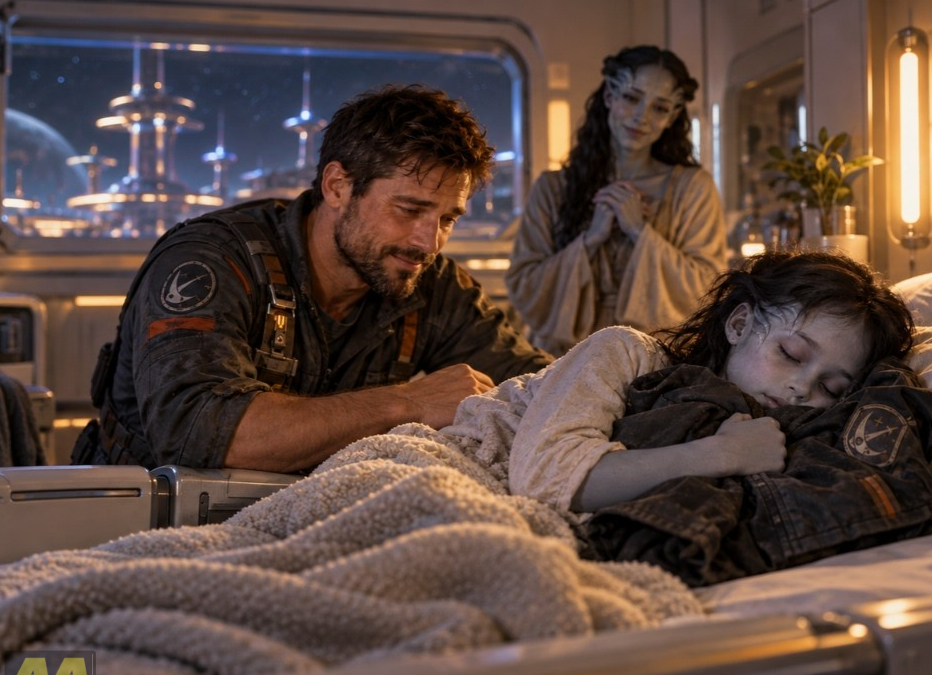
The universe was filled with people who believed strength meant never needing anyone else. They built ships that crossed impossible distances, stations that floated between worlds, and cities where millions of species lived side by side.
They celebrated independence, praised self-reliance, and admired those who could carry their own burdens without asking for help.
But sometimes the strongest thing a person could do was admit that a burden had become too heavy.
Adrien Moss had spent most of his life fixing things that were broken and leaving before anyone could ask him to stay.
A faulty engine, a damaged power line, a failing pressure system, it did not matter where he was or who needed him.
He arrived, repaired what needed repairing, collected his tools, and disappeared into the endless movement of space.
Machines were simple. They told you what was wrong if you knew how to listen.
People were different. People hid damage behind silence. They learned routines to cover fear. They became so skilled at handling everything alone that nobody noticed they were exhausted.
Adrien knew that because he had seen it countless times. But he had never expected to find it in a child.
The first thing he noticed about Casey was not her age, her species, or the way she moved through the crowded Stillwater Interworld Rest Annex like she had been assigned responsibility for the entire building.
It was the way she refused help. Not angrily. Not stubbornly. Simply as if accepting assistance was something she had already decided was unnecessary.
And when a delayed transport brought them together in a small family bay with a damaged ventilation system, Adrien discovered something unusual.
The little Arithi girl was not trying to prove she was strong. She was trying to prove she was not a problem.
But how long could someone keep carrying everything alone before they finally allowed another person to stand beside them?
Adrien Moss was halfway inside the ventilation access panel when the travel case moved. He had not heard footsteps.
That was the first unusual thing. Most children made noise when they moved. They dragged their feet, bumped into things, or announced what they were doing before they did it.
Casey did none of those things. The large travel case, almost reaching her shoulder height, shifted across the floor as she pulled it away from the wall.
Her narrow hands gripped the side handle firmly. She leaned back, used her weight carefully, and guided the case across the room until it rested neatly against the opposite side.
Adrien slowly lowered the screwdriver in his hand. The girl looked about eight years old by human standards.
Arithi aging patterns were not identical to humans, but everything about her suggested childhood. Her skin carried the soft gray-blue shade common among her species.
Two delicate sensory ridges extended backward from her temples beneath her dark hair, moving slightly whenever the room’s airflow changed.
Her name was Casey. Adrien knew because the assignment card beside the door displayed the room occupants.
“Mayervel, adult. Casey, youth. Family bay 12.” The Stillwater Interworld Rest Annex was designed for temporary stays.
Passengers waited there between transfers, repairs, weather delays, and scheduling problems. Most people treated it like a hotel they would forget the moment they left.
Casey treated it like a system she had been given responsibility over. Her blankets were folded.
Her shoes were aligned beneath the sleeping platform. Her personal items were arranged with exact precision.
The emergency light had been lowered to the minimum setting allowed by annex regulations. Now she had moved her luggage because Adrien needed access to the ventilation grill.
“You could have left it there,” Adrien said. Casey straightened. “I can manage.” The sentence caught his attention.
Not because of the words. Because of the way she said them. There was no irritation.
No challenge. No attempt to convince him. She stated it like a measurement. Like saying the room temperature was 21 degrees or the door lock was engaged.
Her mother looked up from the travel terminal in her hands. “Casey, I already moved it earlier.”
Mara Mayervel’s voice carried exhaustion, but not frustration. Adrien recognized that kind of tiredness. It came from long travel, interrupted sleep, and constantly having to solve problems before they became larger problems.
Adrien nodded toward the open ventilation access. “I only need this corner.” Casey looked at the space.
Then at him. “How much?” He held his hands apart. “About this much.” She immediately adjusted the case.
Exactly the amount required. Adrien almost smiled. Instead, he placed the screwdriver beside his tools.
“I’m Adrien. Building maintenance.” “I know.” He looked at the assignment card. “Right. Saves time.”
Casey looked toward the open ventilation panel. “What is wrong with it?” “I don’t know yet.”
“You opened it.” “That is usually how I find out.” She considered that answer. Most children would have asked whether he could fix it.
Casey asked something else. “How long?” “Maybe ten minutes.” “Maybe?” “Yes.” “You do not know.”
“No.” Her sensory ridges shifted slightly. Adrien recognized the movement. Arithi were especially sensitive to environmental changes.
Small differences in pressure, temperature, and airflow that humans ignored could feel obvious to them.
He added, “I do know it will not become dangerous while I’m checking.” Casey watched him.
“Those are different statements.” Adrien paused. They were. “That’s true.” The answer seemed to satisfy her.
She climbed onto the edge of her sleeping platform and watched. Adrien returned to the ventilation system.
The problem revealed itself quickly. A loose internal airflow regulator shifted whenever pressure changed in the corridor.
The damaged part was not dangerous, but it created a small imbalance whenever the nearby doors opened.
A human passenger probably would not notice. Casey noticed. The moment the corridor pressure adjusted, her head turned.
The loose component moved. A low flutter passed through the room. Her hands tightened slightly against the sleeping platform.
Then the sound stopped. Her shoulders relaxed. Adrien looked at her. She noticed. “I’m fine.”
“I didn’t say you weren’t.” “You looked.” “I look at vents for a living.” She studied him.
“Looking is most of the job?” Adrien glanced back at the damaged panel. “More often than people think.”
For the first time, Casey seemed to accept the answer without another question. He removed the damaged regulator and inspected the surrounding components.
The room door opened. An annex attendant appeared. “Twenty minute youth comfort check.” Mara glanced toward the wall display.
The timing was exact. Standard procedure. The attendant smiled. “All comfortable?” “Yes,” Mara replied. “Need anything?”
“No.” “Extra blanket?” “No.” “Different pillow density?” “No.” The attendant stepped farther inside and scanned the environmental panel.
The pressure shifted. The loose regulator fluttered again. Casey’s eyes immediately moved toward it. The attendant did not notice.
“Everything looks good.” The door closed. The room became quiet again. Adrien waited. Five seconds.
Ten. Casey slid from the sleeping platform. She checked the door latch. Then the ventilation opening.
Then the ceiling intake. Then the latch again. Mara sighed softly. “You don’t need to check every time.”
“I know.” Casey returned to her place. Adrien looked back into the ventilation space. The damaged regulator was only part of the issue.
The system was recovering too slowly after pressure changes. Nothing dangerous. Nothing requiring emergency action.
But every twenty minutes, when staff entered to perform checks, the room reminded Casey that something had changed.
For most species, the difference would be meaningless. For an Arithi child, it was like someone constantly moving a chair in a room and expecting them not to notice.
Adrien reached into his tool bag. Casey immediately spoke. “Do not move my case again.”
“I wasn’t going to.” “What are you taking?” “A pressure pennant.” He removed a thin strip of white synthetic material attached to a magnetic clip.
Casey leaned forward. “What does it do?” “Nothing.” Her expression changed. “Then why carry it?”
Adrien looked at the strip. “Fair question.” He clipped it near the ventilation opening. “It shows me what the air is doing.”
“That is doing something.” Adrien looked at her. “You’re right.” He opened the room door slightly.
The white strip lifted immediately. He closed it. The strip moved again, trembled, then slowly settled.
Casey stepped closer. “It should become still faster.” “Yes.” “How fast?” “In this room?” Adrien watched the strip.
“Seven seconds.” Casey counted quietly. “One. Two. Three…” Adrien looked at her. She reached seven.
“Exactly.” He tested it again. Same result. “Good catch.” “I was not trying to catch anything.”
“I mean you noticed it.” “I notice things.” Adrien looked at the ventilation system. “Yes.
I can see that.” He adjusted the internal bracket. Casey stayed beside him. Mara watched from across the room.
There was something different in her expression now. Not concern. Recognition. Like she was seeing someone else finally notice what she had noticed for a long time.
Adrien tightened the bracket. Tested the system. The recovery improved. Four seconds. Better. Not enough.
He checked the wall controls. “The supply pressure is pushing too hard when the corridor opens.”
“Can you repair that?” “Yes.” “How long?” Adrien looked at the panel. “Fifteen minutes.” Casey nodded.
Not because she was satisfied. Because she recorded the information. Adrien almost laughed. AlmoSt. Instead, he picked up his tools.
He stepped into the corridor toward the control panel. A few seconds later, Casey appeared at the doorway.
Mara followed. “Casey, give him space.” “I am.” Technically, she was standing exactly one meter from his open tool case.
Adrien looked at her. “You can watch if your mother says it’s okay.” Casey looked at Mara.
Mara nodded. So Casey watched. Adrien adjusted the local damper response. Tested. Adjusted again. Tested again.
Casey said nothing. That surprised him. Most children filled silence because silence felt uncomfortable. Casey seemed more comfortable when nobody expected anything from her.
Adrien understood that feeling. After the third adjustment, he stepped back inside. “Door teSt.” Casey returned to the sleeping platform.
Adrien opened the corridor door. The pressure changed. The white strip moved. One second. Two.
Still. He closed the door. The strip moved once. Then settled. Casey approached. Adrien repeated the teSt.
Again. And again. Finally, she nodded. “It is correct.” Adrien packed his tools. “That sounds like approval.”
“It is an observation.” “Of course.” She looked at him. Then, very slightly, one corner of her mouth moved.
Not quite a smile. But close. Adrien left the pressure pennant beside the ventilation grill.
“All right. It can stay.” Casey looked at the strip. “Good.” Adrien finished packing. For the first time since he entered the room, Casey did not immediately check the door after the corridor opened.
That was the first thing that changed. And Adrien noticed.
Stillwater Interworld Rest Annex considered Casey Mayervel an easy passenger. Adrien Moss learned that was because the annex records measured the wrong things.
The official system tracked completed tasks. It tracked whether a passenger could organize belongings, follow schedules, understand emergency instructions, and complete basic travel routines without assistance.
By those measurements, Casey was exceptional. She was prepared. She was organized. She was responsible.
She rarely asked for anything. And that last detail was treated as evidence that she needed less support.
Adrien was replacing a worn hinge on another family bay when he heard two allocation officers speaking near the service station.
“Family bay 12 should qualify for lower support youth placement tomorrow.” “She completes every independent function check.”
“We need the space.” Adrien kept working. The conversation was not his responsibility. The annex had thousands of passengers moving through every cycle.
Rooms had to be assigned. Resources had to be balanced. Staff had to make decisions based on available information.
He understood that. Systems existed because too many people needed things at the same time.
But the sentence stayed with him. She completes every independent function check. At 01:17, Adrien passed family bay 12 again.
Casey was awake. At 00:38, another comfort check had occurred. Adrien had been repairing a corridor sensor nearby when the attendant opened the door.
The room pressure remained stable now. No flutter. No delay. No irregular movement. The attendant scanned the environmental panel.
“All comfortable?” “Yes.” “Need anything?” “No.” The attendant left. Casey watched the door close. Then she looked at the pressure pennant.
It remained still. Only then did she lie back down. At 00:58, Adrien passed again.
She was awake. At 01:18, awake. At 01:31, Mara stepped into the corridor. Adrien was organizing his diagnostic equipment when she approached.
“mr. Moss.” “Adrien is fine.” She smiled faintly. “Adrien, can I ask you something?” “Sure.”
“Did you notice her before the repair?” He looked toward the closed room. “The ventilation issue?”
“My daughter.” Adrien understood. “Yes.” Mara nodded. “She has done that since we left Talerith.”
“How long have you been traveling?” “Nine days.” That explained the exhaustion in her face.
Nine days of transfers, delays, waiting areas, and unfamiliar environments. “She likes doing things herself,” Mara continued.
“I noticed.” “That part is real.” Adrien nodded. “She dresses herself. Packs herself. Reads schedules.
Finds routes. Remembers instructions better than most adults.” “I believe you.” Mara looked through the small window in the door.
“But she also believes needing anything makes everyone’s journey harder.” Adrien said nothing. “When this delay started, there were families sleeping in the transfer hall.
She heard an officer say support rooms were limited.” Mara paused. “After that, she stopped asking attendants for anything.”
Adrien looked at Casey’s sleeping area through the glass. “The annex knows?” “They see that she completes everything.”
“That is not the same thing.” Mara looked at him. “No. It isn’t.” A service alert appeared on Adrien’s wrist display.
He checked it. “Plenum inspection for bay 12.” “Is something wrong?” “No. Scheduled verification after the repair.”
Mara’s shoulders lowered slightly. “She might stay awake.” “I can delay it.” “For how long?”
“Until morning if necessary.” Before Mara answered, a small voice came from behind them. “No.”
Casey stood in the doorway. Her hair was slightly loose from sleep. “You said the repair needed testing.”
“It does.” “Then test it.” Mara looked at her. “Casey, you can sleep.” “I am not asleep.”
Adrien crouched slightly so he was closer to her level. “The test can wait.” “Would waiting make the room unsafe?”
“No.” “Would it make your job wrong?” Adrien paused. “No.” “Then why was it scheduled?”
Because maintenance preferred verifying repairs before closing reports. That was the honest answer. Adrien understood immediately what she needed.
She needed the truth. Not comfort. Not a softer version. The truth. “Because maintenance prefers to verify repairs before closing a ticket.”
Casey nodded. “Then verify it.” Mara sighed quietly. “She will stay awake wondering if you skipped something because of her.”
Adrien looked at Casey. She did not deny it. “All right.” He retrieved the access key.
The test required him to work above the ceiling panel. He brought his meter and removed his jacket because the service space was warmer than the corridor.
Casey watched as he placed it over the chair. “Will the pennant move?” “Probably.” “How much?”
“I don’t know yet.” Her sensory ridges tightened. Adrien immediately added, “But the room will stay safe while it moves.”
Casey nodded. He climbed onto the service step and opened the ceiling panel. The deeper airflow sound filled the room.
Casey remained beneath her blanket, watching. Adrien ran the first diagnostic. The pennant moved sharply.
Then settled. The second test briefly reversed airflow. The white strip moved backward. Casey sat up.
“It went backward.” “Expected.” “You did not say that.” Adrien looked down. “You’re right.” He pointed toward the strip.
“Next teSt. It will probably move backward for two or three seconds, then forward, then become still.”
“Probably?” “Air does not sign contracts.” For a moment, Casey stared at him. Then Mara laughed.
A small, surprised laugh. Casey looked at her mother, almost offended. Adrien returned to the panel.
He performed the test exactly as described. Backward. Forward. Still. Casey relaxed. A few minutes passed.
Then she spoke. “Adrien.” “Yes?” “When you finish, are you leaving?” “Yes.” “For the night?”
“Yes.” “Unless something breaks?” “Correct.” Her eyes moved toward his jacket. Adrien noticed. She looked away.
He finished the final measurement and closed the access panel. “Everything is good.” He started packing his tools.
His hand reached for the jacket. “Wait.” He stopped. Casey sat upright. Her hands rested on top of the blanket.
Adrien waited. “Does that need to go with you?” “My jacket?” “Yes.” Usually, yes. That was the answer.
But he understood the question beneath the question. “No. It does not need to go with me tonight.”
Casey looked at him. “You have another?” “Yes. In the maintenance office.” “Can this one stay on the chair?”
“Sure.” She lowered herself back down. Adrien picked up his tools. At the door, he stopped.
“One more thing.” Casey opened her eyes. He pointed toward the pressure pennant. “If it moves a little, that does not mean something is wrong.”
“I know.” “Normal airflow will move it sometimes.” “I know.” Adrien nodded. “If it moves backward for more than five seconds, tell your mother.”
“I could call maintenance.” “You could.” A pause. “But you do not have to.” Casey looked at the wall.
Then quietly said, “Good night.” “Good night, Casey.” Adrien left. At 02:11, he returned. He had forgotten a narrow socket driver.
He opened the door slowly after Mara answered. She raised one finger. Quiet. Adrien stepped inside.
The room was the same. The same soft amber light. The same travel case. The same pressure pennant beside the ventilation grill.
But Casey had changed. She was asleep. Not resting. Not pretending. Actually asleep. One arm extended outside the blanket.
Her small hand held onto the sleeve of Adrien’s jacket. The jacket was no longer on the chair.
It was partly covering the edge of her sleeping platform. Mara stood beside the water dispenser.
Her eyes were wet. “She hasn’t slept like that since Talerith.” Adrien looked toward Casey.
“She was tired.” Mara shook her head. “That is not the reason.” Adrien remained quiet.
“When she was younger, we spent one night in an emergency shelter during a station evacuation.”
Mara spoke softly. “Nothing about it was easy. Everyone kept moving. People changed locations. Adults were constantly making decisions.”
She looked at Casey. “Every time she fell asleep, something changed and someone woke her.”
Adrien understood. “She learned to stay ready.” Mara nodded. “She learned adults praise children who make difficult situations easier.”
There was no anger in her voice. Only sadness. “She became very good at it.”
Adrien looked at the jacket. “I didn’t do much.” Mara smiled slightly. “You told her what you knew.”
He looked down. “You told her what you didn’t know.” Silence. “And when she asked you to leave something,” Mara continued, “you left it without making her explain why.”
Adrien glanced at Casey. “It’s only a jacket.” “To you.” Casey shifted slightly in her sleep.
Her fingers tightened around the sleeve. Adrien lowered his voice. “I’ll collect it tomorrow.” Mara nodded.
“Thank you.” He found the socket driver beneath the chair. Then he left without waking her.
The next morning, the classification review began at 08:40. Adrien was not supposed to be involved.
He knew that. He was standing at the service counter drinking machine coffee when senior allocation officer Ivan Sorell approached.
Ivan was tall, formal, and carried the calm expression of someone who worked with decisions every day.
“Moss.” “Officer Sorell.” “You performed corrective work in family bay 12.” “Yes.” “Environmental fault?” “Minor pressure balance issue.”
“Resolved?” “Yes.” Ivan entered information into his tablet. “Could the fault have affected safe independent rest?”
Adrien looked at him. The question was more specific than expected. “Safe?” “No.” “Could it have affected whether she needed support?”
Adrien considered. “Not after repair.” Ivan nodded. “Good.” Adrien glanced at the tablet screen. A youth accommodation review was open.
Casey Mayervel. He knew he should stop asking. Instead, he said, “What exactly are you evaluating?”
Ivan looked up. “The child’s ability to use lower support accommodation.” “Casey is eight.” “Arithi developmental standards allow supervised lower support accommodation from seven.”
“I’m not questioning the standards.” “Then what are you questioning?” Adrien looked through the glass wall.
Casey sat beside Mara. She was dressed, organized, and prepared. His jacket was folded across her knees.
Poorly. One sleeve stuck out. Adrien looked back at Ivan. “Why does my maintenance ticket matter?”
Ivan slightly tilted the tablet. “The family reported disrupted rest caused by an environmental issue.
If the environment affected her behavior, we consider that.” “And now?” “The issue is resolved.”
“So there is no environmental barrier.” “Yes.” Adrien nodded. “Then the question is whether the room prevented her from resting.”
Ivan watched him. “Yes.” Adrien looked back toward Casey. “She slept after the repair.” “Yes.”
“Did she sleep because she learned to handle the room?” Ivan did not answer. Adrien continued.
“No. She slept because for a few hours, she did not have to keep proving she could handle everything.”
Ivan remained silent. The room behind the glass became his focus. After several seconds, he said,
“What evidence do you have?” Adrien answered carefully. “She stopped checking every few minutes.” “That is your interpretation.”
“Yes.” “Based on observation.” “Yes.” Ivan looked at the tablet. “Observation alone does not overturn assessment.”
“I agree.” That seemed to surprise him. Adrien picked up his coffee. “I’m not asking you to remove support because I think she needs it.”
“Then what are you asking?” Adrien looked at Casey. “I’m asking you to measure the thing you actually want to know.”
Ivan followed his gaze. “And what is that?” Adrien answered quietly. “Whether she can use less support without becoming the person responsible for making sure everything works.”
Ivan looked toward the family waiting area. For the first time, he did not immediately respond.
Because the question was no longer about what Casey could do. It was about what she should have to do.
Disclaimer: This content may be created by Al for entertainment purposes. Any resemblance to real persons, events, or places is coincidental.








