The Horse Was Beaten And Left On The Side Of The Road — A Cowboy Found The Horse And Brought It Home
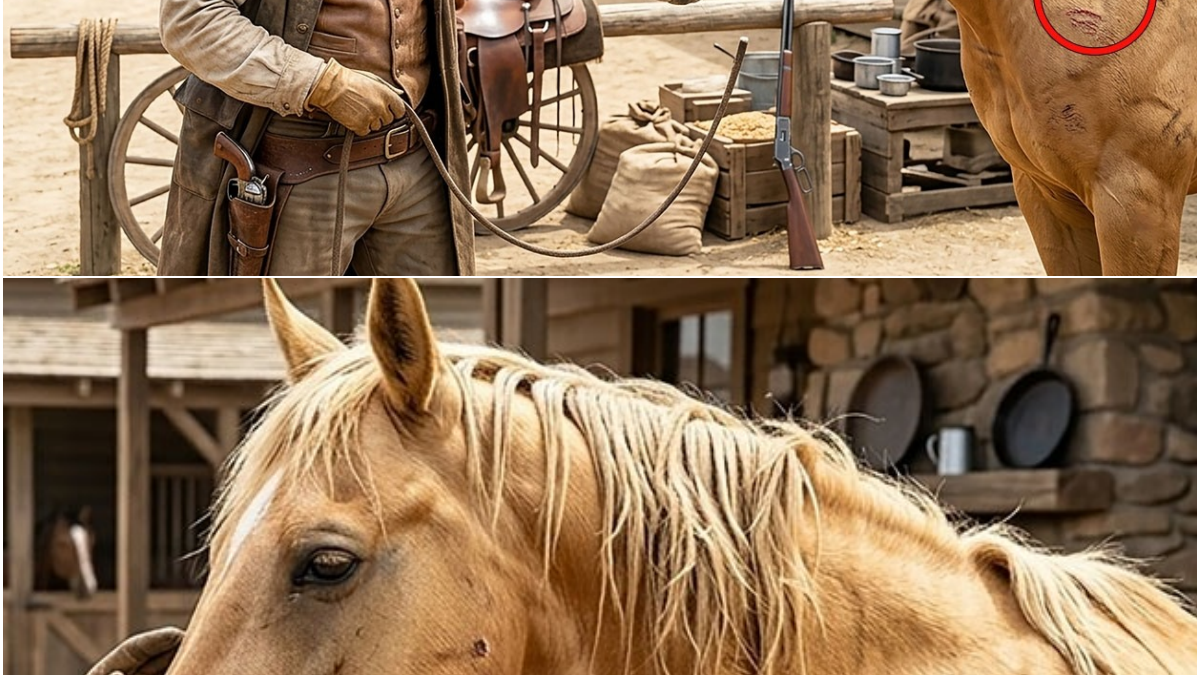
The golden buckskin lay in the West Texas dirt, his sides rising and falling in shallow, ragged breaths.
Clint Vance stood over him, wiping a fleck of blood from his custom Lucchese boots.
His brother Roy watched from beside the truck, a shattered riding crop lying in the sagebrush.
The afternoon sun beat down on the animal’s battered body, turning the dust around him into a haze of heat.
“Spit on him and let the buzzards have the rest,” Clint sneered. “He ain’t worth the lead to put him out of his misery.”
Roy chuckled, but the horse did not move. Its golden coat was stained with mud, its legs trembled, and deep welts marked its flanks.
The brothers had decided that the animal’s refusal to obey was an insult they could not tolerate.
Now they were leaving him beside Route 118, convinced the desert would finish what their cruelty had begun.
Neither man noticed the old Ford slowing in the distance. Hank Dawson had driven this lonely stretch of highway often enough to recognize trouble in the roadside shadows.
When he saw the shape in the ditch, he braked hard and climbed out into the heat.
He expected to find an injured wild animal. Instead, he found a horse whose eyes held a fear no creature should have to carry.
Hank had no idea who had left him there, or what kind of trouble rescuing him might bring.
But as he knelt beside the buckskin and felt the faint warmth beneath his hand, one thought settled into his mind.
What if the horse everyone else had given up on was the one thing capable of changing both their lives?
Hank Dawson knew the Chihuahuan Desert better than most people knew their own backyards. He had spent fifty years learning its moods, its silences, and its unforgiving ways.
He knew how quickly a clear morning could turn into a furnace, how a dry creek bed could become dangerous after a distant storm, and how a man could travel for miles without seeing another living soul.
That afternoon, he was driving his battered 1998 Ford F-250 along State Route 118 near the jagged foothills of the Davis Mountains.
An empty Logan Coach horse trailer rattled behind him. The truck’s 7.3-liter Power Stroke diesel engine hummed steadily beneath the hood, and the air-conditioning was doing its best against the 105-degree heat outside.
Hank was headed back to Copper Creek Ranch, his modest three-hundred-acre spread. The ranch had sparse grazing land, a weathered red barn, and a small tin-roofed house that had grown quieter since his wife, Sarah, had been gone for three years.
He still tended his small herd of Corriente cattle, repaired fences, checked water troughs, and handled the endless chores that came with owning land in West Texas.
But the work had become a routine rather than a source of happiness. He had once believed that hard work could solve most problems.
Then he had watched Sarah’s illness take away the future they had planned together, and he had learned that effort did not always change the outcome.
Since then, he had kept moving because stopping left too much room for memories. The dark shape beside the road interrupted that familiar rhythm.
Hank hit the brakes. The heavy truck fishtailed slightly, the trailer swinging behind it before the tires found their grip.
He threw the transmission into park and looked toward the ditch. At first, he thought he was seeing a wounded coyote or perhaps a mule deer caught among the mesquite.
He reached for the Winchester 1894 lever-action rifle mounted behind his seat, then stepped out into the heat.
The shape was a horse. Hank lowered the rifle and hurried toward it, his worn Justin ropers crunching over the gravel.
The closer he came, the worse the sight became. The buckskin had once been magnificent, with a coat that should have shone like minted gold and a strong, balanced frame.
Now his sides were marked by deep, angry welts. Dried mud and dark blood clung to his coat.
A gash above his left eye had left one side of his face swollen and crusted.
The horse’s breathing sounded wet and uneven. Its ribs moved beneath its skin, and its legs shook whenever it tried to shift.
Hank dropped to his knees. “Easy, partner. Easy now. I ain’t going to hurt you.”
The horse did not respond. One dark eye rolled toward him, clouded with pain and fear.
Hank placed a hand gently against its neck. The hide was dangerously hot, and the animal felt terribly weak.
He had seen injured cattle, horses caught in wire, and livestock suffering from long days without water.
But this was different. The marks across the horse’s body were too deliberate, too numerous, and too evenly placed to be the result of an accident.
Someone had beaten him. Someone had ridden him beyond exhaustion, punished him for something, and left him beside the highway.
Hank’s jaw tightened. “Not today,” he whispered. “You ain’t dying in this ditch.” He ran back to the truck and returned with a canvas bucket, a five-gallon jug of water, and a thick cotton lead rope.
He knew better than to let a severely distressed horse gulp down a large amount of water.
Instead, he soaked a blue bandana and gently pressed moisture against the animal’s cracked muzzle and gums.
The horse’s nostrils flared. Its eye shifted toward the damp cloth. “That’s it,” Hank murmured.
“Just take it slow.” He wiped away some of the dried blood near the injured eye, careful not to touch the wound itself.
The horse flinched, but it did not try to strike him or scramble away. Hank had no idea how long the animal had been there.
He could see no clear brand through the dirt and scars, and he found no obvious identification.
He did not waste time searching for answers. The horse needed shade, treatment, and a chance to recover.
Getting a severely injured animal into a trailer was another matter. Hank backed the F-250 toward the ditch until the trailer ramp sat close to the horse.
He fetched a heavy-duty nylon halter from the tack compartment and worked it carefully over the buckskin’s battered head.
The animal trembled as the straps passed near its wounds. “Come on, boy,” Hank said.
“Give me something. Just a little.” The horse tried to rise, but its front legs folded beneath it.
Hank steadied the halter and waited. He did not want to frighten the animal into a frantic struggle that might worsen its injuries.
He adjusted the lead line and positioned himself where he could guide without pulling the horse off balance.
The work was exhausting. Sweat ran down his face and stung his eyes. His shoulders burned as he tried to support the horse’s weight and encourage it toward the ramp.
For several minutes, nothing changed. Then the buckskin took a breath, gathered what strength he had left, and pushed upward.
His front hooves scraped against the caliche rock. Hank kept the rope steady, moving with him rather than dragging him.
The horse lurched forward, stumbled, and nearly knocked Hank sideways into the sagebrush. But he stayed on his feet long enough to reach the ramp.
“Easy. Easy. You’re doing it.” The buckskin climbed the rubber-matted incline with trembling legs. Once inside, he collapsed onto the bedding.
Hank secured the divider and checked the animal’s position. The horse was exhausted, but he was breathing.
That was enough for the moment. Hank closed the trailer doors. The metallic clank echoed across the empty highway.
He still did not know who had done this. He did know that whoever had left the horse there had expected nobody to stop.
Hank climbed into the truck and started toward Copper Creek. He made a silent promise as the desert rolled past his window.
He would do everything he could to save the horse. And if he ever found the people responsible, they would have to answer for what they had done.
The sun had begun to sink behind the Davis Mountains when Hank pulled beneath the weathered wooden archway of Copper Creek Ranch.
The sky was turning purple, and the first shadows stretched across the pasture. He did not unhook the trailer.
Instead, he drove straight to the barn, jumped out, and threw open the doors. The smell of alfalfa hay and old leather met him.
He switched on the halogen work lights, then called Doc Miller. The old veterinarian answered after several rings.
“Doc, it’s Hank Dawson. I need you at Copper Creek right now. I’ve got a buckskin down.
Severe trauma, dehydration, lacerations. Looks like somebody beat him and left him on the highway.”
There was a short pause. “Where’d you find him?” “Route 118, near the foothills.” “I’m rolling.
Give me twenty minutes. Keep him quiet, and don’t let him drink too much.” Getting the horse from the trailer into the deeply bedded foaling stall was difficult.
The buckskin could barely stand, and his muscles shook with every movement. Hank supported him as best he could, speaking constantly in a calm, steady voice.
When they finally reached the stall, the horse lowered himself into the pine shavings and lay still.
Doc Miller arrived in a cloud of duSt. He had treated livestock in Brewster County for forty years, and his mobile veterinary truck carried enough equipment to handle most emergencies.
He stepped into the barn, took one look at the buckskin, and stopped. “Lord almighty,” he said quietly.
“Who in the world does something like this?” “I don’t know.” Doc set down his medical bag and began examining the horse.
He checked the animal’s breathing, pulse, temperature, and response to touch. Then he looked at the wounds.
“This one above the eye needs attention immediately.” Hank held a light while the veterinarian cleaned the injury.
Doc worked carefully, removing dirt and damaged tissue before beginning the repair. The wound was deep enough to require thirty stitches.
“This wasn’t a branch or a fence wire,” Doc said. “That’s blunt-force damage. Whoever did it used something heavy.”
Hank’s hands tightened around the flashlight. “Will he make it?” Doc did not answer immediately.
He examined the horse again, then began setting up fluids. “He’s badly dehydrated and in shock.
We need to stabilize him before we can know how much damage there is.” They worked for four hours.
Doc hung bags of lactated Ringer’s solution from the stall rafters and ran an IV line into the horse’s jugular.
Hank passed supplies, held the light, and kept a reassuring hand against the animal’s neck whenever the horse became restless.
They cleaned the deep cuts along his flanks and treated the swelling around his face.
Doc checked the horse’s legs and joints, looking for injuries that might not be visible through the bruising.
By the time the treatment was finished, the buckskin’s breathing had steadied somewhat. His temperature remained concerning, and he was still too weak to stand.
Doc packed his equipment and looked at Hank. “He’s young. Maybe five or six. Strong frame, deep chest, good hindquarters.
He was a well-built horse before somebody put him through this.” “Can he recover?” “He can.
But it’s going to take time. His body has been pushed too far, and the fear may take longer to heal than the injuries.
Some horses stop trying when they’ve been hurt badly enough. If he can’t get up by morning, we’ll have to reassess.”
Doc left pain medication and antibiotics, then gave Hank detailed instructions about keeping the stall quiet, maintaining the horse’s warmth, and monitoring his condition.
“I’ll be back at dawn,” he said. “Call me if anything changes.” When the veterinarian’s taillights disappeared down the driveway, Hank dragged a battered lawn chair into the stall.
He brought a chipped mug of black coffee and a heavy wool Pendleton blanket. He laid the blanket over the horse’s barrel, then sat nearby.
The barn was quiet except for the wind moving against the tin roof and the occasional shift of the horse’s breathing.
Hank watched the blanket rise and fall. He thought about Sarah. He remembered the long hours beside her hospital bed, the quiet conversations, the days when they had still believed the treatment would give them more time.
He remembered the helplessness of watching someone he loved grow weaker while he could do little more than hold her hand.
He had lost that struggle. The memory still sat inside him like a stone. Now there was another creature depending on him, another life that might slip away while he sat watching.
Hank leaned forward and set down his coffee. “You can’t quit on me,” he whispered.
He moved closer to the horse’s head, careful not to disturb the bandages. He stroked the soft velvet of the muzzle.
“I know humans haven’t given you much reason to trust them. But I ain’t them.
You hear me? You’ve got to fight. We’re not done yet.” The hours passed slowly.
Around three in the morning, the temperature dropped sharply. Hank shivered in his denim jacket and pulled it tighter around himself.
The horse shifted beneath the blanket, then let out a long, shuddering breath. Hank sat upright.
The buckskin’s eye opened. This time, it seemed to focus on the man beside him.
The horse watched Hank for several seconds, then moved his legs beneath his body. “Easy,” Hank said, barely breathing.
“Take your time.” The horse rolled onto his sternum. His front legs trembled as he tried to gather them beneath him.
Hank stayed still, afraid that even a small movement might interrupt the effort. The buckskin pushed.
His shoulders rose. His hindquarters followed unevenly. For a moment, he swayed so badly that Hank thought he might collapse again.
Then he stood. The horse trembled from nose to tail, but his legs held. Hank slowly rose from the chair.
His eyes stung, and he swallowed hard. “All right,” he whispered. “All right, partner.” He brought a small bucket of fresh water and offered it carefully.
The horse sniffed the surface, then drank slowly. When he finished, he lifted his head and nudged Hank’s shoulder.
It was a small gesture, fragile and uncertain, but Hank felt it deeply. A genuine smile crossed his weathered face for the first time in years.
“I think I’ll call you Spirit,” he said. “Because they sure as hell didn’t break yours.”
The next morning, Doc Miller returned and found the buckskin standing in his stall. He examined the horse carefully, pleased by the improvement but unwilling to celebrate too early.
“Standing is a good sign,” he said. “But we’re only at the beginning.” And he was right.
Spirit’s recovery would not be measured in days. It would take months of patient care, careful feeding, medical attention, and the slow rebuilding of truSt.
Spring turned into summer. The worst wounds on Spirit’s flanks closed, leaving raised scars where the hair would never grow back normally.
His coat began to shine again, and the hollow places along his body gradually filled out.
Hank bought high-protein alfalfa and grain, often cutting back on his own groceries to keep the horse’s feed consistent.
But the physical healing was only part of the work. Spirit was deeply frightened. A sudden movement could send him trembling toward the far side of the pen.
The sharp crack of a breaking twig made him flinch. A coiled lariat was enough to bring his ears flat and his body rigid.
Hank did not force him to overcome those reactions in a hurry. He spent hours standing in the round pen with him, doing nothing more complicated than remaining calm and predictable.
Some days, he spoke softly. Other days, he simply leaned against the fence and let Spirit decide whether to approach.
He used no whip, no spurs, and no harsh equipment. He relied on body language, patience, and gentle pressure followed by release.
If Spirit moved away, Hank gave him room. If he stood quietly, Hank let the moment remain quiet.
“You don’t owe me anything,” Hank often told him. “You just have to learn you’re safe.”
The first time Spirit willingly followed him across the pen, Hank felt as proud as he had when he had first seen the horse stand.
Six weeks into the recovery, Doc Miller returned to check Spirit’s hooves. The horse had been missing three shoes when Hank found him.
One remained on the right hind hoof, twisted and dangerously overgrown. Doc used his nippers to remove it.
When the iron came free, he held it up beneath the barn light. “Take a look at this, Hank.”
Hank examined the shoe. It was unusually heavy, with an asymmetrical wedge welded near the heel.
“Corrective shoe?” Hank asked. “Not the kind you’d want on a horse that needs to move naturally,” Doc replied.
“This is designed to alter the gait and force a higher step. It puts a lot of strain on the tendons.
It’s an old trick used in certain show circles to make a horse look flashier.”
Hank turned the shoe over. A small stamp sat near the toe. A diamond with a V inside it.
His expression hardened. “The Diamond V.” Doc nodded. “Clint and Roy Vance. I’d be careful if I were you.
Those boys have influence in this county.” The Vance brothers were known throughout the Trans-Pecos region.
They came from third-generation money and had built their ranch into a sprawling, modern operation near Alpine.
Their property, the Diamond V, had helicopter pads, extensive barns, and imported horses. They had spent years purchasing land, acquiring water rights, and expanding their influence.
Their business methods were another matter. Smaller ranchers whispered about pressure to sell, water diversions, and sudden trouble after refusing an offer.
Few people wanted to challenge the brothers publicly. Hank had heard the name before. He had never wanted a reason to learn more about them.
Now he had one. The next day, he drove into Alpine and stopped at McCoy’s Building Supply.
He needed fencing wire, but the real reason for the trip was information. In a small community, the feed stores and supply counters often knew what the official records did not.
The proprietor, old man Jenkins, was behind the counter when Hank came in. “You ever shoe horses for the Diamond V?”
Hank asked. Jenkins glanced toward the door. His voice lowered. “I used to. Until Clint asked me to put weighted shoes and special pads on a young buckskin stud he bought out of Oklahoma.”
“What did you tell him?” “That it was cruel. The horse had enough natural ability without being forced into some artificial gait.
Clint fired me and brought in a fellow from out of state.” Hank leaned closer.
“What happened to the horse?” Jenkins hesitated, then continued. “Horse had too much fire. Clint’s got a heavy hand.
He tried to beat submission into him. Word was, about two months ago, Clint forced him toward a jump he couldn’t make with those shoes.
The horse refused, bucked, and threw Clint into a corral fence. Broke his collarbone.” Hank felt his stomach tighten.
“And after that?” “The brothers loaded the horse into a trailer that same afternoon. Said they were taking him to a slaughterhouse in Mexico.
Nobody’s seen him since.” Hank thanked Jenkins and walked back into the sun. The pieces fit together.
The buckskin had been trained for show, forced into an unnatural movement, and punished when his body and instincts refused to cooperate.
When the horse defended himself, the brothers had decided he was no longer worth keeping.
They had left him on the highway and expected the desert to erase the evidence.
Hank sat behind the steering wheel for a long time, looking toward the direction of the Diamond V.
He had spent years keeping his head down. He had learned not to become involved in every dispute, not to waste energy on people who enjoyed conflict, and not to mistake anger for a plan.
But this was different. He had the shoe with the Diamond V stamp. He had Doc Miller’s medical report.
He had the account from Jenkins, and he had a horse whose injuries told a story that no amount of expensive leather could conceal.
Hank did not intend to confront the brothers without preparation. He had seen what influence could do to a small rancher.
He knew that an accusation without evidence could become a problem for the person making it.
So he kept the shoe and the report safe. He began gathering information about the Vances’ other disputes, including the rumors about water diversions and pressure on neighboring ranches.
He also contacted Sheriff Toliver, who had been looking into complaints involving the brothers and their business dealings.
The sheriff listened carefully. “I can’t build a case on rumors,” Toliver told him. “But if you’ve got something solid, bring it in.”
Hank brought him the shoe, Doc’s report, and the details Jenkins had provided. Toliver made copies, asked questions, and told Hank he would follow up.
“Don’t go looking for trouble,” the sheriff said. “I’m not looking for it,” Hank replied.
“It’s already found me.” Toliver studied him for a moment. “Then don’t give them a reason to turn this around on you.”
Hank promised he would be careful. By autumn, Spirit had changed beyond recognition. His golden coat gleamed in the sunlight, and the black points on his legs and mane stood out sharply.
He had regained his strength and carried himself with a proud, balanced posture. His frame was impressive, with a broad chest, strong hindquarters, and the athletic build of a well-bred Quarter Horse.
But Hank cared most about the change in his eyes. The frightened animal who had watched him from the ditch now looked at him with curiosity and truSt. He still had difficult moments, but the panic no longer controlled every part of his day.
In November, Hank decided it was time to try a saddle. He chose a quiet morning and brought out an old custom Wade-tree saddle.
First, he let Spirit inspect the blanket. The horse sniffed it, watched Hank’s hands, and stood still as the Navajo fabric settled across his back.
Hank lifted the saddle slowly and placed it in position. Spirit tensed when the leather touched him, but Hank waited until the horse relaxed before tightening the cinch.
“Easy,” he said. “We’re just going to see how it feels.” Spirit stood quietly. Hank stepped onto a mounting block, took a handful of the horse’s black mane, and swung his leg over.
He settled into the saddle and waited. There was no buck, no sudden leap, no desperate attempt to escape.
Spirit stood still, his ears flicking backward to listen to Hank and then forward toward the open pasture.
Hank let out a slow breath. “All right, partner. Let’s walk.” Spirit stepped forward. His movement was smooth and powerful.
The scars on his flanks remained visible, but they did not define the way he moved.
He traveled with a natural rhythm that Hank had rarely seen in a horse. Over the following months, Hank discovered that Spirit possessed extraordinary cow sense.
When they rode out to gather the Corriente herd, the buckskin seemed to anticipate the cattle’s movements.
He could turn sharply, lower his center of gravity, and separate a calf from the herd with very little guidance.
Hank did not need to pull constantly on the reins. A shift of his weight, a slight change in his leg, or a quiet word was often enough.
It felt as though horse and rider had learned to communicate through the smallest movements.
They became a familiar sight around Copper Creek: the solitary cowboy and the golden horse moving across the scrub, guiding cattle with an ease that made difficult work look simple.
For Hank, the partnership brought back a kind of happiness he had thought was gone.
Spirit gave him a reason to rise early, a reason to plan for the future, and a companion whose trust had to be earned every day.
For Spirit, Copper Creek became a place where no one demanded that he perform beyond his limits.
He had room to run, clean water to drink, and a man who understood that trust could not be beaten into a creature.
But the ranch still faced its own problems. The winter was harsh. Hay prices climbed, and the bank began threatening foreclosure.
Hank’s savings were nearly gone. He had spent much of what he had on Spirit’s treatment and feed, and the cattle operation was not producing enough income to cover every expense.
One evening, he sat at the kitchen table staring at a flyer he had picked up in town.
It advertised the annual Alpine High Desert Cutting Horse Futurity. The competition was known for attracting serious trainers, wealthy owners, and some of the best cutting horses in the region.
The entry fee was steep, but the grand prize was twenty-five thousand dollars. That money could save Copper Creek and give Hank room to keep the ranch operating for another two years.
He looked through the window toward the paddock. Spirit stood beneath the moonlight, his golden coat shining faintly as he watched the house.
Hank knew who would be at the competition. The Vance brothers dominated the local show circuit.
They bought expensive horses, hired professional riders, and collected prizes that strengthened their reputation as the most powerful ranching family in the county.
Entering would put Spirit directly in front of the men who had hurt him. Hank considered the risk.
The noise, the crowds, the unfamiliar horses, and the possibility of seeing Clint again could unsettle Spirit.
He did not want to turn the horse’s recovery into another test of endurance. But Spirit was no longer the helpless animal Hank had pulled from the ditch.
He had become strong, capable, and confident. If the horse was ready, the competition could be a chance to show what he could do without being forced or frightened.
Hank walked out to the paddock and stood beside him. “What do you think, boy?”
Spirit nudged his shoulder. Hank smiled. “I guess we’ll find out.” He returned to the kitchen, picked up a pen, and signed the entry form.
The Alpine Livestock Arena was a cauldron of noise, dust, and money on the day of the futurity.
The bleachers were packed with ranchers, tourists, investors, and families who had come to watch the horses compete.
The smell of frying funnel cakes mixed with manure, sweat, and expensive leather. Trucks and trailers filled the parking area, many of them polished and customized, with living quarters that looked more comfortable than Hank’s entire house.
Hank backed his rusted Logan trailer into a narrow space between two enormous rigs. He climbed down, checked the trailer latch, and looked toward the arena.
He felt out of place. The professional trainers wore starched shirts, custom chaps, and silver buckles.
Their horses were groomed until their coats shone, and their tack carried enough polished metal to catch the sunlight from across the grounds.
Hank wore faded jeans, his battered Stetson, and a plain pearl-snap shirt. His saddle was well cared for, but it had been built for work, not for showing off.
Spirit, however, seemed to notice none of it. When Hank lowered the trailer ramp, the buckskin stepped out with his head high.
He took in the unfamiliar smells, the voices, the clatter of equipment, and the movement of horses in every direction.
For a moment, his muscles tightened and his ears flicked rapidly. Hank stepped beside him and rested a steady hand against his neck.
“You’re all right,” he murmured. “I got you.” Spirit breathed out, then stood quietly. They walked toward the warm-up arena.
Hank kept the lead rope loose, allowing the horse to look around without feeling trapped.
When a loudspeaker crackled overhead, Spirit startled and shifted sideways. Hank did not yank the rope or scold him.
He simply waited until the horse settled. “That’s it. Nothing’s going to happen to you here.”
As they passed the concession stands, the crowd seemed to ripple with a sudden change in attention.
Hank glanced toward the VIP railing. Clint and Roy Vance stood there. Clint wore a tailored blazer and a silver belt buckle large enough to draw attention from the far side of the arena.
Roy stood beside him, holding a drink and speaking to a man in a dark hat.
Both brothers looked comfortable in the kind of place where their money and reputation usually guaranteed them a welcome.
Then Clint’s eyes drifted toward the warm-up pen. His smile disappeared. He stared at the golden buckskin.
He recognized the black markings on the horse’s legs, the shape of his head, and the powerful hindquarters.
But it was the scars that confirmed what he was seeing. Clint shoved through the people gathered near the railing.
Roy followed close behind. They reached the pen just as Hank swung into the saddle.
“Dawson!” Hank did not flinch. He guided Spirit around and faced the brothers. Clint gripped the top rail.
“Where the hell did you get that horse?” “I found him on Route 118.” “That’s my property.”
Hank rested his forearms on the saddle horn. “Funny. When I found him, he was lying in a ditch, badly injured, with no one around to claim him.”
Clint’s face reddened. “You stole him.” Hank looked at him steadily. “According to the livestock rules, an abandoned animal without clear identification can become the responsibility of the person who rescues it, depending on the circumstances.
I’ve got the veterinary records, the shoe he was wearing, and the report of his condition when I found him.”
Clint’s expression tightened. Hank continued in a quiet voice. “Unless you want to tell everybody here that you owned him, and explain why he was beaten half to pieces and dumped beside the highway.”
The people nearest the rail had begun listening. A few turned away from their conversations.
Someone lowered a camera. Roy’s expression changed as he realized the attention was no longer on the horses.
Clint leaned over the railing. “You’re making a mistake, Dawson.” “No,” Hank said. “I made a decision.”
“You think you can embarrass me in front of these people?” “I think the horse deserves to be left alone.”
Clint’s gaze moved to Spirit. The buckskin’s ears had tilted back, and his body had become tense.
Hank shifted slightly in the saddle and spoke softly. “Easy, partner.” Spirit settled beneath him, though he continued watching Clint.
Clint noticed the movement. For an instant, his face showed something other than anger. The horse had responded to Hank with a calmness that Clint had never been able to force out of him.
Then the expression vanished. “You’re going to regret this.” Hank turned Spirit toward the warm-up area.
“Get in line, Clint. There’s a competition today.” He rode away without waiting for an answer.
The cutting competition began an hour later. The rules were straightforward, though the skill required was anything but simple.
Each rider had to separate one calf from a herd and keep it from returning.
The horse was expected to do most of the work, responding to the calf’s movements with speed, balance, and instinct.
Once the rider released the reins, the horse had to demonstrate its ability to work independently.
Hank watched several competitors before his turn. The horses were talented, and the riders knew how to present them.
Some performances were smooth and controlled, with the horse making every movement appear effortless. Others were more aggressive, with quick turns and sharp stops that drew cheers from the crowd.
Clint’s hired professional rode a striking sorrel mare. She was expensive, athletic, and trained to a high standard.
The rider entered the arena confidently, selected a calf, and worked the mare through a precise series of turns and stops.
The performance was technically impressive. When the score appeared, the board showed seventy-six. The crowd applauded loudly.
Clint stood near the rail with a satisfied smile. Hank waited for his name. The announcer’s voice echoed through the speakers.
“Next up, Hank Dawson on Spirit.” Hank rode into the arena. The crowd murmured. Spirit wore no flashy silver tack, and Hank’s working saddle looked plain beside the polished equipment of the other competitors.
But when the buckskin saw the cattle, his entire manner changed. His head lowered slightly.
His ears focused. His muscles gathered beneath his golden coat. Hank felt the change through the saddle.
He guided Spirit toward the herd and selected a quick-footed black Angus calf. The animal moved restlessly among the others, shifting its weight and looking for an opening.
Hank rode deep enough into the herd to separate it. Once the calf moved into the open arena, he released the reins and let Spirit take over.
The calf bolted left. Spirit was already moving. He dropped his shoulder, dug his hind hooves into the dirt, and cut off the calf’s path with astonishing precision.
The calf turned sharply to the right. Spirit pivoted and followed, keeping himself between the animal and the herd.
Hank sat quietly, allowing the horse to work. The calf feinted left again. Spirit read the movement before it became a full turn.
His hooves scattered sand as he shifted his weight and blocked the opening. The crowd grew louder.
Spirit did not chase wildly or waste energy. He stayed balanced, watched the calf, and responded with a confidence that seemed almost impossible for a horse who had once been frightened by the sight of a coiled rope.
For two and a half minutes, the buckskin displayed the kind of instinct that could not be manufactured by expensive equipment.
He anticipated every change of direction and met each movement with a precise counter. The judges leaned forward.
One lowered his pen and watched without writing. Hank felt the horse’s strength and concentration beneath him.
Spirit was not performing for the people in the stands. He was doing what he had learned to do, using the abilities that had always belonged to him.
When the buzzer sounded, the arena erupted. It was not polite applause. It was a roar that rolled across the bleachers and into the parking lot.
Hank gathered the reins and patted Spirit’s neck. “You did good, boy.” Spirit lifted his head, breathing hard, his coat damp with sweat.
He stepped proudly as Hank guided him toward the exit. The digital board flashed the score.
Eighty-two. The highest score in the history of the Alpine Futurity. For a moment, Hank simply stared at the number.
Then he laughed, a deep, surprised sound that seemed to come from somewhere he had not visited in years.
The prize money would save Copper Creek. The ranch would have another chance, and Spirit had just shown everyone what he could do.
Hank looked toward the VIP rail. Clint Vance’s face had gone pale. He had not merely loSt. He had been beaten by the very horse he had dismissed as worthless.
And the horse had done it without being forced, frightened, or punished. Hank did not wave at Clint.
He did not raise a hand in triumph. He simply guided Spirit out of the arena and returned to the stabling area.
The celebration continued around them. People congratulated Hank, asked about Spirit’s breeding, and wanted to know how he had trained such a talented horse.
Hank answered what he could, but he kept the conversation simple. “Patience,” he said. “And letting him be a horse.”
One young rider asked whether Spirit had always been so confident. Hank looked at the scars along the buckskin’s flank.
“No,” he replied. “He had to learn he was safe firSt.” By midnight, the fairgrounds had grown quiet.
Most competitors had returned to their trailers or gone into town. The arena lights still shone over the empty seating, and the night air had cooled enough to make the desert feel almost gentle.
Hank was in the temporary stabling barn, brushing Spirit and wrapping his legs in standing bandages.
The horse stood calmly, occasionally shifting his weight or turning his head to watch Hank’s hands.
“You did good, boy,” Hank whispered. “We’re going home tomorrow. We’re safe.” He offered Spirit a peppermint.
The buckskin accepted it carefully and nudged Hank’s shoulder. Hank smiled. Then the barn door at the far end of the aisle slammed open.
Clint and Roy Vance stepped into the shadows. Both had been drinking. Clint carried a heavy iron tire iron in his right hand.
Roy held a coiled lariat. Hank slowly set down his brush. Clint’s eyes were fixed on Spirit.
“You think you can embarrass me in my own town, Dawson?” Hank remained still. “Go home, Clint.
You’re drunk. You’ve loSt. Walk away.” Clint laughed without humor. “I ain’t losing to a dirt-poor squatter and a broken-down horse.”
Hank glanced toward the barn entrance. The aisle was long, and the brothers stood between him and the open doors.
He had no rifle in his hands. Spirit was in the stall, and the horse could not simply be turned loose without risking injury.
Clint stepped closer. “Hold him, Roy. I’m going to make sure that animal never competes again.”
Roy moved firSt. He swung the lariat toward Hank, aiming to catch him and pull him away from the stall.
Hank ducked, but the rope caught his shoulder and threw him off balance. He struck the heavy wooden divider and stumbled.
Clint saw his opening. He stepped into the stall, raising the tire iron above his head and aiming toward Spirit’s front legs.
Hank tried to recover his footing. “Clint, don’t!” But Clint had already committed himself. He believed he was facing the same frightened animal he had beaten months earlier.
He believed Spirit would recoil, panic, or freeze when confronted with the man who had hurt him.
He was wrong. Spirit did not retreat. The buckskin’s ears flattened against his skull. His body gathered beneath him, and a sharp, furious squeal filled the stall.
Then he reared. The movement was sudden and powerful. His front end rose high, and Clint’s swing faltered as the horse towered above him.
Spirit struck out with both front hooves. The impact drove Clint backward out of the stall and into the opposite wall of the aisle.
The tire iron clattered to the dirt. Clint fell hard and struggled to catch his breath.
Roy froze. The lariat slipped from his fingers and dropped to the floor. He looked at his brother, then at Spirit, who had landed squarely on all four hooves and stood with his ears pinned back.
Hank pulled himself upright, one hand pressed against his bruised shoulder. “Don’t move, Roy.” A new voice came from the barn entrance.
“Sheriff Toliver. Hands where I can see them.” The sheriff stood in the doorway with a twelve-gauge shotgun held ready.
Two deputies were behind him. Roy turned toward the entrance, his face drained of color.
Toliver’s voice remained firm. “Drop your hands and step away from that rope.” Roy obeyed.
The deputies moved into the aisle. One secured Roy while the other approached Clint, who was still on the floor, struggling to move.
“Call an ambulance,” Toliver ordered. “And keep those two separated.” Hank looked toward the sheriff.
Toliver lowered the shotgun once the deputies had control of the situation. “You all right?”
“I’m fine.” The sheriff glanced at Hank’s shoulder, then toward Spirit. “What about the horse?”
Hank looked back. Spirit had already begun to settle. His breathing remained heavy, and his ears were still turned toward Clint, but the buckskin did not advance.
When Hank stepped closer, Spirit lowered his head and nudged his shoulder. Hank rested a hand against the horse’s neck.
“We’re both fine.” Toliver nodded. “I’m glad you brought us in before this turned into something worse.”
Hank looked at him. “You knew they might come?” “I knew they were angry. I didn’t know what they’d do.”
Toliver glanced toward the tire iron on the floor. “But I figured they might try something once they realized they couldn’t control the story.”
Hank had not been careless. Before leaving for the competition, he had taken the heavy horseshoe with the Diamond V stamp and Doc Miller’s medical report directly to the sheriff.
He had also shared what Jenkins had told him and passed along the details he had gathered about the brothers’ dealings with other ranchers.
Toliver had been investigating complaints involving the Vances for months. The brothers had influence, money, and connections, but the sheriff had been building a record of their actions.
The evidence Hank provided helped connect the horse’s injuries to the Diamond V. Now the brothers had made another serious mistake in front of witnesses, at a public event, while trying to interfere with a horse and its owner.
Toliver looked at the deputies. “Get them out of here. We’ll take statements tonight.” Roy began protesting, but the deputy guided him toward the entrance.
Clint was helped onto a stretcher and carried out to the waiting ambulance. The sheriff remained beside Hank.
“Between tonight’s assault, the veterinary report, and the other evidence we’ve collected, they’ve got a lot to answer for.”
Hank looked down at the tire iron lying in the dirt. Then he looked at Spirit.
“Karma’s a funny thing, Sheriff.” Toliver raised an eyebrow. “Sometimes it takes its sweet time,” Hank continued.
“Sometimes it wears horseshoes.” The sheriff gave a short, tired laugh. Hank finished checking Spirit before allowing himself to relax.
The horse had not injured himself during the confrontation, though Hank examined his legs carefully and checked the stall for anything that might have caused a slip.
When he was satisfied, he led Spirit out of the barn into the cool desert night.
The stars shone brightly over the Davis Mountains. The air smelled of dry grass and distant creosote.
The noise of the fairgrounds had faded, leaving the quiet that Hank had once found difficult to endure.
Tonight, the silence felt different. He walked beside Spirit toward the trailer. The horse’s steps were steady, and his head remained high.
Hank stopped beside him and rested a hand against his neck. “You stood up for yourself,” he whispered.
Spirit breathed softly and leaned toward him. Hank thought about the animal in the ditch, too weak to lift his head.
He thought about the long nights, the medical bills, the difficult mornings, and the hours in the round pen when trust seemed to advance only a few inches at a time.
He also thought about Sarah. For a long time, he had believed that the best part of his life had ended when she was gone.
He had continued working because he knew how to work, but he had not expected to feel deeply connected to anything again.
Spirit had changed that. The horse had not erased the past, and Hank had not forgotten what had happened.
But the work of helping Spirit recover had given him a reason to look forward rather than simply endure each day.
The ranch was still modeSt. The fences still needed repair, the barn still needed attention, and the desert would remain as demanding as ever.
But the bank would no longer be waiting at the door, and Hank had enough money to keep Copper Creek running.
More importantly, he had a partner. The morning sun rose over the jagged peaks of the Davis Mountains, painting the Chihuahuan Desert in gold and crimson.
Hank sat tall in the saddle as Spirit carried him across the open ground near the ranch.
The scars on the horse’s flanks remained visible. They would always be part of his story, but they no longer told the whole story.
His coat gleamed in the early light, his black mane lifted in the breeze, and his stride was smooth and confident.
Hank guided him toward the pasture where the Corriente cattle were waiting. Spirit snorted and tossed his head, eager for the open trail.
Hank smiled. They had faced cruelty, fear, and the uncertainty of starting over. They had learned that recovery did not mean pretending the past had never happened.
It meant finding a way to live beyond it. At Copper Creek, the days ahead would still demand patience and courage.
There would be dry weather, broken equipment, and difficult work. There would also be morning rides, quiet evenings, and the steady companionship of a horse who had chosen to trust again.
Hank rested his hand against Spirit’s neck. “Let’s go home, partner.” And together, they rode into the wide, sunlit country.
Disclaimer: This content may be created by Al for entertainment purposes. Any resemblance to real persons, events, or places is coincidental.








