The Honey Packer Rejected 900 Jars of Dark Honey — The Mead Makers Found Her First
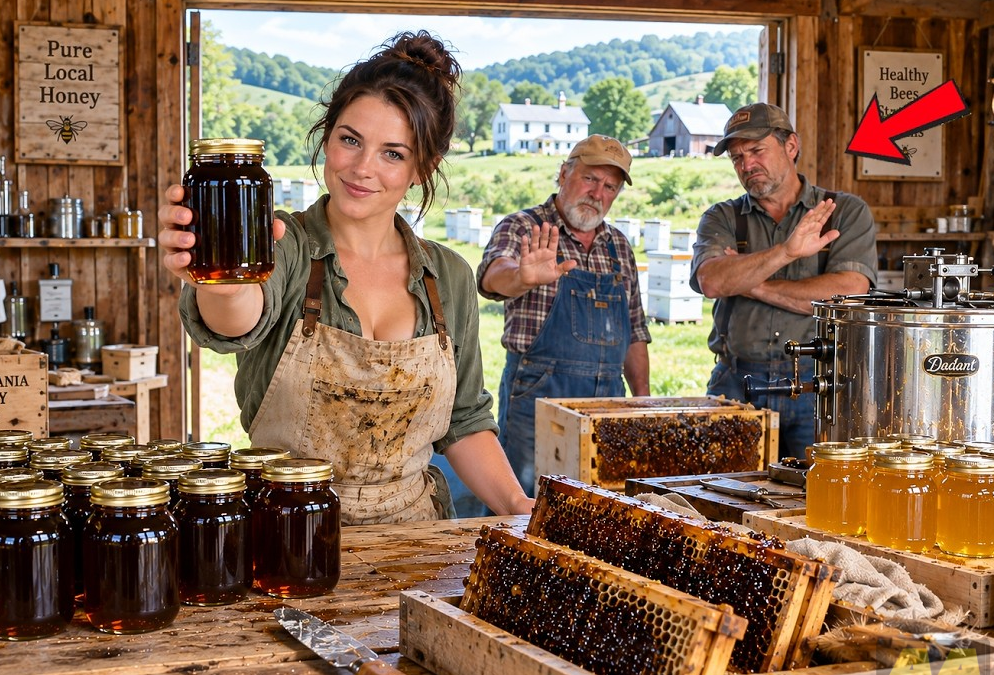
The morning Merritt Slade carried nine hundred jars of honey back from the Kesler Valley Honeypacking Company, she had already spent a full season believing she had finally figured out how to make her little bee operation work.
The truck was old, the honey house smelled faintly of wax and cattle, and her left forearm carried three fresh stings that had swollen into a shape roughly like Ohio.
None of that bothered her. What bothered her was the paper sitting beside her on the passenger seat.
Nine hundred jars, one full year of work, and a payment so small it would not cover the foundation she had bought for the weakest colonies.
At the packing dock, Wendel Pike had held her darkest jar toward the same window light he had used on the pale clover honey before hers.
He had frowned and called it too dark for the ordinary market. Merritt had tried to explain that the honey came from buckwheat and goldenrod, that the color belonged to the hills where her bees worked, and that nothing was wrong with it.
Pike had only shrugged. People wanted honey that looked like sunshine, he said. Merritt loaded every rejected jar herself and drove forty minutes home without turning on the radio.
She thought about the money she had lost, the sugar she had bought, the hours she had spent splitting hives and lifting heavy supers under the August heat.
She thought about her father telling her to move the bees to clover like everyone else.
She thought about Junior Tandy laughing at the feed store. But somewhere between the packing dock and the old farm road leading home, another thought began to take shape.
If everyone was looking at her honey and seeing a problem, what would happen if she stopped trying to make it look like everyone else’s?
Merritt Slade was twenty seven years old when she came back to her father’s farm with ten beehives, very little money, and more stubbornness than experience.
She had spent time working retail in Altuna, Pennsylvania, and had come home after deciding that the life she had built away from the farm was not the life she wanted to keep.
Her father, Ford Slade, had never told her she could not keep bees. He simply watched her buy equipment with the same patient expression he had worn whenever Merritt started another project that might or might not make sense.
Ford was a practical dairyman by nature, although most of his dairy herd had been sold years earlier.
He now kept beef cattle and cut hay on the farm. The land was hilly, with thin shale soil and steep stretches that were difficult to work with machinery.
Clover grew well in some places, but much of the higher ground was covered in buckwheat, goldenrod, aster, and whatever else could survive without much attention.
To Merritt, that looked like opportunity. To Ford, it looked like another reason his daughter was going to work too hard for too little money.
“Take them down to the Nesbitt place,” Ford told her more than once at supper.
“Get them on that clover field like everybody else does.” Merritt would keep eating and shake her head.
“The bees like the hill.” “The bees like whatever is flowering.” “So do I.” Ford would look at her over his plate.
“You are making this harder than it has to be.” Merritt usually smiled. That was how she ended most disagreements with her father.
Not because she had won, but because arguing rarely changed either of them. Her mother, Roa Slade, never argued about bee genetics or honey prices.
She simply kept food warm and listened. By late summer, Merritt had learned enough to understand that the bees were doing exactly what bees were supposed to do.
They gathered nectar from whatever flowers were available, brought it home, reduced the moisture, stored it in the comb, and sealed it when it was ready.
Merritt harvested it, extracted it, and put it into jars. The problem was that the honey coming from her hills was dark.
Very dark. Buckwheat honey could become almost black, with a strong flavor that reminded some people of molasses and others of roasted grain.
Goldenrod honey could be lighter, but it still carried a deeper color and a distinctive aroma compared with ordinary clover honey.
Merritt liked it. The local packing market did not. At the Kesler Valley Honeypacking Company, Wendel Pike had graded honey for twenty six years.
He understood exactly what the commodity buyers wanted. They wanted consistency. They wanted honey that looked similar from one shipment to the next.
They wanted something light enough to sit in a clear grocery container and resemble sunlight.
Merritt’s honey looked nothing like that. When she delivered the nine hundred jars in early September, she waited while Pike examined a jar under the window.
He turned it once. Then again. “Too dark,” he said. “Buckwheat and goldenrod.” “Doesn’t matter what it is.”
“It should matter.” Pike gave her a tired look. “It matters what people buy.” Merritt said nothing.
Pike continued. “Folks want it to look like sunshine. This looks like a crankcase.” The words stayed with her all the way home.
For a week, Merritt left the rejected honey stacked inside the converted milk parlor she used as a honey house.
She did not know what to do with it. She had spent money on sugar for weak colonies.
She had bought foundation. She had driven miles for equipment. She had worked through the hottest part of the season.
Now nine hundred jars were sitting there because somebody had held one beneath a light.
Junior Tandy at the feed store made sure she did not forget. “How’s the burnt honey, Merritt?”
He asked. “Selling like hotcakes.” “Hotcakes nobody’s buying?” “Exactly.” She picked up her supplies and left.
Junior laughed behind her. He thought he had won. Merritt did not care. What she cared about was understanding why the honey that tasted good to her could be worth so little to somebody else.
That was when the phone rang. The woman on the other end introduced herself as Ingred Matson.
She operated a small mead house near Wellsboro and had heard from another beekeeper that Merritt had a large supply of dark honey the local packer did not want.
Merritt invited her to come taste it. Ingred arrived that week and sat at the Slade kitchen table with three jars in front of her.
She opened the darkest one. She tasted a little. Then she smiled. “In mead, the honey is not something you hide,” Ingred said.
Merritt watched her carefully. “What does that mean?” “It means the honey is the flavor.”
Ingred held the jar toward the window. “Pale clover makes a clean mead. Light, mild, easy to ferment.
But it does not give you much character.” She picked up the dark buckwheat jar.
“This does.” Merritt leaned back. “Pike said it looks like a crankcase.” Ingred laughed. “Pike is looking for grocery honey.
I’m looking for this.” She offered Merritt more money for twelve jars than Pike had offered for the entire shipment.
Merritt stared at her. “Well, hell.” Ingred laughed again. For the first time in days, Merritt did too.
That single order did not make her rich. It did something more important. It made her curious.
She began learning everything she could about specialty honey and mead. Her first lesson was painful.
Trying to fill Ingred’s next order, Merritt harvested several supers earlier than she should have.
Most of the frames were capped, but she rushed a few that were not finished enough.
Honey has to reach the proper moisture level before it is ready for storage. Bees naturally remove water from nectar until the honey is concentrated enough to remain stable.
The wax cappings provide another clue that the bees consider the work finished. Merritt knew the general idea.
She had not respected it enough. Three weeks after the second shipment arrived, Ingred called.
One jar had begun to ferment. Then another. The honey was sour and fizzy. Ingred was not angry.
That made it worse. “A mead maker does not want fermentation arriving before we ask for it,” she told Merritt.
Merritt understood immediately. She bought a refractometer and began measuring every batch. From then on, she tested the moisture in every lot before it went anywhere.
No exceptions. That lesson saved her more money than the device coSt. Her second mistake came from trying to solve the problem Pike had shown her.
Merritt decided that perhaps she could make the honey lighter. She heated one batch gently and filtered it through a fine material that removed much of the pollen and natural particles.
The result looked beautiful. It was also disappointing. Ingred tasted it and immediately noticed the difference.
“You made commodity honey,” she said. Merritt looked at the jar. “It looks better.” “It looks like everything else.”
The aroma was weaker. The character was flatter. Merritt had spent an afternoon trying to remove the very things that made the honey valuable to her new customers.
She finally understood. The packing company had not been wrong about what it wanted. It was simply looking for a different product.
Pale, uniform, filtered, predictable honey belonged in that market. Her honey belonged somewhere else. So Merritt stopped trying to make her honey fit.
She began separating harvests by bloom. Early clover and locust were handled separately. Buckwheat was harvested when that flow ended.
Goldenrod and aster were kept apart whenever possible. She used separate supers, separate extraction runs, separate containers, and separate labels.
Instead of selling generic dark honey, she began selling buckwheat honey, goldenrod honey, and other clearly identified batches.
That changed everything. A mead maker could know exactly what was being purchased. A baker could choose a particular flavor.
A specialty customer could understand why one jar tasted different from another. The differences stopped being defects.
They became information. Then another lesson arrived. A bakery in Williamsport ordered four cases of goldenrod honey.
Two months later, the owner called and complained that the honey had become grainy. Merritt drove there the next morning.
She opened one of the jars and smiled. The honey had crystallized. It had not spoiled.
She explained that natural honey can crystallize as glucose forms crystals over time. Different floral sources crystallize at different rates.
Heating and heavy processing can delay that process, but Merritt no longer wanted to remove the qualities her specialty customers valued.
She placed the jar in warm water. After a while, the crystals softened and the honey became liquid again.
The bakery owner watched closely. “So it is still good?” “Very.” “Then why did I think it had gone bad?”
“Because grocery shelves teach people that pretty means perfect.” The bakery ordered twice as much the next season.
Word traveled. Ingred told another mead maker. That mead maker told another. Soon Merritt had more orders for dark varietal honey than her own hives could supply.
That created a new problem. There simply was not enough. Merritt could have added more hives, but she realized something else.
Other small beekeepers were having exactly the same problem she had faced. They were producing dark honey and receiving poor prices for it.
So she started driving. One of the first people she visited was Mara Vine, an older beekeeper with sixty hives on a ridge above Renovo.
Mara had been filling bear shaped bottles with dark honey and selling them at a roadside table.
Merritt offered her a standing contract. The honey had to be properly ripened. The moisture had to be tested.
Different varieties needed to remain separated. Mara considered the arrangement. Then she considered the price.
“That’s more than the packer pays.” “I know.” Mara nodded. “Then we have something to talk about.”
That agreement became the beginning of a network. Merritt started buying tested varietal honey from other beekeepers across three counties.
She paid according to variety and volume, but she always required the same basic standards.
The honey had to be ripe. The source had to be known. The batch had to be tested.
The variety had to be honestly labeled. Within two years, she was working with six beekeepers.
By the third year, the network was moving close to eleven thousand pounds of dark honey in a season.
Orders came from meaderies across Pennsylvania, New York, and Maryland. Two specialty bakeries joined them.
A chef in Pittsburgh began using Merritt’s buckwheat honey with cheese. Her gross revenue passed ninety one thousand dollars.
It was not easy money. She paid the beekeepers. She paid O D Frame, a steady man from two farms over who handled extraction and bottling.
There was fuel. There was equipment. There were jars and labels and repairs. But the business existed.
And it had been built around the very honey another buyer had called worthless. Then came the year that tested whether Merritt had really learned her own lessons.
It was the fourth September. Demand had grown. Ingred’s meadery wanted twice its usual order for a spring release.
A new account outside Erie wanted a shipment too. Goldenrod season was closing. Merritt was trying to fill every request before the flow ended.
She tested the first few buckets from each yard. Then the phone kept ringing. The truck needed loading.
Orders were waiting. She was tired. So she made one small decision. She did not test every batch.
Most of the honey was fine. Some was not. Three weeks later, Ingred called. Her voice sounded different.
Several jars were beginning to ferment. Then the Erie customer called with the same problem.
Merritt stood inside the honey house and knew exactly what had happened. She had broken the rule she had built the entire business around.
Every batch had to be tested. Every time. No matter how busy she was. No matter how much money was waiting.
She did not argue. She did not blame the bees. She did not blame the weather.
She recalled every jar from the affected harvest window. She refunded every customer. The loss went beyond six thousand dollars.
For a small operation, it was enormous. Merritt drove to Wellsboro herself. Ingred showed her the affected cases.
Merritt looked at them for a long time. “I skipped testing,” she said. “That’s on me.
Not the bees. Not the weather. Me.” She rebuilt the system. Every batch was tested with the refractometer.
Every supplier had to meet the same requirement. Every shipment was documented. Every customer received the standard in writing.
Tested raw honey. Honest varietal labeling. Nothing shipped unless it met the moisture requirement. The recall cost Merritt money and truSt.
But it also showed her customers how she handled a failure. Ingred returned. The other mead makers returned.
Some told Merritt that the recall had actually convinced them they could trust her more because she had taken responsibility before anyone forced her to.
Then came the largest offer of her career. A buyer named Bramos, representing a rapidly growing national mead brand in Ohio, found Merritt through an award won by one of Ingred’s meads.
He came to the hill farm himself. He wanted honey by the pallet rather than the case.
He wanted a volume Merritt’s own hives and her network could not honestly produce as single source varietal honey.
The money was enormous. O D Frame was standing nearby when Bramos finished explaining the proposal.
For a moment, O D said nothing. Merritt knew he was doing the arithmetic. The problem was not the money.
The problem was the volume. To fill the contract, Merritt would have to buy anonymous bulk dark honey from wherever she could find it, blend batches together, and create the same uniform product the packing industry preferred.
She would become a larger version of the system she had spent years building something different from.
Merritt took two days to decide. Then she turned the large contract down. She offered Bramos a smaller allocation instead.
Only authentic, tested, single source varietal honey. Only what her network could genuinely produce. Bramos looked surprised.
But he accepted. The smaller agreement worked because the thing he actually wanted was not endless dark honey.
He wanted honey with a story and a source he could truSt. The market had changed around Merritt without Merritt having to change herself to fit it.
Even Wendel Pike eventually noticed. Two years after that first rejected shipment, Pike called her.
He had been seeing more dark honey arrive at his dock from small farms. He knew Merritt had a market for it.
“Would you take some of the dark stuff we keep rejecting?” Merritt smiled. “Sure.” “Same rate as the other suppliers?”
“Same rate.” There was a pause. “Fair enough.” Merritt hung up. She enjoyed the irony for about a week.
Then she went back to work. Ford Slade never made a speech about being wrong.
That was not his way. One autumn, Merritt realized the honey house needed better shelving.
The next morning she found her father outside with a level and a stack of rough cut lumber.
He was already building it. Merritt stood there for a moment. “You didn’t have to do that.”
Ford kept working. “Wasn’t clover money built this?” Merritt smiled. It was the closest thing to an apology she was ever likely to receive.
At the feed store, Junior Tandy eventually bought a jar. He slid two dollars across the counter and mumbled that it was for his tea.
Merritt handed him the jar without saying anything. She had plenty of answers ready. She did not need to use any of them.
By the fifth year, the county fair had become another part of the story. The fair board asked Merritt to speak in the small exhibit hall beside the four H rabbits.
Her talk was supposed to be about honey. It became something larger. A young beekeeper named Dessa Crowe, nineteen years old and struggling with her first three hives, approached Merritt afterward.
She wanted to know how to tell whether honey was ready to harveSt. Merritt walked her to the truck.
The refractometer lived permanently in the glove box. She showed Dessa how to place a drop of honey on the lens and read the scale.
“Under eighteen and a half,” Merritt said. “Every time. It does not matter how tired you are or how badly you want the money.”
Dessa wrote the number on her hand. Merritt laughed. “That will wash off.” “I don’t care.”
The word spread that Merritt actually answered questions. Soon new beekeepers were calling her. Then she began holding small workshops in the honey house.
She taught people how to recognize properly capped honey. How to test moisture. How to separate floral sources.
How to understand crystallization. How heating and heavy filtering could change a product that specialty buyers specifically wanted in its natural form.
The workshops were never the largest part of her income. They did something else. They made Merritt a resource.
She remembered what it had felt like to have nine hundred jars and no idea where they belonged.
She did not want another beekeeper standing in that same place. Her little business kept growing.
Six suppliers became eight. The customer list expanded to eighteen meaderies across four states. Two specialty grocers began carrying her labeled honey.
Revenue moved beyond one hundred ten thousand dollars. It was still a working business with real expenses.
Suppliers had to be paid. O D Frame had to be paid. The truck consumed fuel.
Equipment broke. Jars cost money. Nothing about it became effortless. But the business was stable.
Ingred’s meadery won a regional medal for a buckwheat mead made entirely with Merritt’s honey.
Ingred sent Merritt a photograph of the medal with a handwritten note. “Told you the dark stuff was the good stuff.
Should have charged you for the lesson.” Merritt taped the note inside the honey house.
Under it she wrote her own reply. “Wendel Pike taught me the lesson firSt. He just didn’t know that’s what he was doing.”
She left it there. Years after the original shipment, Merritt still passed the Kesler Valley packing dock on trips into town.
The trucks were still there. Pale clover honey still came through. The light bulbs were still used.
The commodity market still wanted what it wanted. Merritt did not resent it. She had finally learned that markets were not a single thing.
They were different doors. Sometimes a product that could not get through one door was exactly what somebody behind another door had been searching for.
One winter evening, Merritt stood alone in the honey house after the day’s work. The extractor had stopped ticking.
The shelves were filled with jars. Orders waited for the next morning. Outside, the hillside was quiet.
She picked up one jar of buckwheat honey and held it beneath the bare bulb over the workbench.
The color was nearly black. Amber red appeared when the light passed through the thinner part of the glass.
It was the exact color that had once made Wendel Pike frown. The exact color that had sent nine hundred jars back up the hill.
Merritt looked at it for a long moment. She remembered loading those jars herself. She remembered the silence in the truck.
She remembered thinking about every dollar she had spent. She remembered believing the year had been wasted.
It had not been wasted. The rejection had forced her to ask a better question.
Not whether the honey was good enough for the market she had been standing in, but whether she had been standing in the right market at all.
That question changed everything. The honey had not changed. The hillside had not changed. The bees had not changed.
Merritt had changed the way she looked at what they had made. By then, the dark honey that had once been called worthless was being requested months in advance.
Mead makers wanted its depth. Bakers wanted its character. Specialty stores wanted its source. Beekeepers wanted Merritt to buy their late season harveSt.
And Merritt still tested every batch. She still separated varieties. She still checked the frames.
She still drove the same hills where buckwheat and goldenrod grew along the fence rows.
The old truck had long since crossed two hundred thousand miles. The refractometer remained in the glove box.
The honey house still smelled faintly of wax. And somewhere in the middle of all of it, Merritt had built a business from the very thing she had once believed nobody wanted.
She lowered the jar from the light and placed it back on the shelf. There was no grand announcement.
No celebration. Just another evening of work waiting for morning. The lesson was simple. Something can look like a defect when viewed through the wrong market.
Something can look like an opportunity when viewed through the right one. Merritt Slade had learned that from nine hundred rejected jars, a patient beekeeper named Ingred Matson, a refractometer, a hillside full of buckwheat and goldenrod, and one packing house light bulb.
The honey had been dark all along. It had only taken someone long enough to see what that darkness was worth.
Disclaimer: This content may be created by Al for entertainment purposes. Any resemblance to real persons, events, or places is coincidental.








