The Guards Tried to Pull Her Off the Dragon — He Wouldn’t Let Them Come Close
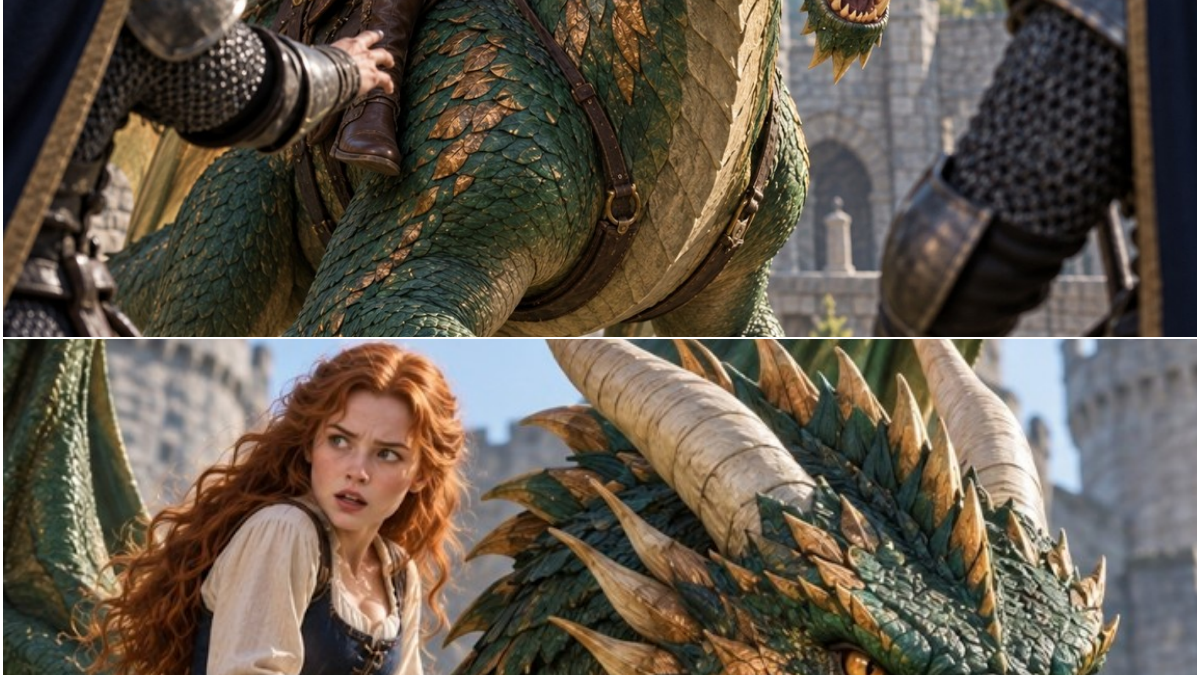
The green dragon came down into the fortress yard in the middle of the morning, his enormous wings beating against the cold autumn air, and there was something terribly wrong with the saddle on his back.
It was empty. No rider sat between the leather straps, no familiar figure leaned forward to guide him, and no voice called out the commands that had accompanied every journey for nine years.
Yet the dragon had returned with his equipment intact, his emerald scales unbroken, and an urgency in his movements that made the soldiers forget their morning duties.
Tessa Vale saw him firSt. Before anyone could order her to stand back, she dropped her satchel and ran across the stones.
Captain Jory Flint reached for her boot as she climbed onto the dragon’s shoulder, but Verdan swung his great head between them, opened his jaws, and released a warning roar that stopped every spear in the yard.
He did not attack. He simply waited, staring at the northern gate as though the entire world beyond it depended on someone opening it.
Tessa understood that he had not come home to reSt. He had come home because something had happened on the border road, something that had separated him from the one person he trusted above everyone else.
But the dragon could not speak, the captain had a fortress to protect, and the rider was nowhere to be found.
What had happened during the hours before Verdan returned, and why was the creature so determined to lead them back into the wilderness?
Halden Post stood on a low hill above the border road, surrounded by pale stone walls and a narrow ditch that had collected the first fallen birch leaves of autumn.
It was not a grand fortress. Its courtyard was a square of worn paving stones, its well stood in the middle, and its buildings were arranged with the practical simplicity of a place built to keep a small company of soldiers supplied and ready.
The granary occupied the eastern side, while the barracks and kitchen stood to the weSt. The northern gate was reinforced with two heavy bars, and the southern road led toward the district headquarters.
Nothing about the fortress had been designed to contain a frightened dragon. Tessa had worked there for three years as a courier.
She knew the sounds of the courtyard, the rhythm of the morning watches, and the particular impatience of Verdan when his rider was late returning from a patrol.
She had carried water to him, cleaned mud from his tack, and learned which gestures made him comfortable and which made him suspicious.
She was not his rider, however, and she had never pretended otherwise. That distinction mattered now.
Her hands trembled as she held the saddle skirt and looked into the dragon’s amber eyes.
Verdan was breathing heavily, his broad chest rising and falling beneath the copper patterns that spread across his emerald scales.
His wings remained half extended, and his claws pressed into the stones. “Easy, Verdan,” she whispered.
“I’m here.” He lowered his head slightly. Captain Jory Flint stood several paces away, his spear held downward.
The two soldiers beside him had not relaxed. One was Denner, a young spearman who had served at Halden for less than a year.
The other was an older soldier whose name Tessa knew but whose judgment she did not particularly truSt.
Jory ordered them not to approach the dragon. He also sent one of them to retrieve the duty ledger.
Then he looked at Tessa. “Where is Haron Pike?” “I don’t know.” “Did you see him leave this morning?”
“No. He took the lark spur round at first light.” “And he hasn’t returned?” “Only Verdan has.”
The captain’s expression tightened. Haron Pike and Verdan had been partners for nine years. The rider knew the dragon’s habits, and the dragon understood his smallest movements.
Haron had never returned from a patrol without him, and Verdan had never come back without Haron.
Jory knew what an empty saddle could mean. In every report he had read about patrol dragons, a riderless return was treated as a serious warning.
A rider might have been separated from his mount, injured somewhere beyond the road, or forced to abandon the patrol.
The dragon’s behavior could offer clues, but it could not establish what had happened. Tessa moved along Verdan’s flank, keeping one hand against his scales.
She examined the leather straps and buckles, looking for damage that might explain the missing rider.
The girth was fastened at the third hole. Haron’s usual setting. The saddle showed no obvious signs of a struggle.
There were no deep scratches along the leather, no broken fittings, and no marks suggesting that someone had dragged a rider from the seat.
Yet the short safety loop, which normally connected Haron’s harness to the saddle ring, hung loose.
“It snapped,” Tessa said quickly. She did not examine it closely. The possibility of an accident was easier to accept than the alternative, and she wanted an explanation before the captain made his own decision.
The near saddlebag was unbuckled and unusually light. Haron’s tally book was missing. He carried it everywhere on patrol and rarely left it behind.
The older spearman opened the paddock gate and called softly to Verdan, inviting him toward the water and shelter.
The dragon ignored him. He remained facing the northern gate, his tail curled near the well and his weight leaning forward.
Tessa filled a bucket and brought it to him. He drank every drop, lifted his head, and returned his attention to the gate.
She studied him again. There were no cuts along his body, no swelling near his wings, and no visible injuries.
He had flown hard, but he was not exhausted. His movements suggested that he was ready to leave again.
Jory noticed the same thing. The dragon allowed Tessa beneath his throat, but nobody else could approach within six paces.
He had not come back in a state of blind panic. He was making a choice.
The ledger arrived, and Jory found Haron’s departure recorded at first light. The patrol was expected to take four hours out and four hours back.
His return time was noon. It was not yet noon. According to the post’s regulations, Haron was not officially late.
Jory explained the problem. Six men were assigned to Halden. Two had to remain on the walls, the winter grain had to be protected, and the district officer would demand an explanation if the captain emptied his post because a patrol rider had not arrived on schedule.
Tessa pointed toward the gate. “Look at him.” “I am looking.” “He’s asking to leave.”
“Or he has thrown his rider somewhere on the ridge and wants to go back to the place where he knows he’ll be fed.”
“He’s not looking for food.” “Animals don’t provide evidence, Tessa.” “Neither does a report written before anyone has looked.”
Jory did not answer immediately. The older spearman suggested bringing chains from the storehouse. Two men could secure Verdan’s hind legs while another handled the saddle.
If the dragon became dangerous, they could restrain him until the district authorities arrived. Tessa stared at him.
“If you approach his hind legs with chains, he’ll put his shoulder through the storehouse wall before he lets you near him.”
“Then we use more men.” “And what happens after someone gets hurt? We still won’t know where Haron is.”
Jory considered the proposal, then walked into the guardroom. When he returned, he carried a folded report.
He had already written that Haron was presumed lost and that the dragon might have been responsible.
Tessa followed him toward the southern ramp, where a mounted messenger was preparing to depart.
“Give me permission to search.” “You can search on foot.” “Verdan will come with me.”
“That’s not your decision.” “It is his.” Jory looked back at the dragon. Verdan had not moved from the northern gate.
Tessa continued. She had walked the lark trail in both directions for years. She knew its turns, its steep sections, and the places where a person could leave the path without being noticed.
If Haron had gone missing somewhere along the route, she might recognize something that a soldier would overlook.
Jory finally agreed, but he imposed conditions. He would accompany her with Denner and the older spearman.
Tessa would remain within his sight, obey his orders, and never attempt to fly. They would turn back at dark regardless of what they found.
Tessa accepted. She added one condition of her own. Haron’s saddle would stay on Verdan.
Removing it in the courtyard would destroy the little trust the dragon had left, and she would not ask him to follow them into the forest after that.
The older spearman tried to unbuckle it anyway. Verdan lowered his head until his jaws were level with the man’s cheSt. One hind foot shifted against the stones.
The spearman released the buckle and stepped away. Tessa packed her satchel with water, bread, spare laces, a small knife, the route ledger, and the week’s sealed dispatch bulletins.
Jory ordered two men to remain on the walls and barred the gates behind the search party.
Before they left, he spoke quietly. “I’ve buried a groom who walked behind a frightened animal.
When I saw you climbing that dragon, I reached without thinking.” “You nearly made him attack you.”
“I know.” “You frightened me.” “I know that too.” Tessa did not forgive him immediately, but she recognized that he was not trying to excuse himself.
The northern gate opened. Verdan passed through the arch first, his copper markings catching the morning light as his shoulders brushed close to the pale stone.
He set off along the border road without waiting for the others. The search had begun.
The dragon walked quickly, stopping whenever Tessa fell behind. He seemed impatient with the soldiers but unwilling to leave the courier behind.
When the gravel road reached the lark trail, he turned northeast into the trees and stopped several paces inside the foreSt.
He looked back at them. Only when everyone had followed did he continue. The trail ran along the shoulder of a hill, winding through birches and patches of pine.
Tessa knew every bend. She had carried dispatches along this route in rain, snow, and summer heat, and she could have followed it in darkness.
Jory read the trail differently. He examined the posts, checked the sightlines, and noted where a person could hide from someone approaching along the path.
A quarter mile into the forest, Verdan stopped beside a fallen birch and lowered his nose to the moss.
The ground had been disturbed. Two long crescents had been torn through the moss, and leaves were scattered in a wide fan.
Ferns behind the fallen tree lay flattened, their stems bent in a single direction. Something large had landed there.
Tessa recognized the marks immediately. “Verdan sat down here.” The dragon had a habit of dropping heavily onto his hindquarters whenever Haron allowed him to reSt. Haron complained that the movement wore the saddle straps, but he had never succeeded in persuading Verdan to stop.
Jory found the patrol boots nearby. One set of prints led northeaSt. They were clear, steady, and unhurried.
There was no evidence that the wearer had stumbled or dragged a foot. The dragon’s landing circle told another part of the story.
The ferns had been pressed flat beneath his body, and the center remained warm brown beneath the scattered leaves.
“He waited here,” Tessa said. Jory crouched beside the tracks. “How long?” “Long enough for the ground to settle.”
A second set of footprints approached from the northeaSt. They were smaller, with smooth soles rather than the heavy nails used in patrol boots.
The two sets stopped opposite each other. Then Haron’s prints continued northeaSt. Jory studied the ground for several moments.
“He met someone.” Tessa looked at the dragon. Verdan had returned to the flattened fern bed, but his attention was fixed farther along the trail.
“Someone he didn’t expect,” she said. “Possibly.” “Then he told Verdan to wait and walked on.”
“That would explain the tracks.” Denner asked why Haron would leave his dragon behind. “Because a dragon cannot be quiet,” Jory replied.
“He cannot fit through close timber without announcing himself to everything within a mile.” They continued northeaSt.
At the third trail post, Jory stopped. A small chalk mark had been drawn low on the weathered wood.
It consisted of a short line and an arrow pointing along the trail. Tessa recognized the symbol from the patrol instructions.
Every border rider carried chalk. If a patrol broke its assigned route, the rider left a mark showing the direction of travel.
The next patrol would find it and know where to look. “When does the next patrol come through?”
She asked. “Six days.” “Then Haron left a message for someone who won’t read it until Thursday.”
Jory wrote the mark into his notebook, including the time and its position. For the first time since leaving Halden, his notes supported Tessa’s interpretation.
The group moved onward until Verdan suddenly spread his wings and launched into the air.
Denner dropped to one knee, gripping his spear as the dragon rose above the trees.
Verdan flew only a short distance, perhaps three hundred yards, then disappeared beyond the canopy.
Tessa ran after him. Jory called for her to wait, but she was already moving.
When they reached the split stone, Verdan stood in the center of the trail, facing them.
The granite block was enormous, cracked through its middle by a birch tree. The western branch climbed toward Crow Rock and the ridge.
The northeastern branch descended toward the Marrow Mill Flats. Across the dark soil, wagon ruts crossed the trail.
They were deep, broad, and numerous. Jory placed his boot into one of them. The mud rose almost to his ankle.
“These aren’t farm carts,” he said. “A heavy wagon made these. More than one.” Tessa knelt and examined the freshest track.
Water still pooled in the bottom, and the sharp edges had not collapsed. The wagons had passed only hours earlier.
Jory looked toward the northeaSt. “The Marrow Sawmill has been closed since the spring before laSt. The lease is unpaid.
The mill race is gated. Nothing should be moving there.” “Then we should look.” “Not yet.”
Crow Rock offered a view of the flats, the ridge, and the road leading toward Kettle Lane.
Jory wanted to inspect the valley before taking the group downhill into unfamiliar ground. Tessa agreed.
They climbed the western branch, following Verdan through the trees. The dragon moved more slowly than before, his head raised above the branches and his attention shifting toward the distant ridge.
From Crow Rock, the countryside opened beneath them. The mill flats lay northeast under a faint haze.
Beyond the creek, the roofs of the Marrow yard were barely visible. Kettle Lane ran west toward the bridge and the county road.
Three narrow columns of smoke rose from the charcoal burner’s clearing. Jory surveyed the area and described the roads.
He could see the bridge, the mill track, and the ridge, but the walls and buildings of the sawmill remained hidden.
Tessa looked at Verdan. “Fly.” She raised her hand in the familiar signal Haron used during training.
The dragon stepped backward. Then he turned his shoulder away from her and raised his head toward the western ridge.
He stared at the smoke. Tessa felt certain she understood. “He wants us to go weSt.”
Jory looked at the wagon ruts in his notebook. “The tracks went northeaSt.” “But Verdan is looking weSt.”
“You’ve worked with him. I’ll trust your judgment for two hours.” It was the wrong decision.
They followed the ridge track toward the charcoal burner’s clearing. Verdan lagged behind, stopping whenever the wind shifted.
Twice Tessa had to return and place her hand against his jaw to persuade him forward.
She told herself the dragon disliked the rocky ground. She told herself he was tired.
She told herself several things because the alternative was admitting that she did not understand him.
The clearing appeared after an hour of walking. Three earth-covered burns sent smoke into the air, and a shelter made of poles and bark stood beside them.
Two men and a boy were working near the shelter. When Verdan emerged from the trees, all three retreated behind it.
Jory approached firSt. He asked whether they had seen a patrol rider. The burners had not.
No soldier had passed along the ridge track that morning, and none had visited during the previous week.
The boy remembered hearing a dragon flying south around eight in the morning. It had been high above the trees and moving quickly.
That was Verdan returning to Halden. The older burner then mentioned something that changed the search.
Wagons had been using the mill track for three mornings in a row. They traveled out early and returned at dusk.
Someone had cut the chain on the Marrow yard gate. “How many wagons?” Jory asked.
“Four.” The burner knew because his brother worked for the county and sometimes hauled loads along the same roads.
Tessa felt the weight of the wasted afternoon. They had spent two hours reaching the clearing and would need another two to return.
The daylight they had left was disappearing, and Haron was still missing. She turned to Jory.
“I was wrong about Crow Rock.” He did not interrupt. “I thought Verdan was showing us where to go.
He was refusing to go there. He was looking at the smoke because Haron had turned him away from it before.”
Jory studied the dragon. “So he was choosing the whole time.” “Yes.” “And we followed your interpretation.”
“Yes.” The captain nodded once. He offered no comfort and made no accusation. Instead, he acknowledged his own mistake.
Three weeks earlier, the granary tally at Halden had come up forty sacks short of the winter count.
The clerk had blamed a miscalculation, and Jory had accepted the explanation without inspecting the storehouse.
He had signed the report. Forty sacks was exactly one wagonload. He had known that when he approved the figures.
Tessa understood the implication. The wagons on the mill track might be carrying grain stolen from Halden itself.
Jory also admitted that the report he had sent south described Haron as presumed lost and Verdan as possibly responsible.
The district would likely order the dragon transferred to its kennels while the matter was investigated.
“How long before they arrive?” Tessa asked. “The report has been traveling for four hours.
They won’t move before morning.” “Then we have tonight.” “Yes.” They turned back toward the split stone.
This time Verdan led. He walked ahead, stopped to make sure they were following, and continued northeast without hesitation when they reached the granite block.
Tessa finally examined the loose safety loop properly. It had not snapped. The leather had been cut cleanly through in one stroke.
The fibers were flat, pale, and undamaged. Someone had deliberately freed the dragon from his rider’s harness.
Jory held the strap toward the fading sunlight. “Nobody cuts a safety loop by accident.”
“Haron did it.” “Then he wanted Verdan to return without him.” Tessa looked toward the mill flats.
“He was sending for help.” The saddlebag held another clue. On its lower edge was a thin gray film, and beneath the buckle keeper lay a single rye grain.
Tessa rubbed the dust between her fingers. “Granary duSt.” Jory examined it. There was no loose grain near the fern bed, except in the Halden storehouse or on a wagon carrying grain away from it.
Verdan had been close to sacks that morning. He had probably stood beside a loaded wagon before Haron sent him home.
Now the question was no longer where Haron had gone. It was how many wagons would leave the Marrow yard before morning.
Jory studied the tracks and calculated the timing. The four wagons had been moving for three days.
They would likely be loaded again tonight, then sent toward the county road after dark.
Tessa knew the Kettle Lane Bridge watch schedule because she carried the weekly bulletins between the posts.
The day watch ended at dusk. The night watch did not take its position until the bridge lamps were lit.
For roughly an hour, the crossing was nearly unattended. The schedule was published in the weekly bulletin.
Anyone who received a copy could know exactly when to move a wagon through the gap.
Jory understood immediately. The men at Marrow had learned the schedule, perhaps through someone who handled the dispatches.
The forty missing sacks had already passed through the system once, hidden beneath a miscount that Jory himself had approved.
He needed reinforcements, but sending most of his men away would leave the post exposed.
He ordered Denner to return to Halden with two written reports. One would retract the earlier accusation against Verdan.
The other would request every available soldier for the Marrow Mill. Denner estimated that the journey and return would take four hours.
Jory knew the men might arrive too late. He sent him anyway. Tessa, Jory, the older spearman, and Verdan continued toward the mill.
The track descended through cut timber, with deep wagon ruts running along its center. The forest thinned near a raw hillside covered in stumps.
Beyond it, the creek curved around the Marrow yard. Tessa knew the sawmill from the outside, but Jory made her draw a map in the dirt.
The yard had a wide gravel apron and a long saw shed beside the creek.
The head saw stood beneath a timber frame, with beams and pulleys stretching over the working area.
A log pond occupied the rear of the property, while a pole barn stood to the eaSt.
Stacks of lumber filled the southern side. Near the gate was a small drying shed with no windows, a low door, and a slatted vent near its roof.
There were two exits. The main gate opened west onto a narrow road leading to Kettle Lane.
The other route was an old skid road that climbed north through the timber and joined the lark trail.
The skid road was rough, steep, and deeply churned. A loaded wagon would struggle to climb it.
They approached through the stumps and reached the lumber racks without being seen. Verdan stopped at the top of the skid road.
He would go no farther. From behind the stacked boards, Tessa counted four wagons on the apron.
Three were covered with tarps and secured with ropes. The fourth stood open and was being loaded.
Nine men were present. Eight carried sacks from the saw shed. The ninth, an older man with a tally book, stood beside the open wagon and recorded each pair as it was loaded.
The sacks were coarse jute, stamped with two lines. Jory recognized the stitching and size.
They were the same sacks used in the Halden granary. Six horses stood harnessed in the pole barn.
Nobody left teams prepared at dusk unless they intended to move them soon. Then Tessa noticed the drying shed.
A man sat outside with a heavy wooden tool across his knees. The door was barred from the outside with a thick timber resting in iron brackets.
That was not how anyone secured lumber. They waited. After eleven minutes, a boy crossed the yard carrying a bucket.
The guard stood, lifted the timber bar, and opened the shed door. Tessa saw a narrow slice of the interior.
There was a dirt floor, several sacks, and a man sitting against the far wall with his wrists tied.
He wore a patrol coat. Haron Pike raised his head. The door closed again. The guard replaced the bar and returned to his stool.
Tessa’s hands pressed against the boards in front of her. She wanted to run across the yard immediately, but Jory’s hand rested against the back of her collar.
He did not pull her away. He simply held her there until she understood what she was about to do.
They retreated into the stumps to discuss their options. The older spearman wanted to enter the yard and announce the captain’s authority.
Jory pointed out that nine men with axes and heavy tools stood between them and Haron.
If soldiers entered through the gate, the men might use Haron as leverage. The dragon could not solve the problem either.
The sawframe was too low and too wide. The lumber racks would collapse if Verdan moved through them, and the drying shed stood against one of those racks.
Any uncontrolled movement could bring the building down. They needed a plan that would leave the shed intact.
Tessa went alone to the top of the skid road. Verdan stood where she had left him, watching the drying shed.
She tried to lead him east along the timber line. If he stood above the main gate, the men in the yard would see him and might surrender out of fear.
She used the hand signal. She spoke softly. She tried the familiar commands. Verdan refused.
He turned away from her hand, stepped toward the skid road, and planted his weight.
He would not move eaSt. Tessa rested her palm against his shoulder. For the first time, she stopped trying to make him do what she wanted and considered what he had been trying to tell her.
He had spent the entire day guiding them toward this place. He had refused to fly over the charcoal smoke because he did not want to go weSt.
He had waited at every important turn until the others followed. Now he stood at the road leading directly to the shed where Haron was being held.
He was not going to be positioned as a threat. He was going to remain where he could reach his rider.
Tessa returned to Jory and explained. “The skid road is the only place he’ll stand.”
The captain considered the map. Then Tessa saw the opportunity. If the men at Marrow tried to leave through the main gate, they would reach Kettle Lane and the bridge.
They would expect the usual gap between the watches. But if they believed that the bridge was being inspected tonight, they might choose the other route.
The skid road. And Verdan was already waiting there. Jory asked how they could convince the men that the bridge was closed.
Tessa opened her satchel. “A courier tells them.” She carried genuine dispatch bulletins, a route ledger, and blank amendment slips.
Her work routinely brought her to mills and farms, where she delivered official information and collected signatures.
There was nothing unusual about a courier arriving at dusk. She could walk into the yard and announce that the bridge watch had been extended.
The information would be false, but the document would look authentic because the schedule, seal, and other details were genuine.
Jory warned her that the men might recognize the deception. She agreed. He then gave her two conditions.
She would carry only authentic documents apart from the single amendment slip, and she would leave the yard before the teams began moving.
Once the wagons started, Jory and the older spearman would enter through the main gate.
Tessa prepared the slip on her knee. The words stated that the Kettle Lane Bridge watch had been extended and that wagon inspections were in force on the county road by order of the poSt.
Only the order was invented. Everything else was accurate. Jory read it and offered to sign it himself.
Tessa refused. A captain’s signature would alert the men that soldiers were nearby. She folded the slip into her satchel.
Before walking down to the yard, she returned to Verdan. She did not give him another command.
She simply placed both hands beneath his jaw and told him where she was going.
He lowered his head until his breath warmed her forearms. Then she left him and walked down the mill track toward the main gate.
The cut chain hung from the gatepoSt. Tessa ignored it. She called out the name of Halden Post and announced the week’s bulletin, using the ordinary voice of a courier who expected to be welcomed only because her work was familiar.
The men stopped loading sacks. The older man with the tally book approached her. “What are you doing here?”
“Delivering the weekly bulletin. The Marrow lease is still on my route sheet.” “There is no lease here.”
“Then I’ll mark it unattended. I need the name for the record.” He studied her red hair, courier vest, and satchel.
“Are you alone?” “Couriers usually are.” She asked him to sign so she could continue toward Kettle Lane before dark.
The man took the amendment slip and read it. Then he read it again. He walked several steps away and examined it once more.
Tessa complained casually about the bridge inspection and the trouble it would cause her on the return journey.
A worker carrying a sack asked what the paper said. The older man ordered him to finish loading and keep quiet.
Tessa recognized the change in the yard. The men were no longer thinking only about the sacks.
They were considering their escape. She deliberately slowed her work, opening the ledger and asking for the mill’s official name.
She spelled it incorrectly, forcing the older man to correct her. While they argued over the spelling, the men began looking toward the wagons.
The older man returned the slip. “The mill doesn’t need a bulletin.” “That’s fine. I just need the record.”
He asked whether the northern skid road still joined the lark trail. Tessa told him the truth.
It did, but the road was steep, damaged, and unsuitable for loaded wagons after dark.
The older man said nothing. Then he turned and began giving orders. Two men went to the pole barn.
Others checked the tarp ropes. Several carried a lantern toward the north corner to inspect the skid road.
The yard’s attention shifted away from the main gate. Tessa put away her ledger. She turned toward the exit.
Jory was waiting nine paces beyond it, hidden in the darkness with the older spearman.
Everything was going according to plan. But Tessa had not finished. The guard had left the drying shed to help prepare the teams.
The timber bar still rested in its iron brackets. Haron was alone inside. Tessa turned back.
She walked along the lumber racks, keeping to the shadows. She reached the shed without attracting attention and placed both hands beneath the heavy bar.
It did not move at firSt. She braced her boots in the gravel and lifted with her legs.
The timber rose from one bracket, then swung heavily against her forearms. She took three careful steps and lowered it onto the ground without letting it fall.
The door opened. Haron was sitting against the far wall, his wrists tied in front of him.
He looked up, expecting someone else. “Tessa?” “Your dragon is at the top of the skid road.
The captain is outside the gate.” Haron stood. “They have two men with crossbows in the saw shed.”
“Can you walk?” “Yes.” She drew her belt knife and cut the cord around his wrists.
The blade slipped once, scraping his skin, but Haron did not complain. They stepped into the yard.
The boy at the fourth wagon saw them. He shouted. The noise carried across the gravel apron, and the men at the north corner turned toward the shed.
The lead team was already moving up the skid road. A man held the horses’ reins while a lantern swung beside him.
The animals were looking uphill when the shouting began. And uphill was Verdan. The dragon came forward over the lip of the cut.
He did not rush. He did not roar. He simply placed his enormous body across the road, shoulder against one bank and tail near the other.
The lantern light revealed his emerald scales and copper markings. The horses panicked. They moved sideways against the bank, then backward down the slope.
The wagon followed, its wheels turning slowly as the team struggled to regain control. The man leading the horses disappeared beneath the near wheel.
Verdan immediately backed away. He took three full steps up the road and raised his head above the bank.
He gave the horses space. Tessa watched him carefully. He had frightened them, but he had not pursued them or tried to strike.
The main gate opened, and Jory ran into the yard with the older spearman behind him.
He ignored the tally man and the men carrying tools. His attention went to the fallen wagon.
Haron was already moving toward the injured teamster. Together, he and Jory helped lift the wagon enough to free the man’s leg.
The teamster made a loud complaint when the pressure came off, which was a welcome sign that he was conscious and able to speak.
The second team became unsettled near the pole barn. Two haulers abandoned their tools and rushed to the horses, trying to prevent them from falling or pulling loose.
For a short time, the entire yard was occupied with the immediate problem of frightened animals, damaged equipment, and an injured man.
Nobody was fighting. Then Denner arrived with three additional soldiers and two lanterns. They came over the northern rise and saw Verdan standing in the cut.
The spearmen raised their weapons. Jory was still kneeling beside the injured teamster. “Lower those spears!”
The soldiers hesitated. “Now!” He called them by name and explained that Verdan had already backed away from the horses without harming them.
Nobody was to approach the dragon with a weapon. The spears lowered. Jory immediately assigned the men to the tasks that mattered.
Four soldiers formed a line between the horses and the wagons, keeping frightened animals away from the workers.
The haulers were ordered to bring the teams through carefully. The older man with the tally book tried to leave.
He walked up the skid road alone, passing the fallen wagon and the men working beside it.
After eleven paces, he stopped. Verdan came down from the rise and lowered himself across the road.
His chest rested against one bank and his tail blocked the other. His head descended until his jaws were level with the man’s cheSt.
He breathed steadily. He did not threaten him. The man sat down in the muddy ruts.
Denner approached and brought him back to the yard. The tally book remained in his hands.
By morning, it would become the most useful record of the entire operation. Jory ordered the tarps removed from the wagons.
The sacks underneath carried the Halden Post stamp. There were far more than forty. The missing grain had not been a single wagonload.
It had been accumulated across several shipments and concealed beneath the first shortfall. Jory stood beside the open wagon, holding a tarp in one hand.
He said nothing for a long time. Then he admitted that he had signed the earlier shortage away as a clerk’s miscalculation because he had wanted the matter to be simple.
It had not been simple. Haron gave his account while sitting on the step of the drying shed, his wrists wrapped in spare bootlaces.
He had left Halden at dawn for the lark spur patrol. At the split stone, he noticed wagon ruts crossing the trail where no wagons should have been.
He landed Verdan in the fern bed and told him to wait. He then continued on foot, knowing that a dragon in close timber would announce his presence long before he reached the mill.
A man met him on the trail. The stranger appeared friendly and offered to show him something near the Marrow yard.
Haron followed. Once inside the yard, he discovered four wagons and sacks bearing the Halden stamp.
He confronted the men and told them he would report what he had found. They did not want to hurt him.
They wanted three more days to move the remaining grain. So they locked him in the drying shed and barred the door.
When the men took him toward the pump later that morning, Verdan appeared at the top of the skid road.
Haron had only seconds. He caught the shoulder strap, drew his knife, and cut the safety loop.
Then he pushed away from the saddle and shouted the command that meant home. Verdan refused twice.
Haron had to push his head away and repeat the command. Finally, the dragon turned and flew toward Halden.
Haron said that watching him leave had been the hardest thing he had done in nine years of partnership.
Jory asked why he had not left a written message. Haron looked at the cropped strap.
“I left the chalk mark. After that, I had a knife and four seconds.” Nobody questioned him further.
The reunion happened away from the wagons, in the quiet stretch of the skid road.
Haron stood and walked toward Verdan. The dragon waited until he was close, then lowered his head and pressed his jaw into Haron’s cheSt.
The rider staggered backward one step and wrapped both arms around the enormous muzzle. They remained like that for a long time.
Then Haron moved to the saddle. He unbuckled the girth, still fastened at the third hole, and carefully lifted the empty saddle from Verdan’s back.
Tessa watched from the bottom of the cut. She had carried water to the dragon for three years.
She had climbed onto his shoulder that morning and walked beside him for hours. But this moment belonged to Haron.
She did not approach. A little after midnight, Halden’s men organized the wagons and prepared to leave the Marrow yard.
The six horses were walked out by their own handlers. The injured teamster rode in the final wagon on a board, with Denner holding a lantern beside him.
Jory checked the bandaged leg himself and explained to the man’s brother what charges might follow.
The exact outcome would depend on the statements gathered the next morning. Tessa walked beside Haron and Verdan along the mill track.
Haron carried his saddle over one shoulder. Verdan walked without tack. Nobody spoke for nearly a mile.
When they reached the split stone, the moon had risen above the wagon ruts. Haron stopped and placed his lantern in the deepest groove.
He said he had examined those tracks for only nine seconds that morning. Then he had made every decision that led him to the drying shed.
Tessa looked down at the muddy line. The entire day had begun with something ordinary and easily overlooked.
A wagon had traveled where no wagon belonged. At Halden, the northern gate stood open when they returned.
The two soldiers on the wall had seen the column approaching and raised both bars without waiting for an order.
Verdan walked through the arch, crossed the courtyard, and went directly into the paddock. He lowered himself onto the gravel.
It was the first time all day he had agreed to reSt. Jory went into the guardroom and retrieved the report he had written at noon.
He stood with a candle in his hand and read the original wording aloud. The rider was presumed loSt.
The dragon was considered at fault. The words sounded different now that Haron was standing beside him.
Jory took out a fresh sheet and wrote a corrected report. He described the tracks, the chalk mark, the cut safety loop, and the grain duSt. He recorded Tessa’s discovery of the wagons and the way she had entered the yard carrying an official bulletin.
He also included the mistakes. Tessa insisted that the report mention her decision to follow Verdan toward Crow Rock.
She had been wrong. The afternoon had been lost because she had mistaken a refusal for a direction.
If the report omitted that detail, the district officer would receive an inaccurate account of how the search had unfolded.
Jory included it. He did not soften the wording or argue with her. When he finished, he read the paragraph concerning her actions before sealing the report.
Tessa listened without interrupting. The captain had begun the day by trying to pull her off the dragon.
He ended it by recording her judgment as part of the official account. Then he spoke about his own behavior.
He admitted that he had frightened her in the courtyard and nearly provoked Verdan into an action neither of them could have controlled.
Tessa told him that she understood why he had reached for her boot. That did not mean the fear had disappeared.
Both things were true. Jory accepted the distinction. Haron spent the night in the paddock.
He took a horse blanket from the storehouse and settled beside Verdan’s foreleg. The dragon lay stretched along the gravel, close enough that the blanket shifted whenever Haron breathed.
Nobody tried to persuade him to sleep in the barracks. Near dawn, Tessa carried two buckets of water across the courtyard.
She was awake before the second bell and had no reason to hurry. She placed the buckets beneath Verdan’s jaw and sat on the paddock rail.
The stones were cold. The dragon drank one bucket, lifted his head, and walked four steps toward her.
He rested his jaw on the top rail beside her hip. Tessa placed her hand against the copper markings on his cheek.
She did not ask him to do anything. She did not give him a command or try to direct his attention.
She simply sat with him until he lifted his head and returned to his resting place.
Haron remained asleep beneath the blanket. At nine, the district officer arrived with two mounted men and a written order concerning Verdan’s transfer to the district kennels.
He read Jory’s corrected report in the guardroom for eleven minutes. Then he folded the transfer order and put it into his coat.
He spent the rest of the morning inspecting the granary floor, examining the tally book, and looking over the recovered wagons.
He questioned Haron about the patrol and the men at the mill. He asked Tessa nine questions and recorded every answer.
There was no public assembly. No speech was delivered in the courtyard. The officer did not make a ceremony out of the recovery of the grain or the return of the rider.
At noon, Jory posted the week’s orders on the guardroom door. The fourth line stated that Tessa had acted under the captain’s authority during the operation at Marrow Mill.
It also acknowledged that the captain’s earlier judgment concerning the missing grain had been incorrect.
Tessa read the notice with two spearmen standing beside her. The older man admitted that he had tried to remove Verdan’s saddle that morning.
He had been only a few inches away from discovering how badly he had misunderstood the animal.
Tessa did not remind him that she had warned him. She had spent enough of the previous day being wrong about things she thought she understood.
Haron found her in the courier room that afternoon. Her round sheets were spread across the table, and a full week of deliveries waited to be organized.
He did not offer her the saddle or suggest that she become Verdan’s rider. He knew the difference between trust and ownership.
Instead, he told her that Verdan accepted water from her when he refused it from most other people.
He also mentioned that he flew the lark route twice a week. If Tessa ever wanted to take the short journey from Halden to the neighboring post instead of walking the full nine miles, there was a saddle with a new safety loop and a second seat behind him.
She said she would think about it. Then, before he reached the door, she changed her answer.
“Yes.” Haron smiled. He did not make a great announcement of it. He simply nodded and left her to finish her work.
At dusk, Jory came to the courier room carrying two mugs. He stood in the doorway until Tessa looked up.
The district would take the wagons, the tally book, and six of the haulers south in the morning.
The injured teamster was in the post infirmary and was expected to recover, though his leg would need careful attention.
Jory had also decided to change the bridge watch arrangements. The schedule would no longer appear in the weekly bulletin.
Tessa pointed out that the change would make her courier rounds more complicated. He agreed.
The information was useful to ordinary travelers, but it had also become useful to people who intended to move stolen goods through an unattended crossing.
The captain had already written the change into the standing orders. He stood there for another moment, holding the second mug.
Then he asked whether she would walk with him on Thursday afternoon. He would be off the roster.
The northern road beyond the gate ran for four miles through the birches, and there would be no dispatches to carry and no patrol reports to discuss.
Tessa accepted. She said she would bring the water. Jory said he would allow it.
Neither of them tried to turn the invitation into something larger than it was. Thursday arrived with clear weather and a pale autumn sun.
The northern gate remained open throughout the afternoon. From the paddock rail, the border road could be seen through the trees.
Two people walked slowly along it, stopping once where the birches thinned and the road widened.
Haron sat nearby on an upturned bucket. The saddle rested across his knees, and he was stitching a new safety loop into the leather by the light reflected from the pale stone wall.
Verdan lay stretched across the gravel beside him. His chin rested on the ground, his eyes closed, and the copper leaf patterns along his neck brightened and faded with every breath.
For the first time since the empty saddle had appeared in the courtyard, nobody was asking him to go anywhere.
And for the first time in many days, Halden Post felt as though the road beyond its northern gate could wait.
Disclaimer: This content may be created by Al for entertainment purposes. Any resemblance to real persons, events, or places is coincidental.








