The Guards Pushed Her Off the Castle Wall — The Dragon Caught Her in Midair
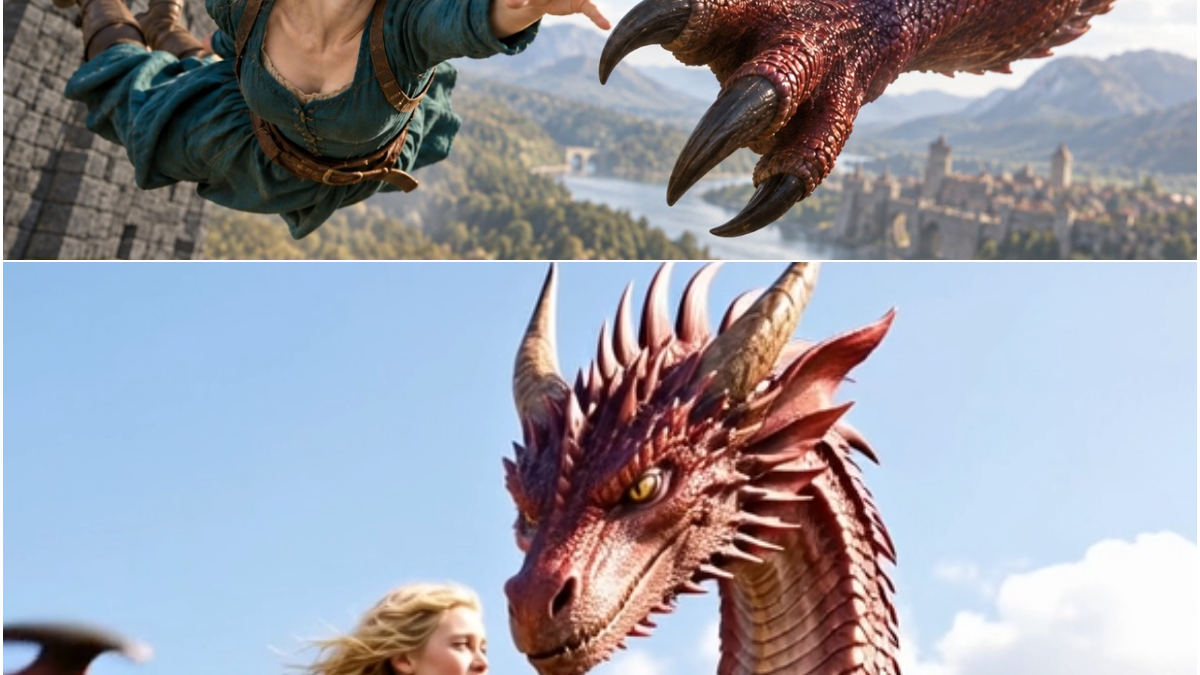
Lena Hart had one hand on the winch and the other reaching for the ratchet when Sergeant Bran seized her wrists.
The movement was so sudden that for a moment she thought he meant to pull her away from the machinery.
Then Guard Corwin caught her legs, and the two men lifted together. The parapet disappeared beneath her boots.
The keep rose above her, the gorge opened below, and the gray stone seemed to turn toward her as she fell.
There was no time to shout. There was barely time to understand that the men who had been standing beside her had chosen to put her over the wall.
Then a shadow crossed the light. Vesper came from his ledge with his wings folded tight, red and violet scales cutting through the air.
His forelimbs closed around her before the river could fill her vision. The catch struck the breath from her chest, and the dragon swung beneath her weight, opening his wings with a force that carried them away from Ashcliffe Keep instead of back toward its walls.
Lena clung to him without remembering when she had reached for his wriSt. They skimmed the gorge, the wind tearing at her coat, the cable station passing below like a toy.
He did not climb. He turned the fall into distance, carrying her toward a shelf of shale beneath the keep.
When he finally set her down, her legs refused to hold her. She knelt in the dust, alive, shaken, and suddenly aware that the dragon had done what no one had thought possible.
But what had made him choose to catch her? The first thing Lena did after the shale stopped moving beneath her hands was take stock of herself.
She had learned long ago that panic was a poor substitute for observation. A machine did not become safer because someone feared it, and a person did not become more useful by refusing to look at what had happened.
She checked her forearm, where the stone had scraped the skin. She examined the torn shoulder seam of her coat and the bruise forming along her hip where the parapet coping had struck her.
Her fingers moved carefully over her ribs. Nothing seemed broken. Vesper stood above her, his great head lowered.
One eye followed her movements. His breathing sounded like bellows working in a cold forge.
For a moment, Lena thought he might touch her again, but he stepped back three paces and folded his wings.
His tail curled around his feet as he turned his attention toward the wall. He made no sound that she could mistake for speech.
He did not ask whether she could stand. He simply waited at the edge of the shale, watching Ashcliffe Keep as if the place had become an object of particular intereSt.
Lena followed his gaze. The parapet was a narrow gray line against the sky. No one stood on it now.
That absence told her nearly as much as the fall itself. Dne reached the shelf firSt. The winch boy slid down the last stretch of path on his heels, his hands extended and his face pale.
He repeated her name as though someone had ordered him to keep saying it until she answered.
He had been inside the drum housing, greasing the fair lead, when he heard her voice rise above the machinery.
He had reached the deck in time to see Bran seize her and Corwin lift her over the wall.
He told the story in fragments, repeating the same details until Lena finally raised a hand.
“Save it for the clerk,” she said. Dne swallowed and nodded. The sally port opened.
Soldiers came through in a loose running line, but several stopped when they saw Vesper.
One lowered his spear, apparently uncertain whether he should point it at the dragon, salute him, or pretend he was not there.
Captain Elias Maher walked through the others without slowing. He was forty, broad-shouldered, bareheaded, and still had his sleeves pushed up from whatever work had occupied him before the commotion.
He came down onto one knee beside Lena. “Is anything broken?” “No.” “Can you stand?”
“I can.” She rose carefully, using the rock for support. Then she looked past him at the soldiers.
“Two of your men put me over the wall.” Elias did not tell her she was confused or shaken.
He did not ask whether she was certain. His expression remained still as he asked who had done it.
“Sergeant Bran held my wrists. Corwin lifted my legs.” He listened without interrupting. Bran arrived a minute later, jogging down the path with precisely the right amount of alarm on his face.
He said Lena had been leaning over the parapet, arguing about the winch, and had slipped.
He claimed he had reached for her and missed. Corwin stood behind him with his hands loose at his sides.
He said nothing. Lena noticed that he did not repeat Bran’s explanation. She put the detail away for later.
Elias looked at both men for a long moment. Then he separated them, assigning each to a different pair of soldiers.
He sent for the watch clerk and ordered that their accounts be recorded immediately, apart from one another.
Dne gave his statement on the shelf in the wind. His hands shook so badly that the clerk had to tell him to sit on a stone.
His account matched Lena’s, though the words were different. That was the kind of agreement Elias wanted.
Vesper launched without warning. Three heavy strides sent grit across the shelf, and a single downstroke lifted him toward the gorge wall.
He climbed and settled on a ledge two hundred feet above the lower yard road.
The soldiers watched him go as they might watch a storm moving across the mountains.
Somebody said Ashcliffe had never kept a dragon. Another soldier answered that Vesper had been on that ledge since spring and had never come near the walls.
A young man with a waterskin asked Lena whether she had called him. She drank, handed the skin back, and shook her head.
“I had never been within a hundred feet of him before this morning.” They wanted to carry her to the infirmary.
She allowed them to escort her as far as the storeroom inside the sally port, where she sat on a crate and refused to lie down.
There was something more important than resting. “The paw on the winch is bad,” she told Elias.
“It seats shallow under a loaded hall. It will skip. That is what I was telling Bran when he put his hands on me.”
Elias went very still. “The lift made a loaded run this morning.” “Barley and iron stock for the forge,” he said.
“And another run an hour before you went over, with the mason’s lime.” “Then you were lucky twice.”
She pushed herself upright. The room tilted, and she steadied herself against the wall until the movement passed.
“Come and look. I would rather show you than argue.” The winch platform was built into the thickness of the wall.
Its timber deck extended around the cable entrance, where the rope passed over a bronze fair lead and descended into the gorge.
Lena climbed the stairs without help. Dne followed, keeping a respectful distance. She loved the machine.
It was simple, heavy, and honest when properly maintained. The hall rope lay in even layers across a drum as thick as a wine cask.
A brake band faced with elm lining clamped the drum under a long lever arm.
When the brake eased, a single iron paw held the ratchet wheel and prevented the drum from turning backward.
Lena swung the paw up on its pin and let it fall. It dropped into the tooth with a dull sound.
The iron should have struck hard. Instead, it settled with only a finger’s width of engagement where twice that should have been present.
“It’s the wrong paw,” she said. “And the wrong pin. This is a shaved carriage pin.
It’s loose in the boss. The paw rides forward under load, and the nose never gets home in the tooth.”
Elias took the month’s papers from his document case. He carried them with him as other men carried a knife.
Inside was the safety attestation for the crossing. The break was recorded as sound. The spare paw and pin were recorded as present in the parts cheSt.
Bran had signed the paper as sergeant of the watch. Elias had countersigned it on the fourteenth day of the month, along with eleven other papers that morning.
“I didn’t walk the drum,” he said. He looked at his own signature. “I read a sergeant’s hand and put mine beneath it.
That is mine to carry.” He ordered the span closed. No runs, loaded or empty, until the winch was fit.
Lena watched the decision settle over him. Four carts waited on the lower road across the gorge.
One carried fever medicine for the undervillage. Closing the crossing meant eleven hours along the goat track for every pound of it.
The quartermaster arrived within the quarter hour. He was an old man with ink on his knuckles and a grievance already prepared.
The barley would sit in the rain. The carters would not hold their mules for three days.
The village needed supplies. Elias listened until the quartermaster had finished. Then he repeated the order without changing a word.
Lena stood in the doorway of the winch shed and noticed that he never once looked to her for support.
“Tomorrow’s run was to be six hundred weight,” she said when the quartermaster had gone.
“If that paw had skipped with six hundred weight on the deck, the drum would have run backward and the platform would have gone down the span like a dropped stone.”
That evening, she walked the entire installation anyway. It was the fourth day of the month, and the fourth day was for inspection.
She checked the anchor stone, the socket where the bearing rope entered its cradle, the return pulley bearings, and the grease pot.
She recorded the date, weather, rope condition, drum layers, brake adjustment, and anything she did not like on the slate hanging by the door.
It was the method Master Harl had taught her. At dusk, she used the flagboard to signal across the gorge.
The station had communicated that way for forty years. Two white flags meant the span was open.
Three meant closure. A red lamp appeared on the far mast within a minute. Harl had received the message.
He would tell the carters, and he would not be pleased. Her hands began shaking around ten that night.
They continued for two hours. Lena sat in the windshed with a cup of tea cooling between her palms and let the shaking happen.
Dne sat in the doorway without speaking. She was grateful for that. Harl, whose hearing had failed years earlier, was at the lower station on the far side, sorting sheave stock.
The closure left him there with no way home except the track. From the north embrasure, Lena could see the undervillage below the keep.
Twenty roofs sat on the shoulder of the mountain. Two windows remained lit at midnight.
The fever had been there for nine days, and the medicine was still on the wrong side of the gorge.
In the morning, Vesper was back on his ledge. The sun rose over the eastern rim and lit his red scales until the violet in his wing membranes looked like ink dropped into water.
Half the garrison found reasons to be on the east wall. By noon, Lena had heard the same sentence four times.
“The dragon catches people.” It was spoken in the mess, at the gate, and on the stair.
Each repetition made it sound a little more like a fact and a little less like a story.
Elias asked her about it while they stood beside the fair lead. “Do you think he would do it again?”
“I don’t know. I don’t think anyone knows, including him. He was on that shelf.
He saw a body come off a wall, and he went. That is all I actually saw.
And I was the body, so I saw less than Dne did.” Elias considered the answer.
Then he asked whether Vesper could be stationed beneath the span while the men worked on the winch.
Lena put down the grease rag. “You’d be asking an animal the size of a barn to be a net.
He would have to be looking, guess where someone might fall, have room to turn in the gorge wind, and want to catch whoever came off.
You would have a man in the air over four hundred feet of rock, relying on somebody’s good idea.
I’ve seen what a rope does when you ask it to be something it isn’t.
He isn’t a rope.” Bran was confined to his quarters with a guard at the door.
Corwin remained on duty but was removed from the wall. He spent the day scrubbing the gatehouse flags and the drain grates.
Lena passed him three times and made a point of not looking away firSt. That evening, Dne asked whether she was afraid to go onto the wallwalk again.
“Yes,” she said. Then she took him up there to inspect the anchor bolts. They walked the wall in the dark.
It was not easy, but afterward the fear seemed less capable of deciding where she could go.
The next morning, Elias asked her to show him the length of the span. The request surprised her.
She had expected him to leave the technical work to the liftmaster and concern himself with the orders.
They began at the cable head and moved toward the anchor stone. “Two ropes,” Lena explained, putting a hand on the thicker one.
“The bearing rope is the road. It’s fixed at both ends and never moves. The platform hangs under a carriage, and the carriage runs along the bearing rope on two grooved sheaves.
That rope carries the weight and does nothing else.” She pointed toward the hall rope.
“The hall rope is the horse. It runs from the platform down the span to the far mast, around a return sheave, and back up here to the drum.
The drum pulls the platform toward us. The brake lets it down toward them.” “If the hall rope goes slack, the platform does not fall?”
“The carriage sits on the bearing rope. It stays there. A brake failure lets it run downhill, which is their side.
A runaway reaches the far buffer at the bottom, and whatever is standing on the deck may not stay standing.”
She showed him a short length of red-dyed cord whipped around the hall rope, a hard knot the size of her thumb.
“When the red comes home to the fair lead, the carriage is at the lowest point of the sag.
We never stop there. The rope angles are worst, the carriage is hardest to start again, and there is nothing beneath it.”
“Harl put that knot there?” “Eleven years ago.” Then she took the cracked spyglass from her coat and handed it to Elias.
He found the damaged section after a moment. Five feet of the bearing rope had been flattened and polished bright.
The tarred strands were pushed out of their lay, and two broken wire ends stood up like whiskers.
“Skid burn,” Lena said. “The carriage stopped moving while the rope kept going beneath it.
That does not happen on a normal run. Something ran away and was caught hard at the bottom of the sag.”
She examined the weathered tar and judged the damage to be five to eight weeks old.
“Ask your night watch about a crossing that isn’t in the book.” There was no entry.
Lena had not made the run. Elias lowered the glass. “You’re telling me the same men signed my paper.”
“I’m telling you what the rope says. It doesn’t care who signed anything, and it doesn’t get nervous when you ask it twice.”
He asked what the repair would require. “Two curved plates, bronze-faced, bolted around the burned length to bridge the broken wires so the sheave flanges can never touch them.
A full day with the span closed. And a chair rig to get someone out there.”
She began making the plates that week. With the winch out of service, there was little else she could do.
She cut the pieces from sheet stock, curved them over a wooden former, filed the edges smooth, and drilled the bolt holes two at a time.
On the second evening, the quartermaster and a sergeant of the East Watch arranged a demonstration without telling her.
Lena heard laughter on the wall and went to see what had amused them. Four men were leaning over the parapet.
They had stuffed a grain sack with sand and straw to roughly the weight of a person.
A joint of salted meat lay on the stone beside them. They shouted down at Vesper.
“Stop,” Lena told them. The sergeant said it was a teSt. “A test of what?”
“Whether the beast will work.” “He isn’t a beast, and he isn’t a machine. He certainly isn’t yours.”
They threw the sack anyway. It fell past the wall, turning slowly, and struck the shale apron below.
The sack burSt. Vesper lifted his head and watched it fall the entire distance without moving.
When the men shouted again, he stood, walked twelve feet along his ledge, and lay down facing the other way.
His tail pointed toward them. “He looked,” Lena said into the quiet. “He knew exactly what that was.
He simply declined.” Elias arrived at the stair and took in the scene. He put the sergeant on the gate for a week and assigned the quartermaster’s clerks to inventory work.
Then he stood at the parapet with both hands on the stone. “I knew they’d try something like it,” he said.
“I didn’t forbid it because I wanted to see what he’d do.” He looked at Lena.
“That’s twice now I’ve let a thing run because I wanted to know how it came out.”
“Then stop wanting that.” She had spoken more sharply than intended. Elias accepted the rebuke without argument.
The sack remained on the shale until dusk. Dne went down the path alone and brought it back in two trips.
Nobody made another joke about the dragon for three days. The next morning, Lena opened the parts chest in front of Elias and the watch clerk.
The spare paw and pin should have been wrapped in felt. Instead, the bundle contained only an empty fold, with a paw-shaped stain pressed into the old grease.
She removed the fitted paw from the ratchet and turned it over. A small crowned S had been struck into the back, with the number two beneath it.
It was the armory’s mark for second sets. “The spare is in the machine,” she said.
“Somebody broke the working paw and put the spare in to cover it. They cut down a carriage pin because the proper pin went into the gorge with the broken one.
Then they wrote on your paper that the spare was still in the cheSt.” Elias turned the iron over twice.
“So the machine has had no spare for weeks, and I signed a paper saying it did.”
“And whoever fitted it knew the nose sat shallow. You feel it drop. You hear it drop.
You only have to put your hand on the thing once.” That afternoon, Bran spoke through the door of his quarters.
He claimed the chest had been like that when he took the poSt. He said Harl had done the fitting himself in spring and that Bran had merely recorded what the liftmen told him.
It was a good answer, delivered well. It was also the first claim that could be checked against Harl, who remained on the far side of the gorge.
With the span shut and the track taking eleven hours, nobody could reach him quickly.
The pressure of the closure grew louder in the yard each day. There were now five carts waiting on the lower road.
Meera Tully, a carter with two crates of fever medicine, had camped at the far station.
Her mule had gone lame in the off hind leg. Every dawn, Meera sent the same question across the gorge with three short flags and one long.
When? Every dawn, Lena answered with two red flags. Not yet. The priest came up from the undervillage on the second day.
Two of the Cooper children had the fever, and the saltfish had run out. He did not raise his voice.
That made his visit harder to bear. Another rumor had begun to spread. If the dragon could catch a woman off the wall, perhaps he could catch a man off the platform.
Some suggested stationing him beneath the span and running the lift whether the winch was fit or not.
Lena brought the matter to Elias. He said he had already refused twice, once to the quartermaster and once to his second.
The argument would return because it was convenient. “Then say it in the yard,” Lena told him.
“Not in your office with the door shut. Men repeat what they hear on stone.
Through a door, they only guess.” That afternoon, Elias stood on the mounting block by the stable and addressed fifty men.
The lift would carry people when the machine was fit to carry them, and not an hour before.
No soldier would be sent out over open air relying on an animal’s goodwill for rigging.
Anyone arranging another sack test would scrub drains until snowfall. It was a good speech, and it was honestly meant.
Lena stood at the back of the yard and doubted it would survive a fifth day of stopped carts.
She was right. On the fourth evening, the quartermaster came to the winch shed with two men, a lamp, and an order written on a scrap of paper.
It authorized a light crossing of medicine and salt without passengers. The signature belonged to someone Lena did not recognize.
She refused. “No persons means no risk,” the quartermaster said. “The paw will skip under any load heavy enough to make the trip worthwhile.
A runaway will send the carriage back across the burned rope at the bottom of the sag.”
“That’s a great deal of theory from a woman with a bruised hip.” “The theory has a flat spot five feet long.
You can look at it through a glass any morning you like.” He left to find someone who could countermand her.
Lena stood in the doorway and understood how the next morning would go. Another scrap of paper would arrive with a better signature.
Men would be told she was shaken and not thinking clearly. A small crossing would begin at dawn before anyone senior had eaten breakfaSt.
She did not go to Elias. That was her choice, made in about a minute.
She was not panicking or confused. She had spent four days watching officers read papers and act on them.
She trusted the machine and her own hands. She did not trust that a captain’s word would still be worth anything after the medicine had sat six days in the rain.
That night, she stripped the winch. She drove the drum’s iron holding bar through the ratchet and pinned it in place so the drum could not turn.
She drew the shaved carriage pin, pocketed the fitted paw, and unscrewed the brake band’s adjusting screw.
It was the one turned iron piece in the assembly that could not be replaced within a week.
She wrapped all three in oiled rag and hid them beneath a loose floorboard in the sheave store.
Then she went to her bunk and slept better than she had since the fall.
In the morning, she ate slowly in the mess with her back to the wall.
The shouting reached her halfway through her bread. By midmorning, twenty men crowded the shed.
Not one could move the drum a quarter turn. Elias found Lena sitting on a barrel in the yard, her hands resting on her knees.
“Where are the parts?” “Safe, dry, and undamaged.” “You’ve locked the only crossing on the mountain.”
“It was already locked. I made it true.” “You made it impossible for anyone to act without you.”
“Your quartermaster had a paper last night with a signature I didn’t know. He would have had a better one by noon.”
Elias leaned against the wall and looked up at the sky. “Meera Tully’s medicine has been on the far yard since Tuesday.
Two children in the undervillage have the same fever, and a third house has it since yesterday.
The road around is eleven hours, and the ford is washed out.” “I know.” “You don’t know,” he said, without heat.
“You made a decision that costs other people, and you made it in the dark so nobody could argue with you.
That is exactly what Bran did. A different size, the same shape.” The words struck harder than she expected.
She had been right about the paw. She had been right about the danger. But she had made herself the only person allowed to decide what happened next.
Elias sent four men and two mules around by the goat track that afternoon. Lena watched them leave from the north embrasure, a small line dropping into the trees below the second bend.
They reached the far yard near midnight and returned the following afternoon with the medicine.
One man had turned an ankle on the ford stones. Meera came back with them.
She was short and broad, with a carter’s forearms and mud to her knees. She found Lena in the sheave store.
“A locked winch and a broken winch look exactly the same from the other side of a gorge,” she said.
Lena did not explain herself. She had begun to understand the shape of what she had done.
She had decided she was the only careful person on the mountain. Being right about the machine no longer felt like enough.
That evening, she took the parts from beneath the floorboard and carried them to Elias’s room.
She laid the paw, pin, and adjusting screw on his table, still wrapped in the oiled rag.
“I was right about the machine,” she said. “I was wrong about you, and I was wrong about what I was allowed to spend to be right.
Those are two different accounts. I’d rather you kept them separate.” “They don’t stay separate,” Elias replied.
“That’s the trouble.” He unwrapped the rag and turned the screw in the lamplight. His shoulders eased.
“You could have put this in the gorge. Nobody would have found it, and nobody could have proved it.”
“I wanted it back in the machine. I wanted to be the one who put it there.”
“Then tell me what the span needs. All of it, in order. You’ll have my name on it and my men under your hand.
If anyone brings you another paper, send them to me. I’ll stand in the yard and eat it in front of them.”
Lena counted the requirements on her fingers. A new paw, properly forged and case hardened, with a turned pin that fit the boss without play.
A relined brake band, because the elm facing was glazed and would not grip in wet weather.
Saddle plates bolted over the burned length of bearing rope at midspan, bridging the broken wires so no sheave flange could touch them.
And a spare of everything in the chest, checked by two people on the first of each month, one of them always the liftmaster.
They completed the first two repairs in three days. Lena forged the paw at the keep’s small hearth, with Dne working the bellows and Elias watching from a stool.
She drew the iron down, hardened it in oil, and tempered it until it reached a straw color.
At one point, Elias asked to hold the tongs. He held them badly. Lena corrected his grip without softening her voice.
He adjusted. The next time, he held them properly and said nothing. When she fitted the new paw and let it fall, it rang into the ratchet tooth like a bolt shot into a good door.
Dne laughed aloud. Elias put his thumb against the iron where Lena’s had been and felt the difference himself.
They relined the brake band with green elm that had been boiled and dried. Lena set the adjusting screw to a measured gap and scribed a white line across the lever arm.
Any watch officer could now see whether the band was properly adjusted. She taught four people who were not liftmen how to read the mark.
Two soldiers, the quartermaster’s clerk, and Dne each had to find it and explain what it meant.
She wrote their names on the slate. A week earlier, she would have considered that unnecessary.
Now she understood that a machine could not be made safe by one pair of hands alone.
They tested in stages. An empty platform went down and back three times, first with the brake alone, then with the paw alone, then with both.
After each run, they checked the drum for heat. Next came sand weighing two hundred weight, down and back twice.
Then three hundred. Then four hundred. Dne worked the drum. Lena held the brake lever.
Elias stood at the fair lead, calling the marks. After every run, Lena placed her palm against the drum bearing, measured the band wear with a bent wire gauge, and recorded the number.
The band lost a hair’s thickness over six runs. That was exactly what it should have loSt.
On the last sand run, they stopped the platform fifty feet out and held it with the paw alone, the brake eased completely off.
The ratchet took four hundred weight without making a sound. Men cheered from the wall.
It was a small, embarrassed, entirely sincere cheer. It was the first sound the garrison had made since Lena went over the parapet that she actually liked.
Afterward, she let Dne call the marks. He was half a beat late twice. She allowed both mistakes to pass without correcting him.
He got the third one right. That afternoon, another group tried to attract Vesper. Half a dozen men at the east parapet shouted toward his ledge, whistled, and waved red cloth on a pole.
They wanted him beneath the span, where everyone could see him being useful. Vesper raised his head and watched the platform, the men, and the cloth.
Then he opened his wings and flew down the gorge, around the northern spur, and out of sight.
He did not return until dusk. “That’s twice he’s been told,” Lena said. “Twice he’s gone.”
Elias had the cloth taken away and burned. He did not defend the men or ask the dragon to reconsider.
Walking back along the wall, he asked whether she thought Vesper understood what they were asking.
“I think he understands falling. He understands something dropping and something not dropping. That’s a good deal more than most of the men on that wall understand about ropes.”
Two days later, Lena rigged the chair for the first time. She would not put a device into service without testing it herself.
The chair consisted of a plank seat, canvas straps, a bronze ring, and a traveler with two grooved wheels that ran on the bearing rope.
Dne paid out the tail line from the winch deck while Lena rode sixty feet over the shale apron and returned.
She recorded that beyond one hundred feet, the sag would pull her down unless a second line from the far mast could haul her home.
That evening, the cold feeling in her chest returned. This time, she took it to Elias rather than making a decision alone.
She noticed herself doing so and was quietly pleased. Bran’s claim about Harl remained unresolved.
He had said the old liftmaster fitted the damaged paw in spring. Lena asked Elias to bring Harl across as soon as the span could safely run.
The next morning, the platform went down and returned with no load. Harl came onto the winch deck with his hat in his hands and the wind moving through his bad ears.
Lena wrote half her questions on a slate and held it where he could read.
Harl examined the old paw. He turned it toward the light, studying the crowned S on its back.
Then he said loudly that he had never fitted that paw in his life. He had asked for the spare set in the seventh week.
He had been told the parts chest was sealed by order of the watch. He had filed three written complaints, all of which came back unanswered.
He had kept the copies. He also had a slate ledger at the far station, recording every crossing, its date, weight, and weather, going back nine years in his square handwriting.
On a night five weeks and four days earlier, the ledger recorded a carriage run down hard on the hall rope.
The far buffer had been struck. Deck timbers had sprung at the uphill end. No person had been injured.
It was not Harl’s run. It was not his load. “They took it across at night,” he said.
“Wine and hides. There’s a merchant on the lower road who pays coin for crossings after hours.
He pays better after midnight.” They had overloaded the platform. The paw had failed, and the drum had begun to run backward.
Bran had clamped the brake band hard, stopping the drum while the carriage was still moving.
The carriage had skidded at the bottom of the sag. The damaged rope, the missing spare, the false attestation, and the night crossing finally made one account.
Someone had accepted money to run an unrecorded load. Someone had damaged the machine by stopping it badly.
Someone had concealed the missing parts. Someone had signed a safety paper to protect the people responsible.
And six weeks later, Lena had been put over a wall because she had found the evidence.
Corwin came to Elias’s door that evening. He stood in the middle of the room with his cap crushed in his fiSt.
He admitted that he had held Lena’s legs. Bran had claimed they would only frighten her, but Corwin had known it was a lie when he lifted her.
He admitted the night runs, the wine and hides, and the money divided three ways with the merchant’s man.
He asked for nothing. When Elias asked why he had come forward now, Corwin said he had heard the new paw fall into the ratchet tooth and finally understood what the old one should have sounded like.
Lena was called in to hear the account repeated. She stood against the door and listened as Corwin described lifting her knees over the parapet in careful detail.
When he finished, he looked up at her. She said nothing. She did not forgive him, and she did not perform a refusal.
She let the silence remain where an absolution might have gone, then walked out. Her hands did not begin shaking until she had gone down the stair and turned the corner.
Bran was arrested that night. His explanations did not survive Harl’s ledger. At the end, he stopped talking and sat with his forearms on his knees, looking at the floor.
He was thirty-five, big and competent, and had made one bad choice during a rainy week.
Then he had made many more to conceal the firSt. Lena watched him through the guardroom grill and felt nothing she could name.
The magistrate sat in the town below the lower road. Both men would have to be taken across the gorge and down to answer for what they had done.
Elias scheduled the escort for the end of the week and recorded it in the daybook where anyone in the keep could read it.
One item on Lena’s list remained unfinished. “The saddle plates,” she said, standing in the yard amid nine days of delayed stores.
“The burned stretch at midspan. I need the span closed for a full day. Until the plates are fitted, every crossing sends two sheave flanges over standing broken wire.”
“How bad is it?” “It hasn’t caught yet. The flat spot is polished where the flange rubs.
But the broken ends move as the rope works, and a flange only has to catch one of them.”
She explained that the load changed the shape of the sag. Below four hundred weight, the curve was shallow and the flange rode lightly over the damaged section.
Above that, the rope bent deeper and the sheave pressed harder into it. “Four hundred is my line.
I’ll put it in writing.” Elias entered the limit in the daybook that hour, in both their hands.
No crossing above four hundred weight until the saddle was fitted. The captain and liftmaster both signed.
The reason was written out in full. Then he looked at the yard. Grain was sprouting in the wet at the bottom of the heap.
The village’s fever had not finished. The carters would not wait another week. “One run at your limit,” he said.
“Four hundred weight. No more grain, and the last of the medicine down. Then we close the span and you get your day.”
He paused. “That is my decision, and it is mine to answer for. I’m saying it out loud so you can tell me what you think.”
“I think it’s a real choice and not a lazy one,” Lena said. “I’d close the span firSt. But if you had taken my word eight days ago and I had taken yours, those plates would already be bolted on.
I’m not going to lecture you about windows.” He almost smiled. “Is that an agreement?”
“It’s an agreement. Run it slowly. Keep the layers even on the drum, and stop for nothing at the red.”
The crossing order went down on the empty platform the next morning. The clerk wrote it, and Elias countersigned it.
It was correct in every particular except one. The load limit was in the daybook but not on the order.
Nobody noticed. They ran the crossing two mornings later in clear weather. The platform went down empty, smooth and level.
At the far station, Harl loaded nine sacks of grain, two crates, and the medicine in its straw.
Meera Tully rode with one hand on her mule’s crate. A young hand stood beside her.
Then the escort sergeant at the far yard made a reasonable decision. Rather than send the two prisoners around the eleven-hour track, he put them on the return platform.
He sent word by flag. The clerk logged the change, and nobody on either side put a number to the load.
Harl signaled the weight in hundreds. Elias read the flags through the glass on the winch deck and called the number aloud.
Six and a half. Lena had about four seconds to decide. She could send four people back down to a far yard with no shelter, two prisoners, and a carter carrying fever medicine.
Or she could run two and a half weight above her written limit, slowly, on a new paw and a repaired brake.
She chose to run it. She said so aloud on the winch deck, in front of Dne, two soldiers, and Elias.
There would be no argument later about whose call it had been. The platform came up the span with nine sacks of grain and two crates.
Meera rode beside her mule’s load. The young hand stood near the rail. Corwin sat against the deck’s side, and Bran stood at the uphill end with his wrists tied in front of him.
Lena held the brake lever. Dne worked the drum with two soldiers at the bar.
Elias stood at the fair lead, calling the marks. The morning was clear. There was little wind.
There was no storm, no fire, and no enemy on the road. There was only a rope with six broken wires standing up from it at the bottom of the sag, and a load two and a half weight above the number in the daybook.
The red knot came home to the fair lead. Elias called it. “Keep hauling,” Lena said.
“Don’t stop at the red.” The drum turned four more times. Then it stopped as though it had struck a wall.
The hall rope came up hard and hummed like a plucked string. Dne’s bar kicked backward, throwing him and the two soldiers off their feet.
Lena clamped the brake in half a second. The paw dropped and held. The platform hung motionless at the lowest point of the sag, its load canted six inches toward the downhill rail.
“Sheave flange,” Lena said. “It’s caught the wire ends. Dne, off the bar. Nobody pulls anything.
Nobody eases anything. Nobody touches that drum.” Elias already had the glass raised. “They’re on their feet,” he called.
“The deck is holding.” “Tell them to sit down and not move. All four of them.
Tell them we’re coming.” Lena ran for the sheave store. She called for the messenger line, the chair rig, the file box, the saddle plates, and every foot of light cord in the keep.
The problem was simple and terrible. Pulling harder would drive the loaded flange into the broken wires and cut the bearing rope.
The bearing rope was the road and the only road. Easing the hall rope would let the carriage roll backward through the damaged section, with four hundred feet of air beneath it and the far buffer waiting at the end of the run.
The platform was four hundred and ten feet from the wall, over the deepest part of the gorge.
Everything Lena needed required a second line running out past the carriage to the far maSt.
She explained the problem to Elias with her hands because there was no time for complete sentences.
“The chair runs on the bearing rope. I can ride the traveler out and clear the foul with a file.
But the traveler has to be hauled from both ends in the sag, or I’ll be hanging on one line with no way home.
We need a line to the far mast, and the only way we’ve ever sent a line to the far mast is on that platform.”
For three or four seconds, the problem seemed closed on every side. Harl was on the far side with six men and all the sheave stock on the mountain.
There was no way to send even a thread across the gorge. A crossbow would not carry a line that far uphill in any wind.
The goat track took eleven hours. The people on the platform had less time than that.
Loads shifted. People grew cold. People grew tired of sitting still above a drop. Lena looked up at Vesper’s ledge.
The dragon stood with his wings half open, watching the stopped platform. He was looking exactly as he had watched the sand sack fall.
“No,” she said before Elias could ask. “Not the way they did it. No shouting, no meat, no men waving cloth.
If we make it a command, he’ll go over the spur, and we’ll deserve it.
Those four will still be out there.” “What do you want?” “I want to do the work in front of him and see what he does.”
Elias turned and cleared the east wall of every man on it without asking her to explain.
Lena fetched the messenger cord herself. It was a quarter-inch braid, six hundred feet wound on a hand reel, no heavier than a full bucket of water.
She carried it down to the south shelf where Vesper had set her down eleven days earlier.
She told everyone else to stay on the wall and remain quiet. To her surprise, they obeyed, including the quartermaster.
Vesper came down from the ledge in a long glide and landed forty feet away.
He folded his wings and waited. He did not come closer. Lena did not go to him.
She sat on the shale with the reel between her boots and let him look at her.
It took about a minute. She spent that minute counting her breathing. Then she stood, made a wide loop in the cord, walked ten paces toward the gorge, and held the line up in both hands.
She turned and pointed with her whole arm toward the far maSt. Harl’s men had lit a smoke fire at its foot.
Green brush sent a clean column upward in the still air. Harl had guessed what she would need before she asked.
Vesper studied the smoke. Then he looked toward the platform. He lowered his head and took the loop of cord from her hands with his teeth, carefully enough that she felt his breath warm across her wrists.
Lena made herself stand still. He stepped off the shelf without ceremony. The reel spun in its frame and screamed.
Dne caught it with a gloved hand and braced his boot against the poSt. The cord paid out in a long white curve over four hundred feet of morning air.
Vesper passed twenty feet above the stopped platform. Meera watched him cross with both arms around her crate.
Later, she would say she felt his wind on her face like a door opening.
He landed at the far yard and dropped the cord among Harl’s men. Then he stepped back three paces and refused to let anyone approach closely enough to touch him.
A moment later, he lifted again and settled on the far rim to watch. They had a line across the gorge for the first time in nine days.
Everything that had been impossible became merely difficult, which was what most impossible things turned out to be.
Harl’s men attached the messenger cord to a proper half-inch rope with a short splice.
Harl would not allow a knot on a line intended to carry a person. He flagged two whites, meaning haul away.
Six men on the winch deck hauled the rope back hand over hand. Four hundred feet of wet half-inch line came over the parapet and coiled on the timbers.
Lena watched the splice pass through the fair lead with room to spare. They anchored the traverse line to the tower buttress on the keep side.
Harl secured the far end to the mast collar. Both crews tensioned it with a windlass bar until it ran clear and straight above the bearing rope and the platform.
The rig was Lena’s, and she called every part of it. A traveler chair on the bearing rope for herself, with a tail line to the winch deck and a control line running to the far maSt. A separate transfer line for the passengers, with two running chairs, each hauled from both sides at once.
No person would leave the platform depending on one crew, one rope, or one man’s grip.
Every knot was tied twice. Dne had to put his hand on each one and name it before she moved to the next.
He found one that was wrong, and she made it again in front of him.
The chairs had plank seats, canvas chest straps, and bronze rings at the top. They were the same pattern the station had used for thirty years.
Lena sat in each on the deck and tested it with her full weight before either went over the gorge.
Then she stood at the parapet with the speaking trumpet and explained the plan to the four people on the platform.
She repeated the instructions twice and had Elias’s men hold up the hand signals beside her so the deck could read them without hearing.
“You’re going out on it,” Elias said. It was not a question. “You’re the only one here who can read that foul, and the only one who’s ever been on that chair.”
“I’m the only one who’s ever filed a sheave flange.” “Yes.” She buckled the harness without looking up.
“If I go and it goes wrong, you close this span for good and send to the capital for a rope man.”
“And you don’t let anyone tell you the answer is a dragon.” “Understood.” He caught the tail of the harness strap and pulled it through the buckle because her hands were full of file and hammer.
It was a small thing, almost nothing. She noticed it anyway. Lena rode out along the bearing rope.
The keep fell away behind her. First came one hundred and ten feet of open gorge, then two hundred, then more.
The river became a bright thread far below. At the halfway point, wind rose through the gorge in long pushes.
The chair turned slowly on its wheels. She felt the far crew take up the control line, keeping it just off slack, exactly as she had instructed.
After that, she stopped thinking about the drop. The foul was exactly what she had predicted, and slightly worse.
Two broken wire ends had risen out of the damaged stretch, slipped beneath the downhill sheave’s flange, and turned over themselves.
The flange had climbed the wires and sat half out of its groove, carrying the weight of nine sacks, two crates, and four people.
The rope beneath it was pinched flat. “Nobody moves,” she called down to the faces looking up at her.
“Not one step. Not one hand. Meera, stay on that crate. Corwin, keep your hands where they are and keep him talking.”
Bran said her name once. She did not answer. She took the file from her belt and began cutting the standing wire ends flush.
Three strokes, then a look. Three strokes, then another look. Her forearm burned. The chair turned slowly in the wind.
She held herself to the traveler with one hand and worked across the rope with the other.
It took eleven minutes. When the last wire came away, she drove two thin bronze wedges beneath the flange.
She took the hammer from her belt and tapped the sheave back toward its groove.
It dropped the eighth of an inch it needed. The platform shuddered, like a cart finding the road after a wheel has slipped into a rut.
Then the load shifted. A grain sack on the downhill side went over. The sack behind it followed.
Four hundred weight of wheat slid two feet in an instant, and the deck canted hard toward the open rail.
Meera went down on her hip and caught the stanchion with both arms. The young hand flattened himself against the deckboards.
Corwin caught Meera’s sleeve and braced his boot against a cleat. Bran had nothing to hold.
His wrists were tied in front of him. He dropped to his knees and began sliding.
Lena was forty feet above the deck, suspended from a rope with a hammer in her hand.
There was nothing she could do to stop him. Then she heard the sound of wings.
Vesper came off the wall behind her, low and fast, his wings beating in short, hard strokes.
He came beneath the canted deck and pressed all four limbs against its outboard edge.
He pushed it level. The entire span rang from anchor to anchor like a struck bar.
It was not graceful. It was not effortless. His hindquarters dropped under the weight. His wings hammered the air.
His head pulled back with the strain. Lena could see the muscles standing out along his red shoulder.
She knew exactly how long he could hold the platform. Not long. “Transfer line now!”
Elias’s voice was already crossing the gorge ahead of hers. Dne and four men ran the first chair out along the traverse.
The far crew paid out their side to keep the line straight. Corwin got the chair.
He fitted the strap around Meera’s chest, cinched it beneath her arms, and pushed her clear of the rail without waiting for an order.
Both crews hauled together. Meera rose toward the keep wall, her hat disappearing into the gorge.
Harl’s men held the far tail so her chair would not swing into the hall rope.
The second chair went out as the first came home. The young hand took it.
His hands shook badly as he buckled himself in, but Corwin checked the strap before letting him go.
Bran remained at the downhill rail, grain piled against his back and his bound hands held out in front of him.
Lena dropped her hammer into the gorge. She unclipped her short line and lowered the third chair past her boots.
Corwin caught it and fitted the strap around Bran’s chest beneath his bound arms. He cinched it hard, put a hand against Bran’s shoulder, and pushed him off the deck into the air.
Vesper held the platform for seventeen seconds. Lena counted afterward. She knew it had been no more than twenty.
She had been looking straight down at him for every one of them. He could not hold the load any longer.
He slid out from beneath the edge and dropped clear rather than risk being caught by the platform as it shifted.
He fell forty feet before his wings caught the air again. The deck tipped four inches and stopped.
It stopped because the sheave had returned to its groove, because the bearing rope beneath it remained sound, and because the people were leaving on a rig supported by two crews rather than one uncertain grip.
Corwin came off laSt. He clipped himself into the returning chair without help and without hurry.
Lena rode her traveler back along the bearing rope, hand over hand, with the far crew easing the control line throughout the return.
When her boots reached the winch deck, so many hands reached toward her that she had to tell three men to step back.
Then she sat down on the timbers. Her legs had their own opinion about standing.
They left the platform hanging in place for six hours. The grain remained on the deck while both crews worked the traverse line, sending the saddle plates, a bolt bag, and two men out to midspan.
Lena made two more trips to the damaged section. She fitted the curved halves around the burned length and bolted them together, their bronze faces bedded over the flattened strands.
Nothing on the rope would be able to catch a flange there again. Then they walked the carriage inward by hand on the drum bar.
Ten turns and a look. Ten turns and another look. The platform came up out of the sag and passed over the new saddle with a soft sound like a cartwheel rolling on gravel.
When it reached the wall, nobody cheered. Everyone was too tired. Meera sat on the parapet, removed her boots, said something uncharitable about mountains, and laughed until she had to cover her face with both hands.
Vesper returned to his ledge and slept for most of two days. He lay on his side in the sun, one wing trailing over the rock.
Lena watched him through the cracked spyglass. He had spent something on them that could not be repaid in any currency he would recognize.
Bran sat in the guardroom afterward, his wrists untied and rope burns across his cheSt. He said to no one in particular that Lena had sent the chair to him third, not laSt. He had expected laSt.
She came to the grill two days later. “I sent the chairs in the order that got four people off a canted deck.
You were the one who couldn’t hold on. That was the whole of it.” “I’m not asking you to say anything.”
“Good. I’m not going to. You put your hands on my wrists on an empty wall because you would rather I fell than someone read a ledger.
I’m glad you’re alive. I don’t like you, and I’m not going to learn to.
You don’t get to use that morning on the span to make any part of this easier for yourself.”
He accepted her words without speaking. Lena walked out. She found that saying them aloud had set the matter down somewhere she could leave it, though she did not entirely trust that feeling for another week.
At the end of the month, the magistrate’s men took Bran down the road on charges of attempted murder and falsifying a safety attestation.
Corwin went with him under a lesser charge, having given his account twice without being forced.
Neither returned to the keep. There was no grand announcement in a great hall and no sealed letter.
Ashcliffe was a garrison on a mountain. What it received instead was a new page in the watchbook.
Elias wrote it himself and read it aloud in the yard before the whole garrison.
The winch and both ropes would be walked by the liftmaster or her named deputy before any crossing, loaded or empty, without exception and without hurry.
Any safety attestation signed by a man who had not personally laid his hand on the paw would be treated as a false instrument.
The liftmaster could stop the span at any hour without permission, explanation, or appeal. “That last one is a knife,” the quartermaster said unhappily from the back.
“Yes,” Elias replied. “She’s earned the handle end of it. You’ve all seen what it looks like when the knife is held the other way around.”
Then he read one more paragraph, which Lena had not known was coming. He recorded his own failure to walk the drum in the seventh week and his approval of a run before the saddle was fitted.
He attached no explanation. Lena added a paragraph beneath it in her own hand. She recorded that she had stripped the winch without authority, delayed the medicine by a day and a half, and run six and a half weight over a rope she had limited to four.
Elias did not say he was sorry. Neither did she. It was the most complete apology Lena had ever heard.
The page hung in the guardroom, where every new soldier had to read it during his first week.
They also hung a load slate on each side of the gorge. The day’s limit was written in figures a foot high, and Harl prepared a flag code for the weights.
Dne learned it in an afternoon. Lena kept the old fitted paw with the crowned S on its back.
She hung it on a nail above the winch shed door, where everyone entering had to pass beneath it.
When Dne asked what it was for, she said it was a reminder that iron told the truth about who had touched it.
Harl stayed on the keep side through autumn and taught Dne the drum. He shouted at him affectionately and inaccurately.
Lena rebuilt the parts chest with two of everything and a slate list fixed inside the lid.
Two people checked it on the first of each month, one always the liftmaster. The Cooper children were back on their feet by the end of the second week.
Meera crossed the span eleven times before winter. She never stepped onto the platform without looking at the load slate first, and she did it loudly and deliberately in front of the soldiers.
The old sentence faded from the garrison. The dragon catches people. It had been replaced by something more useful.
Vesper had held a canted platform for seventeen seconds, then released it when he could no longer bear the weight.
Forty people had seen him do it. None of them could mistake his strength for a machine or his willingness for an obligation.
He remained on his ledge. He fished the river in the gorge and hunted the high goats along the northern spur.
He disappeared for nine days in the middle of the month and returned when he chose.
Nobody fed him at the wall. Nobody called him. Twice that autumn, he flew alongside a loaded platform, thirty feet away from the deck, unhurried and silent.
Lena stopped the drum the first time. After that, she did not stop it again.
He seemed to want nothing more than to be near something that moved. On the last mild evening of the season, Elias stood beside her at the fair lead.
The white scribe mark on the lever arm lay between them. “Do you think he knew what he was doing at midspan?”
“I think he knew something was tipping, and he put his hands on it. That’s what I did, too.
I don’t think either of us was doing anything complicated.” “You were four hundred feet out on a rope with a file in your hand for eleven minutes.”
“That’s just work. You can learn work.” He wiped tar from his palms with a rag and looked sideways at her.
“You did badly for about a month,” she said. “Then acceptably. Now nearly well.” “High praise from the liftmaster.”
He turned the scribe mark beneath his thumb. “There’s a table at the lower yard on market days.
Tully’s cousin keeps it. Harl says the mutton is better than anything in this keep, which is a low bar.
I’d like to find out with you.” Lena considered the invitation a little longer than she needed to, mostly because she wanted to see him wait.
“The span closes at four on the first for the monthly check,” she said. “I’ll do the check, too.
Then we can ride down on the platform like ordinary people.” “Is that safe?” “I’ll tell you when we get there.”
He laughed. Neither of them said anything more that evening. The monthly check came on the firSt. It ended the way Harl had always ended it, with an empty platform sent the full length of the span and back, carrying nobody and nothing.
Lena stood at the fair lead with her hand flat against the hall rope. She felt the run travel through her palm and watched the bare deck move out over the gorge in the afternoon light, small, level, and clean.
It descended through the sag and passed over the bolted saddle with the soft gravel sound.
It reached the far buffer so gently that Harl, standing at the mast, did not even remove his pipe from his mouth.
On the return, the red knot came home to the fair lead. Lena called it aloud out of habit.
Dne called it back. The drum continued turning. There was no reason left in the world to stop there.
High on the eastern ledge, Vesper lifted his head and watched the empty platform climb toward the keep.
Red and violet in the low sun, his wings folded, he held nothing and was harnessed to nothing.
He was free to leave at any moment. He stayed.
Disclaimer: This content may be created by Al for entertainment purposes. Any resemblance to real persons, events, or places is coincidental.








