The Gaur in Texas Are Bigger Than Any Bison — And They’re More Dangerous Than You Think
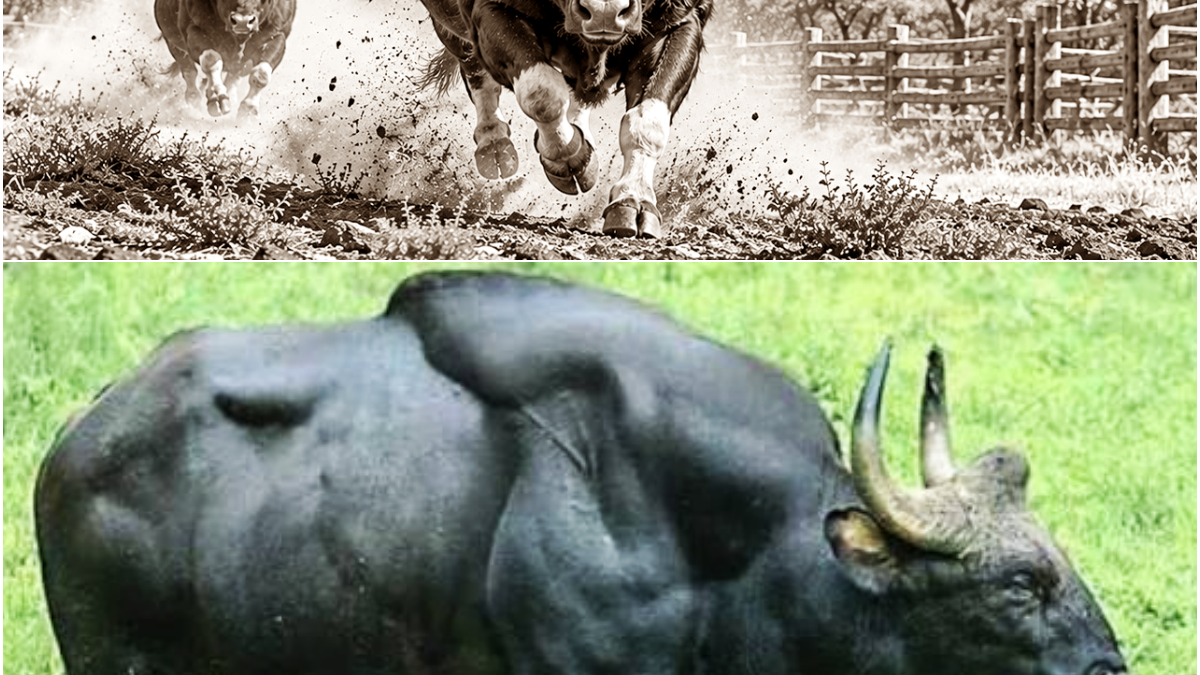
Somewhere in the Texas Hill Country, beyond a two-lane road and a stretch of cedar-covered limestone, an animal stands in the darkness that seems to belong to another world.
Its shoulders rise nearly seven feet above the ground. Its body carries thousands of pounds of muscle, its horns curve outward before turning upward, and its dark coat makes it difficult to distinguish from the shadows around it.
It is not a bison, not a cow, and not any animal most Texans would expect to find in a pasture.
It is a gaur, a giant wild bovine shaped by forests thousands of miles away, where tigers once represented the ultimate test of its strength.
But there are no tigers in Texas. There is only a fence, a ranch, and a set of laws that treat this extraordinary animal as livestock.
Behind that fence, it can be bred, traded, and offered to hunters without the restrictions that govern native wildlife.
The arrangement seems simple enough, until the fence fails. Texas has spent generations building an unexpected collection of animals from distant continents.
Some have remained contained. Others have crossed into the countryside and established themselves beyond the properties where they were introduced.
One of them, the nilgai, has already transformed parts of South Texas. Its story is a warning written across the landscape, but the gaur’s story is only beginning to raise questions.
What happens when an animal built to face a tiger finds itself in a country without one, and what happens if the fence that separates it from the rest of Texas finally disappears?
The gaur is not an animal that can be easily mistaken for ordinary cattle once someone has seen it clearly.
In its native range, it is known as the largest wild cattle species on the planet.
Its natural home stretches across parts of India and Southeast Asia, including forests and hills in Myanmar and Thailand.
It is an animal of wooded country, where thick vegetation can conceal its enormous frame and where a herd can move through the trees with surprising ease.
Its appearance is unmistakable. The coat is usually dark brown, sometimes appearing almost black or blue in certain light.
The lower legs are pale, giving the impression of white stockings. A powerful ridge of muscle rises above the shoulders, creating a hump that makes the animal appear even taller.
Its horns extend outward and curve upward, with pale bases and darker tips. The entire body seems designed around strength, balance, and the ability to defend itself.
A large bull can stand close to seven feet at the shoulder, with the biggest individuals rising a little higher.
That makes it taller at the shoulder than an American bison, the enormous animal that has long represented the wild landscape of North America.
A mature bison bull can reach around six feet at the shoulder and weigh up to a ton.
A large gaur can weigh closer to a ton and a half, with some exceptionally large animals exceeding 3,700 pounds.
The difference is not merely a matter of appearance. A gaur carries a tremendous amount of strength through its shoulders and neck.
Its body is built to move through difficult terrain, climb steep slopes, and cross rivers.
Despite its size, it can move through thick forest with the agility of an animal much smaller than itself.
A herd can travel together, with the adults forming a protective arrangement around the younger animals when danger approaches.
That protective behavior is one of the most important parts of the gaur’s natural history.
In its native environment, the animal evolved alongside predators capable of challenging even a powerful adult.
Tigers are the most significant of those predators. They rely heavily on stealth and surprise, approaching from behind or targeting individuals that are young, old, or already weakened.
A healthy adult gaur is a formidable opponent. Its horns and sheer body weight make a direct attack dangerous.
When a herd senses a threat, the adults can turn toward it, placing their bodies between the vulnerable animals and the danger.
The result is a living barrier of muscle, horns, and heavy skulls. There are accounts of gaur turning on attacking tigers, and the outcome is not always what the predator intended.
The tiger may be an exceptionally capable hunter, but it cannot afford to treat every large bovine as an easy meal.
In the forests where the two species overlap, their relationship is shaped by risk as much as opportunity.
Research into tiger feeding habits in Thailand has shown how important large herbivores are to the predators living there.
Gaur are among the animals that help sustain tiger populations, but the individuals successfully brought down are not necessarily the largest adults.
Reported average weights of gaur killed by tigers have been around 870 pounds, and fewer than half of the animals in one account were fully grown adults.
For a Texas rancher, that detail offers a striking way to understand the animal. Even in the country where the tiger lives, the predator most closely associated with hunting gaur often has to select an animal it can reasonably overcome.
The gaur’s size is not simply an impressive feature. It is part of a defense that has been shaped over an immense period of time.
The animal’s calls can carry long distances through the forest, sometimes reaching a mile and a half during the breeding season.
Its ability to swim and climb adds to its versatility. It can use a range of habitats, from forested hills to areas near water, and its movement is not limited to the open plains that people might associate with cattle.
Yet the gaur’s future in its original home is far from secure. Across Asia, populations have declined under pressure from habitat loss, hunting, and other changes to the landscapes where they live.
The species is classified as vulnerable, and estimates suggest that fewer than 30,000 may remain in the wild, with around 85 percent of those animals found in India.
That creates an extraordinary contraSt. In Asia, the gaur is an animal whose continued survival depends on the condition of its remaining habitat and the protection of wild populations.
In Texas, it can be raised on private ranches as a valuable exotic animal. The same species that faces a difficult future in its natural range can have a commercial value thousands of miles away.
And that difference is part of a much larger Texas story. The state has spent roughly a century becoming an unexpected destination for animals from around the world.
What began as a relatively small collection of unusual species eventually developed into an extensive industry involving private ranches, breeding operations, animal trading, and guided hunts.
The landscape of Texas, especially the Hill Country and the brush country of South Texas, has become home to creatures that would ordinarily belong to Africa, Asia, Europe, or other distant regions.
The scale of the industry is difficult to picture. In 1963, a statewide count identified 13 exotic species and approximately 13,000 animals.
By the late 1980s, the count had expanded to 68 species and more than 160,000 animals.
Today, organizations representing exotic wildlife ranchers describe more than 120 species and well over a million animals spread across thousands of properties.
National Geographic has cited a figure of 125 species, while other estimates vary. There is no single exact number that captures the entire industry.
Different surveys use different definitions, and not every animal or property is necessarily included in every count.
But the broad picture is unmistakable. Exotic wildlife has become a significant part of the Texas ranching economy.
Drive far enough along the back roads of the Hill Country and the unfamiliar can begin to appear ordinary.
A dark shape in a pasture may look like a cow from a distance, until its shoulders seem too high and its body too broad.
An animal with spiral horns may stand near a water tank at dusk. A group of pale or unusually colored animals might cross a field and disappear behind a line of brush before a passing driver can identify them.
For many Texans, such sights are no longer extraordinary. The animals have been present for generations, and people have learned to accept them as part of the countryside.
But the animals themselves have not become native simply because they are familiar to the people who live nearby.
Some of the species found on Texas ranches include blackbuck antelope from India, oryx from North Africa, red deer from Europe, axis deer, aoudad sheep from the Atlas Mountains, and kudu from Africa.
Other properties have kept zebra and giraffe. These animals are bred and traded, sometimes moving between ranches in much the same way that domestic livestock is bought and sold.
A major reason for the trade is hunting. People may be willing to pay substantial sums for the opportunity to pursue an unusual species without traveling to its native range.
The ranch provides the animals, the land, and often the guided experience. In some cases, breeding and sales have also been promoted as a form of conservation, particularly when a species has become rare in the wild.
The scimitar-horned oryx is one example often cited in discussions of the industry. Once considered extinct in the wild, it has been maintained in captive and managed populations, including herds in Texas.
David’s deer, a Chinese species that disappeared from its natural range, also survives through managed populations.
The barasingha, sometimes called swamp deer, has likewise been kept in breeding collections. Supporters of exotic ranching describe this as conservation through commerce.
Their argument is that animals with economic value are more likely to be bred and maintained, and that private ranches can preserve populations that might otherwise be loSt. The industry also supports jobs, particularly in rural areas where employment opportunities can be limited.
But the same arrangement creates a complicated relationship between private ownership and the wider environment.
An animal can be valuable to a rancher while also being capable of escaping into surrounding landscapes.
A species can be carefully managed on one property and become difficult to control if it establishes itself beyond the fence.
That brings the story to one of the most important distinctions in Texas wildlife law.
A native white-tailed deer is treated as wildlife, even when it is standing on private land.
Its management falls under the authority of the state. Exotic animals, by contrast, may be treated as livestock or privately owned animals, depending on the species and the applicable rules.
On many ranches, animals such as gaur, nilgai, and axis deer are held as private property.
That classification has significant consequences. Native wildlife is subject to seasons, bag limits, and other management rules.
Privately owned exotic livestock does not necessarily follow the same system. A ranch may advertise hunts for certain exotic species throughout the year, without the seasonal restrictions that apply to native game.
The arrangement depends on a basic assumption: the animals will remain where they are kept.
Fences are the boundary between the ranch’s private collection and the surrounding countryside. Tall game fencing can help contain animals that might otherwise wander.
Gates and handling facilities make it possible to manage herds, move individuals, and maintain the operation.
As long as the animals remain inside the property, their owners can make decisions about breeding, sales, and hunting.
But fences are not perfect. Floods can damage them. Gates can be left open. Animals can push through weak sections or discover ways around barriers that were never designed for their size or behavior.
And when an exotic species escapes, the consequences can extend beyond the ranch that originally owned it.
Texas has already seen what can happen when an introduced animal establishes itself in the wild.
The clearest example is the nilgai, a large antelope native to India and Pakistan. It is the largest antelope in Asia, with bulls that can weigh 600 to 700 pounds and run at speeds approaching 30 miles per hour.
Its slate-gray coat, long legs, and powerful build make it well suited to the open brush country of South Texas.
The nilgai’s arrival in Texas began with a decision that seemed practical at the time.
The King Ranch, one of the state’s largest and most famous ranches, introduced the animals during the early twentieth century.
The property covers approximately 825,000 acres, an area larger than the entire state of Rhode Island.
A wildlife program associated with Caesar Kleberg brought nilgai from zoological collections to the ranch.
The first releases in 1929 and 1930 involved just 12 animals. The goal was to find a hardy species that could tolerate Texas heat and drought, use the local vegetation, and provide another animal for hunters.
At the time, the modern understanding of invasive species was not as established in wildlife management as it is today.
Bringing in a resilient animal that appeared suited to the environment could be seen as a sensible experiment.
The nilgai seemed to offer several advantages, and there was little reason to imagine that a small founding group would eventually become a widespread population.
The animals did what their biology prepared them to do. They moved, adapted, and reproduced.
They learned to navigate the landscape and pass through ordinary cattle fences. A nilgai can lower its head and push beneath a wire, lifting it enough to move through.
Once it has crossed, the fence can settle back into place, leaving little sign of the passage.
Over time, the population expanded beyond the original ranch. Today, estimates place the number of free-ranging nilgai in South Texas at more than 30,000, with some counts suggesting the real number could be closer to 50,000.
They range from around Corpus Christi toward the Rio Grande, occupying brushland, roadsides, drainage areas, and other habitats.
For residents, the animals have become part of the local scenery. A herd might be seen along a road or grazing near a field, and people familiar with the region may recognize them immediately.
Visitors, however, can be surprised to find a large Indian antelope standing in an American pasture.
The nilgai’s success has also created challenges. In its native range, predators such as tigers help shape its ecology.
In South Texas, there are no comparable natural predators. The animals can thrive in suitable habitat without facing the same pressures that influence their numbers in Asia.
And the nilgai brought another problem into the landscape: cattle fever ticks. Cattle fever ticks can carry a disease that historically caused major losses in American cattle herds.
A federal eradication program began in 1906, and by the 1940s the ticks had been eliminated from most of the United States.
A permanent quarantine zone was maintained along the Texas and Mexico border to reduce the risk of their return.
The nilgai complicated that effort because they can carry the ticks while moving across large areas.
Unlike cattle, which can be gathered and treated, free-ranging nilgai may be difficult to capture and manage.
Their movements can take them across the very boundaries designed to contain the tick problem.
Texas animal health officials have warned that nilgai can carry and spread cattle fever ticks in ways comparable to cattle.
Because the animals range widely and are not easily rounded up, treating them in the field is difficult.
Federal and state agencies have used different control strategies in affected areas, including aerial operations in parts of South Texas.
The story of the nilgai is therefore more than an account of an exotic animal becoming established.
It shows how an introduction intended to improve a ranching operation can eventually create a management problem that extends across public and private land.
And it raises an obvious question about other large exotic species already present in Texas.
If a hardy antelope could move beyond fences and establish a free-ranging population, what might happen if a much larger animal did the same?
The answer becomes more complicated when the animal in question is a gaur. Unlike the nilgai, the gaur is not simply a large antelope adapted to open brush.
It is a massive bovine whose natural behavior developed in forests and rugged country. It has the strength to push through obstacles, the weight to damage weak barriers, and a temperament that can become unpredictable when it is startled or confined.
But there is another example that shows how quickly a fence can stop being a reliable boundary.
In October of 2018, a series of storms settled over the Texas Hill Country and remained there for 10 days.
The rainfall was persistent, and floodwaters rose across parts of the region. On the YO Ranch, one of the state’s best-known exotic wildlife properties, water overwhelmed sections of the fencing.
The ranch covers around 14,000 acres and lies approximately 140 miles west of Austin. It had a long history of keeping exotic animals, and its herds included species that were not native to Texas.
During the storms, the water rose high enough to pull sections of the eight-foot fences down flat.
Among the animals kept on the property were kudu, large African antelope recognized by their long, spiraling horns.
When the fencing failed, the kudu were able to move through the damaged sections and into the surrounding countryside.
The escape demonstrated how quickly an animal collection could become a problem beyond the ranch boundary.
The nilgai had spread over decades, moving through or around ordinary barriers one animal at a time.
The flood did something different. It removed the barrier itself, allowing animals to leave through a wide opening.
For the kudu, the immediate result was freedom to move into unfamiliar territory. For the ranch, it meant dealing with animals that were no longer contained within the property.
And for anyone thinking about the future of exotic wildlife in Texas, it offered a clear reminder that even tall fencing can be vulnerable to conditions no rancher can fully control.
Texas Parks and Wildlife has noted that many exotic animals living in the state were born in Texas, even though their ancestors came from other continents.
But being born in a Texas pasture does not erase the instincts inherited from generations of animals living elsewhere.
A kudu born on a ranch may still react to danger as a wild antelope would.
A nilgai raised in Texas can still have the movement patterns and instincts of an animal adapted to South Asian landscapes.
And a gaur born behind a Texas fence remains a gaur, carrying the physical strength and defensive behavior of its species.
Ranchers who work with exotic animals understand that familiarity does not necessarily mean predictability. Some species can be difficult to handle, particularly when they become frightened or feel trapped.
An animal that has been raised around people may still react suddenly to an unfamiliar sound, an unexpected movement, or the presence of a person too close to its space.
One account from Texas describes a rancher who brought an axis deer into a pen.
The animal was familiar to him, and he had handled it many times. But when it looked toward a fence, it suddenly ran into the barrier at full speed and injured its face.
The rancher treated the injury and later released the deer. But the animal ran into a corner of the fence again and injured itself so severely that it had to be put down.
Afterward, the rancher changed his handling methods, using hoods over the animals’ eyes to help keep them calm.
The incident illustrates how an animal can react in ways that are difficult to anticipate, even when it has been raised and handled by people.
A fence that appears secure to a rancher may become an obstacle that a frightened animal tries to escape at any coSt.
Now imagine the same unpredictability in a creature weighing thousands of pounds. A gaur is not necessarily aggressive toward people.
In its natural habitat, it often avoids humans when it has enough space to move away.
But if it is cornered, injured, startled at close range, or prevented from retreating, its defensive behavior can become dangerous.
Its horns, mass, and strength make it an animal that people should never approach casually.
In its native range, people have lived alongside gaur for generations. Communities familiar with the species have learned to recognize its presence and give it space.
That knowledge is part of the ordinary experience of living in a landscape where large wild animals remain present.
Texas does not have that same history with gaur. Most people would not recognize one in the dark, and even someone who understood that it was a large bovine might not appreciate its size or defensive capabilities.
A person encountering one unexpectedly could mistake it for an unusual cow or a bison, without realizing how different its behavior and strength might be.
A gaur standing in a pasture behind a fence is one thing. A gaur standing on a dark road, beyond the property where it was raised, is another.
A driver might see a dark shape in the headlights and have only a few seconds to react.
A rancher checking a damaged fence might encounter an animal moving through unfamiliar ground. A person responding to an emergency could arrive without knowing that a giant exotic bovine was nearby.
The concern is not that every escaped gaur would immediately become a danger. Many animals would likely avoid people and attempt to find suitable cover.
The question is what happens when an animal with such extraordinary strength is placed in a situation where it cannot easily retreat, and the people nearby have no experience recognizing its warning signs.
There is also the larger ecological question. Could a small group of escaped gaur survive in Texas?
Could they find enough food and suitable habitat? Could they reproduce and establish a population beyond the ranches where they are currently kept?
There are reasons to believe that the answer might be no. The number of gaur in Texas is much smaller than the number of nilgai introduced over the years.
A few escaped bulls would not automatically create a breeding population. The species is associated with tropical and subtropical forests, and its tolerance for certain environmental conditions may differ from that of the nilgai.
Cold weather could be a limiting factor. Texas can experience severe winter conditions, and a sudden freeze combined with limited forage could challenge animals adapted to warmer habitats.
Even South Texas, where nilgai have become established, is not immune to unusual cold events.
But the Hill Country has a different climate and landscape from the southern brush country.
Some areas have wooded hills, streams, and vegetation that might offer suitable conditions for a large bovine.
The region is not identical to the gaur’s native habitat, but the possibility of survival cannot be judged simply by looking at a map.
The nilgai story is a reminder that predictions about exotic animals can be wrong. The first 12 nilgai released in 1929 and 1930 did not look like the beginning of a major wildlife management issue.
Their ability to adapt, move through fences, and reproduce eventually changed the landscape of South Texas.
That does not mean gaur will follow the same path. Different species have different needs, reproductive patterns, and responses to their environments.
But it does mean that the question deserves more than an assumption that an animal will remain contained simply because it has been contained so far.
And there is a second uncertainty: how many gaur are actually present in Texas? Unlike native wildlife, exotic livestock does not necessarily appear in a statewide wildlife census.
Texas Parks and Wildlife manages native species, but privately owned exotic animals fall under a different system.
Their numbers may be recorded by ranchers, breeders, industry organizations, or agricultural authorities, but those records do not necessarily create a complete picture of every animal on every property.
That leaves an important gap. Without a comprehensive count, it can be difficult to know exactly how many gaur are being kept, how they are distributed, or how many might have escaped at some point.
The absence of a public census does not mean that escapes are common, nor does it prove that a free-ranging population exists.
It means that the available information may not be enough to answer every question with confidence.
The same distinction applies to other exotic animals. A rancher may know exactly how many animals are inside a particular enclosure, but that knowledge does not automatically tell the public how many animals exist across the state.
An escape may be reported and resolved privately, or an animal may be recovered before it ever becomes widely known.
This is where the larger debate over exotic ranching becomes difficult. Supporters point to breeding programs, economic activity, and the survival of certain species in managed populations.
Critics and wildlife specialists raise concerns about escape, disease, animal welfare, and the possible effects of nonnative species on ecosystems.
Both the commercial value and the potential risks can exist at the same time. The question is not simply whether exotic animals should exist in Texas.
They already do. The question is how to manage them responsibly, how to prepare for the possibility of escapes, and how to understand the consequences when an animal moves beyond the property where it is privately owned.
The nilgai have already shown that an exotic species can become established and create challenges that extend well beyond the ranch where it was first introduced.
The kudu escape in October of 2018 showed how a natural disaster can undermine even substantial fencing.
The behavior of ranch-raised animals shows that familiarity does not guarantee predictable responses. The gaur brings all of those concerns together in one enormous animal.
It is rare and vulnerable in parts of its native range, commercially valuable in Texas, and physically powerful enough that an encounter outside a controlled setting could be serious.
Yet its exact numbers and distribution in the state are not necessarily visible in the same way as those of native wildlife.
So the scene from the beginning remains possible, even if its future is uncertain. A gaur stands in a pasture in the Hill Country, surrounded by cedar, limestone, and the familiar sounds of a Texas evening.
It is separated from the road by a fence. Beyond that fence are fields, wooded slopes, ranch roads, and properties where people may have no idea that such an animal is nearby.
For now, the fence is the boundary between a private exotic collection and the wider landscape.
But a boundary is only as dependable as the conditions that hold it in place.
A gate can fail. A storm can flood a pasture. An animal can find a weakness that nobody noticed.
And if a gaur ever crosses that line, the first challenge may not be figuring out where it came from.
It may be recognizing what it is before anyone gets too close. The animal was shaped by a world thousands of miles away, where its size and strength evolved alongside predators that no longer exist anywhere near Texas.
Here, it has a different role, a different value, and a different set of risks.
It is a managed animal on private land, but its instincts have not been rewritten by the fence around it.
Meanwhile, the nilgai continue to move through South Texas, descendants of a founding group of just 12 animals.
The kudu that escaped the YO Ranch in the 2018 floods became another reminder that exotic wildlife can move beyond the boundaries people construct for it.
And across the state, other unfamiliar species remain in pastures that look ordinary from the highway.
Most drivers will pass those pastures without giving them a second thought. They may see a dark animal near a water tank, a herd crossing the distant field, or a shape disappearing into the brush.
They may assume it is cattle, deer, or something they have seen before. But sometimes the animal in the field belongs to another continent.
Sometimes its closest relatives live thousands of miles away. And sometimes the story of how it arrived in Texas is only the beginning of a much larger story about what happens when the natural world and human decisions meet at the fence line.
The gaur does not know it is an exotic animal. It does not understand the legal category that makes it livestock, the market that gives it a price, or the debate about whether it belongs in the Hill Country.
It knows the pasture, the herd, the water, and the boundaries it has learned to navigate.
And somewhere beyond those boundaries lies a landscape that was never part of its original world.
The question is whether it will remain a visitor kept behind wire, or whether Texas will someday have to learn what it means to share its countryside with another giant from the forests of Asia.
Disclaimer: This content may be created by Al for entertainment purposes. Any resemblance to real persons, events, or places is coincidental.








