The Fleet’s Most Beautiful Alien Woman Approached Me—And I Forgot How to Breathe
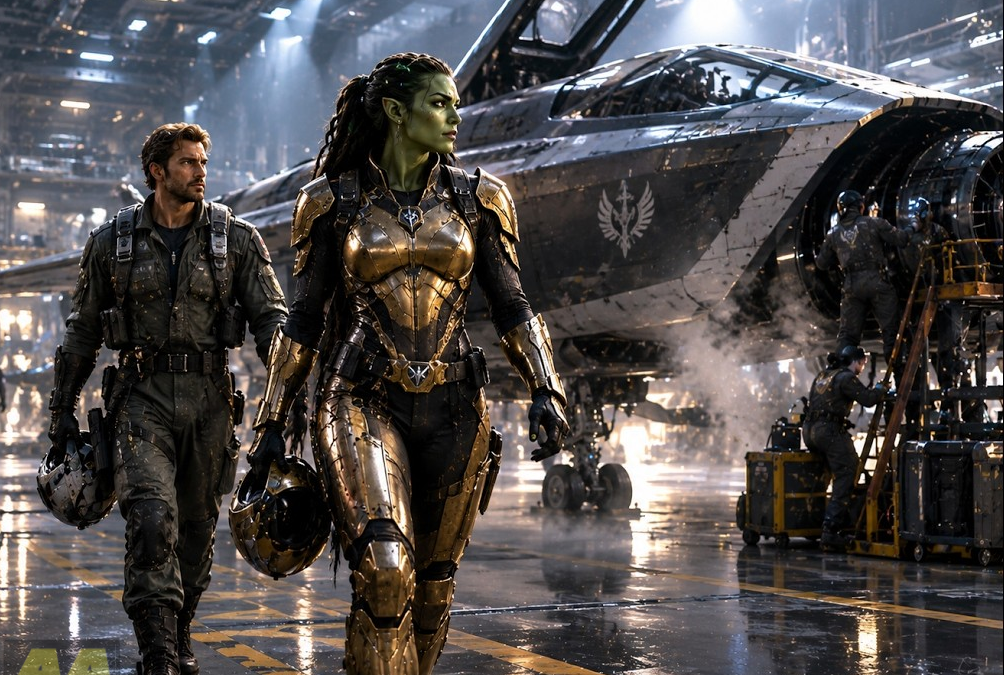
The alarm began before I understood what I was hearing. One moment I was sitting in the mess hall with a bowl of reconstituted stew in front of me, listening to three different species argue about whose turn it was to clean the food processors.
The next moment, the ship lurched hard enough to send spoons sliding across tables. Every conversation stopped.
The lights changed from white to red. Then a voice came through the speakers. “Hull breach.
Deck 11. Contain and seal.” Deck 11 was two levels below me. I was an engineer, not a soldier.
I repaired engines, power couplings, air recyclers, and the old mechanical systems everyone else on the ship considered obsolete.
I had never imagined that those skills might become important during an emergency. I grabbed my tool belt and ran.
The corridor was already filling with crew members moving in the opposite direction. Smoke drifted beneath the ceiling vents.
Warning lights flashed against the metal walls. Somewhere below, something was making a terrible grinding sound.
When I reached Deck 11, I saw the problem. A section of the inner wall had torn open, and atmosphere was escaping through a narrow gap.
The emergency seal had begun closing but had jammed against a twisted support beam. The response team was struggling with the automated controls.
I knew immediately that the system would not solve the problem. Someone needed to use their hands.
I dropped beside the mechanism, opened my tool case, and reached into the damaged panel.
“Come on,” I whispered. “Work with me.” I had no idea that ninety seconds later, when the seal finally slammed shut, my life would begin changing.
Three days later, the entire hangar would fall silent when the most admired diplomat in the fleet walked toward a human mechanic nobody important had ever noticed.
And why would she cross an entire hangar just to find me? The emergency seal locked with a sound that seemed to shake the entire corridor.
For several seconds, nobody moved. Then the pressure readings stabilized. The red warning lights continued flashing, but the terrible hiss of escaping atmosphere was gone.
I remained on my knees beside the damaged panel, staring at the manual bypass I had just improvised.
My hands were shaking. I had burned my wrist. My knees hurt from the metal floor.
And I was trying to understand how something as simple as an old fuse could have become the most important object on Deck 11.
A broad shouldered officer with pale blue skin grabbed my shoulder and pulled me upright.
“You did that manually?” I looked at him. “I think so.” He stared at the panel.
Then he stared at me. “I did not know humans still repaired systems like that.”
“Most of us do not.” The officer said something into his communicator. Other members of the response team began talking at once.
I heard my name mentioned several times. That bothered me more than the alarm. I had never been particularly interested in attention.
On a fleet ship carrying dozens of species, humans were respected, but we were not considered exceptional.
Our technology was reliable, our engineers were useful, and our adaptability had helped us earn a place in the fleet.
But compared with some of the founding species, human engineering looked primitive. Other civilizations had developed systems that could diagnose themselves, repair themselves, and communicate with every surrounding machine.
Humans still carried tool belts. We still used physical switches. We still kept spare fuses.
We still trusted mechanisms that could be understood by someone willing to open a panel and look inside.
Usually, people found that amusing. That night, nobody was laughing. I filed the incident report, visited the medical station to have my wrist treated, and returned to my bunk.
I expected nothing else to happen. By the next morning, the incident had already become a story.
By the afternoon, people I had never spoken to were asking if I was the engineer who had manually closed the Deck 11 seal.
I kept telling them that anyone could have done it. That was not entirely true.
Most of the fleet could have repaired the system eventually. The problem was that eventually had not been good enough.
The ship moved on. So did I. For three days, everything seemed normal. Then I walked into the hangar.
I was halfway through a diagnostic on a shuttle engine when I noticed that something had changed.
The hangar was usually loud. Engines hummed. Repair drones moved between vessels. Crew members shouted across work platforms.
Someone was almost always arguing about spare parts. That morning, however, the noise gradually disappeared.
One conversation ended. Then another. A group of technicians stopped working. I lifted my head.
People were looking toward the entrance. Then I saw her. I had heard about the diplomat before I ever saw her.
Everyone had. She came from one of the founding species of the fleet, a civilization whose influence stretched across hundreds of worlds.
Her people were known for their advanced technology, their diplomacy, and a culture that had inspired generations of artists.
She was also famous. Not in the way human celebrities were famous. Her name appeared in diplomatic reports, scientific journals, historical archives, and broadcasts across the fleet.
When she entered a room, people noticed. Her skin carried a faint glow that seemed to shift beneath the surface when she moved.
Her eyes were a deep violet, and the expression she wore was calm enough to make everyone around her seem nervous.
She walked directly toward me. I looked behind myself. There was nobody there except Owen, who was holding a wrench and suddenly seemed very interested in the floor.
I looked back. She was still coming toward me. My first thought was that I had somehow made another mistake.
My second was that perhaps she had mistaken me for someone else. Then she stopped in front of me.
“You are the engineer who repaired the Deck 11 seal.” It was not a question.
“Yes, ma’am.” I immediately regretted saying ma’am. She tilted her head. “I need your assistance.”
I glanced around. Several officers were watching. Owen had moved three steps farther away. “With what?”
“There is a relay station near the outer ring.” I wiped my hands on a cloth.
“What happened?” “It lost power.” “That happens.” “This is different.” She brought up a holographic display.
A small structure appeared in the air between us. “The station contains four crew members.
They were unable to restore the primary systems before the external network failed.” I studied the image.
“How long?” “Less than six hours of air remain.” I straightened. “Why has nobody opened the station?”
“My engineers attempted to activate the access system remotely.” “And?” “It does not respond.” “Can you override it?”
“We attempted that as well.” I looked at the diagram. “What kind of door?” “Mechanical.”
That explained everything. I looked at her. “You need someone who can operate it manually.”
“Yes.” “You want me.” “Yes.” The hangar seemed strangely quiet again. I stared at the relay station diagram.
The door was old. Very old. It used a mechanical locking system with physical pressure points, a manual release wheel, and a secondary fuse assembly.
Most modern species would consider such a design inefficient. Humans considered it familiar. “When do we leave?”
“Now.” She turned. I grabbed my tool belt. Owen caught my arm as I passed.
“Do you know what you just agreed to?” “Apparently.” “You are going with her.” “I noticed.”
He lowered his voice. “That is the diplomat.” “I know.” “No, I mean the diplomat.”
I looked at him. “I know.” Owen shook his head. “I do not think you understand.”
“I probably do not.” I followed her toward the shuttle. The flight to the relay station took twenty three minutes.
During the journey, she sat across from me while the ship’s navigation system projected the route between us.
I examined the schematics again. “You said your engineers could not bypass the door.” “They could not.”
“What did they try?” “Remote commands.” “Of course.” She looked at me. “Why do you say that?”
“Because it is a mechanical system.” “You say that as if the answer is obvious.”
“It is.” She studied me for a moment. “Your people still use physical controls.” “Yes.”
“Why?” I shrugged. “They work.” For the first time, I saw the faintest smile. “That is a surprisingly simple answer.”
“I am a surprisingly simple engineer.” “I have heard otherwise.” “From whom?” “Several people.” “That is worrying.”
She smiled again. The shuttle reached the relay station. The structure floated against the dark background of space, connected to the outer ring by a narrow service corridor.
We docked. The station’s internal systems were almost completely inactive. Emergency lights flickered along the walls.
The air was warm and stale. We found the access door. I knelt beside the control housing.
She stood behind me while two engineers watched from the corridor. I opened the panel.
“Do not touch anything.” One of the engineers looked offended. “I know how to operate a control system.”
“This is not a control system anymore.” I pointed at the wiring. “It is a machine.”
He stared at the exposed components. I could almost hear him wondering why anyone would build something so complicated.
I understood it immediately. There were three damaged connectors. One fuse had failed. The manual release was locked by pressure from a bent support bracket.
The entire system had been designed to keep operating even if the network disappeared. That made it old.
It also made it useful. I removed the damaged fuse. “Give me a replacement.” The diplomat handed me one.
I looked at her. “You carry mechanical fuses?” “We brought equipment after reviewing your report.”
That surprised me. “You prepared specifically for this?” “Yes.” I installed the fuse. Then I loosened the manual release.
The mechanism moved halfway. Stopped. I pushed harder. Nothing. I looked at the support structure.
“Someone get me a lever.” One of the engineers stared at me. “A lever?” “Yes.”
He looked confused. I pointed. “That metal rod.” He brought it over. I positioned it beneath the support bracket.
“On my count.” The diplomat moved closer. “Do you need assistance?” “I need you to tell everyone to stand back.”
She immediately gave the order. Everyone moved. I pressed down. The bracket shifted. The door mechanism released.
The access door opened. Air rushed into the corridor. A moment later, four exhausted crew members appeared from inside.
They were alive and conscious. The station crew had spent hours waiting for the door to open.
When they realized it had, they began talking over one another. The diplomat closed her eyes briefly.
Then she looked at me. “Thank you.” I shrugged. “I fixed a door.” “You did more than that.”
“I really did not.” She stepped closer. “You solved a problem that our most advanced systems could not solve.”
I looked at the old mechanism. “It was not advanced.” “That was the point.” Her expression changed.
“Our people built systems that can think alongside us. We became so dependent on them that we forgot the value of machines that simply wait for someone to operate them.”
I smiled. “Humans never got that far.” She looked at me. “Perhaps that is why your people were invited into the fleet.”
The return trip felt different. The four rescued crew members were resting in the rear section.
The diplomat sat beside me. For several minutes, neither of us spoke. Then she asked something I had not expected.
“Do humans always celebrate successful missions with food?” “Usually.” “What kind?” “That depends.” “On what?”
“Whether the mission went well.” She considered that. “This mission went well.” “Very well.” “Then I would like to experience this human tradition.”
I looked at her. “You want to have dinner?” “I want to understand why humans use meals to celebrate.”
I smiled. “Then I know a place.” We ate in the ship’s small dining area that evening.
There were no officials. No ceremony. No formal speeches. Just two plates of food and a quiet table beside a window.
She tried human bread. She disliked it. She tried a fruit drink. She liked it.
She asked about Earth. I asked about her home world. We talked for hours. Eventually she told me that she had spent most of her life surrounded by diplomats.
“I have never had dinner with a mechanic before.” “I have never had dinner with a diplomat before.”
She smiled. “Then we are both learning.” After that night, things became complicated. Not unpleasant.
Just complicated. She began visiting the engineering section more often. Sometimes she had legitimate reasons.
Sometimes she did not. I started noticing that. So did everyone else. Owen noticed firSt.
One afternoon he leaned against a maintenance console. “She is here again.” I kept working.
“I see that.” “She has visited this section six times this week.” “I know.” “She has spoken to you every time.”
“I know.” “She does not speak to anyone else.” I tightened a coupling. “Owen.” “Yes?”
“Go away.” He laughed. The diplomat arrived a few minutes later. She was carrying a small device.
“I need your opinion.” “About what?” She handed it to me. “It stopped working.” I examined it.
“This is a personal communication device.” “Yes.” “You could have taken it to communications.” “I could have.”
I looked at her. “You came here because you wanted to see me.” She did not answer immediately.
Then she smiled. “Yes.” That was the first time I understood that whatever was happening between us was not entirely one sided.
Still, there was something I did not understand. She was important. I was not. She had access to rooms where people discussed decisions affecting entire worlds.
I spent most of my day under engines. Our lives could not have been more different.
One evening, I
Disclaimer: This content may be created by Al for entertainment purposes. Any resemblance to real persons, events, or places is coincidental.








