The Dragon Refused to Fight — Then She Learned Why the Enemy Wouldn’t Shoot Him
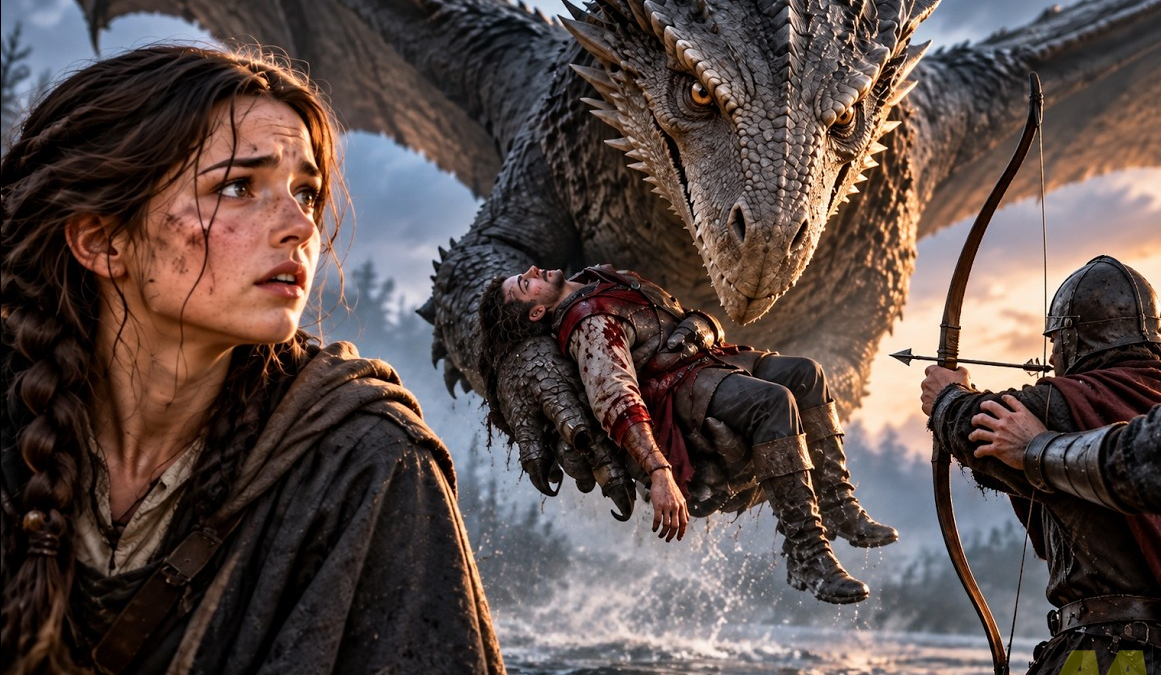
The gray drake came out of the smoke with a man hanging from its forefeet, and for one impossible moment Marin thought the creature had finally chosen a side.
Then she saw where it was going. The drake flew low over the Cold Fork, its wide wings barely clearing the reeds, its shadow sliding beneath it like a second creature racing through the water.
A stranger hung limp beneath its cheSt. On the opposite bank, men raised bows. On the Ashen side, Sergeant Ule shouted for the line to be ready.
Nobody knew whether the animal was bringing a prisoner, a wounded soldier, or something neither army had a word for.
Marin ran down the bank. Her medical bag struck her hip with every step. Water filled her boots.
The drake touched down in the shallows and lowered its burden into the reeds with extraordinary care.
Then it lifted its head and watched her. Its eyes were amber, narrow, and calm.
Behind Marin, men came running with a harpoon line. “Get that thing up the bank,” Ule shouted.
The drake turned its head toward them. Marin looked from the animal to the stranger lying at her feet.
She had perhaps three breaths to decide what mattered. The drake opened its wings. Water rose from the shallows in a flat silver sheet.
And as the creature disappeared north along the river, Marin finally understood that the question was not whether the gray drake could be trusted, but whether anyone at Ashen Post had ever understood what it was trying to do?
Marin dropped to her knees beside the stranger. The man was young, perhaps seventeen, wearing a wet wool coat with the collar turned beneath his neck.
His clothing marked him as one of the Vetch, but the injury did not care which uniform he wore.
His left leg was badly damaged below the knee, and the lower part had twisted beneath him at an angle that made Marin’s stomach tighten.
“Hold him still,” she ordered. Nobody moved. “Now.” Two soldiers stepped forward. Marin cut the trousers open to the knee and pressed both hands around the injured leg.
The boy’s face had already gone pale. “Take your belt off.” A soldier hesitated. “Yours,” Marin snapped.
He understood and handed it over. Marin twisted the belt above the injury and tightened it until the boy’s breathing changed.
He cried out once, thin and startled, then went silent. “Four men,” she said. “Take him to the surgery tent.
If you drop him, you’ll be carrying the rest separately.” That finally moved them. Ashen Post stood on the western bank of the Cold Fork with the quarry road behind it and the river below.
A wooden stockade enclosed two barracks, a granary, several pens, and a stone bastion at the southern corner.
A ballista rested beneath a tiled roof. There were 61 men fit for duty that week and nine others assigned to lighter work because of illness or injury.
The valley beyond them had become strangely quiet. Fields stood unharvested. Villages kept their doors closed.
The war had taught everyone nearby that an open door was an invitation to trouble.
Marin had been at Ashen for 5 months. She was the only physician between Ashen and Kell.
Inside the surgery tent, she removed the boy’s clothing and examined what the river and the fighting had left behind.
A spear wound crossed his left hip. His shin had suffered a compound fracture. His boots were patched at the heels, and a small piece of red thread had been sewn into his collar.
Someone had cared enough to repair his coat. Marin noticed everything. She always did. Desa, the laress who worked beside her, held the lamp.
Marin washed the injury with boiled water and vinegar wine. She removed three small fragments of bone and a piece of wool that had been carried into the wound.
Then she and Desa straightened the leg as carefully as they could and secured it between two wooden splints taken from an old cider barrel.
Marin counted each stitch aloud. “Seventeen. Eighteen. Nineteen.” The tent flap opened. Captain Cade stood there with a ledger under his arm.
“Don’t stop,” he said. Marin did not look up. “Is he a prisoner or a patient?”
Cade asked. “He’s a boy with a broken leg,” Marin replied. “Ask me again in three days.”
Cade studied the stranger. “Write that the gray drake brought in a Vetch frier’s son with his shin in two pieces.
Write that the post physician repaired it. Let the men at Kell argue about what they want to call him.”
Marin tied the final stitch. “Captain.” “Yes?” “He was carrying one of ours firSt.” Cade’s attention sharpened.
“Who says so?” “I saw him.” Marin straightened. “He carried someone over from the ford, put him in the reeds, and went back.”
Cade opened the ledger. “Sergeant Ule says the drake broke from the wing during the action and put itself between our line and theirs.”
“Did it?” “Twice.” “Did it burn anything?” “No.” Cade paused. “He has never burned anything in 2 years and 4 months.”
He closed the ledger and left. That night Marin went to the northern pens. Three stone stalls stood beneath timber rafters.
Hesper occupied the largest, a heavy red brown burner whose handler sat nearby cleaning the scales beneath her jaw.
The gray drake occupied the far stall. Marin raised the hood of her lantern until only a narrow line of light escaped.
One amber eye appeared in the darkness. Then the rest of him emerged. Vero was 27 ft from nose to tail, broad through the chest, low to the ground, and built with the heavy strength of a quarry animal.
His skin was gray green, patterned with pale markings along the flanks. His feet were enormous, each with three thick toes and a padded sole.
His left wing carried an old injury. Near the elbow, part of the membrane had healed into a pale puckered scar.
Someone had written a word on the stallpoSt. Hen. “Charming,” Marin murmured. Vero made a deep sound.
It was so low that Marin felt it through the wooden rail before she heard it.
“That’s him settling,” a voice said. An old man emerged from behind the pens carrying a fork.
Oddson had one eye that was cloudy and another that remained sharp. “I do the feeding,” he said.
“You’re the leech.” “Marin.” “Moranvas.” He pointed at Vero. “Shale Drake. Dusktock. Put a torch in front of one and he’s nearly blind.”
“Is that why he flies at last light?” “That’s why he flies at last light.”
Oddson leaned against the fork. “Nobody’s asked me that in 9 years.” He explained that Vero had come from the Valanc quarries, where shale drakes were bred to move enormous blocks of stone.
They could lift weights from quarry floors and place them on sledges without damaging the stone.
They were workers before armies discovered that their strength could be useful in war. “Before the levy,” Oddson said, “there were nine shale drakes on that ridge.
I had four. A drake doesn’t need much teaching to lift. It needs someone to understand when it wants to lift.”
Marin watched Vero. “Who taught him to rescue people?” “Nobody.” Oddson smiled without humor. “You can teach a drake to lift.
You can teach one to carry. You can teach one to wait. You cannot teach it who deserves carrying.”
Marin remembered that sentence. The next morning, Master of Drakes Halverstein filed the complaint. He did it in front of the wing during morning muster.
The charge was simple. Vero had refused engagement on 19 recorded occasions in 2 years and 4 months.
He had broken formation 11 times. During the action at Salow Ford on the 11th day of the 9th month, he had abandoned his assigned position and left the right side of the line exposed.
A pikeman had been lost in the resulting confusion. Halverstein recommended that Vero be removed from the rolls and rendered at Kell.
The decision would be final in 16 days unless the provost intervened. Marin found Captain Cade in the counting room.
“Sixteen days,” she said. “Fourteen.” “Really?” “The paperwork goes south Tuesday.” “Then argue before Tuesday.”
“With what?” Marin placed both hands on the table. “The muster rolls. The casualty book.
The sick lists. Everything going back to the spring before laSt.” Cade looked at her.
“You’ve been here 5 months.” “I know.” “You’ve seen one battle.” “I’ve seen enough.” “Doctor, a wing exists because men trust the creature above them to stay above them.”
“Then count what the creature has actually done.” Cade stared at her for a long moment.
“I can’t remove the rolls from this room.” “Then I’ll work in this room.” He pushed a stool toward her.
“Fine.” That was how it began. Marin spent the next several nights with the books.
She found Oddson firSt. She found old records from the Valanc quarries. She found reports from the Eastface collapse.
She found references to shale drakes carrying men out from beneath fallen stone. Then she found the rescue records from Ashen.
They were incomplete. But they were enough. On the eighth day, she began working directly with Vero.
Oddson taught her the K, the hand language used by quarry handlers. Two taps against the shoulder plate meant lift.
One long stroke meant set down. A flat palm held in place meant wait. Three quick taps meant come.
A closed fist against the jaw plate meant no. Everything else was tone, posture, timing, and knowing when to remain silent.
The first time Vero tapped his jaw with the back of his wrist, Marin looked at Oddson.
“He wants the fish.” “He wants you to know he wants the fish.” She tossed a river chub toward him.
He caught it. When the bucket was empty, he lowered his head until his eye was level with Marin’s knee.
She stood there for half an hour before he allowed her to touch the side of his jaw.
His skin was warm and dry. He smelled faintly of wet slate and smoke. When she moved toward his injured wing, Vero folded it and turned away.
Marin stopped. She did not force him. Three days later, he allowed her to remove a thorn from his forefoot.
That was the beginning. The injured boy woke on the third day. His name was Joris Vend.
He was 17. His father ran the ferry at Howlet, although the ferry itself had been taken by the army.
Joris asked three times whether he would be punished. “Not after I spent an hour and a half repairing you,” Marin told him.
“That would be wasteful.” He laughed. Then he cried. Then he slept. On the fifth day, Marin asked about Vero.
Joris stopped whittling. “Fairy man,” he said. He struggled for the trade word. “The gray one.
He does not burn.” Marin leaned closer. “My uncle at Salt Marsh. In spring. He was lying in the water at the crossing.
The gray one came down and carried him to the bank.” “Where is your uncle now?”
“Kell.” “Alive?” Joris nodded. Then he pointed toward the river. “Our captain gives order. Nobody shoots the gray one.”
Marin stopped breathing for a moment. “Why?” Joris searched for the words. “It is a bargain.”
He held up one finger. “He brings ours out.” Then another. “We do not harm him.”
“He brings both sides?” Joris nodded. “The fairy man works both banks.” That night Marin wrote everything down.
She carried the page to Cade. He read it twice. Then he lowered his head into his hands.
“Do you understand what you’ve brought me?” “Evidence.” “A sworn statement that the enemy protects one of our drakes.”
“He isn’t one of theirs.” “That isn’t what the paperwork will say.” Cade looked at her.
“The charge against him is unreliability. What you’ve found makes it look like cooperation with the enemy.”
“Then count the reSt.” Marin pulled the casualty book toward herself. “Nobody can argue with arithmetic.”
They worked four or five nights out of seven. Every rescue Vero had made was matched against the sick lists and muster rolls.
Every entry was traced. Every missing name was found. Bevel, who worked in stores, remembered waking beside the pens after being carried from Salow Ford.
“I didn’t see him do it,” Bevel said. “Then how do you know?” “I woke up owing him.”
“Owing him what?” Bevel shrugged. “My life.” Marin recorded the statement. By the tenth day, the numbers were clear.
Vero had carried 39 men from fields and crossings during his 2 years and 4 months at Ashen.
Twenty seven were still alive a week afterward. Nineteen had worn the crown’s coat. Eight had worn Vetch colors.
The records showed that the injuries of the others had been beyond what the post could repair.
Marin did not separate those names. They all belonged in the same column. Then she added the event at Salow Ford.
The right side of the line had already begun falling back when Vero broke away.
Sergeant Ule’s own report said so. Cade read the page. “You’re putting that in yourself.”
“If I leave it out, Halverstein will say it for me.” Cade rubbed his eyes.
“He has numbers too.” “Then let both sides be counted.” On the eleventh day, Marin confronted Halverstein.
He listened without interrupting. Then he told her about another drake he had handled 9 years earlier.
The creature had abandoned its position to rescue a fallen handler. It had never returned.
Halverstein had lost two fingers trying to pull it back. “I know exactly what Vero is doing,” he said.
“Then why condemn him?” “Because I know what happens when everyone decides his judgment is better than the commander’s.”
Marin watched him. “You don’t hate him.” “No.” “You’re afraid of losing him.” Halverstein looked away.
“I’ve already lost one.” That was the closest thing to an explanation she received. On the 16th day, fighting broke out at the ford.
Marin watched from the granary roof. Hesper rose firSt. Vero remained on the ground until the burner had passed.
Then he took the river route. He flew north along the west bank, staying below the wall, avoiding the southern spur.
Oddson explained why. “An old harpoon went through his wing there 18 months back.” “That’s why the notch is there?”
“That is why the notch is there.” “Why does he still avoid it?” “Memory.” That afternoon, Vero carried four men from the fighting.
Three wore crown colors. One wore Vetch colors. The archers on the opposite bank watched him pass.
None raised a bow. Marin saw it. Cade saw it. Everyone saw it. Then the order from Kell arrived.
Vero was to be rendered. The wagon came on the 24th, two days earlier than expected.
It was long and flat, with iron fittings and a heavy canvas cover. Vero would not approach the side of the stall where it stood.
Marin counted her savings that night. She had 61 crowns. Three years of work. She carried the money to Cade.
He looked at the bag and immediately understood. “No.” “You don’t know what I’m going to say.”
“I know exactly.” “I can buy him.” “You will put yourself in the same record as a physician attempting to purchase a condemned crown animal.”
“Then what do I do?” Cade was silent. “There is a way to delay the order.”
“What way?” “A provost can reclassify an animal if the commanding officer requests it.” “Under what category?”
“There isn’t one.” “Then create one.” “I cannot.” “A provost can.” Cade looked toward the rain-dark window.
“Colonel Varn is at Kell.” “Then write to him.” “I already have.” Marin understood. “What did you ask for?”
“Winter grain.” “How much?” “Two hundred sacks.” “And?” “He will make one allocation.” Marin looked at him.
Cade picked up his pen. “I’ll find another way.” The rider went south on Tuesday.
Three days later Marin learned that Cade had withdrawn his grain request and replaced it with a petition for a new service classification for drakes used in casualty carriage.
He had spent his favor. He had given up the grain. The answer arrived on the 27th.
It was not enough. The new classification had not yet been approved. Then the rain began.
It fell steadily through the 26th, and by the 28th the Cold Fork had risen two feet.
Oddson inspected it twice a day. “There’s too much water behind the old weir,” he warned.
Cade had already moved the low pickets. The weir gave way at ten minutes past six on the morning of the 29th.
The river came through the valley like a moving wall. It swept over the flats and cut a new channel around Harrow 8, an island about 120 yards below the ford.
There were 11 men stranded there. Five were from Ashen. Six were Vetch. The river rose faster.
There was no ferry. The old punt had been destroyed days earlier. They tried ropes.
The current tore them loose. They tried a hurdle. It broke away. Marin watched a man on Harrow 8 remove his coat and place it over another person lying on the stones.
Then she turned toward the pens. Oddson already had the old quarry harness. It had been kept for 9 years.
Forty pounds of hemp and leather. “Vero can carry one person,” Oddson said. “One at a time.”
“Then we take them one at a time.” “He’s been on the chain 6 days.”
“I know.” “He may not fly again.” “I know.” Oddson handed her the harness. “Then get it on him.”
Halverstein stood outside Vero’s stall with a crossbow. “The order says he remains chained.” Marin looked at him.
“Then shoot me.” He stared at her. She took the chain off. Vero rose. He stretched his hind legs.
Then both wings unfolded. The damaged left wing trembled as it opened. Marin placed her hand against his jaw.
“I know.” Vero made the deep millstone sound. “Come on.” By the time they reached the ferry steps, Cade had gathered twelve men.
Joris Vend was there on a handcart. He carried a white cloth on a pole.
Across the new channel, Vetch soldiers waited among the willows. Cade handed the cloth to Joris.
“Tell them there is a truce until the island is clear.” Joris shouted across the water.
He had to repeat himself. At last, the Vetch officer raised one hand. Their bows lowered.
“They agree,” Joris said. Then he looked toward Vero. “The fairy man works both banks.”
Halverstein went firSt. He climbed into Vero’s harness. Marin gave two taps. The drake launched.
He flew low over the flooded ground and crossed toward Harrow 8. Within minutes, he returned without Halverstein.
Then he went again. For nearly two hours, Marin directed the rescue. She stood waist deep in the water at the ferry steps.
Each time Vero returned, she caught the rescued person as they descended. She checked breathing.
She checked their eyes. She called each name to the men on the bank. Then she looked back toward the island.
The order mattered. One man with a severe thigh injury went firSt. A second with a crushed chest came next.
Then those unable to stand. The stronger men waited. Nobody argued with her after the first crossing.
Vero made seven trips. On the seventh, an archer who had not received the truce signal loosed a single arrow.
It fell short. Vero shied. His left wing dipped. The person beneath him swung dangerously close to the water.
Marin felt the whole rescue turning toward disaster. Vero did not release the man. He beat his wings three times and climbed.
Then he came down so low that his belly nearly touched the river and placed the man directly into Marin’s arms.
Vero rose onto the grass. His sides heaved. He would not move. Marin walked toward him.
She did not touch him. She stood where he could see her and waited. Two minutes passed.
Vero tapped his jaw twice. Marin placed her palm against his shoulder. Two taps. He returned to the river.
He carried the final four people in eleven minutes. Halverstein was laSt. Vero came back almost without lift.
The damaged wing struck the water. The old injury opened along the scar. He landed hard in the shallows.
Marin and three men pulled Halverstein free. Then Marin saw the wing. “Hold him.” Vero stood still.
Oddson spread the damaged membrane. Cade knelt in the water beside Marin and held the lamp with one hand.
She worked for an hour and ten minutes. Forty one stitches. Vero never moved. His amber eye remained open.
“Why doesn’t he move?” Cade asked quietly. “Because he has decided not to.” Marin pulled the final thread tight.
“Hold the light still.” Eleven men came off Harrow 8. Ten were still alive a week later.
The Vetch sent a messenger that afternoon under a white cloth. He carried onions, cheese, and a written message.
Joris translated it. The truce would end at dark. But the gray drake had free passage whenever he crossed the river.
On the first day of the 10th month, Provost Hen arrived. Halverstein read the original condemnation.
He read every line. Then he folded the paper. “I withdraw it,” he said. Hen looked up.
“On what ground?” “The conclusion is wrong.” “Not the facts?” “No. The facts are correct.”
Halverstein looked toward Vero’s stall. “I called him unreliable. I was wrong.” Marin presented the tally.
She read every column. She read the quarry records. She explained what shale drakes had been bred to do long before armies had placed them on military rolls.
Then she said the sentence she had been building toward for nineteen days. “He isn’t refusing to fight, sir.
He’s doing his work. We put him on the wrong roll and then punished him for not being what we wrote down.”
Provost Hen listened. Then he removed a document from his case. “Colonel Varn has authorized a trial classification.”
Cade went still. “Lift class one.” Hen placed the paper on the table. “One year.
Quarterly reports. Drakes employed in the carriage of wounded from a field of action.” He looked at Cade.
“Your letter helped.” Cade said nothing. Hen smiled faintly. “Colonel Varn adds a private note.”
He handed Cade another paper. Cade read it. His expression changed. “What does it say?”
Marin asked. “He says this is the favor he owed me.” Halverstein stepped forward. “Then Vero is no longer a burner?”
“No.” Hen wrote in the ledger. “Lift class one. Number one.” Then he turned toward Marin.
“There is another matter.” She waited. “The crown now has an animal requiring a physician.”
Marin glanced toward Vero. “Nobody at Kell knows how to write that warrant.” Hen produced another document.
“So I wrote one.” He placed it before her. “Drake leech’s warrant. Under the seal.”
Marin took it. “Thank you.” “Surgeon Marsh will complain.” “Let him.” Four days later, Joris Vend returned across the ford under a white cloth.
His leg was secured in a splint. Marin had written instructions for whoever would care for him at Howlet.
Before he left, Joris handed her a small willow disk. “One for cross,” he said.
He raised the disk. “You come again. My father takes you over.” “I will.” He crossed the river.
Marin watched until he disappeared among the reeds. That evening she found Cade beside Vero’s stall.
The drake was resting with his damaged wing spread over the straw. “The position at Kell is still open,” Cade said.
Marin looked at him. “Staff poSt.” “You’re leaving?” “I was offered it.” “And?” “I refused.”
“Why?” Cade smiled. “Because I would rather write quarterly reports on a trial classification with you.”
Marin laughed. “That is your proposal?” “It is accurate.” “It’s terrible.” “I know.” She stepped closer.
“I was going to stay anyway.” “I know.” Cade looked at her for a long moment.
“I have never thought of you as someone who needed rescuing.” Marin took his coat in both hands and kissed him carefully on the side where his shoulder was not strapped.
Vero watched. From around the corner came Oddson’s voice. “I knew it.” They separated. Oddson appeared with his fork over one shoulder.
“Knew what?” “That drake was smarter than all of you.” Cade laughed. The wing took nine weeks to heal.
Marin kept Vero grounded through the rest of the 10th month and all of the 11th.
He hated it. He showed her by dropping river chub at her feet. He showed her by tapping his jaw whenever another drake passed overhead.
Twice he climbed the launch slope at night and waited there until Marin came outside and ordered him back down.
She removed the stitches in three sittings. The scar followed the old harpoon mark like a narrow river branching from another river.
Vero never regained all of his former lift. He could carry one person. Only one.
Only from level ground or water. Halverstein insisted that the new classification be written precisely.
Vero was not a combat drake. He was a lift drake. That distinction changed everything.
The first snow came on the ninth day of the 12th month. The valley became quiet.
The ballista from the southern bastion was sold. The wing ate barley bread and complained about it.
Cade remained at Ashen. The winter fighting came twice in the 12th month and once in the first month of the new year.
After each clash, the bell on the northern wall rang twice. Men no longer rushed to the pens with chains.
They went to the ferry steps with a harness and a stretcher. Vero flew again on the 16th of the 12th month.
Snow was falling at dusk. Marin stood on the granary roof beside Oddson. The old man watched the gray shape rise from the yard.
“The left shoulder is still dropping,” he said. “I know.” “It always will.” “I know.”
Oddson was quiet. Then he smiled. “Still flies.” Vero climbed only a little. He followed the western bank, low beneath the wall.
The southern spur no longer mattered. There was nothing left there that he needed to avoid.
He crossed the river in the fading light. Then he returned. A man hung beneath his forefeet.
Gray wool. Vetch clothing. Unconscious but breathing. Vero came down through the snow and landed in the reeds below the ferry steps.
Marin ran down the bank. Her boots filled with cold water. She reached the shallows and placed both hands beneath the stranger.
Vero lowered his burden carefully. Then he stood in the water. Snow settled across his gray green back.
His amber eye followed Marin. Behind her, Cade and the others came running. Nobody reached for a chain.
Nobody shouted. Nobody raised a weapon. Marin knelt beside the stranger and opened her medical bag.
Vero remained where he was. For the first time since she had arrived at Ashen Post, Marin did not wonder which side the gray drake belonged to.
She understood now. He belonged to the work. And as the snow thickened over the Cold Fork, Vero lifted his head toward the darkening river, waiting for the next person who needed carrying home?
Disclaimer: This content may be created by Al for entertainment purposes. Any resemblance to real persons, events, or places is coincidental.








