The Dragon Crashed Through the Temple Roof, Bleeding From Iron Arrows — She Alone Didn’t Flee at All
The first arrow struck Emperor Ronin high above the border ridge, piercing the delicate webbing of his left wing before the sound of the bowstring reached him.
For one suspended instant, the autumn sky remained bright and empty around him. Then pain tore through his body, his flight broke, and the mountains tilted beneath his feet.
He had spent eleven years patrolling the frontier, learning to recognize danger in every suspicious silence and every unfamiliar shadow.
Yet House Veil had concealed its soldiers so carefully that even his instincts had failed him.
A second arrow drove between the armored scales of his shoulder. A third struck his flank, and the roar that escaped him rolled across the mountains like thunder announcing an approaching storm.
Below, crossbowmen emerged along the ridge, their dark clothing blending with the stone as they prepared another volley.
Ronin folded his uninjured wing and plunged beneath their line of fire, fighting the terrible weakness spreading through his limbs.
He needed shelter, somewhere beyond their reach, somewhere his enemies would never think to search.
Through the pain came the faint scent of pine, cold stone, and inexpensive temple incense.
It was the scent of an old shrine hidden among the trees, a place where forgotten prayers still lingered beneath a weathered roof.
He had no intention of seeking it, but his failing strength had already begun making decisions for him.
Far below, a young woman was sweeping its floor, unaware that the wounded emperor was falling toward her.
What would happen when the most powerful dragon in the empire landed in the one place that had nothing to offer him?
The Ashgrove shrine had endured forty winters, two roof fires, and a terrible hailstorm that had flattened much of the valley’s barley during the year Marisol was born.
Its cedar beams had held generations of candle smoke, its stone floor had received countless offerings, and its walls had listened to prayers spoken by people who had nowhere else to turn.
It was not an impressive building. Its roof sagged over the eastern corner, its wooden doors had swollen in the damp seasons, and the old carvings above the entrance had faded until their divine figures were difficult to recognize.
Yet Marisol considered it a place worth protecting. She had been sweeping when the emperor came through the roof.
The impact shook the mountain. Cedar beams snapped, clay tiles burst apart, and the offering table shattered against the eastern wall.
A cloud of dust and incense smoke rose through the ruined ceiling as an enormous golden dragon struck the stone floor.
His body twisted at the last moment, his wings spreading wide to keep his injured side from taking the full force of the fall.
Even so, the stone beneath his foreleg cracked, and his tail swept away nearly everything that had stood beside the altar.
For several seconds, the shrine was filled with the sound of his breathing. He was magnificent despite his condition.
His scales carried the deep gold of late afternoon, dark bronze spines ran from his collar to the end of his tail, and his enormous wings shimmered with the warm brown color of steeped tea.
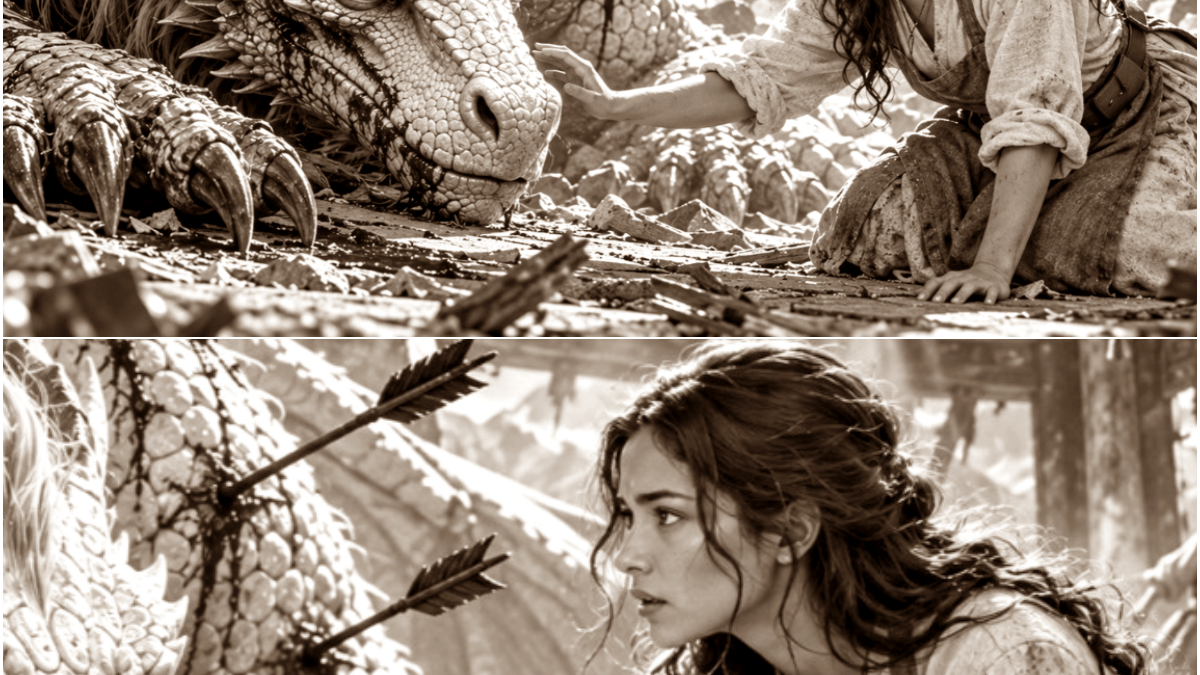
Three black-fletched arrows protruded from his body at terrible angles. His breath came in ragged pulls, disturbing the smoke that still drifted beneath the broken rafters.
His one clear eye opened. “Get back,” he commanded. The words rumbled through the room, carrying the authority of someone accustomed to being obeyed.
Even in his weakened condition, he seemed capable of making the very stones hesitate. “Get back, all of you.
I am not…” His voice dissolved into a harsh cough. He lowered his head, and the movement sent another wave of pain through his shoulder.
Bram, a sixty-one-year-old villager who had come to leave an offering, was the first to reach the doorway.
His walking stick clattered behind him as he hurried outside. Ivy followed, dragging her basket of flowers across the threshold and scattering marigolds along the steps.
Cen the Tinker turned without speaking and ran down the mountain path, continuing long after the shrine disappeared behind the trees.
None of them had ever been taught what to do when an enormous wounded dragon fell into a sacred building.
Their fear made the decision for them. Marisol remained where she was. She would remember that moment for years, although she never thought of her decision as bravery.
She had not considered the danger and chosen to face it. She had simply looked at the destruction around her, seen a creature struggling to breathe, and understood that someone needed to help.
The shrine belonged to her. It had belonged to her grandmother, Lette, before it belonged to her.
For forty years, Lette had kept its candles lit and its doors open. Now the old congregation had scattered, most of its members settling in the lowland towns where newer temples offered greater comfort and more visitors.
Marisol was the last caretaker in the valley, the last person who still swept these floors every morning and repaired the faded banners whenever the thread came loose.
Someone had to remain. She placed her broom against the wall. The dragon watched her through the wreckage of the offering table.
His eye was molten amber, ringed with darker gold, and far too intelligent to belong to an ordinary animal.
There was pain in it, but there was also suspicion and a stubborn determination that seemed almost impossible to weaken.
“I told them to get back,” he said, his voice quieter now. “That includes you.”
“They’re gone,” Marisol replied. “I’m not one of them.” “You should understand what is standing in front of you.”
“I understand what is bleeding on my floor.” She surprised herself with the firmness of her answer.
Then she stepped carefully around the broken pottery and knelt beside his shoulder. Up close, the emperor seemed less like a legend and more like an enormous wounded creature trying not to show how much he hurt.
His scales were hot beneath the dust, and his breathing disturbed the loose ends of her hair.
The arrow in his shoulder had penetrated between two plates, its dark shaft standing above the surrounding scales.
“This is going to hurt,” she warned. “I was present when it entered.” There was a faint trace of dry humor in his answer, almost swallowed by exhaustion.
Marisol reached for a strip of clean linen. Before she began, she looked at him again.
“What is your name?” He hesitated. “Ronin.” The name sounded strangely simple for a creature who could command armies and rule an empire.
Marisol wondered whether he had expected her to ask for a title instead. “And yours?”
He asked. “Marisol.” She wrapped both hands around the arrow shaft and tested its angle.
Her grandmother had once shown her how to remove a fishhook without tearing more flesh than necessary.
The principle was not entirely different, although the scale of the problem was considerably greater.
“Hold still, Ronin.” He obeyed. The effort was visible in the tension of his enormous body.
When Marisol pulled, the dragon’s muscles tightened, his claws scraped against the stone, and a roar burst from his throat.
Dust fell from the remaining rafters. For one terrible moment, she thought he might strike out instinctively, but he kept himself still until the arrow came free.
She immediately pressed linen against the wound. “There,” she said when his breathing began to settle.
“One down.” Ronin opened his eye and studied her. “You did not ask what I would give you in return.”
Marisol reached for another strip of cloth. “What would you give me?” “Anything you wanted, within reason.
Wealth, protection, a position at court. My gratitude, if that is what you seek.” “I’m not asking for anything.”
“Everyone who enters a shrine wants something.” “I’m not here to pray. I’m working.” She began binding the wound, tightening the cloth until it held firmly against his shoulder.
“You’re bleeding on my floor,” she continued. “That makes you my responsibility until you can take care of yourself.”
Ronin said nothing. He had spent much of his life surrounded by people who approached him with requests.
Nobles wanted privileges, generals wanted soldiers, merchants wanted favorable agreements, and distant rulers wanted the emperor’s attention.
Even those who professed loyalty often measured their words according to what they hoped to receive.
Marisol had not asked for a single thing. It unsettled him more than the arrows.
The remaining work took most of the afternoon. The arrow in his flank was difficult to reach, and the one near his wing required careful handling to avoid worsening the injury.
Marisol worked slowly, stopping whenever Ronin’s breathing became too strained. She used clean linen, boiled water, and the strongest herbal preparations she had kept for emergencies.
By the time she finished, the light beyond the broken roof had begun to fade.
The next problem was hiding him. A wounded emperor could not remain in the middle of a ruined shrine with his golden scales visible through every opening.
House Veil had already attacked him, and its soldiers would search the surrounding mountains. If they discovered where he had fallen, they would return with enough weapons to finish what they had started.
Marisol looked around her small room. “Wings in,” she instructed. Ronin shifted, drawing his injured wing closer to his body.
“Tighter.” “It hurts.” “It will hurt whether you hold them wide or not.” He folded them farther.
She dragged an old ceremonial screen across the largest opening in the roof and leaned the broken offering table against it.
The screen had once depicted the mountain gods walking beneath a blue sky, but the paint had faded and the wooden frame had split in several places.
It would not withstand another storm, much less a dragon, but it helped conceal the space behind it.
Marisol pulled down the surviving wall hangings and draped them over the pale curve of Ronin’s wing.
The banners were old, stitched by women who had been gone for generations, and their faded colors blended with the dust covering the shrine.
She moved unused prayer candles into a rough barricade around his hindquarters, then swept broken roof slats into piles and scattered them across the floor.
Ronin watched her with one eye half closed. “You are remarkably organized for someone facing a catastrophe.”
“I’ve had practice.” “Not with this.” “Winters up here bury the doorway. Some years you learn to work quickly or you freeze.”
“This is not snow.” “No. Snow doesn’t have opinions about whether you’re allowed to live.”
She stepped back to examine the room. It looked like a shrine damaged by a severe storm, provided nobody looked too closely at the enormous shape hidden beneath the banners.
“If anyone comes inside, stay still,” she said. “They need to see broken furniture and a fallen statue.”
“I cannot promise to breathe quietly.” “Then breathe slowly.” “I have never needed to hide from anyone in my own territory.”
“Today you do.” Something in her matter-of-fact tone made him fall silent. He had given orders to thousands of soldiers.
He had watched nobles lower their eyes when he entered a hall. He had commanded dragons whose wings could darken an entire fortress.
Yet here, beneath a roof that could barely shelter a single family, he found himself accepting instructions from a young caretaker who had never asked his permission to take charge.
For the first time in a long while, he was grateful that someone else knew what needed to be done.
The soldiers arrived on the second day. Marisol heard them climbing the switchback path before they reached the shrine.
Their boots struck the stones in steady rhythm, and the metal fittings of their crossbows made a familiar clinking sound.
She was outside sweeping broken slate from the steps when Captain Bellamy appeared around the final bend.
He was broad shouldered, with a scar crossing one eyebrow and the controlled expression of a man who expected people to answer his questions.
“We’re tracking a wounded beast,” he announced. “Something fell in this valley two nights ago.
You must have heard it.” Marisol continued sweeping. “A storm damaged the roof.” Bellamy looked past her toward the broken cedar beams.
“A storm.” “Strong wind from the ridge.” “Convenient.” “It was an inconvenient storm for me.”
His gaze moved toward the doorway. “Mind if my men look inside?” Marisol rested the broom against her shoulder.
“This is a shrine, Captain. Not a barracks. You can look, but be careful where you step.
There’s broken glass and pottery everywhere.” She moved aside. Her heart was beating so quickly that she could feel each pulse in her throat, but she kept her expression calm.
Her grandmother had always told her that panic made people careless. If she wanted to protect the shrine, she had to behave as though nothing unusual had happened.
One of Bellamy’s soldiers entered. Inside, the banners hung over the wreckage. The candle crates blocked the view of Ronin’s body, and the dust-covered shape behind them could almost have been mistaken for a fallen statue.
The dragon had folded himself into the smallest position his injured body allowed. Even his breathing was shallow.
The soldier looked around. “Nothing living in here,” he reported. “Just wreckage.” Bellamy remained outside, studying Marisol.
She met his gaze without moving. “If you see anything,” he said at last, “House Veil will reward you for reporting it.”
“I’ll remember that.” The captain turned and led his men down the mountain. Marisol remained beside the doorway until the final footsteps disappeared.
Only then did she grip the frame and allow her knees to weaken. She had been holding herself rigid for so long that her entire body trembled with the effort of remaining upright.
Inside, Ronin watched her. “You lied to armed soldiers,” he observed. “I answered their questions.”
“You concealed an emperor.” “You were difficult to overlook.” He gave a low sound that might have been laughter if his injured body had not made even that difficult.
Marisol returned to the room and checked his bandages. The soldier’s brief inspection had left her anxious, but Ronin’s wounds mattered more than her fear.
She replaced the cloth over his shoulder and brought him water. “You should rest,” she said.
“I have rested enough.” “You have been arguing with the ceiling for twenty minutes.” “I was considering the structural weakness of this building.”
“Then consider it while lying down.” He lowered his head. She did not smile until she had turned away.
By the fifth morning, Ronin could move without the same grinding pain that had accompanied every shift of his weight.
The wound in his flank had closed into a dark seam, and his shoulder had healed enough for him to place some weight on the injured foreleg.
He tested his wing in the gray light before sunrise. “I can fly.” Marisol looked up from the small fire where she was heating water for tea.
“Are you certain?” “I have flown with worse injuries.” “That isn’t the same as saying you should.”
He watched her prepare the tea. The cup she used was cracked, and the little wooden table beside the fire had one uneven leg.
She passed the cup upward toward his lowered head with an expression of such ordinary seriousness that he almost forgot how strange the gesture was.
He accepted it carefully. “I should leave before the patrols return,” he said. “That would be sensible.”
Neither moved. Ronin glanced toward the broken roof. The morning sky was pale and still.
“The crosswind is wrong.” Marisol looked outside. “There isn’t any wind.” “Not yet. It will come from the eastern peaks.”
“Will it?” “Very likely.” She studied him over the rim of her own cup. “Then you should wait.”
He settled back into the nest of old banners and broken slate that had gradually become his bed.
“I will watch the sky.” “Do that.” She turned toward the fire, hiding the smile that had begun to form.
The wind did not change that evening. It did not change the following morning, either.
On the seventh night, the sky was clear and bright with stars. The mountains stood sharply outlined beneath the moon, and the conditions were nearly perfect for a dragon to take flight.
Ronin examined the sky with exaggerated seriousness. “The moon is too bright.” Marisol placed his bowl of broth beside him.
“Is it?” “House Veil’s watchmen could see me across several ridges.” “Wouldn’t want that.” “Precisely.”
She sat on the bench opposite him, mending a torn section of one of the old banners.
Her needle moved steadily through the faded fabric. “You flew alone through an ambush,” she said.
“But clouds have made you cautious.” “I have had eleven years to become accustomed to arrows.”
“And considerably less time to become accustomed to clouds.” He looked at her. There was amusement in her face, but no mockery.
She had recognized his excuse and decided not to embarrass him by demanding another. Ronin lowered his head toward the broth.
“You find this amusing.” “I find it interesting.” “What do you find interesting?” “That an emperor who can command armies is apparently unable to leave a ruined shrine because the moon is too bright.”
He gave a quiet rumble. For a moment, the room seemed almost peaceful. Then his expression changed.
“Everyone who has ever entered this shrine before you came asking for something,” he said.
“A good harveSt. A safe journey. A family member’s return. A blessing, a favor, or a promise that tomorrow would be kinder than today.”
Marisol continued sewing. “And you have never asked me for anything.” “I haven’t needed anything.”
“You have spent an entire week tending to an emperor. You could have asked for wealth, protection, or a place in my court.
You could have demanded that I rebuild this shrine.” “I could have.” “Yet you have not.”
She tied off the thread and examined the repair. “You’re making it sound like a mystery.”
“Is it not?” “No. You were bleeding. I helped. You were hungry, so I fed you.
You were frightened of being discovered, so I hid you. There isn’t much more to it.”
Ronin studied her face. “You do not want anything from me.” “If I wanted something, I would ask.”
“You are not shy.” “No.” He lowered his gaze to the fire. He had spent years surrounded by people who considered every conversation a negotiation.
Even kindness often came with expectations. A gift from a noble might be intended to secure influence.
A compliment from a general might conceal a request for soldiers. An act of loyalty could become an argument for reward.
Marisol’s care had no such structure. She had not helped him because he was emperor.
She had helped because he was hurt. “Perhaps,” she said, setting her sewing aside, “you simply haven’t experienced someone helping you without expecting payment.”
Ronin looked up. “You may find it easier if you stop trying to turn it into a bargain.”
He was quiet for a long time. The fire crackled softly, and beyond the broken roof the stars seemed to hang close enough to touch.
On the ninth night, Ronin asked why she had stayed in the valley. He had begun to understand the shrine as more than a damaged building.
He recognized the care in the way Marisol arranged the candles, the patience with which she repaired its banners, and the pride she took in sweeping the stone floor each morning.
The place was small, old, and isolated, but it carried the marks of a life devoted to keeping it alive.
“Everyone else has gone to the lowland temples,” he said. “You could have gone with them.”
Marisol sat cross-legged beside the fire, holding a banner across her lap. Her needle moved slowly through a worn seam.
“My grandmother Lette kept this shrine for forty years,” she said. “She used to tell me that the gods didn’t need the incense or the flowers.
Those things were for the people who came here.” “What did they need?” “A reason to come.
A place where they could kneel and say what they couldn’t say anywhere else. A place where they could ask for what they wanted without being ashamed of wanting it.”
“And you stayed to protect that place.” “I stayed because somebody had to keep the door open.”
Ronin watched her hands. “Did you never want anything for yourself?” Marisol paused. “I didn’t say that.”
For a moment, something unguarded crossed her face. She looked toward the old carvings above the altar, their features softened by years of incense and duSt.
“I learned early that this room was for everyone else’s needs. I was the one who kept the candles burning and the floor clean.
I listened while people prayed for the things they loved, the things they feared, and the things they hoped might still happen.”
“And your own hopes?” “I kept them outside the shrine.” The words were simple, but Ronin heard the loneliness beneath them.
“That sounds difficult.” “Some years it was.” She returned to her sewing. “I think that’s why I didn’t run when you fell through the roof.
Everyone else in the valley has somewhere else to bring their worries. I only had this place.
Then you arrived, and suddenly there was something here that needed me.” Ronin lowered his head until his chin rested near the edge of the firelight.
“I have a thousand people kneeling in halls built to hold my name,” he said.
“They praise my strength, my victories, and the authority of my house. They bring me their troubles and ask me to solve them.”
Marisol listened without interrupting. “Yet I cannot remember the last time someone looked at me as you did that first evening.
You saw a creature in pain, and you decided the room was responsible for helping him.”
“You were in my shrine.” “You could have been afraid.” “I was.” “You did not act as though you were.”
“I was busy.” He gave a low, thoughtful rumble. For years, Ronin had believed that being needed was close enough to being known.
His people depended on his decisions. His soldiers trusted his commands. His enemies feared his strength.
Yet he had rarely been able to separate the person he was from the authority he carried.
Marisol had done so without even knowing his full story. “You have given me something I did not know I lacked,” he said.
She glanced at him. “What is that?” “The chance to exist without being useful to someone.”
Marisol considered the words. “That’s not a small thing.” “No,” Ronin agreed. “It isn’t.” The wind finally became still on the night when neither of them had another excuse.
Ronin had recovered enough to fly. His wings moved freely, his strength had returned, and the patrols of House Veil had begun withdrawing from the mountains.
He could leave the shrine whenever he chose. Instead, he remained beside the fire. Marisol did not ask him why.
He left only once before the end of that long stay, slipping outside beneath the cover of darkness to test his wings beyond the trees.
He rose carefully above the ridge, circling the shrine before flying farther into the valley.
The air was cold, and the mountains spread beneath him in familiar lines of stone and foreSt.
For the first time since the ambush, he felt the full strength of his body returning.
He could have continued toward the imperial lands. Instead, he turned back. He returned before dawn, landing quietly beyond the shrine and approaching the broken doorway.
Marisol was asleep on the bench beside the fire, a half-mended banner resting across her knees.
The old building smelled of ash, herbs, and the faint sweetness of incense. Ronin stood at the entrance for a long moment.
Then he allowed his body to change. The transformation was difficult in a way he had not anticipated.
His human form had once been familiar, but years of living as a dragon had made it feel like a distant memory.
His limbs seemed strangely narrow, his shoulders unprotected, and his balance uncertain. He stood in the doorway, bare shouldered and unsteady, his golden eyes unchanged.
Marisol woke at the sound of his breathing. She looked up. For several moments, she simply stared at him.
“I wanted you to see,” he said, his voice rough from disuse, “that there is a man inside the dragon.
I do not show this form lightly.” She rose slowly from the bench. “You trust me with it.”
“Yes.” She crossed the room and stood in front of him. Without hesitation, she lifted both hands and gently held his face.
“I already knew you,” she said. Ronin’s eyes remained fixed on hers. “I knew you when you were bleeding on my floor.
I knew you when you folded your wings so you wouldn’t crowd me. I knew you when you tried to hide your pain because you thought you had to remain strong.”
Her thumbs rested lightly against his cheeks. “This isn’t a truer version of you than the dragon I met.
It’s just another part of the same person.” He closed his eyes. Something inside him loosened, something that had remained tightly held for so many years that he had forgotten it could ever be released.
He had expected her to be impressed by his human form, perhaps to see it as a private gift or a declaration of affection.
Instead, she had welcomed it as naturally as she had welcomed his injured body. When the first light of dawn reached the shrine, Ronin had returned to his dragon shape.
He lay beside the fire, his great golden body curled around the warm stones, while Marisol rested one hand against the scales over his heart.
“I have to return eventually,” he said. “I know.” “There is a war to answer for.
House Veil cannot be allowed to believe that its actions have gone unnoticed. I have responsibilities to my people and to the empire.”
Marisol’s hand remained where it was. “I never asked you to abandon them.” “I know.”
He shifted slightly, careful not to disturb her. “I have spent my life believing that every gift came with a ledger attached.
Every kindness had a purpose, every alliance had a price, and every promise carried an expectation.”
He looked toward the roof she had repaired with such care. “You never opened a ledger.”
“Perhaps I didn’t need one.” “I do not want to leave the only place where I have felt that nothing was owed.”
Marisol leaned against the warm curve of his body. “Then don’t leave it behind.” Ronin turned his head toward her.
“What do you mean?” “You can return here. You can bring the things you learn elsewhere back with you.
You can leave when you must and come back when you can. This shrine doesn’t have to become a cage just because it is somewhere you want to stay.”
“And you?” “I’m not going anywhere.” He watched her for a long moment. “You would remain here even if I had to leave for a long time?”
“I kept this place before you arrived. I’ll keep it while you’re away.” The simplicity of her answer moved him more than any grand declaration could have done.
He had been offered loyalty in the form of oaths, military pledges, and public ceremonies.
Marisol offered something quieter. She would keep the candles burning. She would sweep the floor.
She would open the door when he returned. For the first time, the thought of leaving did not feel like losing everything.
It felt like carrying something with him. “There is an old saying,” he murmured. “A woman named Audrey Hepburn is credited with the words that the best thing to hold on to in life is each other.”
Marisol smiled faintly. “You’ve been reading the lowland histories again.” “I have.” “And what do you think of the saying now?”
Ronin lowered his head until his golden eye was level with hers. “I once thought it was too small a thought for something so large.”
“And now?” “Now I think I spent too long searching for something grand enough to explain what I wanted.”
Marisol rested her forehead against his scales. “Sometimes the small things are the ones that stay.”
Outside, the autumn sky brightened above the pines. The broken roof had been patched with new cedar, the offering bowls had been replaced, and the old banners hung once more along the shrine walls.
Incense smoke rose gently through the repaired opening, carrying its faint sweetness into the morning air.
Ronin would return to his empire. He would face House Veil, answer for the ambush, and take up the responsibilities that had waited for him throughout his absence.
Marisol would remain in Ashgrove, keeping the shrine as her grandmother had kept it before her.
Neither pretended that the world beyond the mountains had become simple. But the shrine was no longer only a place where strangers came to ask for help.
It had become a place where Ronin could lay aside his titles and where Marisol could finally imagine that her own wishes deserved room beside everyone else’s.
He had fallen through her roof believing that survival was the only thing left to him.
She had opened her hands to a wounded stranger without knowing what he could offer.
And between them, in the quiet of a small mountain shrine, they had discovered that care did not need to be purchased, affection did not need to be commanded, and a home did not have to be grand to hold an emperor.
It only needed someone willing to keep the door open.
Disclaimer: This content may be created by Al for entertainment purposes. Any resemblance to real persons, events, or places is coincidental.








