The Dragon Abandoned the Race to Save Her — Then She Risked Everything to Save the Dragon
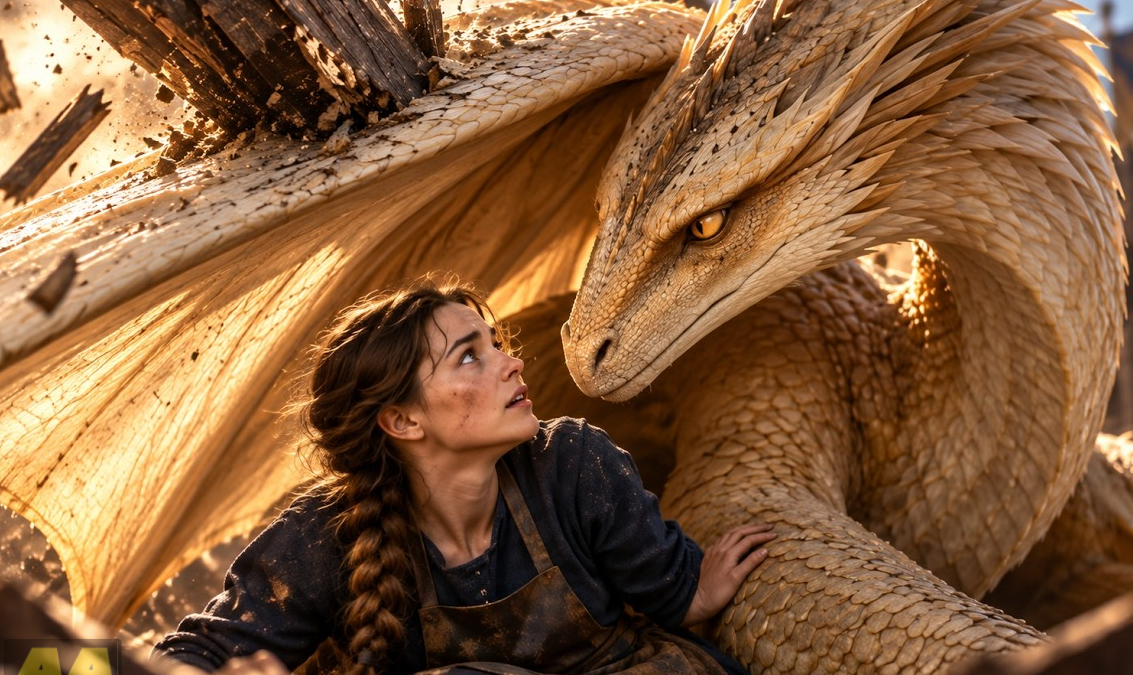
The first warning was not the crack of timber. It was the ground moving beneath Hester Lo’s boots.
She had felt it once already, a slow yielding beneath the wet clay, and she had known exactly what it meant.
The front posts of the shilling stand were sinking. A pale wooden wedge had worked loose from the bracing, and the whole structure had begun to lean toward the course.
But Steuart Crane had been watching the race. Three miles away, the leading corourser flashed past the final beacon while four hundred people roared from the stands.
Nobody looked down. Nobody wanted to hear about loose posts when the winning dragon was less than a minute from the finish.
Hester had gone beneath the stand anyway. Now she stood at the rail with Annet Marlo by one hand, little Tom on her hip, and Pip somewhere among the packed rows above.
The structure gave another soft movement. Then the wood groaned. Hester looked up. A racing dragon came across the course, wings beating hard, her rider flattened against her neck.
At almost the same moment, the front of the shilling stand began to bow forward.
Hester did not have time to think. She shouted for Pip. The dragon turned. Why would a creature trained to race toward the finish suddenly abandon the course and fly straight toward the collapsing stand?
Hester never forgot what happened next. The dragon dropped between the stand and the children.
Her wings opened. The world disappeared beneath amber membrane and warm breath. And while timber came down around them, Hester Lo realized that the creature everyone called a racing beast had chosen, without being told, exactly whom she needed to protect.
Hester pushed Annet and Tom against the rail post and shouted toward the upper rows.
“Pip, down now, Pip, come down!” The boy appeared between two adults, furious and frightened because he could not hear her clearly over the crowd.
He began sliding along the plank toward the steps. “Hurry!” The stand moved again. This time there was no mistaking it.
The whole front section tipped forward with a long wooden groan. Pip jumped the final rows and landed on his hands.
Hester caught him by the collar. Then the dragon came down. She dropped between them and the collapsing structure with such force that the turf shook beneath Hester’s knees.
Her rider flew over her shoulder and rolled clear. The dragon stretched both wings wide, and the nearest wing swept around Hester and the three children.
Light became amber. The first timber struck. Then another. Then another. Hester heard boards hammering against the wing membrane.
The sound seemed endless. The dragon lowered herself, spreading her legs wide and bracing against the ground.
The wing above Hester sagged under the weight of falling wood but held. Tom screamed.
Annet buried her face in Hester’s apron. Pip stared upward without making a sound. “Don’t move,” Hester said.
“Nobody moves until I say.” A heavy beam struck the wing. The dragon gave a deep grunt.
The membrane dropped several inches. Hester put both hands against the turf. “Hold,” she whispered.
The dragon held. At last the noise stopped. Hester crawled toward the edge of the wing.
A thick beam had pinned the trailing edge, tearing the membrane. Beyond it, the dragon’s leg trembled under the strain.
The rider had reached them. He was young, covered in dirt, with a cut above one eyebrow.
“Get it off her,” he said. “You’ll tear the wing.” He looked at Hester. “Then what do I do?”
“Lift it. Don’t drag it.” He put both hands beneath the beam. “On three,” Hester said.
“One. Two. Three.” They lifted. The beam rose just enough. The dragon carefully drew the injured wing underneath it.
Hester pulled the children clear. When she stood, the shilling stand was lying across the grass.
People were climbing through the wreckage. Somewhere near the finish, a horn sounded three times.
Another dragon crossed the line. The crowd at the guild stand cheered. For several moments, they did not even understand what had happened.
Hester had no time to think about them. There were injured people everywhere. She worked until her father’s old frier satchel was almost empty.
She bound an ankle, set a broken arm, dressed a scalp wound, and gave a trembling twelve year old girl the task of tearing linen into strips so she would have something useful to do.
By late afternoon, Hester had treated fourteen people. Only then did Pip tug her sleeve.
“The dragon’s crying.” “Dragons don’t cry.” “She’s making a noise.” Hester looked toward the riverbank.
The dragon was lying on her belly with all four legs tucked beneath her. She was not especially large for a corourser.
Her shoulders stood about as high as a tall horse, and her neck was long and narrow.
Thin frills ran behind her jaw, with an old notch in one of them. Her left wing was wrong.
The third spar had cracked. The membrane was torn from the joint almost to the trailing edge.
Four dark marks showed along her back where splinters had struck her. The sound Pip had heard was low and continuous, like a kettle beginning to sing.
The rider knelt beside her head. Dr Fell, the physician from the guild stand, examined the wing from several feet away.
“The third spar is cracked,” he said. “The sail is split. If it heals crooked, she will never fly properly again.”
Master Pel, the owner, stared at the damaged wing. “Can it be repaired?” “With silk and patience.”
“How much?” “That depends on whether you want to spend money repairing a corourser that may never race again.”
The rider stood. “She’ll race again.” Dr Fell looked at him. “You heard me, Callum Hail.”
“I heard you.” “She may never take a rider again.” Callum looked at Ren. “She is the best corourser I have ever sat.”
Pel sighed. “The Michaelmas fair at Windome is six weeks away. Garside of Cold Harbor will buy grounded coroursers for the lime carts.
If she cannot fly by then, she goes to him.” “I’ll pay her keep,” Callum said.
“With what?” “My winnings.” “You lost your purse today.” “I have some money put by.”
Pel looked at him for a long moment. “I thought so.” Hester stepped closer. “She can stay with me.”
Pel turned toward her. “I have a meadow by the river,” Hester said. “And my father’s old forge.
The doors are wide enough for her.” That was when Steuart Crane arrived with Gideon Tulk.
Tulk had built the shilling stand. He was covered in sawdust and looked sick. “Master Pel,” Crane said.
“We need to discuss damages.” Hester felt anger rise in her throat. “The stand was already failing.”
Crane turned toward her. “You have many opinions about timber for a woman who spends her evenings sewing up market injuries.”
“I told you the posts were sinking.” “After the accident.” “Before it.” Pel looked from Hester to Crane.
“Enough. Get the dragon off the course.” The walk to Forge Lane took until the lamps were lit.
Ren would walk, but she would not be hurried. At the first field gate she stopped, stretched her neck through the opening, and looked both ways.
At the second gate she did exactly the same. “She does that every time,” Callum said.
“Why?” “I don’t know.” At the boatyard, Ren stopped when she smelled the tar. She backed away.
“Leave her,” Hester said. “We’ll take the tannery road.” “The tannery stinks worse.” “It doesn’t smell like tar.”
Callum stared at her. Then he turned Ren around. The dragon followed. At Forge Lane, Ren refused to enter the old forge.
Hester looked at the dark beams overhead. “She doesn’t want to go under the roof.”
“She sleeps in a timber stable.” “Not tonight.” So they settled her in the meadow.
Hester hung lanterns from the apple tree and fence posts. She brought out her father’s old bench, heated water, and used the last of the fine silk she had bought years earlier for a wedding dress she had never made.
She mixed Valyrian root and willow bark into warm ale. Ren sniffed it. Then she drank the entire bucket.
Callum laughed. It was the first time Hester had heard him laugh. The work began.
Hester had never repaired a dragon’s wing, but she had set horses’ bones beside her father since she was nine.
The principle was the same. Find the damaged place. Bring it straight. Hold it there.
Keep it from moving. The difficulty was getting close enough. When Hester reached toward the wing root, Ren swung her head around and stopped a foot from Hester’s face.
Hester withdrew her hand. She waited. Then she held both palms beneath Ren’s nose. “Let me touch the wing,” she said.
“Not there. Here.” She placed her hand lower along the spar. Ren watched. She did not move.
“All right,” Hester whispered. Callum helped straighten the spar. Hester placed padded ash laths on either side and bound them with wet rawhide.
The material would shrink as it dried. The membrane took most of the night. It was thin and strong, and the torn edges had begun curling inward.
Hester warmed them with cloths and carefully stitched them together. Callum held the lantern. When the membrane slipped, he put down the lantern and held it steady between his fingers.
Near midnight, he asked, “Would you have ridden past?” Hester looked up. “If you had been me?”
“Yes.” “No.” Callum looked toward the meadow. “I think I would have.” “You didn’t.” “I didn’t hear anything.”
“You felt her turn.” He said nothing. Hester continued stitching. By dawn, the wing was wrapped and secured.
Callum fell asleep against the pump. Hester sat on the bench. Ren lowered her head until her nose touched Hester’s knee.
Hester remained perfectly still. Then she placed her hand against the notched frill beneath Ren’s jaw.
The dragon closed her eyes. Callum returned later with fresh fish. Ren refused the herring.
“She always eats herring,” he said. “She doesn’t now.” Hester mixed honey with water. Ren drank it.
That became the beginning of a new routine. Callum came every morning. Hester worked on people from town.
Ren stayed in the meadow. The dragon tolerated visitors if they stayed beyond the fence.
Anyone who climbed over it received a very clear warning. Hester learned her rules. Ren did not like tar.
She did not like creaking branches. She did not like being hurried through gates. She did not want anyone touching the root of her injured wing.
And whenever Hester left for a night call, Ren sometimes lay across the meadow gate.
“You cannot do that,” Hester told her. Ren closed her eyes. “I have to go.”
The dragon remained there. “I’ll be back before the church bell.” Hester left. When she returned, Ren moved aside without complaint.
The town talked. Some said the dragon had caused the stand to collapse. Others remembered the amber light beneath her wing and disagreed.
On the sixth day, Bet Marlo arrived with her children and a basket of pies.
Pip stood apart from the others. “Hester,” he said. “Yes?” He took a wooden wedge from his pocket.
“It fell out before she came.” Hester stared at it. The wedge was pale pine.
One side was still gray with wet clay. “Where did you find it?” “By the poSt.”
“Keep it safe.” “Why?” “Because someone may say it was never there.” Pip put it back into his pocket.
On the ninth day, Ren stopped eating. She stood in the river with water up to her shoulders.
Her eyes had lost their brightness. Hester examined her from the bank. One of the splinter wounds had swollen.
“There’s something inside,” she said. Callum looked at her. “Can you get it out?” “I have to.”
Ren turned her head. When Hester approached, the dragon opened her jaws and snapped them shut inches from Hester’s arm.
Hester stopped. “She won’t let you.” “I know.” That night they waited. Ren slept in short stretches.
Hester sat near the frier’s bench. Callum sat beside her. After midnight, he spoke. “I hit her twice.”
Hester looked at him. “At the stand.” “I thought she was turning away from the line.
I thought she had been frightened by something in the crowd.” He stared at Ren.
“I used the stick. She ignored me.” “You were trying to keep her safe.” “I was trying to win.”
The words stayed between them. Near dawn, Ren rolled carefully onto her side. The injured area was exposed.
Hester stood. She took her knife and forceps. Then she walked toward the dragon. Ren watched her.
Hester knelt. She placed one hand beside the swelling. “All right,” she said. “I’ll be quick.”
She was not quick. The splinter lay deep. When Hester found it, Ren shuddered and cried out.
Callum held the lantern. Hester kept working. At last the forceps closed around something hard.
She pulled. A black wooden splinter emerged, tar still clinging to one end. Ren released a long breath.
Hester dropped the splinter onto the cloth. “Honey.” Callum already had the pot. By evening, Ren’s fever had broken.
By the morning of the twelfth day, she had eaten four eels and a duck.
Hester dressed in her dark blue gown and walked into Kessle with Callum. The moot hall was full.
The Reeve that year was Joan Aske. Tulk spoke firSt. The stand had stood for eleven summers, he said.
Crane followed. He insisted Hester had warned him only after the accident. Hester waited. Then Joan Aske looked up.
“Mistress Lo?” Hester stood. “I felt the stand move during the second heat. I went underneath.
The two front posts were sitting in wet clay. A packing wedge had already slipped loose.
I warned Master Crane.” “Before the fall?” “Yes.” Crane shook his head. “I was watching the race.”
“That is what I said.” There was laughter. Hester ignored it. She removed the black splinter from her pocket.
“The dragon was struck from above.” She placed it on the table. Dr Fell examined it.
Then he looked at the Reeve. “The chest and forelegs were clear,” he said. “The injuries were along the back and upper wing.
Mistress Lo is correct. The dragon did not fly into the stand.” Tulk shifted in his chair.
Then Pip stepped forward. He placed the wooden wedge beside the splinter. “It fell out firSt.”
The hall became quiet. Joan Aske picked up the wedge. She examined the clay. Then she looked at Tulk.
The hearing did not take long after that. The stand had failed. The damages would be shared by Tulk and the guild.
Hester’s medical work on the injured people was to be paid at two crowns each.
Fourteen patients. Twenty-eight crowns. Pel found Hester outside the hall. “The Michaelmas fair still stands,” he said.
Hester nodded. Callum said nothing. Pel walked away. Three days later, a letter arrived from Ravensmore.
Callum read it beside the meadow. “They want me to ride their autumn string.” Hester continued oiling Ren’s wing.
“When?” “Sixteen days.” “That is good.” “Yes.” He folded the letter. “It is four days north.”
Hester looked at him. “And Ren?” “They would send a groom.” “She would hate that.”
“I know.” That evening, they sat beneath the forge eaves while rain fell over the meadow.
After a long silence, Callum asked, “Why don’t you have a license?” “Because the guild says I need five years under a licensed physician.”
“And?” “None would take me.” “Why?” “Because I am a frier’s daughter who sets bones in a smithy.”
He considered that. “Apply again.” “I have four times.” “Apply a fifth.” She smiled faintly.
“Will you sign it?” “Yes.” A week later, Callum wrote to Ravensmore. He refused the position.
The splint came off on the twenty-sixth day. The spar beneath it was straight. Ren stretched her wing.
The membrane opened fully. For the first time since the accident, the dragon stood beneath the open sky with both wings spread.
Then she went into the river. Hester laughed. Callum laughed too. After that, the work became harder.
Ren began trotting. Then running. Then floating several yards above the grass. She could fly.
But she needed height to lift. The flat meadow was not enough. On the forty-first day after Lamas, Pel arrived with Dr Fell and Garside of Cold Harbor.
Half of Kessle came with them. Garside carried a halter. Pel looked at Ren. “Can she fly?”
“She can.” “With a rider?” “Not from the flat.” Callum brought out the racing saddle.
Ren refused it. Hester examined the old scars. The saddle pressed directly across them. “She cannot wear it yet.”
“Then what?” “Bearback.” Callum stared at her. “You cannot be serious.” “Not you.” Hester looked toward the ridge.
“Me.” Callum stepped closer. “You cannot abide a height.” “I know.” “You told me you cannot even climb the loft ladder.”
“I know what I told you.” Pel watched them. “One try,” he said. “From the ridge.”
The climb to Kessle Beacon took fifteen minutes. Hester’s knees were weak before they reached the top.
The valley stretched below them. The course was visible in the distance. Ren stood beside her.
Then the dragon folded one foreleg beneath herself and knelt. Hester looked at her. Ren waited.
Hester placed her hand against the notched frill. Then she climbed onto the dragon’s back.
Callum gave her instructions. “Lie forward.” Hester did. “Hold the strap.” She did. “Whatever happens, do not pull.”
Hester nodded. Ren rose. The world suddenly seemed very high. Then Ren ran. The grass disappeared beneath them.
For one terrifying moment, they dropped. Hester’s hands tightened. She wanted to pull. She did not.
Ren opened both wings. The air caught them. The fall became flight. Hester opened her eyes.
The river was beneath her. Kessle was behind her. The meadow looked impossibly small. Ren drifted toward the left.
Hester remembered Callum’s words. Weight forward. Weight right. She shifted. Ren corrected. They flew in a long circle over the river flats.
Hester understood what Ren was doing. The dragon did not want to land where everyone was waiting.
She wanted the long approach. She wanted the meadow ahead of her. So Hester let her choose.
Ren came down running. Her feet struck the grass. Once. Twice. Then she slowed. She stopped beside the frier’s bench.
Hester could not release the strap. Callum came running. He lifted her down. Her legs trembled.
“Don’t say anything yet,” she whispered. “I won’t.” Dr Fell examined Ren’s wing. Then he looked at Hester.
“Who taught you that stitch?” “No one.” He nodded. “Send your petition to Windcomb again.”
He removed his hat. “I will sign it.” Pel stood beside Ren. “She flies,” he said.
“She does.” “She will not race again.” Callum nodded. Pel looked toward Garside. “She has no use to me now.”
Garside named his price. Ninety crowns. Callum looked at Hester. He had sixty-four. “All of it,” he said.
Hester stepped forward. “Ninety-two.” Everyone turned. “Twenty-eight crowns from the Reeve’s award,” she said. “Added to his sixty-four.”
Pel stared at her. “You would spend your medical fees on a dragon who cannot race?”
“She flew with me.” Pel looked toward the Reeve. Joan Aske was standing by the fence.
Then Pel looked at Garside. Garside shrugged. “Ninety-two,” Pel said. Callum looked at Hester. She did not look back.
Pel took the money. The bill of sale was signed before sunset. Ren belonged to Hester and Callum.
The halter went onto a nail in the forge. It never went back around Ren’s neck.
That night, Hester and Callum sat beside the river. “You spent your shop money,” he said.
“I spent twenty-eight crowns.” “The shop is still empty.” “It can wait.” He opened his little book.
The pages were filled with racing figures. But near the back, the writing had changed.
“Eels, not trout,” Hester read. “Morin duck hates tar.” “Won’t go under timber.” “Won’t be hurried at a gate.”
“Needs the drop.” “Nelt for H.” Hester smiled. “You stopped recording your race times.” “I know.”
“What will you do now?” He closed the book. “The Windcomb yards need someone to school their young coroursers.”
“That sounds dangerous.” “I am good at getting thrown.” She laughed. Then he looked toward the river.
“I thought I would stay.” “Stay where?” “Here.” He paused. “If you’ll have me.” Hester stared at him.
“You asked that like a man asking for a rented stall.” “I don’t know how else to ask.”
So she kissed him. Ren watched from the river. The next spring, Hester received her license.
Dr Fell’s name stood at the bottom of the petition. Three other physicians had signed beneath it.
The shop by the conduit opened soon afterward. People came. Some traveled from the downs.
Some brought children. Some brought horses. And some came because they remembered the amber shelter beneath Ren’s wing.
Hester kept the old forge too. Callum worked there with young coroursers from the Windcomb yards.
He was thrown often. He broke one finger. Hester set it. Ren lived without a halter.
She came and went as she pleased. Sometimes she disappeared for two days. Sometimes three.
She always returned. Usually with an eel. Whenever a message came from a farm beyond the last beacon and there was no time for a cart, Hester went to the meadow gate.
Ren always came. Sometimes she made Hester wait. Then she lowered her shoulder. Hester climbed forward of the wing roots and lay against Ren’s warm neck.
She was still afraid of heights. Every time. But she trusted the dragon. On the day of the Lamas meet, Hester returned from a call at Hado.
She carried her satchel across her back. Below, the course was crowded. The rebuilt shilling stand stood on dressed stone footings.
Coroursers raced around the final beacon. Ren began drifting left. Hester shifted her weight. The dragon corrected.
Neither of them looked toward the course. They flew over the river flats toward Forge Lane.
Ahead, a man stood beside the meadow gate with a young gray corourser on a lead.
Callum looked up. Hester smiled. Ren opened her wings. And together they descended toward home.
Disclaimer: This content may be created by Al for entertainment purposes. Any resemblance to real persons, events, or places is coincidental.








